AR for Exhibitions and Retail: A Guide to Increasing Dwell Time with Spatial Content
Think of it this way: what if you could point your phone at your stand or a product and see an extra layer of helpful, interactive information laid right on top? That’s the magic of augmented reality (AR). It’s not about escaping to a different world like virtual reality (VR); it’s about making your current one even better, more engaging, and more valuable.
What Is Augmented Reality and How Does It Work?
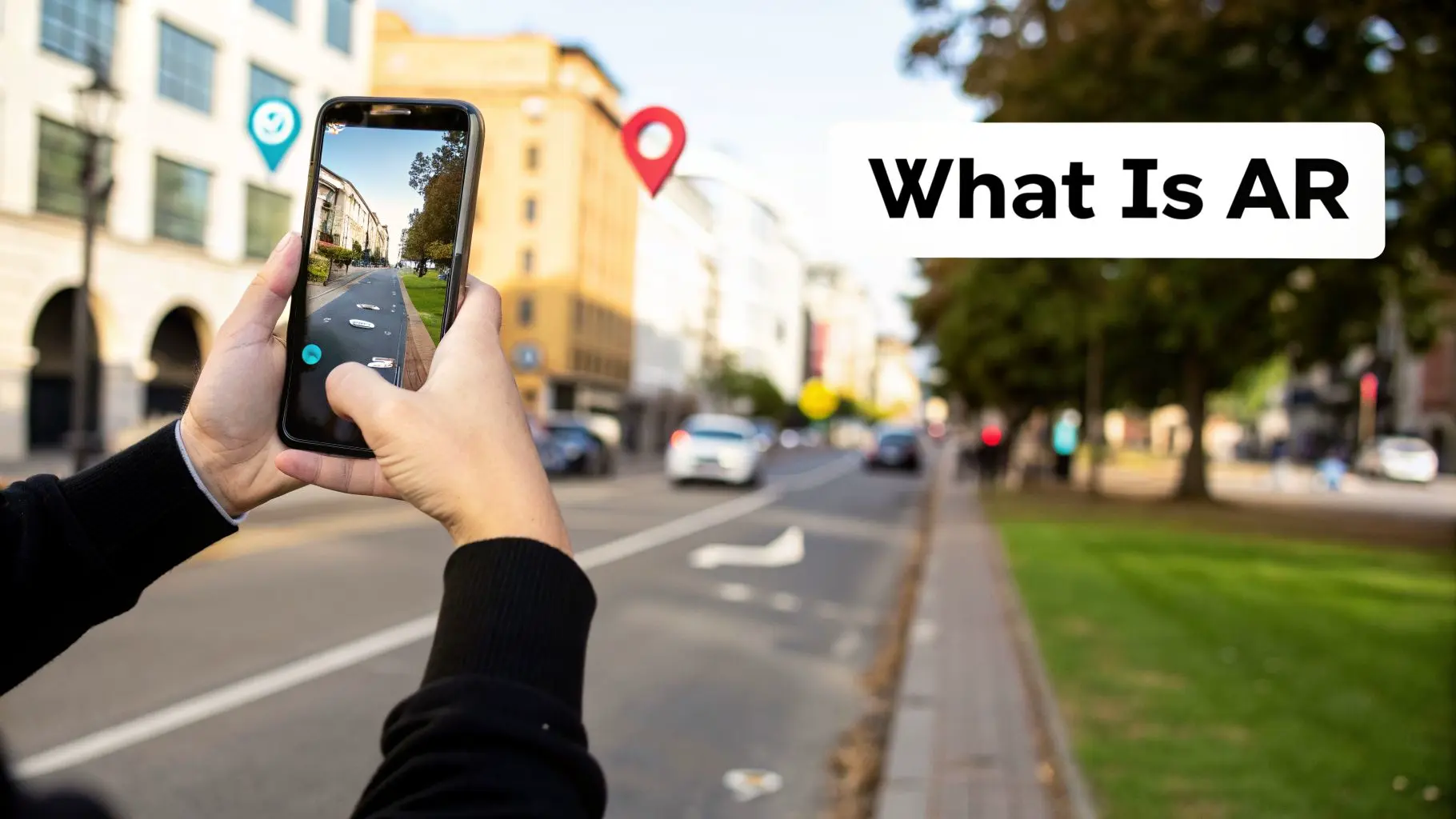
At its heart, augmented reality works by cleverly mixing the digital and the real. It all comes down to a team effort between three things you use every day: a camera, some smart software, and a screen. Your smartphone is a perfect, pocket-sized example of this in action. First, the camera sees your real-world environment. Next, the software gets to work, analysing what it sees to figure out where and how to place digital objects or information. Finally, your screen shows you the finished product, your world, but with a new digital layer on top.
The Two Main Types of AR
Not all AR is created equal. The technology generally splits into two main camps, each with its own way of placing digital content into your world.
- •Marker-Based AR: This type needs a specific visual cue, a "marker", to get started. When your device’s camera spots a predefined image, like a QR code on a product box or a design on your exhibition stand, it springs to life, overlaying the right 3D model, video, or animation. It's incredibly reliable and precise, making it a go-to for interactive print, packaging, and event signage.
- •Markerless AR: This is the more advanced of the two, as it doesn't need a special trigger image. Instead, it uses sophisticated algorithms, a technology often called Simultaneous Localisation and Mapping (SLAM), to understand the space around you. It identifies floors, walls, and tabletops, letting you place digital items anywhere you want. It’s the tech that lets a customer see if that new sofa really fits in their living room, right from your retail app.
Augmented Reality vs Virtual Reality at a Glance
It's easy to get AR and VR mixed up, but they offer fundamentally different experiences. Here's a quick breakdown to clear up the confusion.
| Feature | Augmented Reality (AR) | Virtual Reality (VR) |
|---|---|---|
| Experience | Overlays digital elements onto the real world. | Creates a completely immersive, fully digital world. |
| Hardware | Smartphones, tablets, smart glasses. | VR headsets that block out external light and sound. |
| Interaction | Interact with both the real world and digital overlays. | Interact solely within the virtual environment. |
| User's View | User can still see their actual surroundings. | User's view of the real world is completely replaced. |
| Typical Use | Interactive product demos, configurators, navigation. | Gaming, simulations, virtual tours, and social spaces. |
In short, AR adds to your reality, while VR replaces it. Both are powerful, but they solve different problems and create entirely different kinds of engagement.
At its heart, augmented reality is about providing context-aware information and experiences exactly when and where they are most useful. It closes the gap between digital data and the physical world.
The potential here is enormous. In the UK alone, the immersive entertainment market, which heavily features augmented reality, is set to generate a massive USD 8,934.6 million in revenue in 2025. Projections show this market skyrocketing to USD 68,549.0 million by 2033, powered by a remarkable annual growth rate of 29.9%. Getting these fundamentals down is the first step toward figuring out how AR can work for your brand. For a closer look at bringing these experiences to life, check out our guide to augmented reality experiences and see how this tech can solve real-world problems. Understanding the difference between marker-based and markerless AR will help you pick the right tool for the job, whether your goal is marketing, training, or customer support.
Understanding Core AR Development Technologies
To get an augmented reality experience up and running, developers need special toolkits that do the heavy lifting. Think of them as the engines that connect the digital world to our own, giving your phone or tablet the power to see and understand its environment. Right now, two platforms really own this space: one for Apple devices and another for Android. Knowing a bit about the hardware and tracking technology is invaluable for any marketing or brand manager thinking about AR. It gives you a real appreciation for the skill that goes into creating a smooth, believable, and high-quality app.
The Powerhouse SDKs: ARKit and ARCore
- •Motion Tracking: This is how a device knows where it is and how it’s oriented in the real world. It’s the magic that keeps a virtual product “stuck” to your exhibition floor, even as a visitor walks around it with their phone.
- •Environmental Understanding: The software scans for flat surfaces like floors, tables, and walls. This is absolutely critical for placing digital objects in a way that feels grounded and natural.
- •Light Estimation: This clever function analyses the ambient light in the real world and applies it to virtual objects. It’s a subtle but vital detail that makes a 3D model look like it truly belongs in the room.
These SDKs handle all the complex sums in the background, which frees up developers to focus on the creative side of the experience. The UK Augmented Reality market is segmented by these very components, with forecasts stretching to 2030. Despite a projected 12% dip in AR/VR headset shipments for 2025, an expected 87% rebound in 2026 will create huge opportunities for UK creators who master these tools. You can find more details in recent augmented reality statistics.
The Creative Canvases: Unity and Unreal Engine
While ARKit and ARCore provide the real-world awareness, it’s real-time 3D platforms like Unity and Unreal Engine that act as the creative canvas. These game engines are where the magic really happens, serving as the main workshops for building, animating, and programming everything the user will see and do.
Unity and Unreal Engine are the production studios for AR. They are where artists and developers come together to build everything the user sees and interacts with, from the 3D models to the user interface and game logic.
They were originally built for making video games, but their incredible real-time rendering, physics engines, and asset libraries make them a perfect fit for AR development. A studio’s expertise in these platforms is a direct reflection of its ability to produce experiences that are both visually stunning and technically sound. Whether you're creating an interactive marketing campaign, a detailed product configurator, or a complex training simulation, all the development happens here. Mastering this part of the tech stack is what separates a fun gimmick from a genuinely valuable business tool. To learn more about this process, you can also check out our guide to augmented reality application development.
How AR Is Transforming Industries Today
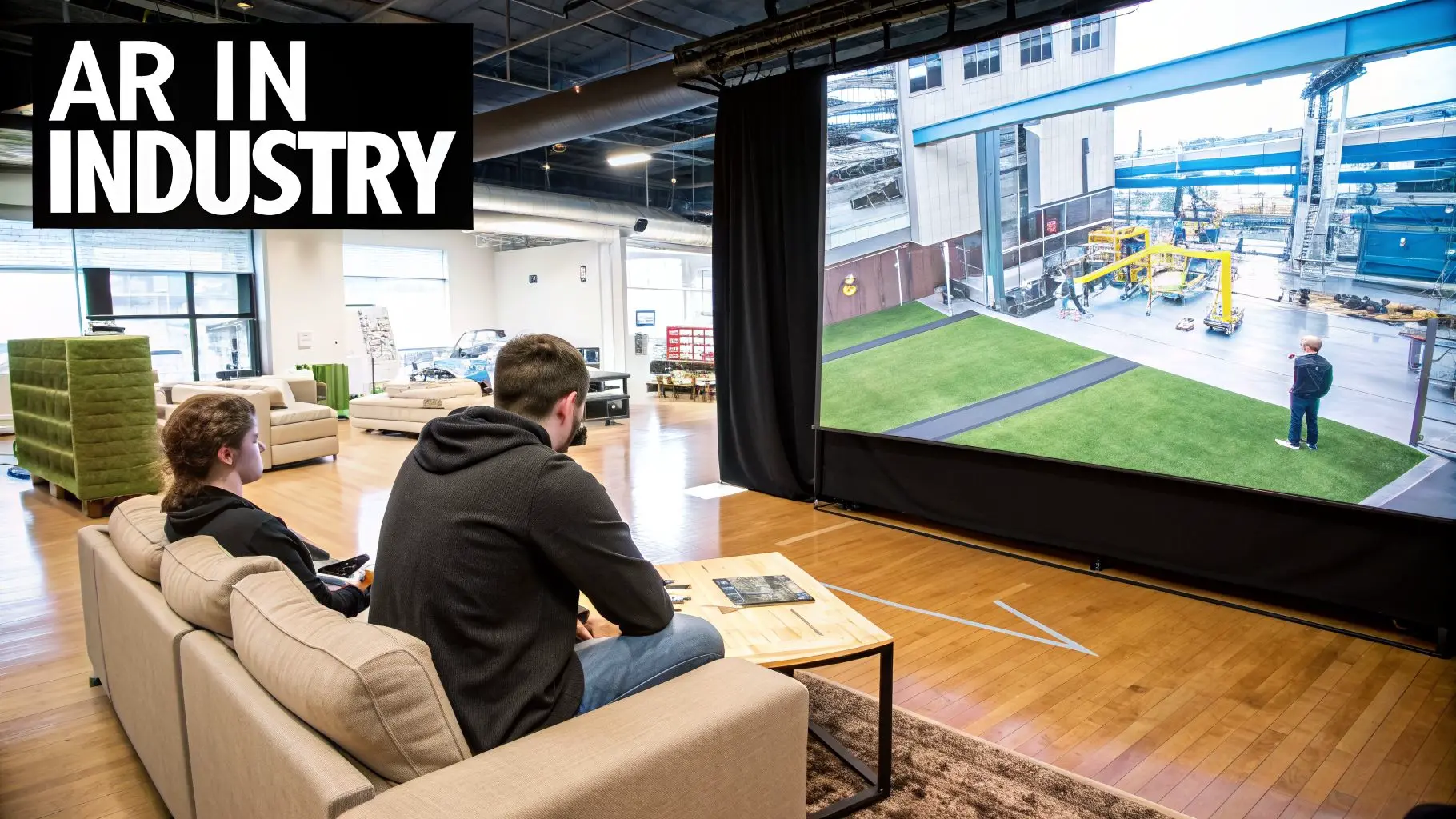
The theory behind augmented reality is interesting, but where it really shines is in solving real-world business problems. Across a whole range of sectors, AR has grown from a quirky novelty into a core tool for boosting efficiency, engagement, and sales. This isn't about some distant future; it's about what businesses are getting done right now. From the shop floor to the exhibition hall, AR acts as an interactive bridge between your digital data and your physical world. This link is fixing old problems and opening up brand-new ways to connect with customers and streamline operations.
Reinventing Retail And Exhibitions
In the competitive worlds of retail and exhibitions, getting and keeping a customer's attention is everything. Augmented reality gives you a fantastic way to do just that, offering experiences that feel personal, memorable, and drive real commercial outcomes. Think about a visitor at a trade show. Your stand space is limited. With AR, you can bring your entire product catalogue to life. A visitor can point their phone at a simple trigger image on your stand and suddenly be exploring a complex piece of machinery in 3D, trying out customisations, or seeing an animated data visualisation, all without you needing to ship bulky physical items. This increases stand dwell time and creates an interactive buzz that makes you stand out from the crowd. The same idea works brilliantly for retail. Instead of just looking at flat photos, a customer can use their phone to pop a true-to-scale 3D model of a sofa right into their living room. They can walk around it, check if it fits, and see how the colour looks with their walls. This kind of "try before you buy" feature, or product configurator, makes a massive difference to a buyer's confidence and has been proven to reduce returns. To see a prime example of AR's impact on business and consumer behaviour, explore how transformative applications like Augmented Reality in Ecommerce are revolutionising industries today.
Empowering Manufacturing And Field Services
For industrial businesses, AR is a complete game-changer for getting things done safely and quickly. Complex machinery often needs an expert eye, but that expert can't always be on-site. Augmented reality closes that gap with remote assistance. Imagine a technician on site, wearing AR glasses while looking at a piece of equipment. An expert, who could be hundreds of miles away, sees exactly what the technician sees through a live feed. The expert can then draw digital instructions, diagrams, and arrows directly onto the technician’s view, guiding them through a tricky repair one step at a time.
This approach slashes equipment downtime, cuts travel costs for your top experts, and massively reduces the risk of human error. It’s like having a master engineer standing right over your shoulder, giving you the right advice at the right moment.
This isn't just for repairs, either. It’s also being used for complex assembly and quality control. Workers can follow holographic instructions projected onto their workstations, making sure every part is placed correctly and to the exact specification.
Revolutionising Training And Education
The education world is also being completely reshaped by augmented reality. Traditional learning can be quite abstract, relying on diagrams in textbooks, but AR makes complex subjects tangible and interactive. Take a medical student learning anatomy. Instead of just memorising charts, they could use a tablet to bring a detailed, life-sized 3D anatomical model to life in the classroom. They can walk around it, pull apart different organ systems, and watch animated processes like blood flow in real-time. This kind of hands-on learning makes difficult subjects feel much more intuitive and interesting. The key benefits are clear:
- •Visualisation: It makes abstract ideas visible and far easier to grasp.
- •Interaction: Students aren't just passive observers; they can manipulate virtual objects, which helps them learn actively.
- •Safety: It allows for training in dangerous scenarios, like complex machinery operation or surgery, without any real-world risk.
From corporate onboarding to intricate surgical training, AR offers a safe and incredibly effective way to build skills. For more ideas on how AR is boosting sales and improving customer experiences, you can read our guide on augmented reality for ecommerce. The principles that work so well in retail can be easily adapted to create powerful educational tools.
The AR Production Pipeline From Idea To Launch
So, how does an augmented reality project go from a spark of an idea to a polished app that drives footfall at an exhibition? For any business looking to get into AR, understanding this journey is vital. A professional production pipeline is what turns ambitious concepts into fun, reliable experiences, breaking the whole process down into clear, manageable stages. This roadmap demystifies the development cycle and helps set the right expectations. It also shows exactly where the touch of an experienced studio makes all the difference in crafting a high-quality final product.
Stage 1: Concept And Design
Every great AR project starts with a rock-solid plan. This first phase is all about strategy and thinking about the user, long before a single line of code gets written. The main goal here is to figure out what the experience needs to do and who it's for. This involves a few key steps:
- •Defining Goals: What's the main objective? Are we trying to increase stand dwell time, generate qualified leads, or boost post-show sales? This is where we establish clear goals.
- •User Experience (UX) Design: We map out the entire user journey. How do they start the experience? What do they see and do? How will they interact with the digital product demo or configurator?
- •Technical Scoping: We’ll decide on the best approach , whether to use marker-based or markerless AR, and choose the right platform, like a dedicated app or WebAR, making sure it works on the right devices.
This stage wraps up with detailed wireframes, user flow diagrams, and a full project spec document. This becomes the blueprint for the entire production.
Stage 2: 3D Asset Creation
With the plan locked in, our artists get to work creating the digital assets. This is where the visual magic of the augmented reality experience is built, always with a careful eye on both quality and performance. 3D models for AR have to be incredibly well-optimised. Unlike assets made for films or big-budget games, AR models need to be lightweight. This ensures they load fast and run smoothly on all sorts of mobile devices. A model that’s too complex, with too many polygons, will make the app lag or even crash, completely killing the experience.
The real art of AR asset creation lies in balancing stunning visuals with smooth performance. An object needs to look convincing and detailed, but be simple enough for a smartphone to handle in real-time without melting the battery.
This stage covers everything from modelling and texturing to rigging (creating a digital skeleton so the model can be animated). Every single asset is meticulously crafted to work within the strict technical limits of mobile AR, a specialised skill that comes from deep experience.
Stage 3: Interactive Development
This is where everything comes together. In a game engine like Unity or Unreal Engine, our programmers take the concept and the 3D assets and write the code that brings the experience to life. They build the interactive logic we designed back in stage one. Our developers connect the engine to the phone’s built-in AR tech, like ARKit or ARCore. They implement all the core features, like making objects appear on real-world surfaces, building the user interface (think buttons and menus), and programming all the animations and interactions. It’s a deeply technical phase that turns static models into a living, breathing AR world.
Stage 4: Rigorous Testing And Deployment
Before an app goes live, it has to go through a boot camp of testing. We need to be sure it's stable, intuitive, and works perfectly on a whole range of devices, especially in a busy exhibition hall environment. Our Quality Assurance (QA) team hunts for any bugs, performance hiccups, or confusing parts of the experience. Testing covers a lot of ground:
- •Device Compatibility: We check that the app runs well on different phones and tablets, which all have different screen sizes and processing power.
- •Environmental Conditions: We see how the AR tracking holds up in all sorts of lighting, from bright expo halls to a dimly lit retail space.
- •User Journey: We follow the exact path a user would take to spot any confusing steps or broken interactions.
Once the app is polished and gets the green light, it’s time to launch. This final step involves submitting it to the Apple App Store and Google Play Store or setting it up for the web. A successful launch is the final milestone in the augmented reality production pipeline.
Measuring Success and Calculating Your AR Project ROI
An augmented reality project can be a real showstopper, but the "wow factor" only gets you so far. For any AR experience to be a genuine success, it needs to deliver clear, measurable results for your business. It’s all about proving value beyond the initial excitement. This means moving past flashy demos and focusing on solid analytics. Here's how you can measure performance, calculate your return on investment (ROI), and make smart, data-driven decisions for your next project.
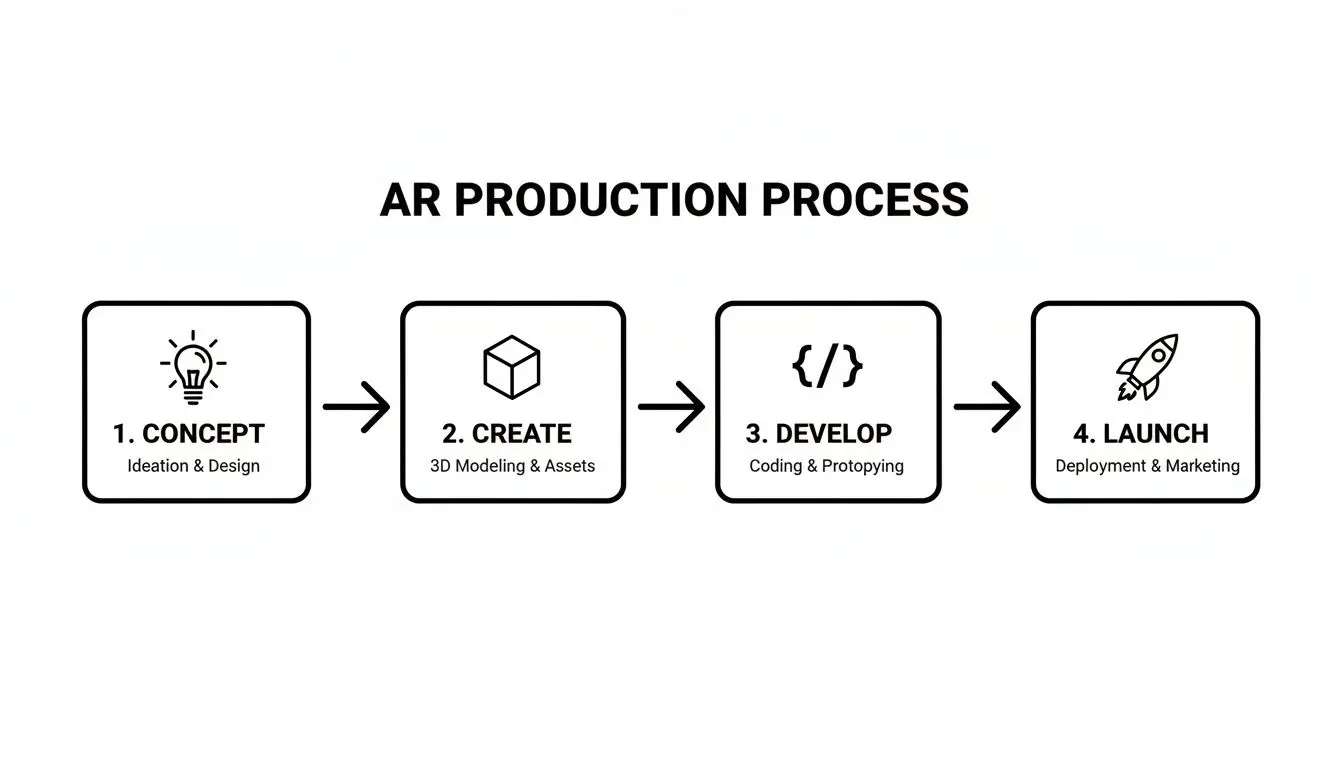
Understanding this production pipeline is the first step. It helps you get a handle on the costs and timelines involved, which are the building blocks for any ROI calculation. The next, and most crucial, step is deciding what success actually looks like for your project. The right metrics for a retail campaign will be worlds away from those for an industrial training module.
Defining Your Key Performance Indicators
Before you even think about launching, you need to set clear Key Performance Indicators (KPIs). These are the specific, measurable data points that prove your AR experience is hitting the mark. Your choice of KPIs should be tied directly to your project's goals. For AR for exhibitions and other marketing projects, you should be tracking:
- •Stand Dwell Time: How much longer are visitors staying at your booth compared to previous shows?
- •Interaction Rate: What percentage of visitors engage with the AR experience?
- •Qualified Leads Generated: At a trade show, how many visitors who used your AR demo asked for a follow-up from sales?
- •Social Shares: Are people sharing screenshots or videos of your AR experience? This is a brilliant indicator of authentic brand advocacy.
For sales-focused retail apps, your attention shifts to the bottom line. The KPIs here are all about commercial outcomes:
- •Conversion Lift: Compare the conversion rate of users who engaged with the AR feature against those who didn't.
- •Reduced Return Rates: Does a "try before you buy" feature actually lead to fewer products being sent back?
Finally, for training and operational uses, the metrics are all tied to performance and safety improvements:
- •Reduced Error Rates: Do employees make fewer mistakes after an AR-guided training session compared to the old-school manual?
- •Faster Task Completion: How much time does AR save when used for complex assembly or maintenance jobs?
- •Improved Knowledge Retention: Can you measure a higher rate of skill proficiency in trainees who used the AR module?
A Framework for Calculating AR ROI
Once you have your KPIs nailed down, you can use a simple framework to calculate your return on investment. The formula itself is straightforward; the real work is in gathering the right data.
ROI (%) = [(Financial Gain from Investment - Cost of Investment) / Cost of Investment] x 100
The "Cost of Investment" is your total project spend. This covers everything from the initial concept design and 3D asset creation right through to development and deployment. The "Financial Gain" is where your KPIs come into play. You need to translate those metrics into a real monetary value. For example, if your AR exhibition experience led to 20 high-quality leads worth £5,000 each in potential business, your gain is £100,000. If your retail AR feature slashed your product return costs by £15,000, that’s your gain. By weighing tangible gains against your development costs, you build a powerful business case for future immersive projects. For businesses exploring what's possible, a deep understanding of augmented reality application development provides a real competitive edge. Ultimately, measuring success properly is what turns augmented reality from a cool experiment into a core strategic tool.
Estimating AR Project Timelines and Costs
To help you plan, it's useful to have a rough idea of what to expect in terms of timelines and budget. AR projects can vary wildly in scope, from a simple social media filter to a complex industrial application. The table below provides a high-level overview of typical project ranges. Remember, these are just estimates, the final figures will depend on your project's specific features, complexity, and the level of polish required.
| AR Project Type | Estimated Timeline | Estimated Cost Range (UK) |
|---|---|---|
| Simple AR Filter (e.g., social media) | 2, 4 Weeks | £2,000 , £8,000 |
| Marker-Based AR App (e.g., exhibition stand) | 4, 8 Weeks | £8,000 , £20,000 |
| Markerless AR App (e.g., retail configurator) | 8, 16 Weeks | £20,000 , £50,000+ |
| Complex Enterprise AR (e.g., training) | 4, 9+ Months | £50,000 , £150,000+ |
These figures should give you a starting point for internal discussions and help you align your ambitions with a realistic investment. The key is to start with a clear goal, as that will define the scope and, consequently, the budget.
Why Partner With Studio Liddell For Your AR Vision
Picking the right creative partner is everything when it comes to turning a great augmented reality idea into a high-performing app that people actually want to use. At Studio Liddell, we’re not just another group of developers. We're a full-service creative digital production company with a long history of making world-class digital content. We bring together top-tier technical skills with a genuine passion for storytelling. The result? AR experiences that don’t just look good, but deliver real, measurable results for your business. Our team handles the entire process, from the initial brainstorming and storyboarding all the way to a polished launch. Whether you need an app for the Apple App Store, Google Play, or a bespoke build for a specific event, we manage the whole project from start to finish.
Our Technical and Creative Expertise
Our production powerhouse is built on years of hands-on experience with the industry's best real-time 3D engines, Unity and Unreal Engine. Being fluent in both means we can pick the perfect tool for your specific project, ensuring it’s not only visually stunning but also runs smoothly on every device you’re targeting. But tech is only half the story. We’ve put these skills to the test creating memorable immersive content for some fantastic clients, including:
- •English Heritage: We helped bring history to life, making educational experiences that truly engage visitors.
- •Merck: We developed sophisticated technical simulations where absolute precision and clarity were non-negotiable.
- •Sky Kids & BBC: We’ve had the joy of creating beloved characters and imaginative worlds for millions of viewers.
This work shows just how adaptable we are. We can pivot from entertainment and culture to highly complex and specialised business tools without missing a beat.
Specialists in High-Impact AR Applications
While our skillset is broad, we've carved out a real specialism in using augmented reality for exhibitions and retail spaces. We excel at designing interactive product demos and configurators that get people to stay at your stand longer, engage more deeply with your brand, and drive sales.
We believe the best AR is a perfect blend of creative spark and flawless technical work. Our aim is always to build something that not only looks incredible but also solves a real problem, whether that’s explaining a complex product or creating a brand moment people will never forget.
On top of that, our team has deep expertise in building complex technical and training simulations. We get that these applications need to be incredibly accurate, easy to understand, and deliver measurable learning outcomes, making us the go-to partner for projects where there’s no room for error. Your augmented reality vision deserves a partner with the experience and the creative drive to bring it to life properly. Let's have a chat about your ideas and see how our end-to-end production services can deliver an AR experience that truly shines.
Common Questions We Hear About Augmented Reality
Venturing into AR for exhibitions or retail for the first time can feel like exploring new territory. It's a field that moves at lightning speed, so it’s completely normal to have questions about the nuts and bolts of it all, cost, timelines, and which platform is right for you. To help clear things up, we've gathered the questions we hear most often from brands just starting their AR journey.
What Sort Of Budget Does An AR App Need?
This is the big one, and the honest answer is: it depends entirely on what you want to achieve. For a straightforward, marker-based app, perfect for bringing an exhibition graphic or product packaging to life, you could be looking at a starting point of £10,000 - £20,000, assuming you have existing 3D models. If you’re aiming for something more ambitious, like a markerless AR product configurator with bespoke 3D assets and complex user interactions, the budget will naturally be higher. These projects typically range from £30,000 to well over £100,000, reflecting the craftsmanship involved in creating the 3D content and the complexity of the development.
Can We Use AR On Our Website, Without An App?
Yes, you absolutely can. This is what we call WebAR, and it's a fantastic way to get your experience in front of people with zero friction. Using brilliant tech like 8th Wall or built-in browser features (known as WebXR), users can launch your AR experience just by scanning a QR code on your stand or clicking a link on their phone.
The beauty of WebAR is that it removes the need for an app download. People can jump straight from an ad, a social post, or your packaging directly into the experience. This makes it perfect for marketing campaigns, product showcases, and events where you need to grab attention instantly.
What's The Difference Between AR, VR, And MR?
It’s easy to get these terms mixed up, but they each describe a very different kind of experience. Here's a simple breakdown:
- •Augmented Reality (AR): This is all about adding a digital layer to the world you see. Think of an AR app that lets you explore a 3D model of a machine on an exhibition floor using your phone’s camera. It augments your reality; it doesn't replace it.
- •Virtual Reality (VR): VR is about total immersion. You put on a headset that completely blocks out your surroundings and transports you to an entirely digital world. You’re no longer at the event, you're inside a virtual simulation.
- •Mixed Reality (MR): Think of this as AR 2.0. With MR, digital objects don't just float on top of the real world; they appear to be part of it and can even interact with it. Imagine a digital character in your game that can hide behind a real pillar on your exhibition stand.
How Long Does It Take To Build An AR Experience?
Just like cost, the timeline is tied directly to the project's complexity. A simple proof-of-concept or a fun social media filter can be brought to life surprisingly quickly, often in just 2-4 weeks. For a polished, commercial-grade app for a retail launch or a major trade show, you should plan for a 3-6 month development cycle. That timeline gives us the space to cover everything properly, from initial creative concepts and design to development, rigorous testing, and a smooth launch. For major enterprise-level projects, like complex training simulators, the work can extend to 6-12 months or more.
Ready to turn your stand footprint into an immersive brand experience? At Studio Liddell, we combine broadcast-quality animation and deep technical expertise to build AR content that delivers real impact for exhibitions and retail. Brief us on your stand footprint