A Producer's Guide to Augmented Reality Games
Imagine holding up a magic window to the world, only to discover a hidden layer of digital fun just waiting to be found. That’s the essence of augmented reality games. This technology overlays interactive, digital content onto our real-world environment, all through the screen of a device like your smartphone or tablet. Suddenly, your living room can become a fantasy battlefield, or a stroll through the local park turns into an epic treasure hunt.
What Are Augmented Reality Games?
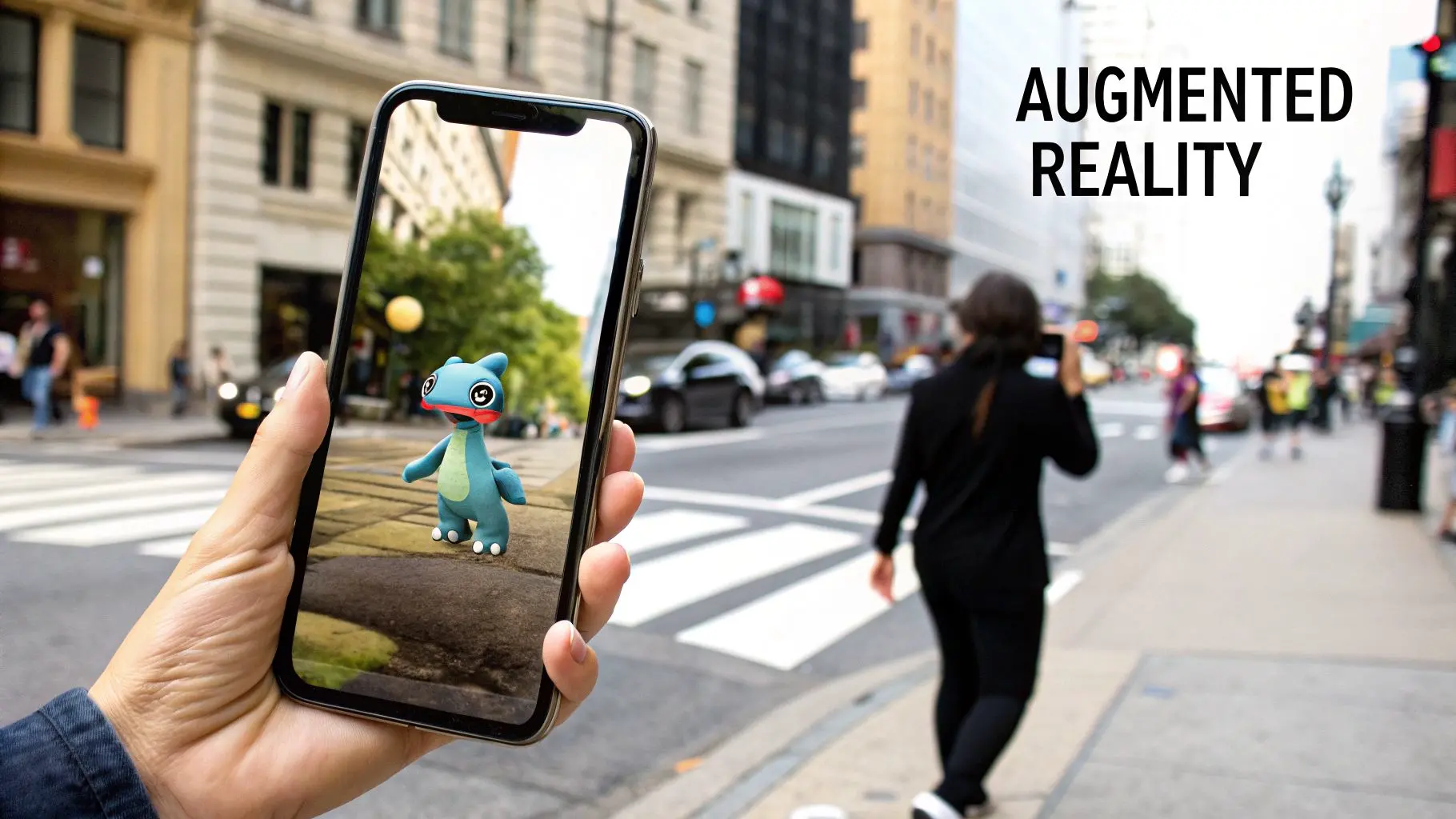
Unlike its cousin, virtual reality (VR), augmented reality doesn’t transport you to an entirely different world. Instead, it enriches the one you’re already in. This is the single most important distinction to grasp. VR is about complete immersion, you put on a headset and your physical surroundings disappear, replaced by a computer-generated environment. Think of it like stepping into a movie. AR, on the other hand, is like looking through your phone’s camera and seeing a digital dragon perched on your actual coffee table. The world is the stage.
Why The Distinction Matters For Businesses
For business leaders, marketers, and educators, this difference is everything. The biggest advantage AR has over VR is its sheer accessibility. It doesn’t demand specialised, often expensive, hardware like a VR headset. It works on the very devices that billions of us already carry in our pockets every single day. This simple fact makes AR an incredibly powerful platform for:
- •Mass-market engagement: You can reach a colossal audience without asking them to buy a single new piece of kit.
- •Brand storytelling: Create interactive narratives that weave your brand directly into a customer's personal space.
- •Interactive learning: Develop educational tools that bring subjects to life in a tangible, real-world context.
The real power of augmented reality lies in its ability to leverage existing hardware. By turning billions of smartphones into portals for interactive experiences, AR removes the significant barrier to entry that often limits the reach of other immersive technologies.
This widespread availability completely changes how brands can connect with their audiences. You’re no longer just telling a story; you’re inviting people to step inside and participate in it, using their own environment as the backdrop. To get a better feel for its practical applications, take a look at these compelling 10 examples of augmented reality you should know. You’ll see how this technology is already being used to create truly memorable interactions. The potential of augmented reality games isn't some far-off concept, it’s a powerful opportunity, right here and now.
Exploring Core AR Game Mechanics and Types

Not all games augmented reality experiences are built the same. The technology underneath allows for hugely different ways to play, and each one is suited to different business goals. Getting your head around these core types is the first step in matching a creative idea with a solid commercial aim, whether that’s getting people through the door, boosting engagement with a product, or creating a brand activation people will be talking about for weeks. The "mechanics" of an AR game are all about how players actually interact with the digital stuff in their physical world. This interaction is what separates a short-lived novelty from something genuinely compelling. By breaking these down, we can map out which approach is going to deliver the best results.
Location-Based AR Games
Location-based AR games turn the entire world into a giant game board. These experiences use your phone's GPS to pin digital content, characters, and quests to specific physical places. The whole point of the game is to get out and explore, encouraging players to physically travel to different spots to make progress. This is the exact model that made Pokémon GO a global phenomenon. Its success wasn’t just a fluke; it showed a powerful business application in action: driving real-world footfall. A retail business could use this to create a branded treasure hunt that leads new customers right to their front door. A city’s tourism board could design an interactive historical tour that brings the past to life on its streets.
Marker-Based AR Experiences
Marker-based AR needs a specific, pre-defined visual trigger, a marker, to kick off the digital experience. This "marker" can be just about anything: a QR code on a poster, a logo on product packaging, or even a particular page in a magazine. When your device's camera sees the marker, it instantly overlays the 3D model, animation, or game right on top of it. This type is incredibly effective for marketing and event activations. Just imagine:
- •AR for Exhibitions: A simple graphic on your trade show booth springs to life, showing a 3D animated demo of a complex product when scanned. Your static display is suddenly an interactive magnet for visitors, dramatically increasing how long they stick around.
- •Product Packaging: A breakfast cereal box, when viewed through a phone, could launch a fun mini-game starring the brand’s mascot. This forges a direct, playful connection with the consumer right at the point of purchase.
The biggest advantage here is control. The experience is tied directly to a physical object you own, making it a reliable tool for direct brand engagement.
By anchoring a digital experience to a physical object, marker-based AR creates a powerful and direct link between your brand's real-world presence and an interactive digital world. It's a bridge that invites customers to look closer.
Markerless AR Experiences
Markerless AR is the most flexible and technically impressive approach. Instead of needing a specific trigger image, this tech uses clever algorithms to understand the geometry of the world around you. It detects flat surfaces like floors, tables, and walls, letting users place and interact with virtual objects absolutely anywhere. This freedom is its greatest strength. A furniture retailer could let customers drop a true-to-scale 3D model of a sofa right into their own living room. An educational app could let a student place a virtual human heart on their desk and walk around it. For games augmented reality, this opens the door to creating sandboxes where players build virtual worlds that are completely intertwined with their physical space. To make these concepts clearer, let's compare them side-by-side and look at where each one shines in a business context.
AR Game Types and Their Business Applications
| AR Game Type | Core Mechanic | Primary Business Use Case | Example Application |
|---|---|---|---|
| Location-Based | Uses GPS to place digital content in real-world locations. Encourages physical exploration. | Driving footfall, tourism, large-scale public engagement. | A city-wide scavenger hunt that leads players to local businesses and landmarks. |
| Marker-Based | Requires a specific visual trigger (QR code, logo, image) to launch the AR experience. | Product packaging, print advertising, event activations. | Scanning a wine bottle label to see a video of the winemaker and food pairing suggestions. |
| Markerless | Detects surfaces (floors, tables) to allow users to place 3D objects anywhere in their environment. | Product visualisation, interactive education, creative sandbox games. | An automotive app that lets you "park" a new car model in your own driveway to see how it looks. |
Each of these approaches offers a unique way to blend the digital and physical. The key is to choose the mechanic that best supports what you're trying to achieve, whether that's drawing a crowd, delighting a customer, or simply showing your product in a whole new light.
The Technology Powering Modern AR Games
To bring a digital dragon roaring into your living room, you need more than just a clever idea. The magic behind today's immersive AR games is built on a sophisticated tech stack, a partnership where powerful game engines and foundational software development kits (SDKs) work in perfect harmony. For anyone commissioning a project, getting to grips with these core components is the key to having informed conversations with developers and understanding how technical choices shape the final product. At the heart of almost every AR game, you'll find one of two industry-leading game engines: Unity or Unreal Engine. Think of them as the creative canvas and the raw processing power needed to build interactive 3D worlds. Each has its own strengths, and the choice between them often defines a project's capabilities and visual style from the very beginning.
Choosing Your Engine: Unity vs Unreal
Unity is often praised for its flexibility and massive creator community. Its Asset Store is a genuine treasure trove of pre-made models, tools, and plugins that can seriously speed up development. When it comes to AR, Unity's lightweight architecture and brilliant cross-platform support make it a fantastic choice for deploying games efficiently across both iOS and Android. Many developers find it's the quicker engine for prototyping, which means you can test and iterate on gameplay ideas much faster. Unreal Engine, on the other hand, is the undisputed champion of sheer graphical power and photorealistic visuals. If your AR game demands high-fidelity lighting, complex special effects, and a truly cinematic feel, Unreal is an absolute powerhouse. While it traditionally has a steeper learning curve, its visual scripting system, Blueprints, allows designers to build complex interactions without writing a single line of code, a huge plus for artist-led projects.
The decision between Unity and Unreal isn't about which is "better," but which is the right fit for your project's specific creative vision and commercial goals. It's a strategic choice that balances visual ambition with development speed and platform reach.
For a deeper dive into the nuts and bolts, our guide to augmented reality application development offers more detailed insights into the process.
The Foundational SDKs: ARKit and ARCore
While game engines provide the muscle, they need a brain to understand the real world. This is where the platform-specific SDKs from Apple (ARKit) and Google (ARCore) come into play. These toolkits are what feed the game engine the crucial data it needs to blend virtual objects seamlessly with a physical space. These SDKs are the unsung heroes of AR, handling all the complex maths that makes the experience feel real and believable. They are responsible for:
- •Motion Tracking: This is what allows the virtual camera in the game to perfectly match the movement of your physical device. When you walk around a virtual object, it stays anchored in place as if it were really there.
- •Plane Detection: The software intelligently identifies flat surfaces in your environment, like floors, walls, and tabletops. This is what enables you to place a virtual character on the ground or a digital object on your desk.
- •Light Estimation: A clever feature that analyses the ambient lighting in your room and applies it to the virtual objects. It ensures a digital character in a dimly lit room has the right shadows, making it look far more integrated into the scene.
This powerful combination of an engine and an SDK is what makes modern AR games possible. These technologies are driving significant market growth, creating a dynamic and exciting sector for producers to operate within.
The AR Game Production Workflow: From Concept to Launch
Getting an AR game from a spark of an idea to a polished app on someone's phone isn't guesswork. It's a structured journey. This end-to-end production workflow is what ensures the creative vision, technical execution, and business goals all stay perfectly aligned, preventing those costly missteps and delays that can derail a project. A proven pipeline is what separates a fun little prototype from a commercially successful product. The whole process can be broken down into clear, sequential phases. Each stage builds on the one before it, keeping every stakeholder in the loop and making sure the project stays on track, on time, and on budget. For any producer looking to commission an AR game, understanding this roadmap is crucial.
Discovery and Concepting
The journey doesn't start with a single line of code. It starts with a conversation. The Discovery and Concepting phase is where we lay the foundations and properly define the "why" behind the game. It's all about making sure the core gameplay directly serves your specific business goals. During this phase, we focus on a few key activities:
- •Objective Setting: What are we actually trying to achieve here? Are we driving foot traffic to a venue, boosting brand engagement at an event, or creating a new educational tool? Defining success right from the start is critical.
- •Audience Analysis: Who is this for? Getting a clear picture of the target demographic shapes everything that follows, from the art style to the game's difficulty.
- •Core Mechanic Ideation: This is where we brainstorm the central gameplay. Will it be a location-based scavenger hunt? A simple marker-based mini-game? Or maybe a more freeform markerless creative sandbox?
This strategic groundwork all comes together in a detailed Game Design Document (GDD). Think of the GDD as the project's bible; it outlines the game's concept, mechanics, audience, and technical needs, making sure everyone is working from the same script.
Pre-Production and Prototyping
With a solid concept locked in, we shift into Pre-Production. This is where the game begins to take visual and functional shape before we commit to full-scale development. The goal here is to test our ideas and iron out any creative or technical wrinkles early on. Storyboards and concept art bring the visual language to life, while user flow diagrams map out the player's journey from opening the app to finishing a level. The most important thing to come out of this phase, though, is the interactive prototype. This is a bare-bones, stripped-back but playable version of the core mechanic, built to answer one simple question: is it fun? Prototyping lets us fail fast and cheap, refining the core experience before the serious coding begins.
Main Production and Development
Here we go. This is the longest and most intensive phase, where the full team gets to work bringing the game to life. Artists create the 2D and 3D assets, animators make characters move, and our developers write the code that stitches it all together in a game engine like Unity or Unreal Engine.
A disciplined production process, usually managed with agile methods, is absolutely essential for keeping complex AR projects on schedule. Working in regular "sprints" and creating frequent builds allows for constant feedback and tweaks, ensuring the final product lines up perfectly with the original vision.
This flow chart gives you a simple look at how the core technologies, the SDK, the game engine, and the device itself, all work together during this stage.
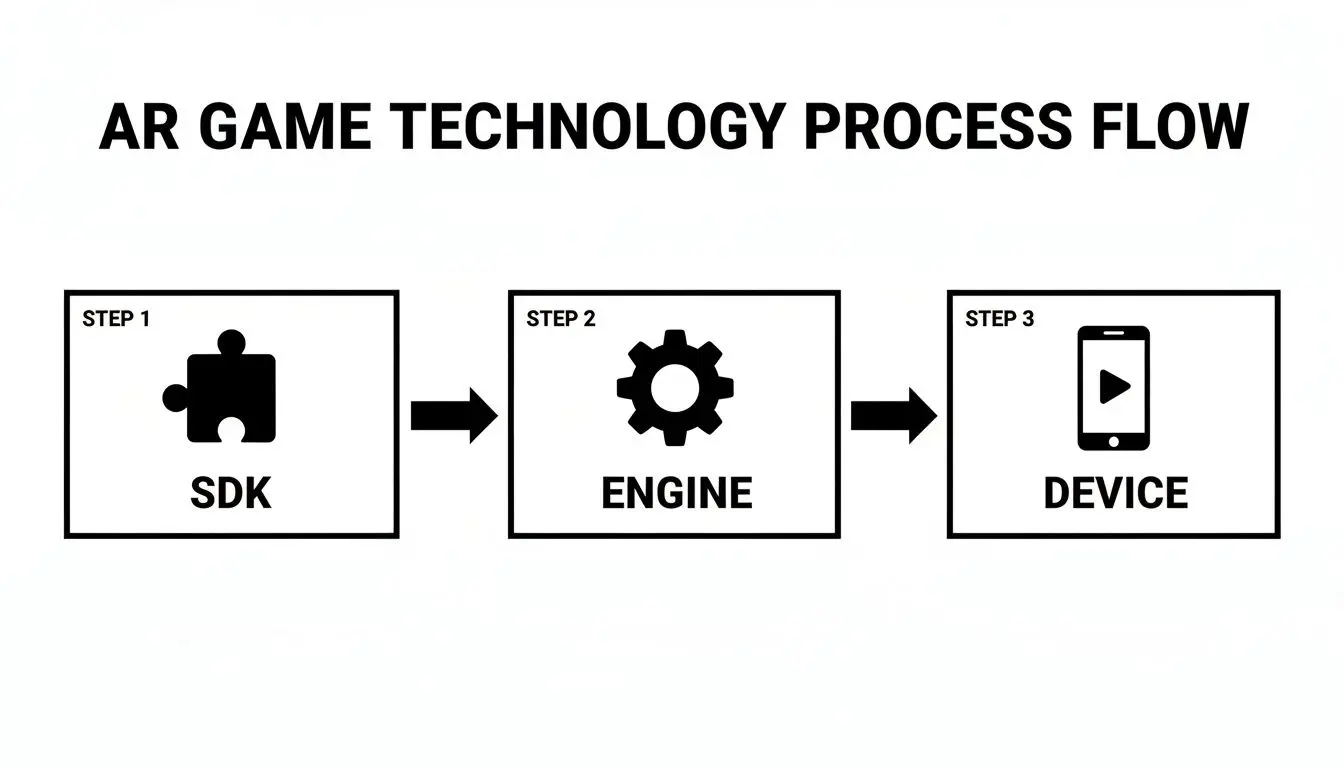
As you can see, the foundational SDK (like ARKit or ARCore) feeds real-world data to the powerful game engine, which then renders the final, interactive experience you see on your phone.
Post-Production and Launch
Once the game is "feature complete," it moves into Post-Production. This is the final, critical stage that’s all about polish, optimisation, and getting ready for the big launch. The key steps here are:
- Rigorous QA Testing: A dedicated quality assurance team puts the game through its paces on a huge range of target devices. They're hunting for bugs, checking performance, and making sure the user experience is smooth and intuitive.
- Performance Optimisation: The team fine-tunes the game to ensure it runs efficiently. This means minimising battery drain and stopping devices from overheating, both common challenges in AR development.
- Deployment: Finally, the game gets submitted to the Apple App Store and Google Play Store. This involves preparing all the marketing assets, writing compelling descriptions, and navigating the review process for each platform.
Measuring the Business Impact of Your AR Game
An augmented reality game isn't just a creative flourish; it's a serious business tool capable of delivering real, measurable results. Whether you're a marketing agency orchestrating a product launch, an educational body crafting interactive lessons, or a business looking to improve your training programmes, you have to know what success looks like. It's all about bridging the gap between a fun, engaging AR experience and the business outcomes it drives. To prove the value of your investment, you absolutely must define your Key Performance Indicators (KPIs) before a single line of code is written. Think of these metrics as the language of business impact. They translate player activity into a clear return on investment (ROI). Without them, you're just building something cool; with them, you're building a strategic asset.Defining Your Core KPIs
Your goals will dictate which metrics matter most. A game designed for a bustling trade show will have vastly different KPIs from one intended to train factory workers. The trick is to align your measurement framework with the game's primary purpose from day one. We can break these KPIs into three main buckets:- •User Engagement Metrics: These tell you if the game is actually compelling and sticky. Are people playing it, and more importantly, are they coming back for more?
- •Marketing and Brand Metrics: These measure the game's ripple effect on your brand's perception and its ability to drum up new business.
- •Operational and Event Metrics: These are tied to specific use cases like events, retail, or training, measuring the direct impact on real-world actions.
The most effective way to demonstrate the value of a games augmented reality project is to present clear data that links player actions to specific business objectives. Success isn't just about download numbers; it's about proving the game influenced customer behaviour or improved operational efficiency.
Tracking Engagement and Player Behaviour
The foundation of any successful game is an engaged audience. If nobody's playing, you can't hit any of your bigger business goals. Simple as that. Key engagement KPIs to watch are:
- •Session Length: How long, on average, does a user play in one go? Longer sessions are a great sign that you've built an immersive and captivating experience.
- •Daily Active Users (DAU) / Monthly Active Users (MAU): This classic metric shows how many unique users are jumping into your game daily or monthly, giving you a clear picture of its overall reach and health.
- •Retention Rate: What percentage of users return to play after one day, seven days, or thirty days? High retention is a powerful signal that your core gameplay loop is rewarding and fun.
- •Completion Rate: For games with distinct levels or goals, what percentage of players are actually reaching the end? This helps you spot any frustrating bits or friction points in the user journey.
This data is the bedrock of your analysis, giving you a direct line of sight into what’s working and what isn’t inside the game itself. The UK is a prime market for these experiences. You can discover more about the UK gaming market's impressive growth, which continues to be a major force in the global entertainment industry.
Measuring Marketing and Event Success
When your AR game is part of a marketing campaign or a live event, its success is all about how well it influences what people think and do. Here, the crucial metrics change:
- •Dwell Time: At an exhibition or in a retail space, how long do people stick around to interact with your AR experience? Longer dwell times have a direct link to higher brand engagement.
- •Lead Generation: Can users pop their details into the game to get more information or a special offer? Tracking the number of qualified leads is a direct, hard-hitting ROI metric.
- •Social Shares: Does the game make it easy for players to share screenshots or videos on social media? That organic reach is a powerful sign you've created something memorable.
- •Brand Recall: Using post-experience surveys, you can measure if players remember your brand, product, or key message better than people who didn't play.
To really nail down the business impact and inform your budget, it's smart to think about different revenue models. Reviewing various top mobile app monetization strategies can give you a solid framework for forecasting potential revenue streams, which is a vital part of any ROI calculation. By defining and tracking these KPIs, you turn your AR game from a creative idea into a measurable business driver.
Budgeting for Your Augmented Reality Game Project
Right, let's talk about the important stuff: money. Planning an augmented reality game means having a frank conversation about the investment needed to get from a brilliant idea to a polished app in the hands of your audience. Budgets can swing wildly, so the first step is always to understand what actually drives the cost. Think of the final price tag as being controlled by a few key levers. The more you pull on any of these, the more development time and specialist skills are needed, and the higher the budget climbs.
What Drives the Cost of an AR Game?
The single biggest factor is always the project's scope. A simple, marker-based game for a trade show is a completely different beast from a sprawling, multiplayer AR world. Here are the main things that will shape your budget:
- •Mechanic Complexity: A basic ‘point your phone and see something cool’ experience is straightforward. A game with proper physics, multiple levels, and complex ways for players to interact? That’s a whole different level of work.
- •Asset Quality and Quantity: Are we using off-the-shelf assets, or do you need custom, high-detail 3D models and character animations built from the ground up? Creating bespoke assets is an art form and requires serious time from skilled artists.
- •Platform Targets: Building for just iOS or just Android is one thing. Creating a cross-platform experience that runs perfectly on both takes more development, and crucially, a lot more testing.
- •Backend Requirements: Does your game need to save a player's progress, host leaderboards, or let people play against each other online? Features like these need a solid server infrastructure, which adds a significant layer of cost and complexity.
Getting a Feel for Budget Tiers
To give you a clearer picture, let's break down what you can realistically expect at different investment levels for games augmented reality. These are ballpark figures, of course, but they offer a practical starting point. Simple Promotional Experience (£15,000 - £30,000) In this range, we’re typically looking at a slick, marker-based AR app. It’s perfect for a marketing campaign, bringing product packaging to life, or making a splash at an event. The focus is on a single, core interaction using relatively simple 2D or 3D assets. Mid-Range AR Game (£30,000 - £75,000) This budget unlocks a lot more potential. You could be looking at a markerless AR game with more involved mechanics, custom 3D models, and several interactive elements. This is the sweet spot for a solid branded game designed to keep people hooked for more than just a few minutes. Complex, High-End Production (£75,000+) When you go beyond this figure, you’re stepping into the world of high-end, ambitious productions. This could be a location-based game using GPS, multiplayer features, persistent player accounts, and top-tier, bespoke 3D art and animation. These are the big-hitter projects aimed at making a major commercial impact.
Being open and honest about your budget from day one is the most important thing you can do. It allows a studio to tailor their creative and technical ideas to what’s actually feasible, making sure the final concept is both exciting and achievable.
This upfront approach builds a solid foundation for the project, making sure every pound you spend is working directly towards hitting your business goals.
Burning Questions About AR Game Development
Stepping into the world of augmented reality games naturally sparks a few questions. For any business thinking about this tech, getting clear, straightforward answers is the first step towards making a confident move. Here are the most common queries we tackle for our clients.
How Long Does It Take to Build an AR Game?
This is the big one, and the honest answer is: it all comes down to complexity. A quick, punchy promotional game built around a specific marker , think a QR code on a product , can be turned around pretty swiftly. For an event or a short campaign with simple mechanics, you're often looking at a timeline of 4-8 weeks from the first chat to launch day. But what if you want something more involved? A markerless game with custom 3D characters and more complex gameplay will naturally need more time in the oven, typically around 4-6 months. For the really ambitious projects , we're talking multiplayer, location-based features, and a beefy backend server , the development cycle can easily stretch to 6-12 months, sometimes longer. That's why a thorough discovery phase is so important; it lets us map out every feature and set a schedule that makes sense for everyone.
Do Our Customers Need Special Goggles or Headsets?
The real power of mobile AR is just how accessible it is. You're not asking people to buy special glasses. You're reaching a massive, mainstream audience instantly, tapping into the billions of AR-ready phones already out there in the wild.
How Do We Actually Measure the ROI of an AR Game?
Measuring the return on your investment is all about defining what "success" looks like for you, right from the very start. There's no single magic number, so setting your KPIs upfront is mission-critical.
- •For Marketing & Brand Awareness: We're looking at user engagement. How long are people playing? How many come back each day? We can also measure brand lift through surveys, track social media chatter, and see how many qualified leads the game generates.
- •For Retail or Events: Here, it’s about real-world results. We can track the increase in footfall to a specific shop or measure how much longer customers stick around at an exhibition stand.
- •For Training & Education: The ROI is tangible. You can measure it in better employee performance , things like higher knowledge retention, quicker task completion, and, crucially, a noticeable drop in on-the-job mistakes.
Ready to see how an AR game could hit your specific business goals? The team at Studio Liddell has been crafting immersive digital experiences since 2019. We can guide you through every stage of the journey. Book a production scoping call with our experts and let's get the conversation started.