PPC Advertising Cost: Your 2026 Budget Guide
Most advice on PPC advertising cost starts in the wrong place. It starts with the click. That's useful, but it's incomplete. If you only ask what a click costs, you'll optimise for the cheapest traffic and miss the more important question, which is what it costs to generate a profitable enquiry, sale, or qualified lead. That's why the standard answer, “it depends”, feels so unhelpful. The dependency isn't random. PPC costs move because a few specific parts of the system move: what you pay to platforms, what you pay to manage the account, and what you invest in the assets that turn attention into action. Cheap clicks can still be expensive if the ad is weak, the landing page is generic, or the conversion path leaks demand. A better way to budget is to treat PPC as a production system. Media buying matters. Bidding matters. Tracking matters. But creative quality and conversion design often decide whether the spend compounds or gets burned.
Rethinking Your PPC Advertising Cost
The most common mistake in PPC is treating cost per click as the main measure of efficiency. It isn't. It's only one input. A low CPC can hide a bad campaign. You may be buying low-intent traffic, targeting the wrong audience, or sending visitors to a page that doesn't match the promise in the ad. On paper, the click looks cheap. In practice, the acquisition cost becomes painfully high because the campaign is underperforming after the click.
Cheap clicks often produce expensive outcomes
The stronger question is this: what is the total cost of an outcome? That outcome might be a product sale, a booked demo, a lead form submission, or a call from the right buyer. Once you frame PPC that way, the conversation changes. You stop looking only at bids and start looking at the whole chain:
- •Traffic quality
- •Ad relevance
- •Landing page clarity
- •Offer strength
- •Tracking accuracy
- •Conversion follow-through
Practical rule: If a campaign gets cheaper clicks but worse leads, it hasn't reduced your PPC advertising cost. It has only shifted the waste to a later stage.
Many teams get stuck trying to solve a conversion problem with bidding changes alone. Sometimes that works. Often it doesn't.
PPC cost is a systems problem
The most useful way to think about PPC is as a system with dependencies. If your tracking is messy, automation learns the wrong signals. If your landing page is slow or vague, paid traffic under-converts. If your creative doesn't differentiate, the platform has less reason to favour your ads. That's why serious cost control rarely comes from shaving pennies off bids. It comes from building a tighter system that turns more of the traffic you already buy into revenue.
The Three Core Components of PPC Cost
When marketers ask about PPC advertising cost, they usually mean media spend. That's only one layer. A more accurate view splits cost into three parts: media spend, management and tech fees, and creative plus conversion assets. That systems view matters because, as Hochman Consultants notes on PPC cost structures, budgets can range from £50 to over £500,000 per month, and the total cost is heavily shaped by management models and conversion efficiency. Here's the simple breakdown visually:
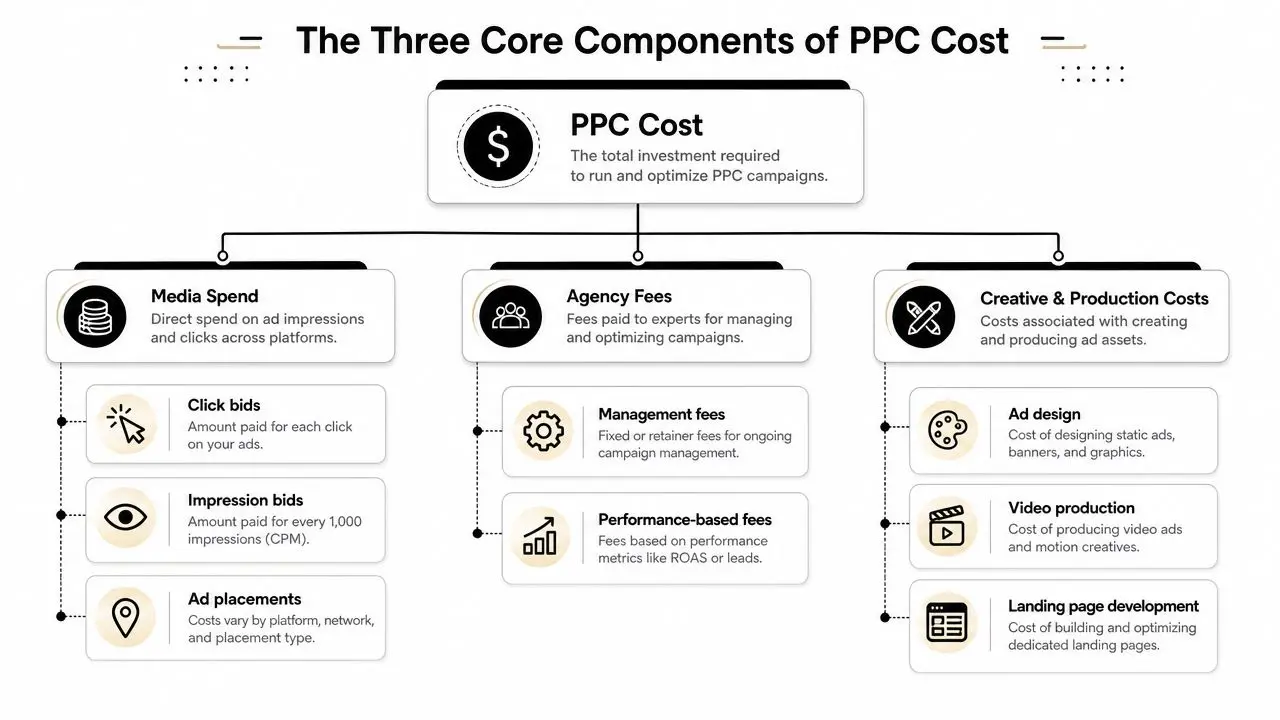
Media spend
This is the amount paid directly to Google, Meta, Microsoft Ads, LinkedIn, YouTube, or another platform. It covers the auction itself: clicks, impressions, placements, and audience access. This is often the first point of analysis because it's visible and immediate. You can see spend rising or falling every day. But media spend alone doesn't tell you whether the account is healthy.
Management and tech fees
Someone has to structure campaigns, write ad copy, monitor search terms, adjust bids, fix tracking, review performance, and decide where budget should move next. That work may sit with an in-house team, a freelancer, or an agency. The pricing model changes the total cost. Some charge a retainer. Some take a percentage of spend. Some use a hybrid arrangement with reporting, conversion tracking support, or feed management included.
Creative and conversion assets
This is the most overlooked part of PPC budgeting and often the most decisive. It includes:
- •Ad creative such as static visuals, motion assets, videos, and copy variants
- •Landing pages built for a specific audience, offer, or campaign
- •Testing assets like alternate headlines, form layouts, or page structures
- •Production input that improves message clarity and visual quality
Think of PPC like building a house. Media spend is the land. Management is the architect and site manager. Creative and conversion assets are the materials people experience when they arrive. If you underfund that third layer, the whole structure performs below its potential. For teams focused on optimizing marketing budget and ROI, this is the key budgeting mistake to avoid. Spend isn't just what the platform invoices. It's what the full system requires to produce profitable outcomes.
PPC Cost Benchmarks for UK Businesses in 2026
You still need benchmarks. They're useful as a planning baseline, as long as you don't mistake them for a forecast. A UK-focused roundup from Reboot reports that many advertisers pay £0.09 to £0.40 per click on major ad networks, that 61% typically pay in that range, and that 44% of businesses report monthly Google Ads spend of £80 to £8,000 according to these UK PPC statistics. This gives you a real starting point. It does not give you your number.
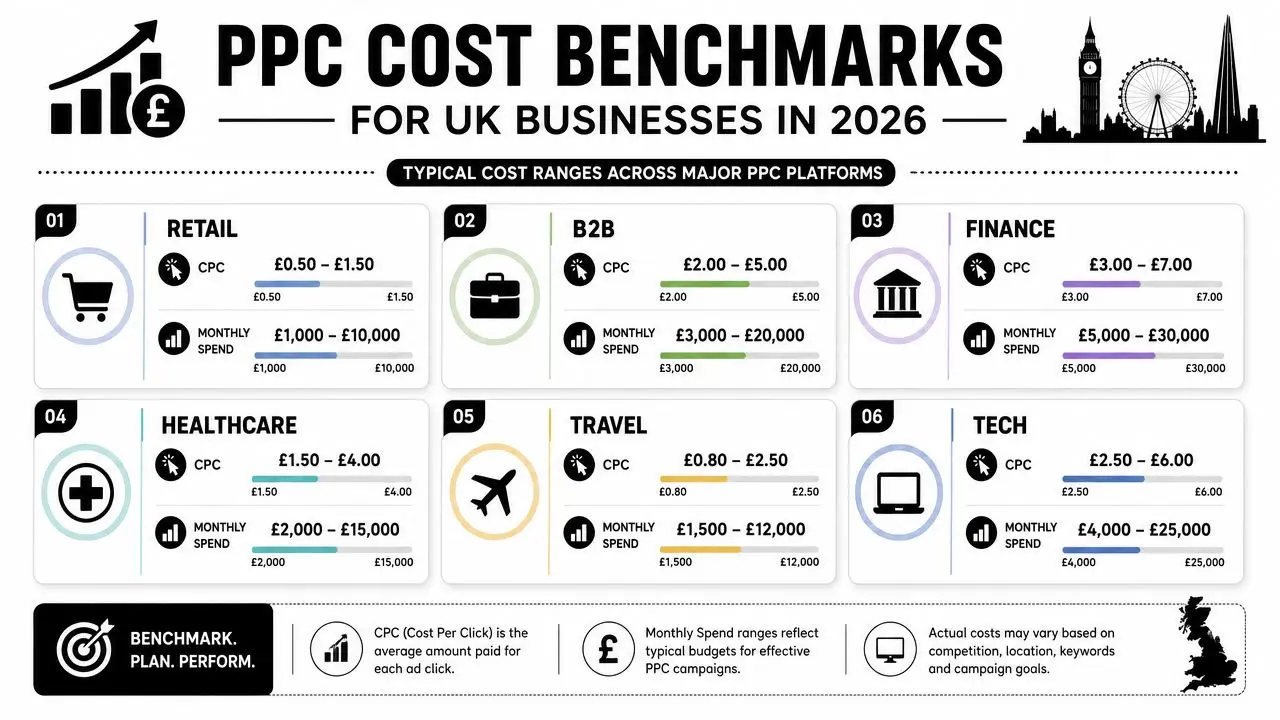
What the benchmarks actually tell you
The first useful takeaway is that PPC costs in the UK sit on a wide range. There is no single market rate that applies across every account. The second takeaway is that monthly spend and CPC are not interchangeable. A business can sit in a modest CPC band and still spend heavily because of volume, audience breadth, campaign count, or poor conversion efficiency. Another may accept higher clicks in a narrower, more profitable niche and still run a leaner account overall.
A practical way to read the numbers
Use the benchmark figures as planning guardrails, not commitments.
| Budget view | What it suggests |
|---|---|
| Lower click prices | Broadly possible in some networks, audiences, and lower-pressure categories |
| Wider monthly spend ranges | Spend usually reflects ambition, complexity, and account structure as much as bid level |
| Variation across businesses | Buyer intent, geography, funnel stage, and creative maturity all affect where you land |
That's why channel comparisons can mislead. Search, social, display, and video each produce different user behaviour. A lower-cost social click may carry weaker intent than a search click. A video view may support conversion later rather than immediately. Judging all channels by the same surface metric creates bad budget decisions.
Benchmarks help you avoid fantasy planning. They don't remove the need for judgement.
If you want a platform-specific comparison on paid social, this guide on how much an ad on Facebook costs in the UK is useful as a companion read because it highlights how channel economics can differ from search-led PPC assumptions.
Key Factors That Influence Your Ad Spend
Two businesses can target similar buyers and still end up with very different PPC advertising costs. The gap usually comes from execution choices rather than one platform being mysteriously more expensive.
Competition, intent, and geography
The first driver is the market itself. Competitive sectors attract more bidders. High-intent searches also cost more because more advertisers want the same attention at the same moment. Geography matters too. A tightly defined local campaign often behaves very differently from a national account. The same applies to audience layering. If you narrow too far, delivery can become constrained. If you broaden too far, you may buy reach that never converts. A few recurring cost drivers show up in most accounts:
- •Keyword or audience pressure. More bidders usually means higher auction tension.
- •Targeting precision. Broad targeting can scale fast, but it can also waste spend fast.
- •Seasonality and timing. Some categories become more expensive when demand spikes.
- •Offer clarity. A weak offer makes every impression and click work harder.
Relevance acts like a discount or a tax
Platforms reward advertisers who create a better user experience. In Google Ads, that tends to show up through relevance and expected engagement signals. In paid social, the same logic applies through ad resonance, audience fit, and post-click experience. If the ad matches the search or audience intent, and the landing page continues that message clearly, the account usually becomes more efficient. If the ad overpromises, looks generic, or sends users to a mismatched page, costs rise because the system reads weak user response. That's why poor creative behaves like a tax. It doesn't always announce itself as a creative issue. It shows up as bloated spend, erratic lead quality, or campaigns that need constant intervention.
Automation can amplify weak inputs
Automation is useful, but it doesn't rescue bad foundations. Broader PPC commentary from ScaleStation argues that automation and auction dynamics can increase PPC pressure, and that businesses should question whether rising costs come from market inflation or internal inefficiencies such as under-attributed conversions. That's an important distinction. If your tracking doesn't capture value properly, automated bidding learns from incomplete signals. If your sales cycle is long, last-click reporting can undervalue the campaigns doing the early persuasion. For teams dealing with app-led acquisition or longer digital journeys, this complete guide to mobile app promotion in the UK is a useful reminder that campaign economics often look very different once you account for the full path to conversion.
Practical Tactics for PPC Cost Optimisation
The fastest way to reduce wasted spend isn't heroic bidding strategy. It's disciplined account hygiene. Most underperforming accounts leak money through preventable problems: irrelevant search terms, loose targeting, vague ad messaging, broken tracking, or landing pages that don't carry the intent forward.
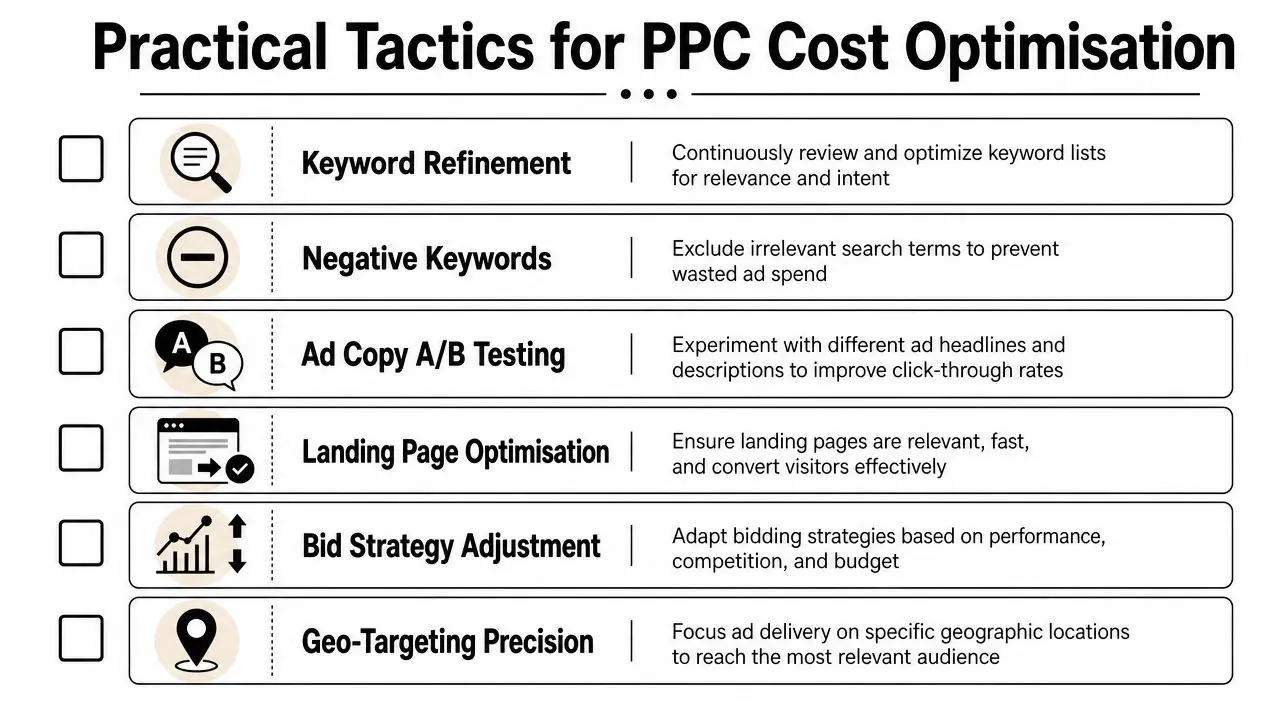
Start with waste removal
These are the first fixes because they tend to improve efficiency without needing a full rebuild.
- •Negative keywords. Review search term reports and block traffic that's clearly irrelevant, low-intent, or mismatched to your offer.
- •Geo tightening. Exclude locations that don't convert or that sit outside your true commercial footprint.
- •Ad schedule checks. If certain times produce poor-quality leads, stop paying for them.
- •Tracking validation. Make sure forms, calls, thank-you pages, and offline outcomes are being recorded correctly.
This work isn't glamorous, but it protects budget.
Improve the handoff from ad to page
A lot of PPC spend is lost in the gap between a strong click and a weak landing experience. If the ad promises one thing and the page says another, conversion falls. If the page is cluttered, slow, or built for everyone, users hesitate. If the form asks too much too early, the funnel stalls. A tighter handoff usually means:
- •Message match between keyword, ad, and landing page
- •Specificity in the headline and offer
- •Fewer distractions on campaign pages
- •Clear proof such as relevant examples, product detail, or next-step clarity
Better PPC accounts don't just buy attention well. They receive attention well.
Treat creative testing as a cost-control tool
Creative testing is often discussed as a growth tactic. It's also a cost tactic. When teams test distinct hooks, visuals, formats, and landing page variants, they learn which messages pull qualified clicks rather than casual ones. That reduces waste upstream and improves conversion downstream. A practical optimisation rhythm looks like this:
- Stabilise tracking and exclusions
- Tighten targeting and query control
- Test ad messaging against intent
- Improve the landing page experience
- Adjust bidding once the data is cleaner
How Better Creative Reduces Total PPC Cost
Creative is usually treated as a support function in PPC. In reality, it often determines whether the account becomes cheaper or more expensive to scale. That's especially true when budgets move up. Add People's UK pricing guide says lower-cost PPC campaigns often run at £500 to £2,000 per month, mid-range campaigns at £2,000 to £10,000 per month, and higher-cost campaigns above £10,000 per month, with some competitive clients spending £20,000 to £30,000 per month. At that point, weak creative isn't a minor flaw. It's a compounding expense.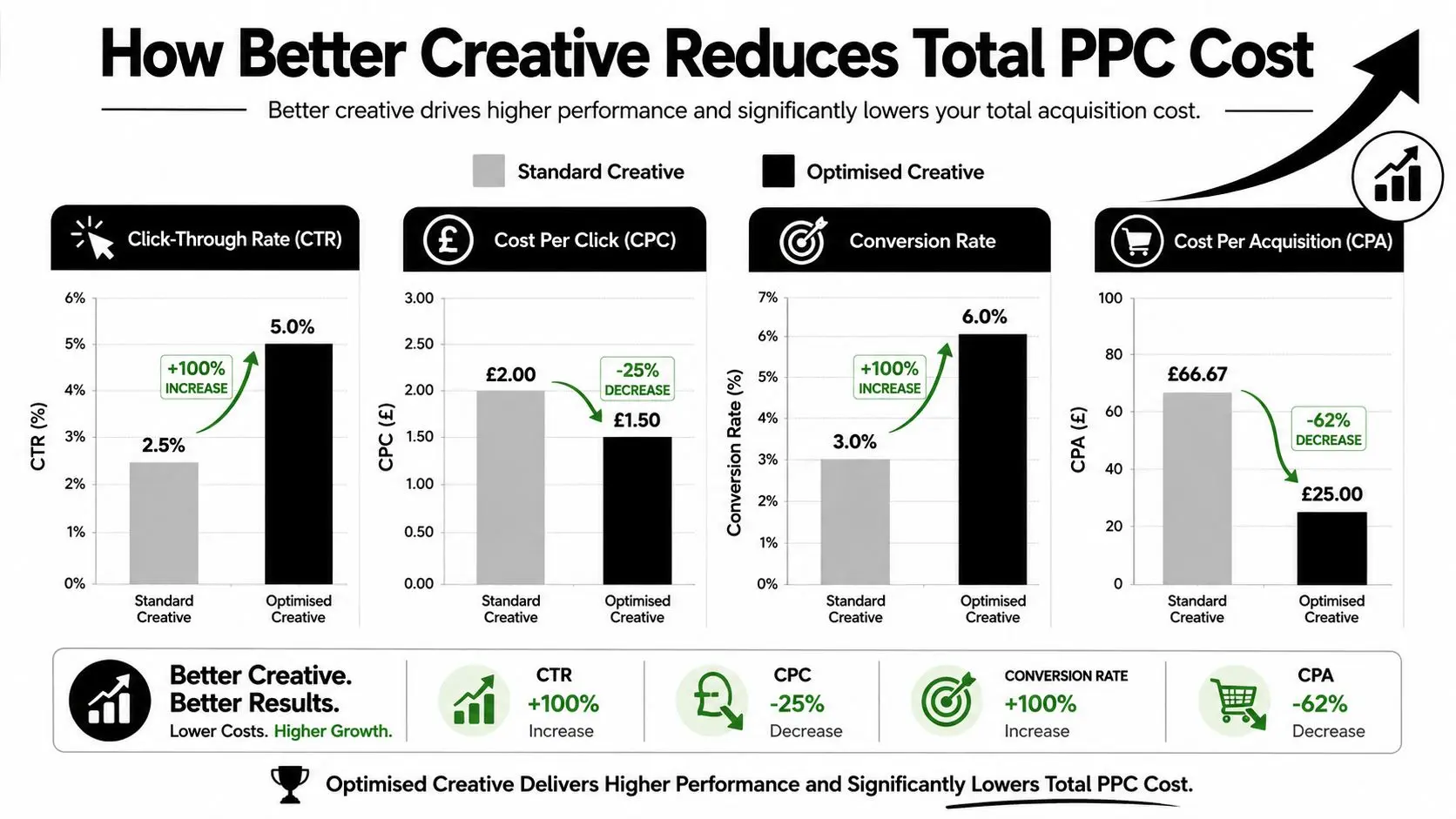
Why stronger creative changes the economics
Better creative does three jobs at once. First, it improves attention quality. The right visual, headline, and framing attract people who are more likely to care. Second, it improves relevance signals inside the platform, which can support more efficient delivery. Third, it prepares the user for the landing page, which lifts the chance of conversion after the click. Weak creative does the opposite. It broadens curiosity, attracts low-fit clicks, and creates friction when the landing page asks the user to become serious.A practical comparison
Take two campaigns with the same service offer and the same media discipline. Campaign A uses standard stock-led visuals, generic copy, and a broad landing page built for the whole business. The ads are technically fine, but they don't frame the problem sharply or show the product in a compelling way. Users click, then hesitate. Campaign B uses more considered creative. The visual language is specific to the buyer. The copy mirrors search intent or audience pain points. The landing page reflects the campaign message instead of recycling the homepage. The user arrives with a clearer expectation and finds a clearer next step. The difference isn't just aesthetic. It's financial.- •Higher relevance can make the media spend work harder
- •Clearer differentiation filters out weaker traffic
- •Better continuity from ad to page improves conversion efficiency
- •Sharper messaging helps sales teams receive better-qualified leads
This is why spending more on creative can reduce total PPC advertising cost. Not always instantly, and not by magic, but because the whole account stops fighting itself. A useful companion read is this piece on a strategic content plan as the engine of modern user acquisition, especially if your paid campaigns need stronger assets across multiple stages of the funnel.
If your ads look interchangeable, the platform has little evidence that your experience deserves preference.
Building Your First PPC Budget Framework
A workable PPC budget needs more than one line item. If all you budget is media, you'll end up improvising the parts that usually drive efficiency. Use a simple framework with three buckets:
Budget the full system
| Cost area | What to include |
|---|---|
| Media | Platform spend across search, social, display, video, and remarketing |
| Management | In-house time, freelancer support, or agency fees, plus tracking and reporting tools |
| Creative and conversion | Ad production, landing pages, copy variants, testing assets, and page improvements |
Ask the right planning questions
Before setting the number, pressure-test the system:
- •What counts as a valuable conversion? Don't stop at click volume.
- •How strong is the landing experience today? If it's weak, budget for fixing it.
- •Do we have enough creative variation to test properly? One ad is not a strategy.
- •Can tracking reflect the actual sales cycle? If not, automation will optimise against partial data.
A practical first budget doesn't aim for the cheapest possible entry. It aims for enough resourcing to learn, test, and improve. That's the key point. Good PPC budgeting isn't about suppressing spend. It's about allocating spend across the parts of the system that create returns.
If your paid campaigns need stronger creative, sharper landing experiences, or production support that improves conversion performance, Studio Liddell can help build the assets that make every pound of media work harder.