How Much Is an Ad on Facebook in the UK
So, what's the real story on Facebook ad costs? While you get to set the budget, the final price tag is decided in a fast-paced digital auction. There's no one-size-fits-all answer, but UK businesses can generally expect to pay somewhere between £0.40 and £2.00 per click or £5 to £10 per 1,000 impressions. Of course, this can swing quite a bit depending on your industry and what you're trying to achieve.
A Quick Guide to UK Facebook Ad Costs
Think of Facebook's ad system less like a price list and more like a bustling auction house. But here's the twist: it’s not just about who has the deepest pockets. The winning bid is determined by the ad's 'Total Value', which is a clever mix of your bid amount, its quality, and how relevant it is to the people you're trying to reach. What this means is a seriously creative and engaging ad can often beat out a pricier, less interesting one. The image below gives a snapshot of some key cost benchmarks for UK advertisers.
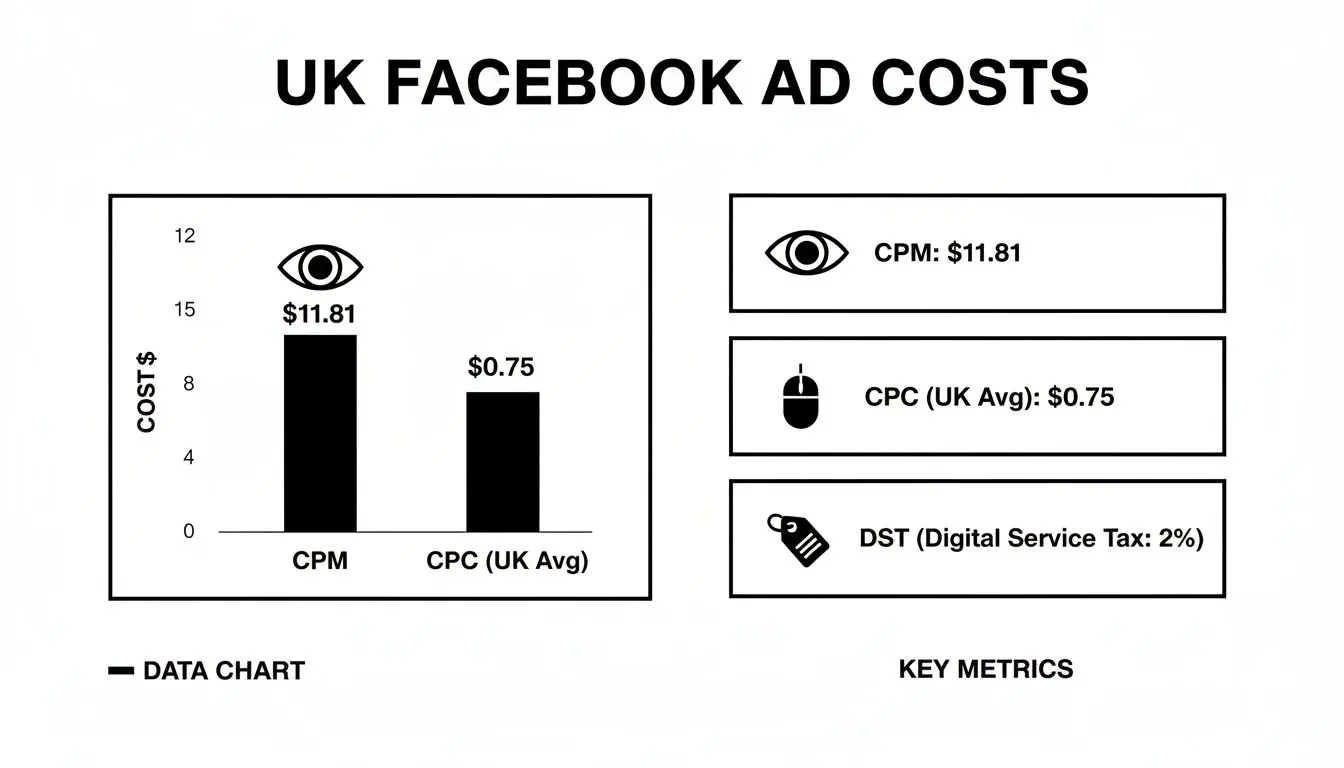
These numbers give you a feel for the average costs you might face, plus the extra Digital Services Tax that will affect your final spend.
UK Benchmarks for 2026
For anyone advertising in the UK, it’s crucial to know the local landscape. The average Cost Per Mille (CPM) , that's the price for 1,000 sets of eyeballs on your ad , is predicted to be between $10.85 and $11.81 in 2026. This high level of competition makes the UK a more expensive market to play in. On top of that, you'll need to budget for the 2% Digital Services Tax (DST) surcharge, which gets added to UK ad spends. It's a small but important detail to factor in.
Remember: These are just averages. Your actual costs will be unique to your campaign's specifics, such as your audience, industry, and the quality of your ad creative.
For a deeper dive into the different factors that can sway your Facebook ad spend, you might find a practical guide to Facebook ad costs to be a useful resource. A well-thought-out campaign is absolutely vital for maximising your return. At the end of the day, you can't control the auction itself, but you can certainly influence the result. By focusing on the things you _can_ manage, like brilliant creative and sharp targeting, you can make your budget work much harder. A little extra investment in quality creative can lead to some big savings on your media spend.
Winning the Facebook Ad Auction
If you want to understand "how much is an ad on Facebook", you need to forget about simple price lists. Meta’s advertising system isn’t about who has the deepest pockets. Instead, it’s a fast-paced, real-time auction that decides which ad gets shown based on its total Total Value. This setup is great for users because it ensures their feeds are filled with content that’s actually relevant and interesting, not just ads from the highest bidder. It stops feeds from getting clogged up with big-budget, low-quality junk. Think of it like a TV talent show. The winner isn't just the contestant who paid the most to get on stage. The real winner is the one who combines natural talent, audience appeal, and a bit of showmanship to put on a performance people remember. Your ad works the exact same way, it needs more than just a big bid to succeed.
The Three Pillars of Total Value
Meta uses three main ingredients to calculate an ad’s Total Value. If you can get a handle on these, you’ll start winning more auctions and bringing down your cost for each result. The goal is to make an ad that Meta _wants_ to show its users. The formula is surprisingly simple: [Advertiser Bid] x [Estimated Action Rates] + [Ad Quality] = Total Value Let's break down what each of those moving parts really means for your campaign.
- •Your Bid: This is what you’re willing to pay for your desired result, whether that’s a click, a lead, or a sale. It’s important, of course, but it’s just one piece of the puzzle. A massive bid can’t rescue a terrible ad.
- •Estimated Action Rates: This is Meta’s best guess at how likely someone is to take the action your campaign is built around. So, if you're running a campaign for website sales, it’s the probability someone will not only click but actually complete a purchase.
- •Ad Quality: This is all about how relevant and engaging your ad is. It’s measured by feedback from users who see or hide your ad, plus assessments for things the algorithm dislikes, such as clickbait, engagement-baiting, or overly sensational language.
Why Creativity Is Your Competitive Edge
This formula is precisely why putting your budget into high-quality, creative assets is a non-negotiable. A genuinely compelling animated video or a striking graphic will naturally get more likes, comments, and shares. That positive engagement directly boosts both your Ad Quality and your Estimated Action Rates.
A lower bid paired with a highly relevant, engaging ad can consistently outperform a higher bid with a boring one. The algorithm rewards content that improves the user experience.
This means that a stunning 2D or 3D animation isn’t just another production cost, it's a strategic investment that actively lowers your media spend. By focusing on the two parts of the equation you can actually control, action rates and ad quality, you make every penny of your budget work harder. Your creativity is what gives you the ultimate advantage.
Key Factors That Drive Your Ad Spend
Ever wonder why the price of a Facebook ad can feel so unpredictable? You can run two campaigns with the exact same budget and get wildly different results. Understanding what’s going on behind the scenes is the key to mastering your ad spend. The cost isn’t random; it’s a direct response to a handful of variables in the ad auction. Think of it a bit like booking a flight.The price is always shifting based on when you want to fly (seasonality), where you’re going (your audience), and which seat you pick (ad placement). Your Facebook ad costs work in a very similar way, reacting to five critical factors.
How Different Factors Impact Your Facebook Ad Costs
Before we dive into the details, it helps to see the big picture. This table shows how different choices you make can either lower or raise your campaign costs. Think of it as a quick cheat sheet for understanding the cost dynamics at play.
| Factor | Low Cost Scenario | High Cost Scenario |
|---|---|---|
| Audience | Broad, general interest group (e.g., 'UK adults who like gardening'). | Niche, high-value B2B audience (e.g., 'Finance Directors in London'). |
| Ad Quality | High engagement: lots of likes, comments, and shares. | Low engagement: users hide or report the ad. |
| Seasonality | Off-peak periods like a quiet Tuesday in February. | Peak shopping seasons like Black Friday or Christmas. |
| Placement | Less competitive spots like the Audience Network. | Prime real estate like the Instagram or Facebook Feed. |
| Objective | Low-commitment goals like Brand Awareness or Video Views. | High-value goals like Conversions or Lead Generation. |
As you can see, every decision has a knock-on effect. Now, let’s unpack what each of these really means for your budget.
Your Audience Targeting
The first, and arguably most important, factor is who you’re trying to reach. The more specific and in-demand your audience is, the more you'll have to pay to get their attention. It's a classic case of supply and demand; when tons of advertisers are all fighting for the same small, valuable group of people, the price naturally goes up. For instance, a campaign targeting a massive audience like 'UK adults interested in gaming' will likely have a pretty low Cost Per Mille (CPM). There are millions of these users, so the competition is spread thin. But if you narrow your focus to a tiny B2B niche like 'XR developers in Manchester', you're now competing for a much smaller, highly sought-after group. The cost to reach them will be substantially higher because their attention is just more valuable to specialised businesses.
Ad Quality and Relevance Score
Meta wants its users to have a good experience, and it rewards advertisers who help make that happen. The platform measures this with what it calls a "relevance score," which is basically a rating of your ad's quality and how much people are engaging with it. An ad that gets positive feedback, likes, shares, comments, is seen as high-quality. On the other hand, if people are hiding your ad or, even worse, reporting it, your quality score will tank. When that happens, Meta will charge you more to show your ad to people. This means a high-quality, genuinely engaging ad creative is one of your best weapons for lowering costs. It signals to the algorithm that your ad is a welcome part of a user's feed, not an annoying interruption.
Beyond optimising your bids and targeting, the effectiveness of your landing page and sales funnel significantly influences your ad costs. A higher conversion rate means you get more value for your ad dollar, so learning how to actively improve your e-commerce conversion rate is a crucial step.
Seasonality and Competition
The time of year has a huge effect on ad prices. During peak shopping seasons like Black Friday, Cyber Monday, or the big run-up to Christmas, competition goes through the roof. Millions of businesses are all bidding to reach shoppers, and that intense competition drives auction prices up for everyone. By contrast, running a campaign on a quiet Tuesday in February will almost always be cheaper. If you’re aware of these seasonal trends, you can budget much more effectively. You can either allocate more spend to stay competitive during those busy periods or plan campaigns for quieter months to maximise your reach for less money.
Ad Placements
Where your ad actually shows up on Meta's network also plays a big part in its cost. There are dozens of possible placements, from the Facebook Feed and Instagram Stories to Reels, Messenger, and the Audience Network. Unsurprisingly, some of these spots are far more competitive, and expensive, than others.
- •Higher Cost Placements: The Instagram and Facebook Feeds are prime real estate. Users spend most of their time scrolling here, so the competition to get a spot is fierce, and the price reflects that.
- •Lower Cost Placements: Placements like the Audience Network or the old right-hand column on Facebook are often cheaper. The trade-off is that they might also have lower engagement rates.
Your Campaign Objective
Finally, what you’re asking a user to do will directly affect your costs. A campaign optimised for something like 'Brand Awareness' or 'Video Views' is generally cheaper because these are low-commitment actions. You’re essentially just paying for eyeballs. However, a campaign optimised for high-value actions like 'Conversions' or 'Lead Generation' will cost more. Here, you're asking users to do something significant, like make a purchase or fill out a detailed form. For example, the average cost per action (CPA) for a technology company can be as high as £40-£50, simply because a single conversion is worth so much more than a single view.
Budgeting Scenarios for UK Businesses
Okay, so we've covered the theory. But what do these numbers actually look like in the real world? It's one thing to know the averages, but figuring out "how much is an ad on Facebook?" for _your_ specific business means looking at some practical examples. Here are three common scenarios for UK businesses. Think of these as a starting point you can build on , the goal is always to start with a test budget you're comfortable with, see what the data tells you, and then scale up.
Scenario 1: The Local Shop
Imagine a small, independent bookshop in Bristol that wants to get more people through the door and become a well-known local spot. They’re targeting people who live within a 10-mile radius and are interested in reading, literature, and local events.
- •Suggested Daily Budget: £15 - £25
- •Monthly Spend: Approximately £450 - £750
- •Primary Objective: Reach or Store Traffic. The aim here is to get their ads in front of as many local people as possible or to prompt them to get directions on their phone.
- •Estimated Results: With this kind of budget, the bookshop can realistically reach thousands of unique locals multiple times a week. The focus isn't on tracking direct online sales but on building a community presence, promoting in-store author events, and becoming a familiar name in the neighbourhood.
Scenario 2: The Growing E-commerce Brand
Let's picture a UK-based online shop selling sustainable fashion. They want to drive sales from environmentally-conscious millennials and Gen Z shoppers all over the country.
- •Suggested Daily Budget: £100
- •Monthly Spend: Approximately £3,000
- •Primary Objective: Conversions (Sales). The whole campaign is geared towards finding users who are most likely to click 'buy now'.
- •Estimated Results: A £100 daily budget is a fantastic starting point for gathering crucial sales data. Based on UK retail averages, a Cost Per Click (CPC) might hover around £0.70, and a Cost Per Acquisition (CPA) could land near £21.47. This means their budget could start generating roughly 4-5 sales per day once the campaign finds its feet.
Key Insight: For any e-commerce business, the first phase is all about collecting data. This budget gives you enough room to A/B test different ad creatives and audience groups. You can quickly find out what drives the most profitable sales, which will help you bring down that CPA over time.
Scenario 3: The B2B Service Company
A Manchester-based software company is launching a new project management tool. Their mission is to generate high-quality leads from marketing and operations managers in the UK's tech sector.
- •Suggested Daily Budget: £65 - £70
- •Monthly Spend: Approximately £2,000
- •Primary Objective: Lead Generation. The goal is to persuade decision-makers to sign up for a product demo or download an in-depth whitepaper.
- •Estimated Results: The B2B audience is much more niche and, as a result, more expensive to reach. The average Cost Per Action (CPA) for a B2B lead can be around £23.77. With a £2,000 monthly budget, the company could realistically aim to generate around 84 high-quality leads each month. Since each of those leads represents a significant potential return, the higher initial cost is often well worth it.
For businesses in this space, our guide to mobile app promotion offers even more strategies for reaching professional audiences.
Creative Production vs Media Spend
When businesses ask, "how much is an ad on Facebook?", they almost always focus on just one number: the media spend. That’s the budget you pay directly to Meta for your ad placements. But there's another cost that's just as vital, and it’s the one many advertisers miss: creative production. This is what you invest in designing and building the ad itself. It could be a simple graphic, a live-action video, or a stunning 2D or 3D animation. It's a detail that often gets overlooked, but it's one of the most powerful levers you can pull to manage your total advertising cost.
How Better Creative Lowers Your Media Spend
Think of it this way: your media spend is the fuel for your campaign, but your creative is the engine. A powerful, finely-tuned engine simply doesn't need as much fuel to cover the same distance. In exactly the same way, brilliant creative makes your media budget work harder, directly pushing down your CPC and CPM. This all comes back to how the Facebook ad auction works. As we’ve covered, the auction doesn't just hand the prize to the highest bidder; it rewards the ad with the highest Total Value. A massive part of that value is determined by your ad quality and the platform's estimated action rates, both of which are hugely influenced by your creative. A genuinely compelling animation or a visually striking video will naturally earn more engagement from users. That positive feedback sends a clear signal to Meta's algorithm that your ad is high-quality, which in turn boosts its relevance score.
By investing in professional creative, you are directly tipping the scales of the ad auction in your favour. The algorithm is built to reward content that gives users a good experience, allowing you to win more ad placements at a much more efficient price.
An Investment, Not an Expense
It's a common but costly mistake to see creative production as just another expense on the spreadsheet. The reality is that it's an investment that pays for itself over and over by cutting the cost of every single click and impression you buy. Here’s a breakdown of how that works in practice:
- •Higher Relevance Scores: Engaging creative generates better user feedback, which directly improves your ad's quality score.
- •Lower CPC/CPM: With a higher quality score, Meta charges you less to show your ad to your target audience.
- •Increased Engagement: Thumb-stopping content grabs attention in a crowded feed, leading to more shares, comments, and clicks.
- •Improved ROI: When your media spend becomes more efficient, your overall return on investment gets a dramatic lift.
At the end of the day, a cheap, poorly produced ad will cost you far more in wasted media spend than you ever "saved" on production. High-quality creative, including expertly crafted adverts with animation that drive real engagement, isn't a cost, it's a strategic tool for making your entire budget more effective.
Actionable Tips to Control Your Ad Costs
Knowing the theory behind Facebook ad costs is a great start, but getting your hands dirty and actively managing your spend is what really moves the needle. This is how you turn a campaign from a costly guess into a predictable profit engine. It’s about more than just setting a daily budget; it's about smart, continuous optimisation. So, are you ready to make every pound work harder for you? Here are some of the most effective strategies we use to drive down costs while pushing performance up.
Use the Meta Pixel and Conversion API
Before you even think about launching a campaign, your first job is to ensure the Meta Pixel is installed correctly on your website. Think of this little snippet of code as your campaign's brain. It watches what people do after clicking your ad and feeds that crucial intelligence back to Meta's algorithm. To get an even clearer picture, especially with all the new privacy updates, you need to set up the Conversion API (CAPI) as well. It works hand-in-hand with the Pixel, creating a direct server-to-server link that catches conversion data the browser might miss.
Better data leads to smarter ad delivery. When Meta knows exactly who is buying from you or signing up, it gets much better at finding more people just like them. This directly lowers your cost per result.
A/B Test Your Creative and Copy
You should never assume you know what your audience wants to see. A/B testing, where you run slight variations of an ad against each other, is absolutely non-negotiable if you want to control your costs. The trick is to test just one thing at a time so you know exactly what made the difference. Here are a few simple tests to start with:
- •Test your hook: Use the same ad creative but change the first three seconds of the video or the first line of text. See which one stops the scroll.
- •Test your headline: Keep the image or video the same but try two completely different headlines. One could focus on a benefit, while the other creates a sense of urgency.
- •Test your call to action: Does "Shop Now" work better than "Learn More"? The only way to know for sure is to test it.
Even a basic test can show you a clear winner in just a few days. Once you find it, you can put your full budget behind the best-performing ad and watch your cost-per-result drop.
Build Custom and Lookalike Audiences
Some of the most powerful audiences you can target are the ones you've already earned. By tapping into data from your Meta Pixel, email lists, or app users, you can create Custom Audiences. These are warm audiences, people who already know your brand, which makes them far cheaper and easier to convert. Once you have a solid Custom Audience (like a list of past purchasers), you can take it a step further and create a Lookalike Audience. You’re essentially telling Meta: "Go find me more people who look and act just like my best customers." This is one of the most effective ways to find new, high-intent customers at scale, often for a fraction of the cost of broad, interest-based targeting.
Frequently Asked Questions
Now that we've walked through the mechanics of Facebook ad costs, you're probably wrestling with a few practical 'what-ifs'. Let's tackle some of the common questions we hear all the time to get you started on the right foot.
What Is a Good Starting Budget for Facebook Ads in the UK?
For a small, local business just testing the waters, a budget of £15-£25 per day is usually a solid starting point. This gives you enough spend to gather some initial data and see what resonates with your audience. If you're a national e-commerce brand or chasing B2B leads, you'll need a bit more firepower. We'd suggest starting in the £50-£100 per day range to give you a more robust foundation for testing different creative and scaling up what works. The golden rule is to start with a figure you’re comfortable learning with, then reinvest your profits as you see positive returns.
How Long Should I Run an Ad Before Deciding If It Works?
Patience is a virtue here. You really need to give any new campaign at least four to seven days before you even think about making big changes. This window gives the ad enough time to push through Meta's "learning phase," which is where the algorithm is working hard to figure out the best way to deliver your ad. During this initial week, try to focus on the overall trends rather than panicking over daily dips and spikes in performance.
Is CPC or CPM More Important to Track?
This one comes down entirely to what you're trying to achieve. There's no single right answer. If your main goal is brand awareness , just getting your name and message in front of as many relevant people as possible , then CPM (Cost Per 1,000 Impressions) is your north star. But, if you're trying to drive people to your website, then CPC (Cost Per Click) is the metric that truly matters. And for campaigns focused on sales or generating leads, both of those take a back seat to your Cost Per Acquisition (CPA). That's the real measure of success.
Ready to create high-quality, engaging ad creative that lowers your media spend? Get in touch today to discuss your next project.