A Complete Guide To Mobile App Promotion In The UK
A solid mobile app promotion plan starts long before you even think about hitting the 'publish' button on the app stores. It's all about laying the groundwork defining your audience, getting a feel for the competition, and setting crystal-clear goals. This early work is what separates a blockbuster launch from one that fizzles out.
Building Your Pre-Launch Promotion Strategy
A successful launch is never a matter of luck; it’s the direct result of careful, meticulous planning. The effort you invest before your app goes live sets the tone for its entire journey. Rushing this stage is like trying to build a house without a blueprint, a risky move that often leads to expensive mistakes and missed opportunities. A strong pre-launch strategy makes sure every single promotional activity, from designing ad creative to chatting with influencers, is pulling in the same direction. It’s about asking the tough questions right at the start. Who is this app actually for? What problem are you solving for them? And with a sea of other apps out there, why should they choose yours? Nailing these answers makes everything else fall into place.
Define Your Target Audience and Value Proposition
First things first, you need to know exactly who you're trying to reach. Broad labels like "millennials" or "small business owners" just won't cut it. You need to dig deeper and create detailed user personas that map out their demographics, online habits, frustrations, and what they're looking for in an app. Once you’ve got a clear picture of who you're talking to, you can shape a powerful Unique Value Proposition (UVP). This is a short, sharp statement that spells out the main benefit of your app and what makes it different from everything else on the market. Your UVP should instantly answer:
- •What does your app do?
- •Who is it for?
- •Why is it the better choice?
This statement becomes the DNA of your marketing. It keeps your messaging consistent and punchy, whether it's in an ad, a social media post, or your app store description.
Analyse the Competitive Landscape
You’re not launching your app into an empty stadium. The UK mobile app market is incredibly competitive, and knowing who you're up against is key to carving out your own space. Dive deep into a proper analysis of both your direct and indirect competitors. Scour their app store listings, read their user reviews (the good and the bad), check out their social media game, and see what their marketing looks like. This homework is where you'll find the gaps in the market. Maybe your rivals have clunky interfaces, are missing a crucial feature, or users are constantly complaining about their support. Their weaknesses are your openings. Learning how to make an app stand out in the UK market is all about using these insights to position your app as the obvious, better alternative.
Set Clear and Measurable Goals
You can't hit a target you can't see. Your pre-launch promotion needs clear objectives, or you'll have no idea if what you're doing is actually working. Set goals that are specific, measurable, achievable, relevant, and time-bound (SMART).
Forget vague ambitions like "get lots of downloads." A much stronger goal is: "Achieve 10,000 downloads in the first 30 days post-launch, keeping the Cost Per Install (CPI) under £1.50 and hitting a day-7 retention rate of 25%."
This level of precision gives your team clear targets and allows you to properly judge how well your promotional campaigns are performing. This flowchart breaks down the essential stages of building out your pre-launch strategy.
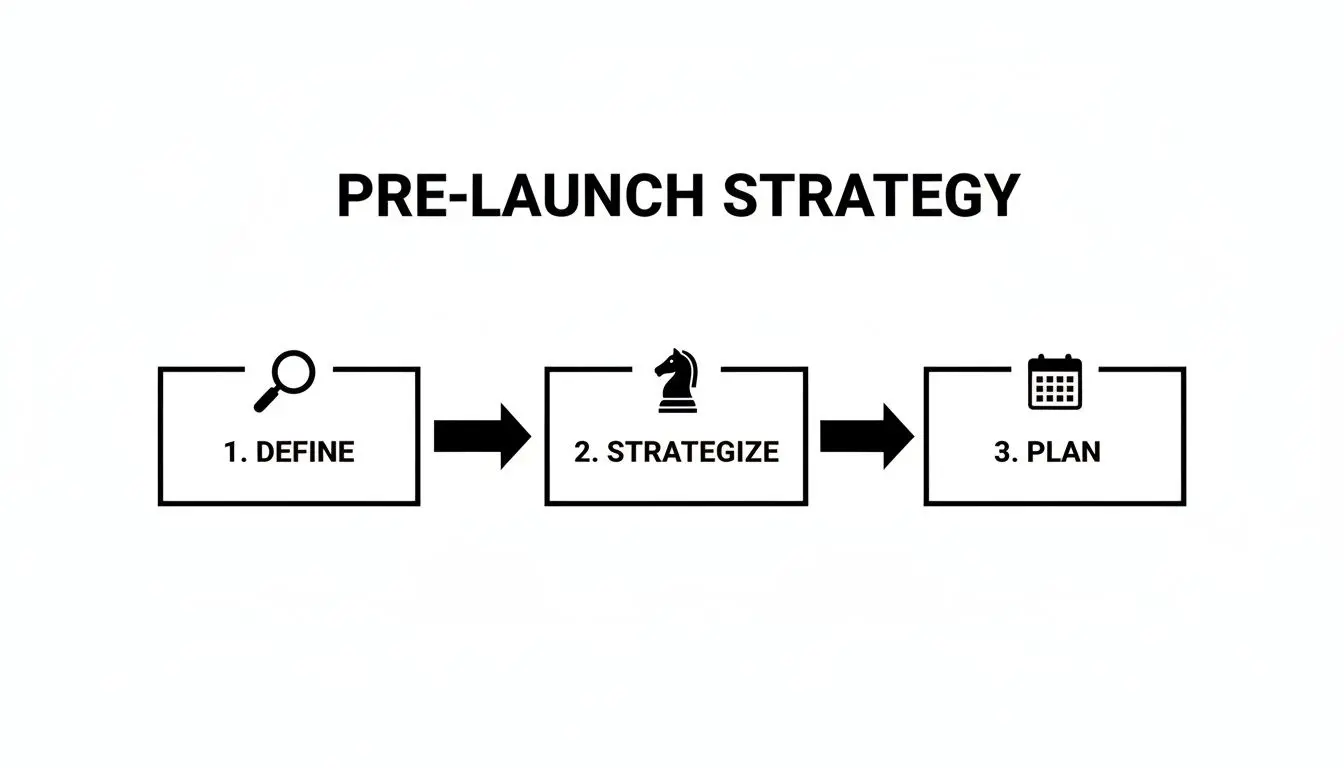
Following this Define, Strategise, Plan model ensures every marketing move you make is backed by solid research and clear-cut objectives. To help you get organised, here’s a quick look at the kinds of activities you should be thinking about before launch.
Essential Pre-Launch Promotional Activities
This table outlines the critical promotional activities to undertake before your app is live. Each task is designed to build momentum and ensure you're ready to make an impact from day one.
| Activity | Objective | Key Metrics |
|---|---|---|
| Market Research | Understand target audience, competitors, and identify market gaps. | User persona accuracy, competitor feature matrix, TAM/SAM. |
| Website & Landing Page | Create a hub for pre-launch buzz and email sign-ups. | Email subscribers, conversion rate, bounce rate. |
| Content Marketing | Build authority and organic interest with blog posts, videos, and social media content. | Website traffic, social engagement, shares, keyword ranks. |
| PR & Influencer Outreach | Secure early media coverage and endorsements to build credibility. | Media mentions, influencer posts, pre-launch sign-ups. |
| App Store Optimisation | Prepare keywords, descriptions, and visuals for maximum store visibility. | Keyword rankings (forecasted), screenshot appeal. |
By systematically working through these activities, you create a coordinated campaign that covers all your bases, from building an initial email list to having your app store page perfectly optimised for discovery. The potential here is enormous. The UK's mobile application market was valued at USD 13,930.12 million and is on track to explode to USD 63,854.23 million by 2035. This incredible growth is driven by the fact that nearly everyone has a smartphone, with people spending 4 to 5 hours a day on their devices. A smart plan is your ticket to getting a piece of that action.
Optimising Your App Store Presence
Your app store page is your digital shop window. Simple as that. For most people, it's the first and only chance you get to convince them to tap 'download'. Get it wrong, and they'll scroll right past, no matter how brilliant your app actually is. This is where App Store Optimisation (ASO) becomes your most powerful tool. Think of it as a continuous process of tweaking your app's visibility inside the app stores to drive more organic downloads. It’s all about figuring out what your target audience is searching for and positioning your app as the perfect answer.
Mastering ASO Fundamentals
You can think of ASO as SEO, but specifically for the Apple App Store and Google Play Store. To really get a grip on this, mastering content optimization for ranking is non-negotiable. It’s a strategic mix of smart keyword research and eye-catching creative assets. Your app's title, subtitle, and keyword fields are prime real estate. The first job is to research the terms your UK audience actually uses. You're looking for that sweet spot between high-traffic keywords and less competitive, long-tail phrases that show someone knows exactly what they want. Here are the key bits of text to nail:
- •App Title: Needs your brand name and your absolute most important keyword.
- •Subtitle (iOS) / Short Description (Android): A punchy, benefit-led summary.
- •Keyword Field (iOS): A comma-separated list of all your relevant keywords.
- •Full Description: This is where you can go into detail on features and benefits, weaving in your secondary keywords naturally.
Don't forget to localise for the UK market. That means considering regional slang, spelling (like 'organise' not 'organize'), and any cultural quirks.
Designing Creative Assets That Convert
Keywords get people to your page, but your visuals are what seals the deal. Your app icon, screenshots, and preview video need to tell a cohesive story and show off your app's value in just a few seconds. The icon is the very first thing people see. It must be simple, memorable, and recognisable even when it's tiny. A good rule of thumb is to avoid text and focus on a bold, clean design that screams your brand's identity.
A study found that apps with strong, well-designed icons can see up to 560% more downloads. It’s not just a logo; it’s a powerful conversion tool.
Screenshots should be much more than just static grabs of your UI. Use them to shout about key features and benefits, adding short, punchy captions that explain the value. The best screenshots walk a user through a mini-story, showing them exactly what they can achieve with your app. For a deeper dive, check out our complete guide to successful app store optimisation.
Creating High-Impact App Preview Videos
A well-made app preview video is probably the single most persuasive thing on your store page. It's your chance to show the app in action, using slick 2D or 3D animation to bring its features to life. A great animated trailer can massively boost conversion rates by showing, not just telling. For both the Apple App Store and Google Play, your video needs to be:
- Fast-Paced: Grab their attention in the first 3-5 seconds.
- Benefit-Focused: Don't just list features; show what users can accomplish.
- Visually Engaging: Use top-quality animation, motion graphics, and a clear call-to-action.
- Optimised for Sound-Off: Most people watch on mute, so use on-screen text to tell the story.
Acquiring Users Through Paid And Organic Channels
So, your app is officially live in the stores. Congratulations! Now the real work begins. Your focus has to pivot sharply from development to user acquisition, the relentless effort of attracting a steady stream of high-quality users who will actually stick around. The key to long-term success isn't choosing between paid ads or organic growth. It’s about making them work in tandem. A balanced strategy uses the immediate punch of paid advertising to get things moving, while simultaneously laying the groundwork for sustainable, organic growth that builds trust and a loyal community.Driving Immediate Growth with Paid Advertising
Think of paid user acquisition as the accelerator. It’s hands-down the fastest way to get your app in front of a very specific audience and kick-start those initial downloads. The goal isn’t just to buy installs; it’s to acquire users whose lifetime value (LTV) eventually outweighs what you spent to get them. To do this effectively, you need to lean on scalable PPC advertising strategies. For apps targeting a UK audience, a few platforms are non-negotiable:- •Meta Ads (Facebook & Instagram): Still the king for granular targeting. Meta’s ability to drill down into deep demographic data and user interests is perfect for reaching niche audiences. Plus, their ad formats like video and carousels are brilliant for showing off what your app can do.
- •Google App Campaigns: This is your all-in-one solution for hitting Google's entire network, Search, Google Play, YouTube, and the Display Network. You feed it the assets and tell it your goals (like installs or specific in-app actions), and Google’s machine learning handles the rest, optimising for performance.
- •TikTok Ads: If your app skews younger, you simply can't ignore TikTok. It’s a powerhouse for reaching a massive, highly engaged audience. The trick here is to create authentic, short-form video creative that feels native to a user’s “For You” page, not like a jarring ad.
Remember, your creative is the make-or-break element of any paid campaign. Engaging video ads, snappy animated explainers, and interactive playable ads almost always crush static images. They let you show, not just tell, your app's value in the few seconds you have to stop someone from scrolling.
Building a Sustainable Organic Engine
Paid ads give you that initial surge, but organic growth is what builds a truly resilient, long-lasting user base. These are the people who find your app through non-paid channels because they see it as genuinely useful or interesting. It’s a slower burn, for sure, but the users you gain this way are often far more loyal and engaged. The heart of any strong organic strategy is content marketing. By creating genuinely helpful content, you pull your target audience towards you and position your brand as a credible authority in your space. This is why we believe a strategic content plan is the engine of modern user acquisition , it turns your brand into a magnet for the right kind of users.
A well-executed organic strategy does more than just drive downloads; it builds a community. Users who find you through helpful content or a trusted recommendation are far more likely to become long-term advocates for your app.
Here are the channels that deliver real organic results:
- •Content Marketing (Blogging): Writing articles that solve real problems for your ideal users is a fantastic way to pull in traffic from search engines. Got a fitness app? Write about "Best Home Workouts for Beginners in the UK."
- •Social Media Marketing: This has to go beyond just posting app updates. Focus on creating shareable content like infographics, quick video tutorials, and user-generated content campaigns. Build a community, don't just broadcast to an audience.
- •Public Relations (PR) & Influencer Marketing: A single feature in a respected tech blog can send a massive wave of downloads your way. Likewise, partnering with UK-based influencers who genuinely align with your app's values can introduce you to their audience in a very authentic, trustworthy way.
So, how do these two very different approaches stack up against each other?
Comparing Paid vs Organic Acquisition Channels
Choosing where to invest your time and money can be tricky. Both paid and organic channels have distinct advantages depending on your goals, whether you need immediate results or are playing the long game. This table breaks down the core differences.
| Channel | Typical Speed to Results | Cost Model | Best For |
|---|---|---|---|
| Paid Social Ads | Immediate (24-48 hours) | CPC / CPI / CPA | Rapidly scaling downloads and reaching highly specific demographics. |
| Google App Campaigns | Fast (Days to a week) | CPI / CPA | Maximising reach across multiple platforms and optimising for installs. |
| Content Marketing/SEO | Slow (3-6+ months) | Time & Resource Investment | Building long-term authority, trust, and sustainable organic traffic. |
| Influencer Marketing | Varies (Days to weeks) | Flat Fee / Commission | Generating authentic social proof and reaching engaged, niche communities. |
Ultimately, the most successful app promotion strategies don't treat this as an either/or choice. They use paid channels to ignite growth and gather crucial data, which then informs and strengthens the slower, more sustainable efforts of the organic engine.
Keeping Your Users Engaged And Active
Getting someone to download your app is just the first chapter of the story. The real challenge, and where you'll find long-term success, is in keeping them coming back. A thoughtful user engagement and retention strategy is what separates a fleeting trend from a truly successful app.
This all comes down to simple economics: acquiring a new user can cost five times more than holding onto an existing one. By focusing on what happens after the install, you not only save money but also dramatically increase the lifetime value (LTV) of each person. Plus, loyal, active users are the ones who leave positive reviews and recommend your app to their friends. This creates a powerful, self-sustaining cycle of organic growth.
Crafting Push Notifications That Add Value
Push notifications are a direct line to your users, but you have to use that line with care. Bombarding people with irrelevant messages is the fastest way to get your app uninstalled. The key is to be helpful, not intrusive. The best notifications are timely, personal, and give the user something to do. They should feel less like an advert and more like a helpful nudge from a friend.
- •Personalised Alerts: Don't just send generic blasts. Use your data to send messages that actually matter to the individual. For a fitness app, this could be a "congratulations" for hitting a personal best.
- •Time-Sensitive Reminders: If someone left items in their shopping cart, a gentle reminder can be surprisingly effective. A travel app could alert a user that the price has dropped on a flight they were looking at.
- •Exclusive Content or Offers: Make people feel special. Send notifications about early access to new features or a limited-time discount that's just for them.
The goal is to provide genuine value with every single interaction, reinforcing how useful your app is in their day-to-day life.
Using In-App Messaging To Guide and Onboard
While push notifications bring users back to the app, in-app messages are your tool for guiding their experience once they're there. They're perfect for seamless onboarding, highlighting new features, or offering help without interrupting what the user is doing. Think of these messages as a friendly guide inside the app. When a user opens a complex feature for the first time, a small, unobtrusive pop-up can quickly explain how it works. This kind of proactive support prevents frustration and helps people discover the full value of your app.
A well-executed in-app messaging strategy can boost user engagement by up to 300%. By providing the right information at the right time, you empower users and encourage them to explore your app's capabilities more deeply.
This is also a fantastic way to prompt for reviews or feedback. After a user successfully completes a key action, like finishing a level in a game or making a purchase, a polite in-app message can ask them to rate their experience. The timing is everything.
Re-Engaging Lapsed Users With Email Marketing
Even the very best apps will see users drop off. People get busy, forget, or lose interest. This is where a targeted email marketing campaign can be incredibly effective at reminding them why they downloaded your app in the first place. Don't just email everyone. Segment your list to target users who haven't opened the app in 30, 60, or 90 days. Then you can craft a compelling "we miss you" campaign that highlights what they've been missing out on. Here are a few proven tactics for re-engagement emails:
- Showcase New Features: Detail the exciting updates and improvements you've made since they were last active.
- Offer a Special Incentive: A discount or an exclusive piece of content can be a powerful motivator to get them to log back in.
- Remind Them of Value: Use their past activity to jog their memory. Remind them of the progress they made or content they saved.
Measuring Performance and Optimising for Growth
Launching your app is just the starting line. A successful promotion strategy isn’t a “set it and forget it” affair; it’s a living, breathing process that needs constant attention and adjustment to actually work. If you’re not obsessed with the data, you’re just guessing. You need to get into the habit of continuously measuring performance. This is the only way to make smart, evidence-backed decisions that stop you from burning cash and start driving real growth. This is all about turning raw numbers into actionable insights. It means forgetting about vanity metrics like total downloads and focusing on the numbers that really define your app's health.Identifying Your Core Key Performance Indicators
To get a clear picture of what's going on, you need to track a handful of crucial Key Performance Indicators (KPIs). These are the numbers that tell you if you're acquiring the right kind of users and if your app is genuinely delivering on its promise. Your core KPIs should always include:- •Cost Per Install (CPI): This is simply what you pay, on average, to get one new user from a specific campaign. Tracking this tells you how efficient your ad spend is.
- •User Lifetime Value (LTV): This metric predicts the total revenue you'll make from a single user over their entire time with your app. This is the big one.
- •Retention Rate: What percentage of users come back to your app after their first visit? High retention is a fantastic sign that your app is valuable and sticky.
- •Churn Rate: The opposite of retention. This tracks how many users ditch your app over a set period. A high churn rate is a massive red flag that something is broken.
Your number one goal is to make sure your LTV is significantly higher than your CPI. When you nail that, you’ve got a sustainable business.
Think of it like this: CPI is your initial investment in a user, while LTV is your long-term return. A healthy app business is one where the return consistently outweighs the investment, creating a profitable cycle of growth.
The Power of A/B Testing and Iteration
Once you’re tracking the right metrics, you can start making them better. The single most effective way to do this is through rigorous A/B testing, sometimes called split testing. The concept is simple: you create two versions of a single thing, an ad creative, a push notification, your app store description, and show them to different groups of your audience to see which one performs better. You can, and absolutely should, A/B test almost everything:
- •App Store Assets: Test different icons, screenshots, and preview videos. Which combination gets you the most downloads?
- •Ad Creatives: Pit different ad copy, visuals, and calls-to-action against each other to drive down your CPI.
- •In-App Messaging: Experiment with different wording and timing for onboarding messages or special offers to see what improves engagement.
This process of measuring, learning from the data, and optimising is a continuous loop. Every test gives you a valuable lesson that refines your strategy and makes sure every penny of your marketing budget is working as hard as possible. The UK mobile app market is a seriously lucrative space, with revenues projected to hit USD 32,860.0 million by 2030. To grab a piece of that pie, especially with the Apple Store holding a dominant revenue share and the Google Store growing fastest, a data-driven approach isn't just an option, it’s essential. You can discover more insights about the UK's mobile app market growth on Grand View Research.
Your Top Mobile App Promotion Questions Answered
Even with a killer promotion plan, you're bound to hit a few bumps in the road. As we work with app developers and marketers across the UK, the same questions and challenges seem to pop up again and again. Getting solid, practical answers to these common hurdles can be the difference between a campaign that fizzles out and one that finds real, lasting success. So, let's tackle the big questions head-on. We'll get straight to the point on budgeting, figuring out which metrics actually matter, setting realistic timelines for your optimisation, and making that crucial call on whether to launch on iOS or Android first in the uniquely balanced UK market.
How Much Should I Budget for Mobile App Promotion in the UK?
There's no single magic number here, as every app is different. A classic rule of thumb is to set aside a marketing budget for your first year that’s roughly equal to what you spent on development. But a far better way to approach it is to work backwards from your user acquisition goals. First, figure out your target Cost Per Install (CPI). Once you have that, multiply it by the number of users you want to bring in. This gives you a data-backed starting point. For a UK launch, we often see initial test budgets landing somewhere between £5,000 and £25,000. This first phase is all about gathering data and seeing what resonates before you pour serious money into a full-scale campaign.
Key Takeaway: Don't think of your budget as one big pot of money. It’s much smarter to split it across different stages: pre-launch activities to generate buzz, a powerful burst campaign for launch day, and then a steady, ongoing budget for continuous user acquisition and re-engagement.
This phased approach helps you build momentum from day one and, more importantly, keep it going.
What Is the Most Important Metric to Track for App Success?
It’s incredibly tempting to get fixated on total downloads, but honestly, that’s mostly a vanity metric. If you want to know if your app is truly healthy and has a future, you need to laser-focus on two things: your user retention rate and its Lifetime Value (LTV). Retention tells you if your app is actually delivering on its promise and giving people a reason to come back. LTV, on the other hand, is the pounds-and-pence figure of how much revenue a user will generate throughout their entire relationship with your app. Ultimately, your entire promotional effort should be geared towards one simple equation: making sure your LTV is comfortably higher than your Customer Acquisition Cost (CAC). Get that right, and you’ve got a profitable, sustainable business. Chasing these two metrics ensures you’re not just getting any users, but the right users who will stick around and contribute to your growth.
How Long Does App Store Optimisation Take to Show Results?
App Store Optimisation (ASO) is a marathon, not a sprint. It’s a long-game strategy that demands patience and consistent work, not a quick fix you can set and forget. You might spot some small, encouraging upticks in your keyword rankings or general visibility within a couple of weeks of updating metadata like your app title, subtitle, or keyword list. However, to see significant, stable improvements in your organic downloads, you’re realistically looking at two to three months of continuous, dedicated effort. This isn't just about tweaking text. It's a holistic process that involves:
- •Regularly refining your written descriptions.
- •Refreshing your creative assets, like screenshots and preview videos.
- •Proactively encouraging positive user reviews and ratings.
- •Keeping a very close eye on what your competitors are up to.
The app store algorithms need time to recognise and reward these positive changes, which is why consistent iteration is the name of the game.
Should I Focus on iOS or Android Promotion First in the UK?
The UK mobile market is fascinatingly balanced. iOS holds about 49.3% of the market share, with Android just ahead at 50.1%. Because it’s so evenly split, the dream scenario is to launch and promote on both platforms at the same time to capture the entire market. But we all live in the real world of limited resources. If you have to choose one to start, the decision boils down to your specific target audience and how your app makes money. Historically, iOS users have been more willing to open their wallets for in-app purchases and subscriptions. That makes it the default starting point for premium apps or those with a subscription model. On the flip side, Android has a slightly larger audience and offers a bit more flexibility for developers when it comes to submitting and updating the app. Before you decide, dive deep into your user personas, where do they really spend their time? Ready to create high-impact promotional videos that make your app stand out? Studio Liddell has been producing studio-quality 2D and 3D animation for global brands since 2019. Book a production scoping call to discuss how we can bring your app's story to life.