Photorealistic Animation: The Complete UK Production Guide
A producer is reviewing a director's animatic for a television advert. The product reveal looks convincing in motion, but the question is immediate: can the digital object pass for filmed footage when the deadline, broadcast specifications and client expectations all arrive at once? Photorealistic animation is 3D CGI designed to read as photography. The result depends on more than a detailed model. Physically based materials, believable light transport, accurate camera behaviour, natural motion, lens characteristics and careful compositing all have to agree. A single weak element can expose the image as synthetic. The distinction matters. Stylised 3D deliberately simplifies shape, colour or lighting. Motion graphics may prioritise typography, graphic rhythm and brand clarity. Photoreal work has a narrower tolerance. A reflection that sits at the wrong angle, a shadow with the wrong softness or a product surface without convincing micro-detail can undermine the entire shot. The UK has developed a specialist animation sector closely connected to CGI, VFX and 3D production. One sector profile estimated animation revenue at approximately £300 million, with about 4,700 highly skilled people, while the wider post-production and VFX economy was valued at approximately £1.4 billion. The sector profile helps explain why photorealistic animation supports not only animated features, but also live-action cinema, television, advertising and immersive media.

What Photorealistic Animation Really Means in Modern Production
The image must behave like a photograph
A convincing shot starts with reference, not software settings. The production team needs to understand the camera, lens, light source, surface response and movement the viewer expects. For a product, that may mean studying edge highlights, brushed metal, translucent plastic or fingerprints. For a character, it includes skin response, eye moisture, hair breakup and the way clothing settles during movement. A photoreal asset can still look wrong if the camera is treated as an afterthought. Depth of field, motion blur, exposure and perspective need to support the same visual logic as the surrounding plate or environment. If the object is perfectly sharp while the background carries a shallow-focus blur, the audience notices the mismatch even if the modelling is excellent.
Detail isn't the same as realism
More polygons won't rescue poor proportions. A high-resolution texture won't fix a material that reflects light incorrectly. Extra simulation won't make movement feel natural if the blocking has no sense of weight or intention. The strongest teams establish an approval target early. They agree what the hero asset should look like under the intended lighting, test that asset before building every shot, and identify the visual risks while changes are still inexpensive. Photorealism is a production discipline, not a finishing filter. The UK's technical base supports this approach. Modelling, rendering, compositing and digital character production have contributed to work across both original animation and the wider VFX economy, which is why a relatively small domestic animation sector can have influence beyond its own production volume. The practical route is to control the pipeline from reference and layout through to final QA, while treating AI, real-time tools and tax planning as production decisions rather than separate technology conversations.
The Seven-Stage Photorealistic Animation Pipeline
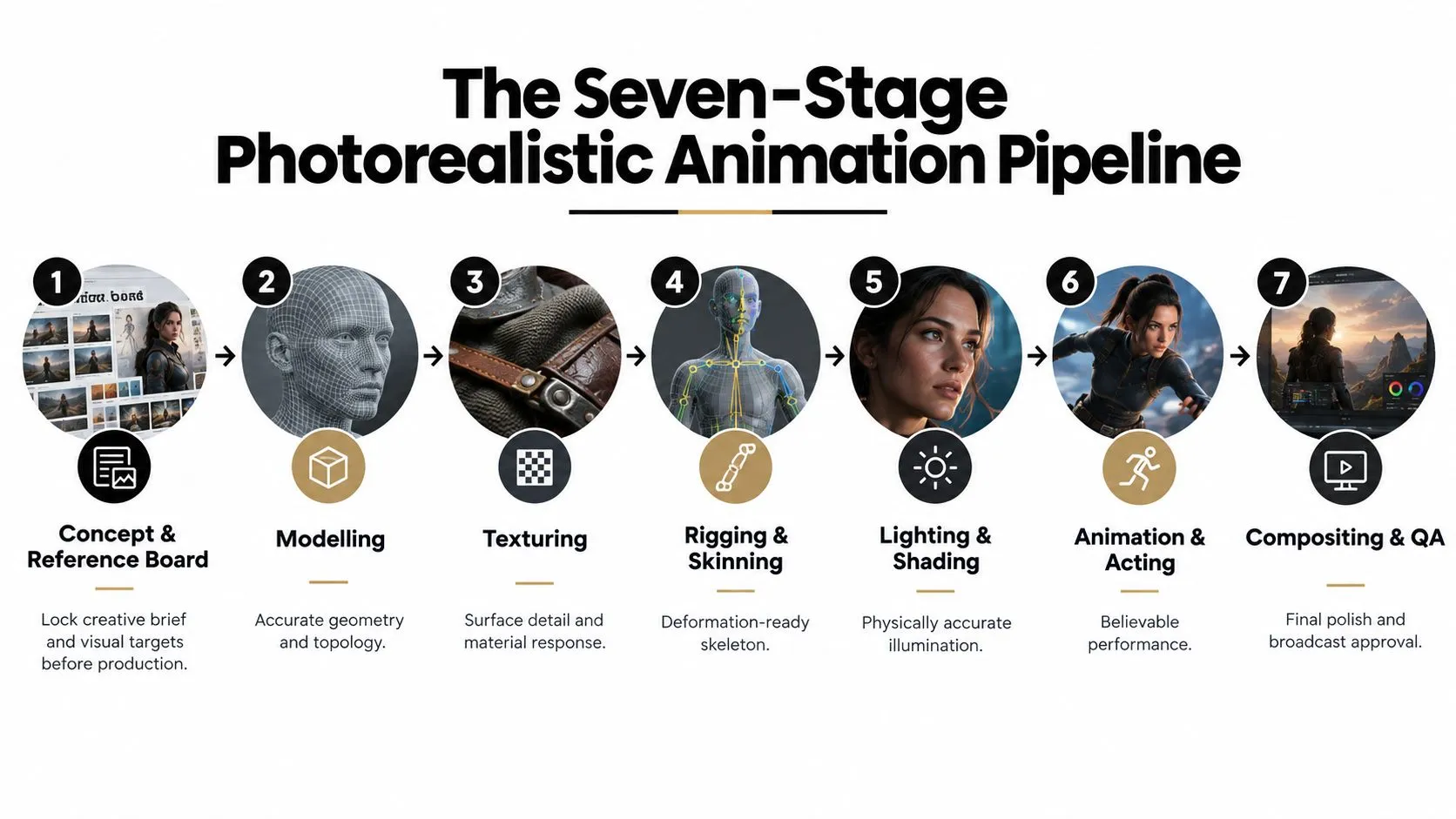
Photorealistic animation is built through linked decisions. Each stage delivers something specific, and each rushed decision creates a problem for the next department.
1. Modelling
Modelling delivers accurate geometry, proportions and topology. The common failure is rushing the mesh to reach a preview render, then discovering that the topology cannot support clean deformation, close-up shading or reliable asset reuse.
2. Texturing
Texturing establishes colour, roughness, displacement, normal detail and other surface information. Reference photography and scanned materials can help, but the artist still has to interpret scale and wear. Texture detail that is too large makes a surface look manufactured, while excessive uniformity makes it look artificial.
3. Shading
Shading translates texture information into a physically based material. The shader needs to respond predictably when the lighting changes. A product may have the right base colour and still fail because its roughness, clear coat, transmission or subsurface response is wrong.
4. Lighting
Lighting sets mood and connects the asset to its environment. Many “almost there” shots fail here. A model can be technically accurate, yet the highlights, shadow direction or bounce light can contradict the reference plate.
5. Motion
Motion includes layout, blocking, animation and simulation. It carries weight, timing and follow-through. Bad motion usually breaks the illusion faster than imperfect shading because the audience recognises unnatural acceleration and contact immediately.
6. Rendering
Rendering computes the image from the scene, camera and lighting decisions. Sampling, denoising, resolution, motion blur and render capacity affect both quality and cost. A clean test frame isn't proof that an entire sequence will render consistently.
7. Compositing
Compositing integrates CG with plates, grades, grain, atmosphere and optical effects. It's the final opportunity to align contrast, colour and depth, but it can't reliably repair a wrong model, light rig or performance.
Production rule: Approve the hero asset under representative lighting before multiplying it across shots. That decision protects modelling, look development and render time later.
In virtual production, the pipeline adds a live camera-tracking loop. A tracked camera records position, orientation and focus, while a real-time engine updates the 3D environment for compositing or on-set display. The UK case study involving Ravensbourne University London and Mo-Sys shows why calibration, lens profiling and tracking validation should operate as image-quality gates. The published virtual-production workflow connects tracking errors directly to spatial misalignment, perspective drift and inconsistent parallax.
Where AI Actually Helps a Photoreal Workflow
AI is useful when it removes repetitive work without taking responsibility for the visual decision. Denoising, upscale, inpainting cleanup, roto assistance, reference gathering and motion-capture cleanup can reduce manual effort. Look development can also benefit from faster exploratory passes, provided artists treat generated suggestions as starting points rather than approved design. The senior role remains substantial. An experienced artist still decides whether a surface matches the brief, whether a light feels physically plausible, whether a performance communicates the intended character and whether a technical shortcut will survive a full sequence. Client-facing judgement can't be delegated to a button.
AI Assistance Across the Photoreal Pipeline
| Pipeline stage | AI assistance level | Human still required for |
|---|---|---|
| Reference and concept | Useful for organising and exploring references | Creative direction, rights decisions and visual target approval |
| Modelling and texture preparation | Helpful for cleanup and variation | Proportion, topology, scale and material interpretation |
| Look development | Useful for rapid alternatives | Final shader, colour and art-direction decisions |
| Rotoscopy and compositing | Strong for repetitive preparation work | Edge quality, integration, grading and shot continuity |
| Motion capture cleanup | Helpful for removing noise and repetitive corrections | Acting choices, timing, contact and performance nuance |
| Rendering | Valuable for denoising and upscale | Sampling strategy, artefact review and final approval |
| Production management | Useful for search, tagging and task support | Priorities, staffing, client communication and risk ownership |
The workforce risk is not theoretical. Recent North West evidence reported that freelancers represent 77% of the region's animation workforce, while 42% feel less secure, 28% are considering leaving, and 42% report a negative impact from AI, compared with 11% reporting a positive impact. The North West animation survey findings point to a practical danger: reducing junior and repeat work too aggressively can weaken the experienced talent pool needed for difficult photoreal sequences. A sensible adoption plan protects senior judgement, gives mid-level artists structured training and keeps contingency capacity for delivery. RenderIO's 2026 automation guide is useful background for teams mapping repetitive content tasks before selecting automation. The same principle applies to AI animation software and production planning. AI should act as a force multiplier, not a reason to hollow out the pipeline.
UK Budgets, Timelines, and Tax Relief Reality
A defensible budget separates qualifying core expenditure from the total production cost. That distinction shapes finance planning, supplier discussions and the credit calculation. Blending creative development, admin and non-qualifying costs into one figure obscures the funding position. Keep animation labour, supporting production costs and excluded services visible from the first estimate. For animated productions, AVEC provides a 39% taxable credit on qualifying expenditure, compared with 34% for film and high-end television. The credit applies to qualifying expenditure incurred from 1 January 2024. New productions must use AVEC from 1 April 2025, while the previous film, high-end television, animation and children's television reliefs are scheduled to close for new claims from 1 April 2027, subject to the transition timetable set out in the government's AVEC reform guidance. Production finance teams should confirm which regime applies before committing spend.
A practical calculation
Government guidance states that AVEC can be claimed on up to 80% of qualifying core costs, with animated productions receiving the 39% rate. A production with £1,000,000 of qualifying core expenditure therefore has a maximum eligible base of £800,000, before applying the credit rate. At 39%, the potential taxable credit is £312,000, subject to the scheme's conditions and exclusions. The official creative industries tax-relief statistics guidance explains how the calculation works.
| Budget question | What the producer should identify |
|---|---|
| Core expenditure | Which labour and production costs directly support the qualifying work |
| UK activity | Whether the project meets the relevant UK production conditions |
| Animation proportion | Whether animation represents the required share of core costs |
| Evidence | Contracts, invoices, schedules, timesheets and production records |
| Transition position | Which relief regime applies to the production and its expenditure |
A qualifying programme must be certified as British by the British Film Institute, intended for broadcast, including online streaming, spend at least 51% of core costs on animation, and relate at least 10% of core costs to UK activities. HMRC's Animation Tax Relief guidance shows why the split between animation, live action and other work should be established during scoping rather than reconstructed after delivery. Build broadcast QA checks and approval time into the schedule, because late technical fixes can affect both labour and render capacity. Photoreal sequences have no universal price. Asset complexity, shot count, character performance, simulation, revisions, render strategy, delivery formats and specialist artist availability all change the estimate. Freelance availability can also affect contingency and schedule risk. Build the plan around approvals, reference capture and look development, then price the production work that follows. A UK CGI cost guide can support the initial discussion, but a reliable quote still needs a defined brief.
Where Photoreal Animation Earns Its Place
Photorealism earns its budget when the audience needs to trust what the image represents. It isn't automatically the right choice for every explainer or brand film. A graphic approach may communicate a process more clearly, and live action may be more efficient when the subject can be filmed without control or continuity problems.

High-end television and streaming advertising
Photorealistic animation is effective when a product needs to appear under controlled camera movement, lighting or environmental conditions. Accurate reflections, contact shadows and material response can deliver a premium product shot without the limitations of a physical location.
Product launches
For automotive, consumer technology, food packaging and industrial products, physically based materials do much of the persuasive work. Metal, glass, plastic, liquid and coated surfaces need to respond correctly as the camera moves. Stylised CGI may be preferable when the campaign wants abstraction, but it shouldn't be used to disguise unresolved product detail.
Architectural and property visualisation
Real-world lighting, surface scale and atmospheric depth help stakeholders understand a space before it exists. The value lies in decision-making clarity, not just visual spectacle. A lighter illustrative style can work for early massing or concept communication, while photorealism becomes more useful when materials, views and atmosphere affect approval.
XR and virtual production
Photoreal assets need to sit beside live-action footage or an LED environment without a visible seam. Camera tracking, lens metadata, colour management and parallax become as important as the asset itself. The UK's wider animation and VFX capacity supports this crossover between offline rendering, live-action production and immersive media, as documented in the sector profile cited earlier.
Corporate and technical films
A photoreal approach can justify itself when one asset must appear consistently across a long-form film, product demonstration, training sequence and interactive experience. Medical and technical communication also benefits from controlled visual accuracy, although subject-matter review remains essential.
The practical rule is simple. Photorealism pays back when the audience expects to touch, drive, operate or buy what they see.
Studio Liddell Case Study Highlights and Outcomes
A production case study must separate verified delivery facts from an illustrative workflow. The UK automotive launch scenario here describes a brand film that needs studio-grade car imagery when track filming cannot fit the schedule. The production problem extends beyond modelling. Camera language, paint response, reflections, environment and perceived speed all need to hold together under review.
Decisions that protect the image
Reference photography at a partner facility gives artists dependable material for paint, glass, tyres, trim and reflections. A USD-based asset pipeline supports controlled interchange between departments, while Houdini can handle procedural atmospherics, crowd elements and environmental effects when the brief requires them. See Studio Liddell's produced work for examples of CGI film and television delivery at this standard. Render strategy should follow shot risk. Internal rendering of final beauty passes can reveal reflection or shading inconsistencies before the sequence reaches final compositing. That review can prevent a late fix from spreading across multiple shots, making it more useful than just adding render capacity.
The change that tests the pipeline
A late livery change can affect texture maps, material separation, look development, reflections and compositing. In this illustrative workflow, the change is absorbed at the texture approval gate, where the updated livery is re-rendered through the affected shots. A comp-only fix would be quicker, but it would leave the underlying asset inconsistent for later versions and deliverables. The schedule holds only when the asset is modular, dependencies are documented and approvals happen at defined gates. That discipline also reduces risk when freelance artists join or leave a UK production during delivery. The broader UK market makes reusable infrastructure worthwhile. Written evidence submitted to Parliament described an animation base of approximately £1.7 billion, with more than 16,000 people working across over 800 primarily animation-focused companies and studios. The parliamentary evidence supports standardised naming, physically based materials, colour management, reusable rigs, version control and automated render validation.
What a responsible outcome statement looks like
A team can report delivery timing, QA status, tax-relief eligibility or audience research only when those records exist. Claims about passing broadcast QA early, completing an ATR submission or improving brand recall require production documentation and test evidence. Without that evidence, the transferable lesson is clear: pre-production reference and look development protect the schedule more reliably than adding render capacity at the end.
Best Practices and the Road Ahead for Photorealistic Work
The most reliable photoreal projects establish quality gates before the expensive stages begin.
A working checklist
- •Lock the visual target: Approve the creative brief, reference board and hero-asset direction before detailed modelling starts.
- •Test lighting early: Run a representative lighting and shading test on the hero asset, including the intended camera and display conditions.
- •Make look development a gate: Don't start full animation until materials, colour and lighting have an approved direction.
- •Validate topology: Check deformation, subdivision and close-up requirements before the asset enters production.
- •Plan dailies around people: Include freelance availability, review windows and clear feedback ownership in the schedule.
- •Test the final medium: Review the final composite on the target display or delivery environment, not only on an artist's workstation.
- •Validate every frame: Check picture, audio, metadata, naming and file integrity before delivery.
Broadcast work needs a mastering stage after lighting and compositing. The BBC specifies Linear PCM WAV audio at 48 kHz and 16-bit depth or greater by prior agreement, with programme levels aligned to EBU R128 integrated loudness at -23 LUFS. The BBC technical specification makes the operational point clear: a rendered picture isn't a finished programme. The next 12 to 24 months are likely to bring more overlap between real-time engines and offline rendering, wider use of AI denoising and upscale in compositing, and more automated broadcast checks. Those developments should be judged by repeatability, artefact rates, review quality and workforce resilience, not by demonstrations on a single hero frame. Some capabilities already fit production well, especially repetitive cleanup, denoising and structured asset search. Other promises still depend on difficult scene continuity, nuanced performance and reliable client approval. The producer's job is to separate a useful production control from a tool demo, then keep the human decision-maker in the loop. --- Studio Liddell offers 3D and 2D animation, CGI film and television production, virtual-production shots, games and XR experiences, with AI-assisted efficiencies used where they support the established pipeline. Visit Studio Liddell to discuss your reference requirements, delivery specifications and photoreal production risks with a team that can scope the work from brief through final QA.