How Much Does CGI Cost in 2026: Real UK Price Ranges
A UK CGI project in 2026 typically lands between £1,500 and £20,000+ per finished minute, depending on category. Per-minute figures are a starting point, not a quote. That range sounds unhelpfully broad until you compare what's being produced. A text-led motion graphics explainer, a photoreal product advert, an architectural flythrough and an entertainment-grade VFX sequence may all last 60 seconds, but they don't demand the same modelling, animation, lighting, simulation, compositing or approval process. The practical question isn't only “how much does CGI cost?” It's what kind of CGI are you buying, what assets already exist, and where will the final work be used? This guide separates standalone CGI from CGI embedded in a wider production, then applies that distinction across four useful categories: motion graphics, 3D advertising, architectural visualisation, and entertainment or VFX.
What CGI Actually Costs in the UK Right Now
A UK CGI project in 2026 typically sits between £1,500 and £20,000+ per finished minute, depending on the category. A short-form social cutdown, a hero brand film and an immersive XR experience follow different cost logic, so runtime alone won't produce a reliable quote. UK animated video pricing gives a useful starting point. Motion graphics can cost £1,500 to £5,000 per finished minute, while 3D animation starts around £8,000 per finished minute and can exceed £20,000 for complex product visualisations, with the latter generally taking 8 to 16 weeks. These figures are published by a UK animated video production pricing guide, but they're still starting points rather than fixed studio rates. A 60-second piece could therefore cost around £2,000 or £120,000, depending on whether it uses simple graphic design, reusable assets, bespoke photorealism, character work, live-action integration or interactive development. That isn't a contradiction. It reflects the number of production decisions hidden behind the word “CGI”.
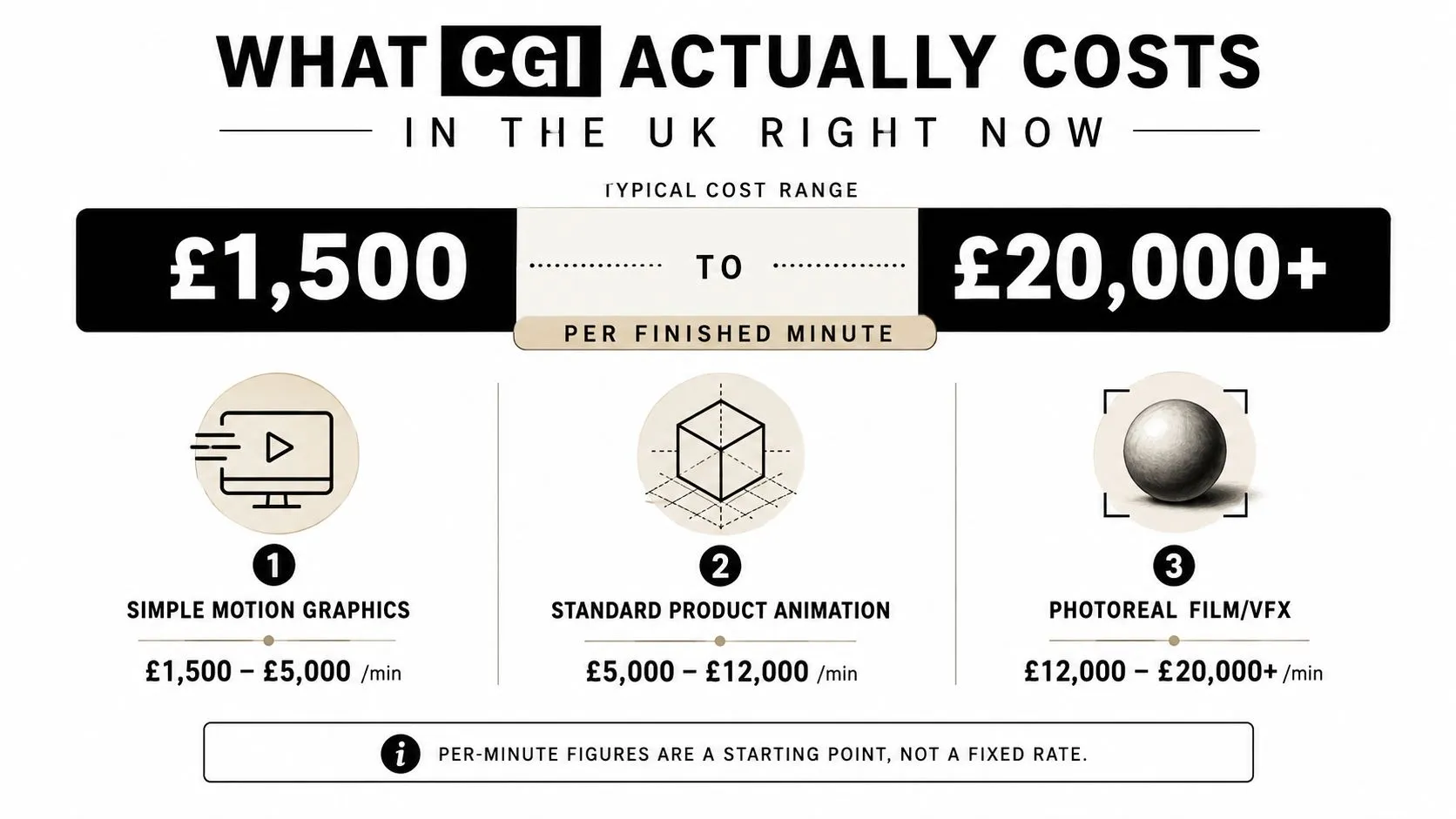
The four pricing buckets
Motion graphics usually relies on graphic systems, typography, designed transitions and controlled asset libraries. 3D advertising places more weight on modelling, materials, camera work and polished lighting. Architectural visualisation depends on accurate spaces, finishes, furniture, camera paths and often still-image deliverables. Entertainment and VFX can add character performance, crowd work, simulations, matchmove and integration with live action. The quote should be built from the brief, deliverables and turnaround. A useful introduction to the production terminology is this complete guide to CGI animation. It helps buyers distinguish a finished image or animation from the pipeline required to create it.
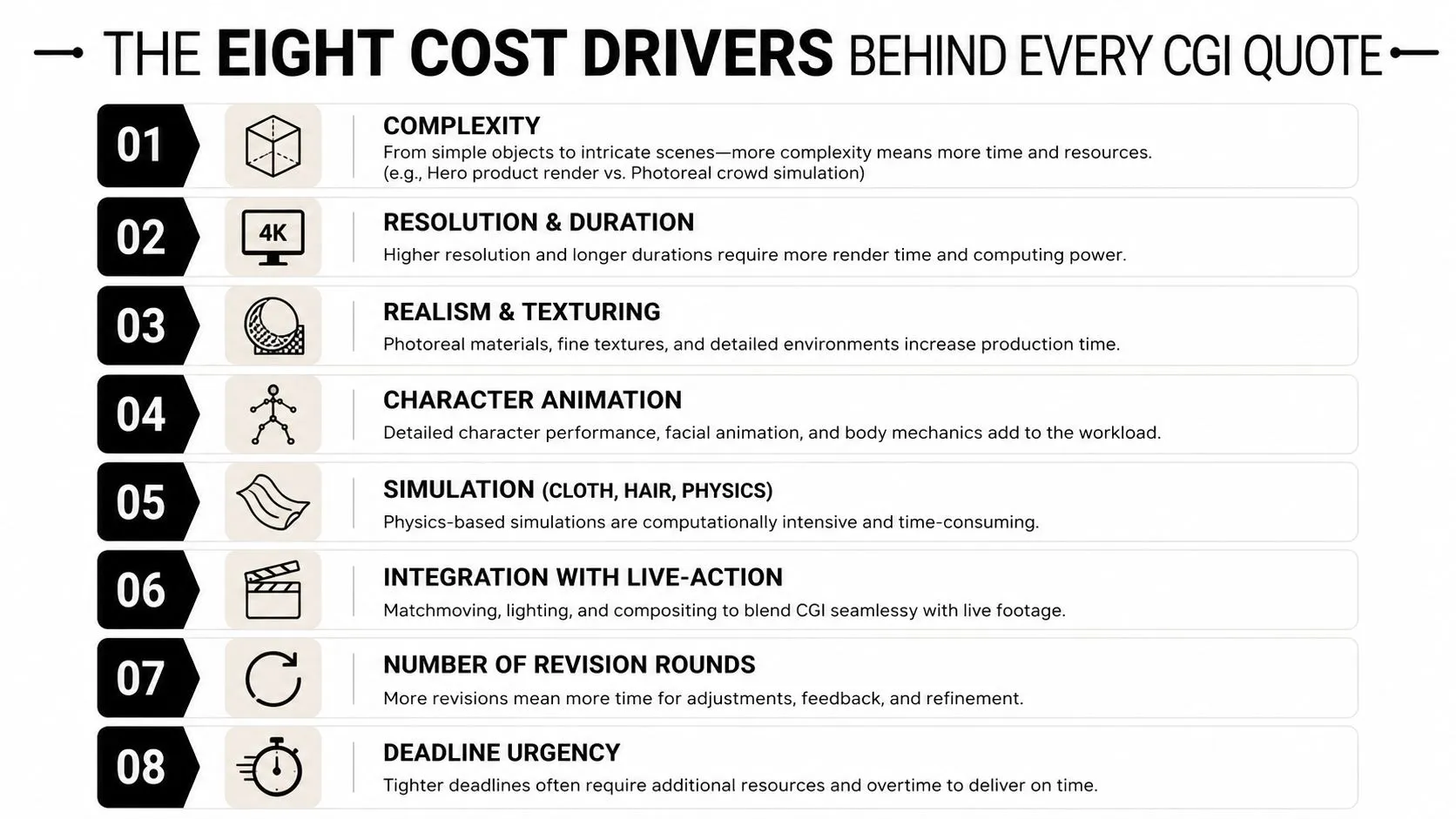
The Eight Cost Drivers Behind Every CGI Quote
A good CGI quote is a model of labour, risk and deliverables. The eight drivers below are the levers that move the number.
Complexity
A single hero product on a controlled background is a contained task. A photoreal crowd simulation requires substantially more work across animation, behaviour, lighting and rendering. The more independent elements a shot contains, the more departments need to coordinate.
Resolution and duration
A longer film creates more frames, but resolution also affects render and review requirements. A 10-second hero shot can demand more work than a longer graphic sequence if every frame contains detailed reflections, transparent materials or moving parts.
Realism and texturing
A clean stylised look can use deliberate simplification. Photoreal work requires careful surfaces, imperfections, reflections, light response and camera treatment. A product model that looks acceptable in a viewport may need extensive material development before it survives a final close-up.
Character animation
Characters introduce rigs, posing, weight, timing and performance review. Facial animation adds another layer, particularly when dialogue, lip sync or emotional nuance matters.
Simulation
Cloth, hair, fluids, smoke and physics are not just visual effects added at the end. Artists need to test, cache, revise and render them. A fabric movement that looks simple on screen can be expensive when it must behave consistently across multiple shots.
Integration with live action
Matchmove, camera tracking, rotoscoping, clean-up, set extensions and compositing create separate workstreams. They also make the quality of the original plates, camera data and production reference important.
Revision rounds
A quote with a defined approval process is safer than an open-ended promise to “keep refining”. Changes after the animatic or layout stage can force downstream work to be repeated, especially when the client changes the camera, product design or script.
Deadline urgency
A compressed schedule can require parallel staffing, faster review decisions and less flexibility in render planning. The cost isn't only overtime. Rush work can prevent a studio from allocating the same team to other booked work.
Practical rule: approve the story and camera direction before investing heavily in final modelling, materials and render polish.
AI tools can accelerate previs, reference exploration or some texture tasks, but they don't automatically remove the need for senior judgement, continuity checks and final quality control. For teams producing frequent short-form content, intelligent video templates for creators can help with repeatable content structures, although templates aren't a substitute for bespoke CGI when the product, world or performance needs to be unique.
CGI Price Ranges by Use Case and Project Type
A 30-second product advert and a 30-second XR demo can share the same runtime while requiring completely different production systems. The use case sets the headline price through asset complexity, interaction, technical delivery and the number of finished versions. Runtime matters, but it rarely explains the quote on its own.
| Use Case | What usually drives the quote | Typical delivery pattern |
|---|---|---|
| Motion graphics and explainer CGI | Controlled design language, manageable shot count and reusable assets | Short campaign or package |
| 3D advertising and product films | Bespoke modelling, materials, lighting, animation and compositing | Hero film with planned cutdowns |
| Architectural visualisation | CAD or BIM preparation, accurate geometry, materials, staging and camera work | Still images, walkthroughs or both |
| Entertainment, VFX and XR | Character performance, simulation, interaction, optimisation and technical deployment | Longer, multi-disciplinary production |
Motion graphics can stay relatively contained when the visual system is defined and the team can reuse elements across formats. Costs rise with custom 3D objects, complex transitions, multiple aspect ratios and extensive versioning. A UK pricing guide places standard motion graphics packages at £600 to £1,800, standard brand packages at £2,500 to £5,500, and premium or 3D packages at £5,500 to £12,000. That motion graphics pricing guide also lists UK motion designer day rates of £350 to £700. Product advertising carries a different production burden. A single hero object may need high-detail modelling, variant materials, close-up shots, controlled reflections and several rounds of client review. The same approved asset can then support cutdowns, pack shots or social formats, which changes the value of investing in the initial build. Architectural CGI pricing varies widely depending on whether the brief calls for stills, a walkthrough or a wider presentation package. A small set of clean stills can use a relatively contained pipeline. An animated walkthrough requires accurate geometry, materials, environment dressing, camera movement and approval of the architectural source data. Entertainment and XR add technical work that a linear advert may avoid. Interaction design, real-time optimisation, spatial behaviour and deployment can require specialists beyond a conventional animation crew. Buyers building that capability in-house may also need tech recruiting for computer vision teams, particularly where the experience must be maintained after launch.
Standalone CGI Versus CGI Inside a Larger Production
Per-minute pricing becomes misleading when it hides whether the work is standalone. A standalone CGI film carries its own pre-production, asset creation, look development, lighting setup, animation and final delivery costs. That makes the first finished seconds expensive because the project must establish the entire visual system before it can produce the result. CGI inside a larger campaign behaves differently. A product model, environment, lighting rig and material library may support a hero film, social cutdowns, web banners and multiple aspect ratios. The production still needs careful planning, but the marginal cost of another deliverable can be much lower than the cost of starting again.
| Factor | Standalone CGI | CGI in a larger production |
|---|---|---|
| Asset creation | Paid for within one project | Shared across films, cutdowns or episodes |
| Look development | Carries the full initial setup | Reused once approved |
| Aspect ratios | Often requires separate framing decisions | Planned as a format system |
| Scene reuse | Limited unless planned from the start | Built into campaign or series delivery |
| Additional edits | Can require new setup work | Often uses existing shots and assets |
| Budget behaviour | High initial cost per finished second | Lower marginal cost for additional versions |
A standalone 30-second 3D advert might run £12,000 to £25,000, while three cutdowns using the same visual language inside a wider campaign could add only 40% to 60% on top of the first asset, rather than requiring three complete builds. Those figures are planning examples, not universal rates, and the saving depends on reusing scenes, cameras, materials and animation. The decision should happen before modelling begins. Tell the studio whether you need 9:16, 1:1 and 16:9, whether seasonal refreshes are likely, and whether an agency or internal team will need access to the asset library.
Three Sample Budgets From Real Project Types
The following scenarios show how a UK production team might separate line items. They're planning models, not fixed market quotes. The final figure still depends on the brief, assets, approvals and technical requirements.
| Line item | Small brand spot (£) | Mid-tier series (£) | XR experience (£) |
|---|---|---|---|
| Brief, treatment and storyboards | 500 to 900 | 3,000 to 4,500 | 5,000 to 8,000 |
| Modelling and asset preparation | 1,000 to 1,800 | 6,000 to 9,000 | 12,000 to 20,000 |
| Animation and interaction | 1,200 to 1,800 | 12,000 to 16,000 | 15,000 to 25,000 |
| Rendering, implementation and export | 800 to 1,200 | 4,000 to 5,500 | 8,000 to 12,000 |
| Sound, voice and licences | 500 to 800 | 1,000 to 2,000 | 5,000 to 10,000 |
| Review allowance and delivery | 500 to 500 | 2,000 to 1,000 | 0 to 0 |
| Indicative total | £4,500 to £7,000 | £28,000 to £38,000 | £45,000 to £75,000 |
A small brand spot
A 15-second social CGI product reveal with one hero asset and one revision round can land around £4,500 to £7,000. Modelling and animation usually carry the biggest creative variables, while sound design and usage licences can affect the final delivery line.
A mid-tier training series
Four 60-second 3D motion graphics episodes for an internal training library can sit around £28,000 to £38,000 across the run. The economics improve when the episodes share icons, environments, transitions and a consistent visual system.
An XR walkthrough
A five-minute interactive walkthrough of an unbuilt residential development, with photoreal materials, narrative voiceover and headset export, can range from £45,000 to £75,000. The asset count, real-time optimisation, interaction design and headset testing matter more than the nominal five-minute duration. Client review cycles need explicit allowance. If stakeholders change the approved animatic, camera logic or technical output late in production, the studio may need to rebuild work that the original budget assumed was final.
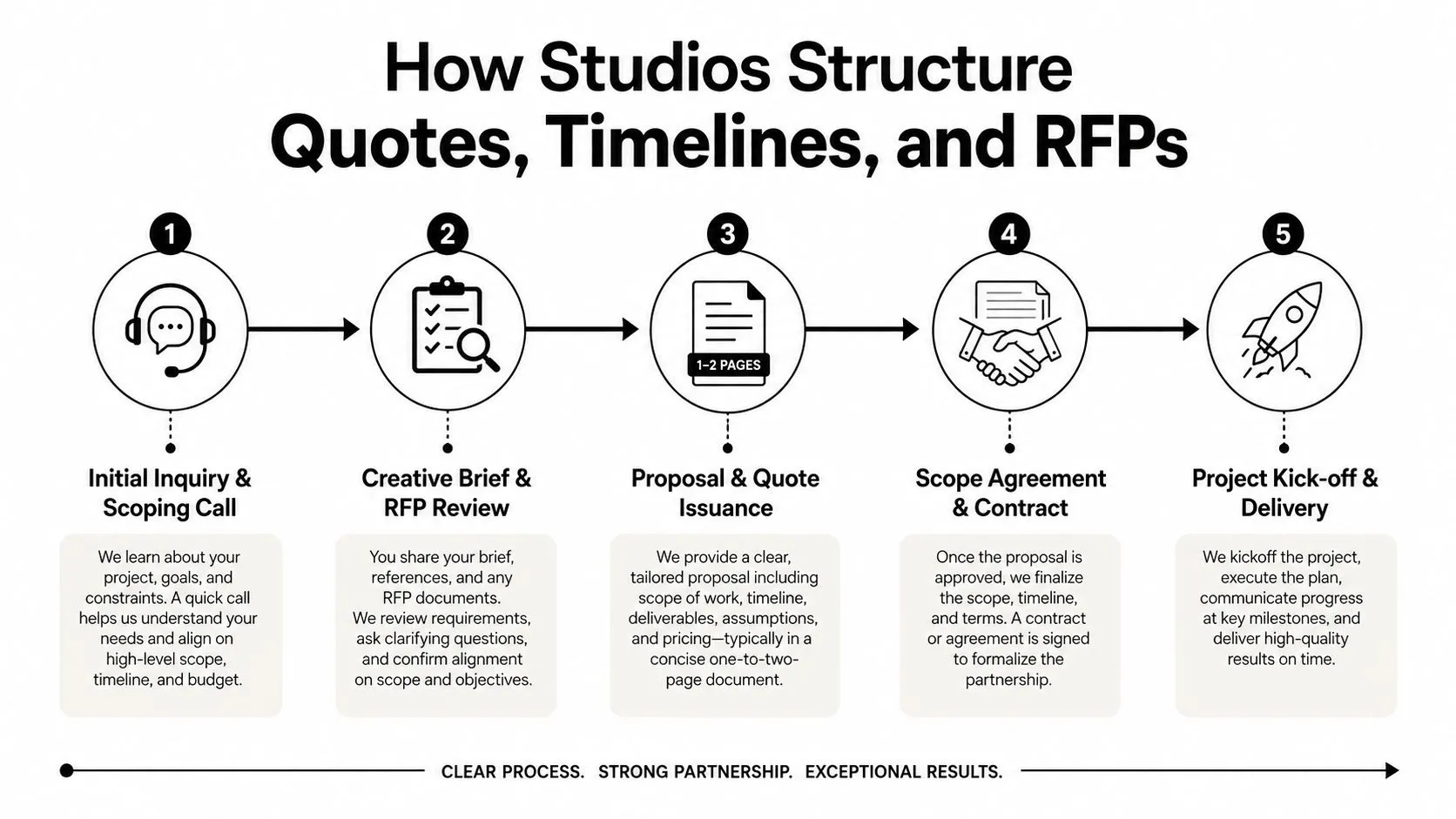
How Studios Structure Quotes, Timelines, and RFPs
A serious studio starts with a scoping conversation, not a guessed per-minute price. The producer needs to know what you're making, where it will appear, which assets exist, who approves it and when the final files must be delivered. A typical proposal sets out the deliverables, assumptions, exclusions, fees and approval gates. Standard work often breaks into pre-production of 1 to 2 weeks, production of 2 to 6 weeks, and post-production of 1 to 2 weeks. A normal brief-to-delivery window can run 6 to 12 weeks, while VFX-heavy or XR work may take longer. These planning bands align with UK animation guidance stating that a standard 2D project commonly takes six to eight weeks, and that 3D generally takes longer because modelling, lighting and rendering extend the schedule. See this buyer's guide to choosing an animation studio for further procurement considerations.
What to include in an RFP
Give bidders enough information to price the same problem:
- •Reference imagery: Show the intended realism, lighting and visual language.
- •Distribution channels: State whether the work is for broadcast, paid social, web, events, training or a headset.
- •Deadline date: Include the actual delivery requirement and any fixed launch or media dates.
- •Approval stakeholders: Name the people who can approve script, design, animation and final delivery.
- •Existing assets: Supply CAD, models, brand guidelines, footage, voiceover or music information where available.
- •Output requirements: Confirm aspect ratios, resolution, frame rate, file type and version count.
Vague briefs create vague quotes. Late script changes, undefined aspect ratios and multiple uncoordinated approvers are common reasons a project exceeds its original assumptions. A studio may include a contingency allowance of 10% to 15% for scope drift, as a practical protection against undefined change rather than hidden margin. The most useful proposal makes that allowance visible and explains which decisions would consume it.
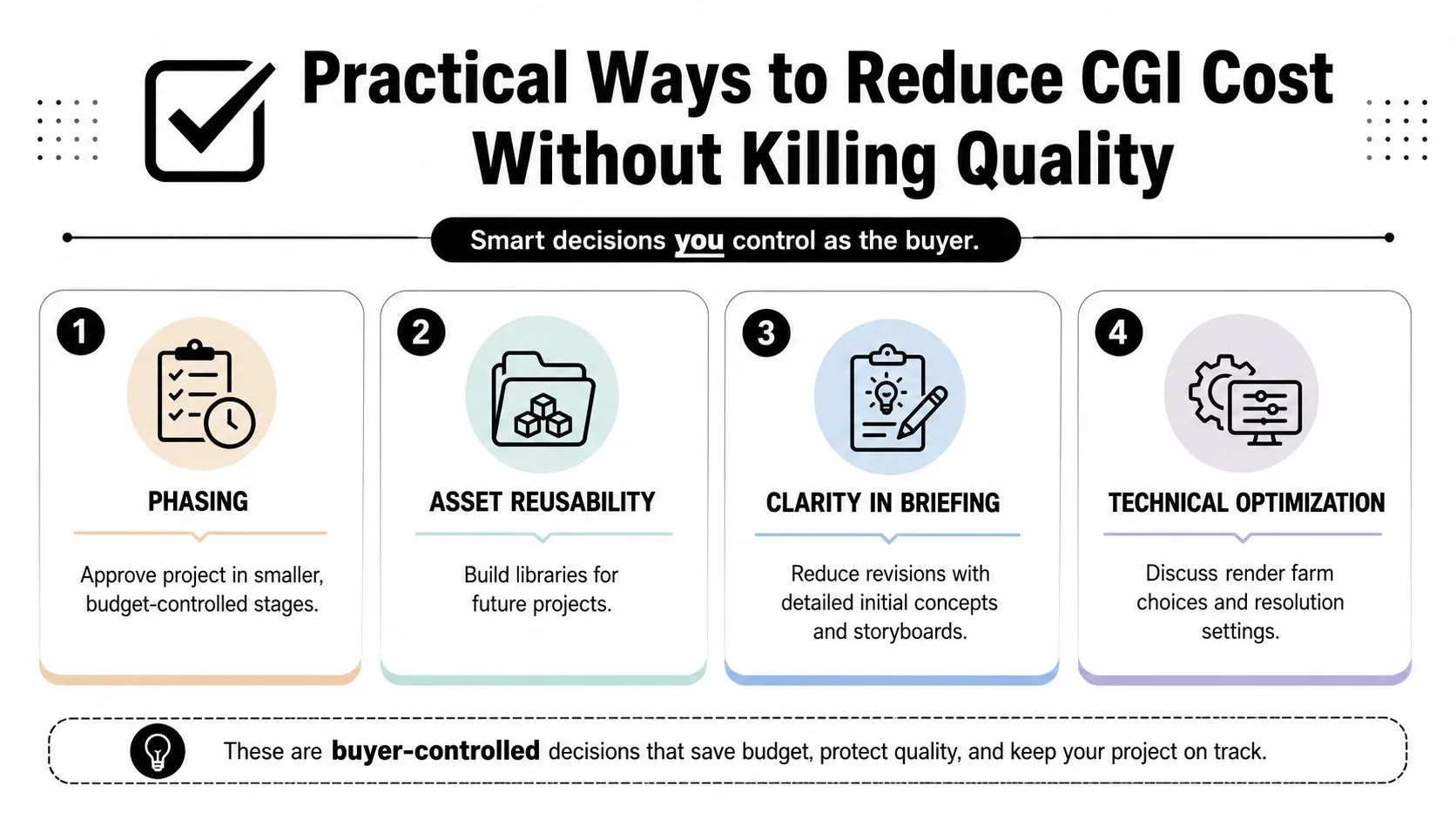
Practical Ways to Reduce CGI Cost Without Killing Quality
A production lead can often remove thousands from a CGI budget before modelling begins. The decisions with the greatest effect are usually asset complexity, shot count, render demand and the number of versions required. Start with a costed shot list. Separate hero shots from supporting shots, then reserve detailed simulations, close-up materials and complex lighting for the moments viewers will closely inspect. If six shots show the same product from similar angles, combine them into fewer, stronger compositions rather than paying to build six distinct set-ups. Reduce revision cost by supplying usable references at the brief stage. CAD, product photography, brand colours and approved copy prevent artists from solving information gaps through exploratory work. A missing reference can create modelling, shading and compositing revisions later, even when the original creative idea has not changed. Set a render budget beside the creative budget. High-resolution output, motion blur, reflections, volumetrics and particle effects can increase render and review time without improving every frame. Test one representative shot first, then approve the quality level before applying it across the sequence. Track versions by purpose, not by request. A cutdown, social crop or event loop should have a defined audience and job. Removing versions that have no confirmed channel often saves more than reducing detail across every deliverable.
AI tools can speed up previs and texture exploration, but senior artists still need to check continuity, materials and final output. The dependable saving comes from removing wasted iterations. This guide to reducing animation and XR production costs covers related production controls.
CGI Cost Questions Buyers Ask Before Approving a Quote
What hidden costs can appear later?
The usual additions are revision rounds beyond the included allowance, stock asset licences, music, voiceover, platform-specific re-renders and usage extensions. They aren't automatically unfair charges. They become a problem when the original quote doesn't state whether they're included, excluded or subject to approval. Ask for a clear assumptions list. It should state the number of deliverables, revision stages, formats, licence terms, supplied assets and final file specifications.
What moves the quote most often?
Scope creep is the most common cause. An unsigned-off animatic followed by a script change or a late format request can affect modelling, animation, camera work, rendering and sound at the same time. The best protection is an approval gate with a named decision-maker. Creative exploration belongs before production locks, not after final animation has started.
How should I start a scoping conversation?
Send the script or rough message, reference images, available models or CAD, target audience, distribution channels, desired formats, deadline and approval structure. A studio should then return questions, assumptions and a written proposal that separates creative development, production, post, licensing and delivery. Studio Liddell offers end-to-end 2D and 3D animation, CGI film and TV production, motion graphics, games and XR development, with Unity and Unreal experience for real-time work. Visit Studio Liddell with your brief, and request a production scoping call that tests the right category, reuse opportunities and delivery plan before you commit to a headline per-minute figure.