Photo Flip Books: A Guide to Print and Digital Creation
At a live activation, the giveaway everyone remembered wasn't the biggest screen in the room. It was a thumb-sized flip book people kept picking up, replaying, and showing to each other.
What Are Photo Flip Books A Timeless Form of Animation
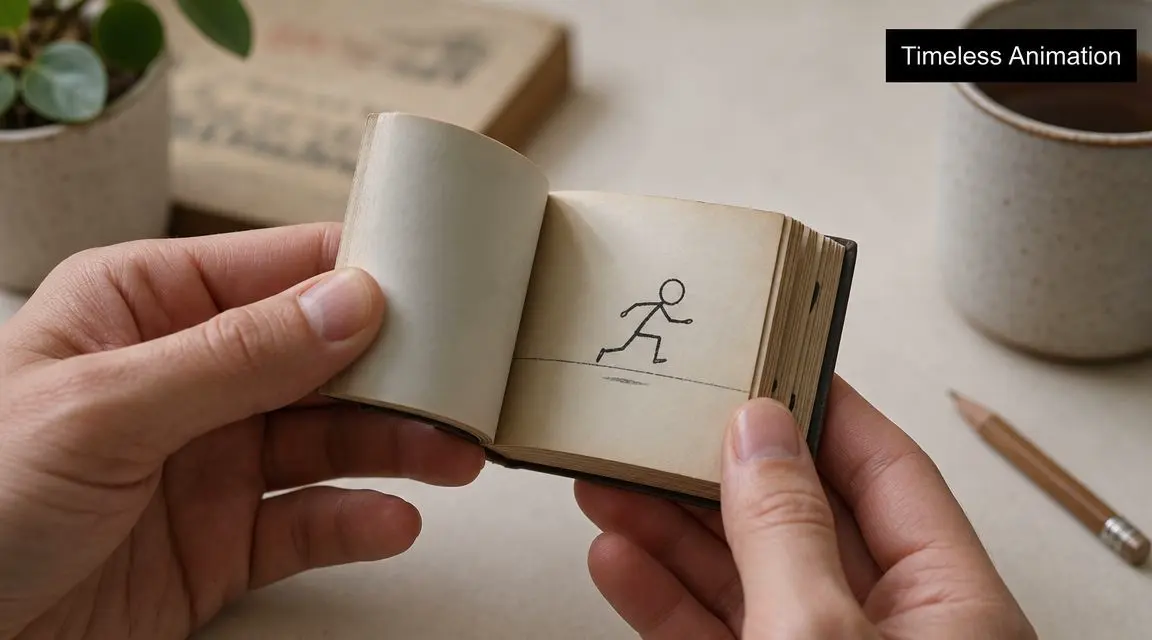
A photo flip book is a short sequence of still images bound in order so the viewer can flick through them quickly and see motion appear. The principle is simple. Each page changes slightly from the last, and the eye stitches those changes into movement through persistence of vision. That simplicity is exactly why the format has lasted. You don't need software to understand it. You just need a sequence, a hand, and enough precision that the motion reads cleanly.
A British origin that still matters
The earliest documented flip book is widely credited to John Barnes Linnett's kineograph, patented in 1868 in the UK, making it one of the first linear-sequence animation devices and a foundational milestone in pre-cinema history, as noted in this kineograph history reference. That date matters for more than trivia. It places the idea of sequential image animation in Britain decades before commercial cinema. The mechanism hasn't changed much since. You still create a run of slightly different images, bind them, and rely on fast viewing to create motion.
Practical rule: If a sequence doesn't work as a flip book, it usually won't work as animation either. Weak posing, abrupt changes, and poor pacing show up immediately.
Why the format still works
Photo flip books sit in a useful middle ground between print and motion. They're physical enough to feel crafted, but they behave like micro-animation. That gives them a distinct role in design, education, and branded storytelling. They also teach discipline. A good sequence needs continuity of framing, readable action, and a clear beginning and end. Those are the same fundamentals that drive stronger motion design, previs, and XR storyboards. A novelty version can be charming. A well-produced version becomes a compact piece of visual communication.
Physical vs Digital Choosing Your Medium
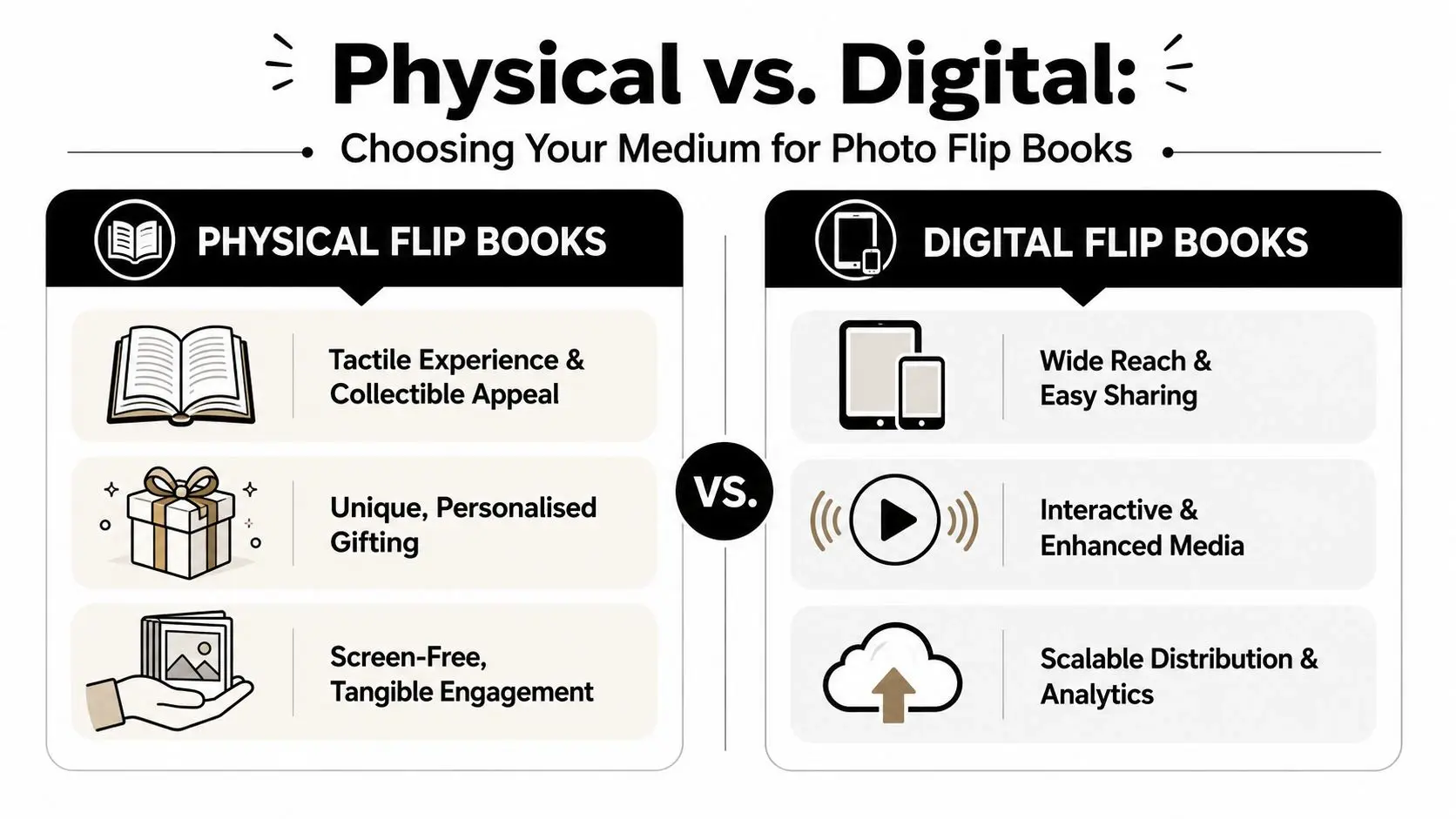
Choosing between physical and digital photo flip books starts with the job the format needs to do. If the goal is memory, tactility, and a premium handout, print usually wins. If the goal is reach, versioning, and measurable engagement, digital is the stronger tool. That's not a matter of taste. It's a matter of use case.
Where physical outperforms
Printed photo flip books are tactile, ownable, and hard to ignore in the hand. They work well as event keepsakes, direct mail inserts, premium packaging extras, and educational artefacts where physical interaction is part of the experience. Manual formats also create a distinct rhythm. The viewer controls playback speed. That can make the object feel more personal than a screen-based loop. What doesn't work so well is scale. Print introduces fulfilment, stock, trimming, binding tolerances, and shipping. Once you need multiple versions, regional variations, or rapid iteration, the process gets heavier.
Where digital outperforms
Digital photo flip books travel better. They can sit inside campaign landing pages, email journeys, microsites, touchscreens, or tablet-based presentations. They also support richer media behaviour. The format can carry audio, video, navigation, hotspots, and links without losing the sequential-book metaphor. A major operational advantage is measurement. In the wider flipbook platform space, teams track views, visitors, downloads, pages viewed, time spent, and links clicked, which turns the format into something closer to a content channel than a novelty object. That shift sits inside a broader printed photo product market that Fortune Business Insights says was valued at USD 3.51 billion in 2025, is projected to reach USD 3.62 billion in 2026, and USD 5.61 billion by 2034, with a 5.61% CAGR across the forecast period, according to this photo album market overview.
Physical holds attention in the hand. Digital extends the lifespan of the idea.
A practical decision filter
Use this quick lens when deciding:
| Medium | Best fit | Main trade-off |
|---|---|---|
| Physical flip books | Premium handouts, gifts, tactile learning tools, event keepsakes | Harder to scale and harder to measure |
| Digital flip books | Campaign distribution, remote sharing, analytics, interactive storytelling | Less tactile and easier to dismiss if the experience feels generic |
If your audience already values displayable media at home or on desks, it's worth looking at adjacent formats too. A useful companion read is this digital photo frame guide, because it highlights the same core decision brands face with image-led storytelling. Do you want a physical object people keep, or a screen-based asset they revisit? In practice, the strongest campaigns often pair both. A printed object creates presence. A digital layer carries the measurable journey.
The Creative Production Workflow
A professional flip book doesn't start with printing. It starts with motion thinking. Even when the final output is a small object, the production logic is closer to animation than static editorial design.
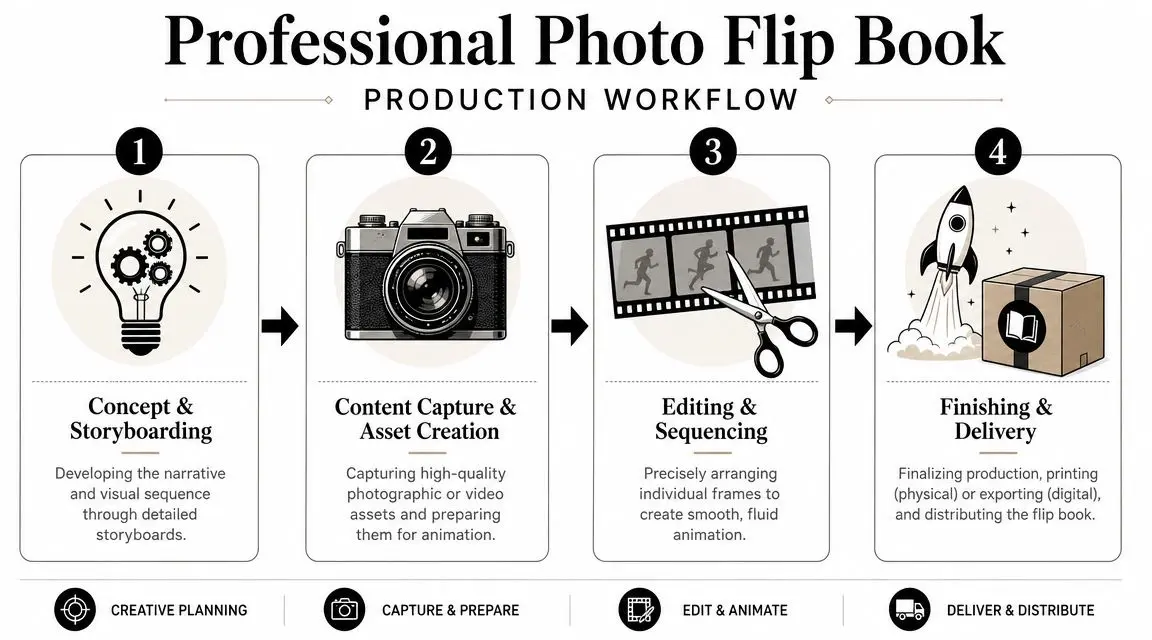
Stage one concept and asset creation
The first decision is where the sequence comes from. There are three common routes:
- Live-action capture using burst photography or short-motion extraction from video.
- Designed stills built from illustrations, composited photography, or motion graphics frames.
- 3D animation output where the frames are rendered specifically for print or digital page-turn behaviour.
Stage two sequencing and pacing
Most weak flip books commonly fail due to the frame sequence. The frame sequence has to progress in small, consistent increments. If the action jumps too far, the motion stutters. If nothing changes enough, the book feels static. The strongest sequences usually do one thing clearly:- •A single gesture such as a wave, blink, nod, or spin
- •A reveal where text, branding, or a product comes into frame
- •A transformation where one object becomes another
- •A loopable beat that can restart cleanly
The thumb is your playback engine. Design for that speed, not for a gallery wall.
Stage three layout and design
Layout for a flip book is not the same as layout for a brochure. The trim has to stay consistent. The area held by the thumb needs to be considered. Important image detail can't sit where binding, drilling, or grip will interfere. For hand-bound hobby formats, practical assembly matters. Instax's UK guidance recommends cutting all pages to the same size, leaving extra space at the top for punching holes, punching before attaching photos, and binding with metal rings, all of which help reduce alignment and page-turn problems in compact flip books, as shown in this Instax DIY flip book tutorial. That advice scales upward. Consistency in page geometry affects playback quality. Uneven stacks and drifting image position make even strong sequences feel amateur.
Stage four finishing and delivery
For print-ready output, 300 dpi is critical. One UK print production guide also specifies RGB exports, common page formats such as 9x9", 12x12", and A4, and page counts from 18 to 122 pages for print-ready books in related photo-book workflows, as detailed in this photo book technical guide. For flip books, the resolution point matters most. When pages move quickly, under-resolved frames lose the tiny differences that make motion legible. Edges break down first. Then facial detail, text, and small object motion start to smear. A professional output pass usually checks:
- •Frame consistency: no accidental crop drift
- •Safe zones: critical content away from trim and bind stress
- •Paper behaviour: enough stiffness to fan cleanly
- •Digital export logic: responsive playback, navigation, and load behaviour on screen
Good production is invisible. The viewer should notice the motion, not the mechanics.
Strategic Use Cases for Brands and Educators
A photo flip book earns its keep when the format solves a communication problem that standard print or standard video doesn't solve as well. That usually happens in one of two settings. A live audience needs a physical object worth keeping, or a learner needs a compact visual sequence that explains motion more clearly than a static diagram.
Brand activations and campaign takeaways
At events, physical photo flip books work best when they capture a moment the attendee has already invested in. A short performance, a branded pose, a miniature product reveal, or a personalised portrait sequence can all land well because the takeaway feels earned rather than generic. The business challenge is measurement. For brands using flip books at events, a key problem is the lack of performance data. Physical versions often don't provide clear dwell-time, engagement, or conversion metrics, which leaves open questions about ROI compared with GIF booths or shareable video keepsakes, as discussed in this event photo flipbook overview. That gap changes the strategic conversation. If a campaign needs reporting, attribution, or downstream audience behaviour, the physical object often needs a digital companion. In exhibition environments, that might mean pairing a printed takeaway with an interactive layer, a landing page, or a spatial experience planned around stand interaction. The same thinking sits behind this guide to AR for exhibitions and retail, where dwell time is treated as a design problem, not just a creative flourish.
Educational storytelling that shows process
In education, photo flip books are unusually good at showing change over time. That makes them useful for topics that are hard to explain in one frame. A few strong fits:
- •Science sequences: growth cycles, movement, cause and effect, transformation
- •History and heritage: reconstructed moments, before-and-after interpretation, timeline beats
- •Design teaching: walk cycles, pose transitions, frame progression, visual continuity
The format is also forgiving. Learners can replay it instantly without scrubbing a timeline or navigating an interface. That matters in classrooms, workshops, and family programming where the teaching goal is clarity, not technical novelty.
A flip book is often the shortest route between “I see the picture” and “I understand the process”.
Premium print versus practical utility
Not every use case deserves a luxury object. If the flip book is just a novelty souvenir, a lighter production route may be enough. If it needs to survive handling across a school term, a museum programme, or repeated event use, the spec has to change. That's where many teams get caught out. The charming DIY logic that works on a craft table often fails in public circulation. For campaigns and institutions, the better question isn't “Can we make one?” It's “Can we make one that still works after repeated use, and can we prove it supported the wider objective?”
The Next Generation Interactive and AR Flip Books
The most interesting development in photo flip books isn't that they've gone digital. It's that they now sit comfortably between print, motion, and spatial media. A printed sequence can still do the emotional work. The digital layer can handle accessibility, interaction, and continuity after the object leaves someone's hand.
Interactive versions that do more than simulate paper
A digital flip book shouldn't just imitate page turning. It should use the metaphor where it helps and drop it where it gets in the way. That means clickable hotspots, embedded motion, layered captions, alternate language support, and navigation that works for touch as well as desktop viewing. There is a known gap around accessibility and durability. Consumer-level guidance rarely answers whether standard flip books hold up in schools, museums, or public settings, creating a clear opening for more durable professional formats and for accessible digital or AR alternatives, as outlined in this photographic flip books discussion. A digital build can solve several of those issues at once. Text can scale. Captions can remain on screen longer than the physical action. Audio can support users who need a different route into the content.
Print that triggers AR
AR changes the role of the printed object. The flip book becomes both a tactile artefact and a marker for a second layer of content. A phone or tablet recognises the page or cover, then launches animation, sound, 3D content, or contextual overlays. That hybrid model is often stronger than replacing print entirely. The object gives people something to keep. The AR layer extends the moment and makes the content easier to update over time. For a deeper look at how print can activate immersive content, this article on print augmented reality is a strong reference point. There's also a useful parallel in products that mix physical books with scannable content. A practical example is the idea of a QR code photobook, where printed pages connect to digital media rather than trying to contain the full experience on paper alone.
The wider animation logic behind the format
At a production level, flip books share DNA with sprite sheets, frame loops, UI animation, and short-cycle motion assets used in games and apps. The principle is the same. Motion is broken into readable states and rebuilt in sequence. That's why the format still matters. It isn't old technology surviving by nostalgia alone. It's a compact expression of how animation works across media.
Budgeting and Timeline Planning
Budgeting a photo flip book project starts with one decision. Are you making a craft object, a campaign asset, or a durable communication tool? Each one has a different production burden. A simple in-house version can move quickly if the sequence is short, the imagery is already available, and the finish doesn't need to survive heavy use. Once custom capture, retouching, motion development, print testing, fulfilment, or AR integration enter the scope, the timeline expands because more departments have to touch the work.
The biggest cost drivers
Some variables matter more than others:
- •Asset complexity: Existing photos are faster to process than custom shoots or 3D-rendered sequences.
- •Sequence difficulty: Subtle, readable motion is easier to execute than fast or multi-subject action.
- •Output format: A hand-bound run, a premium printed finish, and an interactive digital build are very different jobs.
- •Approval layers: Educational, heritage, and branded projects often involve more review rounds than internal prototypes.
- •Durability requirements: Public handling changes paper, binding, and testing decisions.
What to scope early
If you want a realistic brief, lock these points before production starts:
| Scope question | Why it matters |
|---|---|
| Who is using it | Determines durability, accessibility, and interaction level |
| Where it will live | A trade show, classroom, direct mail pack, or museum all drive different specs |
| What success looks like | Keeps the team from overbuilding a novelty or underbuilding a campaign asset |
| Whether print and digital are paired | Affects asset planning from the start |
The biggest mistake is treating photo flip books as cheap because they're small. Small objects are often less forgiving. Every trim error, registration issue, and pacing problem is easier to see when the sequence has no room to hide.
Partnering with Studio Liddell for Your Project
If you want a basic flip book, a craft workflow will get you there. If you want a format that connects print, motion, interaction, and spatial storytelling, you need a team that understands all four. That's where specialist production becomes useful. The challenge isn't just making pages move. It's building an idea that works as a physical object, a digital experience, and a branded communication asset without losing clarity.
Studio Liddell is well placed for that kind of brief because the same production logic behind photo flip books also underpins animation, real-time content, and immersive design. If a project starts as a printed sequence and needs to grow into an interactive launch piece, an exhibition layer, or an AR activation, that cross-medium capability matters. You can see the broader production offering through its animation services. The most effective photo flip books don't sit in a novelty corner. They work as miniature narratives, tactile campaign assets, learning tools, or gateways into digital experiences. Done properly, they feel simple to the audience and highly controlled behind the scenes. That's usually the mark of good production.
If you're exploring photo flip books as a printed keepsake, a measurable digital asset, or an AR-led campaign piece, Studio Liddell can help shape the concept, production workflow, and delivery plan into something people will remember.