Motion Graphics for Advertising: A Practical UK Guide
You've approved a 30-second master, then discovered that the social team needs vertical cut-downs, the broadcaster wants a different delivery, and the product message disappears when the animation is cropped. That isn't a finishing problem. It's a production decision that should have shaped the brief from the start. Motion graphics for advertising works when design, timing, brand rules and delivery formats are planned as one system. The UK market makes that especially important. British advertising has long trained studios to communicate quickly in short commercial units, while today's spend is distributed across broadcaster video-on-demand, connected TV, social platforms and programmatic display. The useful question isn't whether motion looks polished. It's whether the asset makes the brand, product and next action clear in every placement.
What Motion Graphics Mean in Modern Advertising
Motion graphics for advertising is a focused discipline within commercial video. It uses movement to organise information, establish brand recognition and prompt an action. That's different from broader animation, where the central objective may be character performance, narrative emotion or a fully realised fictional world. A typical advertising treatment combines vector-led design, kinetic typography, animated iconography, infographic-style visualisation and composited live-action. A designer may build the visual system in Illustrator or Figma, animate in After Effects, create dimensional elements in Cinema 4D, then use a real-time engine where fast iteration or interactive output justifies it. The software matters, but the hierarchy matters more. Viewers need to understand what they're seeing before they admire how it moves.
The formats buyers actually commission
The same creative logic appears across very different placements:
- •Short bumpers need an immediate brand and product cue.
- •Social cut-downs need strong framing, readable captions and a clear first beat.
- •Television commercials need controlled pacing, broadcast-safe delivery and a memorable end frame.
- •In-app explainers often prioritise product comprehension over spectacle.
- •Digital out-of-home screens must communicate without relying on sound.
- •Programmatic display video needs concise visual information in a restricted space.
A good UK guide to what motion graphics are makes the same practical distinction. Motion graphics borrow techniques from animation, but advertising uses them to solve communication problems.
Start with the commercial job
The brief should name the decision the viewer needs to make. Is the animation building awareness, explaining a technical feature, reinforcing a promotion or driving a click? Each answer changes the amount of copy, the pacing, the focal movement and the CTA treatment.
Producer's rule: If the viewer can remember the visual trick but not the brand or offer, the motion has done its job badly.
Narrative animation can take time to establish a world. Advertising motion usually has to earn attention, communicate value and close with recognition in a much tighter window. That's why commercial outcomes, not artistic expression alone, should guide every creative and technical choice.
How UK Advertising Shaped the Motion Graphics Industry
British motion design didn't begin with social media templates. The country's advertising history gave designers a long education in compression, graphic clarity and brand-led movement. The oldest acknowledged film advert still in existence is Dewar's Scotch Whisky from 1897, a useful early marker for moving-image promotion in the UK. When commercial television launched on 22 September 1955, animated advertising shifted from longer cinema-style pieces towards shorter, high-impact broadcast formats, as documented in the British Film Institute's animated advertising collection. The new television environment rewarded a particular kind of discipline. Historical accounts describe animation occupying up to a third of television commercials in the early years. Whether a spot used drawn characters, typography or graphic transitions, the commercial unit forced the creative team to establish an idea quickly and land the brand before the viewer moved on.
From broadcast restraint to digital modularity
The Central Office of Information also contributed to a visual culture built around direct communication and graphic restraint. Later, Channel 4 idents, including the work associated with Martin Lambie-Nairn in the 1980s, showed how motion could become a brand asset rather than a decorative transition. Britain's commercial production base then fed into digital animation and computer graphics. BFI-compiled analysis recorded £97.1 million spent on UK-qualifying animation programmes in 2016, compared with an estimated £46 million in 2011, as reported in The Story of British Animation. That wider economy supported talent, pipelines and technical experience useful to advertising, branded content and television. The result is a distinctly practical strength. UK studios often understand that the hero film is only one part of a campaign. The genuine production challenge is turning a visual idea into versions that retain its brand cue when the canvas, runtime, sound environment and audience behaviour change.
Main Styles and Where Each One Works Best
The right treatment depends on the communication job, not on which technique looks most fashionable. A logo sting can be perfect for brand recall and completely wrong for explaining a complex product. A character animation can create warmth, but it may consume budget that a simple typographic system would use more effectively across many variants.
| Style | Typical Runtime | UK Budget Band (GBP) | Best-Fit Channels | Primary Goal |
|---|---|---|---|---|
| Logo sting or brand ident | Short format | Qualitative, scoped to design and animation complexity | Broadcast, social, OOH digital | Recognition and recall |
| Explainer sequence | Short to medium format | Qualitative, driven by script, design and version count | Paid social, websites, in-app video | Product understanding |
| Social-first kinetic typography | Short cut-down | Qualitative, usually efficient when the system is modular | Reels, Stories, feeds and display | Attention and response |
| Character-led or mascot animation | Campaign or episodic format | Qualitative, with rigging and performance affecting scope | Brand campaigns, children's content and social | Affinity and memorability |
Logo stings and idents
A sting is compact, but it still needs timing, sound and a deliberate reveal. The common mistake is to treat it as a logo flying in from nowhere. Stronger work builds a recognisable brand behaviour, perhaps through a particular easing style, graphic motif or transformation that can be reused elsewhere.
Explainers
Explainers work when the message has a sequence. They're useful for product flows, diagrams, data visualisation and services that need demonstration rather than atmosphere. Avoid animating every sentence. The storyboard should decide which information deserves screen time and which can remain in the voiceover.
Social cut-downs
Kinetic typography is efficient when the copy is already sharp. It becomes noisy when the team tries to fit a full press release into a vertical edit. Social variants need rewritten beats, not just a smaller version of the master. Character-led work earns its place when the character carries a distinctive relationship with the audience. It's less suitable when the brief needs a large volume of product-led variations on a fixed launch date. Hybrid treatments now sit between these categories. Live-action product footage with animated labels, graphic overlays or tracked typography often gives paid social teams the immediacy of filmed content and the clarity of designed information.
The Production Workflow From Brief to Delivery
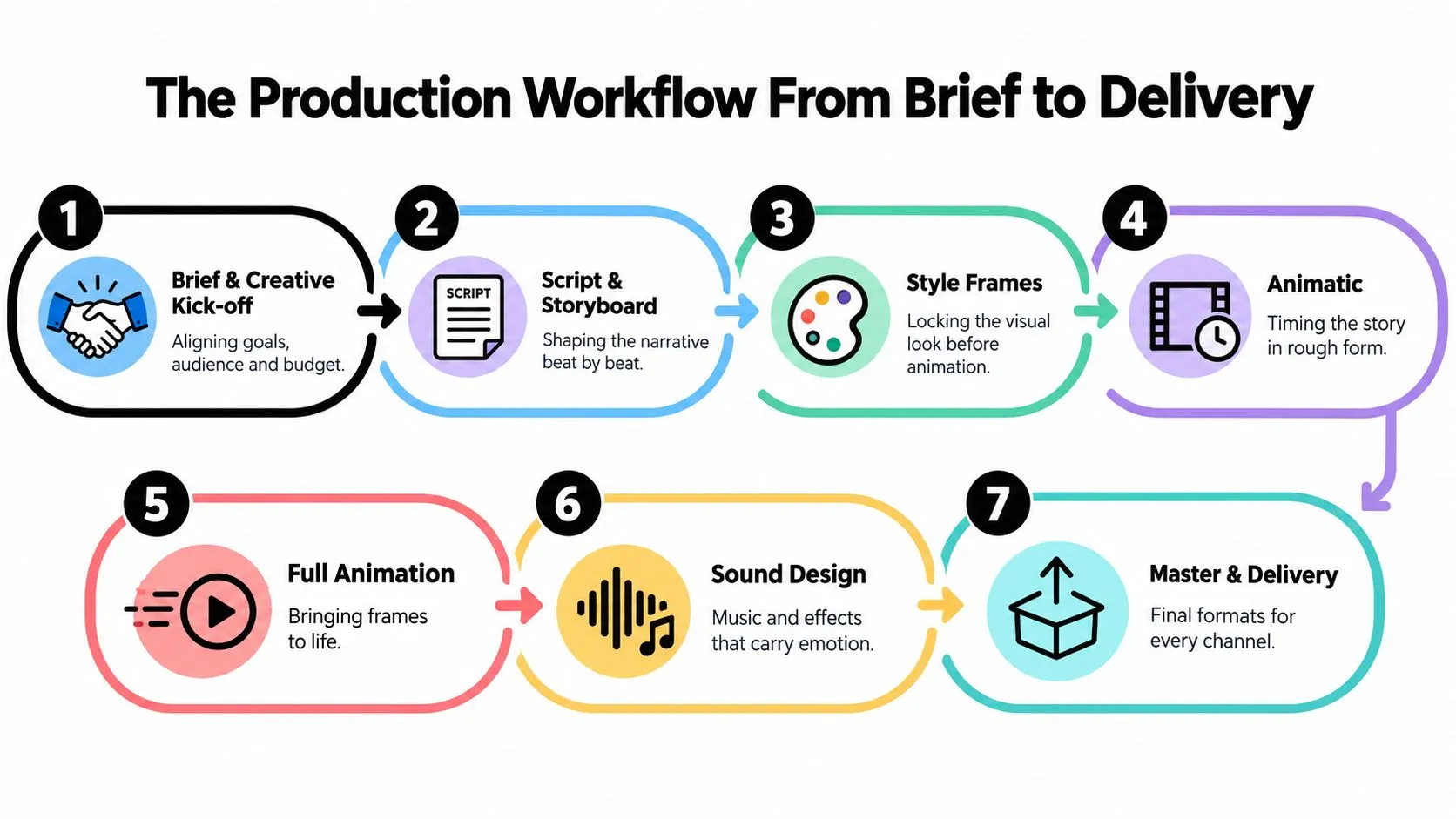
A motion job goes wrong when the team treats the first animation pass as the first meaningful decision. By that stage, the script, design language and timing should already have received approval. The standard route has seven stages: brief and creative kick-off, script and storyboard, style frames, animatic, full animation, sound design, then master and platform exports. UK planning guidance places a typical motion graphics project at £1,500 to £5,000 per minute, with lead times of 2 to 4 weeks, although complexity, revisions and deliverable volume change the quote. A separate UK production guide describes a broader standard animation timeline of 4 to 8 weeks and allocates 25% to 30% to pre-production, 60% to 70% to animation and 10% to 15% to post-production, as set out by Educational Voice's UK production rates guide.
Where approvals carry the most weight
The brief aligns audience, objective, message, channels, budget and delivery date. The script and storyboard then settle the argument beat by beat. Style frames lock the visual direction before the team spends time animating it, while the animatic proves whether the idea works at the intended pace. Full animation is where design decisions become movement. Sound design should start early enough to influence rhythm, not arrive as a late layer placed beneath finished visuals. Final mastering then creates the required platform files, captions, audio versions and naming structure. The most expensive late change is usually not a minor adjustment. It's a change to the approved message, visual system or timing that forces downstream work to be rebuilt. Shared review tools such as Frame.io help, but only when one person owns consolidated feedback and the team works from a clear version history. If live-action footage or stills photography are part of the job, the production schedule must reserve time for tracking, keying, clean-up and compositing. For a deeper production view, the animation production pipeline guide is useful when planning parallel shoots and animation.
Rush work changes the economics
A delivery date under four weeks can attract a 20% to 30% rush premium, according to this UK animation cost breakdown. Studios can compress a schedule by running design, copy and technical preparation in parallel, but they can't remove the need for decisions. A rushed animatic approval is particularly dangerous. If the timing fails there, full animation only makes the wrong structure more expensive. Teams should protect the approval gates that prevent rework, even when the launch date is fixed. For teams developing scripts alongside campaign concepts, AI creative copywriting with Claude can help generate and compare early messaging routes. It doesn't replace the creative lead, brand review or legal approval. It gives the team more material to assess before the storyboard is locked.
Designing for Multiple Platforms Without Losing the Brand
A single 30-second master rarely serves every channel well. It may be technically adaptable, but auto-cropping can remove the product, split a headline or place the CTA beneath interface controls. UK advertisers are operating in a video-heavy market with fragmented placements. Search and online display represented 83% of total UK ad spend in Q3 2025, while video investment reached £9.3 billion in 2025 and accounted for 64% of online display spend, up from 51% five years earlier, according to UK ad-spend reporting from the Advertising Association and IPA. More video doesn't mean one video file. It means more versions with different viewing conditions.
| Platform | Aspect Ratio | Typical Runtime | Safe Area Notes |
|---|---|---|---|
| Broadcaster VOD and CTV | 16:9 | Master-led | Keep key text within broadcaster-safe margins |
| TikTok, Reels and Shorts | 9:16 | Short cut-down | Reserve space for platform interface and captions |
| LinkedIn and in-feed social | 1:1 | Short cut-down | Keep the product and CTA central |
| Facebook mobile feed | 4:5 | Short cut-down | Protect text from cropping and UI overlap |
Build scenes as reusable blocks
The efficient approach is to design a hero version from modular scene blocks. Each block should have a clear function, such as brand introduction, product demonstration, proof point or CTA. The editor can then create a vertical cut-down by changing the composition and timing, rather than merely scaling the original. A UK-focused video advertising guide recommends 4:5 for feed, 9:16 for Stories and Reels, and 16:9 for in-stream, with 15 to 30 seconds for feed and Reels and 15 seconds or under for Stories and in-stream. It also cites UK advertising ranges of roughly £5 to £20 CPM and £0.01 to £0.06 cost per view, as detailed in ProfileTree's Facebook video advertising guide. Those figures make adaptation a production issue, not just a media issue. If one placement costs more to enter or produces a different viewing pattern, the creative needs its strongest brand, product and CTA cues early enough to survive that environment. Lock the system before versioning:
- •Typography: define headline sizes, line lengths and animated treatments.
- •Colour: use approved colour tokens rather than approximate platform exports.
- •Logo behaviour: specify size, contrast, position and minimum clear space.
- •Captions: design for muted viewing and avoid placing text beneath interface elements.
- •Motion: retain the same easing and transition logic across every cut-down.
Creative Choices That Move the Metrics
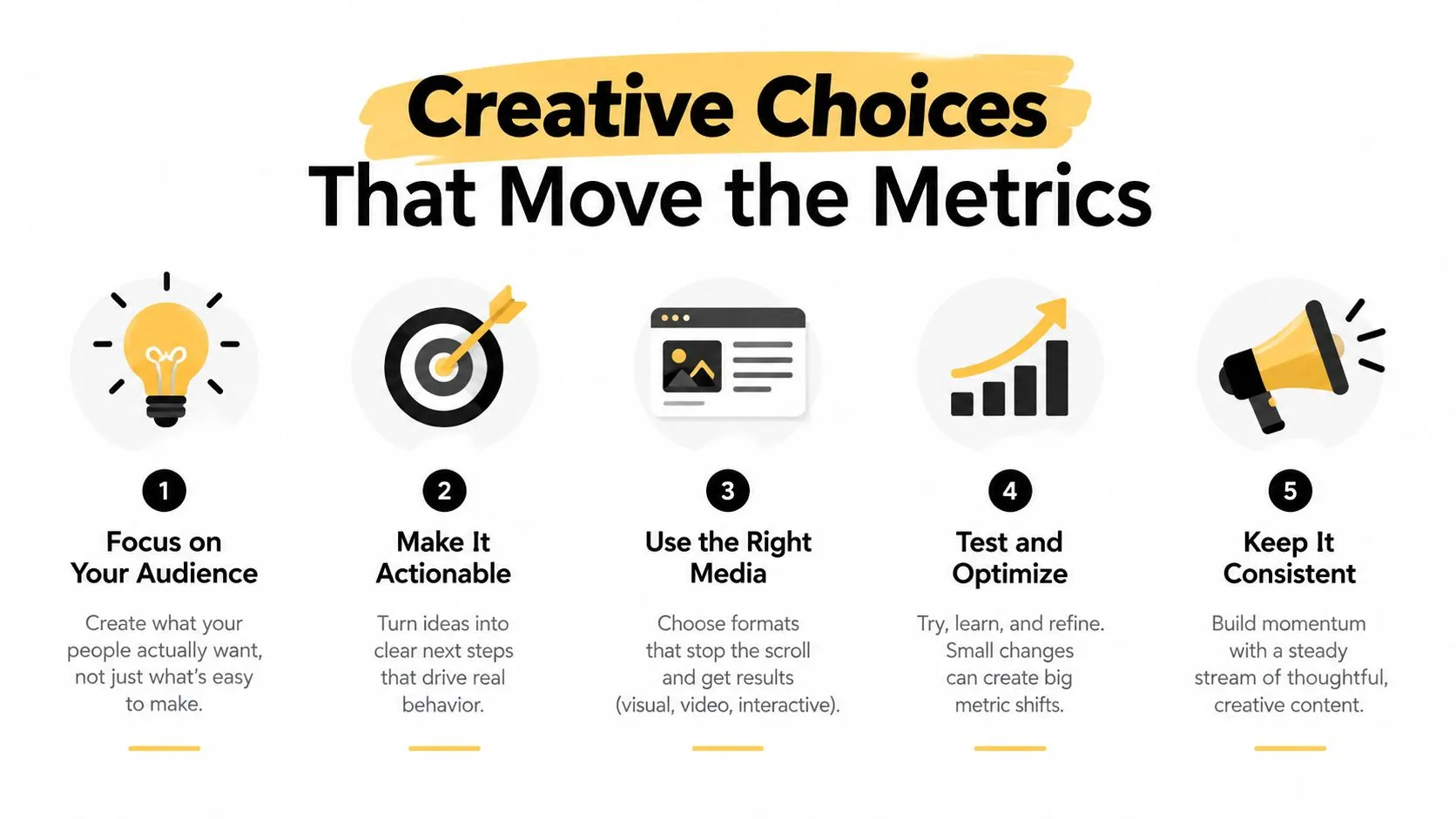
Motion doesn't improve an advert just because something moves. It improves communication when movement tells the viewer where to look, what changed and why the next beat matters. A UK motion graphics publication cites 2x higher brand remembrance, 3x more watch-through when the hero moves and 38% longer time on page with motion cues, as reported by Boostbery's motion graphics service guidance. These figures shouldn't be treated as a guarantee for every campaign. They're a reason to test the role of movement instead of assuming that a more elaborate animation will produce a better result.
Give movement a hierarchy
A focal product reveal should move with more purpose than a background texture. If every element pulses, slides and rotates at the same intensity, the viewer has no clear route through the frame. Use a hierarchy:
- Primary movement reveals the product, offer or human action.
- Secondary movement supports the reading order, often through type or iconography.
- Ambient movement gives the frame life without competing for attention.
Test the creative, not just the media
Run motion and static variants against comparable audiences and spend where the campaign allows. Track watch-through, brand lift, assisted conversions and the quality of the resulting traffic, rather than relying on a single completion figure. Short-burst campaigns make statistical confidence difficult. A difference may reflect audience mix, placement, frequency or timing rather than the animation itself. Keep the test question narrow. For example, compare a static product reveal with a moving product reveal while holding the copy, offer and landing page constant.Testing discipline: Change one meaningful creative variable at a time, or you won't know what produced the result.Sound design also contributes to recall, but the visual must work when sound is off. A strong motion system communicates the proposition through framing, type and contrast first, then uses music and effects to reinforce the emotional beat.
Choosing a UK Motion Graphics Studio
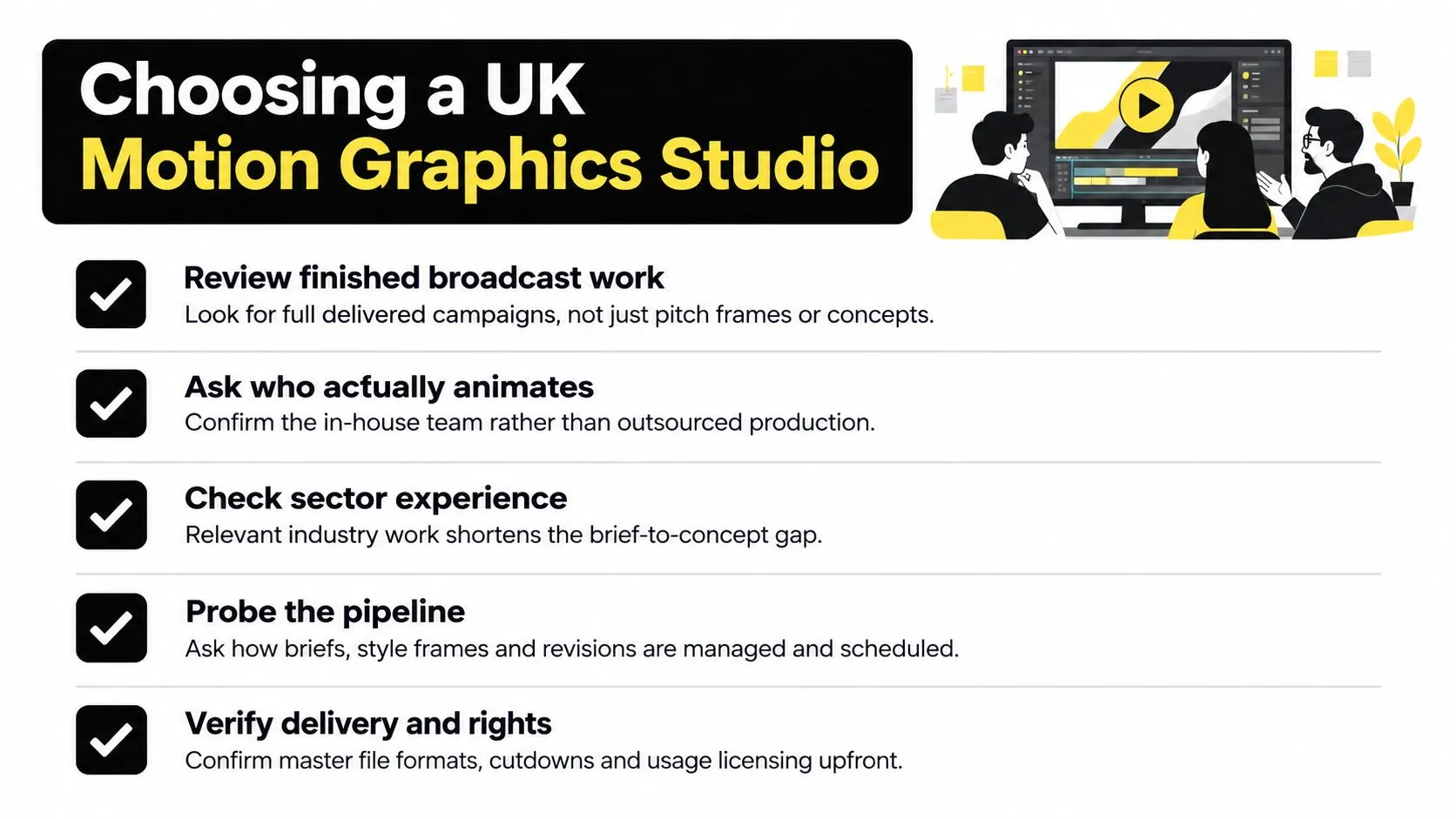
A showreel can demonstrate taste, but it won't tell you whether a studio can deliver your campaign under real approval and versioning pressure. Ask to see finished broadcast or paid-social work, including the final formats, not only polished pitch frames.Five checks before you appoint
Review delivered campaigns. Look for evidence of end frames, captions, cut-downs, legal copy and channel-specific exports. A concept reel hides the part of production where many projects become difficult. Ask who animates. Confirm whether the proposed designer, compositor and 3D artist will work on the job in-house. External specialists can be useful, but the studio should disclose who owns the core animation and who manages quality control. Check the technical pipeline. Ask about After Effects, Cinema 4D, compositing, colour management and any real-time tools relevant to the brief. A studio doesn't need every tool for every job. It does need a pipeline suited to the output. Probe team seniority and scheduling. Find out who reviews the work, who consolidates feedback and what happens when a key person is unavailable. References from comparable campaigns reveal more than a generic testimonial. Clarify rights and delivery. Put music licensing, PRS clearance where relevant, voice usage, source file ownership, IP assignment, indemnity, insurance and international reuse rights in the contract. Don't assume that a master file includes every editable asset.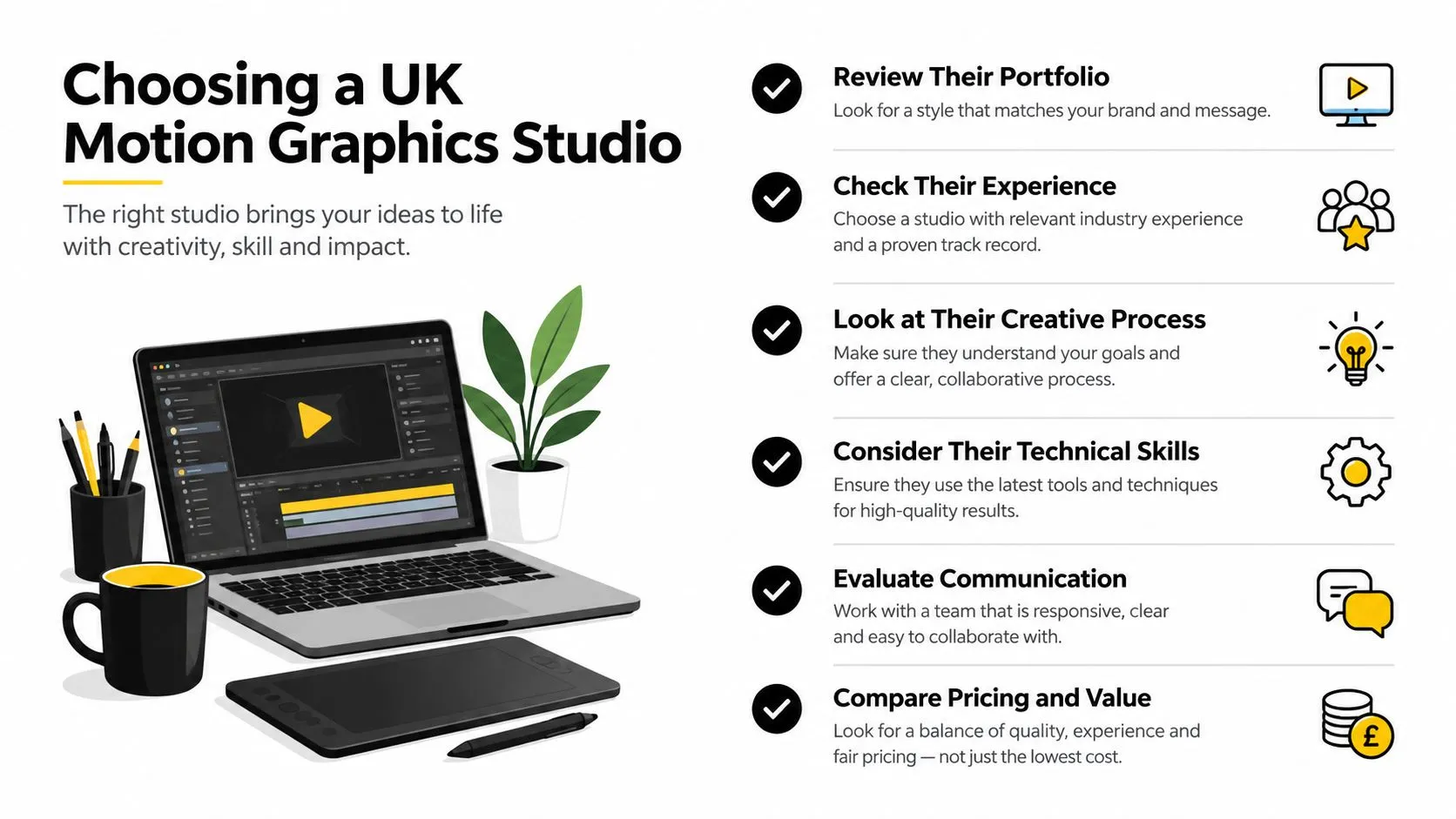
Red flags in a quote
A suspiciously fast turnaround usually means the studio has ignored approvals, versioning or render time. A flat fee without a proper brief encourages disputes because neither side has defined the number of scenes, revisions, outputs or rights. Outsourcing isn't automatically a problem. Hidden outsourcing is. If a studio presents itself as an in-house production team while sending core animation overseas without disclosure, you may lose control over communication, schedules and data handling. A useful buyer's guide to choosing an animation studio can help structure the procurement conversation. If you're weighing a broader filmed-and-animated campaign, this practical resource on how to elevate your business with video is also relevant because it frames production as a connected content decision rather than an isolated edit. Put these questions in the RFP:- •How many revision rounds are included, and what counts as a revision?
- •Who owns the source files and third-party assets?
- •Which broadcast-safe and platform-specific formats are included?
- •Who clears music, fonts, stock footage and voice usage?
- •What insurance covers a crew-led shoot or location work?
- •What happens if the launch date moves or the media plan changes?
A studio should answer these clearly before the creative pitch. If the commercial terms remain vague while the visuals look impressive, the project is not ready to commission.
Common Questions Buyers Ask Before Commissioning
Can AI tools really reduce production time?
They can speed up exploration, copy variations, clean-up and some repetitive tasks. They don't remove the need for art direction, rights checks, brand governance, animation craft or client supervision. The decision rule is simple. Use AI where it produces reviewable options or reduces repetitive labour inside an established pipeline. Don't use it as a reason to promise a shorter schedule before the team has defined approvals, visual consistency and legal ownership. The saving can move into prompting, selection, correction and integration rather than disappearing.
When is Unity or Unreal worth the overhead?
Use a real-time engine when the project needs interactive behaviour, live camera changes, repeated scene variations, spatial experiences or a pipeline that will continue beyond one rendered advert. For a straightforward 2D campaign or a conventional composited spot, After Effects may be faster and easier to control. Cinema 4D remains useful for designed 3D scenes, product animation and controlled rendering. Unity and Unreal become more compelling when the same assets must serve advertising, XR, events or interactive applications. The wrong engine adds technical setup without improving the viewer's experience.
What should a 30-second spot cost?
Avoid budgeting from runtime alone. A 30-second social-led spot may be relatively contained if it uses a simple graphic system and limited variants. A brand anthem can require more design development, sound, compositing and review. A character-driven explainer may add rigging, facial performance and character asset work. UK planning guidance places typical motion graphics pricing at £1,500 to £5,000 per minute, with 2 to 4 week lead times, but those figures describe a planning band rather than a guaranteed quote. Ask for a scope that separates concept, pre-production, animation, post-production, versions and rights.
How do we know whether the campaign worked?
Choose the measurement before production. For awareness work, consider brand lift and recall. For response activity, examine view-through behaviour, qualified visits and assisted conversions alongside platform reporting. Don't judge motion by a high completion rate alone. A viewer may finish an advert without noticing the advertiser or understanding the offer. Pair behavioural metrics with a brand or conversion measure that reflects the campaign's actual job.
Which contract terms matter most?
IP assignment, usage rights, music and voice licensing, source file ownership, indemnity and international reuse should be explicit. So should revision limits, delivery formats, approval responsibilities and cancellation terms. Ask whether the studio can reuse project elements in other markets, whether the client receives editable files, and whether third-party assets have restrictions. A low production quote can become expensive when the campaign expands internationally and the original licence doesn't cover the new use. Studio Liddell works across 2D and 3D animation, motion graphics, broadcast content and XR production, so it can be considered when a campaign needs a connected visual system rather than a single isolated file. Visit Studio Liddell to discuss the brief, delivery formats and production route before you lock the budget.