Mobile Marketing Games: A Practical Guide for UK Brands
The proportion of UK adults playing games on mobile phones rose from 6% in 2009 to 23% in 2019, while console gaming declined from 27% to 16% over the same period, according to Ofcom's Online Nation report. For brands, that shift changed the opportunity: a playable experience could reach people through the phone they already carried, rather than a dedicated gaming device. But access to players isn't the same as influence. Mobile marketing games deserve a place in a campaign only when the play communicates something useful and the measurement can show what happened afterwards.
What Mobile Marketing Games Are and Why Brands Use Them
A mobile marketing game is a playable experience designed around a brand's commercial objective. The product, message or brand promise shapes what the player does, rather than appearing only as an advert around someone else's game. Think of a branded mini-game as a well-run shop demonstration, not a billboard. A demonstration lets someone handle the product, make a choice and discover a benefit. A good marketing game translates that experience into touch controls, feedback and a clear outcome.

Make the message something players do
Say a paint brand wants shoppers to understand how its colours work together. Instead of showing a static room photograph, it commissions a decorating challenge: players select complementary colours, apply them to a room and see the result. The commercial message sits inside the action. Players aren't told that the range offers coordinated colours; they practise combining them. A useful next step might be saving their palette or exploring the selected products. That's the connection between mobile games and broader experience marketing examples: participation should help someone understand the offer, not merely occupy their time.
Separate attention from business value
Brands generally use the format for several connected reasons:
- •Sustained attention: A worthwhile challenge can encourage active participation rather than a passing glance. Longer sessions are an opportunity, not a guaranteed result.
- •A message carried by the mechanic: Sorting, building, matching or choosing can demonstrate a product benefit more clearly than an instruction screen.
- •Diagnostic interaction: With appropriate analytics, a team can distinguish starting, completing, exploring products and taking a subsequent action.
The boundary matters. A banner inside an ordinary mobile game is in-game advertising. A game whose challenge depends on the brand is branded entertainment. Both can be useful, but they require different creative work and buying decisions. Nor should this be confused with mobile game marketing, which usually means acquiring and retaining players for a game itself. Here, the game serves a wider brand objective.
Commissioning test: Does the intended audience enjoy this type of play, and can the brand contribute something meaningful to the repeating action?
If either answer is uncertain, validate the idea before commissioning polished art. A recognisable logo won't rescue an activity that people don't want to repeat.
Four Formats Compared and How to Pick One
Picking a format is really picking a behaviour. Before comparing mechanics, decide what you want a player to do after playing: search for the brand, redeem a code, return next week, or remember the name. The lightest format that can plausibly produce that behaviour is usually the right starting point. Mobile marketing game formats compared
| Format | Core mechanic | Typical brand goal | Relative production effort |
|---|---|---|---|
| Branded mini-game | One short mechanic with the brand built into the world or reward | Awareness and recall | Medium |
| Advergame | Game built around the product or a campaign theme | Engagement and sampling | Low to medium |
| Gamified app | Rewards, challenges or levels added to an existing brand app | Retention and loyalty | High |
| AR/VR experience | Spatial or immersive play using a camera or headset | Demonstration and dwell time | High |
These are planning categories, not fixed price bands. A simple advergame can require less work than a heavily animated mini-game, but a full campaign world can reverse that comparison. Likewise, adding a basic progress indicator is a much smaller job than building a complete loyalty system. The terminology overlaps, which causes confusion at briefing stage. A branded mini-game can also be called an advergame; the useful distinction is how much of the experience revolves around the product and how much ongoing infrastructure it needs.
Match the experience to the job
For a crisps brand, a mini-game might ask players to catch falling flavours and finish with a coupon. The mechanic is immediately understandable, while the packaging and flavour names supply the recognition cues. The coupon also gives the team a measurable action to count. A cereal advergame could build a breakfast challenge around assembling a bowl. Here, the product becomes the subject of the game, making it suitable for introducing a range or supporting sampling. A bank could add weekly savings streaks to an existing app. That's gamification of utility rather than a standalone game: the value remains helping someone manage their money, and rewards should support that purpose without pressuring customers into unsuitable financial decisions. A furniture retailer's AR tool could let shoppers place a sofa in their room. AR on a phone can support a mobile campaign; headset VR is a separate delivery route, with different access and deployment requirements. Neither becomes a game until it includes meaningful goals, choices or challenges. Branded downloadable play has a long history, from ad-funded games to free advergames. The format is established, which means players already understand it and will judge it against real games, not against other adverts.
Choose in a practical order
- Start with the campaign goal. Use the table to identify the simplest format capable of achieving it.
- Check audience fit. Show representative players the proposed interaction, not just a mood board.
- Fund the operating life. Include updates, hosting, platform maintenance and campaign support in the decision.
Goals and KPIs That Prove a Game Is Working
Campaign goals mapped to KPIs| Campaign goal | Primary KPI | Supporting metric | What it proves |
|---|---|---|---|
| Brand awareness | Unaided recall lift | Completion rate of first play | Whether attention was accompanied by stronger recall |
| Consideration | Branded search lift | Post-play engagement | Whether interest extended beyond the session |
| Sales or footfall | Conversions among exposed players | Promo-code redemptions | Whether play is linked to purchase |
| Retention or loyalty | Return sessions per week | Reward claim rate | Whether players return and use the reward |
| Lead generation | Qualified sign-ups | Opt-in rate at play end | Whether leads are useful, not just numerous |
Define what counts before development
For an awareness campaign, unaided recall means asking people which brands they remember without supplying a list. First-play completion helps diagnose whether the experience held together, but the survey supplies the recall evidence. For consideration, branded search lift can reveal interest beyond the game environment. Supporting post-play engagement might include viewing a product comparison or saving a configuration, provided those actions relate to the buying decision. Sales and footfall need outcome definitions that the business can recognise. A product-page visit isn't a sale, and a map opening isn't a verified shop visit. If direct footfall measurement isn't available, label the proxy clearly. Lead generation needs an equally explicit definition:- •Qualified sign-up: Specify the eligibility, business need or purchase interest that makes a contact useful.
- •Valid opt-in: Record the permission needed for the intended follow-up, without bundling unrelated marketing choices.
- •Accepted handover: Agree how the sales team will receive and assess the contact.
Use benchmarks without borrowing someone else's target
For definitions and comparison questions, LetsDeployIt's app engagement benchmarks for 2026 can help teams examine how app engagement is measured. Treat external benchmarks as context, not a substitute for targets suited to your audience, format and acquisition route. Impressions, installs and total plays are delivery measures. They help explain reach and participation, but none independently demonstrates that people understood the proposition or became more likely to buy. Record a baseline before launch. Capture the existing level of the chosen outcome, document other campaign activity and agree how the result will be compared. Without a starting point, a dashboard can show activity while leaving the commercial change unresolved.
Designing a Value Exchange Players Accept
Players have a reason to accept brand presence when they receive something worthwhile in return. IAB UK reports that 38% of UK adults play games on a smartphone every day, while 63% of gamers accept advertising when it enables free access to content. That isn't blanket permission to interrupt. The same IAB UK discussion identifies stronger receptiveness to gaming accessories and relevant in-game purchases, with unrelated products least accepted. Relevance and control should therefore shape the experience from the concept stage.
Offer a choice rather than a blockage
Rewarded video gives the player an explicit transaction: choose to watch, receive the stated benefit. An opt-in playable offers a different exchange: try something interactive before deciding whether to continue. Both are sensible starting points because the player can understand the offer before accepting it. A forced interstitial breaks the activity regardless of whether the message is useful. Don't interpret the case for opt-in formats as proof that every rewarded placement will outperform every interstitial; test the actual placement and creative. The reward should also be proportionate. If the ordinary game becomes frustrating unless someone engages with advertising, the apparent choice isn't a generous one.
Players should be able to explain what they received, not just what the brand asked them to do.
Build usefulness into the interaction
Consider these practical patterns:
- •Gain access to an optional item. A branded challenge awards a cosmetic accessory or useful bonus. Explain the task and reward before entry, and confirm delivery afterwards.
- •Teach through play. A home-improvement mini-game asks players to choose the right tool for a surface, then explains the choice. The information remains valuable even if they don't purchase immediately.
- •Let someone try a product behaviour. An interactive advert lets a shopper explore a feature or configure an option before opening the retailer's site. Don't imply that a simplified simulation reproduces real-world performance exactly.
The common requirement is alignment. A useful product interaction makes sense within the play; an unrelated form or promotional screen doesn't become useful merely because it follows a game. Check reward completion alongside subsequent actions. If people tap through but abandon before receiving the promised benefit, investigate unclear instructions, technical faults or misleading calls to action before celebrating click-through. Before approving a concept, ask:
- What does the player get? Name the entertainment, information or benefit.
- Is the brand part of the loop? Remove the logo mentally and check whether the interaction still expresses anything distinctive about the product.
- Can the player leave without a penalty? Preserve a clear exit and avoid punitive loss messages.
Targeting Children and Families Safely
Around 90% of UK children play games on digital devices, and the Information Commissioner's Office launched a monitoring programme covering 10 popular mobile games, examining default privacy settings, geolocation controls and targeted advertising. For a brand, this makes privacy an early production decision. A family-friendly visual style doesn't establish that a game's advertising, tracking or purchase systems are appropriate for young players.Resolve the audience and data questions
Before development, document the answers to these questions:- Who is the game for? Specify the intended age range, whether it is child-directed and whether children are likely to access it despite a broader target audience.
- What targeting is enabled? Identify behavioural advertising, profiling and advertising identifiers. Define the protective defaults for younger players rather than relying on an advertising supplier's standard configuration.
- How does permission work? Record when consent is required, who can provide it, how it is logged and how it can be withdrawn. Have the responsible privacy adviser confirm the applicable requirements.
- Is location necessary? Remove geolocation if the mechanic doesn't need it. If it does, specify when access is requested, the precision required and what happens when permission is refused.
- What needs parental control? Decide how rewarded advertising and purchases will be handled, including parental gates where appropriate.
Design for less data
Contextual placement can connect an advert to relevant content without building a behavioural profile. Aggregate event reporting can answer usability questions without retaining a detailed history of each child's activity. First-party collection isn't automatically privacy-safe. Minimise identifiers, limit retention, restrict access and review third-party SDKs as carefully as the game code. Rewards should be age-appropriate and shouldn't pressure children to disclose information or repeatedly seek purchases.Go or no-go check: If the team can't explain an audience, targeting, consent, location or parental-control decision, the production brief isn't ready.Resolve those gaps before implementation. Retrofitting protections can require changes to the interface, analytics architecture and commercial model.
Production Choices That Affect Performance
Session behaviour should shape the production brief. Independent UK audience findings reported by The Drum found that nearly 70% of UK consumers played on smartphone or tablet, 94% of mobile gamers played at least once per day, and 38% played three to four times daily. Those findings support testing a sequence rather than forcing every message into the first encounter. A short introduction can establish the proposition; a subsequent experience can offer more depth to people who have engaged, where the permissions and delivery environment allow it.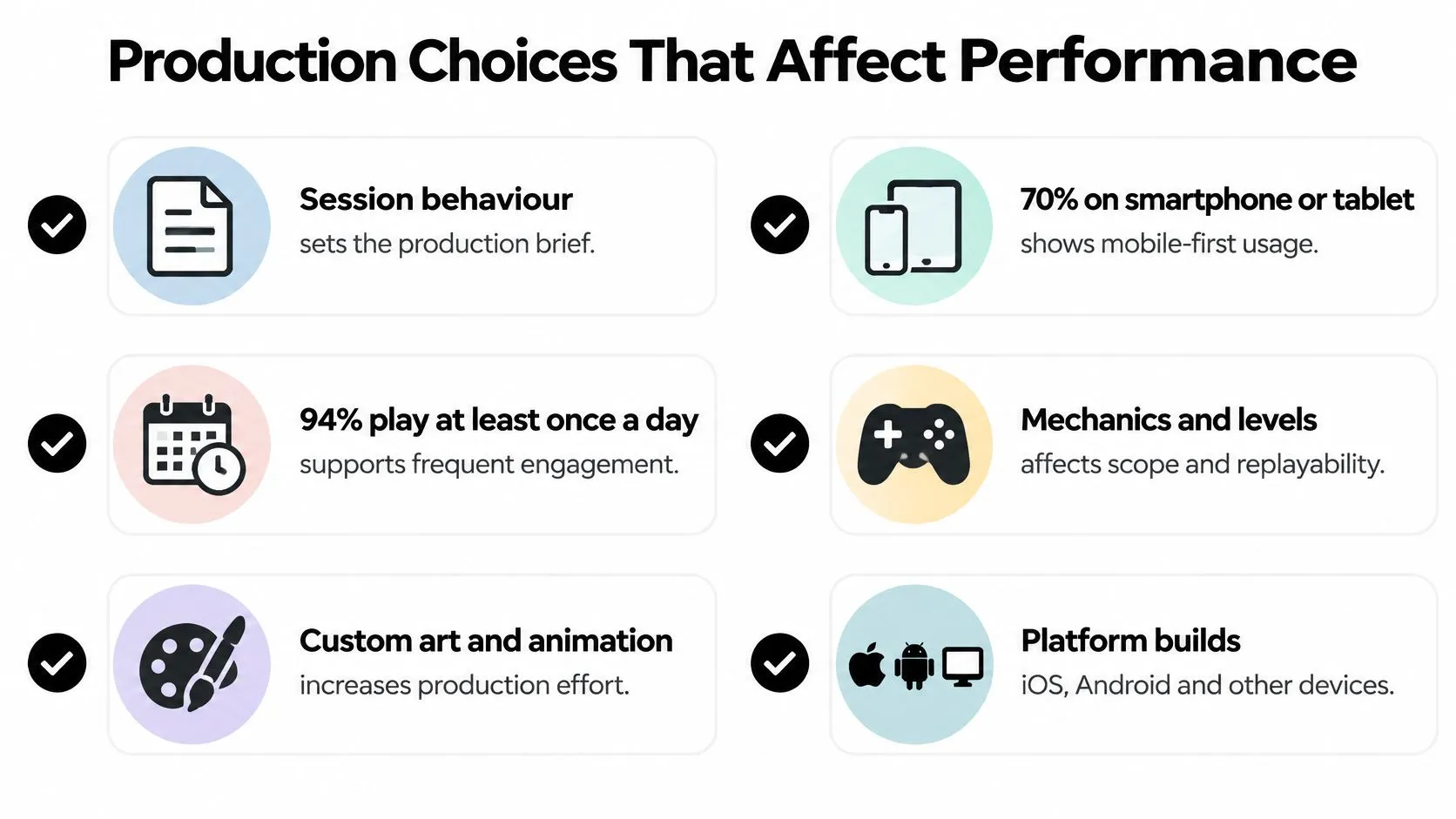
Choose the delivery environment before the engine
Start by deciding where someone will play. A browser-based campaign, an embedded playable advert and a downloadable app have different file-size constraints, integration needs and routes to launch. HTML5 is a practical choice for lightweight browser play and advertising placements where avoiding installation matters. Unity or Unreal can support richer real-time environments, but the team must still budget for mobile optimisation, packaging and device testing. Don't choose an engine from screenshots alone. Confirm publisher requirements, expected devices, available team skills and ownership of the code. The broader game design and development decisions should fit the campaign's operating conditions. Build reusable interface, reward and gameplay components where appropriate. Keep campaign text, product imagery and difficulty settings separate from core logic so authorised changes don't require rebuilding unrelated features.Instrument and test the actual experience
Create an event dictionary before implementing analytics. Name events consistently, define their triggers and include permitted attributes such as creative variant, placement and build version. Then test:- •First-frame render rate: Does the experience display successfully after it is requested?
- •Time to interactive: How long until the player can meaningfully act?
- •Playable completion: Can players understand and finish without assistance?
- •Orientation support: Do controls, text and safe areas work in the permitted layouts?
- •Mid-range phone loading: Test on representative hardware and constrained connections, not only development devices.
- •Session context: Check whether the experience works with muted sound, interruptions and limited attention.
Loading time and time to interactive aren't interchangeable. A visible opening screen may appear quickly while controls remain unresponsive; record both so the team knows what to fix. Repeated exposure also needs active management. Set frequency controls at the delivery layer, where supported, and distinguish creative variants in reporting. Plan refreshes around declining response and audience exposure, not merely a calendar reminder. A polished build that nobody can comfortably load or control is an unfinished marketing asset.
Measuring Real Impact Beyond Installs
The measurement gap is substantial: Advanced Television's account of UK gaming research reports that one-third of UK gamers say an in-game brand interaction makes them more likely to consider that brand in real life, rising to 47% among 18, 24-year-olds, while 82% of marketers say they lack a clear view of what is working and 73% identify underperformance only after it is too late. Those statements describe reported attitudes and marketer experiences, not experimentally verified sales effects. They nevertheless identify the right commissioning question: how will the brand distinguish delivered play from additional demand?
Compare proof with limitation
Measurement methods for mobile marketing games
| Method | What it proves | Main limitation | Best when |
|---|---|---|---|
| Exposed versus control group | Estimates lift in purchase or search among exposed people against a comparison audience | Needs a clean control group and a matched audience | Large audience with a usable, lawful ID match |
| Brand-lift survey | Measures differences in awareness, consideration or purchase intent | Self-reported and open to survey bias | Awareness or consideration is the goal |
| Search-lift analysis | Identifies a rise in branded searches during the campaign window | Correlation only; other activity may drive searches | The brand is searched by name |
| Promo-code or QR test | Records direct redemptions associated with a play session | Undercounts offline buyers and gifting | Retail or product offers |
| Post-campaign conversion analysis | Reports sales or leads by cohort after play | Results depend on the attribution window chosen | Purchase cycles are long |
A campaign can influence someone who never clicks. They might remember the brand later, search on another device or buy through a retailer. Click-only attribution cannot describe that whole journey. Equally, not every purchase by a player is incremental. Existing customers may be more likely both to engage and to buy. Comparing enthusiastic players with an unrelated audience can overstate the effect.
Pair methods rather than chasing perfect attribution
Where feasible, combine a controlled comparison with a direct response mechanism. A control group estimates additional outcomes; a campaign-specific code records identifiable redemptions. Each answers a different question. Random assignment provides a stronger basis for causal inference than selecting non-players after the event. If randomisation isn't possible, document how audiences were matched and what differences remain. For surveys, keep questions and sampling consistent between groups. For search analysis, log concurrent television, social, PR and retail activity. For conversion analysis, choose the attribution window before examining the results, using the actual purchase journey rather than whichever window produces the largest total. Use privacy-appropriate customer behaviour analytics to connect the steps you can observe, while stating where identity matching or consent limits visibility. The final report should separate:
- •Observed activity: What people demonstrably did.
- •Associated outcomes: What happened among exposed cohorts.
- •Estimated incrementality: What a suitable comparison suggests would not otherwise have happened.
That distinction makes the findings more defensible. It also helps the next production team decide whether to improve the mechanic, distribution, offer or follow-through.
Budgets, Timelines and Production Phases
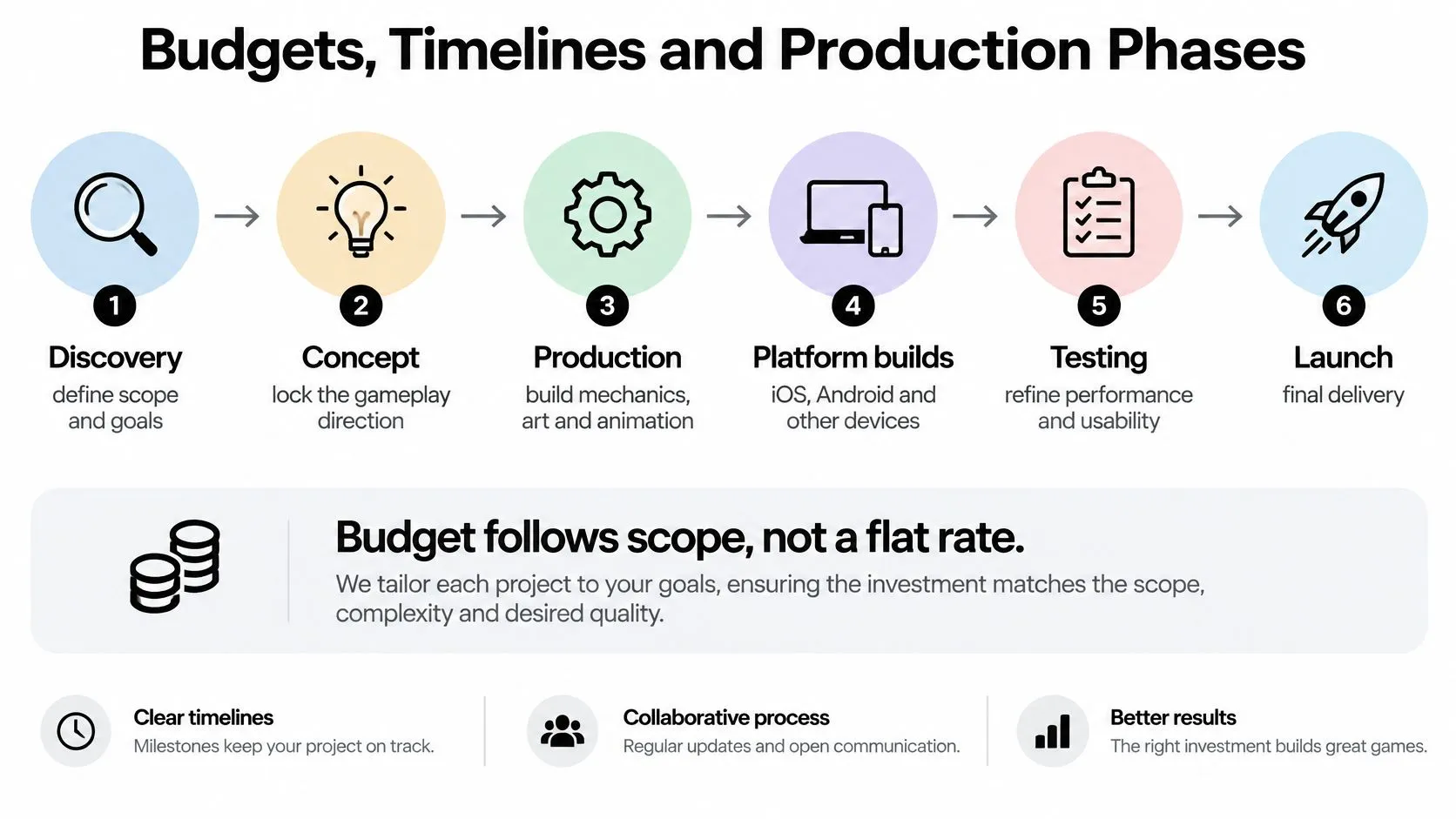
Budget follows scope, not a flat rate. Say a retailer commissions a product-matching game for a seasonal launch. The initial idea sounds compact, but its estimate changes if it requires custom characters, separate app releases, a loyalty integration and licensed music. The useful estimate prices those decisions separately. It should also distinguish production from media, hosting, maintenance and post-launch optimisation.
Buy the decisions in the right order
- Brief and mechanic definition. Agree the audience, commercial objective, delivery environment and permitted data use. Identify the people authorised to approve creative, technical and legal decisions.
- Concept and playable prototype. Test the central action with placeholder graphics. Make this the first paid production milestone after scoping, with clear acceptance criteria.
- Art and build. Produce approved assets, implement gameplay and complete the required platform integrations. Changes to the mechanic now can invalidate finished animation or interface work.
- Playtest and QA. Test usability, device performance, accessibility, reward fulfilment and analytics. Include regression testing after fixes.
- Launch and optimisation. Complete deployment, verify live reporting and assign responsibility for support, updates and campaign changes.
Separate costs from dependencies
Ask for line items covering mechanics, levels, custom art, animation, platform builds, analytics integration and QA. Identify which assets already exist, which require adaptation and which need new creation or licensing. Approval time belongs in the schedule. Brand review, privacy assessment, retailer integration and platform submission can affect the critical path even when development is progressing normally. Our completed AR and VR project for Merck Pharmaceutical is a relevant cross-format credential. It isn't a substitute for defining the scope, approvals and delivery conditions of a new mobile campaign.A useful estimate tells you what you can remove, what that saves and what stops working when you remove it.Compare studios against the same phased scope. A cheaper total may exclude integration, testing or maintenance rather than represent a more efficient route to the same outcome.
Brief a Studio for Your First Mobile Marketing Game
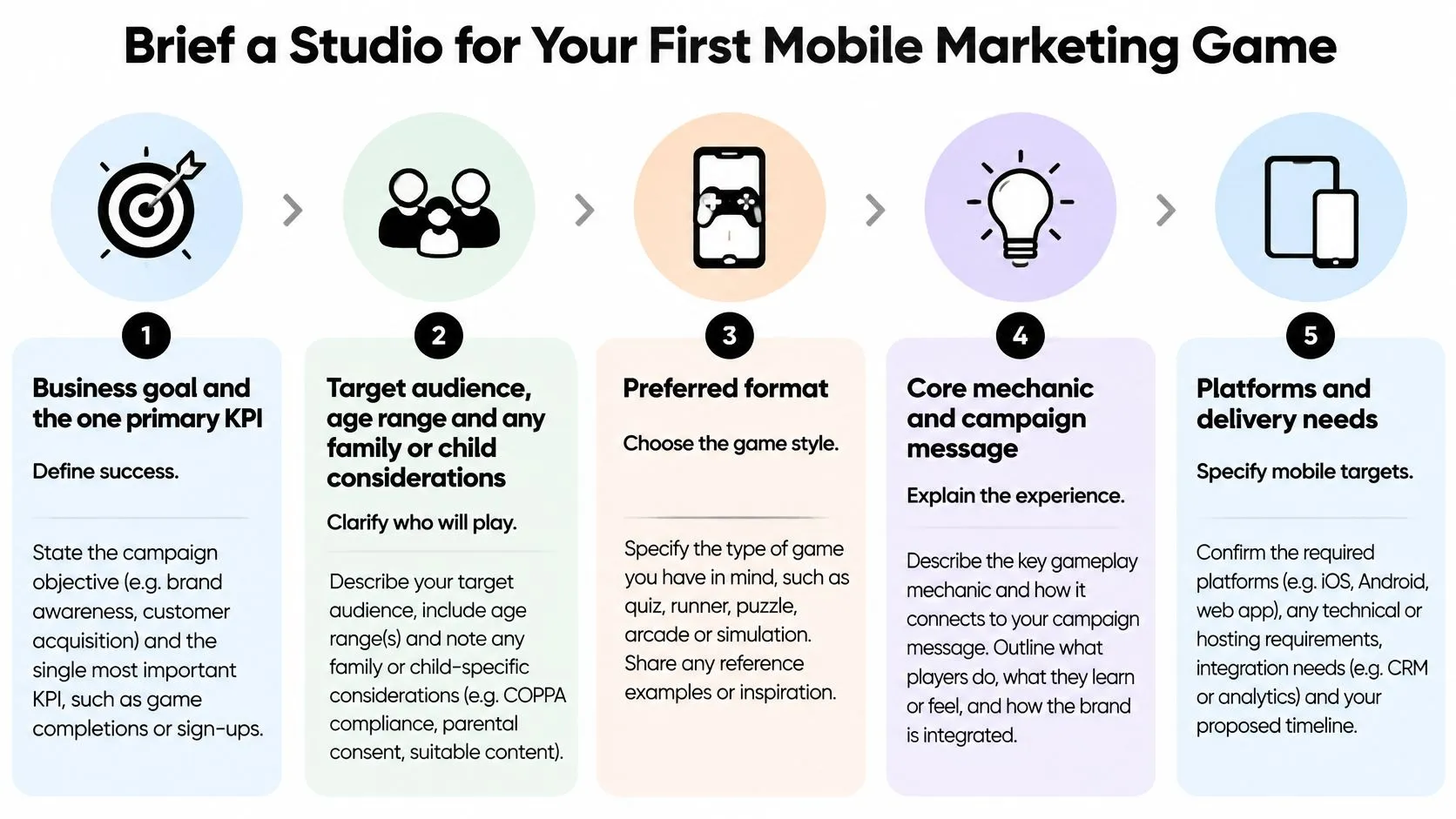
A usable brief lets a production team challenge the idea before it becomes expensive. It should describe the desired result and practical constraints without pretending every creative decision has already been solved. Use the following fields as a copy-ready starting point. Give unknowns an owner and a decision deadline rather than leaving them implicit.Write a brief that can be estimated
- Business goal and primary KPI. State the commercial change you want, how it will be judged and who owns the result. A missing KPI makes creative approval subjective and the final outcome unjudgeable.
- Target audience and age range. State whether the game will reach under-16s and identify family considerations. Specify proposed consent arrangements, collected data and whether geolocation and targeted advertising are switched off for younger players. Ask the studio to demonstrate the privacy controls before quoting, using the regulator's focus on defaults, location and advertising as a practical checklist, not an assumed age-based legal rule.
- Preferred format and reason. Choose a mini-game, advergame, gamified app or spatial experience because it supports a particular task. Allow the studio to propose a simpler alternative.
- Required platforms. Name iOS, Android, web playable or other delivery targets. Include the intended placement and any publisher specifications. A missing platform list makes the estimate unreliable because packaging, integration and testing remain undefined.
- Session length and mechanic. Describe the intended play length as a design target, then express the core action in a sentence. For example: players sort ingredients into suitable recipes to explore the product range.
- Available brand assets and rights. List supplied logos, models, animation, audio and product information. Record licensing limits, territories and approval requirements.
- Measurement plan. Identify the planned control-group, survey or promo-code approach, together with data ownership and reporting responsibilities. Confirm feasibility before promising cross-platform attribution.
- Budget range and latest launch date. Explain whether the budget includes distribution and ongoing operation. Name immovable dependencies so the studio can propose a realistic phased scope.