10 Experience Marketing Examples
Beyond the banner ad, you're competing with habits that are hard to break. People scroll past polished campaigns, mute autoplay video, and forget most digital impressions within minutes. If your team is under pressure to make a launch, event, or product story stick, passive media won't carry the whole load. That's why experience marketing matters. It gives people something to do, not just something to watch. The strongest campaigns turn a message into a moment, whether that's a VR installation, an AR retail layer, a character-led animation series, or a mixed reality game on a crowded event floor. When it works, the brand becomes tangible. The challenge is execution. Good ideas often collapse under weak production planning, mismatched technology, or creative that looks impressive but doesn't survive contact with a real audience. I've seen brands overbuild interactions nobody understands, and I've seen simpler formats outperform because the journey was clear from the first second. These 10 experience marketing examples focus on what actually helps. They show how one studio pipeline can connect animation, XR, branded storytelling, and live engagement into something more coherent than a one-off stunt. If you're trying to develop an effective video content plan, this is the practical layer many teams miss. The examples below break down where each format fits, what trade-offs come with it, and how to shape work that audiences don't just see, but feel.
1. 3D Animation Services in the UK. Studio-Quality Production from Pitch to Delivery
For brands that need polish, control, and repeatable assets, 3D animation is often the most dependable experience layer you can build. It's especially useful when live-action is impractical, the product doesn't exist yet, or the world you need cannot be filmed. That makes it one of the strongest experience marketing examples for launches, trailers, explainers, and IP expansion. Studio Liddell's value here is end-to-end production. The work runs from brief and visual development through previz, layout, lighting, and final comp, which matters because most production delays happen in handoffs between teams, not in the software itself. If you want a sense of the output range, their 3D animation examples from film, XR and ads show how the same pipeline can support very different audience needs.
Where this works best
BooSnoo for Sky Kids is a useful reference point because character consistency matters more when a brand or IP extends into shorts, promos, and supporting digital content. The same is true for product reveal films, series packages, and campaign trailers. If the asset build is modular from the start, you don't just get one film. You get a reusable visual system.
Practical rule: sign off style frames and previz before asking for heavy lighting or comp revisions. Most expensive “creative changes” are really late structural changes.
A few production habits separate efficient 3D work from expensive chaos:
- •Bring references early: mood boards, camera references, and examples of pacing save rounds later.
- •Treat previz seriously: if stakeholders ignore animatics, they usually try to fix story problems in final render.
- •Build for reuse: model libraries, environments, and rigged assets can support future edits, cut-downs, and platform variants.
2. 2D vs 3D Animation. Which Drives Better Results for Ads and Explainers?
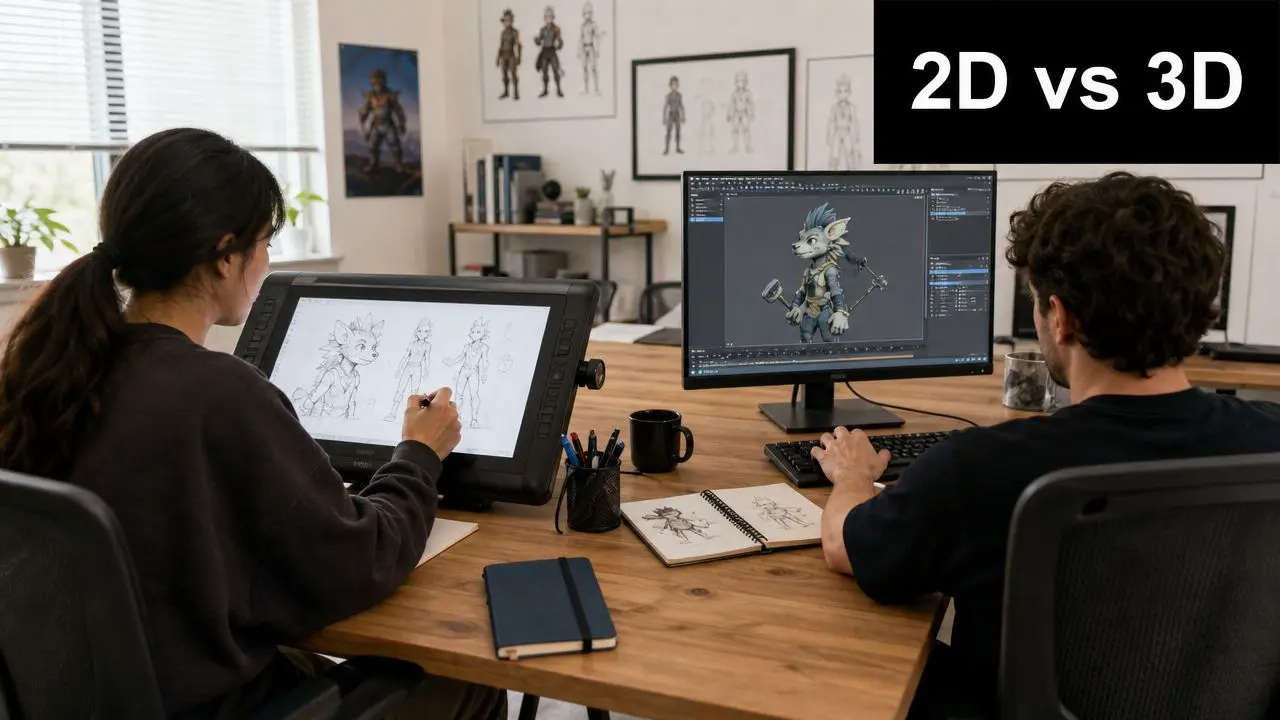
The better format isn't the one your team likes most. It's the one that matches the job. That sounds obvious, but plenty of campaigns choose 3D when they need speed, or choose 2D when they need spatial clarity. 2D usually wins when you need simplicity, warmth, graphic flexibility, or a faster response to messaging changes. Explainers, social sequences, and concept-led brand films often land better in 2D because the audience processes the message quickly. 3D wins when form, depth, product detail, or environment realism carry the idea. Technical demos, premium launches, and dimensional product storytelling usually benefit from that extra visual information.
A practical decision split
If your audience needs to understand a process, 2D often gets there faster. If your audience needs to believe in an object, mechanism, or world, 3D usually does the heavier lifting. What doesn't work is choosing based on fashion. A sleek 3D spot can still feel vague, and a charming 2D explainer can still feel cheap if the art direction doesn't align with the brand. Hybrid approaches are often the most useful middle ground. You might use 2D graphic framing for speed, then switch to 3D inserts for key reveals.
- •Choose 2D for: messaging-led explainers, frequent revisions, and lightweight social adaptations.
- •Choose 3D for: product reveals, spatial walkthroughs, and premium visual storytelling.
- •Choose hybrid for: campaigns that need both fast comprehension and standout moments.
A good studio should be able to argue against the more complex option when it isn't helping. That's often a better sign of production maturity than a flashy reel.
3. Character and Creature Animation. Rigging, Performance, and Pipeline Best Practices
Character work is where production craft becomes visible fast. If the rig fights the design, the audience feels it. If facial controls are weak, performance falls flat even when the render looks expensive. For branded worlds, children's content, games marketing, and creature-heavy spots, this is one of the most demanding experience marketing examples because viewers judge movement instinctively. The best results start before animation. Edge flow, deformation zones, and silhouette choices all affect what the rig can support. Producers who approve a design without checking animation needs often pay for it later with corrective fixes, unstable poses, and limited expression range.
What buyers should ask about
Ask how the rig will handle broad body motion, facial nuance, and shot-specific demands. Ask whether the team expects keyframe animation, motion capture, or a mix. Ask how QA is handled for broadcast delivery, because character errors often slip through when version control is loose.
A beautiful model isn't a finished character. Performance lives in the rig, the controls, and the review process.
Three practices tend to keep character pipelines healthy:
- •Prototype early: simple movement tests reveal design problems before full rig development.
- •Match technique to need: motion capture helps with large-scale body movement, while keyframe work adds timing and personality.
- •Document everything: naming conventions, control guides, and rig versions save major confusion once multiple artists touch the same asset.
BooSnoo is a strong example of why this matters. Character-led work only scales into additional shorts and formats when the performance system is dependable, not just the model sheet.
4. Motion Graphics Services for Brands. From Logo Stings to Title Sequences
Motion graphics often looks easy from the outside. It isn't. Short-form branded motion has to communicate identity, timing, hierarchy, and polish with very little room for waste. Done well, it becomes the connective tissue across a campaign. Done badly, it feels like decoration pasted on at the end. That's why motion graphics belongs on any serious list of experience marketing examples. It shapes how people enter the story. A logo sting, title sequence, social cut-down, or event opener can carry the same brand system across paid media, presentations, on-site screens, and digital content.
What separates effective motion from noise
The best branded motion starts with assets designed for movement. Static logos, type systems, and layouts often need adaptation before they animate cleanly. Teams that skip that stage usually end up with awkward transitions, unreadable titles, or generic effects that don't feel owned by the brand. A useful production conversation should cover delivery specs early. Frame rate, aspect ratio, codec, alpha requirements, and social variants aren't admin details. They shape the creative.
- •Provide a complete brand pack: fonts, colour values, logo lockups, and usage rules.
- •Design for cut-downs: title cards and transitions should work in multiple durations.
- •Keep motion principles consistent: easing, text behaviour, and transition logic should feel like one system, not isolated files.
Sky Kids style packages and series graphics show how much this layer contributes to recognition. Even when the audience remembers the character or story first, motion design often controls the professionalism they feel.
5. VR Production Studio in Manchester. Designing Immersive Experiences with Real Impact
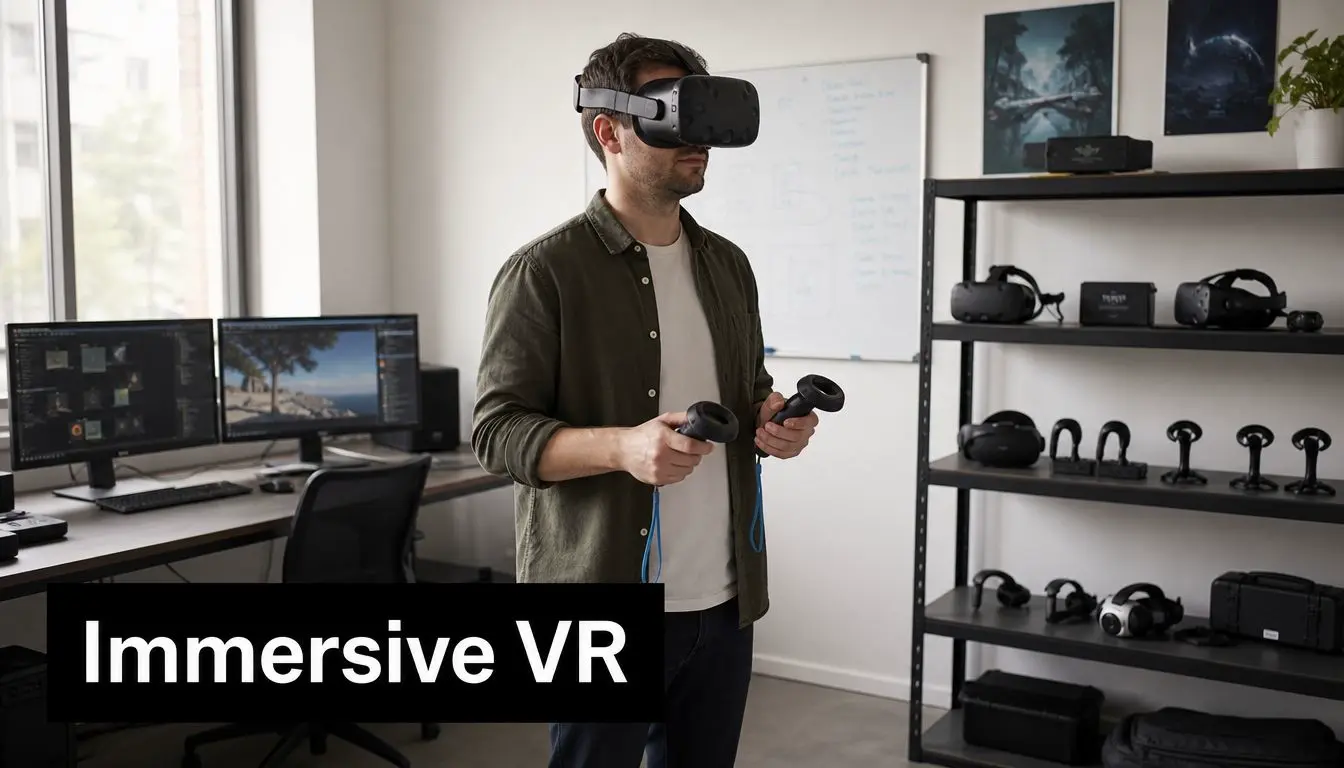
VR is useful when you need more than attention. You need presence. That could mean a training scenario, a branded world, an event installation, or a narrative piece where the audience has to feel inside the experience rather than adjacent to it. In the UK, Microsoft's AI Tour gives a concrete benchmark for what strong immersive production can do in a business setting. It engaged over 15,000 enterprise attendees across London and Manchester, and the campaign delivered a 50% increase in conversion rates compared with standard presentations, plus a 35% faster progression through sales stages for participating enterprise accounts, according to PortMA's experiential marketing case study roundup. That matters because it shows VR and real-time interactive systems aren't just spectacle. They can move enterprise buyers forward when the experience is tied to a real decision.
Production realities that matter
Studio Liddell's Manchester position makes sense for brands that want one partner across concepting, Unity or Unreal development, optimisation, and deployment. That's especially useful for event builds, LBEs, and headset-based demos, where technical decisions affect comfort, throughput, and maintenance. A few lessons keep showing up in production:
- •Design around comfort first: nobody remembers your message if they spend the session disoriented.
- •Optimise for the target headset: a good Quest build beats an ambitious build that drops frames.
- •Plan the live environment: cable management, staff flow, cleaning, and reset time affect the audience experience as much as the content.
If you're staging a physical installation around the VR itself, details like event backdrops from ABC Hire also affect how cleanly the whole environment reads on site.
6. AR for Exhibitions and Retail. Increase Stand Dwell Time with Spatial Content
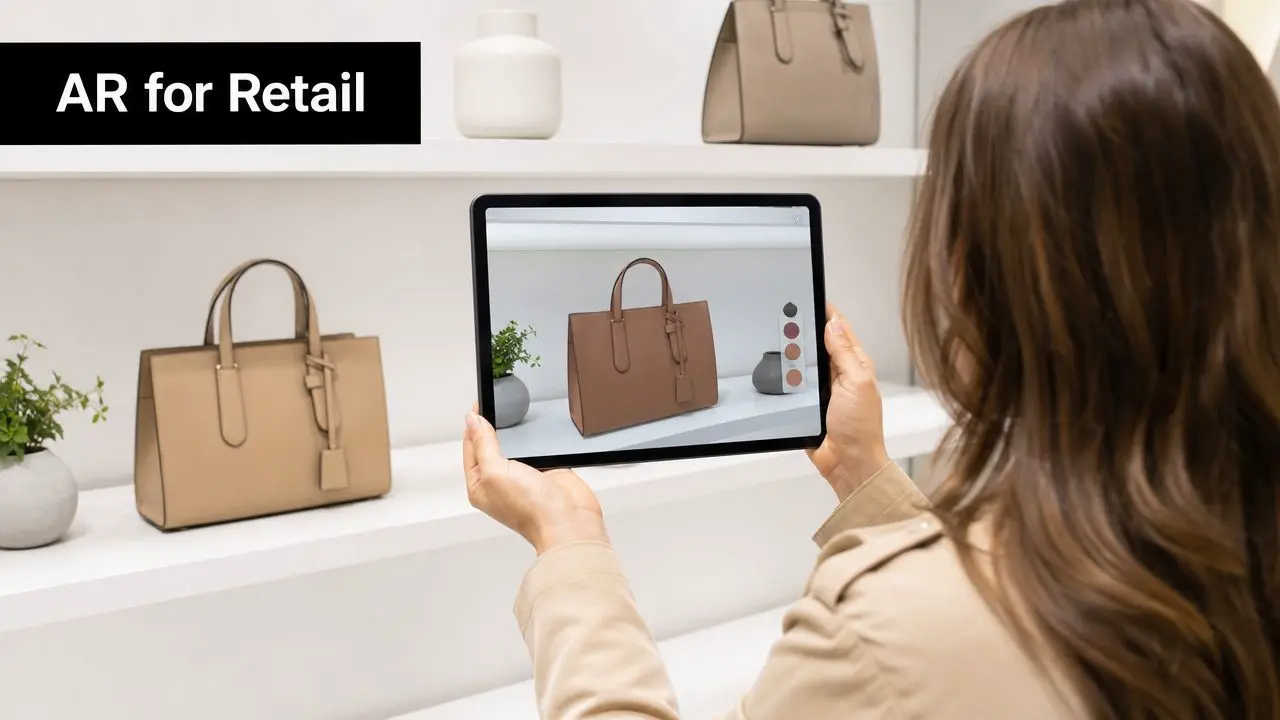
AR is often the quickest route to making a physical space interactive without putting a headset on every visitor. In exhibitions and retail, that matters. You usually have seconds to earn attention, and long onboarding kills footfall. Good AR gives visitors a reason to stop, explore, and understand more than they could from packaging, graphics, or static display alone. Think product configurators, exploded views, heritage overlays, try-ons, or spatial demonstrations that reveal how something works inside its real setting.
Why this format keeps growing
There's a clear gap in the market. A 2025 UK Salesforce report notes that only 18% of UK marketing teams currently integrate AI-driven personalisation or Unity or Unreal XR into campaigns, while 85% of UK consumers expect digital-physical hybrid experiences, according to Salesforce UK on experiential marketing. That mismatch creates room for studios that can bridge physical events and real-time content cleanly. For brands planning an exhibition, Studio Liddell's guide to an augmented reality event is relevant because the operational side matters as much as the concept. Tracking reliability, lighting conditions, device handling, and fallback options all affect whether an AR idea survives a busy floor.
On-site reality: if a visitor needs instructions longer than a few seconds, your AR activation is already losing people.
- •Reduce onboarding friction: launch directly into the interaction.
- •Use obvious visual anchors: visitors shouldn't have to guess where to point.
- •Plan non-AR alternatives: some audiences won't use their own device, and venue conditions vary.
7. Location-Based VR. Throughput, Safety, and ROI. A Producer's Guide
LBVR succeeds or fails on operations. Creative matters, but throughput is the deciding factor on a real floor. If reset times drag, staff have to over-explain controls, or hygiene slows every session, even a strong concept can underperform. Many brands misjudge immersive entertainment. They commission an impressive prototype, then discover it doesn't fit queue management, venue staffing, or event turnover. For event-led experiences, the game loop must be designed for repeated use under pressure.
The producer's view
Dance! Dance! Dance! is the kind of mixed reality format that shows the right priorities. In an event context, accessibility has to be immediate, spectator value has to be built in, and setup has to be quick enough that staff can keep the line moving. The sweet spot is usually a compact loop with a clear win state. You don't want players learning basic interactions inside the premium part of the session if you can teach them before they enter.
- •Separate tutorial from play: teach controls before the clock starts.
- •Design for spectator energy: leaderboards, visible scoring, and watchability drive participation.
- •Train staff like hosts, not technicians: the audience remembers confidence, clarity, and pace.
Safety and hygiene also need producer ownership. Headset fit, boundary management, cleaning cycles, and supervision can't be left as afterthoughts. In LBVR, those are part of the product.
8. Medical and Training Simulations in XR. Accuracy, Assessment, and Compliance
Some of the strongest experience marketing examples sit far from consumer campaigns. Training simulations are one of them. In medical, technical, and regulated sectors, XR works because it lets people practise decisions in context rather than read about them in abstraction. The catch is accuracy. A visually polished simulation can still fail if the sequence, terminology, or assessment logic is wrong. That's why subject-matter experts have to stay involved throughout development, not just sign off at the end.
What robust simulation work looks like
Scenario authoring needs to be tied to learning objectives from the start. You're not just building an environment. You're building a measurable training event with clear actions, expected outcomes, and review criteria. GeoEnergy NI is a useful example of the kind of technical communication pedigree that supports this work. When a studio can explain complex systems clearly, it's better positioned to build simulation logic that learners and stakeholders can trust.
The hard part isn't rendering realism. It's deciding what the learner must notice, do, and remember.
A practical XR training pipeline usually includes:
- •SME workshops: define procedures, edge cases, and failure points.
- •Assessment rubrics: score decisions, timing, and sequence, not just completion.
- •Data controls: privacy, retention, and user handling must be planned before deployment.
- •Update planning: procedures change, so the content must be maintainable.
This category rewards disciplined production far more than novelty.
9. BooSnoo for Sky Kids. Scaling a Beloved IP from Series to Digital Shorts
IP extension is one of the clearest ways to turn content into an experience ecosystem. A character doesn't live in one episode anymore. It lives across shorts, promos, social clips, games, and branded moments that all need to feel coherent. BooSnoo is a good example because the challenge isn't just making one polished piece. It's preserving charm, recognisability, and production efficiency as the format shifts. That's where many studios struggle. They treat a short-form extension as a miniature version of the original instead of a format with its own rhythm and audience behaviour.
What scaling IP actually requires
A durable asset library matters. So do style guides, animation rules, colour systems, and approval checkpoints that prevent drift. The reason Studio Liddell's work on children's brands stands out strategically is that this kind of expansion only works when the pipeline was built for reuse from the beginning. Their thinking is reflected in extending children's brands across platforms, which is directly relevant for teams trying to move from TV IP into digital and interactive formats without diluting what made the property work. In the UK market, this wider logic connects to live and hybrid brand experiences too. Consumers respond strongly to in-person brand engagement. Media Agency Group cites UK figures showing 85% of consumers are more likely to purchase after attending a brand experience, 70% of attendees become repeat customers, and 74% reported a more favourable opinion of a brand after an in-person experience in a 2023 study, as outlined in its piece on the rise of experiential marketing in the UK. The lesson for IP owners is simple. Consistency across touchpoints makes repeated engagement far more likely.
10. Dance! Dance! Dance! Building a High-Throughput Mixed Reality Game for Events
Mixed reality event games have one brutal test. Can a first-time player understand the fun almost immediately while everyone nearby also understands what's happening? If the answer is no, the experience stalls. Dance! Dance! Dance! belongs in this list because it solves for event reality rather than ideal conditions. It needs to be legible, social, resettable, and resilient under crowd pressure. Those constraints make it a better reference than slower, more cinematic XR work when your goal is live activation.
Why event games work when they do
A strong event game creates two audiences at once. One person plays. Everyone else watches, reacts, queues, records, and shares. That spectator layer is often what turns a fun booth into a visible brand moment. The broader experiential logic is proven in the UK. One major campaign in central London delivered over 44,000 food samples and 12,000 immersive “Pipnic” experiences, according to Real Business on experiential marketing. What made that activation effective wasn't just scale. It embedded the brand into a memorable, sensory, location-based encounter. A mixed reality game can do the same if the interaction is clear and socially contagious.
- •Keep the loop short: event formats need quick entry and quick payoff.
- •Make scoring visible: spectators should grasp the stakes instantly.
- •Build shareable moments: replays, reactions, and celebratory beats extend the experience beyond the booth.
The common mistake is overcomplicating mechanics. Event audiences don't want mastery first. They want confidence first.
10 Experience Marketing Examples Compared
| Item | Implementation Complexity 🔄 | Resource Requirements ⚡ | Expected Outcomes ⭐ / 📊 | Ideal Use Cases | Key Advantages 💡 |
|---|---|---|---|---|---|
| 3D Animation Services in the UK: Studio-Quality Production from Pitch to Delivery | High, full end-to-end pipeline, cross-discipline reviews | High, specialist teams, industry tools, rendering resources | ⭐⭐⭐⭐ Broadcast-quality visuals; strong audience engagement 📊 | High-end series, TV ads, product reveals | Studio-grade quality; scalable production; reduces internal studio overhead |
| 2D vs 3D Animation: Which Drives Better Results for Ads and Explainers? | Medium, decision framework guides approach | Low, Medium, 2D lighter; 3D needs more assets/time | ⭐, ⭐⭐⭐ Variable by medium; trade-off between speed and visual depth 📊 | Social ads, explainers, platform-driven campaigns | Data-driven selection; clarifies cost vs impact; speeds brief development |
| Character & Creature Animation: Rigging, Performance, and Pipeline Best Practices | Very high, rigging, facial systems, mocap integration | Very high, technical artists, mocap studios, tooling | ⭐⭐⭐⭐ Believable performances; reusable rigs; broadcast QA 📊 | Character-driven series, VFX-heavy productions, feature segments | Advanced rigging; mix of mocap/keyframe; reusable assets reduce future cost |
| Motion Graphics Services for Brands: From Logo Stings to Title Sequences | Low, Medium, design-led workflows, clear guidelines | Low, Medium, designers, motion tools, export pipelines | ⭐⭐, ⭐⭐⭐ Improved brand recall; quick, platform-ready deliverables 📊 | Logo stings, title sequences, social cut-downs | Fast turnaround; maintains brand consistency; platform optimisation |
| VR Production Studio in Manchester: Designing Immersive Experiences with Real Impact | High, spatial design, engine development, optimisation | High, Unity/Unreal developers, hardware testing, QA | ⭐⭐⭐ High dwell time and immersion; measurable engagement 📊 | LBEs, exhibition installs, immersive brand experiences | Multi-platform deployment; analytics-driven; supports revenue models |
| AR for Exhibitions and Retail: Increase Stand Dwell Time with Spatial Content | Medium, tracking, UX, device management | Medium, tracking tech, multi-device support, analytics | ⭐⭐⭐ Increased dwell time; measurable interaction and conversions 📊 | Retail configurators, exhibition activations, try-ons | Interactive demos; measurable ROI; shareable experiences |
| Location-Based VR (LBVR): Throughput, Safety, and ROI, A Producer's Guide | High, operations, safety, throughput engineering | Very high, venue build-out, staffing, hardware refresh cycles | ⭐⭐, ⭐⭐⭐ Optimised revenue per sqft; repeat revenue models 📊 | VR arcades, event venues, seasonal pop-ups | Throughput optimisation; scalable venue networks; operational frameworks |
| Medical & Training Simulations in XR: Accuracy, Assessment, and Compliance | Very high, SME validation, compliance, precise scenario authoring | Very high, medical SMEs, secure data systems, specialised devs | ⭐⭐⭐⭐ Objective skill assessment; improved retention; compliance records 📊 | Surgical training, emergency response, regulated corporate training | Rigorous validation; measurable competencies; regulatory compliance support |
| BooSnoo for Sky Kids: Scaling a Beloved IP from Series to Digital Shorts | Medium, multi-format asset coordination and QA | Medium, character teams, pipeline reuse, format deliveries | ⭐⭐⭐ Scalable IP reach; consistent audience engagement 📊 | Children's IP extension, multi-format distribution | Proven asset reuse; consistent character quality; efficient pipeline |
| Dance! Dance! Dance!: Building a High-Throughput Mixed Reality Game for Events | Medium, High, real-time optimisation, accessibility design | Medium, event hardware, support staff, telemetry systems | ⭐⭐⭐ High throughput engagement; social shareability 📊 | Event-based mixed-reality games, festivals, competitive activations | Rapid session design; strong replay value; telemetry for optimization |
Your Blueprint for Memorable Brand Experiences
The strongest experience marketing examples don't behave like isolated stunts. They behave like systems. A 3D animation campaign can feed social cut-downs, event visuals, product explainers, and IP extensions. A VR activation can support sales conversations, exhibitions, and training. An AR layer can turn a stand from static display into a guided interaction. When those pieces share one creative logic, the brand feels deliberate instead of fragmented. That's the main production lesson behind the examples above. Format comes second. Clarity comes first. Before you choose 2D, 3D, AR, VR, or mixed reality, decide what the audience needs to do, understand, and remember. Too many teams start with technology and only later ask what role it's meant to play. That's how you end up with impressive assets that don't move anyone. The examples also show that practical constraints are part of the creative. Throughput, onboarding time, headset comfort, file delivery specs, rig reliability, modular asset design, and stakeholder review process all shape the final impact. Ignore those details and the work becomes harder to scale. Respect them and the same investment can stretch across live activations, digital content, and longer-term brand building. That's especially important now because experience design is no longer confined to one channel. Live interaction, screen-based storytelling, and spatial content increasingly overlap. The brands getting the most from this shift are the ones building connected ecosystems, not one-off moments. If you're developing brand activation event ideas, think beyond the event footprint itself. Ask what can be reused, adapted, extended, or measured after the day ends. For teams that need both animation and XR under one roof, Studio Liddell is one relevant option. Its work spans 2D and 3D animation, apps, games, TV ads, multi-episode series, and immersive XR production, which is useful when your campaign needs one production partner instead of several specialist vendors. A good blueprint is simple to describe. Build one strong idea. Design it for the authentic audience journey. Produce it in a way that lets the experience live in more than one place. That's how brand moments stop being disposable and start becoming part of how people remember you. --- If you want a production partner that can connect animation, XR, games, and branded digital storytelling into one coherent campaign, explore Studio Liddell and book a conversation around your next experience-led project.