Land a Stop Motion Animation Job: A UK Career Guide
If you're searching for a stop motion animation job in the UK, you're probably running into two problems at once. Most online advice is too broad, and most job listings don't reflect how this part of the industry hires. UK stop motion is small, craft-heavy, and relationship-driven. Studios don't just want someone who loves animation. They want someone who can fit into a precise pipeline, protect a shot from avoidable mistakes, and show they understand how physical production differs from CG. That changes how you should train, what you should put in your reel, and where you should look for work. A lot of applicants call themselves “stop motion animators” when they’re really at the experimentation stage. That’s not a criticism. Everyone starts there. But hiring teams can tell very quickly who understands the discipline as a professional set craft and who only understands the aesthetic. If you want to get hired, you need to close that gap.
Mastering the Core Disciplines of Stop Motion
A stop motion production rarely hires for one vague creative role. It hires for specific disciplines. If your portfolio tries to be everything at once, it often reads as junior. If it shows a clear specialism and a working understanding of adjacent departments, it reads as employable.

Animator, model maker, rigger, lighting technician
The animator handles performance, timing, spacing, eye direction, weight, and continuity. This is a frequently sought-after initial role, but it’s also the easiest to misunderstand. Good stop motion animation isn’t just moving a puppet attractively. It’s controlling movement in tiny, repeatable increments so the action reads cleanly in playback. In UK studio practice, productions such as Aardman commonly animate on twos at 25 frames per second, which means each puppet position is held for two frames and results in roughly 750 to 800 unique exposures per minute. Animating on ones doubles the labour and is usually kept for very fast action, as noted in this stop motion production reference. If you don’t understand that trade-off, your test animation will usually show it. The model maker solves a different problem. They build characters and props that can survive handling, hold detail under camera, and remain consistent across a shoot. That means thinking about finish, durability, replacement parts, and how materials behave under heat and light, not just whether the sculpt looks good on a turntable. The rigger works below the skin of the puppet. If an armature slips, drifts, binds, or wears out too quickly, the animator pays the price frame by frame. A good junior rigging portfolio shows clean engineering decisions, maintainability, and an understanding of how movement will be performed on set. The lighting technician in stop motion needs patience and consistency more than flair. Dramatic lighting that flickers, shifts colour, or softens a model is a problem, not a signature.
Practical rule: Pick one discipline as your hiring target, then learn enough about the next department along the chain that you don't create problems for them.
What studios actually want to see
Hiring managers look for evidence that you understand physical constraints. That usually appears in work like this:
- •For animators: Clear walk cycles, subtle head turns, controlled dialogue tests, and shots with a beginning, middle, and end.
- •For model makers: Clean seam handling, expressive sculpting, consistent paint finish, and replacement systems that make sense.
- •For riggers: Armatures that look serviceable, stable, and precise, not just impressive in close-up photos.
- •For lighting crew: Controlled exposure, repeatability, and proof that you can maintain a look over time.
A common mistake is presenting one polished still image and assuming it proves production readiness. It doesn't. Stop motion hiring is built around repeatable execution.
The hands-on skills that matter
The strongest junior candidates usually have practical habits, not just creative instincts. They mark positions, test materials early, and simplify shots before adding complexity. They also understand why amateur work often breaks down: puppets soften, cameras shift, and movement gets pushed too far between frames. Useful foundations include:
- Material handling
- Increment control
- Set discipline
- Capture workflow
The applicants who stand out aren't always the most stylistic. They're often the ones whose work looks dependable.
How to choose your specialism early
If you’re not sure where you fit, use your own working habits as the clue.| If you enjoy... | You should test... |
|---|---|
| Performance, timing, acting | Animation |
| Sculpting, finishing, fabrication | Model making |
| Mechanisms, joints, precision builds | Rigging |
| Mood, exposure, consistency on set | Lighting |
The Professional Stop Motion Production Pipeline
A Bristol animator finishes a shot at 7pm, hands it off, and the comp team spots a rig problem that should have been caught on set. In a small student film, that is annoying. In a UK studio pipeline with booked stages, fabrication schedules, and client review dates, it costs money and knocks other departments off plan.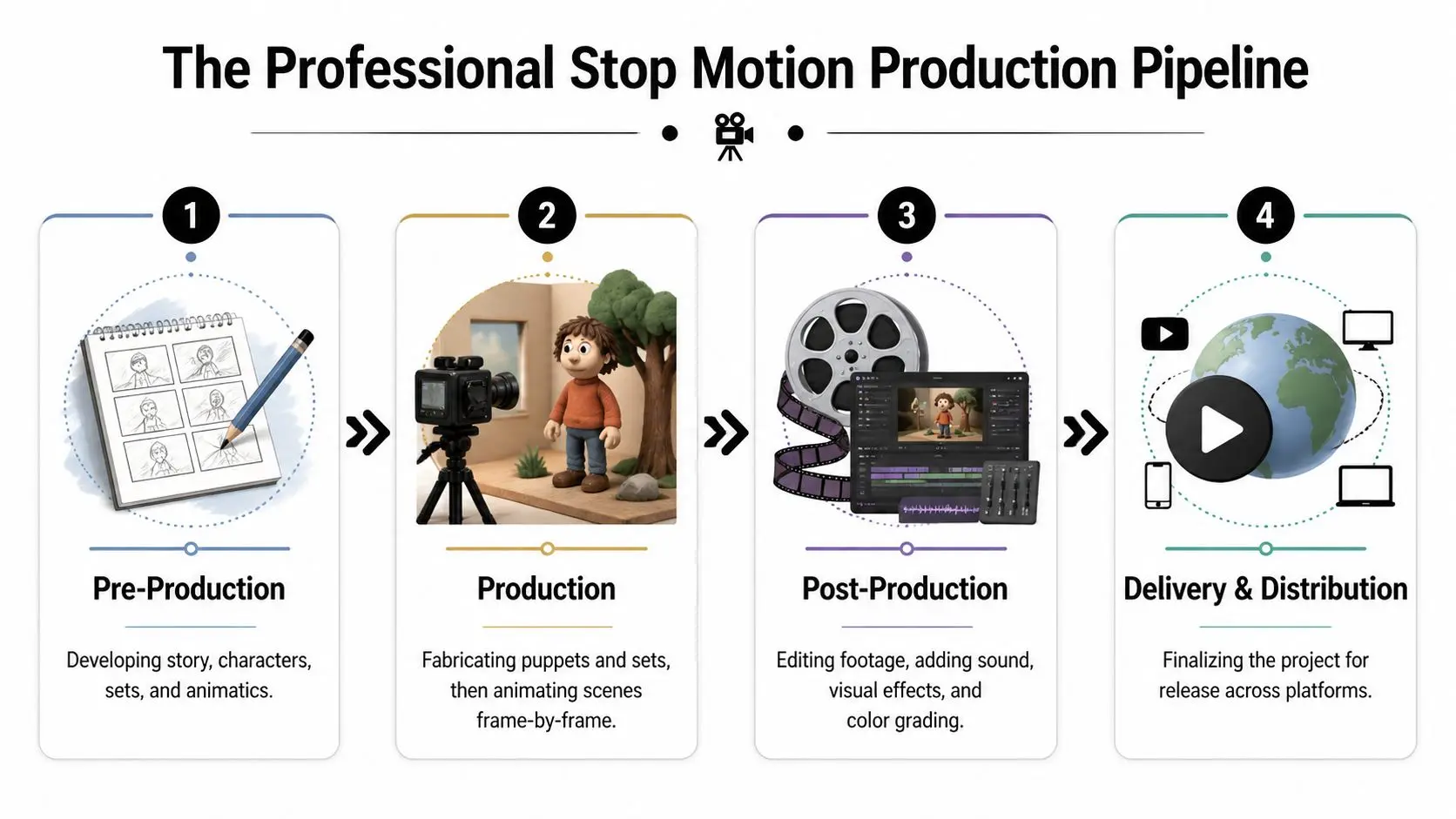
Pre-production decides whether production is calm or expensive
Professional stop motion runs on clear handoffs. By the time a shot reaches the stage, the director, animator, puppet department, art department, camera, and post team should already agree on what the shot is, how it will be achieved, and what could go wrong. In UK hubs such as Bristol and Manchester, studios tend to judge pre-production by one practical question. Can the shot be built, lit, animated, and finished without discovering core problems halfway through? If the answer is no, the shot is not ready. Animatics carry more weight in stop motion than many new applicants expect. They are not just timing guides. They expose access issues, lensing problems, rigging needs, replacement requirements, and whether a set gives the animator room to work. A rushed animatic usually creates expensive fabrication changes later. A useful test is simple. If the storyboard artist, fabricator, and animator each describe the shot differently, the production team is still guessing.Fabrication has to survive performance
Beautiful design work does not get hired on its own. Studios hire builds that perform repeatedly under lights, under pressure, and across a schedule. That means puppets, costumes, props, and set pieces need to hold alignment, allow access, and recover after handling. A puppet that looks excellent in stills but drifts off model after a few seconds of animation is not production-ready. Recruiters and heads of department spot that quickly. This is one of the biggest gaps between graduate work and studio work in the UK. Applicants often present sculpt quality, paint finish, or costume detail, but they cannot explain joint range, tie-down strategy, maintenance, or how a replacement system was logged. In a real pipeline, those details matter because someone else has to inherit your work without delay.Shoot days expose weak habits fast
Capture is where discipline becomes visible. Frame by frame work punishes inconsistency. Slight lighting shifts, bumped set dressing, poor notes, or careless rig placement all create problems that post has to spend time cleaning. On a professional set, the animator is not working in isolation. They are protecting continuity for editorial, giving comp clean options, and making sure the next shot can match what has already been approved. Good set practice includes checking frame edges, keeping silhouettes readable, watching contact points, logging takes properly, and backing up stills in an organised way. I have seen applicants talk about animation as pure performance. Studios in Bristol rarely separate performance from set discipline. If your spacing is strong but your shot creates cleanup headaches, the result is still weak by hiring standards. If you want a useful comparison from a neighbouring discipline, this guide to end-to-end studio production for 3D motion graphics shows the same principle. Every downstream department depends on decisions made upstream.Post-production rewards organised crews
Post is where the footage gets finished, not rescued. Cleanup, compositing, grading, editorial, and sound all work better when the set team has logged takes clearly and handed over consistent assets. That includes boring but necessary admin. Frame naming. Take notes. Version control. Replacement charts. Clear shot status. In many UK productions, especially smaller commercials and short-form jobs around Manchester, the people who stay employed are the ones who make handover easy for the next department. A strong candidate understands where their work sits in that chain. An animator should know what comp needs. A fabricator should know what animation will stress. A junior applying to a stop motion animation job does not need to know every department in depth, but they do need to show that they can work in a shared system. Studios also look at how you present yourself outside the reel. A tidy portfolio site helps producers and recruiters check credits, stills, breakdowns, and contact details quickly. For many applicants, simple one page websites for creators are enough if the work is easy to review. The professional difference is straightforward:- •Shots are approved before fabrication starts, not debated on set.
- •Builds are tested for performance, not just appearance.
- •Animators protect continuity, lighting, and cleanup options while they animate.
- •Post receives organised files and useful notes, not a mess to sort out.
- •Good hires understand the whole chain, even when they specialise in one department.
That is the standard UK studios hire against. Talent matters. Reliability inside a pipeline gets people booked again.
Building a Showreel That Gets You Hired
Most applicants overestimate the value of effort and underestimate the value of editing. A hiring manager doesn’t need proof that you worked hard. They need proof that you can do the job. Your showreel is the single clearest answer to the question every recruiter asks within seconds: Can this person contribute on a real production?

Put employability ahead of personality
Style matters, but not before clarity. If your reel opens with a long logo, abstract title card, moody music intro, or work that needs explanation, you’re wasting your strongest seconds. Lead with the shot that proves your value fastest. For an animator, that might be a performance with believable weight and intent. For a model maker, it might be a puppet breakdown showing sculpt, finish, and function. For a rigger, it might be a clean mechanical demonstration paired with evidence of how the build performs in motion. A good reel answers these questions quickly:
- •Can you control movement?
- •Can you finish work cleanly?
- •Can you repeat quality across more than one shot?
- •Do you understand the discipline you’re applying for?
If the answer only becomes clear after a minute, the reel is too slow.
Tailor the reel to the job
One generic reel is usually weaker than two or three focused versions. Studios hire by need. If you apply for fabrication with an animation-heavy reel, or for animation with a reel dominated by concept art, you create friction for the reviewer. Use role-specific cuts such as:
| Target role | What should dominate the reel |
|---|---|
| Animator | Performance tests, walks, acting, physical interaction |
| Model maker | Puppet builds, finish quality, replacement systems, scale awareness |
| Rigger | Armature construction, joint control, practical access, durability logic |
| General entry role | Clear craft fundamentals across two adjacent skills |
The same rule applies to your portfolio site. Don’t bury your best work in clutter. Many junior artists benefit from studying examples of simple one page websites for creators, because a clean single-page portfolio often helps a recruiter reach your best work faster.
Hiring view: If I have to hunt for the relevant work, I start assuming you don't know what the role requires.
Show process, but only when process adds proof
Process material is useful when it explains competence. It’s not useful when it pads the reel. Good supporting material includes:
- •Before-and-after views that show rig removal or surface cleanup
- •Puppet breakdowns that reveal armature access, replacement parts, or fabrication logic
- •Passes and tests that show timing choices, not just final glamour shots
- •Shot sheets or frame grabs when they reveal your control and planning
Bad supporting material usually includes long mood boards, coursework slides, or behind-the-scenes clips that don't clarify your contribution.
Personal projects can get you hired
You don’t need studio credits to make a strong stop motion animation job application. You do need work that feels purposeful. Build short projects around one hiring question at a time:
- Can you animate weight?
- Can you animate thought?
- Can you fabricate for performance?
- Can you keep continuity?
Presentation details that quietly matter
Studios notice care. Name files properly. Label your role clearly on collaborative projects. Keep music unobtrusive. Add contact details on-screen and in the description. Make sure the video loads quickly and can be viewed without friction. One more thing. Don’t hide unfinished edges behind cinematic grading or loud sound design. If the animation is weak, decoration won’t save it. If the craft is strong, you don’t need to oversell it.Where to Find Your Stop Motion Animation Job in the UK
You finish a reel, send it to a few big job boards, then hear nothing for weeks. That happens because UK stop motion hiring rarely works like volume-based digital recruitment. Studios hire around productions, freelance cover, short assistant runs, and recommendations from people already on the floor.
Why the market feels hard to see
The field is small, and many openings never sit publicly for long. Some are posted discreetly on studio sites. Some are filled through recent testers, trusted freelancers, or people who have already made sensible contact. If you only search broad creative job boards, you miss a large part of the actual hiring activity. In the UK, location matters more than many new applicants expect. Bristol remains the obvious centre because of the concentration of stop motion production there and the wider network of art department, puppet, modelmaking, post, and production talent around it. Manchester matters for a different reason. It has long-standing strength in fabrication, character build, creature work, and specialist making, which often overlaps with stop motion hiring. Treat those places as working ecosystems, not just dots on a map. A stronger search strategy is to build a targeted list of studios, puppet workshops, modelmakers, production companies, and creative suppliers in Bristol, Manchester, and nearby areas. Then track them properly. Check careers pages. Follow company updates. Watch for signs of incoming production, commercial work, or expansion in departments adjacent to animation.Search by studio and function, not just by title
Job titles in stop motion are inconsistent. One studio might advertise for an animation assistant. Another might list a junior maker, shoot assistant, production runner, armature technician, or art department trainee for work that leads into the same career path. Search terms should reflect that reality:- •Studios and facilities
Look at the companies themselves first, especially in Bristol and Manchester.
- •Departments
Animation, fabrication, puppets, modelmaking, rigging, art department, production support, and stage crew all matter.
- •Project type
Features, commercials, children’s TV, idents, branded content, and museum or installation work all create stop motion employment.
- •Region
Use city and county terms, not just “UK”. If you want a wider view of hiring channels beyond stop motion, this guide to animation job resources in London is useful context. For stop motion specifically, regional targeting usually produces better results. A common mistake is to only look where listings are visible.
Bristol and Manchester work differently
Bristol tends to reward applicants who understand production pace and screen performance. Manchester often rewards applicants who can speak clearly about build quality, materials, mechanisms, and workshop discipline. That is not an absolute rule, but it is a useful one. An animator applying into Bristol should know the local standard of performance is high. A maker applying into Manchester should expect close questions about finish, durability, access, and whether the piece can survive handling on set. Applicants who ignore those differences often send decent work framed in the wrong way. That is why generic applications fail. The work may be good enough. The targeting is not.
Speculative applications still matter
Good speculative emails get read because they save time for a producer, recruiter, or department lead. Weak ones create more work. A useful speculative application should do four things:
- Name your discipline immediately
- Show that you know the studio
- Link the right work first
- Ask for the right thing
Use adjacent entry points intelligently
A lot of people enter stop motion through nearby roles. That can mean modelmaking, prop work, scenic support, runner jobs, workshop assistance, production coordination, or junior rigging. In UK studios, especially smaller ones, reliability in one department often gets noticed before someone is trusted with more specialised work. This route has a trade-off. Adjacent roles get you into the building and teach set discipline, but they do not automatically prove animation ability. Keep developing the specific craft you want to be hired for, even while taking nearby work.Build recognition before vacancies open
Relationships in stop motion are usually built through repeated contact and visible improvement. Festivals help. Portfolio reviews help. So does being the applicant who sends a better reel six months later instead of disappearing. People remember candidates who are specific, polite, and easier to place in a real production setup. They also remember who arrived with unrealistic expectations, sent the wrong material, or treated a small craft sector like a mass-application numbers game.Nailing the Interview and Animation Test
By the time you reach interview stage, your reel has already done the first job. Now the studio wants to know whether the person behind the work is thoughtful, dependable, and easy to trust under production pressure. That’s especially important in stop motion. You’re often working in close quarters, on expensive sets, with fragile assets, against a schedule that doesn’t leave much room for drama.How to talk about your work properly
Weak candidates narrate what’s visible. Strong candidates explain decisions. If you’re showing an animation shot, don’t say, “This is a sad walk cycle.” Explain how you adjusted spacing, holds, or posture to support that feeling. If you’re showing fabrication, discuss material choice, access points, replacement strategy, or how the build was meant to perform on set. Interviewers usually listen for three things:- •Judgement
Can you tell the difference between a nice idea and a workable one?
- •Self-awareness
Do you know what still needs improvement?
- •Collaboration
Can you receive direction without becoming defensive? A good answer often includes one thing you’d keep, one thing you’d change, and the reason behind both.
Be specific about your mistakes. It signals maturity, not weakness.
Questions you should be ready for
Studios tend to ask variations of the same underlying questions. Prepare your own examples in advance.
| Likely question | What they’re really checking |
|---|---|
| Tell us about this piece | Whether you understand your own process |
| What part did you handle? | Whether you’re honest about contribution |
| What was difficult? | Whether you can diagnose problems |
| How do you take feedback? | Whether you’ll be workable on a team |
| Why this studio? | Whether you’ve done your homework |
Don’t memorise speeches. Build clear examples. Useful examples include a shot that went wrong and how you recovered it, a build that needed redesign, a timing choice you changed after review, or a collaboration where another department changed your plan for the better.
How to approach the animation test
The animation test is rarely about making something flashy. It’s about showing process under constraint. Start by reading the brief carefully and stripping it to fundamentals. If the test asks for a simple character action, prioritise clarity, weight, balance, and intent. Don’t chase complexity unless the basics are already controlled. A solid approach looks like this:
- Thumbnail the action
- Plan timing before touching the puppet
- Block the major positions first
- Check playback constantly
- Leave time for polish
Questions to ask the studio
You should ask questions too. Good ones show that you understand production reality. Ask about things like:- •How animation notes are reviewed
- •How departments hand off work
- •What a strong first few months looks like in the role
- •Whether the team expects narrow specialism or broader flexibility
Avoid questions that suggest you’re only interested in perks or prestige. Early interviews are about fit, standards, and readiness. A studio doesn’t need you to know everything. It does need you to think like someone who can learn quickly without creating avoidable problems.
Salary Expectations and Career Progression in 2026
A common UK stop motion path looks like this. You start on short contracts, pick up assistant or support work, spend time between productions, then gradually become the person a studio trusts to carry shots, solve problems, or handle a specialist craft area without supervision. Pay follows that pattern. It rarely climbs in a neat line. That is why broad salary tables for stop motion are often misleading. The UK market is small, heavily project-based, and clustered around a few production centres, especially Bristol and parts of the North West, including Manchester. A junior animator at a major studio production, a freelance fabricator on a commercial, and a workshop technician supporting puppet builds may all be in the same sector while working on very different terms. The safest way to frame pay in 2026 is by what changes your rate. Studios pay more for proven reliability, specialist craft, and credits on recognised productions. They also pay differently by region, contract length, and whether the role is tied to series work, features, commercials, or mixed media output. Bristol usually offers the deepest concentration of stop motion roles, but it also has the strongest competition. Manchester and nearby production networks can be attractive for artists with hybrid skills, especially if they can move between animation, fabrication, design, and broader content pipelines.
UK stop motion animation salary ranges 2026 estimate
| Role | Junior (0-2 Years Experience) | Mid-Level (3-6 Years) | Senior (7+ Years) |
|---|---|---|---|
| Animator | Lower pay bands, fixed-term contracts, test-heavy entry | Higher rates once shot consistency is proven | Premium goes to lead-level reliability, speed, and note handling |
| Model maker | Often starts through workshop support or assistant fabrication | Better pay for clean finishes, repeatability, and material control | Senior rates attach to specialist builds, supervision, and problem-solving |
| Rigger | Entry points are fewer, usually tied to technical craft ability | Strong demand if rigs are reliable and easy for animators to use | Senior riggers are valued because replacement is difficult mid-production |
Career progression is easier to map than exact pay. Animators usually progress from assistant or junior-level support into shot ownership, then senior, lead, or supervision. Fabrication artists often branch into character builds, mould-making, armatures, replacement parts, paint and finish, or department leadership. Riggers can become particularly valuable because a good one saves time for every other department. In UK studios, progression usually depends on three things. Consistency under production pressure. Clean communication with heads of department. A reputation for handing work over in a state that does not create problems downstream. That last point matters more than many applicants realise. A flashy shot may get attention. A year of dependable work gets renewals, referrals, and better contracts. Recruiters and production managers remember the people who hit quality on schedule, take notes well, and stay calm when a puppet, rig, or shot plan starts fighting back. The strongest long-term careers are rarely built on one narrow title. They are built on a clear specialism plus adjacent value. An animator who understands puppet care and continuity is more useful on set. A fabricator who understands how animation stresses a build makes better decisions in the workshop. In Manchester especially, where teams may be smaller or more hybrid, that flexibility can help you stay employed between pure stop motion productions. If your goal is stability, build depth first, then range. UK studios hire specialists. They keep calling the ones who are also easy to place across real production needs. If you're developing a portfolio, planning a showreel, or looking for production insight from a studio working across animation, games, and XR, Studio Liddell is worth exploring. Their work spans broadcast-quality animation and immersive production, which makes them a useful reference point for anyone building a modern career around screen craft.