Immersive Digital Experiences in 2026: A Practical Guide
The popular advice is simple: put on a headset, add a dramatic reveal, and call the result immersive. That approach produces memorable demonstrations, but it often fails the harder test, whether the experience ships reliably, works for its intended audience, and creates value beyond a busy event floor. Immersive digital experiences are better understood as designed systems. They combine spatial interaction, real-time content, carefully chosen hardware, narrative structure, and measurable user behaviour. A polished VR demo can be part of that system, but so can an AR product guide, a mixed reality game, an interactive installation, or a training simulation that helps someone perform a task with greater confidence. The UK has the creative and technical base to support this wider view. The sector has been estimated at 1,000 specialist companies, around 4,500 employees, and £660 million in sales, with activity distributed beyond London across places including Brighton, Bristol, Newcastle, Liverpool, Manchester, Cambridge, Oxford, and Edinburgh, as summarised in the UK immersive audiences report. The production question now isn't whether XR can attract attention. It's where a carefully scoped experience can replace, extend, or improve an existing process.
What Immersive Digital Experiences Actually Mean
Immersion doesn't start with a headset. It starts with the relationship between a person, a space, a story, and a response. A VR experience can transport someone into a designed environment. AR can add useful information to the physical world through a phone or headset. Mixed reality can anchor digital objects to real surroundings and let people interact with both at once. WebAR can remove the app download and make a lighter experience available through a browser. Location-based installations add the physical venue, staff, queue, safety process, and audience flow to the production brief. The technology stack matters, but it serves the experience rather than defining it.
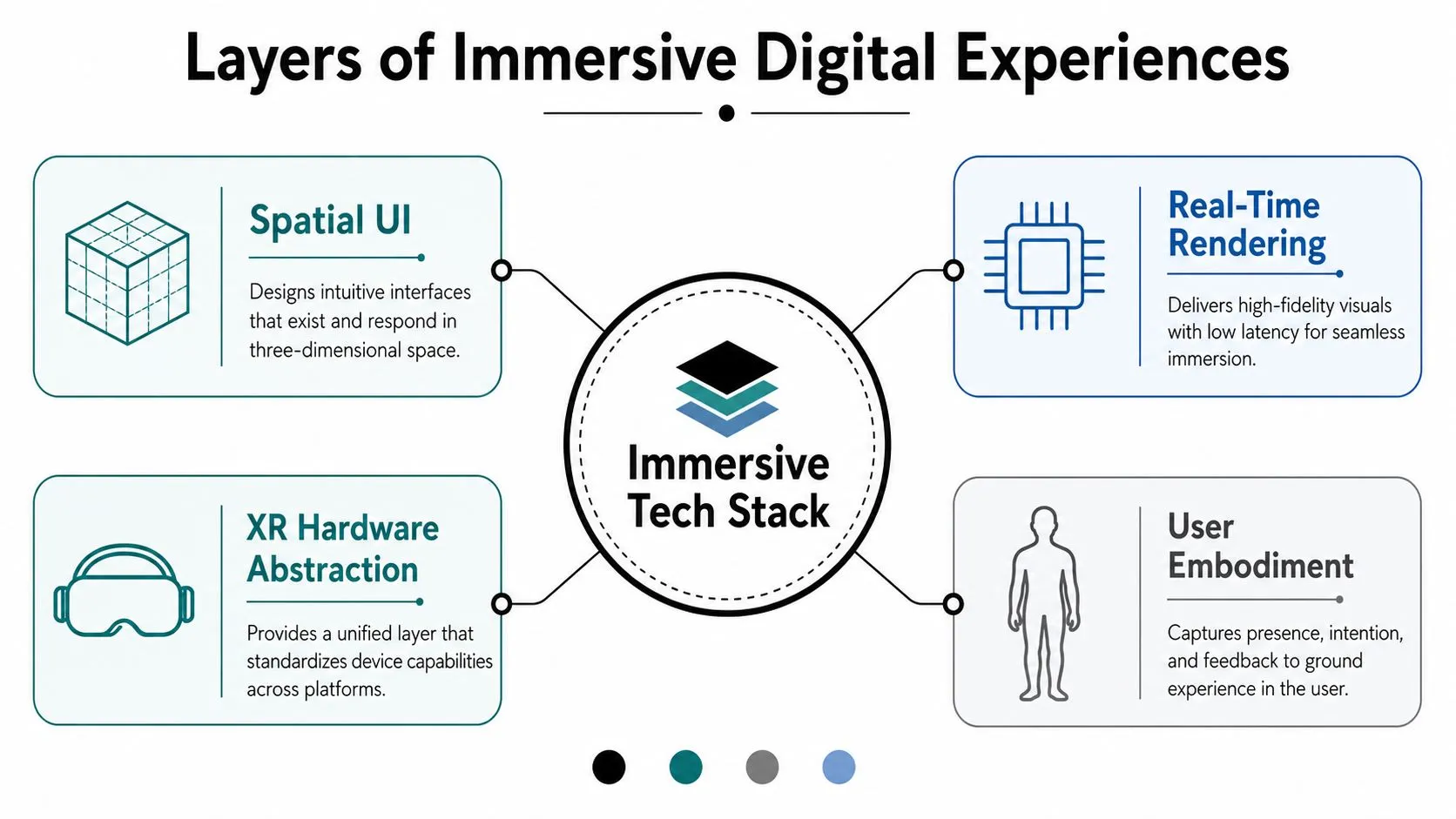
Four layers shape the experience
- •Visual immersion covers stereoscopic imagery, animation, lighting, spatial composition, real-time rendering, and the clarity of digital overlays.
- •Auditory immersion includes spatial sound, dialogue, musical cues, environmental ambience, and audio feedback that helps users understand what has changed around them.
- •Haptic immersion uses controllers, vibration, tracked objects, motion platforms, or physical interfaces to make actions feel consequential.
- •Contextual immersion gives the user a reason to act. It includes narrative, task design, social setting, physical location, accessibility, and the consequences of each choice.
Spatial UI design becomes especially important because conventional screen habits don't transfer neatly into three-dimensional space. A button can't float in front of a user without considering reach, sightlines, fatigue, occlusion, and the possibility that the user doesn't know what to do next. Real-time rendering creates responsiveness, while AI-enhanced systems can support procedural generation, adaptive non-player characters, or content variations. Those tools still need direction, testing, and editorial control. For a clear explanation of how physical and digital environments can coexist, the mixed reality guide is a useful reference. The practical distinction is straightforward: choose the format that supports the behaviour you need, not the device that looks most impressive in a pitch.
Where the UK Immersive Market Creates Real Value
The UK market shows why spectacle is a weak buying criterion. A UK mapping exercise identified 1,550 unique XR business examples, with 37.9% in consumer engagement and 21.7% in learning and development, while engineering and manufacturing led adoption at 24.13%, according to the UK XR business mapping data. These categories overlap, but the commercial pattern is clear. Public activations win attention. Operational applications have more potential for repeat deployment. Across the broad grouping of consumer engagement and learning, 46% of UK XR use cases are concentrated in consumer engagement and learning. That concentration does not make consumer work less valuable. A well-designed activation can support brand understanding, visitor participation, or product education. The buying error comes from assessing a one-off event with the criteria of a repeatable business workflow.
The value pool looks different by buyer
| Vertical | Share of UK Projects | 2024-2026 CAGR | Typical Buyer |
|---|---|---|---|
| Consumer engagement | 37.9% | Not established in the verified UK data | Brand, agency, venue, retailer |
| Learning and development | 21.7% | Not established in the verified UK data | Training, HR, education, operations |
| Engineering and manufacturing | 24.13% adoption | Not established in the verified UK data | Engineering, manufacturing, technical sales |
The verified UK data does not establish CAGR for these verticals. Buyers should therefore focus on the job the experience performs rather than fill the gap with invented forecasts. Does it reduce reliance on physical prototypes? Can a trainee rehearse a difficult scenario safely? Does it let a sales team show equipment in context before a site visit? Can stakeholders understand a complex process without waiting for a full production environment? Those questions expose the trade-offs. A consumer activation may optimise for reach, participation, and recall. A training or engineering application may serve fewer people, but run repeatedly, support a controlled workflow, or reduce the cost of access to equipment and locations. The format matters less than whether the client can operate it after launch. The broader sector has been estimated at around £660 million in sales, with potential to reach £1 billion, according to the same UK market analysis. At that scale, procurement teams need evidence, maintenance responsibilities, content ownership, and deployment terms, not only an impressive demo. For browser-based examples and practical deployment considerations, the UK WebAR business guide provides a useful companion.
The Production Pipeline from Brief to Delivery
A shippable immersive project behaves more like software production than a single film render. The brief must specify the audience, environment, device, interaction model, content lifecycle, and evidence required after launch. Those decisions determine the production route before anyone builds a polished demo.
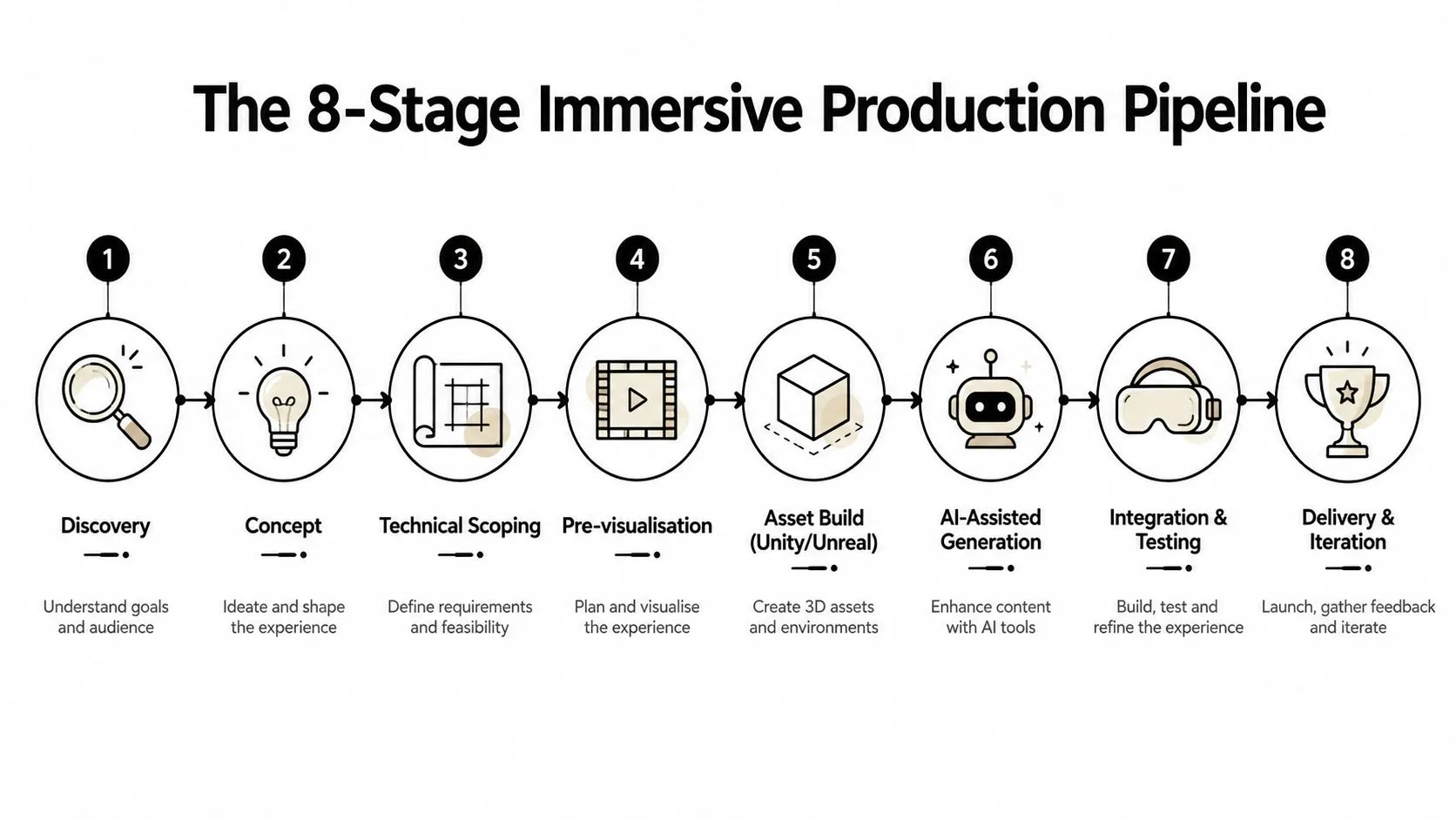
A useful pipeline has eight connected stages, with decisions and tests carried between them:
- Discovery defines the user, business problem, physical setting, accessibility needs, and success measures. AI can organise research, while the producer decides which operational constraint matters most.
- Concept turns the brief into an interaction and story that users can understand. Generative tools speed up moodboards and visual exploration, but direction still requires rejecting ideas that do not serve the audience.
- Technical scoping sets the hardware, engine, tracking approach, data requirements, and deployment route. Early technical choices expose risks before they become production costs.
- Pre-visualisation tests camera logic, spatial composition, game loops, navigation, and user flow. A rough blockout often reveals problems that polished concept art conceals.
- Asset build produces geometry, materials, animation, lighting, and interactive components in Unity or Unreal. AI-assisted textures and references can save time, but every asset needs review for continuity and performance.
- AI-assisted generation supports variations, dialogue prototypes, environmental detail, or procedural content. Generated material adds review work because it may be inconsistent, legally uncertain, or technically unsuitable.
- Integration and testing brings together code, hardware, sound, tracking, analytics, and content. Lost tracking, weak onboarding, and awkward reset states usually appear here, rather than in a controlled trade show demo.
- Delivery and iteration packages the experience, deploys it, records useful telemetry, and establishes a support route for updates.
Practical rule: A trade show demo proves that something can happen. A product build proves that it can happen repeatedly, safely, accessibly, and with a credible maintenance plan.Content management and device change need ownership after launch. Headset firmware, operating system updates, browser behaviour, and venue networks can affect deployment, so the handover should name update responsibilities, approval points, and escalation routes. The animation production pipeline guide explains shared discipline between linear animation and interactive production, particularly approvals, asset control, and final delivery. Immersive work adds device testing, live-site constraints, and operational support to that discipline.
Real Projects and What They Reveal
A project earns its place in a portfolio by surviving real use, not by looking impressive in a controlled demo. Dance! Dance! Dance! exposes the operational demands of a mixed reality event game. Participants must understand the idea quickly, respond reliably, and move through the venue without creating congestion. A mechanic that looks excellent on screen can still fail if onboarding is slow, resets are awkward, or staff cannot recover a disrupted session.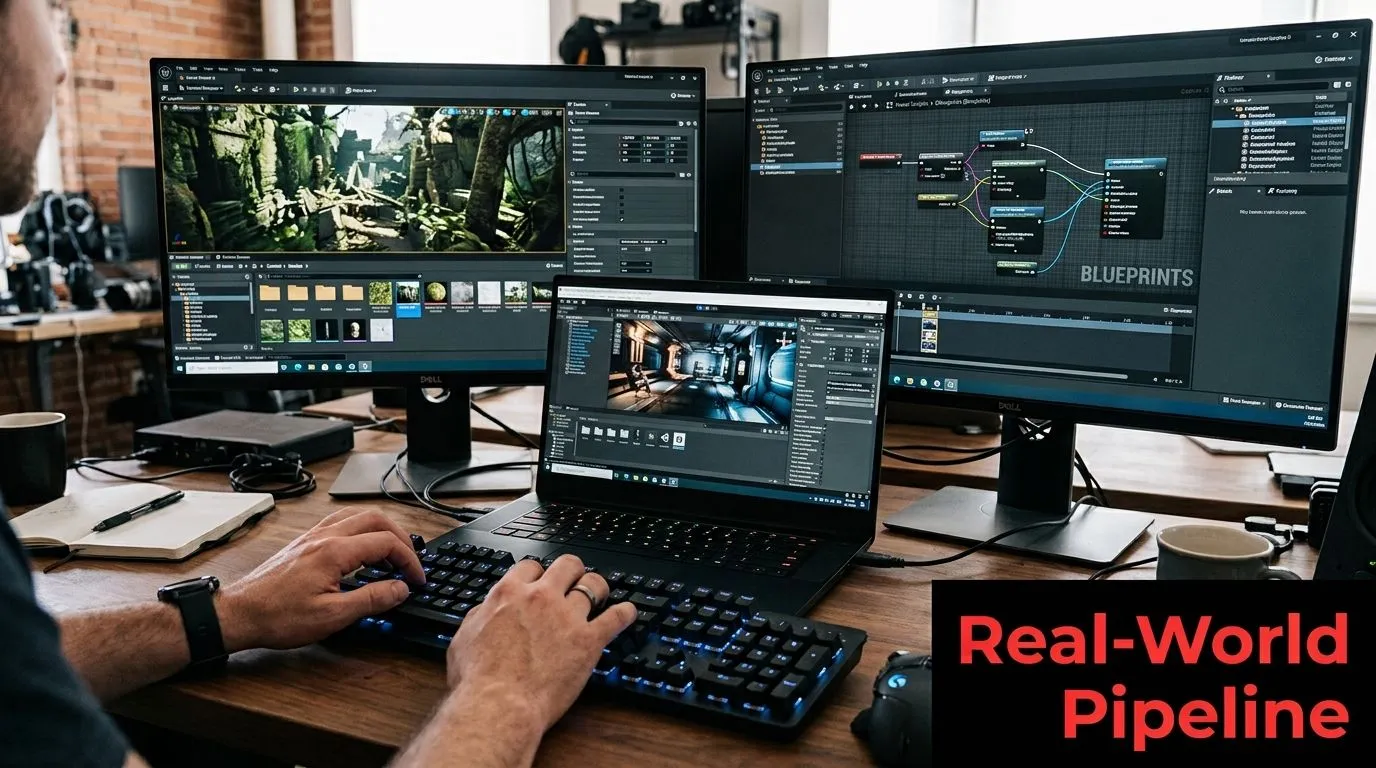 Aurora tests a different production problem. A VR short film brings direction, performance, spatial staging, sound, and optimisation into one pipeline. The audience can look anywhere, so the team must guide attention across a wide field without breaking story rhythm. Spatial sound helps establish focus, but it cannot repair unclear blocking or weak narrative intent.
 What the projects reveal in practice
Dance! Dance! Dance! places throughput beside art direction. The production brief needs answers for startup time, participant guidance, staff intervention, and recovery after a failed session. Those details determine whether an activation can serve a queue consistently. With Aurora, performance capture and post-production remain connected creative decisions. Capture quality affects the result, but retargeting, animation cleanup, comfort, and device optimisation decide whether the finished film is watchable. GeoEnergy NI shows the value of visual explanation in technical communication. Infrastructure becomes easier to discuss when stakeholders share a clear visual reference instead of interpreting disconnected diagrams. BooSnoo for Sky Kids adds the pressure of adapting a recognised children's property. Series material and digital shorts must retain coherent timing, character performance, age suitability, platform constraints, and editorial tone. Existing assets still need judgement, not automatic reuse. The useful pattern across these examples is operational. Events are judged by flow and repeatability. VR film is judged by attention management and comfort. Technical animation is judged by clarity. For commissioning teams, the question is whether the format supports the intended job after the novelty has worn off.Choosing the Right Format for Your Goal
Choose the format according to the job the experience must perform. A headset is not automatically the better choice because it looks more immersive in a demo. If people need to inspect a product in their own surroundings, phone-led AR usually reduces access and staffing problems. If they must practise a risky or unfamiliar procedure, VR can provide a controlled scenario. Mixed reality fits work that depends on digital content remaining anchored to a shared physical room.| Outcome | AR | VR | Mixed Reality |
|---|---|---|---|
| Product visualisation | Strong for placing content in a user's space | Useful for full product environments | Strong where the product must interact with the room |
| Training and rehearsal | Suitable for contextual prompts | Strong for controlled scenarios | Useful for physical and digital task integration |
| Event participation | Accessible through phones or shared devices | High impact, but needs headset handling | High impact where physical space is part of the game |
| Remote reach | Strong through mobile or web delivery | Requires compatible hardware | More dependent on device availability |
| Story-led immersion | Adds layers to the real world | Offers the strongest sense of transport | Blends authored content with shared surroundings |
| Operational workflow | Useful for guidance and visual overlays | Useful for simulation | Useful for collaborative visualisation |
The trade-offs buyers should accept
AR lowers the hardware barrier, but tracking conditions, device variation, and outdoor or retail lighting can change the result. A mobile build may reach more people, yet it gives the production team less control over screen size, performance, and the surrounding environment. VR gives the team tighter control over what users see and hear. It also creates work that a pitch deck often hides: comfort testing, hygiene, onboarding, charging, device resets, supervision, and recovery when a session fails. Those responsibilities affect throughput as much as the creative concept. Mixed reality can connect a digital object to a physical room with strong effect, though spatial mapping and device support require validation on the actual site. That testing matters when the experience depends on shared positioning, real furniture, changing light, or limited floor space. A hybrid format can be the practical answer. A headset installation may deliver the main event experience, while a shorter mobile or browser version extends the message after visitors leave. The follow-up should have a defined job, rather than becoming a lower-quality copy of the installation. A vendor should specify what the chosen format enables, what it restricts, and what the delivery team must operate on site. Ask how many people can complete a session, what happens after tracking fails, which devices are supported, and what content can be reused. If the response lists features without connecting them to the business goal, the format has not been selected properly.Measuring ROI Beyond Engagement Metrics
Dwell time can expose friction, but it does not make a business case by itself. A long session may indicate confusion, while a short one may help a visitor understand a product, complete a training task, or give a stakeholder enough confidence to approve the next stage. The useful question is what changed because the experience existed. Set the measurement plan before production. Define the user action, the evidence required, when value should appear, and which baseline provides a fair comparison. An exhibition may be judged by qualified conversations instead of footfall. Training may use task completion against an assessment rubric. A technical visualisation may be measured through stakeholder approval or fewer repeated explanations during the sales process.| Metric | Direction of Value | Benchmark Range |
|---|---|---|
| Dwell time | Longer exploration matters when it indicates genuine understanding | No verified benchmark available |
| Throughput | More completed sessions can improve venue efficiency | No verified benchmark available |
| Training retention | Stronger recall and task confidence can support operational value | No verified benchmark available |
| Stakeholder buy-in | Faster shared understanding can support decisions | No verified benchmark available |
Separate experience metrics from outcome metrics
Experience metrics describe behaviour inside the product. They include starts, completions, drop-off points, interaction paths, support requests, and repeat visits. Outcome metrics describe what changed outside it, such as a completed enquiry, an approved design, a successful assessment, or a decision to progress. Track both, but do not present them as equivalent. A high completion rate may show that the interface works. It does not prove that training improved, a sale progressed, or a design received approval. Connect each outcome to a recorded action and an agreed baseline, then define who will review the result and when. Privacy should shape the analytics design from discovery onward. Collect only what the project needs, explain the purpose clearly, and separate anonymous interaction data from identifiable records. Spatial telemetry can reveal more than a click path, particularly in workplace or training contexts. Its retention, access, and deletion rules should therefore be agreed before implementation.The buyer's test: If the analytics dashboard disappeared, could you still explain what business decision the experience is meant to support?The UK evidence base has a measurement gap. Coverage often celebrates use cases, while fewer sources quantify whether immersive work improves productivity, retention, or conversion across sectors. That makes baseline planning and post-launch review more valuable. A repeatable experience should leave the client with evidence that supports the next budget decision, not only an engagement report.
A Client Checklist for Commissioning the Work
Procurement teams do not need to become XR engineers. They do need a brief that exposes creative, technical, legal, and operational assumptions before anyone signs a contract. Use the checklist below as a negotiation tool, not as a formality.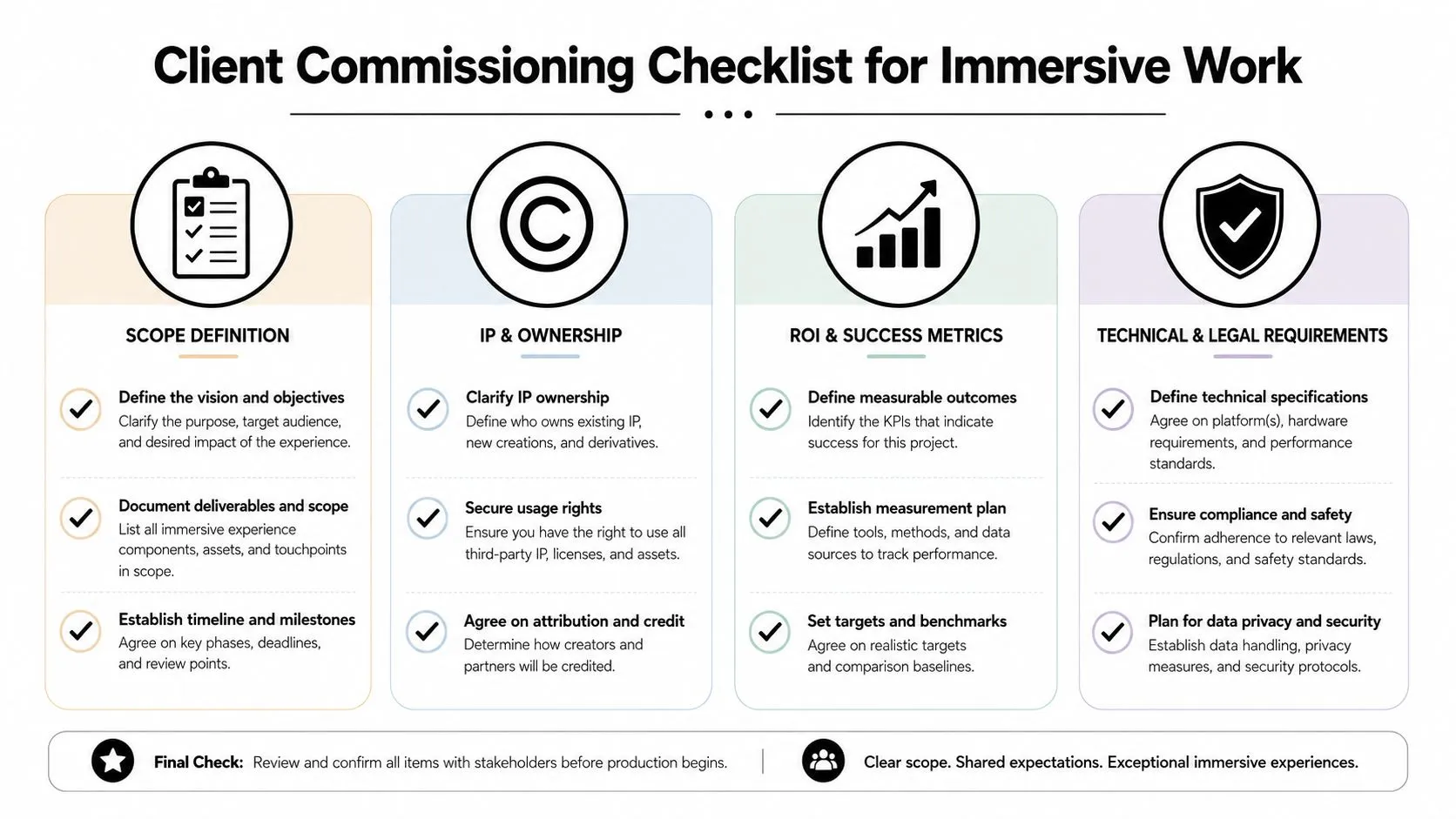 Start with the decisions that affect cost and rework:
 - •Scope: What will the audience do, on which device and in which environment? What sits outside the project?
- •Success: Which user behaviour matters, how will it be recorded, and what baseline will support comparison?
- •Ownership: Who owns source files, 3D models, code, generated assets, music, voice recordings, and future adaptations?
- •Updates: Who can change content after launch, and what will each update require from the supplier?
- •Accessibility: How will the experience address WCAG expectations and duties under the Equality Act? What alternative route serves users who cannot wear a headset, hear spatial audio, or use a controller?
- •Privacy: Does it collect biometric, movement, voice, spatial, or identifiable telemetry? Where is that data stored, who can access it, and how long is it retained?
- •Hardware: Who buys, configures, transports, cleans, charges, insures, and replaces the devices?
- •Support: What happens when tracking fails, a headset updates, a venue network blocks a service, or an operator needs help?
- •Delivery: Which render targets, file formats, frame rates, audio specifications, app stores, browsers, or enterprise systems must be supported?
- •References: Can the supplier show comparable work and provide references for projects that reached deployment?
- •Acceptance: What counts as approval for creative quality, performance, accessibility, analytics, and technical stability?
- •Exit: Can the client export assets and data? What happens if the supplier relationship ends?
A useful procurement test is whether the answers identify an operator, an owner, and a fallback for each dependency. A trade-show demo can hide all three. A shipped experience cannot. Broadcast buyers already understand the cost of vague delivery requirements. BBC online guidance specifies ProRes4444.mov, a 16:9 1920x1080 frame, an After Effects compatible project, and an enabled alpha channel for online graphics, as set out in the BBC online content guidance. UK channel graphics guidance calls for 32-bit embedded alpha in Targa files and sequential Targa files for animated sequences, with listed size targets of around 1.6 MB for SD and 8 MB for HD in the UKTV branding specification. Programme delivery has its own contract conditions. The BBC requires Network television programmes to use AS-11 DPP files, according to its technical requirements. STV Commercial's guide specifies 25 fps or 50 fps, prefers `.mov` and `.mxf` over `.mp4`, requires EBU R128-compliant final mixes, and lists HD delivery as Apple ProRes 422 HQ at 1920x1080, 25 fps, with 48 kHz PCM audio in its edit delivery guide. XR uses different formats and performance limits, but the commissioning principle remains the same. Agree the specification before the final week, when changing it is most expensive.
Where Immersive Work Goes Next
Immersive work will earn its place through repeatable operational value, not spectacle. Commission it when the chosen format improves a defined user action and the team can measure, maintain, and support that improvement after launch. If the brief cannot identify the action, it remains a campaign idea. If ownership, analytics, support, and access requirements are unclear, production should wait. AI will shorten parts of the pipeline, including concept exploration, asset variations, texture work, dialogue prototypes, and automated testing. It will not replace art direction, editorial judgement, performance optimisation, rights checks, or human acceptance testing. Faster generation can create more review pressure, because the team receives more material to assess. A workable pipeline needs clear review gates, named approvers, and a decision on which outputs are fit for release. Spatial computing platforms are developing more persistent links between digital content and physical places. Lighter mixed reality glasses may make contextual overlays easier to use, but a business case should not depend on hardware the audience does not yet own. Build the core experience so its value survives a change in device strategy.
Treat immersive content like a product
The strongest projects operate as maintained software rather than disposable campaigns. Plan telemetry around decisions the client can act on, then budget for content updates, version control, support windows, accessibility testing, and a route to retire or export the experience. Standards may reduce delivery friction, but target devices and controlled test conditions will still matter. Accessibility should be tested during production, not added at the end. Procurement must also allow iteration after launch, because release is the start of operational ownership, not the final creative act. Teams building a wider search and content strategy for regional digital production can use the local SEO insight hub to examine how location, expertise, and commercial intent work together. XR procurement follows the same logic: relevance and evidence matter more than noise. Studio Liddell develops animation, interactive, VR, AR, and XR work across concept development, real-time production, asset creation, and delivery. If you are planning an immersive digital experience, bring the audience, format, device, and success measure to a practical scoping conversation, then visit Studio Liddell to discuss the next production step.