How Does Facebook Make Money: Revenue Guide
Meta generated $164.5 billion in total revenue in 2024, and its Family of Apps segment brought in $162 billion. That means Facebook makes money overwhelmingly through advertising across Facebook, Instagram, Messenger, and WhatsApp, not through subscriptions or user fees. For UK marketing directors, the important point isn't just that Facebook sells ads. It's that Meta runs a large-scale attention-to-auction system, where free consumer products capture time, behaviour, and context, then convert that attention into paid access for advertisers. The company's revenue depends on how efficiently it can match a UK advertiser's budget to the right audience at the right moment, inside a real-time auction. A useful way to think about Facebook's model is to compare it with a media owner's and a marketplace's model at the same time. Meta owns the audience surface, controls the auction, and sets the rules of access. The result is a business where UK advertisers, not users, are the actual paying customers, and where revenue rises when competition for those audiences intensifies. That's why a decent primer like the Facebook app PPC guide is worth reading alongside broader media strategy work. It helps translate the platform's mechanics into campaign decisions, especially when budget planning needs to account for auction pressure rather than fixed media rates. For a strategic framing of audience demand and content planning, the internal note A strategic content plan and the engine of modern user acquisition sits in the same territory.
The Attention-to-Auction Revenue Engine
Facebook's money engine starts with a simple exchange. Users get free access to a product built for social connection, content, messaging, and discovery. Meta then converts the attention that product attracts into monetisable inventory by collecting on-platform behavioural signals and presenting them to advertisers who want reach.
Why free products matter so much
The free product is not a side feature, it is the revenue engine. Meta's 2024 results show how concentrated that engine remains, with $162 billion of revenue flowing through Family of Apps, the group that includes Facebook, Instagram, Messenger, and WhatsApp, against $164.5 billion in total revenue Business of Apps. That gap is small enough to make the strategic point clear, almost all of Meta's money comes from monetising attention across its consumer platforms. For UK businesses, that matters because the platform is not charging you for access to users in a flat-fee way. It sells opportunities to win impressions inside an auction, where audience definition, campaign objective, and market demand all shape the price. That is also why Facebook can stay free for users while remaining one of the most efficient ad infrastructure businesses ever built.
Practical rule: if the platform is free, you are not the customer in the usual sense, the advertiser is.
The best way to frame the business model is as a pipeline. Attention creates signals, signals create targeting value, targeting value attracts bids, and bids create revenue. Broad claims about “Facebook making money from data” miss the mechanism. The company earns because advertisers compete to access attention that Meta can package and sell at scale, not because it charges users to log in. For a visual version of that logic, the Facebook app PPC guide is useful alongside the content acquisition strategy view, because both frame audience behaviour as the upstream input to commercial value. The principle is the same whether the objective is lead generation, app installs, or ecommerce sales.
How the Real-Time Ad Auction Actually Works
The auction is where Facebook's revenue becomes concrete. An advertiser enters the system with a budget and an objective, then Meta evaluates that advertiser against other bidders who are trying to reach the same user or audience segment. The winner is not just the highest bidder, because relevance and predicted action also matter.
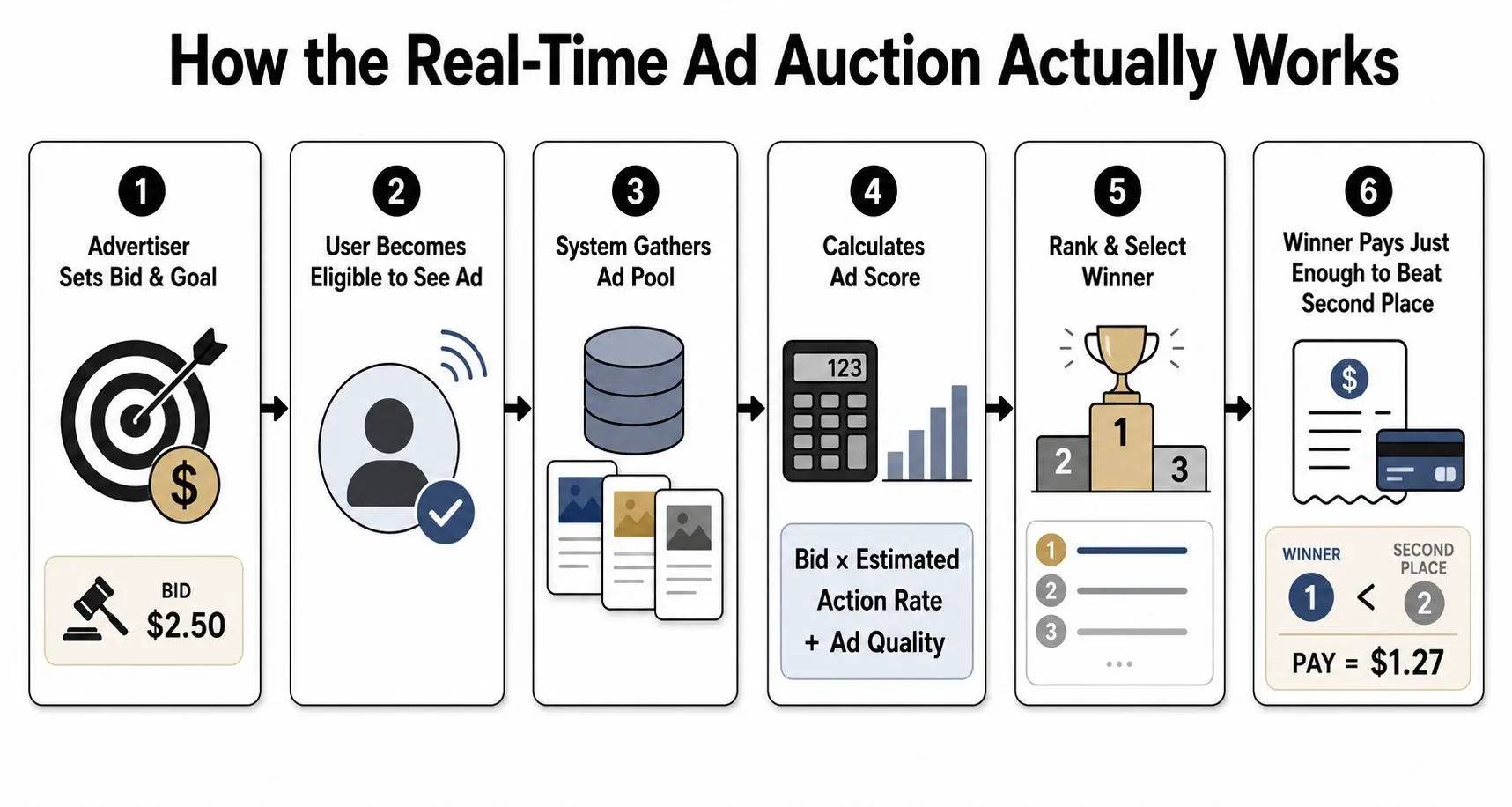
What UK advertisers are actually paying for
Meta has described the auction as a system where advertisers set budgets and bid for clicks or impressions, and the platform then places ads against audiences it predicts will convert IMBA Missouri. That means the price isn't a static rate card. It shifts with auction intensity, audience quality, and the probability that a user will take the action the advertiser wants. A mid-sized UK ecommerce brand bidding for conversions is a good example. If it targets a narrow audience of repeat buyers during a crowded retail period, it competes against more advertisers chasing the same people. That raises pressure in the auction, so the brand often pays more to hold its position, even if the campaign itself remains efficient in business terms. Meta's own model also shows why targeting quality matters. The system ranks ads using bid strength alongside predicted action and ad quality, which means a lower bid can still win if Meta expects stronger engagement or conversion. In other words, the platform isn't only selling reach. It's selling a better chance of the right outcome.
A narrower audience is often more expensive because more advertisers are chasing the same pool of users, not because the platform “charges extra” in some simple way.
That auction structure is why UK marketers see costs rise when demand spikes. Seasonal retail competition, aggressive app-install campaigns, and tight retargeting pools all increase competition for the same inventory. Meta benefits because stronger advertiser demand makes each impression worth more inside the auction, even when the user experience stays free. A practical way to think about this is to compare auction buying with buying a fixed media slot. On Meta, you are not reserving a page or a show break. You are entering a live pricing environment where the final cost is shaped by the other bidders in the room.
Ad Formats and Where They Fit in the Funnel
Meta monetises the auction through multiple placements, and each format serves a different point in the funnel. That variety matters because a platform with only one or two ad types would have less inventory to sell and fewer ways to match advertiser intent. More format choice means more monetisable surfaces, more bids, and more chances to keep spend inside the ecosystem.
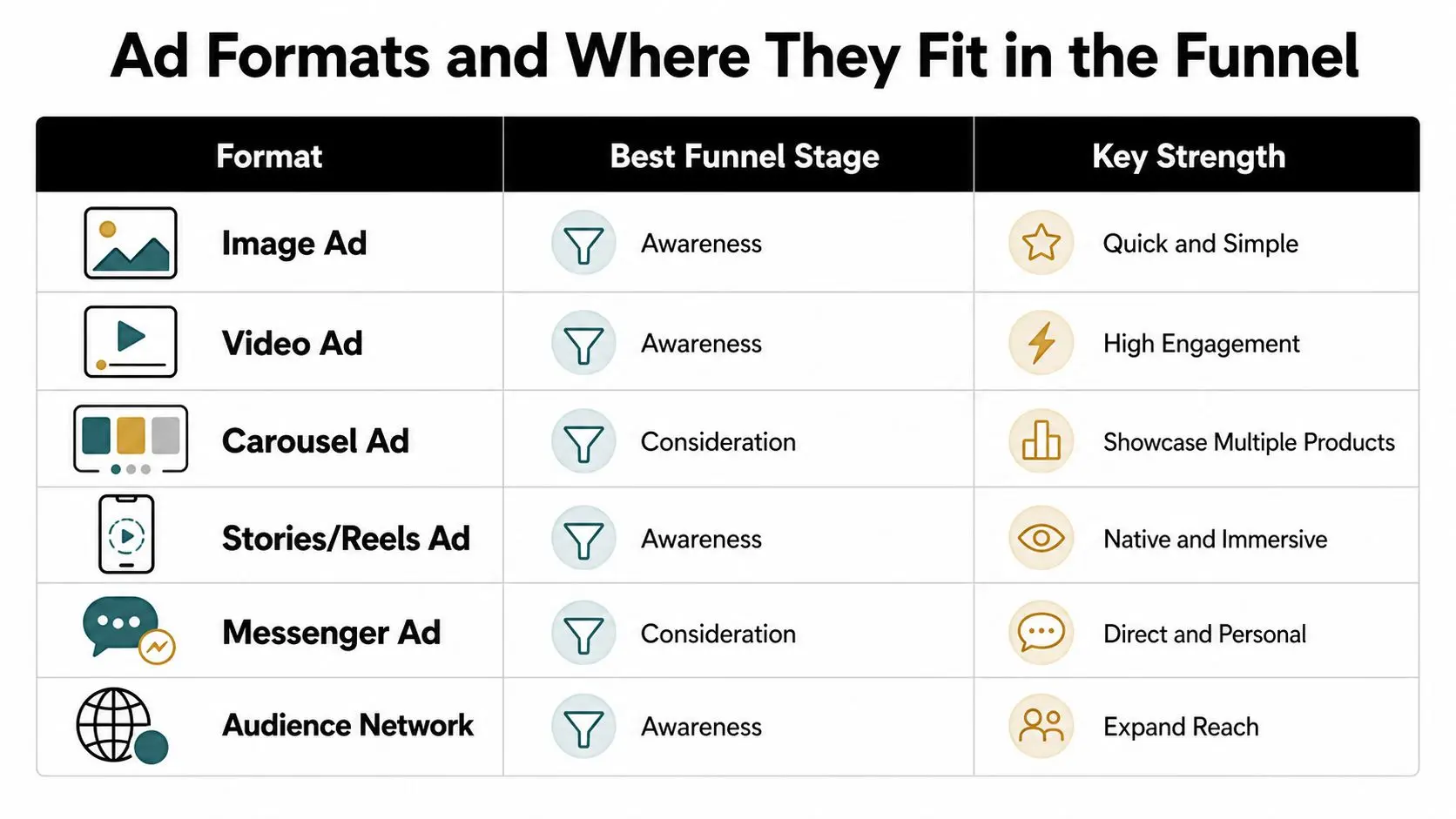
Format choice changes revenue behaviour
Image ads usually work well when a campaign needs clear, direct response messaging. Video ads tend to sit higher in the funnel because they can carry more story and more context. Carousel ads sit between those two, especially when the advertiser wants to show multiple products, features, or steps without moving the user away from the feed. Stories and Reels placements matter because short-form, high-frequency consumption creates fresh inventory. Meta has every incentive to push these surfaces because they expand the number of ad slots available inside fast-moving content environments. The same logic applies to Messenger ads and Audience Network inventory, both of which extend monetisation beyond the core feed. For teams choosing formats, the right question is not which one is best. It is which one matches the user's stage of intent. Awareness campaigns can tolerate more friction and more creative storytelling. Lower-funnel campaigns need cleaner pathways to action and tighter measurement, because that is where conversion value is easiest to prove. For a practical view of how format choice changes creative requirements, the guide for creating AI video ads is a useful reference point. It is especially relevant when teams need to produce variants quickly for Reels, Stories, and other short-form placements.
Practical rule: when Meta creates a new placement type, it usually creates new inventory first, then sells the same audience attention in a different wrapper.
That is why format innovation matters to revenue. Every new surface gives Meta another place to run the auction, which gives advertisers another way to spend. The more placements a brand uses, the more opportunities Meta has to capture budget inside its own ecosystem. A useful comparison comes from gaming inventory, where placement design changes how attention is monetised across sessions and formats. Studio Liddell's complete guide to in-game ad formats and strategy shows the same basic principle in a different environment. Format diversity increases the number of surfaces an advertiser can buy, and that widens the revenue base without changing the core auction model.
Privacy Regulation and the Myth of Selling User Data
The most persistent misconception about Facebook is that it makes money by selling personal data to advertisers. That's not how the business works. Meta places ads on behalf of advertisers using signals available on the platform, rather than handing raw user data to third parties.
What privacy changes have actually shifted
That distinction matters more in the UK because privacy rules have tightened the conditions for targeting and measurement. The ICO continues to enforce UK GDPR and PECR expectations around consent and online advertising, which affects how granular targeting can be and how reliably marketers can attribute outcomes. Browser and device changes have also made some off-platform signals less useful, so precision is not what it used to be. The commercial implication is not that monetisation disappears. It's that the auction gets noisier. When targeting gets less exact, advertisers can respond by bidding more broadly, leaning harder on creative, or maintaining spend to avoid losing reach. Meta still earns because the auction remains the path to audience access. That is the more useful way to interpret privacy pressure. Regulation doesn't remove the market for Facebook ads, it changes the shape of the market. The platform can still monetise if enough advertisers decide that imperfect targeting is better than no reach at all. A lot of coverage misses this point by focusing on data as a product rather than data as an input to auction efficiency. Meta's revenue depends on whether advertisers believe the platform can still find buyers, viewers, or app users at scale. As long as that belief holds, the company can preserve monetisation even when measurement is noisier.
The real question is not whether privacy changes hurt Facebook's ad system. It's how much advertiser behaviour has to shift before the auction stops clearing at attractive prices.
Recent UK ad-market reporting continues to show digital spend remains central to the industry, which helps explain why Meta's model stays resilient even under tighter privacy controls StockAnalysis. That does not mean the platform is untouched. It means the business has adapted by turning weaker signals into a pricing problem, not a shutdown event.
Beyond Advertising Hardware Payments and Commerce
Advertising dominates, but it's not the whole picture. Meta does have smaller revenue streams, and they matter because they point to where the business might go next, even if they remain marginal today.
The smaller lines are strategic, not dominant
One source says Facebook's non-advertising business made up around 2% of revenue in 2020, mainly from payments and other fees Kamil Franek. Another source notes that Meta receives net fees from developers who use its payments infrastructure, which confirms that transaction-based revenue exists, but at a much smaller scale Shiksha. Those streams sit beside Reality Labs hardware, commerce tools in Marketplace and Shops, and the broader push toward more transactional behaviour inside the app family. The strategic logic is obvious. If Meta can keep users, creators, and merchants inside its walls for longer, it has more places to earn indirectly, even if advertising remains the core engine. Hardware is the clearest long-term bet. It gives Meta a route into spatial computing and immersive environments, where future monetisation could extend beyond feed ads. But hardware also carries cost, operational complexity, and adoption risk, which is why it has not displaced the ad model. Commerce tools are more subtle. They do not replace ads, they make ads more actionable. If a user discovers a product in the app and completes part of the journey without leaving Meta's environment, the platform gains another reason for marketers to keep budget there. The pattern is consistent. Meta keeps building surfaces where attention can be monetised more than once, either directly through ads or indirectly through fees and commerce activity. Right now, those layers remain secondary. They still matter because they show where Meta would like the business to evolve if advertising ever faces a sharper ceiling.
Revenue Breakdown and Historical Trajectory
The historical record shows just how thoroughly Facebook settled into advertising dependence. In 2017, Facebook generated $39.9 billion from advertising, and advertising was already estimated to contribute about 85% of total revenue TheStreet. By 2020, one analysis said advertising made up 98% of Facebook's $86 billion revenue, while another dataset put the figure at 97.9% Kamil Franek.
Meta Advertising Revenue Trajectory
| Year | Total Revenue | Ad Revenue Share | Key Context |
|---|---|---|---|
| 2017 | Not provided in verified data | About 85% | Facebook already depended heavily on advertising TheStreet |
| 2017 | Not provided in verified data | Not provided in verified data | Facebook generated $39.9 billion from advertising Business of Apps |
| 2020 | $86 billion | 98% | Advertising was near-total as a revenue source Kamil Franek |
| 2020 | Not provided in verified data | 97.9% | A different dataset reinforces the same concentration Kamil Franek |
| 2024 | $164.5 billion | Not provided in verified data | Meta's scale remains overwhelmingly tied to ad monetisation across its apps Business of Apps |
The pattern is hard to miss. Facebook tried other monetisation lines over time, but advertising kept absorbing almost all of the revenue base. That concentration matters because it explains the company's strategic incentives. Meta will prioritise auction efficiency, audience reach, and advertiser demand long before it relies on direct user payments. It also explains why the Family of Apps segment is so central. When $162 billion of the company's $164.5 billion in 2024 revenue sits inside that family Business of Apps, the business case for preserving ad demand becomes self-evident. Everything else is secondary, even when it looks strategically interesting. The long-run conclusion is straightforward. Facebook did not become a subscription company, and it did not become a direct sales company. It became an auction business wrapped around consumer attention, with small auxiliary streams layered around it.
Practical Takeaways for UK Businesses and Marketers
If you buy media on Meta, the revenue model tells you what really moves your costs. Auction pressure rises when too many advertisers want the same audience, especially when the audience is narrow and the objective is conversion. That is why campaign timing, creative variation, and audience design matter more than many boards realise.
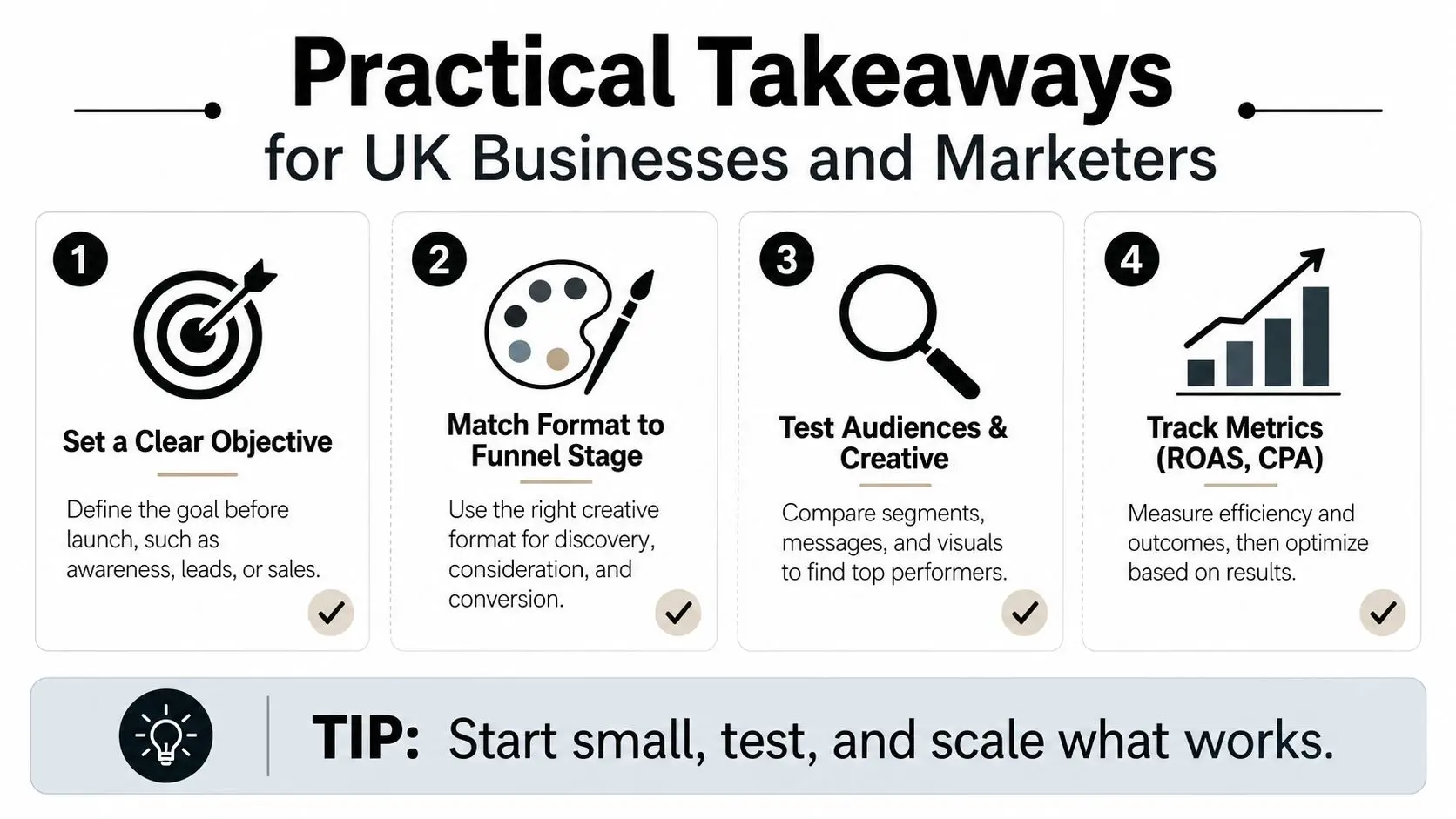
What to do with this knowledge
Start with the objective, not the format. If you need reach, choose placements that build attention cheaply and test creative variation early. If you need conversion, accept that tighter audience definitions usually mean more competition and higher auction pressure, so your creative and landing page need to do more work. Use privacy changes as a planning input, not a panic trigger. Targeting precision may be weaker than it was, but Meta still has a huge incentive to keep ads working well enough for advertisers to spend. That means your team should focus on first-party signals, cleaner measurement, and creative that can still persuade when attribution gets messier. The smartest budget decisions usually come from comparing placements, not chasing a single “winner”. Image, video, Stories, Reels, Messenger, and Audience Network all sit differently in the funnel, so the question is which one supports the outcome you want at the right cost structure. Meta benefits when you diversify placements because you keep more budget inside its auction system, and you benefit when the mix matches intent more closely. For UK teams trying to benchmark spend, the internal guide How much is an ad on Facebook in the UK is a practical companion because it connects pricing thinking to local buying conditions. Pair that with a disciplined creative process and you'll make better decisions than teams that treat Facebook as a generic media bucket. If you want to pressure-test a campaign concept, Studio Liddell can help map the creative structure for social placements, explainers, and performance-led video within the same production workflow. Visit Studio Liddell to discuss a brief, review your asset needs, and turn the auction mechanics into sharper creative decisions.