A Guide to 3D Motion Graphics for Modern Brands
Ever tried explaining your most complex product with a slide deck and watched people's eyes glaze over? Now, what if you could show them a dynamic, photorealistic model they could see from every single angle? That's the real power of 3D motion graphics. It helps to think of it less like a traditional cartoon and more like a digital sculpture that's been brought to life with movement.
Breaking The Third Dimension
At its heart, the jump from 2D to 3D is all about one thing: depth. While 2D animation happens on a flat plane (think of a drawing on a piece of paper), 3D motion graphics exist in a proper three-dimensional digital space. This one fundamental shift completely changes the game. Instead of just moving left, right, up, and down, objects can now move forward and backward. A virtual camera can fly around a product, soar through an architectural design, or even travel inside a complex piece of machinery. This extra dimension allows for hyper-realistic lighting, shadows, and textures that make digital objects feel tangible.
Think of it this way: 2D animation is like a painting, beautiful, but fundamentally flat. 3D motion graphics are like a sculpture you can walk around, inspect from any angle, and even interact with inside a simulated world.
For businesses, that distinction is everything. It’s the difference between showing a flat diagram of an engine and letting your audience see every single piston fire in perfect synchronisation from the inside out.
From Flat Design to Immersive Stories
Adding that third dimension does more than just make things look cool; it completely transforms how you tell a story. The ability to manipulate depth, perspective, and lighting gives creators a powerful toolkit to guide a viewer's eye and create a specific mood. For businesses, this translates into some serious advantages:
- •Clarifying Complexity: Suddenly, abstract concepts, intricate data sets, or internal processes can be made simple and genuinely easy to understand.
- •Enhancing Realism: Products can be shown off with photorealistic detail, building trust and desire long before a customer ever holds the item in their hands.
- •Boosting Engagement: Dynamic camera moves and immersive scenes are far better at capturing and holding attention than static images or simple 2D visuals.
3D motion graphics are a key part of the modern media toolkit. Getting a sense of the wider landscape of Content Creation can help you see just how significant its role has become.
Market Dominance and Growth
You don't just have to take our word for it; the market growth tells the same story. Within the animation world, 3D has become the undisputed leader, commanding a massive 61.2% of the global animation market share. The global 3D animation market was valued at a staggering USD 26.63 billion and is projected to hit USD 44.44 billion by 2029. This boom is fuelled by its widespread use in everything from blockbuster films and video games to the latest virtual reality experiences. The trend is crystal clear: when brands and creators really need to make an impact, they’re turning to the depth and realism that only 3D can deliver.
How Businesses Use 3D Motion Graphics to Win
Theory is one thing, but what really matters are the results you can see and measure. Smart companies aren't asking _if_ they should use 3D motion graphics anymore; they're figuring out exactly _how_ to solve real-world business problems and get ahead of the competition with it. This technology has a unique ability to pull products and ideas out of the abstract and place them into a visual reality. It’s about creating clarity and impact that your customers, investors, and team members can instantly grasp.
From Medical Devices to Data Platforms
Imagine a medical device company trying to explain a groundbreaking surgical tool. A brochure with diagrams can only go so far. A 3D motion graphics video, on the other hand, can take the audience on a journey _inside_ the human body, showing the tool’s precise function in a way that’s impossible to misunderstand. This builds immediate confidence with surgeons and makes regulatory explanations far simpler. Or think about a SaaS firm with a powerful but complex data analytics platform. How do you show the value of something you can't touch? Instead of relying on static charts, a compelling 3D animation can transform abstract data into a flowing, interconnected story, showing exactly how insights are uncovered and business value is created.
The core benefit is translation. 3D motion graphics translate complex, invisible, or technical concepts into simple, powerful, and memorable visual stories that drive action.
Every application is tied directly to a business goal, turning a creative piece into a hard-working tool for growth. Whether you’re launching a product or training a global team, the right visuals make all the difference. You can explore how these visuals come to life, from initial concepts to the finished animation, by learning more about the full range of motion graphics services for brands.
Driving Tangible Business Outcomes
The applications for 3D motion graphics span practically every department, from marketing and sales right through to operations and HR. Each use case is designed to solve a specific problem and deliver a measurable return. Here are a few powerful examples we see time and again:
- •Photorealistic Product Showcases: For e-commerce brands, showing a product from every angle with perfect, consistent lighting can dramatically increase conversion rates. Customers feel much more confident hitting ‘buy’ when they can see a realistic, 360-degree view of what they’re getting.
- •Immersive Brand Experiences: At a busy trade show, a standard banner just fades into the background. An immersive 3D motion graphics display on a huge screen can literally stop people in their tracks, drawing them to your stand and creating a brand moment they won't forget.
- •Simplifying Complex Training: Companies can ditch dense technical manuals and instead use 3D animations to deconstruct complex machinery or processes. This doesn't just improve knowledge retention for employees; it also massively reduces training time and the associated costs.
- •Architectural Visualisation: Before a single brick is laid, 3D animations let architects and property developers offer clients a virtual walk-through of a future building. This is invaluable for securing investment, speeding up planning approvals, and pre-selling units off-plan.
By aligning the creative potential of 3D motion graphics with clear business goals, companies aren't just making prettier content, they're building a more effective, persuasive, and profitable way to communicate.
The Journey From Concept to Final Render
Ever wondered how a simple sketch or a line in a script becomes a polished, dynamic piece of 3D motion graphics? It’s not magic, but it is a highly structured journey. Think of it as a well-defined production pipeline where creativity and technical precision meet at every single stage. This process is designed to make sure the initial vision isn't just brought to life, but is refined and elevated into a final product that hits all its goals. Understanding this roadmap is also crucial for you, the client. It demystifies where time and budget go, gives us clear points for feedback, and makes sure there are no surprises. Each phase builds directly on the last, creating a steady flow of progress from an abstract idea to tangible, moving art.
Phase 1: Brief, Storyboarding, and Pre-visualisation
Before a single pixel is rendered in 3D, the entire project gets mapped out. This begins with a clear brief, outlining the project's goals, audience, and key messages. From there, we move to the storyboarding phase, where we visualise the narrative as a series of simple drawings, a lot like a comic strip. It’s here that we lock down the core camera angles, shot compositions, and the overall flow of the animation. Next up, we move to pre-visualisation, or "previz." This often involves creating a very basic, low-fidelity 3D version of the storyboard. You can think of it as a digital rehearsal. This step is invaluable for getting the timing right, testing out camera movements, and spotting any creative or technical problems early on. It’s the architectural blueprint for the whole project.
Pre-visualisation is where we answer the big questions: Does the pacing feel right? Is the story clear? Are the camera moves working? Nailing this saves a massive amount of time and resources further down the line.
Phase 2: Modelling, Texturing, and Lighting
With the blueprint signed off, the digital construction can begin. 3D modelling is the process of sculpting the digital assets, be it characters, products, or entire environments, from simple shapes into detailed, complex forms. It’s the equivalent of a sculptor working with digital clay, meticulously crafting every single curve and surface. Once the models are built, they're essentially blank, grey sculptures. The texturing phase is what gives them colour, surface detail, and a sense of realism. Our artists apply digital materials, like gleaming metal, clear glass, or rich wood, to make the objects look believable and tangible. This is how a generic car model becomes a specific, showroom-quality vehicle with metallic paint and real rubber tyres. Then comes lighting, a critical step that breathes life and mood into the scene. Just like in professional photography or filmmaking, we strategically place virtual lights to create shadows, highlights, and atmosphere. The quality of the lighting can be the difference between a flat, uninspired scene and one that’s cinematic and emotionally resonant.
Phase 3: Animation, Compositing, and Delivery
This is where everything starts to move. During the animation phase, our artists bring the static models to life. They might do this by manually setting keyframes for every movement or by using advanced techniques like motion capture. They control every gesture, every expression, and every camera move to perfectly match the approved storyboard and previz. After the animation is complete, the various layers (characters, backgrounds, effects) are combined in compositing. This is where we add the final polish: colour grading, visual effects, sound design, and music. It’s the last touch that ties everything together, making sure the finished piece is seamless, impactful, and ready for delivery in the client's required formats. The technological backbone for this whole journey is constantly evolving. The global 3D animation software market is forecast to grow by USD 10.86 billion between 2023 and 2028, largely driven by its increasing use in media and entertainment. This growth, especially with breakthroughs in cloud services and real-time rendering, is always refining how studios like ours approach the production pipeline. You can discover more insights about the animation software market and its projected growth.
Understanding the Technology That Powers 3D Animation
Behind every polished piece of 3D motion graphics is a powerful combination of software and hardware. Think of this tech stack as the artist’s digital workshop, a collection of specialised tools, each with a specific job in bringing a creative vision to life. Getting to grips with these core components helps clarify how a studio’s technical capabilities directly shape a project's quality, timeline, and creative potential. The foundation of any 3D project is the primary creation software. These are the sprawling digital environments where artists build, animate, and render entire worlds from scratch. Industry workhorses like Autodesk Maya, Cinema 4D, and the open-source powerhouse Blender serve as the central hubs for most of the production pipeline, from modelling all the way through to animation. This infographic breaks down the core stages of the 3D animation process, showing how an idea moves from a simple sketch to a final, fully rendered image.
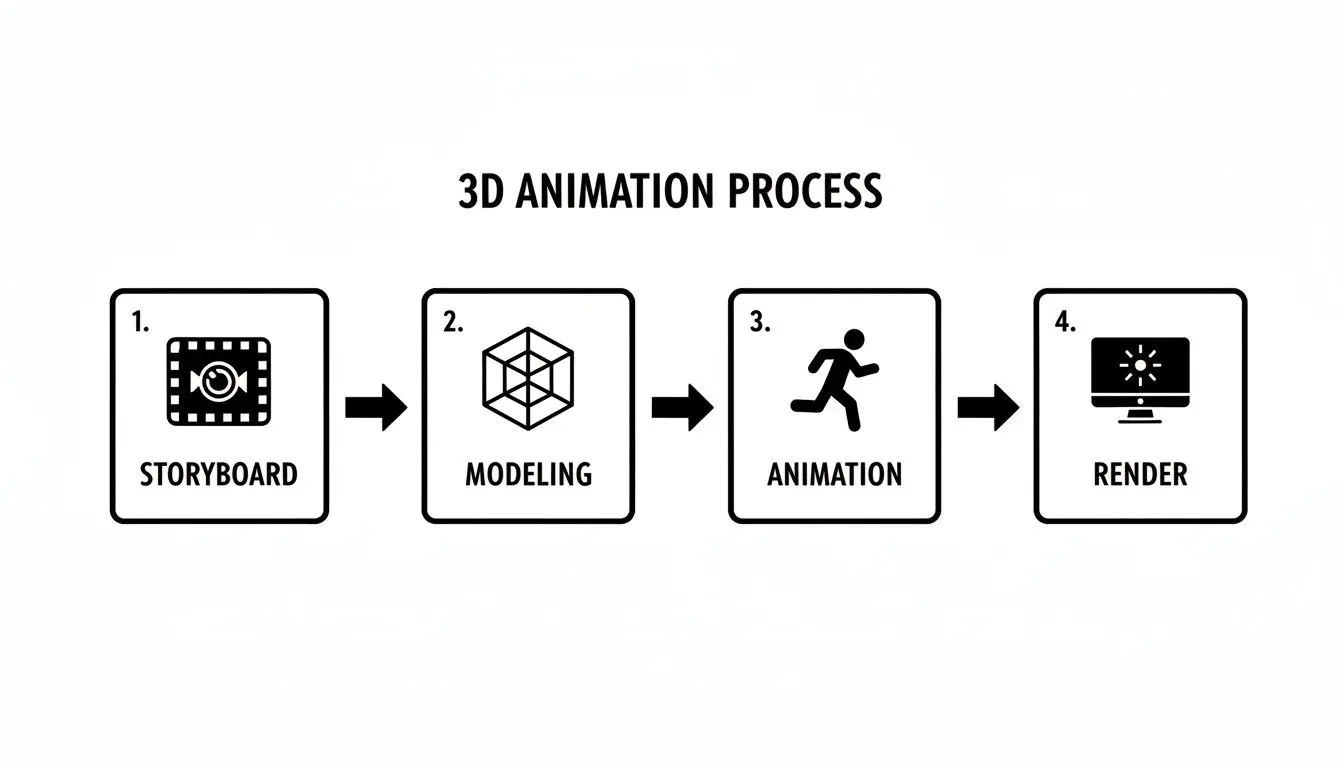
Each step is built on the one before it, which really highlights the structured workflow needed to ensure quality and consistency from the first concept to the final delivery.
The Core Software Toolkit
A typical production involves far more than just one application. A professional studio uses a suite of interconnected tools to get the best results, often moving assets between them to play to each program's strengths.
- •Modelling & Sculpting: Tools like ZBrush are the go-to for creating highly detailed organic models, think characters or creatures, which are then brought into the main 3D application.
- •Texturing: Software like Adobe Substance 3D Painter is essential for applying realistic surface materials. This is how a simple model gets the distinct texture of brushed metal, rough concrete, or shimmering glass.
- •Rendering Engines: These are specialised plugins or standalone programs like Redshift, V-Ray, or Arnold. They do the heavy lifting, calculating the final look of an image by processing all the lighting, shadow, and reflection data to create a photorealistic result.
For projects that demand intricate character work, new AI-powered consistent character AI video generators are proving invaluable in keeping a unified look across diverse animated sequences. This ecosystem of software ensures every last detail is meticulously crafted.
The Rise of Real-Time Engines
Perhaps the biggest shift in 3D production technology has been the adoption of real-time engines like Unreal Engine and Unity. These platforms were originally built for making video games, but now they’re completely changing the game for the animation industry. Unlike traditional rendering, which can take hours or even days to produce a single frame, real-time engines render visuals instantly. This gives directors and artists immediate feedback, allowing them to make creative decisions on the fly without getting bogged down by lengthy processing times.
This shift to real-time isn't just about speed; it's about creative freedom. When you can see the final result instantly, you can experiment more, refine lighting in the moment, and explore new camera angles without penalty. It transforms the entire creative process from a slow, linear pipeline into a dynamic, interactive workshop.
This technology is no longer just for games. It’s being used to create everything from animated TV series to the virtual production sets for major films. Choosing a studio that’s proficient in these platforms can unlock incredible new creative possibilities and dramatically shorten production timelines. For a deeper dive into how these platforms stack up for animation producers, feel free to explore our detailed comparison of Unreal vs Unity for real-time animation.
Budgeting for Your 3D Motion Graphics Project
Right, let’s talk numbers. It’s the big question on everyone's mind, and understanding the investment for a 3D motion graphics project is key to getting it off the ground. The honest answer is, there’s no one-size-fits-all price. The cost is completely tied to the complexity and scale of your idea. Think of it like building a house , a cosy bungalow isn't going to have the same budget as a sprawling, custom-built mansion. This section is a straightforward, practical guide to what things cost and how long they take. We’ll break down the main things that affect the budget, so you can write a clear brief and get an accurate quote right from the start.
Key Factors That Influence Your Budget
A few core elements really drive the final cost of any 3D motion graphics project. Getting your head around these beforehand will help you nail down your goals and manage everyone’s expectations. Each one is a mix of an artist's time, technical resources, and raw creative brainpower. Here are the main drivers you'll need to think about:
- •Complexity of Models and Scenes: A simple, stylised object is worlds away from a photorealistic, mechanically perfect model with hundreds of intricate moving parts. In the same way, a scene showing one product against a plain background is far less intensive than, say, a detailed architectural walkthrough.
- •Animation Length and Detail: A longer video usually costs more, that’s a given. But the _density_ of the animation is just as important. A 30-second video packed with non-stop, complex character movement and sweeping camera shots demands way more effort than a 60-second video with slow, simple product rotations.
- •Level of Realism (Photorealism): Chasing that photorealistic look is a huge undertaking. It requires an obsessive level of detail in texturing, lighting, and rendering. This quest for perfection needs more senior artist time and racks up significantly longer render times, which pushes the budget up.
- •Render Time: This is the hidden cost that often surprises people. Complex scenes with advanced lighting, reflections, and super high-resolution textures can take hours and hours of pure computing power to render just a _single second_ of footage. That machine time is a major cost factor.
We often get asked, "Why does a 30-second animation take four weeks?" The answer is all in the detailed, step-by-step production process. Every stage, from storyboarding and modelling to animation and rendering, has to be completed and signed off before the next one can begin. It’s how we guarantee quality and make sure we’re all on the same page.
Realistic Budget and Timeline Ranges
To make this all a bit more concrete, let’s look at a few typical project scopes. These are ballpark figures to give you a rough idea, but remember, we'll always need a detailed brief to give you a precise quote.
| Project Type | Typical Budget Range (GBP) | Estimated Timeline | Best For |
|---|---|---|---|
| Simple Logo Sting | £3,000 - £7,000 | 1-2 Weeks | Social media, video intros/outros, brand reinforcement. |
| Product Showcase (60s) | £8,000 - £20,000 | 3-5 Weeks | E-commerce websites, trade show displays, sales presentations. |
| Technical Explainer (90s) | £20,000 - £50,000+ | 6-10 Weeks | Explaining complex software, medical devices, or industrial processes. |
As you can see, the investment scales directly with the project's complexity and its strategic importance. A simple logo animation is a quick win, a high-impact asset you can get out there fast. On the other hand, a detailed technical explainer is a serious investment designed to solve a major communication problem, like making a complex sales process simple or improving technical training. The goal is always to match the investment to the business objective. By understanding these factors, you can come to your 3D motion graphics project with confidence, clarity, and a realistic idea of what it takes to bring your vision to life.
How to Choose the Right 3D Animation Studio
Picking the right creative partner is easily the most important decision you'll make for your 3D motion graphics project. Everything hangs on this choice , the quality of the final animation, how smoothly the production runs, and the ultimate return on your investment. Think of this as your guide to confidently finding a studio that acts as a true partner, not just another supplier. It’s about looking past a flashy showreel to understand the substance behind the style. You need a team with the creative spark, technical chops, and production discipline to take your idea from a simple brief to a polished final delivery. This framework will give you the right questions to ask and the key things to look out for.
Scrutinising the Portfolio and Pedigree
Every studio has a portfolio, but knowing how to read between the lines is what matters. Don't just get dazzled by pretty pictures; analyse their work with a critical eye.
- •Diversity of Style: Does their work jump between different looks, from hyper-realistic to beautifully stylised? This shows they’re flexible and can adapt to your brand's unique feel.
- •Technical Complexity: Hunt for projects that show off some serious skill. We're talking detailed mechanical explainers, believable character performances, or vast, complex scenes. This is a dead giveaway of a team’s technical depth.
- •Broadcast Experience: Has the studio produced work for TV or film? This is often a sign of a much higher standard of quality control, pipeline management, and the ability to hit unmovable deadlines under pressure.
A strong portfolio isn't just a highlight reel; it's a collection of case studies. It should answer not only "what did you make?" but also "what problem did you solve for the client?" This focus on outcome over output is the hallmark of a strategic partner.
When you're sizing up a studio, remember you're not just hiring artists. You're investing in a battle-tested production process.
Assessing the Process and Communication Style
A brilliant idea can fall apart fast without a rock-solid production process and clear, consistent communication. This is where the seasoned pros really separate themselves from the pack. The United Kingdom has become a world-class hub for animation, with a market valued at an impressive USD 3.94 billion. That figure is projected to nearly double to USD 9.36 billion by 2030, fuelled by major international productions that demand rigorous, reliable pipelines. You can read the full analysis on the UK's animation and VFX market to see just how much the industry is booming. When you're talking to potential partners, get into the nitty-gritty of how they work. Ask them to walk you through their entire pipeline, from the initial brief and storyboarding right through to the final render and delivery. A transparent, well-defined process with clear milestones for feedback is non-negotiable. It keeps you in the loop and prevents costly surprises from popping up late in the game.
Your Essential Due Diligence Checklist
Before you sign on the dotted line, arm yourself with a few specific, targeted questions. The answers you get will tell you everything you need to know about a studio's capabilities and whether they’re the right fit for you.
- Who will be my day-to-day contact? You need a dedicated producer or project manager who can give you clear updates and answer your questions without delay.
- What is your process for feedback and revisions? Get a clear understanding of how many rounds of changes are included and at which stages they happen.
- What technical formats can you deliver in? Make sure they can provide the exact file specifications you need, whether it's for broadcast, a social media campaign, or a massive event display.
- How do you handle scope changes? A professional studio will have a clear, fair process for managing and quoting any changes to the original plan.
Your 3D Motion Graphics Questions Answered
When you're thinking about investing in 3D motion graphics, a few practical questions always come up. Here are the answers to the most common ones we hear, covering everything from the briefing process to what you’ll need to get started.What Makes a Good Project Brief?
A strong brief is the absolute bedrock of a successful project. It doesn’t have to be a novel, but it does need to be clear. Think of it as the map for our creative team, it gets everyone pointing in the same direction right from the start. To help us give you an accurate quote and kick things off without a hitch, try to cover these key points:- •The Big Goal: What's the main purpose of this animation? Are you trying to boost sales, demystify a complex process, or just get your brand name out there?
- •Your Audience: Who are you actually talking to? Knowing this helps us nail the right tone, style, and level of detail.
- •Key Messages: If a viewer only remembers one to three things after watching, what should they be?
- •The Technical Bits: Where will the animation live? Let us know the required length, resolution, and aspect ratio (e.g., 16:9 for YouTube, 9:16 for social media stories).
- •Creative Inspiration: Got links to animations or styles you love? Sharing them is the quickest way to get us on the same page aesthetically.
How Long Does a 3D Motion Graphics Project Usually Take?
Timelines can swing quite a bit depending on how complex the project is. A simple 15-second logo sting might only take a week or two. On the other hand, a detailed 90-second technical explainer, complete with intricate models and environments, could take anywhere from six to ten weeks, sometimes more. It's not just the final runtime that dictates the schedule; it’s the multi-stage production process. Each phase, storyboarding, modelling, texturing, animation, rendering, and post-production, needs its own dedicated time for both creation and your feedback. A well-planned timeline always includes key checkpoints for revisions, ensuring the final piece is exactly what you envisioned without any costly backtracking.
What Assets Do I Need to Provide?
To get the ball rolling, the most crucial things you can give us are tied to your brand identity. This is how we make sure the final animation feels like a natural part of your brand's world.
Your brand guidelines are the essential starting point. That means your logo in a vector format (.AI or .EPS), your specific brand colours (with HEX or Pantone codes), and any official fonts you use.
If we're showing off a specific product, having 3D CAD files is a massive head start. It's not a deal-breaker, our team can model anything from scratch with just reference photos, but existing files can speed up the modelling phase and guarantee 100% accuracy. And of course, if you already have scripts, voiceover recordings, or storyboards, they are always incredibly helpful.
Ready to transform your complex ideas into stunningly clear visuals? The team at Studio Liddell has been creating studio-quality 3D animation and motion graphics for global brands since 2019. Let's have a chat about your project and explore how we can bring your vision to life. Book a production scoping call