Motion Graphics Services for Brands: From Logo Stings to Title Sequences
Trying to explain a complex idea with just words and a flat drawing is a tough sell. Now, imagine showing that same concept as a dynamic, moving 3D model, where every part works just as it would in real life. That’s the magic of motion graphics services: they take flat designs and breathe life into them, adding that all-important third dimension , _depth_. It's a game-changer for brands, allowing them to build immersive digital stories that are leagues ahead of any static image.
What Are Motion Graphics and Why Do They Matter?
At its core, motion graphics is the art of animating visuals within a three-dimensional space. Think of it like this: a 2D architectural blueprint is flat, but a 3D model lets you walk through the finished building. While 2D animation moves things across a flat plane (using X for width and Y for height), 3D adds the Z-axis, giving us depth and perspective. That one simple addition, the Z-axis, opens up a whole new world of creative freedom. It's what allows for hyper-realistic product visualisations, epic brand stories, and crystal-clear technical explainers that make complicated ideas feel simple. You can spin objects around, fly a virtual camera through a digital world, and perfectly mimic real-world lighting and textures.
Styles & Deliverables
The real difference lies in how objects exist and move. In 2D, things slide across the screen. In 3D, they can move towards you or away from you, creating a sense of realism and immersion that just isn't possible otherwise. Our motion graphics services cover a huge range of styles and final deliverables:
- •Logo Stings & Idents: Short, high-impact animations of your logo that build instant brand recognition at the start of videos or broadcasts.
- •Title Sequences: Captivating opening credits for TV series, films, or corporate events that set the tone and draw the audience in.
- •Product Visualisation: Showing off a new gadget from every conceivable angle, highlighting every feature in stunning detail, long before a physical prototype even exists.
- •Brand Storytelling: Building entire digital universes for your ads, creating a truly memorable and impactful brand experience.
- •Technical Explainers: Breaking down incredibly complex machinery or scientific concepts into digestible, easy-to-understand visual parts, something we explore in our guide on CGI and animation for modern brands.
By adding a third dimension, you aren’t just making graphics move; you're building a world. This spatial context allows for more sophisticated storytelling, making abstract concepts tangible and products more desirable.
Social Cut-downs & Multi-platform Delivery
It's no surprise that UK industries are increasingly turning to specialised motion graphics studios to grab and hold audience attention. From entertainment to architecture, the demand for high-quality visual content has absolutely exploded. To get a feel for their impact, exploring how to create dynamic animations and motion effects shows just how powerful they can be for the user experience. But one master video is rarely enough. We design our motion graphics with a multi-platform strategy in mind from day one. This means creating a core piece of content and then strategically producing optimised 'cut-downs' for every channel, ensuring your message lands with maximum impact on YouTube (16:9), Instagram Reels (9:16), LinkedIn (1:1 or 4:5), and more.
The Journey From Concept to Final Render
Turning a simple idea into a polished motion graphic is a structured, collaborative journey. It’s far less about a chaotic burst of creativity and more about a well-defined production pipeline. This process is how professional motion graphics services ensure every project hits its mark, stays on budget, and meets deadlines, transforming an initial concept into a final, stunning visual, stage by stage. It all kicks off with a crystal-clear creative brief. This is the foundational document, the blueprint for the entire project, that captures your goals, target audience, key messages, and the visual style you’re after. From there, we develop storyboards and animatics, which are essentially sequences of sketches and simple animations that map out the story and camera angles, giving you the very first glimpse of the final piece.
Building the Digital World
With the roadmap approved, the digital construction gets underway. This is where our artists and technicians roll up their sleeves and build every single element that will appear on screen. It’s a multi-layered process that demands a perfect blend of artistic flair and technical precision. The core stages of this phase include:
- •3D Modelling: Artists create the digital assets, characters, products, or environments, from scratch, sculpting them into 3D shapes.
- •Texturing & Shading: Next, these surfaces are "painted" with textures and shaders to give them colour, material properties (like gleaming metal or rough plastic), and a sense of realism.
- •Rigging: For any object that needs to move, a digital skeleton or 'rig' is built inside the model. This is what allows animators to manipulate it convincingly, whether it's a character walking or a complex machine part turning.
The quality of this foundational work is absolutely critical; it directly shapes the final animation's believability and visual punch. This diagram shows the simple but powerful evolution from a flat 2D concept to a fully realised 3D object.
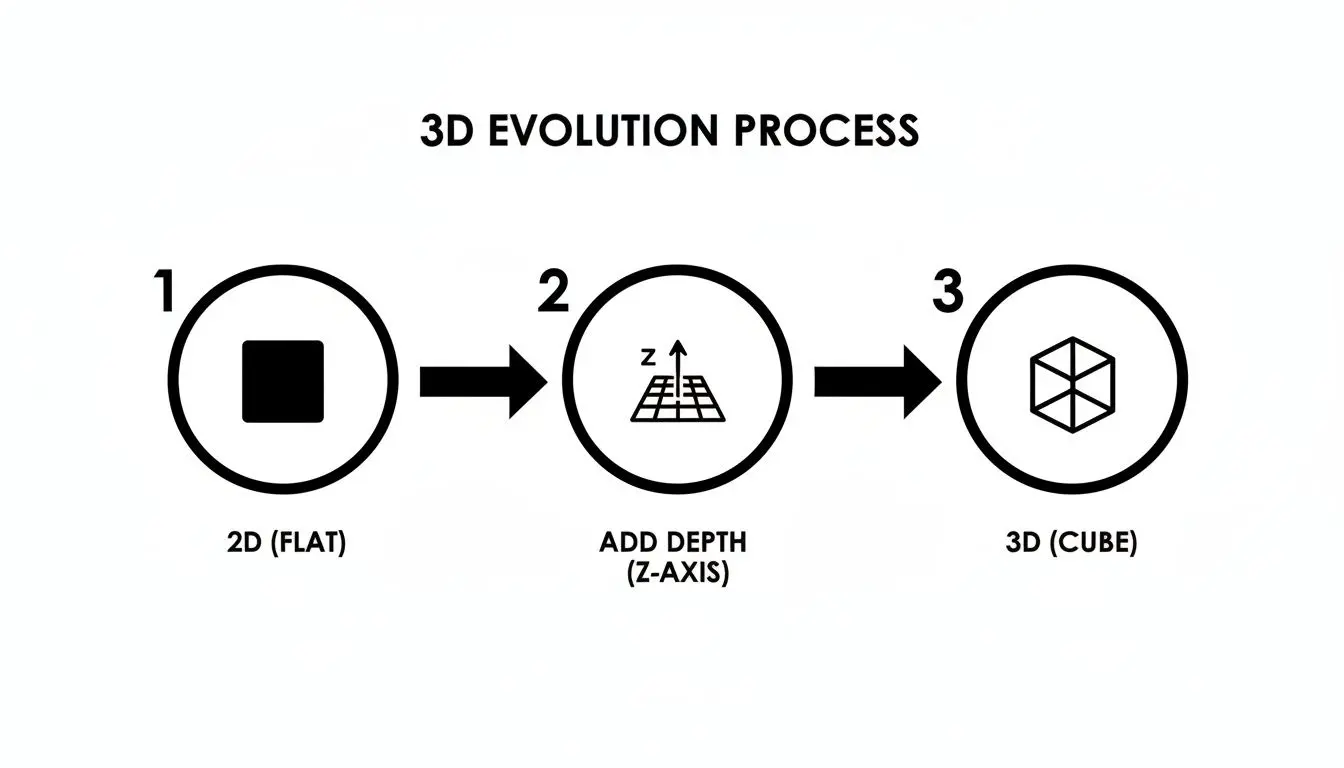
This jump into the third dimension fundamentally changes how we can interact with and perceive a digital object, unlocking a whole new world of storytelling possibilities.
Bringing the Scene to Life
Once all the assets are built and prepped, the animation and rendering stages bring everything together. This is where movement, light, and atmosphere combine to create the magic you see on screen. Animators use the rigs to bring characters and objects to life, meticulously crafting every movement frame by frame. At the same time, lighting artists set up digital lights within the scene to create mood, direct the viewer's eye, and make sure every element looks its absolute best, much like lighting a real-world film set. For a more detailed breakdown of the whole process, you can check out our guide on how to create 3D animation.
The final step is rendering. This is the heavy-lifting, computationally intensive process where the computer calculates all the data, models, textures, lighting, and animation, to generate the final, high-resolution image for each frame of the video.
Finally, in post-production, all the rendered frames are stitched together, or 'composited'. This is where we apply colour correction, add visual effects, and integrate the sound design to create the polished, final deliverable. This methodical journey, refined over years and now supercharged with real-time engines like Unity and Unreal Engine, is how we guarantee a studio-quality result every single time.
How UK Industries Use Motion Graphics
It’s easy to think of 3D motion graphics as something reserved for the silver screen, but its real power is being unlocked right across UK business. We’re seeing it solve genuine communication challenges everywhere, from ambitious marketing campaigns to highly technical training modules. It’s a versatile tool that takes abstract or complex ideas and transforms them into visuals that people not only understand but remember.
For marketing agencies and brands, 3D motion graphics offer a way to cut through the constant noise. Think about those slick logo stings that instantly build brand recognition, or a product launch video that stops you mid-scroll. These visuals can pull a product apart, show you its inner workings, and spotlight key features in a way static images or a simple video just can't compete with. The result? Content that not only grabs attention but holds it, boosting engagement and brand recall.
Entertainment and Media
In the entertainment world, 3D motion graphics are the lifeblood of storytelling. They’re behind those captivating title sequences that set the tone for a whole TV series, drawing you in before a single line of dialogue is spoken. Beyond the opening credits, they are absolutely essential for visual effects (VFX). From building futuristic cityscapes to creating fantastical creatures that blend seamlessly with live-action footage, this is what separates good content from an unforgettable cinematic experience. The UK's creative industry is a powerhouse, and its growth tells the story. The market for Animation, VFX, and Post Production, which all lean heavily on 3D motion graphics, is projected to climb from USD 3.94 billion in 2025 to a massive USD 9.36 billion by 2030. This boom is partly driven by trends like the 30% rise in motion capture technology adoption in games and film, a technique we use to bring truly lifelike performances to our characters. You can dig deeper into the UK Animation and VFX market trends on Mordor Intelligence.
Technical and Educational Sectors
Perhaps one of the most powerful applications for 3D motion graphics is in the B2B tech and educational spaces. When you're trying to explain a complex process or a highly technical product, words often don't cut it. This is where 3D visuals step in to bridge the gap, making the invisible visible.
By translating complex data and processes into clear, intuitive 3D models, we empower organisations to communicate their most challenging concepts with absolute clarity. It’s about turning complexity into comprehension.
This is exactly what we did for our GeoEnergy NI project. The challenge was to explain the intricate geology and engineering behind geothermal energy, a concept that’s incredibly difficult to grasp from diagrams alone. By creating a detailed 3D motion graphic, we were able to:
- •Visualise underground rock formations: We built a digital model of the earth's crust, showing precisely how geothermal systems operate thousands of feet below the surface.
- •Demonstrate the technology: The animation walked viewers through the drilling process and showed how heat is extracted and converted into usable energy.
- •Engage stakeholders: The final video delivered a clear, memorable, and persuasive explanation for investors, policymakers, and the public.
This kind of approach is invaluable for any organisation that needs to communicate technical information effectively. Whether it’s for medical training simulations, engineering explainers, or educational content, motion graphics services deliver the clarity and impact required to truly educate an audience and win over stakeholders. It proves they are far more than a creative flourish; they are a powerful strategic tool.
Choosing the Right UK Motion Graphics Studio
Finding the right creative partner for your project isn’t just another item on a to-do list; it’s probably the most critical decision you'll make for its success. When you're looking for the best UK provider of motion graphics services, it's tempting to just compare quotes. But the reality is, you need a partner with the perfect mix of technical chops, creative flair, and the discipline to see it all through. This guide will give you some solid, practical criteria to help you size up potential studios. We'll show you how to look at a portfolio with a critical eye, understand why a transparent process is non-negotiable, and check a studio's track record so you can find a team that will actually bring your vision to life.
Assess the Portfolio for Quality and Fit
First things first: the portfolio. It's the obvious place to start, but you need to know what you're really looking for. Don't get distracted by the flashy stuff; measure their work against what _you_ actually need. Look for variety. Does the studio show a range of styles, or does everything have the same look and feel? Even more important, can you see work that gels with your own brand's tone? A studio that’s a master of gritty, realistic visual effects might not be the right fit if you need something playful and stylised.
A strong portfolio isn’t just a highlight reel; it’s evidence of creative problem-solving. Look for work that tackles similar challenges to yours, whether that's simplifying a complex product or telling an emotional brand story.
Once you've found a stylistic match, it's time to get forensic about the technical quality. Look closely at the details that separate the truly professional work from the amateur:
- •Smoothness of Animation: Do the movements feel natural and believable, or are they a bit stiff and robotic?
- •Lighting and Texturing: Do the materials look authentic? Is the lighting used well to set the mood and draw your eye?
- •Composition: Is each shot thoughtfully framed, guiding you to the most important part of the scene?
These little things are dead giveaways of a studio's level of craftsmanship and attention to detail.
Understand Their Production Process
A brilliant final video is always the result of a brilliant process. Any studio worth its salt will be completely open about its production pipeline, walking you through each stage from the initial brief right up to the final delivery. It’s this structure that keeps projects on time and on budget. Ask them to talk you through their workflow. They should be able to clearly explain how they handle key phases like storyboarding, asset creation, animation, and rendering. This conversation will tell you a lot about their project management skills and, crucially, how they handle client feedback and changes. For a much deeper dive, have a look at our buyer’s guide to choosing an animation studio.
Verify Their Experience and Reputation
A portfolio shows you what a studio _can_ do. Testimonials and case studies show you what they've _actually done_ for other businesses. You're looking for proof that they're reliable partners who deliver on their promises. Case studies are gold dust because they give you the full story. They'll outline the client's original problem, the studio's creative solution, and what the project achieved. This gives you a peek into their strategic thinking and their ability to deliver real business results. And don't be shy about checking for reviews or asking for references. Hearing directly from past clients gives you an unfiltered view of what they're like to work with, especially on things like communication and professionalism. Finally, trust your gut and look for red flags. Be wary of studios with a vague process, poor communication in your initial chats, or a portfolio that feels inconsistent. A truly professional partner will make you feel confident and in the loop every step of the way, setting the stage for a smooth and successful project.
Understanding Pricing Bands and Timelines
Let's get down to the brass tacks: what’s this going to cost, and how long will it take? It’s often the first question we’re asked, and for good reason. Getting a clear handle on the budget and schedule is crucial for any project's success. Transparency is everything here. The final price tag isn't just a number pulled out of thin air; it’s a direct reflection of the creative talent, technical skill, and sheer computing power needed to bring your vision to life. Let’s break down what really drives the cost and timeline of a motion graphics project.
What Shapes Your Project Budget
A few key factors consistently shape the budget. Think of them as dials , the higher you turn each one, the more time and expertise are needed, which naturally affects the cost. The main drivers you'll need to consider are:
- •Complexity and Detail: This is the big one. A simple, clean animation of a logo is worlds away from a photorealistic product visualisation with dozens of moving parts, complex textures, and atmospheric lighting. The more unique elements we need to model, texture, and animate, the more hands-on time it requires.
- •Video Duration: While it's not a simple cost-per-second formula, the length of the video is a major factor. A 90-second explainer video simply requires more animation, rendering, and post-production polish than a quick 15-second social media clip.
- •Level of Photorealism: Are you after a more stylised, graphic look or something so realistic it could be mistaken for a live-action shot? Achieving hyper-realism is a highly specialised skill. It demands meticulous work in lighting, texturing, and shading to perfectly mimic the real world, which is incredibly time-intensive.
It all boils down to a simple principle: the more time, talent, and computational power a project demands, the higher the investment. A detailed brief is your best tool for getting an accurate quote right from the start.
Factors Influencing Motion Graphics Project Costs
To help visualise how different creative choices impact the budget, here’s a quick comparison of low versus high-complexity elements.
| Factor | Low Complexity (Lower Cost) | High Complexity (Higher Cost) |
|---|---|---|
| Asset Detail | Simple geometric shapes, basic logos | Intricate machinery, detailed characters, organic models |
| Texturing | Flat colours, simple material properties | Realistic wood grain, metallic sheens, complex surfaces |
| Animation | Basic movement, simple camera paths | Fluid character animation, physics simulations (e.g., water, smoke) |
| Environment | Plain background, simple studio lighting | Detailed architectural scenes, natural landscapes, dynamic lighting |
| Render Style | Stylised, non-photorealistic look | Hyper-realistic visuals, indistinguishable from reality |
| Revisions | One or two rounds of minor tweaks | Multiple rounds of significant creative changes |
Understanding where your project sits on this spectrum is the first step towards building a realistic budget and timeline.
Illustrative Pricing and Timelines
So, what does this look like in practice? Below are some typical pricing bands to give you a ballpark idea. Keep in mind these are just examples; your project's unique creative needs will determine the final quote.
- •Simple Logo Sting (5-10s): £2,000 - £5,000 | 1 - 2 Weeks
- •Social Media Ad (15-30s): £5,000 - £12,000 | 2 - 4 Weeks
- •Product Explainer (60-90s): £12,000 - £25,000+ | 4 - 8 Weeks
- •Technical Visualisation (1-3 min): £20,000 - £50,000+ | 6 - 12+ Weeks
For a standard 60-second explainer, a 6-week schedule is pretty typical. This usually breaks down into a week for discovery and storyboarding, two weeks for building the 3D assets, another two for animation and rendering, and a final week for post-production touches and revisions.
File Delivery Specs
When all the creative work is done, what do you actually get? We’ll package everything up into the exact file formats you need for your chosen platforms, whether it’s for a TV broadcast, your website, or a social media campaign. The most common file formats we deliver are:
- •.MP4: This is the workhorse for digital content. It’s highly compatible and offers a fantastic balance of quality and file size, making it perfect for websites, social media, and presentations.
- •.MOV (ProRes): If you need the absolute highest quality for broadcast or for use in another video edit, this is the format to go for. It’s less compressed, which means it holds more visual detail but results in a much larger file.
Beyond the file type, we handle all the technical details. We'll make sure the resolution (1080p, 4K), aspect ratio (16:9 for YouTube, 9:16 for Instagram Stories), and frame rate are all perfectly optimised so your animation looks incredible wherever it’s shown.
The Future of Motion Graphics
The world of digital content doesn’t just evolve; it accelerates. Techniques that felt like the cutting edge of production just a few years ago are now becoming the standard, pushing creative studios to constantly look over the horizon. The future of motion graphics services is being forged where real-time tech, artificial intelligence, and immersive experiences collide, opening up possibilities that were once pure science fiction. Leading this charge is the rise of real-time rendering. Traditionally, creating a single, high-quality frame of 3D animation could take minutes, sometimes hours, of intense computer processing. Game engines like Unity and Unreal Engine have completely flipped this model on its head. By rendering visuals instantaneously, they create a space for rapid-fire iteration and creative discovery. This isn’t just about making things faster; it’s about fundamentally changing the way we work. Imagine being able to tweak lighting, camera angles, or textures and see the final-quality result immediately. This kind of interactive process gives artists and clients the power to make better creative decisions, much more quickly.
The Impact of AI and Immersive Tech
Beyond real-time, artificial intelligence is quietly reshaping production pipelines. AI-powered tools are now helping out with complex tasks like motion tracking, rotoscoping (the meticulous job of isolating elements in video), and even generating basic animations. These tools aren't here to replace artists; they're here to augment them, freeing up valuable time to focus on the high-level creative storytelling that truly makes a difference. This technological leap is happening at a time of incredible market growth. The UK's 3D Animation market is part of a global sector expected to climb from USD 26.63 billion in 2025 to USD 44.44 billion by 2029. A big part of this is the growing trend of mixing techniques, with 65% of animated projects in 2023 blending different styles for a unique, hybrid appeal. We’re also seeing motion capture adoption jump by 30% in UK video games and films. You can dig deeper into the trends in the 3D animation market here.
The future belongs to studios that are technologically fluent. The ability to seamlessly integrate real-time engines, AI efficiencies, and XR development into a proven production pipeline is no longer an advantage, it's a necessity.
The final piece of this futuristic puzzle is how motion graphics are merging with immersive technologies like Augmented Reality (AR) and Virtual Reality (VR). Motion graphics are no longer stuck on flat screens. They’re becoming spatial, tangible elements that audiences can interact with in three-dimensional, virtual worlds. This shift opens up some incredible new territory for:
- •Immersive brand experiences: Think of a product launch where customers can explore a virtual model of the new item right in their own living room.
- •Interactive data visualisation: Complex datasets can be transformed into explorable 3D environments, making dense information feel intuitive and impactful.
- •Enhanced training simulations: Realistic, animated scenarios can provide safer and more effective training for difficult, real-world tasks.
For brands and creators, this means it's time to think bigger. The key is to partner with a forward-thinking studio, one that combines years of broadcast experience with a deep, practical understanding of these next-generation tools. That's how you create content that doesn't just get noticed today, but is built for the digital experiences of tomorrow.
Frequently Asked Questions
Jumping into the world of motion graphics services for the first time can feel a little daunting. We get it. To help clear things up, we've put together some straightforward answers to the questions we hear most often from new clients. Our goal is to make sure you feel completely comfortable and ready to kick off your project with confidence.
What Do You Need From Me to Start a Project?
To get the ball rolling, the best thing you can give us is a clear creative brief. Think of it as the blueprint for your project. It should lay out what you want to achieve, who you're talking to, the main messages you need to land, and any specific ideas you have for the look and feel. Don't forget to include your brand guidelines, along with your ideal timeline and budget. The more information you can share right at the start, the more accurately we can scope everything out and nail your vision.
How Many Rounds of Feedback Are Included?
Our process is built around collaboration, not endless back-and-forth. We typically include two to three key rounds of feedback at major milestones in the project. You can expect to give your input after we've developed the storyboard or animatic, once the main 3D assets are built, and just before we hit go on the final render. This structure keeps the project moving forward smoothly while making sure you have plenty of opportunities to shape the final result.
We see feedback as a series of constructive checkpoints, not hurdles. It's all about working together to make sure the final animation hits your strategic goals and perfectly captures your creative vision.
Who Owns the Final Animation and Assets?
It's simple: you do. Once the project is wrapped up and the final payment is settled, you own the full rights to the finished video files. You're free to use them however you see fit, across any platform, as laid out in our agreement. The raw project files and the individual bits and pieces we create during production usually stay with us. However, if you need access to these or specific transfer rights, that's something we can always discuss and build into the plan from the outset.
Ready to see what stunning motion graphics can do for your brand? Get in touch with Studio Liddell to chat about your project. Send us your brand pack