Game Development Pre Production
You're staring at the same problem most studio leads face right now. The pitch feels strong, the art team is excited, and someone is already talking about trailers, but the cash burn starts the moment you confuse a good idea with a shippable plan. Game development pre production is where you stop that mistake before it becomes expensive, messy, and hard to unwind. Treat pre-production as a finance gate, not a creative warm-up. In the UK, that matters because the market is large, crowded, and under pressure, with 2,148 games development companies in May 2024, including 1,697 development studios and 278 service providers according to ICAEW citing TIGA. It also matters because big-budget games can take three to five years to develop as noted in UK industry reporting, so every bad early assumption gets amplified across a long build.
If you haven't locked scope, you haven't started production. You've started spending.
The right pre-production process is blunt. Define what the game is, prove the riskiest mechanic, lock the stack, set milestones that map to funding, and make sure the team and IP are clean before you scale. Do that properly and you'll know whether to green-light, reshape, or kill the project while the cost is still manageable.
| Factor | Pre-Production | Full Production |
|---|---|---|
| Scope certainty | Low to medium, actively being tested | High, changes are expensive |
| Team size | Small, flexible, senior-heavy | Larger, more specialised |
| Cash exposure | Controlled and reversible | Much harder to unwind |
| Funding readiness | Built around proof and validation | Built around delivery and burn |
| Best outcome | Kill, reshape, or green-light with clarity | Ship on time with fewer surprises |
Why Pre-Production Matters More Than Ever for UK Studios
A small UK studio can burn a year and a half chasing a promising idea that never had a locked scope. That is not a creative win or a production problem. It is a finance problem, and it starts when a team builds before it knows what it is building, who will fund it, and what proof a publisher or grant body will demand. The pressure is harsher now because the UK market is tightening. New studio formation fell to 137, the lowest level in 15 years, while UK development employment dropped from about 28,500 to 27,350 in the year to September 2025 according to recent UK industry data shared by TIGA. That is a survival signal. The market still grew in value to £8.7bn in 2025, so demand is there. The problem is whether a studio can shape a project that survives scrutiny and cash burn.
What pre-production is actually for
Pre-production is the cheapest phase to stop a project, reshape it, or cut it down into something that can survive. Publishers, grant bodies, and investors want a vertical slice, a signed-off GDD, or a clear prototype before they release serious money. They are protecting themselves from the scope drift that kills studios. In the UK, that scrutiny matters more because the sector has moved from its bedroom-coding roots into a mature market where improvisation is expensive. If you are still treating pre-production as a loose creative warm-up, you are already behind. The work here is to turn creative intent into funding credibility, then into a plan that can be delivered with a smaller, tighter team and a modular pipeline. Scope risk is financial risk. Catch it early, and you can kill the wrong idea cheaply, resize the right one, or prove enough to earn the next cheque. Leave it until production, and you pay for the same mistake with staff time, morale, and runway.
Defining Scope, Concept and the Pitch Deck
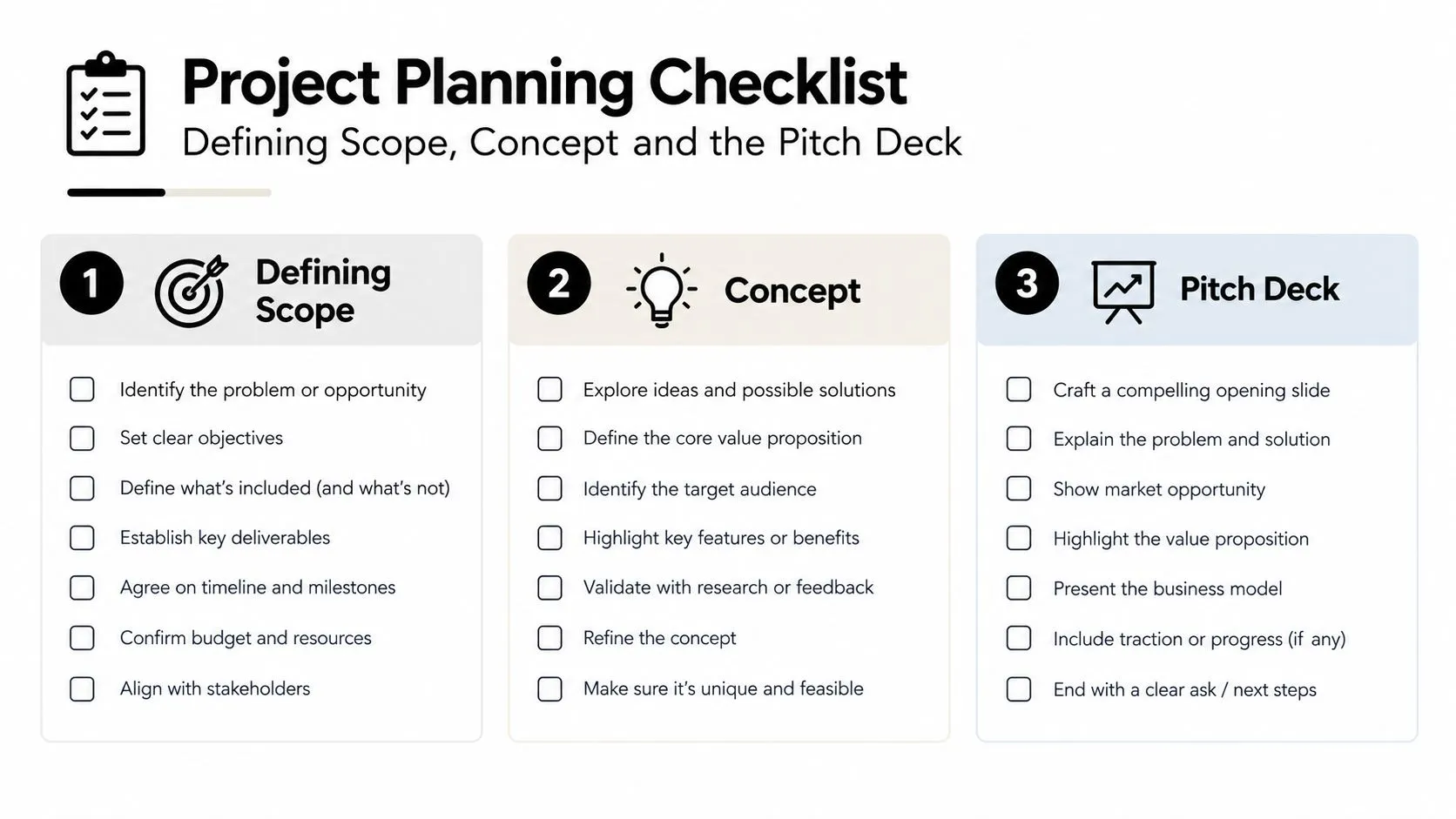
Start with one sentence. If you can't say what the game is in one sentence, you don't have a concept, you have a mood board. Then write a hard scope statement that names the platform, audience, monetisation model, and the few features that actually define the experience. The other half of the job is subtraction. Write down the things the game is not, the modes you're not shipping, the systems you're not building, and the art scope you're not funding. That discipline saves teams from the silent budget killer, which is “we'll figure that out later.”
What the pitch deck needs to prove
A UK publisher or grant assessor wants a deck that answers seven questions fast, hook, market context, USP, comparables, monetisation, team, and ask. The mistake I see constantly is burying the hook on slide eight. If the idea is weak enough that you need seven slides to warm up, it isn't ready. Use a Concept Brief and a Scope In/Scope Out matrix on day one. That way everyone signs the same reality, not a different interpretation of the same creative idea. If you need an external benchmark for the shape of a proof-of-concept workflow, Studio Liddell's own MVP proof of concept for digital products is a useful reference point for how teams separate validation from full build. A good pitch pack is short, sharp, and brutally honest. If the ask is vague, the response will be vague. If the scope is controlled, the conversation changes immediately.
Prototyping and the Vertical Slice
A prototype is not a trailer. A vertical slice is not a montage. They serve different jobs, and the sooner a studio lead stops mixing them up, the sooner the project becomes fundable.
Three layers that actually matter
A paper or greybox prototype validates the mechanic. A milestone build sits between experiment and polish. The vertical slice proves one full play loop at ship quality, and it is the one artefact that publishers, investors, and internal stakeholders tend to trust. For a small UK team of six to ten, don't slice the whole game. Pick one mechanic, one level slice, and one enemy type. Polish that one path hard enough that it demonstrates quality, pacing, readability, and platform viability. Everything else is overhead. A practical six-to-ten-week window is enough if the team is disciplined. Week one is definition and risk list. Week two is core mechanic prototype. Weeks three and four are content assembly. Weeks five and six are art, audio, and tuning. The last stretch is performance fixing and packaging. Each owner needs a clear lane, producer, design, code, art, and QA, or the slice becomes a committee project and dies by context switching. Make it run on the target device early. If it can't hold together on a Steam Deck or a mid-tier Android device, you do not have a slice, you have a PC demo with lies in it. For a useful adjacent example of how teams structure proof before a full build, the hands-on guide to Vision is worth reading because it frames early interactive validation as a product discipline, not a polish exercise.
A vertical slice should answer one question clearly, can this game survive full production on the hardware and budget you actually have?
Tech Selection, Tools and Pipeline Choices
Locking the engine first is usually the wrong move. Lock the proof target first, then choose the stack that gets you there without burning the team on unnecessary integration pain. A five-person Dundee studio moving a Unity prototype toward Switch has very different needs from a London team building a PC-first Unreal action title.
Choose the stack from the slice backward
Unreal makes sense when visual ambition and real-time presentation are central, but it brings heavier art-pipeline overhead. Unity is often the safer choice for smaller teams that need flexibility and faster iteration, especially when the team already knows it. Godot can be attractive for lean experimentation, but the key question is not ideology, it's whether the team can support the platform and pipeline confidently. Middleware changes the equation too. Wwise can save time on audio integration, while Spine or Puppet3D can speed up animation workflows, but only if the integration risk is lower than the time saved. That's the rule. If a tool adds complexity your team can't absorb, it's a false economy. Source control and automation need to be decided early. Binary-heavy teams usually want Perforce for assets and Git for code. Build automation and CI/CD should be part of the pre-production conversation, not something you “add later” after the vertical slice. I've seen more budget sink into retrofitting pipeline discipline than into the feature that was supposedly risky.
| Stack Option | Best Fit | Cost & Licensing | Integration Risk |
|---|---|---|---|
| Unreal | High-fidelity, real-time-heavy projects | Can become expensive in effort if the team is small | Medium to high if the team lacks engine experience |
| Unity | Small to mid-sized teams, flexible multi-platform work | Usually easier to justify for lean teams | Lower when the team already knows the tool |
| Godot | Experimental, lightweight, prototype-led work | Lower tool overhead, but support depth matters | Medium, because team familiarity is often the limiting factor |
| Perforce + Git pipeline | Teams with large binary assets and separate codebases | More setup work up front | Lower once the rules are clear |
| Wwise, Spine, Puppet3D | Specialised audio and animation needs | Worth it when the integration payoff is real | Higher if the team bolts them on too late |
For a practical overview of how engine decisions affect production shape, the game engine guide for modern studios is a useful internal benchmark. The core rule still stands. Run a short compatibility spike before you sign licences or assume the stack will behave the way the sales page promised.
Milestones, Budgets and Funding Readiness
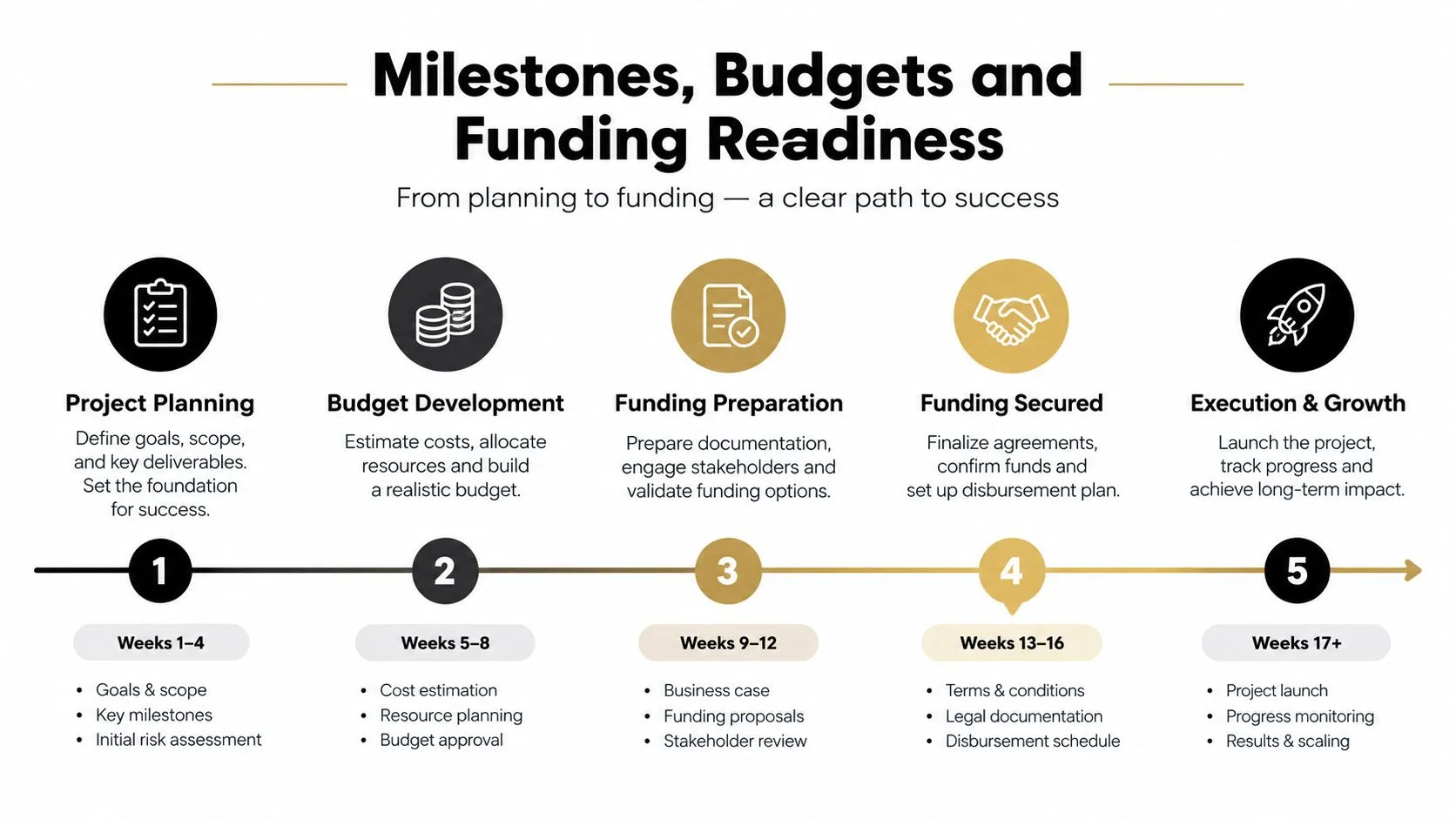
Milestones are funding instruments. If you treat them as internal calendar markers, you'll underprice risk and overpromise progress. If you treat them as gates with evidence attached, you'll know exactly what a publisher, investor, or grant panel is buying.
Build the budget from reality
Start with a bottom-up budget, not a hopeful one. In the UK, senior dev day rates commonly sit around £550 to £750/day, so your burn is not a theory, it's a number that compounds quickly. Add 15 to 20% contingency for hiring lag and tool-licence surprises, because both happen more often than teams want to admit. Structure pre-production around three clean gates, concept lock, prototype sign-off, and vertical slice delivery. Each gate needs a deliverable that someone outside the studio can evaluate without a phone call. That's how you avoid vague approval. Time your pitch readiness around funding windows rather than around your optimism. If you know a UK funding route or publisher review cycle is closing, get your materials ready a month ahead. A rushed pack at deadline is rarely as strong as a clean pack that has already been challenged internally. If you're actively mapping investor paths, the investors for gaming startups directory is a practical starting point for understanding who might back an early-stage UK team. Use it as a search tool, not as a substitute for a solid milestone plan.
Never fund a slice you can't explain in one sentence. If the milestone sounds fuzzy, the money will feel fuzzy too.
Team Roles, IP and Legal Foundations
Pre-production is when you lock the people, not just the plan. A UK studio of eight usually needs a producer, a tech lead, a lead designer, and a lead artist in-house, while other roles can stay flexible. If you try to keep everything casual at this stage, ownership confusion shows up later, usually at the worst possible moment.
Contracts before content
Put IP assignment, confidentiality, and morality clauses into every contract before vertical-slice work starts. Once a designer ships a mechanic under a consultancy agreement, ownership can become a headache that costs more than the feature itself. That's not drama, that's avoidable admin. You also need to separate founder IP from studio IP through a clean assignment and an ISA. Investors and UK grant assessors look for that line early because it tells them the studio owns what it claims to own. Register the working title and core trademark early, and document the chain of title for any third-party assets. If playtests involve personal data, run a basic data-protection review before you start collecting feedback. If you're outsourcing specialist work, platforms like Hire developers mexico can be relevant when a studio is comparing flexible delivery models, but only if the legal paperwork is cleaner than the staffing plan. The IP meaning in game development guide for UK studios is a good internal reference for getting the ownership basics straight. The point is simple. A messy rights chain kills deals faster than a weak prototype.
Templates, Checklists and the Move Into Production
A studio doesn't need more strategy theatre. It needs a small pack of documents that forces a decision. A one-page pre-production brief, a milestone acceptance checklist, and a green-light review pack are enough if they're used properly.
What each artefact should contain
The brief should hold the concept, target platform, audience, scope boundaries, monetisation model, key risks, and ownership notes. The acceptance checklist should name what “done” means for the slice, including playable build quality, performance target, and approval status. The green-light pack should combine scope, budget, risk, IP, and team readiness so a founder, publisher, investor, or funding panel can say yes or no without guessing. Store the pack in Confluence, Notion, or a shared drive, but keep one source of truth. If it lives in five places, nobody owns it. If it lives in one place and gets updated, production starts from something real instead of a half-remembered conversation. A practical checklist for the end of pre-production should include:
- •Vertical slice demo recorded, so stakeholders can review it without a live meeting.
- •GDD locked, with scope changes tracked rather than improvised.
- •Engine and toolchain versioned, so the build can be reproduced.
- •Audio direction set, so sound doesn't become a late-stage argument.
- •Accessibility targets confirmed, so compliance doesn't become an afterthought.
- •UK R&D tax credit evidence started, so the paper trail exists before the sprint noise begins.
- •Publisher or UKGC reporting lines defined, so people know who approves what.
Tie each artefact to a decision. The brief decides whether the idea is still coherent. The checklist decides whether the slice is real. The green-light pack decides whether the studio can afford to scale. When production begins, change the cadence. Tighten sprint ownership, define change-control rules, and re-baseline milestones against the funding that has cleared. That's the handoff that keeps a strong pre-production phase from being wasted by sloppy execution. --- If you want a blunt outside review of scope, pipeline, and funding readiness, Studio Liddell can help map the pre-production phase into a practical production plan. Visit Studio Liddell if you want a studio conversation that focuses on what the project can actually support, not what the pitch deck wishes were true.