IP Meaning in Game Development A UK Studio's Guide
A lot of teams only start asking about IP when a publisher asks for proof of ownership, a platform deal gets serious, or a freelancer relationship goes sour. By then, the problem is rarely abstract. It’s commercial. A launch slips, a licence stalls, or a buyer wants warranties you can’t comfortably give. That’s why the core ip meaning in game development isn’t just “legal protection”. It’s control over what you’ve paid to build, what you’re allowed to ship, and what you can still monetise after the first release. In UK production work, that question reaches into contracts, pipelines, naming, art direction, AI use, and the way a studio plans sequels, spin-offs, and client partnerships.
Your Game Is More Than Code It's Valuable IP
A game can look production-ready and still be commercially fragile. I’ve seen projects where the art is signed off, the build is stable, and the pitch deck is polished, yet one unresolved ownership issue makes the whole package hard to fund or license. The most common mistake is simple. People assume payment equals ownership. In game development, that assumption can break a project. Intellectual Property, or IP, is the bundle of rights attached to the creative work inside the game. That includes the obvious assets, such as code and artwork, but also the less visible pieces that make the project ownable and valuable in the market: branding, characters, worldbuilding, music, interface design, and production know-how. For clients commissioning game or XR work, this matters just as much as it does for studios. If you’re paying for a prototype, an interactive installation, a branded game, or a character-led experience, you need to know what you own at the end. If that answer is vague, the project carries risk long after delivery. A smart IP conversation starts early. It asks who is creating what, under which agreement, with what rights, for which territories and uses. It also asks what the property could become next. A one-off game asset might later support an animation short, an educational app, or a cross-platform brand extension, which is why early thinking around TV IP to games and XR across platforms is often more valuable than teams expect.
Practical rule: If an asset could matter to your launch, your funding, or your future licensing plans, treat it as IP from day one.
What Is Game IP Deconstructing Your Digital Assets
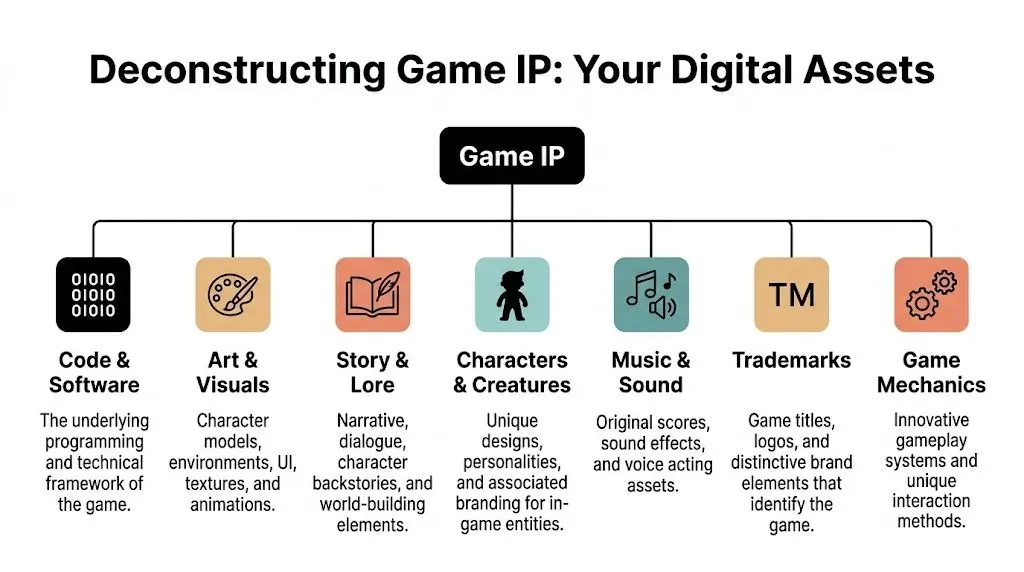
When clients hear “IP”, they often think of a logo or a game title. In practice, a game is a stack of distinct assets, each carrying different value and different risks. The easiest way to understand ip meaning in game development is to break the game apart and inspect what needs protection.
Code and systems
The codebase is the operational backbone of the product. It includes gameplay logic, tools, shaders, backend integrations, and any bespoke systems your team has built in Unity or Unreal. If a contractor writes part of that stack without a proper assignment, you can end up using critical software you don’t fully own. Mechanics sit near this category, but they deserve separate thought. A mechanic may not always be protected in the same straightforward way as artwork or music, yet the implementation, balancing, naming, interface expression, and underlying tools around that mechanic still matter commercially.
Art, audio, and narrative assets
Character models, concept art, environment design, textures, animation cycles, key art, UI screens, sound design, voice records, score, scripts, dialogue, lore, and world bibles are typically where teams recognise value fastest, as they all contribute to what a player remembers and what a buyer can license. A useful external primer on what is intellectual property protection gives a general overview of how different IP rights attach to creative work. For game teams, the practical step is to stop treating these assets as one blob. Catalogue them by creator, version, licence status, and intended use.
Characters, brands, and recognisable identity
A game’s commercial lift often comes from the parts that can travel beyond the original build. That includes:
- •Game title and logo. These are brand assets, not just packaging.
- •Lead characters and creature designs. These may anchor sequels, merch, social campaigns, and licensing.
- •Distinctive visual language. UI motifs, icon systems, and signature design cues can become part of brand recognition.
- •Story world elements. Factions, settings, names, and lore terms often outlive a single product release.
A game doesn’t become valuable because it has assets. It becomes valuable because those assets are organised, ownable, and reusable.
The asset audit most teams skip
Before any funding round, publishing conversation, or client handover, I’d want a working list like this:
| Asset group | Typical examples | Common risk |
|---|---|---|
| Code | gameplay systems, tools, plugins, integrations | contractor ownership or third-party licence conflicts |
| Visuals | concept art, 3D models, UI, animation | unclear authorship, reused stock, missing permissions |
| Audio | music, SFX, voice work | limited usage rights or session terms |
| Narrative | scripts, lore, dialogue, world bible | collaborative ownership confusion |
| Brand | title, logo, names, slogans | weak clearance or no registration plan |
That exercise sounds administrative, but it changes decisions. Teams spot gaps earlier, clients ask better questions, and commercial discussions stop relying on assumptions.
The Four Pillars of IP Protection in the UK
In UK game production, the legal framework isn’t a single switch you turn on. It’s a set of tools, each suited to different parts of the project.
Copyright covers the core creative work
For most studios, copyright does the heavy lifting. In the UK, game IP is primarily protected under the Copyright, Designs and Patents Act 1988, which automatically protects elements such as code, art, and story on creation. That legal framework supports an industry that contributed £7.4 billion to the UK economy in 2022, as noted by Brabners on AI and intellectual property in game development. This is why process matters. You don’t usually need registration for copyright to exist, but you do need evidence of authorship, ownership, and permission to use the work.
Trade marks protect market identity
Trade marks are about recognition in the market. They’re the right tool for game names, logos, and other brand identifiers that players, platforms, and partners use to tell your property apart from everyone else’s. That matters more than many teams think. A strong title can become the anchor for stores, trailers, sequel naming, merch, and licensing negotiations. If the branding matters commercially, it deserves proper clearance and a filing strategy.
Registered designs can matter more than expected
Registered design protection gets less attention in games, but it can be relevant when the visual appearance itself carries distinctive value. Think interface systems, icons, product styling, or a recognisable visual component that isn’t only “art” in the broad sense but part of a designed product experience. For studios doing game-adjacent work, this becomes especially relevant in XR, installations, and branded digital experiences where the visual shell is part of the deliverable.
Patents are specialised, not a default answer
Teams often assume a clever mechanic should be patented. In UK game development, that’s usually the wrong starting point. Patent protection for pure software is difficult, and the threshold is much higher than most early-stage projects expect. A simple comparison helps:
| Protection type | Best suited to | Production reality |
|---|---|---|
| Copyright | code, art, music, writing | automatic, but ownership still needs documenting |
| Trade mark | game name, logo, brand signals | useful when commercial identity matters |
| Registered design | visual appearance of defined elements | selective, but valuable in the right cases |
| Patent | narrow technical inventions | rarely the first tool for games |
If a dispute ever escalates, teams also need to understand enforcement, not only registration. A broader litigation overview such as Intellectual Property Infringement Litigation is useful for understanding how infringement conflicts can become business problems once rights are contested across markets.
Who Owns the IP Navigating Studio and Contractor Rights
This is the part that causes the most expensive confusion. A studio can commission excellent work, pay on time, and still not own what it bought. In the UK, employees and contractors are treated differently, and if you don’t handle that properly in writing, ownership can stay with the person who made the asset.
Employees are one thing, freelancers are another
In broad production terms, work created by employees in the course of employment is usually easier for the employer to control. Contractors are different. Their default position is riskier unless the agreement clearly assigns rights. That’s why this fact matters so much: UK studios must secure signed IP Assignments from all contractors; without them, the contractor retains the rights to their work despite being paid. Sprintlaw reports that disputes over contractor IP have contributed to delays in 20-30% of UK indie games, because investors and publishers want a clear chain of title before proceeding, as explained in Sprintlaw’s guide to IP meaning in gaming for UK studios and platforms.
What breaks in real projects
When ownership is fuzzy, the damage shows up in ordinary production moments:
- •Funding due diligence. Investors ask who owns the character art, code, soundtrack, and brand.
- •Platform and publishing deals. Contract warranties become hard to sign legitimately.
- •Licensing discussions. Buyers won’t pay properly for rights you might not control.
- •Sequels and ports. Legacy assets become legal baggage if they were never cleanly assigned.
If the chain of title is incomplete, the game may still run. The business around it won’t.
What actually works
Studios need a repeatable rights process, not one heroic clean-up exercise before launch. I’d expect to see:
- •Signed agreements before work starts. Not after first delivery, and not once the relationship becomes awkward.
- •Specific assignment wording. “Work for hire” style assumptions from other markets don’t fix UK ownership issues on their own.
- •Clear schedules of deliverables. If the contract says “art assets” but the freelancer also builds tool scripts or UI kits, ambiguity creeps in.
- •Third-party material disclosure. Stock libraries, marketplace assets, and pre-existing tools need declaring.
- •Moral rights language where appropriate. This should be handled carefully and professionally, not copied blindly from a template.
The client-side question to ask early
If you’re hiring a studio or mixed team, ask one direct question: “Can you show how rights flow from every contributor into the final deliverable?” A good partner won’t treat that as hostility. They’ll treat it as production hygiene.
Beyond the Launch Licensing and Commercialisation Strategies
A client signs off the game, launch goes well, and the next conversation starts a week later. Can this character line support merchandise? Can the world be adapted for a museum install, an animated short, or a mobile spin-off? If those questions arrive late, the studio is forced into expensive retrofitting. If they are planned early, the game becomes a commercial asset with options.
Licensing works best when commercial use is designed in
Licensing is rarely a bolt-on revenue line. It usually depends on decisions made during production: how the brand is named, whether hero assets are documented properly, whether character designs are consistent enough for third-party use, and whether the studio can separate reusable IP from project-specific files and licensed dependencies. In client conversations, I usually reduce this to a simple test. Could another partner pick up your character pack, brand guide, audio rights position, and usage rules without needing six weeks of legal clarification? If the answer is no, the property is harder to license, harder to value, and slower to expand. That matters in the UK market, where growth often comes from mixed commercial models rather than one platform release. A property may start as a PC or console game, then move into mobile, XR, education, location-based entertainment, branded content, or retail product. Each route has different margin potential, approval cycles, and rights requirements.
Where game IP creates commercial range
The practical shift is to treat the game as one product inside a wider IP plan. That can include:
- •Merchandising. Apparel, collectibles, art books, soundtrack releases, and promotional goods built around distinctive characters or a clear visual identity.
- •Transmedia development. Short-form animation, narrative extensions, companion apps, publishing, or educational adaptations.
- •Co-branded work. Partnerships with retailers, sports organisations, museums, visitor attractions, or public engagement campaigns.
- •XR and location-based formats. Interactive installations, themed experiences, and immersive versions of an existing world or mechanic.
For teams planning across those channels, Studio Liddell’s IP development work shows how IP planning can sit inside a production pipeline that also covers animation, XR, games, and branded experiences.
The trade-off is speed now versus value later
Studios under schedule pressure often optimise for shipping the first version. That is understandable, but it creates avoidable limits. A UI built only for one screen format can make ports slower. Character art created without a usable style guide can delay merchandising. Music licensed too narrowly can block trailers, social campaigns, or regional re-releases. The better approach is to decide early which parts of the project may need to travel and build for that reality. If the property could support licensing, prepare approval rules and brand assets. If mobile or Switch is likely, review technical dependencies and platform rights while the build is still flexible. If there is a realistic path into broadcast, education, or an immersive activation, define those commercial uses before contracts and content pipelines harden around a single release.
Strong IP earns more when it is organised for reuse, partner review, and expansion across formats.
Emerging IP Challenges AI and the Future of Creation
A client signs off a character direction built with AI-assisted concepting. Six months later, the game is heading to pitch meetings, platform discussions, and licensing conversations. That is usually the point where someone asks a simple question with expensive consequences. Where did this asset come from, and can you prove you own what you are selling? AI has shortened parts of production, but it has also made chain of title harder to defend. In a UK studio setting, the practical risk is rarely the tool on its own. The risk sits in undocumented prompts, unclear training provenance, weak contractor terms, and a team assuming that heavy human editing automatically solves ownership questions. Human input still matters. A lot. But commercial partners do not buy assumptions. The studios that stay out of trouble treat AI like any other production dependency that can affect rights, approvals, and resale value. They decide early whether AI is limited to ideation, internal reference, code support, or final asset creation. They also set rules for who can use which tools, what gets logged, and what needs sign-off before anything enters a client build or a master asset library. That matters even more when freelancers are involved. If a contractor uses an AI tool on concept art, UI elements, marketing copy, or audio drafts without disclosing it, the studio can inherit a rights problem it did not price for. In practice, UK clients increasingly want warranties around originality, disclosure, and third-party material. If the paperwork and asset history are weak, the conversation quickly shifts from creativity to liability. A workable policy usually answers four questions:
- •Which tools are approved for commercial work
- •Which tasks can use AI, and which require fully human-created output
- •What records must be kept, including prompts, edits, approvals, and source files
- •Who is responsible for checking contractor compliance and client disclosure obligations
The same commercial logic appears in other digital ownership debates. Studio teams looking at provenance, scarcity, and resale rights can see the overlap in this piece on NFTs and digital assets in interactive projects. The format changes. The underlying issue does not. Value holds when ownership history is clear enough to survive due diligence. There is also a less obvious IP question here. Sometimes the most valuable asset is not the generated output. It is the studio method behind it. Prompt frameworks, selection criteria, internal tooling, review gates, and platform-specific adaptation workflows can all create commercial advantage across console, mobile, XR, and branded interactive work. In many cases, those methods are better protected as confidential know-how than exposed through formal registration. For UK clients, that is the primary future-of-creation issue. AI can speed up production, but speed without proof creates avoidable risk at the exact moment a project starts to gain commercial value.
Practical IP Advice for Your Next Project
Teams don’t need a theory seminar before greenlight. They need a working checklist. Use this before any new game, XR build, branded interactive piece, or client commission:
- •Define ownership at kickoff. Decide what the client owns, what the studio retains, and what third-party tools or materials sit outside the transfer.
- •Get contractor paperwork signed early. If a freelancer is touching concept art, code, audio, UI, or narrative, assignment language should be agreed before production starts.
- •Create an asset register. Track creator, date, source files, licences, approvals, and intended usage for every meaningful asset group.
- •Separate pre-existing IP from project IP. If a contributor brings prior tools, kitbash libraries, or reusable templates, document that boundary clearly.
- •Check naming before branding hardens. It’s cheaper to revisit a title or logo early than after marketing assets are built.
- •Write an AI usage rulebook. Even a short internal policy is better than vague assumptions spread across Slack threads and production calls.
- •Prepare a chain-of-title file. Publishers, investors, and licensing partners will ask for proof eventually. Don’t build it in a panic.
One habit makes all of this easier. Treat IP admin as part of production management, not as a legal clean-up job at the end. When producers, creative leads, and clients all work from the same ownership logic, fewer unpleasant surprises appear late in the schedule.
Frequently Asked Questions on Game Development IP
Does paying for freelance work mean I own it
Not by default. In UK practice, payment alone doesn’t automatically transfer ownership from a contractor. Rights need to be assigned in writing.
Is my game protected automatically in the UK
Key creative elements such as code, art, music, and story are generally protected by copyright on creation. That helps, but automatic protection does not solve ownership gaps between multiple contributors.
Should I patent my game mechanic
Usually, that isn’t the first place I’d spend time or budget. For most game teams, ownership of code, art, branding, and confidential production know-how matters earlier and more often than a patent strategy.
What do publishers and investors usually care about most
They care about whether you can prove you own or control the rights needed to ship and monetise the game. If contributor agreements are missing, confidence drops quickly.
Can IP include more than the finished game
Yes. It can include characters, worldbuilding, logos, concept art, music, documentation, tools, and other assets with reuse value. In practice, that broader view is what creates sequel, licensing, and transmedia opportunities.
Do AI-assisted assets create extra risk
Yes. If the team can't show what was generated, how humans contributed, and what policies governed the workflow, ownership and copyright questions become harder to answer.
If you're planning a game, XR experience, or cross-platform IP and want the production side and ownership side thought through together, Studio Liddell works across animation, games, immersive content, and IP development with a practical focus on what gets made, what gets delivered, and what can still create value after launch.