Fulham Palace Museum London: A Visitor's Guide
A few minutes after leaving the road, the noise drops away. You step through the grounds at Fulham Palace and suddenly London feels distant, even though the city is still right outside the gates. That contrast is what makes fulham palace museum london distinctive. It isn’t only a museum in a historic building. It’s a former residence, a garden, an archaeological site, and a working cultural place that still has room to evolve.
An Introduction to London's Riverside Treasure
Fulham Palace sits beside the Thames, but its character comes from layers rather than a single view. Visitors often expect a stately house. What they find is more complex. The site holds traces of domestic life, church authority, horticultural experimentation, public learning, and long-term care. That matters for anyone assessing the palace, whether as a visitor, educator, curator, or prospective partner. Some heritage sites are best understood as frozen moments. Fulham Palace works differently. It reads more like a long conversation between periods of use.
More than a house museum
The palace has a rare mix of qualities:
- •Historic residence: It functioned as a bishop’s home for centuries, which gives the interiors a lived-in rather than purely ceremonial feel.
- •Museum setting: The rooms interpret the site’s history through objects, architecture, and changing exhibitions.
- •Garden destination: The grounds aren’t an afterthought. They are central to the site’s identity.
- •Community venue: Learning activity, events, and inclusive programming keep it active in the present.
For a general visitor, that means there isn’t just one way to experience it. You can come for architecture, for botany, for archaeology, or for a quieter walk with a strong sense of place.
Why the place feels different
Many London museums ask you to begin with labels. Fulham Palace asks you to begin with the setting. The route in, the lawn, the old fabric of the buildings, and the enclosed feeling of the grounds all do interpretive work before you read a single panel.
Heritage value isn’t only in the object on display. It’s also in how a site lets people feel time passing through materials, rooms, and landscape.
That’s also why Fulham Palace has practical potential beyond tourism. It already offers the ingredients that digital interpretation teams look for: strong narrative layers, visible architectural change, outdoor circulation, and stories that can be experienced in place rather than merely described.
A 900-Year Journey Through History
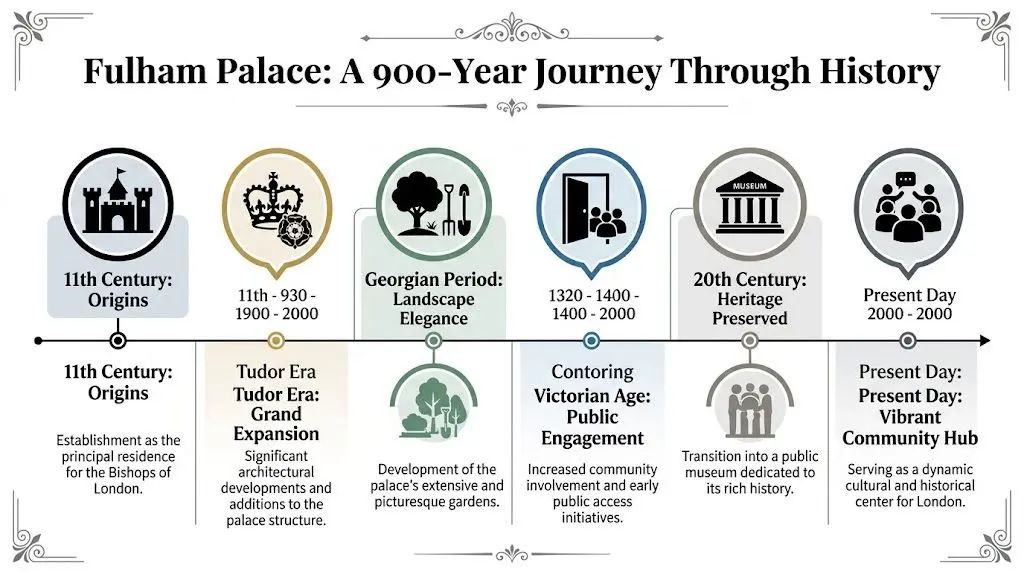
Fulham Palace’s history is often summarised in one line, but the timeline deserves closer attention. The site served as the principal residence of the Bishops of London from the 11th century until 1973, and its origins go back to the Saxon-era Manor of Fulham, acquired by Bishop Waldhere in 704 AD, as noted by the Fulham Palace historical overview.
From Saxon manor to episcopal power base
That early acquisition matters because it explains why the palace is more than a handsome old house. It began as part of a wider pattern of landholding, authority, and church administration. Over time, that function deepened, and Fulham became one of the most important residential centres connected to the Bishops of London. The site’s long occupation also changes how you should read the building. You aren’t looking at a single-period composition. You’re looking at a place repeatedly altered to suit new expectations of status, worship, hospitality, and domestic life.
Architecture as a record of change
The palace is a Grade I-listed complex and includes medieval structures within a scheduled ancient monument, again described in the earlier linked historical overview. Those formal designations are useful because they signal what specialists already recognise. This is a site where physical fabric carries national significance. Several architectural periods remain legible.
- •Tudor work gives the palace some of its most recognisable character, especially around the courtyard and Great Hall.
- •Georgian rooms add a different rhythm and proportion, showing how comfort and taste shifted.
- •Victorian interventions make clear that the bishops who lived here did not treat it as a relic. They adapted it.
This mixture can confuse first-time visitors. They sometimes assume inconsistency means loss of authenticity. In heritage terms, the opposite is often true. Layering is the authenticity. The building still shows that people changed it because they needed it to work.
A site shaped by conflict and survival
Fulham Palace also carries marks of disruption. Historical accounts attached to the site include the 12th-century captivity of Bishop Robert de Sigello during the Anarchy and later WWII German bombing damage. Those events matter less as isolated anecdotes than as reminders that important places are never insulated from national upheaval. The palace endured because each generation found a reason to repair, adapt, and keep using it.
Historical reading: At Fulham Palace, continuity doesn’t mean everything stayed the same. It means the site remained important enough to keep changing.
Excavation widened the story
One of the strongest reasons to treat Fulham Palace as a major heritage site is that the story doesn’t begin with bishops. Early 21st-century archaeological excavations uncovered evidence of Neolithic, Iron Age, Roman, and Viking settlements, including a Roman villa, showing 6,000 years of human activity on the site. That transforms the interpretive frame. Instead of seeing the museum as a bishop’s residence with an old garden, you begin to understand it as a stratified Thames-side settlement. That opens richer questions:
- •Why was this riverside location repeatedly occupied?
- •How did later religious and domestic use sit above much earlier settlement evidence?
- •How can visitors grasp that depth when much of archaeology is, by nature, fragmentary?
Those questions become especially important when thinking about interpretation. Archaeology often struggles in traditional gallery form because so much depends on context, reconstruction, and imagination. Fulham Palace has exactly the kind of timeline that benefits from careful visual storytelling.
Exploring the Palace and Gardens Today
A strong visit to Fulham Palace begins with a small shift in perspective. You are not entering a museum with a garden attached. You are entering a long-inhabited riverside estate where rooms, walls, paths, and planting schemes all carry evidence of use.
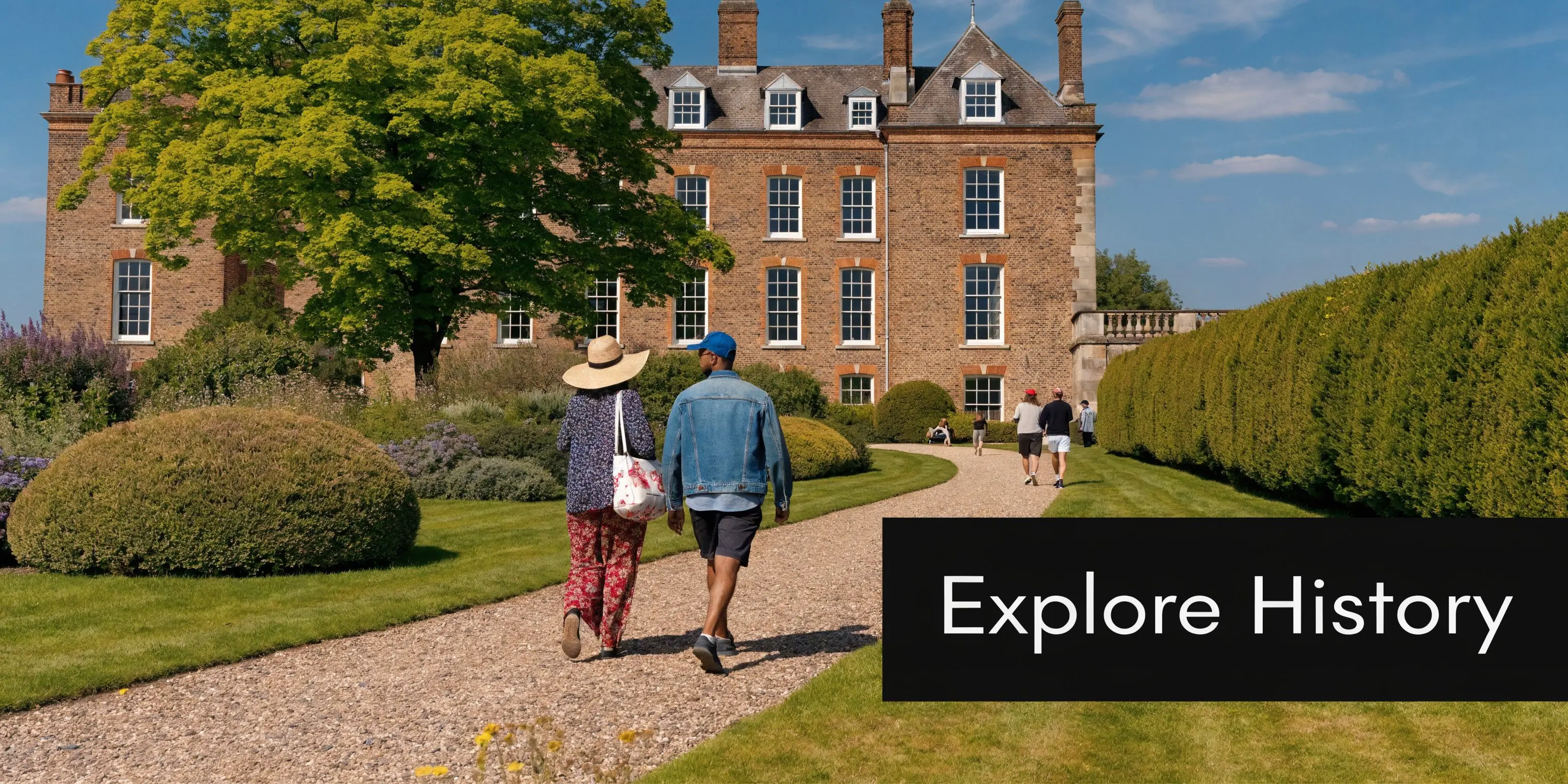
That matters because Fulham Palace is easiest to understand in layers. The interiors explain authority, worship, residence, and display. The gardens explain cultivation, experiment, and daily management. Together, they read like two halves of the same manuscript.
Start inside the museum rooms
The museum is presented within restored Georgian rooms at Fulham Palace, and the official site outlines the collections, historic interiors, and current visitor offer on the Fulham Palace website. The setting does part of the interpretive work for you. Objects are not isolated in a neutral box. They sit inside rooms that still communicate how the estate functioned. Look for material that helps decode the place rather than treating each item as a stand-alone treasure:
- •Paintings and stained glass show how status, memory, and ecclesiastical identity were presented.
- •Architectural fragments make alterations visible, almost like finding earlier drafts beneath a final text.
- •Archaeological material and Roman finds widen the chronology beyond the bishops’ household.
- •A cope and scale model help visitors grasp both ceremonial life and the broader form of the site.
The scale model is especially effective for children, first-time visitors, and anyone less familiar with historic houses. Large estates are often hard to read because you encounter them room by room. A model works like a site map with memory built into it. It helps the plan make sense before the details start competing for attention.
Then read the building itself
After the displays, pause and treat the architecture as evidence. The Great Hall communicates status and gathering. The courtyard explains approach, sequence, and public arrival. Smaller rooms often reveal the quieter mechanics of residence and administration. Asking one clear question in each space helps: what activity was this room designed to support? That method sounds basic, but it is one of the best ways to avoid the common problem of historic-house visiting, where dates are remembered but purpose remains vague.
The gardens carry the story forward
Outside, the interpretation changes scale. The grounds are not a pleasant interval between indoor displays. They are part of the record. The walled garden, broader grounds, and long botanical associations show that Fulham Palace was also a place of cultivation, collecting, and exchange. Old trees do something labels often cannot. They make duration tangible. A veteran specimen can convey elapsed time more quickly than a paragraph of text. A clear route works well:
- Begin on the main lawn to understand the house in its estate setting.
- Move into the historic rooms while that overall layout is still fresh in mind.
- Return outside to the walled garden to see how enclosed productive space differs from formal approach space.
- End with the oldest planting features and mature trees to connect the human timetable of bishops and rebuilding with the slower timetable of the grounds.
At sites like Fulham Palace, gardens function as archives in living form.
Why the site has real interpretive potential
What stands out today is the range of material the site holds together. Different architectural periods sit alongside archaeology, domestic history, religious history, and horticulture. In weaker heritage settings, that mix can feel scattered. Here, it offers multiple entry points for different audiences. That is also where Fulham Palace becomes interesting for creative partners. Its story is unusually well suited to digital interpretation. Archaeology could be reconstructed through animation. Lost phases of the house could be explored through XR overlays. Botanical history could be explained through interactive media that links planting, trade, and imperial networks to the physical garden visitors can still walk through. For a studio, museum technologist, or cultural partner, the opportunity is practical as well as imaginative. Fulham Palace already has the ingredients that digital storytelling needs. A layered timeline, surviving fabric, open grounds, and audiences who benefit from seeing change across centuries rather than as a series of disconnected facts.Planning Your Visit to Fulham Palace
Practical planning matters more here than people expect. Historic sites often have shifting access needs, and a smooth visit usually depends on checking the essentials before you travel.Fulham Palace visitor information at a glance 2026
| Attribute | Details |
|---|---|
| Entry | Fulham Palace is described as one of 33 free museums in London in the verified data provided via WhichMuseum. |
| Opening pattern | The site is described in verified data as open daily. Check the official website before travelling in case of event-related changes. |
| Location context | It is a Thames-side historic site in Fulham, West London. |
| Nearest Tube | Verified data notes proximity to Putney Bridge station. |
| What to prioritise | Historic rooms, Great Hall, gardens, and walled garden. |
| Best visit style | Allow time for both indoor interpretation and outdoor walking. |
| Accessibility planning | Detailed physical accessibility information is not clearly set out in the verified material, so visitors with specific access requirements should contact the venue directly before visiting. |
How to plan with fewer surprises
A straightforward approach usually works best:- •Check the day’s access status: Heritage venues can have closures or partial restrictions due to events, conservation work, or programming.
- •Wear suitable footwear: Grounds, garden routes, and older surfaces can vary.
- •Decide your focus in advance: If you like interiors, start in the museum. If you prefer the grounds, begin outdoors and then move inside.
- •Leave time to pause: This isn’t a rush-through attraction. The value is in noticing details.
The accessibility question
Accessibility is one area where visitors often want clearer guidance. The verified material shows strong inclusive programming, but it also notes a gap in detailed public information about physical access. For many people, especially those planning a longer journey, that matters.
Ask specific questions before travelling. Entrances, surfaces, toilets, seating, and route gradients are much easier to assess in advance than on arrival.
If you’re arranging a school, group, or family visit with additional requirements, direct contact is the sensible route. Historic sites can sometimes offer practical workarounds even when online information is limited.
Current Exhibitions and Learning Programmes
Fulham Palace is at its best when understood as an active learning environment. The site doesn’t rely only on permanent display. It keeps inviting people back through programmes, research activity, and socially engaged interpretation.
Temporary exhibitions with a wider brief
The museum’s recent work shows a willingness to present difficult history alongside more familiar stories of architecture and gardens. Verified information notes a 2023 exhibition on the Church of England’s role in colonial expansion and transatlantic slavery, developed from a multi-year research project and community collaboration. That matters because it moves the palace away from a comfortable house-museum model. The implication for partners is clear. Fulham Palace is capable of handling layered, contested, and evolving interpretation rather than only celebratory heritage.
Young archaeology in practice
One of the strongest signs of educational seriousness is the site’s archaeology offer. Fulham Palace hosts London’s only Young Archaeologists’ Club, run by the Council for British Archaeology for ages 8 to 16, and the programme includes hands-on digs and artefact handling. The same verified data also notes a 15% rise in youth participation in archaeology across the South-East post-2025, linked to this area of activity in the source material from the palace’s young adults page: https://www.fulhampalace.org/learning/young-adults/ That combination matters because it turns archaeology from a display topic into an activity. Young people don’t just view the past. They test, uncover, and interpret it.
Why this programme mix works
The learning offer is effective for three reasons.
- •It uses the site itself as a teaching tool. A real archaeological site changes the tone of learning.
- •It supports repeat engagement. Clubs, workshops, and recurring sessions create continuity.
- •It widens the idea of museum literacy. Participants learn through handling, observation, and discussion, not only through labels.
For exhibition teams, there’s also a useful lesson in presentation. Hands-on archaeology, social history, and architectural interpretation all benefit from strong visual communication. A thoughtful guide to the role of graphics in creating engaging exhibits is relevant here because sites like Fulham Palace depend on clarity. Visitors need help connecting fragments, spaces, and stories across time.
Good learning design doesn’t simplify history into something smaller. It gives people better tools to handle complexity.
A place for repeat visits
Many heritage venues are enjoyable once. Fulham Palace has stronger repeat-visit logic because the learning activity keeps changing. Families can return for programmes. Local audiences can revisit exhibitions. Schools can approach the site through archaeology, its grounds, or religious history depending on curriculum needs. That flexibility is one of the museum’s most useful assets. It supports audience development without forcing the site into a single identity.
Digital Futures and Heritage Partnerships
Fulham Palace is unusually well suited to digital interpretation. Not because it needs technology to become interesting, but because its stories are spatial, layered, and partly invisible. Those are the conditions where digital tools can do real heritage work.

Where digital interpretation would add value
Some sites need screens because the physical experience is thin. Fulham Palace is the opposite. The physical experience is rich, but parts of the story are hard to access directly. Examples include:
- •Archaeological layers that can’t be seen in their original context
- •Former phases of the building that survive only in fragments
- •The lost moat and earlier estate form which require reconstruction to understand
- •Sensitive histories that benefit from multi-voice interpretation rather than a single wall panel
AR, VR, animation, and interactive graphics can help with all of these, provided they are used with restraint. The aim shouldn’t be spectacle. It should be orientation, access, and understanding.
Accessibility is the practical driver
A particularly strong case for digital investment sits around access. Verified information notes that, while Fulham Palace is active in inclusive programming, detailed physical accessibility information remains limited. It also states that 24% of UK museum visitors have disabilities, and highlights the growing case for digital XR tours in line with projected 2026 inclusivity benchmarks from the Museums Association, as summarised in the event-related source material: https://www.fulhampalace.org/whats-on/events/ingredients-of-an-inclusive-museum-panel-discussion/ That matters for several reasons. First, historic sites often have physical constraints that can’t be removed without harming historic fabric. Second, access isn’t only about ramps and thresholds. It also concerns confidence, route planning, interpretation format, and sensory load. A well-designed digital layer could support visitors by offering:
- •Pre-visit route previews for grounds and entrances
- •Remote access tours for visitors who can’t comfortably move around the site
- •Layered interpretation modes for different learning preferences
- •Reconstructed scenes that show the palace in earlier periods without altering the building itself
Digital access works best when it solves a real visitor problem, not when it simply adds novelty.
Why this site suits XR and animation
From a partnership perspective, Fulham Palace has several qualities creative studios usually want. The narratives are clear. The setting is visually distinctive. The time depth is exceptional. The site includes indoor rooms, outdoor routes, and archaeological content. That mix supports everything from short interpretive films to mobile AR sequences and immersive orientation tools. There is also a strong public communication case. Heritage organisations increasingly need to explain relevance across multiple channels. If you’re considering how video and interactive content fit into institutional growth, this broader guide to Mastering Videos for Business Growth is useful because it frames video as a practical communication asset, not just a marketing extra. For exhibition and visitor-experience teams, spatial content offers a particularly good fit. This discussion of AR for exhibitions and retail is relevant because it addresses dwell time and on-site engagement through place-based storytelling. Those principles transfer well to heritage environments when applied carefully.
What a sensible partnership model could look like
The strongest heritage-tech partnerships usually start small. A realistic roadmap for Fulham Palace might include:
- A digital orientation layer for first-time visitors
- An archaeology visualisation pilot linked to learning programmes
- An accessibility-focused remote experience for schools and off-site audiences
- Animated interpretation assets for exhibitions and web use
Photography Filming and Venue Hire
Fulham Palace has obvious visual appeal, which makes photography and filming a natural area of interest. Historic brickwork, period rooms, and garden settings give the site commercial as well as educational value.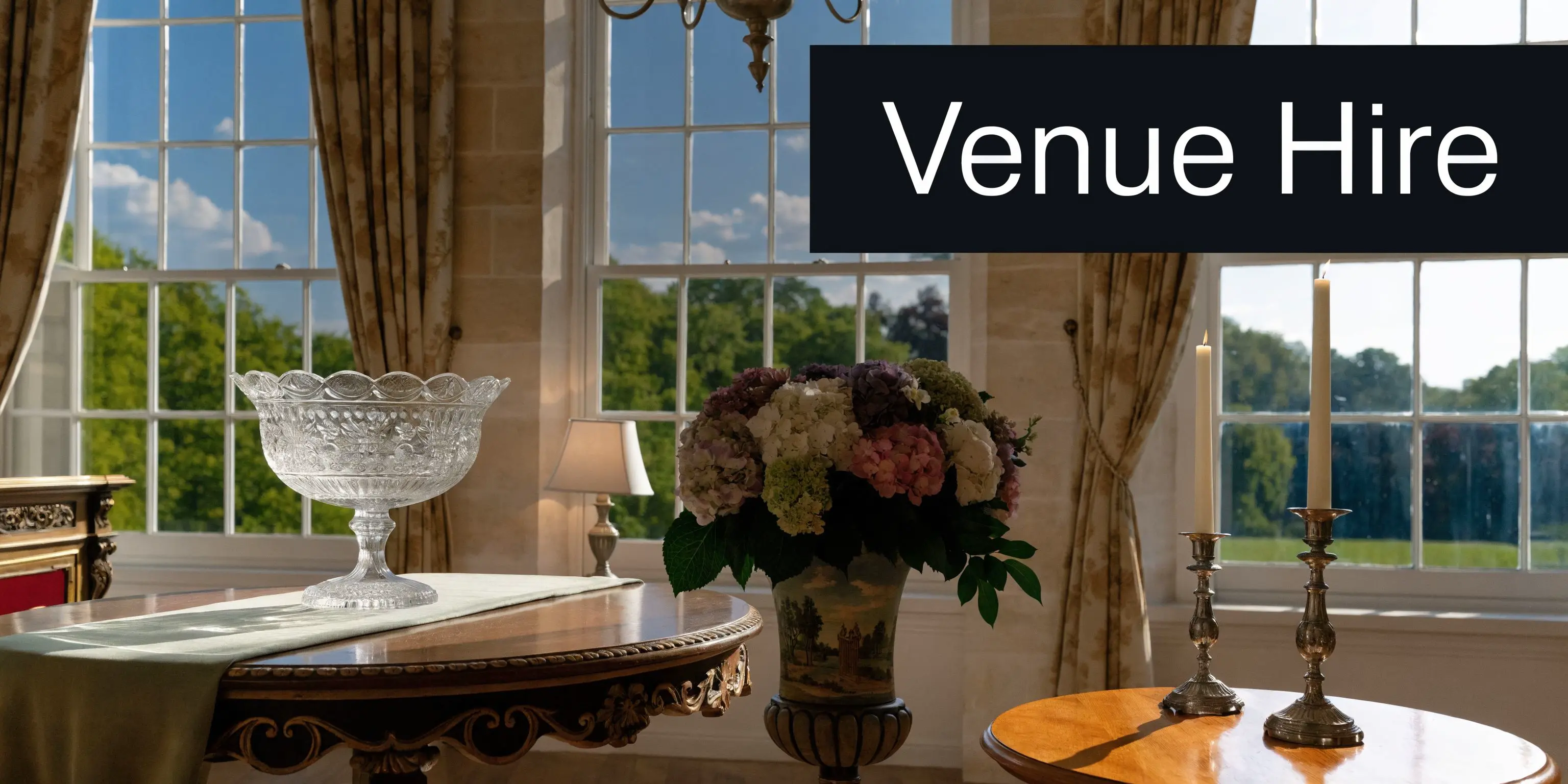
Personal use and professional use aren’t the same
Visitors often assume that if a site is open to the public, all photography is automatically fine. In practice, heritage venues usually separate casual personal photography from organised shoots, commercial filming, and productions that involve crew, lighting, tripods, or access control. That distinction is sensible. Commercial work affects visitor flow, safeguarding, collections care, and the fabric of the site. If you’re planning creative work, ask about:- •Permitted locations: Some rooms or garden zones may be more suitable than others.
- •Crew footprint: Historic venues need to know how much space, power, and equipment you intend to use.
- •Timing: Early access or closed periods may be needed to avoid conflict with public opening.
- •Content sensitivity: Heritage settings often review brand fit and intended use.
Venue hire has wider partnership value
The palace’s rooms and grounds also lend themselves to events, private functions, and cultural gatherings. That isn’t just a revenue stream. It is another way the site stays active and visible. For prospective partners, venue hire can be a first-stage relationship. A workshop, filmed conversation, stakeholder event, or pilot installation often gives both sides a lower-risk way to test collaboration before moving into a larger interpretive commission.
Accessibility should be built into production planning
Any filming or event proposal at a historic site should include an accessibility review from the start. That helps avoid late-stage compromises and improves both visitor and participant experience. A practical reference point is this ultimate WCAG compliance checklist, especially for teams producing digital exhibition content, event microsites, captions, or supporting media. It won’t solve the site’s physical constraints, but it does help teams make their communication outputs more usable. If the project involves advanced capture, previsualisation, or mixed workflows between location and studio, it’s also worth understanding the wider production environment around virtual production equipment for creative studios. That context helps teams judge what should happen on site and what can be created or extended off site.
Historic venues reward careful prep. The more precise the brief, the easier it is to protect the place and get stronger creative results.
A Timeless Landmark for a Modern Age
Fulham Palace succeeds because it doesn't have to choose one identity. It is a former bishop’s residence, a museum, a garden, an archaeological site, and a public learning environment. Those roles strengthen one another. For visitors, that means fulham palace museum london offers more than a standard heritage outing. You can read centuries of architectural change, encounter objects that anchor the story, and move through grounds that carry their own historical meaning. For institutions, educators, and creative partners, the site offers something equally valuable. It has depth, but it also has room for new forms of interpretation. The strongest future work here will respect the fabric, clarify the stories, and widen access without flattening complexity. Fulham Palace is the kind of place that rewards slow attention. It also rewards ambition, as long as that ambition is thoughtful. The past is already present in the walls, rooms, and gardens. The next challenge is making more of that richness available to more people, in person and digitally. Visit it as a museum, and you'll leave with a stronger sense of London's long history. Approach it as a potential partner, and you’ll see a heritage site with unusual capacity for meaningful public storytelling.
If you're exploring how animation, interactive media, or XR could support heritage interpretation, visitor engagement, or educational storytelling, Studio Liddell is worth a look. Their background in digital production, immersive experiences, and visual communication makes them a strong fit for organisations that want to translate complex places into clear, memorable experiences.