Creative Digital Media Production Explained
A brand manager needs an immersive product explainer, a museum is commissioning a VR exhibit, and a learning team wants an animated training module. All three briefs arrive in the same week, and each sounds like a “content project” until someone asks the questions that determine whether it ships: What platform is it for? Which assets must be created? Who approves the work? What happens if the script changes after animation has started? That's the practical meaning of creative digital media production. It's the organised delivery of moving-image, interactive, and immersive content using digital tools, specialist teams, and a controlled production pipeline. The work can include 2D or 3D animation, CGI, games, apps, VR, AR, motion graphics, and real-time experiences. The UK has a substantial commercial base for this work. Official estimates put the creative industries at £145.8 billion in 2024, equal to 5.5% of total UK GVA, while the sector recorded £124 billion in 2023 and 2.4 million jobs across the country, including film and video, TV and radio, software, and computer games (UK Government creative industries economic estimates). The question for a buyer isn't whether digital production is real. It's how to choose the right service, pipeline, deliverables, and commercial model for the job.
What Creative Digital Media Production Means
Traditional video production records a real performance, location, or interview, then shapes that material through editing and post-production. Creative digital media production can include the same stages, while also creating the world on screen. A team might model a product before it is manufactured, animate a character that has no physical performer, or build an interactive environment that changes in response to a viewer. That difference changes how the job is planned. A live-action shoot is organised around locations, crew, lighting, and performer availability. Digital production is organised around assets, dependencies, software builds, review versions, rendering, platform requirements, and technical testing. One character may require a model, textures, a skeleton, facial controls, animation tests, lighting setups, sound, and several delivery formats before a finished scene reaches its audience.
Four questions keep the project grounded
Start with services. Identify whether the brief needs 2D animation, 3D character work, CGI, motion graphics, XR, an app, or a game. These labels point to different production demands, so they should not be treated as interchangeable visual styles. Then define the pipeline, the route from an approved brief to a finished asset. It sets the order for writing, design, modelling, animation, building, rendering, compositing, testing, and delivery. Like a production map, it shows which decisions must be settled before later work can begin. Next, specify deliverables. A broadcast master, vertical social edit, headset build, game-ready asset pack, and editable source files each require different preparation. “One video” leaves too many technical questions unanswered. Finally, test the commercial reality. A strong concept can still miss its target if approvals are unclear, sound and accessibility are absent from the budget, or the team learns late that the experience must run on a particular headset or device.
Producer's rule: Treat the distribution channel as a design constraint from the first conversation, not as a finishing-stage export decision.
The UK production ecosystem supports many formats. Film and high-end TV production spend reached £6.3 billion in 2022, the highest recorded level at the time and £1.8 billion above 2019, according to UK Government sector-vision reporting cited in the UK Government data. The same delivery logic applies to a children's series, a technical explainer, or an immersive event installation.
The Core Services Studios Deliver
A buyer can understand most studio offerings through five service groups. They overlap in practice, but each one solves a different communication or experience problem.
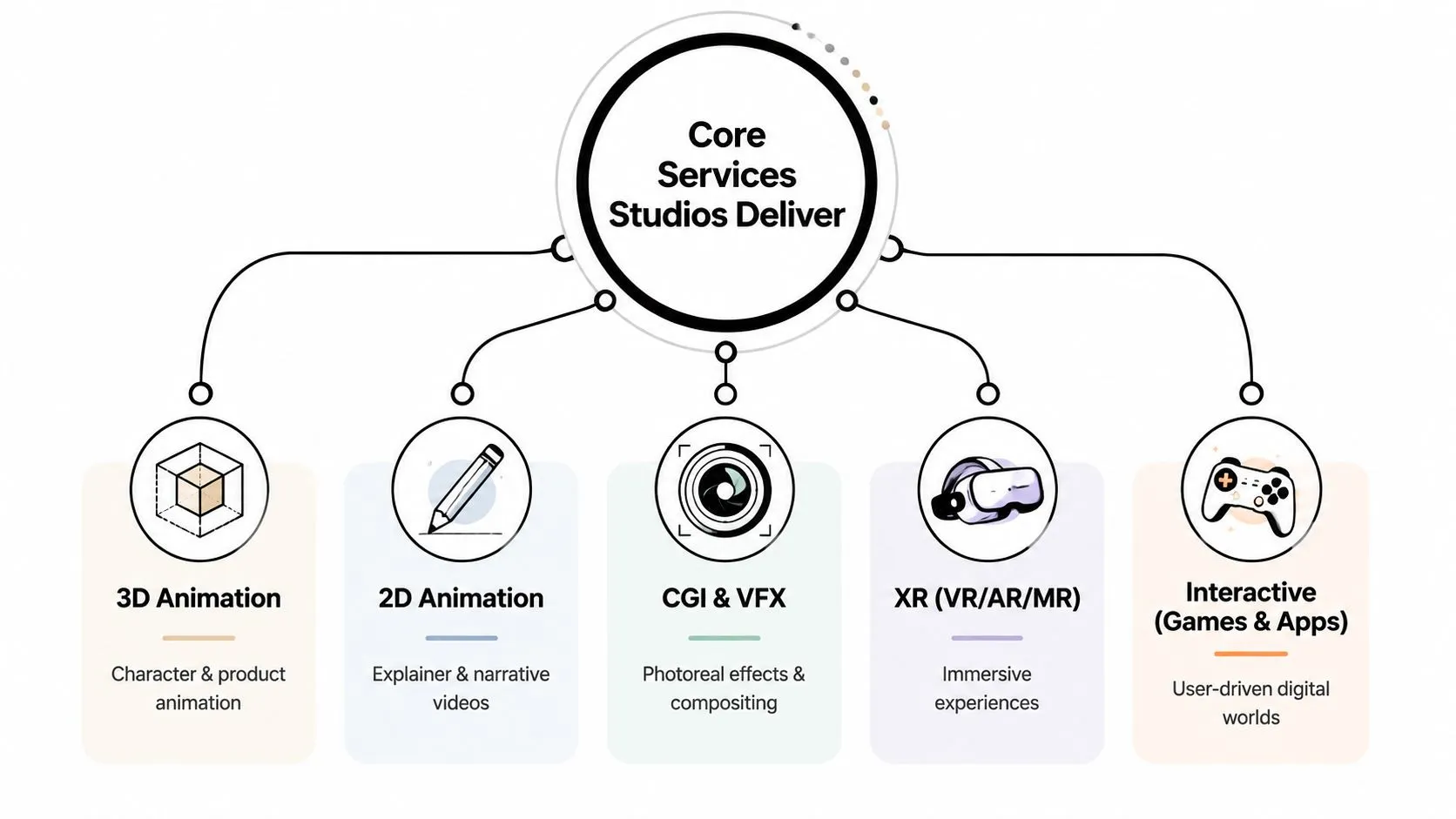
3D animation is a virtual film set
A 3D animation team builds a digital set, places virtual cameras, designs lighting, and directs characters or objects through a scene. It suits TV series, adverts, trailers, product films, title sequences, and game cinematics because the team can control the camera and environment after the assets exist. The trade-off is preparation. Detailed models, believable materials, character rigs, cloth, hair, and lighting all require specialist work before the final animation can be approved.
2D animation is illustrated storytelling
2D animation uses drawn, designed, or cut-out elements to explain an idea through shape, movement, typography, and rhythm. It can feel direct and expressive, which makes it useful for explainers, educational films, brand stories, and social content. A simple visual language doesn't automatically mean a simple production. The team still has to develop a visual system, storyboard the action, create artwork, animate it consistently, and manage feedback.
CGI and visual effects create controlled reality
CGI is like digital photography for objects, places, or effects that don't exist. A studio can create a product render, simulate an environment, add a screen replacement, or composite digital elements into filmed footage. The buyer should ask whether the project needs photorealism, stylisation, live-action integration, or compositing. Each choice affects modelling detail, render time, lighting, tracking, and review effort.
XR builds inside the viewer's environment
VR, AR, and mixed reality place content around the user or into the user's physical space. VR creates an enclosed experience through a headset. AR adds digital content to a camera view or location. Mixed reality connects digital objects with a user's surroundings and actions. The experience has to work as both a creative idea and a technical product. Tracking, interaction design, device performance, accessibility, installation, and maintenance all belong in the brief.
Games and apps turn creative work into software
An interactive project behaves more like a software product with art. Users make choices, trigger events, repeat actions, and sometimes move through systems that the production team can't fully predict. The UK video game industry was valued at £7.82 billion in 2023, according to UK parliamentary evidence summarised by The Data City (UK digital creative industries evidence). Studios often blend these services, reusing characters, environments, animation systems, and design principles across a series, live-event installation, app, or technical film. That service choice drives the budget because every additional platform introduces assets, testing, and delivery requirements.
Inside the Production Pipeline and Toolchain
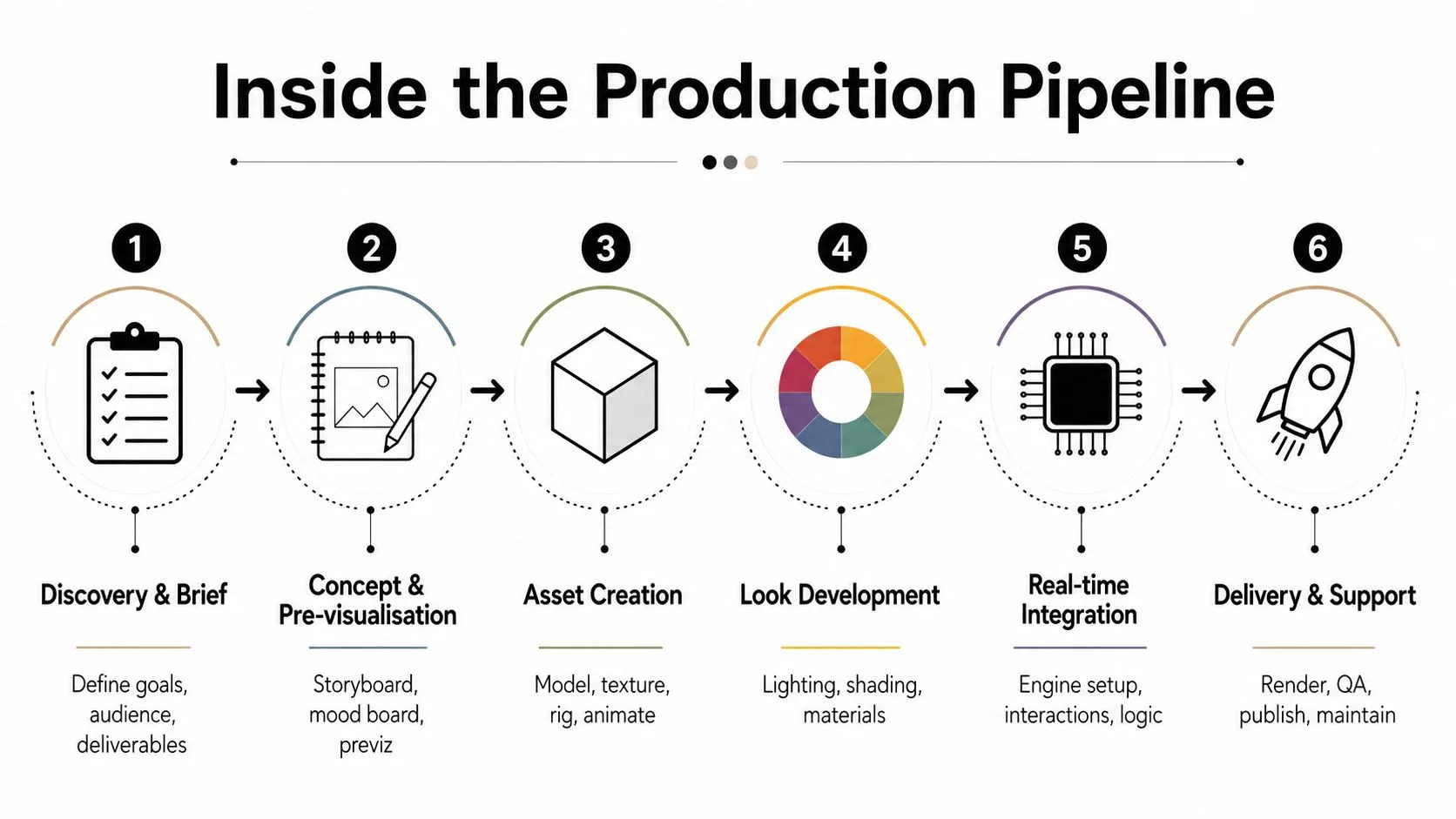
A reliable pipeline makes creative decisions visible early. The client shouldn't wait for a polished final render to discover that the message, camera, or interaction is wrong.
Discovery turns an idea into a production brief
The producer clarifies the audience, purpose, duration, channels, language versions, accessibility needs, technical targets, approval owners, and deadline. A museum VR brief needs different questions from a broadcast advert, even if both begin with “make it immersive”. Concept development and pre-visualisation then turn the brief into something reviewable. Storyboards, mood boards, scripts, animatics, and previz show timing and composition before the team spends heavily on final assets. The client should approve the creative direction here.
Asset creation builds the parts
Modellers create geometry. Texture artists define surfaces. Riggers build controls that let animators move characters or objects. Interactive teams may prepare optimised meshes, collision systems, interface elements, and engine-ready materials. Animation or interactive build follows. A film team blocks poses, timing, and camera movement. An XR team adds interactions, logic, menus, feedback, and device behaviour. Lighting and look development establish the visual finish, while rendering or real-time capture produces images from the scene. Compositors combine layers, correct colour, add effects, and integrate elements. Sound designers and mixers then shape dialogue, music, effects, spatial cues, and final stems. QA checks picture, sound, frame rate, interaction, loading, controls, accessibility, and device performance. A useful reference for clients who want a deeper stage-by-stage explanation is The animation production pipeline guide.
AI belongs inside selected stages
AI-assisted tools can support storyboard exploration, asset look development, rotoscoping, voice synthesis, lip-sync assistance, inpainting, and automated checks. They're most useful when they reduce repetitive work while a named artist or producer remains responsible for the result. AI can save time on clean-up, version preparation, search, and technical checking. It doesn't remove the need for human decisions about performance, story, brand consistency, rights, or approval. Generative imagery that looks impressive in a mood board may still fail as a riggable, repeatable, or legally cleared production asset. The producer's honest warning is simple. Projects usually slip during unclear briefs and slow feedback, not because a modeller can't create a mesh or an engineer can't open an engine project. Define review rounds, decision-makers, and change control before production begins.
Real-Time Engines and AI in Modern Workflows
Unity and Unreal can both support animation, XR, interactive installations, and real-time content. The right choice depends less on brand preference than on the visual target, deployment environment, available team, existing assets, and the cost of maintaining the project after launch.
Unreal suits high-fidelity presentation
Unreal is often considered when a project depends on cinematic lighting, detailed environments, or demanding VR visuals. Its Lumen and Nanite workflows can support high visual ambition, but the team needs the relevant technical experience and hardware discipline. That can make Unreal a strong choice for a VR short, virtual production shot, or premium interactive environment. It can also create unnecessary complexity for a lightweight AR experience or a simple mobile interaction.
Unity can favour approachable, multi-device builds
Unity's broader familiarity and C# workflow can make it attractive for mobile, AR, 2D, and projects that need to target a varied device set. A lighter rendering approach may be easier to optimise when battery use, loading time, or hardware range matters more than cinematic fidelity. Engine selection affects costs beyond the initial build. A team that already has reusable tools, shaders, interaction systems, and deployment knowledge can move more predictably than a team learning an engine while delivering the project. For a wider look at AI-assisted creative workflows, exploring AI content generation tools can help a buyer distinguish concept exploration from production-ready implementation. AI-assisted layout, inpainting, lip-sync, and machine-learning denoising may reduce repetitive tasks, but they still need review, consistency checks, and rights clearance.
Technical buying question: Ask the studio which engine reduces risk for your audience, devices, and maintenance plan, not which engine produces the most impressive demo.
The practical comparison of render quality, tooling, team skills, and commercial consequences is covered in Unreal versus Unity for real-time animation. A producer should also ask what happens after launch. An app, event build, or headset experience may need updates, device testing, analytics review, and technical support long after the first delivery.
Deliverables, Timelines, and Budget Ranges
A quote becomes useful only when it describes what the client will receive. “Final animation” might mean a broadcast master, a social cutdown, an editable project, a set of stills, or all of these. Write the delivery list before comparing prices. Typical UK advertising and TV animation projects take 8 to 12 weeks from brief to delivery, depending on complexity and approval cycles, according to this UK animation production guide. Broadcast specifications should be agreed before production, not discovered at export. Common requirements include 1920×1080 HD or 3840×2160 UHD, 25 fps, and 5.1 audio with separate dialogue and music stems (motion graphics delivery specifications).
| Project Type | Typical Duration | Budget Range (GBP) | Core Deliverables |
|---|---|---|---|
| Short animated film | 8 to 12 weeks for a typical advertising or TV animation project | Scope-dependent | Master film, review versions, captions or audio stems where required |
| CGI commercial | Scope-dependent | Scope-dependent | Broadcast master, social cutdowns, stills, project assets if agreed |
| XR experience | Scope-dependent | Scope-dependent | Headset or device build, installation package, test plan, support materials |
| Branded app | Scope-dependent | Scope-dependent | App build, interface assets, store or deployment files, maintenance plan |
The verified data does include a UK animation production breakdown with a total budget of £32,962. That example allocates £8,340 to a producer's 12-week salary, £8,376 to a director, £7,104 to storyboards, and £5,892 to animation, illustrating why teams cost work through staff weeks and specialist tasks rather than one universal flat fee (UK animation production schedule example). Scope creep usually enters through additional scenes, new characters, late script changes, extra aspect ratios, revised brand direction, or unplanned language versions. A useful commercial reference is the Fundl traction page example, but buyers should still request a line-by-line estimate, assumptions, exclusions, approval schedule, and change-request rate. BBC publicity delivery requirements include 1920×1080 at 25 frames per second, 50 fields interlaced, H.264 at a minimum 50 Mbps, 48 kHz/24-bit AAC audio, and delivery at least 10 days before broadcast or by the stated delivery date, whichever is sooner (BBC publicity delivery requirements). These details can affect the finishing plan and should appear in the initial scope.
Case Studies Showing Real Production Impact
A useful studio portfolio doesn't just show attractive frames. It shows how a team changed its production method to suit the audience, platform, and commercial purpose.
BooSnoo shows how an IP becomes repeatable content
BooSnoo for Sky Kids represents the demands of children's television and character-led production. The team has to protect the identity of the characters across scenes, episodes, promotional material, and digital shorts. That means the asset design, rigging, animation style, lighting, editorial rhythm, and delivery process need to work repeatedly, not only for one showcase shot. The commercial lesson is to ask whether a studio can build a repeatable production system around an IP. A one-off character test may look excellent, but a series requires consistent naming, version control, approved models, reusable environments, and a review process that keeps creative decisions aligned.
Dance! Dance! Dance! treats the event as a live system
A mixed reality event game has a different success condition. The team must create an engaging visual world while managing player flow, technical reliability, operator needs, and the physical venue. Real-time graphics and interaction logic matter because the experience responds to participants rather than playing identically for every audience. The producer needs to define what happens when a player misses an instruction, a device loses tracking, or a queue grows. Art direction and game mechanics must support throughput and recovery, not just the ideal play session.
Aurora makes space part of the story
Aurora demonstrates the creative demands of a VR short film. A conventional film can cut rapidly between shots and rely on a fixed frame. A VR production has to guide attention through spatial composition, sound, movement, performance, and pacing without assuming that the viewer is looking in one precise direction. Pre-visualisation becomes especially valuable because the director needs to test where the viewer stands, what they notice, and how the scene changes around them. Performance capture and post-production then have to preserve presence while meeting headset performance requirements.
GeoEnergy NI prioritises comprehension
GeoEnergy NI shows how the same digital pipeline can explain technical material to an industry audience. The challenge isn't to add visual complexity. It's to decide what the viewer needs to understand first, which processes deserve visualisation, and which details can remain in supporting narration or graphics. That requires subject-matter collaboration, a clear messaging hierarchy, storyboard reviews, and disciplined iteration. A technical animation case study should therefore be judged by stakeholder clarity and decision support, not only by render quality.
How to Evaluate and Brief a Production Studio
A reliable brief gives a studio enough information to estimate risk. It doesn't need to prescribe every creative decision, but it should identify the audience, objective, channels, duration, references, technical requirements, approval chain, deadline, and required outputs. Ask for a reel filtered to your format. If you need a character-led 3D series, a studio's live-action compositing reel won't answer the key questions. If you need XR, request evidence of interaction design, device optimisation, deployment, and support.
Questions that expose production maturity
Use the first meeting to ask:
- •Named leads: Who will produce, direct, design, animate, engineer, and own QA?
- •Comparable work: Can the studio show a recent project with a similar platform, audience, scale, and approval structure?
- •Review cadence: What does the client see at brief, storyboard, previz, animation, look development, and final stages?
- •Version control: How does the team label, store, approve, and retrieve assets and builds?
- •Change control: Which changes are included, and how are additional requests estimated?
- •Ownership: Which source files, assets, licences, and engine projects transfer at delivery?
- •Risk management: Can the studio show the assumptions, dependencies, and risks behind the estimate?
A good partner helps shape the brief before pricing the work. A fixed-fee quote issued without discovery may hide missing requirements rather than demonstrate certainty. The buyer's guide to choosing an animation studio provides a useful framework for testing capability, process, and commercial fit.
Red flags deserve direct questions
Be cautious if the studio avoids naming the day-to-day team, can't explain its QA ownership, treats source files as an afterthought, or promises a short deadline without showing the approval assumptions. Ask for references from comparable budget and timeline bands, not only from famous clients or visually impressive projects.
Commercial test: A trustworthy estimate tells you what must be true for the price and deadline to hold.
Studio Liddell is one option for buyers looking for a full-service creative digital production partner covering 3D and 2D animation, XR design and development, apps, games, motion graphics, and AI-enhanced production. The relevant comparison remains the same as with any supplier: named capability, suitable pipeline, clear deliverables, and transparent assumptions.
Choosing the Right Path for Your Next Project
Start with the audience and the place where they'll experience the work. A children's television project points towards 2D or 3D animation and a render-led pipeline. A live event may need a real-time engine, interaction logic, operator tools, and XR deployment. A VR film needs spatial storytelling and careful pre-visualisation, while a technical explainer may benefit from CGI, motion graphics, or a controlled combination of both. Then match the creative route to your internal capability. If your team can supply a locked script but not production design, you need a studio that can develop the visual treatment. If you have developers but lack animation expertise, look for a partner that can integrate art, rigging, cinematics, and engine work without creating a handover gap. Define the proof of success before production. Depending on the project, that may mean audience understanding, event dwell time, training assessment, campaign engagement, app retention, or successful broadcast delivery. Don't promise a metric you can't measure, and don't judge a headset experience using only film-production criteria. Finally, brief two or three studios against the same scope document. Compare their questions as carefully as their prices. The right path is the one where service, pipeline, deliverables, budget, and partner capability align from the first meeting through final QA. --- Studio Liddell can help turn an early idea into a structured production plan across animation, motion graphics, XR, interactive content, and AI-enhanced workflows. Visit Studio Liddell to discuss your brief, clarify the right production route, and book a practical scoping conversation.