Brand Storytelling Video That Earns Attention and Trust
A UK digital ad may receive less than 2.5 seconds of attention, yet distinctive colour, audio, logos or characters can create memorability after just 1.5 seconds of exposure, according to a London-presented attention study reported by ProfileTree's video storytelling analysis. That changes the production question. A brand storytelling video can't spend its opening moments warming up slowly. It needs to establish recognition, meaning and a reason to continue almost immediately. The strongest work combines a human or character-led narrative with a clear brand cue, then adapts that idea for YouTube, social feeds, streaming environments, websites, events or immersive spaces. The story still matters, but the first seconds decide whether the story gets a chance to work.
What a Brand Storytelling Video Really Is
A brand storytelling video uses character, conflict, change and meaning to make a brand easier to remember. It isn't just a beautifully shot advert, a product demonstration or an explainer with background music. Those formats can be useful, but storytelling begins when the audience can follow a journey and understand why something happens. A product demo answers, “How does this work?” An explainer usually answers, “What is this, and why should I care?” A direct-response advert asks for action. Storytelling asks the viewer to recognise a situation, care about an outcome and connect that outcome with the brand. The distinction is practical. A technical animation might show how a system operates, while a story-led version could follow the person trying to solve a real problem, show what stands in their way and make the product part of the resolution. The second treatment gives the information a memory pathway. Viewers don't need to retain every sentence if they remember the character, the problem and the brand's role in changing the situation.
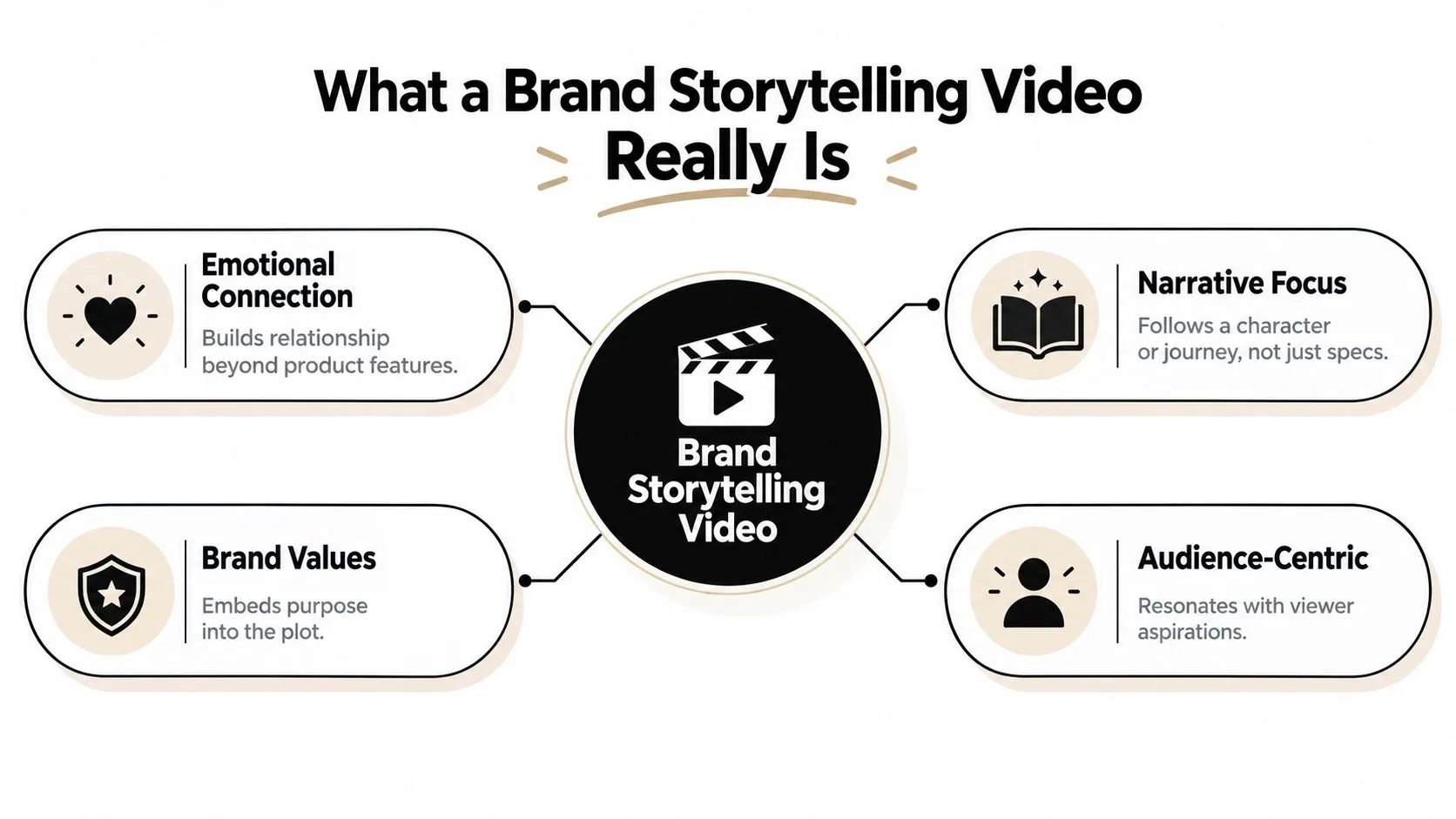
The four ingredients buyers should look for
- •A recognisable audience need: The viewer should see a tension, ambition or problem that feels relevant to them.
- •A causal journey: Events need to connect. The character takes an action, that action creates a consequence, and the brand has a credible place in the chain.
- •A meaningful brand role: The company shouldn't appear as decoration. Its product, service, belief or behaviour should help create the resolution.
- •Distinctive assets: Colour, sound, typography, logo treatment, character design or visual language should carry recognition even when exposure is brief.
That last point is often missed. Many teams commission a long-form narrative, then add the brand at the end. In crowded digital environments, the better approach is to make brand identity part of the storytelling grammar from the first frame.
Practical rule: If the brand disappeared from the opening, the viewer should still encounter a recognisable visual, sonic or character cue that belongs to it.
Use storytelling when your objective involves memory, trust, identity or emotional association. Use a product demo when the buyer needs proof of function. Use an explainer when complexity is blocking understanding. A campaign can contain all three, but calling every branded film a story makes briefing and measurement less precise.
Why Storytelling Video Earns Attention and Drives Discovery
Video has become a dominant storytelling medium in the UK because 94% of adult internet users watch YouTube, while the platform averaged 51 minutes of daily watch time in 2025, up from 47 minutes the year before, as reported by Sunday Treat's UK video marketing statistics. That scale creates opportunity, but it also creates competition. A brand storytelling video has to work inside a fragmented attention environment rather than assuming a captive audience. Brand discovery is part of the case for investment. A separate UK consumer study found that 49% of adults discovered a new brand after seeing streaming TV advertising in the prior year, rising to 74% among 18- to 34-year-olds, according to Small Business's report on video ad influence. Video storytelling therefore has a role before a buyer searches for a product. It can put a name, character, promise or distinctive world into memory first. The same research makes the performance picture more nuanced. More than 30% of respondents liked video adverts that told a story, while 42% preferred adverts that were informative and to the point. In the reported survey, 22% said they'd be more likely to purchase after watching informative video content, and 12% said they'd potentially buy after seeing story-led adverts. Another UK and Europe-based advertising study found that 39% of consumers who acted on an advert during the previous week cited a video advert as the inspiration.
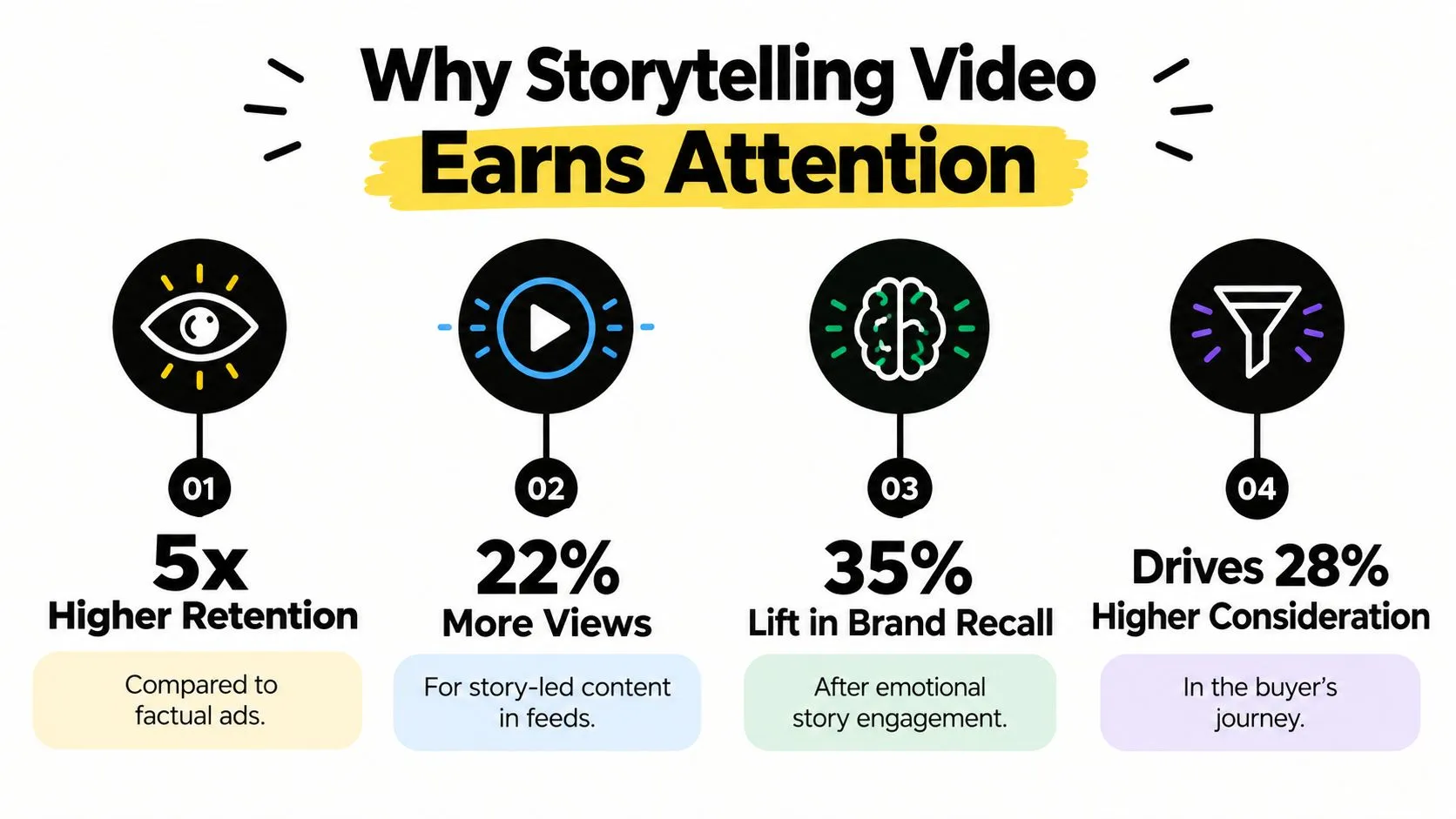
Design for the first seconds, not the perfect full view
The evidence suggests a useful distinction. Informational clarity can support immediate purchase intent, while a story can build emotional meaning and recognition. A good treatment doesn't force one mode to do every job. It makes the brand identifiable quickly, then uses narrative to give the message a reason to matter. For practical guidance on opening frames, pacing and scroll behaviour, the BlitzReels video hook guide offers a useful reference. The lesson for a producer is simple: don't hide the most distinctive asset behind a slow introduction. Put the brand world, character or sonic identity to work before the viewer has decided whether to continue. Google's Brand Lift framework measures ad recall, brand awareness, consideration and brand association, so success shouldn't be judged by views alone. A story-led campaign needs a declared outcome, such as stronger recall or consideration, and a creative structure that gives those measures something to detect.
Choosing the Right Format for Your Story
Format should follow the job the story needs to do. 2D animation gives a team control over graphic language, metaphor, typography and stylised characters. It suits explainers, educational content, social assets and campaigns where clarity matters more than physical realism. A 2D treatment can also simplify a complex process without pretending that the viewer is looking at a literal environment. 3D animation becomes more valuable when the story depends on volume, camera movement, physical materials, creature performance, product detail or a reusable world. It can support a cinematic brand film, a trailer, a series or a digital asset system, but it usually demands more modelling, look development, lighting, rendering and compositing. Live action can create immediate human credibility, especially for founder stories, testimonials, workplace culture or real-world demonstrations. XR is different again. It makes the audience a participant, so the story must account for interaction, spatial design, hardware, safety and deployment rather than only framing a sequence for passive viewing.
| Format | Best For | Typical Timeline | Typical Budget Band |
|---|---|---|---|
| 2D animation | Explainers, educational films, graphic brand stories and efficient cut-downs | 4, 6 weeks for a 60-second animation | £1,500, £8,000 for a 60-second animation |
| 3D animation | Cinematic films, characters, products, creatures, trailers and reusable worlds | 8, 16 weeks for a 60-second animation | £8,000, £30,000+ for a 60-second animation |
| Live action | Human stories, interviews, testimonials, demonstrations and real locations | Depends on cast, location, crew and post-production requirements | Scope-specific |
| XR | Immersive training, games, exhibitions, retail experiences and location-based entertainment | Scope-specific | Scope-specific |
The 2D and 3D figures in the matrix come from Educational Voice's UK comparison of 2D and 3D animation. They aren't universal quotes. They show why format decisions need to happen before a script becomes visually expensive. Choose 2D when the idea depends on clarity, metaphor and pace. Choose 3D when the audience needs to believe in a world, object or performance. Choose XR when participation is part of the message, not just a technical extra.
Creative Frameworks That Make Stories Stick in Seconds
A narrative arc gives the audience a route through the idea. It doesn't guarantee that they'll enter the route. For short-form brand storytelling video, the treatment needs an asset-led opening, a clear causal middle and a branded ending. The classic arc works when the audience needs to understand a change:
- Setup: Establish the character, world or situation, with a recognisable brand cue already present.
- Conflict: Introduce the obstacle. Keep it visual where possible, so the viewer doesn't need a long spoken explanation.
- Resolution: Show the changed state and connect it to the brand's role.
A production test for the opening
Ask whether the first 1.5 seconds contain a recognisable asset. The attention study referenced earlier found that distinctive colour, audio, logo or character can support memorability within that short exposure window. The opening doesn't need to explain the whole proposition. It needs to establish identity and create a question the next moment can answer. Then build the middle around causality. Avoid a sequence of attractive shots that don't change the situation. Each beat should answer one of three questions:- •What does the character want?
- •What prevents progress?
- •What does the brand enable or reveal?
Close by repeating the distinctive asset in a new context. Google's Brand Lift framework focuses on recall, awareness, consideration and association, so the final cue should make the relationship between story and brand unmistakable. For a production-focused treatment of this principle, Reels in Motion's production guide for brands and studios provides useful context. Judge a treatment by what the viewer can recognise, feel and explain, not only by how polished the frames look.
How Brand Storytelling Videos Are Made From Brief to Delivery
The production pipeline is a sequence of decisions, not a single creative leap. The strongest projects protect the early stages because changes to a brief or storyboard cost less than changes to finished animation, lighting or compositing.
Start with a brief that can survive review
The brief should state the audience, business objective, brand truth, desired viewer response, distribution environments and required deliverables. It should also identify what must remain consistent across versions, such as a character, product, tone of voice or sound identity. Scripting turns that information into a spoken and visual plan. Storyboarding tests composition, rhythm and cause-and-effect before production begins. Previsualisation or an animatic then tests timing, camera movement, transitions and approximate sound. At this gate, stakeholders should approve the story logic rather than debate final textures.
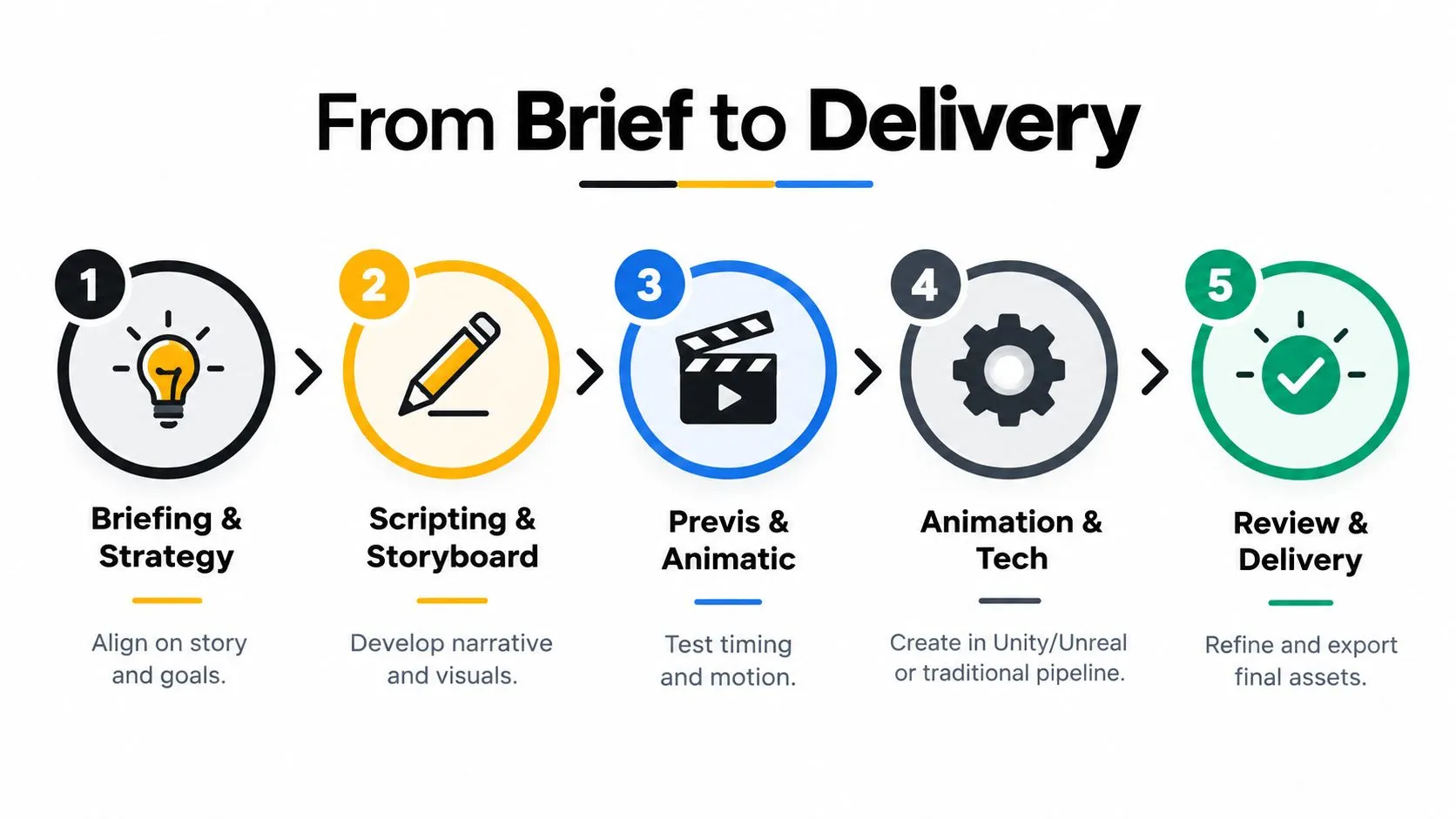
Build the right technical pipeline
Traditional animation may move from design and asset creation into rigging, animation, lighting, rendering and compositing. Real-time production can use Unity or Unreal when interactive previews, rapid iteration or XR deployment are central to the brief. The choice should follow the required output and team capability, not fashion. Sound design deserves an early place in the plan. A voice, musical motif or sonic logo can make the brand recognisable before the viewer has processed every visual. Post-production then combines picture, sound, titles, colour, accessibility versions and platform-specific exports. A UK animation production guide places a typical studio project at 6, 8 weeks from brief to delivery, with approximately 15, 20% of budget in pre-production, 60, 70% in production and 10, 15% in post-production, as outlined by Educational Voice's animation production rates guide. A separate UK pricing guide places animation at £2,000, £15,000 per finished minute, with projects commonly running 6, 10 weeks and rush work costing 20, 40% more, according to Educational Voice's UK animation budget guide.
Review discipline: Approve the brief, script, storyboard and animatic at separate gates. Don't use a lighting review to reopen the central idea.
Broadcast delivery can introduce technical requirements that social exports don't share. For example, UKTV's branding specification requires animated sequences as sequential Targa files and graphics as 32-bit embedded-alpha Targa files, with stated uncompressed file sizes of around 1.6 MB for SD and 8 MB for HD, alongside 720x576 16:9 anamorphic SD framing. Producers should confirm delivery specifications before building the final pipeline. For a broader production reference, see Animated video production, the complete guide. For fast platform-native experiments that sit alongside a hero film, ImagineVid's guide to platform-ready UGC ads can help teams think about variant content without confusing it with the core brand narrative.
Real World Examples That Show Storytelling in Action
The most useful examples aren't copies to imitate. They're patterns that help a buyer recognise which creative problem a production approach can solve. BooSnoo for Sky Kids demonstrates how a beloved children's IP can extend from a series into digital shorts. The production challenge isn't only character animation. It involves preserving personality, visual rules and audience expectations while adapting pacing and format for a different viewing context. That makes it a useful reference for teams planning a kids' IP roadmap rather than a single isolated film. Dance! Dance! Dance! shows a different requirement, a mixed reality game designed for events. In this setting, storytelling has to coexist with throughput, player onboarding, physical space and technical reliability. The narrative can't require a long explanation before participation begins. The world, objective and feedback loop need to become understandable through interaction. Aurora, an award-calibre VR short, places more weight on direction, performance capture, spatial sound and optimisation. A VR story isn't a conventional film viewed through a headset. Sound placement, user attention and comfort influence how the audience experiences the dramatic beat. GeoEnergy NI represents the technical communication end of the spectrum. Complex subject matter becomes easier to discuss when visual strategy gives stakeholders a shared model. Instead of asking every viewer to decode specialist language independently, the film can use animation, sequencing and visual metaphor to organise the explanation. These examples span children's entertainment, events, immersive narrative and B2B communication. You can explore the wider Studio Liddell work portfolio to compare how the same fundamentals, clear intent, distinctive design and disciplined production, adapt across contexts.
Distributing Measuring and Briefing Your Next Brand Story
Distribution should shape the treatment before production starts. A YouTube film may need a strong opening that works with sound on or off, while a social cut-down needs immediate recognition in a vertical frame. Streaming, websites, exhibitions and XR installations each create different conditions for attention, sound, interaction and completion. Plan a master narrative and a useful asset family. That may include a hero film, shorter edits, silent-captioned versions, alternate aspect ratios, stills, title cards and cut-downs built around different moments. The story should remain coherent even when the edit changes. Measurement also needs a defined role. Views and completion can describe distribution, but Google's Brand Lift framework is designed to quantify ad recall, brand awareness, consideration and brand association. Select the measure that matches the business question. If the film introduces a new brand, recall may matter most. If it supports a known offer, consideration may be more relevant. Authenticity is a governance issue as much as a creative one. Channel 4's branded-entertainment research found that six in ten viewers felt positive about branded entertainment, seven in ten rated it highly for quality, entertainment and originality, and only 11% felt negative about brand involvement in a show they enjoyed, according to Channel 4's branded-entertainment research. The implication is not that every brand should imitate entertainment. It's that audiences can welcome brand involvement when the content offers genuine value and the integration respects the experience.
A practical partner and briefing check
Before appointing a studio, ask for:
- •A relevant pipeline: Can the team show work involving your format, audience or delivery environment?
- •Clear approval gates: Does the proposal define who signs off the brief, script, storyboard, animatic and final?
- •Technical ownership: Who handles sound, accessibility versions, platform exports and broadcast specifications?
- •Budget transparency: Are assumptions, revisions, rush risks and deliverables visible?
- •Measurement alignment: Does the creative brief connect the story to recall, awareness, consideration or association?
- •Rights and governance: Are music, characters, talent, data and usage permissions documented?
For teams monitoring how audiences respond after launch, Captapi's guide to NLP models for brand monitoring provides useful background on analysing language and sentiment. Use that kind of monitoring as a complement to brand-lift research, not as a substitute for a clearly defined objective. --- Studio Liddell develops 2D and 3D animation, brand films, explainers, games and XR experiences, with production planning that covers story, previz, animation, real-time workflows and final delivery. Visit Studio Liddell to discuss your brief and book a production scoping conversation focused on the seconds-level attention, distinctive assets and measurable brand outcome your next story needs.