Bespoke Business Apps: A Guide to Custom Software
You're probably dealing with one of two problems right now. Either your team is bending itself around software that was never built for the way you work, or you've got a customer experience opportunity that generic tools can't deliver without ugly compromises. That's usually the point where bespoke business apps stop sounding like a luxury and start looking like the sensible option. If your staff are juggling spreadsheets, disconnected SaaS tools, manual rekeying, and awkward approvals, the issue isn't discipline. The issue is system design. Custom software isn't about building something flashy for the sake of it. It's about removing friction, protecting margin, and giving your business tools that fit your operation instead of distorting it.
Moving Beyond Off-the-Shelf Frustration
Off-the-shelf software works well when your process is ordinary and your needs are narrow. The trouble starts when your business isn't ordinary anymore. A growing team usually hits the same wall. Sales uses one platform. Operations uses another. Finance exports data into a spreadsheet because the first two systems don't quite talk to each other. Then somebody builds a workaround, somebody else copies it, and before long your process depends on tribal knowledge rather than a reliable system. That's where bespoke business apps earn their keep. They're built around your rules, approvals, data structure, users, and commercial reality. Instead of asking your team to adapt to someone else's product roadmap, you build software that reflects how your company runs.
What bespoke changes in practice
A custom app can do things generic software often handles badly:
- •Join disconnected workflows: Pull tasks, records, approvals, and reporting into one operational flow.
- •Reflect your real roles: Give managers, field staff, finance, and customers interfaces that match what each group needs.
- •Enforce process properly: Build business rules into the product so people follow the right route by default.
- •Support differentiation: If your advantage comes from service design, delivery model, or specialist knowledge, custom software can encode that advantage.
This isn't a fringe decision in the UK market. The UK app development industry has reached £32.3 billion in 2026 and recorded a 5.5% CAGR since 2021, reflecting sustained demand for custom digital solutions, according to IBISWorld's UK app development industry data.
Practical rule: If your team keeps creating exceptions, side documents, and manual checks just to make software usable, you don't have a training problem. You have a product fit problem.
When the pain becomes expensive
The obvious cost is inefficiency. The less obvious cost is decision drag. Leaders stop trusting reports because the numbers come from too many places. Staff hesitate because the process isn't clear. Customers feel the seams when handovers break. At that point, buying another subscription usually makes things worse. You're adding another layer to a stack that already doesn't fit.
Choosing Your Path Bespoke vs Off-the-Shelf Solutions
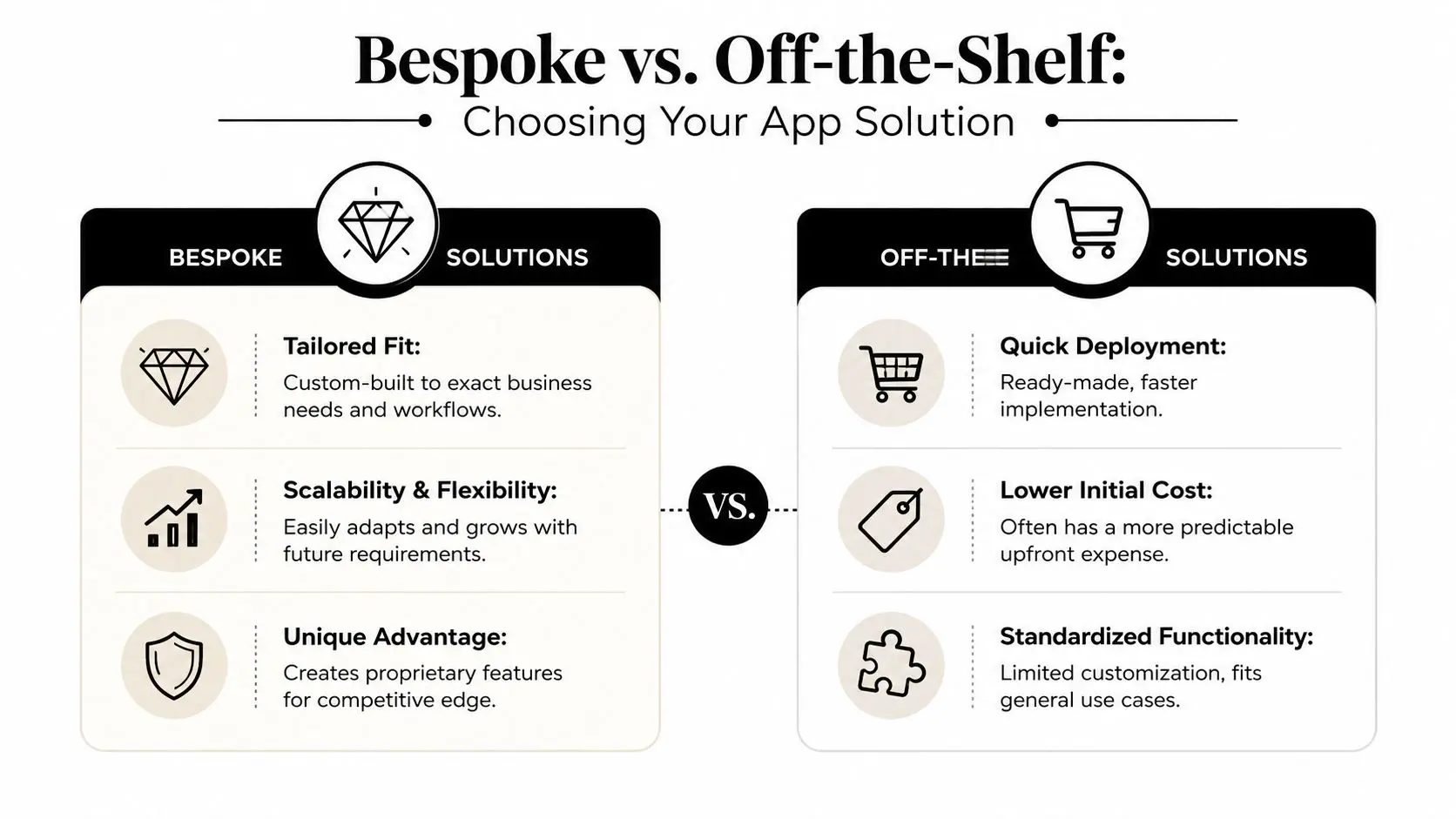
The choice isn't ideological. It's commercial. Off-the-shelf software is often the right answer when speed matters more than fit and your workflow is close to a standard pattern. Bespoke is the right answer when your process, margin, or customer experience depends on doing things your own way.
The trade-off in plain terms
| Decision factor | Bespoke app | Off-the-shelf software |
|---|---|---|
| Initial setup | Higher upfront commitment | Faster to procure and start |
| Workflow fit | Built to your process | You adapt to the tool |
| Differentiation | Can support unique capabilities | Usually standardised |
| Control | You define priorities | Vendor controls roadmap |
| Long-term shape | Evolves with the business | Expands within product limits |
If you need a straightforward CRM, project tracker, or booking tool and your business can run happily inside established patterns, don't overbuild. Use the packaged product and move on. If your operation depends on specialist approval chains, unusual pricing logic, catalogue complexity, internal compliance steps, or layered integrations, generic software often becomes expensive in slower ways. You pay in workarounds, training friction, reporting gaps, and duplicated effort.
A useful threshold for retail
Retail is a good example because it exposes the limit quickly. A 2026 analysis found bespoke software becomes financially viable for UK retailers when online sales exceed 27% of total revenue, driven by catalogue complexity and multi-channel ERP integration needs that standard tools struggle to handle, as outlined in this UK bespoke software analysis for retailers. That threshold matters because it kills lazy thinking. Bespoke isn't always the smart move early. But once digital revenue and operational complexity cross a certain point, refusing to build your own system can become the more expensive choice.
Don't ask whether bespoke is better in theory. Ask whether your current software is forcing cost, delay, or customer friction into core operations.
If you need external delivery support
Many firms reach the right conclusion on custom software and still stall because they're unsure how to resource it. If you're weighing internal build capacity against external partners, this guide from LatHire on custom software development is a useful reference for thinking through outsourcing structure, team access, and delivery control. The short version is simple. Buy software when your needs are common. Build software when your business stops being common.
Unlocking Competitive Advantage with Custom Apps
The strongest case for bespoke business apps isn't technical elegance. It's operational advantage. Consider a service company with engineers in the field. A generic stack might require one tool for jobs, another for stock, another for sign-off, and a manual report back each day. A custom field app can combine scheduling, parts usage, customer signatures, photo capture, and escalation into one flow. The engineer spends less time administrating and more time solving the actual job. That's not innovation theatre. That's fewer dropped details, cleaner records, and faster invoicing.
Internal systems that remove drag
Internal bespoke apps usually pay off when they target friction that staff deal with every day. Examples include:
- •Operations control apps: For tracking work orders, approvals, exceptions, and handovers across departments.
- •Specialist CRM systems: For sectors where standard pipelines don't match their sales or service cycle.
- •Project dashboards: For businesses managing multi-stage delivery with dependencies, review gates, and external stakeholders.
- •Knowledge-led workflows: For teams that rely on structured checklists, evidence capture, and audit trails.
A well-designed app turns policy into behaviour. People stop guessing which template to use or who signs something off. The software leads them through the right path.
Customer-facing apps that feel distinctive
The external opportunity is just as important. A customer app shouldn't exist because “everyone has an app”. It should exist because it solves something your buyers care about. That might mean self-service ordering with unusual product logic. It might mean a portal that shows job progress clearly. It might mean an interactive configurator that helps customers understand a complex product before they buy. For businesses exploring low-code routes for operational software, Studio Liddell's model-driven apps approach is one example of how data-heavy business systems can be structured around forms, business processes, and centralised records rather than another patchwork of spreadsheets and admin tools.
The best bespoke apps don't feel bespoke to the user. They feel obvious, because the workflow finally makes sense.
Where immersive tools start to matter
Some businesses can go further than forms and dashboards. If your sale depends on demonstration, training, simulation, or spatial understanding, a flat interface may be too limited. Real-time 3D, AR, and VR stop being novelties. A maintenance guide can become a spatial overlay. A training sequence can become a repeatable simulation. A sales app can become a product experience rather than a catalogue. That's not necessary for every brief. But in the right commercial setting, it's a serious edge.
From Concept to Launch The Bespoke App Development Journey
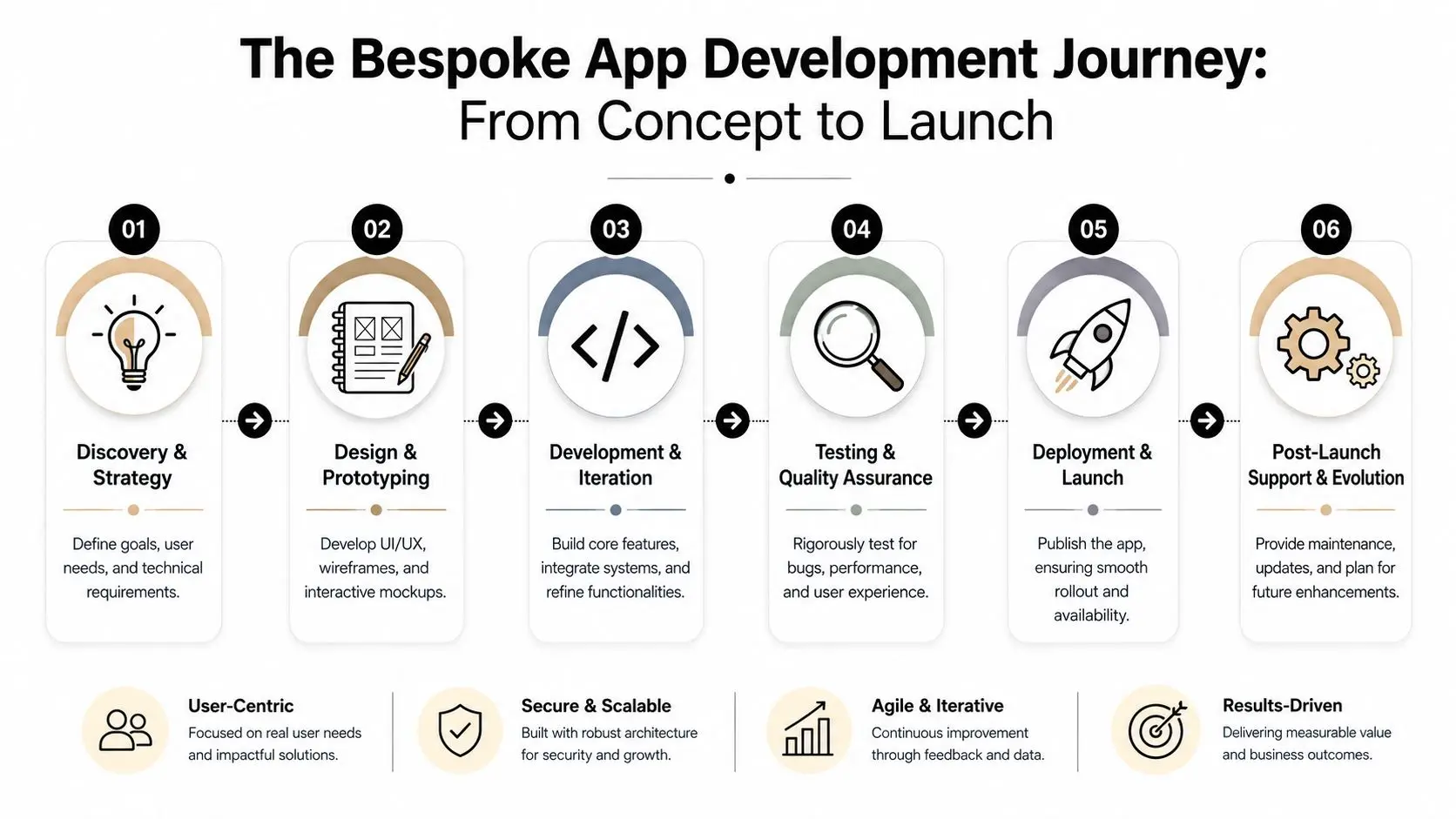
Most clients worry about the same thing. Not whether custom software is useful, but whether delivery will become a murky, expensive black box. It shouldn't. A competent app project follows a clear path, and you should know what decisions happen at each stage.
Discovery first, screens later
A solid project starts with business questions, not visual design. What problem are you solving? Who uses the app? Which systems does it need to touch? What does success look like in daily use? You should expect discovery to produce:
- A defined scope: Core features, exclusions, and user roles.
- Workflow mapping: Current process versus preferred process.
- Technical direction: Platform, integrations, hosting shape, and security approach.
- Delivery priorities: What must exist at launch and what can wait.
Build in stages, not in one giant reveal
Once the product logic is clear, design and development can move in parallel. UX work should test how people move through the system. Engineering should build the highest-value functions first. In the UK, bespoke web app projects typically average a 3 to 6 month timeline, while mobile-first, serverless architecture can support feature additions within 4 to 8 weeks post-launch, which is described as a 50% faster update cycle than vendor-dependent off-the-shelf platforms in this BusinessCloud analysis of bespoke app delivery. That matters because the first launch shouldn't be treated as the final shape of the product. Good custom software improves through use. Teams learn. Customers reveal friction. Priorities sharpen.What your role should be
You don't need to become a software producer, but you do need to stay involved. A healthy client role includes:- •Making decisions quickly: Approval delays damage momentum.
- •Providing real user input: Managers alone don't expose workflow pain properly.
- •Realistic testing: Don't sign off on features your team won't use.
- •Protecting scope: New ideas are welcome, but not all at once.
A bespoke app project succeeds when the client brings operational clarity and the delivery team turns that clarity into a usable product.
Launch isn't the finish line. It's the point where the app begins proving itself in live conditions.
Future-Proofing Your App Technical and Creative Essentials
A bespoke app can still fail if the foundations are weak. Clever features won't save poor architecture, clumsy UX, or brittle integrations. Essential requirements are straightforward. Your app needs clear permissions, dependable data handling, sensible integration logic, and an interface people can understand without a training manual. If any of those are missing, adoption suffers and support costs climb.
The technical basics that deserve attention
A future-proof app usually gets four things right early:
- •Security and access control: Staff should only see and change what their role requires.
- •Integration design: ERP, CRM, finance, inventory, and reporting systems need clean handoffs.
- •Data structure: If the underlying records are messy, the interface will be messy too.
- •User experience: Workflows should be short, readable, and hard to misuse.
This is why app commissioning isn't just a coding purchase. It's an operational design decision.
Where creative technology changes the value
Some app briefs need more than forms, dashboards, and standard web screens. That's where real-time engines start to matter. Unity and Unreal can power business tools that are far more interactive than a conventional admin interface. A manufacturer can use a 3D configurator to let buyers inspect options before ordering. A training team can build scenario-based simulations instead of passive learning modules. A site operator can use AR guidance to support maintenance or assembly tasks in context. Those products sit at the intersection of software and content production. They need pipeline discipline, asset optimisation, interaction design, and deployment planning. They also need restraint. Not every business app needs XR, but when a product, place, or process is easier to understand spatially, immersive design can outperform flat UI. One practical route is to pair conventional application logic with real-time visual layers. For example, an operations platform can handle records, permissions, and reporting, while a Unity front end handles simulation, walkthroughs, or interactive product exploration. That split often makes more commercial sense than forcing everything into a single visual model. Studio Liddell is one option in this space because it combines app development with Unity and Unreal production capability, which is useful when a brief includes both operational software and immersive content rather than just standard interfaces.
Budgeting for Success Costs ROI and Finding Your Partner
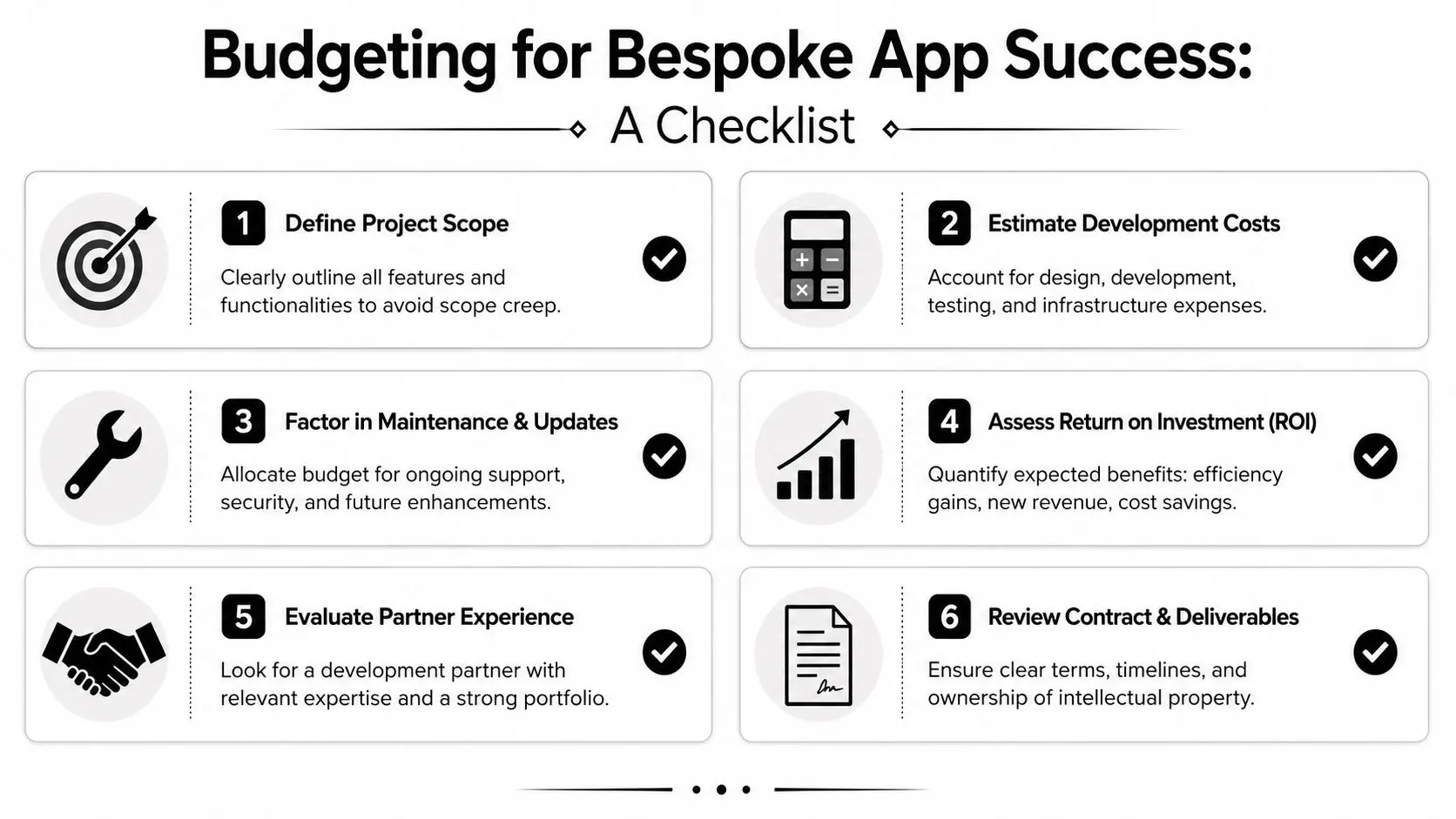
Most app projects don't go wrong because the idea is poor. They go wrong because the buyer under-scoped the work, ignored support costs, or chose a partner that couldn't handle complexity cleanly.
What sensible budgets look like
For UK SMEs, bespoke business app projects typically fall in the £20,000 to £80,000 range, with annual maintenance and support usually budgeted at 15% to 25% of the initial cost, according to this UK guide to bespoke software costs. That's the middle ground. Simple internal tools can sit lower. Enterprise-grade systems can go far beyond it. The point isn't the headline figure. The point is matching investment to operational value. If you want a more app-specific breakdown of features, complexity, and production variables, this article on how much an app costs to make in the UK is a useful planning reference.
How to think about ROI without fantasy maths
You don't need invented uplift figures to judge return. Use your own business mechanics. Look at:
- •Labour time removed: Manual entry, duplicate handling, approval chasing, reporting admin.
- •Errors prevented: Fewer missed fields, bad handovers, lost documents, and inconsistent records.
- •Revenue enabled: Faster quoting, smoother buying journeys, stronger retention through better service.
- •Tool consolidation: Fewer overlapping platforms and less overhead managing them.
If infrastructure cost is part of the concern, especially for apps with variable usage or heavier media components, it's worth reviewing guidance on cost-efficient cloud strategies from CloudCops GmbH before you lock in a hosting approach.
A partner checklist that actually matters
When you assess delivery teams, skip the sales gloss and check these points:
| What to check | Why it matters |
|---|---|
| Process clarity | You need to see how scope, reviews, and change requests are handled |
| Relevant build experience | Similar workflow complexity beats generic portfolio size |
| Design discipline | Good UX reduces support burden and user resistance |
| Technical range | Integrations, cloud setup, testing, and future enhancements all matter |
| Post-launch support | Ownership doesn't help if nobody can evolve the product properly |
A good partner doesn't just promise features. They help you avoid building the wrong thing.
Commissioning Your First Bespoke Business App
If your current software stack keeps forcing workarounds, the answer probably isn't another plug-in or another monthly subscription. It's a better-designed system. Bespoke business apps make sense when your workflow is commercially important, your customer experience needs to feel distinct, or your team is wasting too much energy compensating for tools that don't fit. The decision gets stronger when you need integrations, specialist logic, or immersive layers such as 3D product experiences, simulations, or AR support tools. Keep the first move simple. Define the operational problem, identify the users, list the systems involved, and decide what absolutely must work at launch. Then pressure-test those assumptions with a delivery partner that can challenge weak thinking instead of just nodding through a spec. If you're still comparing agencies, this guide on how to find and choose the right mobile app development agency will help you ask sharper questions before you commit. The best first conversation isn't about features. It's about business friction, user behaviour, and what success looks like once the app is live. --- If you want to explore a bespoke app properly, start with a scoping conversation with Studio Liddell. Bring the messy workflow, the clunky handoffs, and the systems that don't line up. A good discovery session should turn that confusion into a practical build plan.