Augmented Reality in Ecommerce: A Practical Guide for Retailers
Augmented reality is revolutionising ecommerce by creating a direct, interactive link between the digital storefront and the customer's physical world. Using just a smartphone, shoppers can now bring products to life in their own space. This technology overlays interactive 3D models of anything from furniture to fashion onto a live view of their room, turning a simple browse into a hands-on, engaging experience. Think of it as a personal virtual showroom or fitting room, accessible to anyone with a compatible phone.
The New Reality of Online Shopping
Imagine your customer, phone in hand, pointing it at an empty corner of their living room. In an instant, the new sofa they were considering appears right by the window, perfectly to scale. This isn't a futuristic concept, it's fast becoming the new standard for online retail. Augmented reality goes far beyond static photos and videos, forging a tangible connection with your products before the customer even thinks about clicking "buy". This shift is driven by evolving customer expectations. Shoppers no longer just want to see a product; they want to experience it. By empowering them to visualise items in their own home, you help them make confident purchasing decisions from the start. It’s a powerful way to build trust and eliminate the hesitation that often accompanies online shopping.
Bridging the Imagination Gap
The biggest hurdle for ecommerce has always been the "imagination gap", the uncertainty a customer feels when they can't physically see, touch, or measure an item. Augmented reality closes that gap for good. It solves this problem by:
- •Showing true-to-life scale: Customers can immediately see if a piece of furniture will overwhelm their room or if a piece of art is the right size for their wall. No more guesswork with a tape measure.
- •Making style matching easy: Shoppers can check if a product's colour and design genuinely complement their existing decor before committing.
- •Creating interactive moments: Instead of just flicking through photos, users can walk around a virtual product, zoom in on the details, and get a proper feel for it from every angle.
By turning an abstract product listing into a concrete virtual object in the customer's own home, AR removes the guesswork and gives buyer confidence a massive boost.
The market is certainly taking notice. The augmented reality sector is on track for significant growth, projected to hit USD 25,763.2 million by 2030 with a compound annual growth rate of 34.7%. While hardware was once the main driver, software is now the fastest-growing part of the industry, creating huge opportunities for app development and real-time engine expertise. You can discover more insights about the UK AR market growth here. This explosion in adoption is a clear sign that AR is no longer a gimmick but a core part of the modern ecommerce toolkit.
How AR Drives Real Ecommerce Results
Forget the novelty factor for a moment. Augmented reality in ecommerce delivers real, measurable results that directly impact your bottom line. Investing in AR isn't just about creating a memorable gimmick; it's a strategic move to solve some of the biggest challenges in retail today, turning innovative tech into tangible ROI. At its core, AR closes the imagination gap that exists between browsing online and holding a product in your hands. This is where buyer hesitation creeps in. When a customer can actually see how a new sofa will look in their living room, or how a pair of sunglasses fits their face, that uncertainty evaporates. This newfound confidence is a powerful nudge, often being the final push they need to click "buy". The commercial momentum behind this shift is undeniable. The data below projects massive growth for the AR market, showing it’s far from a passing trend.
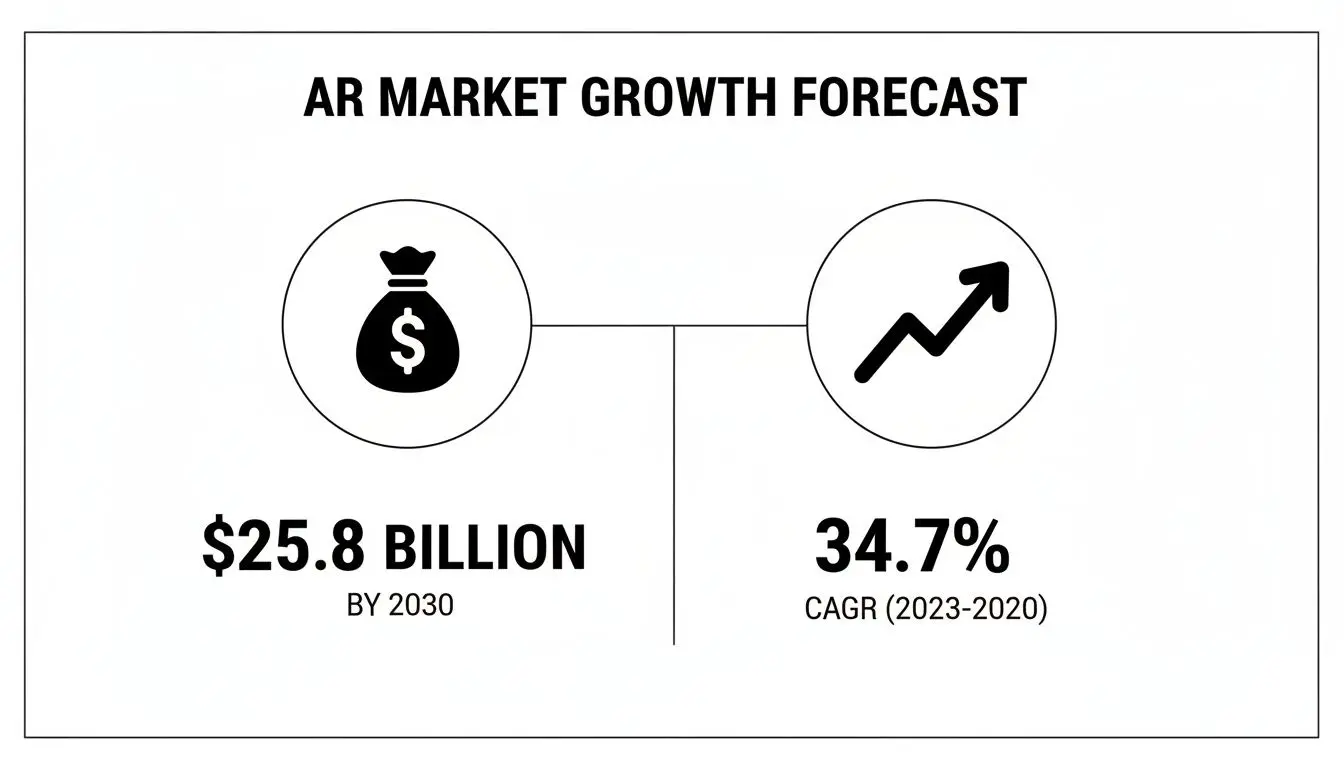
This forecast isn’t just about technology; it highlights a fundamental change in how people will expect to interact with brands online.
Boosting Conversions and Slashing Returns
Perhaps the most compelling reason to implement augmented reality in ecommerce is its proven ability to lift conversion rates. When you let customers interact with a 3D version of your product in their own space, they feel more informed and connected. This connection translates directly into sales. The impact here is significant. Industry data shows that products enabled with 3D and AR see 94% higher conversion rates. Why? Because AR takes the guesswork out of the equation, giving shoppers a crystal-clear preview of what they’re buying. Learn more about how AR is shaping the UK ecommerce landscape for a deeper dive into this trend. At the same time, AR tackles one of ecommerce’s biggest logistical nightmares: returns.
By setting accurate expectations about size, scale, and style, AR ensures that what arrives at the customer's door is exactly what they anticipated. This alignment between expectation and reality can slash returns by as much as 25%.
Fewer returns mean more than just saving on shipping. It protects your profit margins, reduces waste, and leads to happier, more satisfied customers.
Enhancing Engagement and Building Brand Loyalty
In a crowded online marketplace, simply getting a customer's attention is a battle. Keeping it is even harder. AR transforms passive scrolling into an active, engaging experience. Instead of flicking through flat images, customers are invited to interact, explore, and essentially play with your products. This deeper level of engagement brings several key benefits:
- •Increased Time on Page: Interactive AR features keep people on your product pages for longer, giving your brand message more time to sink in.
- •Greater Emotional Connection: Letting someone bring your product into their personal space fosters an early sense of ownership and a much stronger emotional bond.
- •Improved Brand Perception: Offering a genuinely useful, forward-thinking shopping experience positions your brand as an industry leader, building trust and long-term loyalty.
Ultimately, customer sentiment tells the whole story. Research shows 63% of shoppers feel AR improves their shopping experience, and an incredible 71% say they would shop more often if a retailer offered it. These aren’t just vanity metrics; they signal a fundamental shift in consumer demand that businesses can’t afford to ignore. The table below breaks down exactly how AR moves the needle on the metrics that matter most to your business.
AR Impact on Key Ecommerce Metrics
| Metric | Impact of AR Integration | Supporting Statistic |
|---|---|---|
| Conversion Rates | Significantly increases the likelihood of a purchase by allowing virtual product interaction. | AR experiences can lead to a 94% increase in conversion rates. |
| Product Returns | Drastically reduces return rates by setting accurate customer expectations for size, fit, and appearance. | Brands have seen returns cut by as much as 25%. |
| Customer Engagement | Boosts on-site time and interaction as users actively explore products in their own environment. | Shoppers who engage with AR are 3x more likely to convert than those who don't. |
| Purchase Confidence | Eliminates uncertainty and "imagination gaps," helping customers make faster, more confident decisions. | 40% of consumers say they would be willing to pay more for a product if they could experience it through AR. |
| Brand Loyalty | Creates a memorable and helpful shopping experience that encourages repeat business and positive sentiment. | 71% of shoppers would shop more frequently if a retailer offered augmented reality. |
Integrating AR is about more than just technology; it’s about improving the customer journey from discovery to delivery, leading to better outcomes for everyone.
How AR Brings Products Out of the Screen
Augmented reality in ecommerce isn't a one-size-fits-all solution. Think of it more as a toolkit, filled with different experiences designed to tackle specific customer anxieties and remove common barriers to purchase. These tools turn passive, two-dimensional browsing into an active, engaging exploration, pulling your products right out of the screen and into the customer’s world. Each type of AR experience targets a different point of friction in the online shopping journey. It’s the instant, visual answer to questions like, "Will this actually fit me?" or "Will this match my decor?". This power to erase customer doubt is precisely what makes AR so commercially potent.

Virtual Try-On Experiences
For any brand selling fashion, accessories, or beauty products, Virtual Try-On (VTO) is a game-changer. It uses a device's front-facing camera to intelligently map a customer's face or body, letting them see how sunglasses, a new watch, or a particular shade of makeup will look on them in real time. VTO essentially replicates the fitting room experience, a vital part of the buying process that was traditionally lost online. When you give customers the freedom to experiment with different styles and colours from their own home, you build immense confidence in their decision. A shopper who can see for themselves that a lipstick shade complements their skin tone is far more likely to add it to their basket. The data backs this up. AR engagement in retail has jumped by nearly 20% since early 2020. The results are even more impressive: conversion rates for shoppers who use AR are a staggering 90% higher than for those who don't. A huge 56% of consumers say AR gives them more confidence in a product's quality, and 61% actively prefer to shop with retailers that offer it.
Product Visualisation in Your Space
When it comes to furniture, home decor, or large electronics, the primary concerns are always about fit and scale. Product Visualisation, often called "View in Your Room," meets this challenge head-on. By using a phone's rear camera, customers can place a true-to-scale 3D model of an item directly in their own living room. This feature instantly resolves critical uncertainties:
- •Will that sofa overwhelm the living room?
- •Does the wood finish on that coffee table clash with my flooring?
- •Will that 65-inch TV actually fit on the media unit?
By completely removing the guesswork, this AR feature empowers customers to make smart, informed decisions. This dramatically cuts down on the risk of expensive and frustrating returns, transforming a product from an abstract image on a webpage into a tangible object in their home. You can see more real-world applications by checking out these 10 powerful examples of augmented reality in action.
Interactive Product Demos
Some products are too complex or feature-rich to be explained by static photos or even a video. This is where interactive AR demos shine. Imagine a customer placing a 3D model of a new coffee machine on their kitchen counter, then tapping on different parts to see animated guides on how to use the milk frother or run the cleaning cycle.
This type of augmented reality in ecommerce turns a product page into an interactive user manual. It gives brands a way to showcase intricate features, explain complex mechanics, and highlight unique selling points in an immersive 3D format that is both informative and memorable.
The Technology Behind Immersive Retail
What’s the technical foundation that makes these incredible experiences possible? It’s a clever combination of sophisticated yet accessible technology. Understanding the core components helps demystify the process and enables you to make smarter choices about bringing AR into your own business. At the heart of any high-quality AR experience are the native frameworks built by the biggest names in mobile. Think of these as the engines that let a smartphone truly understand and interact with the physical world around it.
Native Frameworks and WebAR
The two heavyweights in the app-based AR world are:
- •Apple's ARKit: This is the software development kit (SDK) for building AR experiences on iPhones and iPads. It’s packed with robust features for detecting surfaces, tracking images, and creating realistic lighting, making it the go-to for rich, high-performance native apps.
- •Google's ARCore: This is the Android equivalent, offering a similar, powerful set of tools for developers. ARCore is particularly adept at motion tracking and environment understanding, allowing virtual objects to be placed and anchored convincingly in a real-world space.
While these native frameworks deliver the most powerful features, they require customers to download an app. To get around this friction, WebAR has become a game-changer. WebAR delivers augmented reality experiences directly through a mobile web browser, no app required. This accessibility makes it a fantastic choice for driving widespread engagement and quick product visualisations.
The Production Pipeline
Building an AR experience isn't just about coding the final app; it all depends on a well-oiled production pipeline. The most critical part of that process is creating top-notch 3D assets. After all, your virtual products have to look every bit as good as the real thing. This process typically involves:
- 3D Modelling: Skilled artists take product photos, technical drawings, or CAD files and transform them into detailed 3D models.
- Texturing and Materials: Digital textures are applied to the models to perfectly replicate surfaces like wood grain, fabric weaves, or brushed metal.
- Optimisation: This is a crucial, non-negotiable step. The detailed 3D models are carefully simplified to ensure they load quickly and run smoothly on a phone, without sacrificing visual quality.
"A beautiful 3D model that takes too long to load is a commercial failure. The art of AR asset creation lies in balancing photorealism with performance to deliver an instant, seamless user experience."When considering the tech foundation, it's also important to remember that principles of futuristic user interface design are key to creating AR that people actually want to use. The way a user interacts with a virtual object must feel natural and effortless.
Game Engines as Development Hubs
How do you bring all these pieces together, the 3D models, user interactions, and AR logic? Developers often turn to powerful real-time 3D engines. Originally built for video games, their capabilities are a perfect match for building commercial AR applications. The two main players here are Unity and Unreal Engine. These platforms act as the central workshop where developers import the 3D assets, write the scripts for behaviour, and compile the final AR experience for either a native app or the web. If you want to go deeper on this, our guide to AR app development provides a comprehensive overview. This screenshot from Unity's site shows the cross-platform nature of modern AR development. A single project can be adapted for smartphones, tablets, and even AR glasses. Ultimately, the choice between these technologies comes down to your specific business goals, target audience, budget, and the desired complexity of the experience.Your Roadmap to a Successful AR Launch
Implementing augmented reality in your ecommerce store can feel like a daunting task, but it’s a journey that can be broken down into clear, manageable stages. Following a structured plan simplifies the process and ensures the final experience delivers on your business goals. This roadmap will guide you from initial concept to a fully optimised feature that brings in measurable results.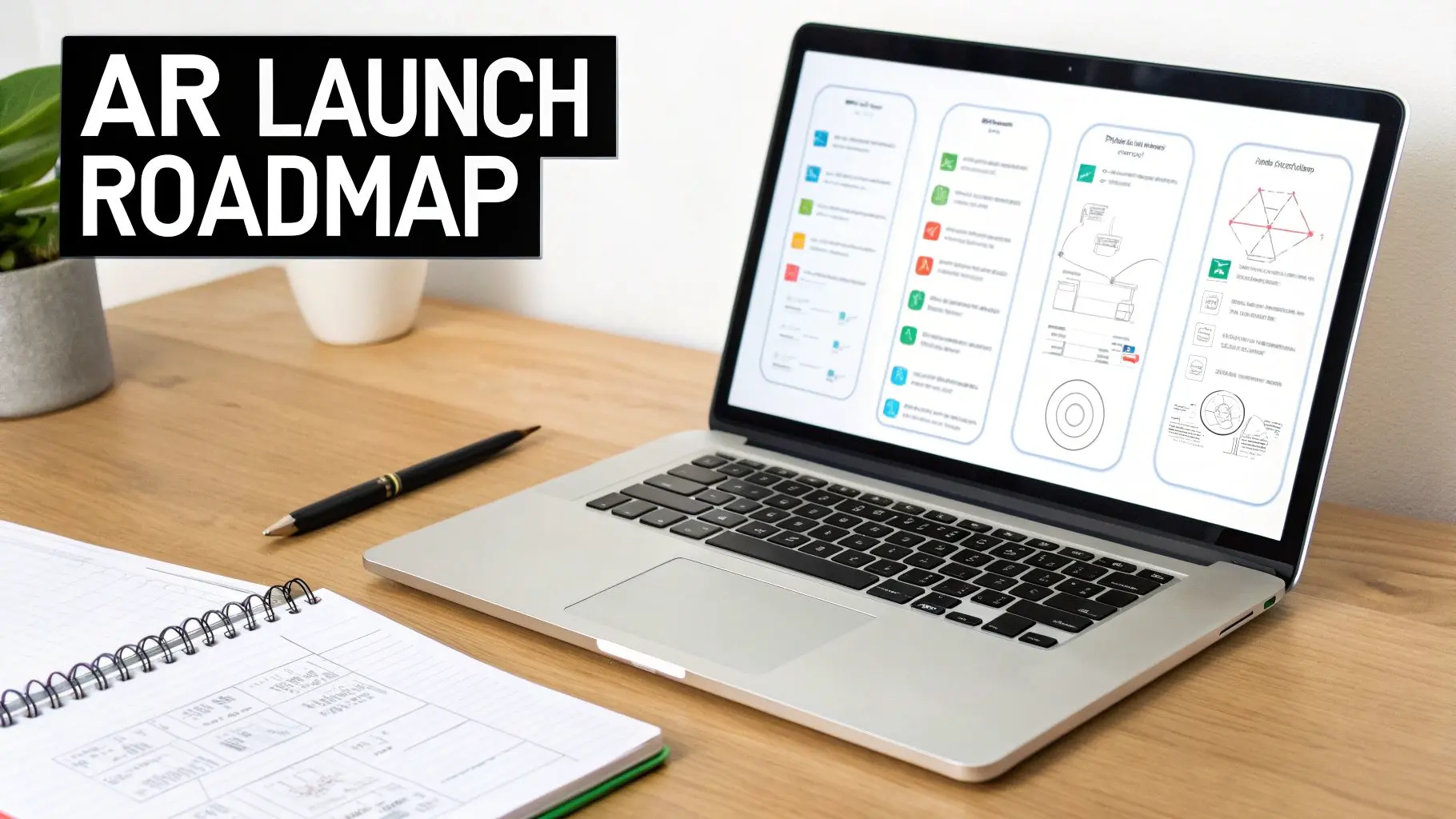 Stick to these four phases to sidestep common pitfalls and build an AR experience that truly helps your customers and your bottom line.
 Phase 1: Strategy and Discovery
Before a single 3D model is built or a line of code is written, you need a rock-solid strategy. This is about asking the right questions to ensure your AR investment is aimed at solving a genuine business problem. Without this clarity, you risk building something that looks cool but doesn't actually provide value. Define what success looks like for you. Are you trying to:- •Increase conversion rates for a particular product category?
- •Slash costly returns for items where size and fit are common issues?
- •Boost customer engagement and create a memorable brand experience?
Once your goals are clear, select your product champions. Items that are difficult for customers to visualise, like furniture, large appliances, or complex gadgets, are often the perfect candidates. Start with the products where an AR view would answer the most critical customer questions.
Phase 2: Asset Creation and Development
This is where your vision starts to come to life. The success of this phase depends on one thing: the quality of your 3D assets. A shoddy, unrealistic 3D model will instantly break the illusion and erode customer trust. It’s a common mistake that can completely derail a project. The process involves creating digital twins of your physical products that are both photorealistic and highly optimised. This is a specialised skill that balances incredible visual detail with lightning-fast performance. A model must look amazing but also load instantly on a customer’s phone. Simultaneously, the AR experience itself is developed. This is where you put earlier technical decisions into action, choosing between WebAR or a native app, and using a platform like Unity or Unreal Engine. The goal is a slick, intuitive interface that makes interacting with your virtual products feel completely effortless.
A common mistake is underestimating the importance of asset optimisation. A beautiful 3D model that causes a customer's phone to lag is worse than no model at all. Performance is a core part of the user experience.
Phase 3: Integration and Launch
With your 3D assets and AR experience ready, the next step is to weave them seamlessly into your existing ecommerce platform. Whether you're on Shopify, Magento, or a custom-built site, the AR feature needs to feel like a natural part of the product page, not a clunky add-on. This phase involves meticulous testing across a range of devices and browsers to squash any bugs. Ensure the "View in Your Room" button is easy to find and that the instructions are simple. A soft launch to a small group of customers is a smart move to gather early feedback before the full rollout.
Phase 4: Measurement and Optimisation
Getting your AR feature live isn't the finish line, it's the start of an ongoing cycle of improvement. To know if your augmented reality in ecommerce strategy is working, you must track the right metrics. Key performance indicators (KPIs) to watch include:
- •Engagement Rate: What percentage of shoppers are using the AR feature?
- •Conversion Uplift: Are products with AR selling at a higher rate than those without?
- •Return Rate Reduction: Have you seen fewer returns for your AR-enabled products?
- •Time on Page: Are people spending more time on product pages that have AR?
This data provides invaluable insights into user behaviour. You might find that users are dropping off at a specific step, or that the feature is more popular on certain devices. Use what you learn to tweak the interface, improve your models, and fine-tune the experience to drive even better results. The table below provides a quick summary of this four-phase approach.
AR Implementation Roadmap
| Phase | Key Activities | Critical Success Factor |
|---|---|---|
| Strategy & Discovery | Define business goals, identify target products, and choose the right AR technology (WebAR vs. native app). | Aligning the AR feature with a clear, measurable business objective (e.g., reducing returns by 15%). |
| Asset Creation & Dev | Produce high-quality, optimised 3D models, and develop the AR user experience in Unity or Unreal. | Achieving a perfect balance between photorealistic 3D assets and fast-loading performance on mobile. |
| Integration & Launch | Embed the AR feature into your website/app, conduct rigorous cross-device testing, and plan the rollout. | Ensuring a smooth, intuitive user experience with clear calls-to-action and instructions. |
| Measurement & Opt. | Track engagement, conversion uplift, and return rates. Use analytics to gather insights and refine the feature. | Using data-driven insights to continuously improve the AR experience and maximise ROI. |
Finding the Right Partner for Your AR Vision
Bringing a high-impact augmented reality experience to life requires more than just technical skill. It demands a partner with deep creative expertise and a proven production track record. This is where a studio’s heritage in 3D CGI, animation, and immersive XR becomes a true strategic advantage. Turning the complex challenges discussed in this guide into a seamless, engaging customer feature is no small feat. It’s a process that involves translating your brand’s vision into a studio-quality solution. It means handling everything from the meticulous creation of high-fidelity 3D assets to the intricate development work in powerful engines like Unity and Unreal. A seasoned partner understands that success isn’t just about the technology, but about how that technology serves a commercial purpose.
From Complex Pipelines to Commercial Success
Proven production pipelines are the backbone of any successful AR project. These established workflows, often refined over years of experience and enhanced with AI-driven efficiencies, are designed to deliver captivating AR features on time and on budget. They ensure that every 3D model is perfectly optimised for performance without sacrificing visual quality.
The goal is always to deliver an experience that not only engages and delights customers but also drives tangible commercial success for your brand. It’s about turning immersive interactions into measurable ROI.
The right partner connects their end-to-end capabilities directly to your business goals. They don’t just build an AR feature; they create a powerful sales and marketing tool that elevates your brand. This requires a unique blend of artistic talent and technical knowledge, something that is crucial when selecting a production house. For more guidance, our article on how to choose the right mobile app development agency offers valuable insights that also apply here. Ultimately, the journey from concept to a fully realised AR feature is a collaborative one. Finding a partner who understands your brand, your customers, and your commercial objectives is the most critical step. It’s about starting a conversation focused on turning your vision for augmented reality in ecommerce into a practical, powerful, and profitable reality that moves your business forward.
Common Questions About AR in Ecommerce
As brands begin to explore augmented reality, a few practical questions almost always come up. Getting clear answers to these common queries can demystify the process and highlight the real-world value of investing in AR. Let's tackle some of the most frequent questions we hear from businesses. Answering these questions gives you the clarity to move forward with confidence, ensuring your AR strategy is built on solid ground.
How Much Does It Cost to Implement AR?
The honest answer is that it varies widely depending on scope and complexity. A simple WebAR product viewer for a handful of products could start in the low thousands of pounds, making it an accessible entry point. On the other end of the spectrum, a fully custom native app with advanced virtual try-on features for a large catalogue is a much bigger investment. The main cost drivers are:
- •The number of 3D models required: Every product needs a high-quality, optimised 3D asset. This is a primary cost factor.
- •Platform choice: WebAR is generally more accessible, while a feature-packed native app will require a larger budget.
- •Level of custom functionality: Bespoke interactions or integrations with other systems will influence the final cost.
At Studio Liddell, we scope every project based on your specific commercial goals and budget. The aim is always to ensure a clear and achievable return on your investment.
Do My Customers Need a Special App to Use AR?
Not always, which is a massive advantage for user adoption. While native apps built on Apple's ARKit or Google's ARCore can offer incredibly rich experiences, they require a customer to download something from an app store. That can be a significant barrier. This is precisely why WebAR technology has become so popular. It lets your customers launch an AR experience directly from their mobile browser, no download needed. Most modern smartphones are already AR-ready, meaning a user can go from your product page to seeing an item in their room in seconds.
How Are the 3D Models of Our Products Created?
Creating high-quality 3D models that look great and perform flawlessly is a highly specialised skill and the foundation of any successful AR experience. The process involves turning product photos, CAD files, or even the physical products themselves into digital twins that look perfectly realistic but are light enough to load instantly on a phone.
A beautiful but slow-loading 3D model fails the user and the business. The craft lies in balancing visual fidelity with technical performance.
Production studios like ours handle this entire pipeline. We cover everything from the initial 3D modelling and intricate texturing (to perfectly replicate materials like leather or wood) to the crucial optimisation stage, which guarantees your products look flawless wherever they're viewed. We use tools like Unity or Unreal Engine to bring it all together.
How Do We Measure the Success of Our AR Features?
You measure success against the business goals you defined at the very beginning. Tracking a few key metrics will give you clear, data-backed proof of how the feature is impacting your bottom line. Important metrics to monitor include:
- •The engagement rate of the AR feature itself. Are people using it?
- •The uplift in conversion rates for products that have an AR view versus those that don't.
- •The reduction in product return rates, a direct sign that people are buying with more confidence.
- •The average time spent interacting with the AR experience.
This data provides invaluable insight into customer behaviour and proves the direct commercial value of your investment in augmented reality.
Bringing your vision for augmented reality in ecommerce to life requires a partner who deeply understands both the creative and technical sides of production. Studio Liddell has been at the forefront of 3D production and immersive experiences since 2019. Let's have a chat about how our studio-quality pipeline can create an AR feature that drives real commercial results for your brand. https://studioliddell.com