Augmented Reality for Products: Your Ultimate Explainer Guide
Augmented reality for products isn't a sci-fi fantasy anymore. It’s a real, powerful tool for sales and marketing that closes the gap between simply browsing online and making a confident purchase. When you let customers virtually place a 3D model of your product in their own home, you dramatically boost their confidence and speed up the entire sales process. It's the difference between a static product page and a hands-on, dynamic demonstration.
Why Augmented Reality Is Reshaping Product Engagement
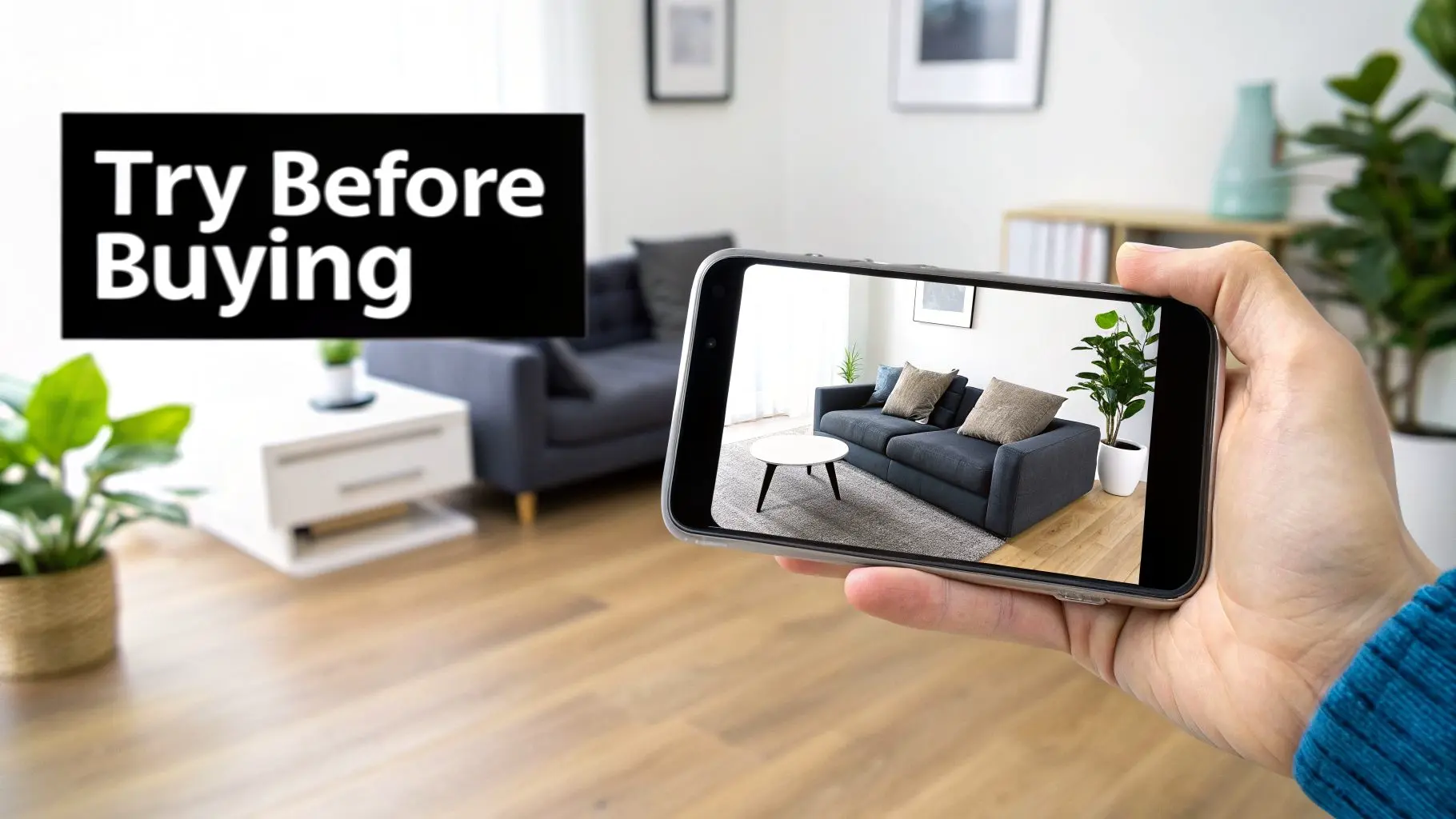
Think of your product catalogue. Now, imagine it’s not just a flat, 2D document, but an interactive guide that leads customers straight to a sale. That’s the real value of augmented reality for products. For any modern brand, it’s becoming an essential tool. AR technology uses a smartphone or tablet to overlay digital information, like a perfect 3D model of your product, onto a person's real-world environment. This simple action solves one of the biggest problems in e-commerce: the "imagination gap."
By allowing customers to visualise ownership, AR removes a massive barrier to entry for brands and leads to higher sales as a result. It's a safe, cost-effective demonstration tool without the need for costly shipping or returns.
Suddenly, your product isn't just an image on a screen. It’s an active object in your customer's life. They can walk around it, check out the details from every angle, and, most importantly, see if it _truly_ fits their space and style before they click "add to basket."
The Immediate Business Advantages
The perks of AR go well beyond just being a cool feature. They translate directly into measurable results that have a real impact on your bottom line. From driving sales to forging stronger brand connections, AR delivers genuine, tangible value. For businesses, this looks like:
- •Reduced Product Returns: When customers are absolutely sure about their purchase, those costly returns start to disappear.
- •Increased Conversion Rates: In some e-commerce scenarios, interactive 3D visualisations have been shown to increase conversions by as much as 94%.
- •Enhanced Customer Engagement: AR creates an immersive experience that grabs attention and keeps your brand front and centre, turning window shoppers into active participants.
Here's a quick look at the immediate business advantages gained by integrating AR into your product strategy.
Key Benefits of Augmented Reality for Products at a Glance
| Benefit Area | Impact on Business | Example Application |
|---|---|---|
| Sales & Conversions | Increases purchase confidence and shortens the sales cycle. | A furniture retailer lets customers place a virtual sofa in their living room to check size and style. |
| Marketing & Engagement | Creates memorable, shareable experiences that boost brand awareness. | A cosmetics brand offers a "virtual try-on" for lipstick shades via a social media filter. |
| Customer Experience | Reduces purchase anxiety and minimises costly product returns. | An electronics company provides an AR overlay showing how to set up a new home theatre system. |
As you can see, the applications are practical and the impact is significant. AR offers a clear path to improving key business metrics across the board.
How Augmented Reality for Products Actually Works
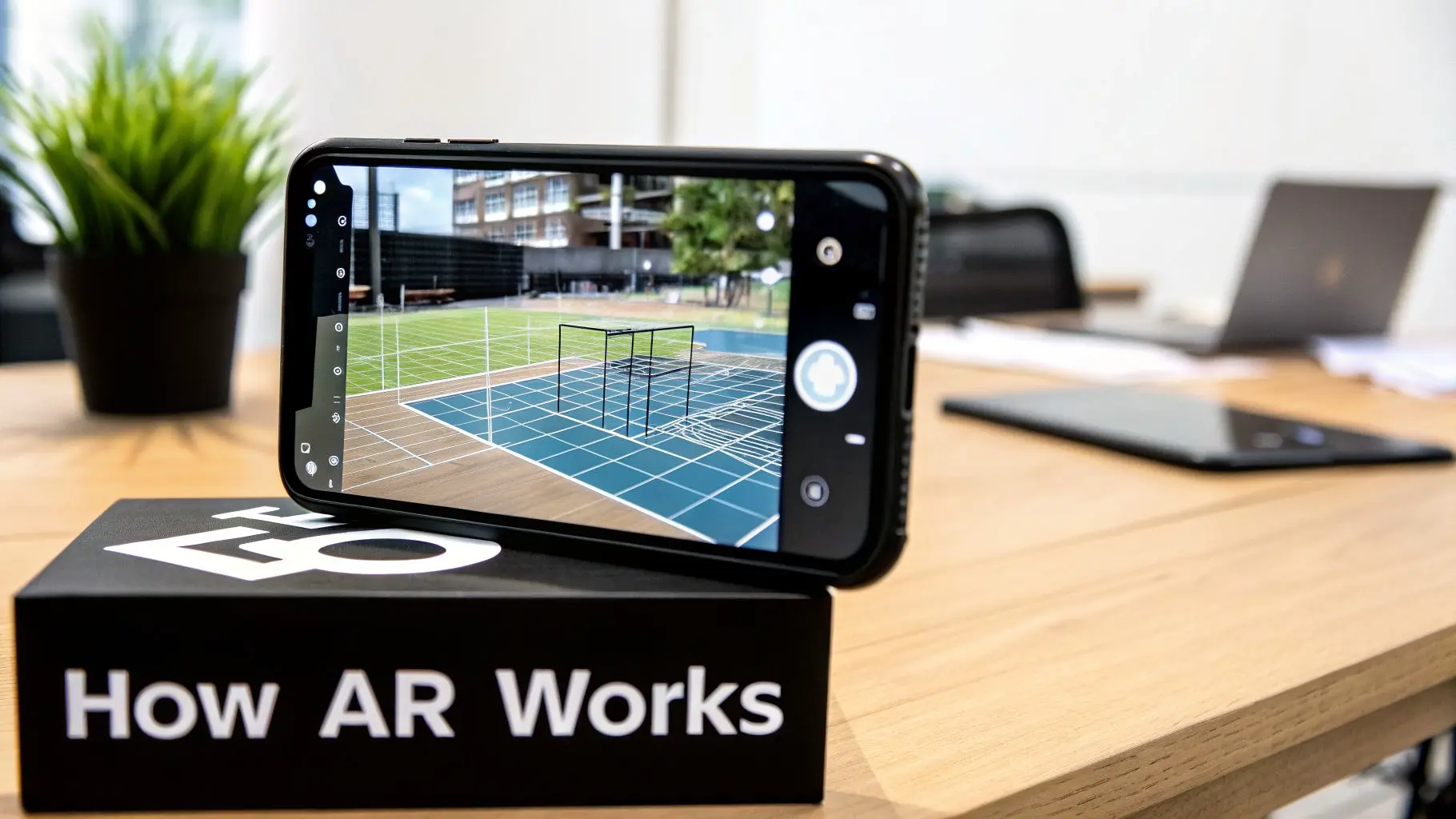
So, how does augmented reality for products really work? Think of your smartphone's camera as more than just a lens, it’s a window that can blend the digital and physical worlds together. This technology layers interactive 3D models and useful info right on top of what you see in front of you. It’s what lets a customer see if a new sofa fits their living room or how a watch looks on their wrist, all through their phone. While it feels like magic to the user, it’s all down to some very clever tech working in perfect harmony behind the scenes.
Marker-Based vs Markerless AR
AR experiences generally kick off in one of two ways. Each has its own strengths, depending on what a brand wants to achieve and where the user is.
- •Marker-Based AR: This type uses a specific, real-world image as a trigger, think a QR code, a brand logo, or a page in a catalogue. When your device’s camera recognises this 'marker', it knows exactly where to overlay the 3D content. It's incredibly reliable and precise, making it perfect for interactive packaging or exhibition stands where you control the trigger point.
- •Markerless AR: This is the tech that powers most of those fantastic “place in your space” features. Instead of needing a specific marker, the system’s algorithms are smart enough to find flat surfaces like floors and tables in the user's environment. This lets people place and play with a virtual product wherever they like, offering far more freedom.
Most modern augmented reality for products now leans on markerless tech, simply because it creates a more natural and useful experience for visualising products at home.
The Brains Behind the Scene: SLAM Technology
The secret ingredient making markerless AR possible is SLAM (Simultaneous Localisation and Mapping). It's a complex process that lets a device map out and understand a physical space in real-time. As you move your phone around, SLAM is constantly working. It maps the geometry of the room by identifying key features and surfaces, all while tracking the phone's exact position within that newly built map.
In short, SLAM gives your device spatial awareness. It's the reason a virtual sofa stays 'glued' to your living room floor as you walk around it, making the whole illusion feel stable and believable.
This constant mapping and tracking is the foundation for any AR interaction that feels genuinely grounded in reality. Without it, virtual objects would just float around unconvincingly.
WebAR vs Native Apps: Which Is Right for You?
Once you’ve got your head around the tech, the next big question is how to get it to your customers. Your two main choices are through a web browser (WebAR) or a dedicated, downloadable app (native app). Of course, any AR experience needs accurate digital versions of your products. For many retailers, this journey starts with their existing photography. Guides are available that show you how to create 3D models from pictures, turning your product shots into the 3D assets that are the heart of the experience. Here’s a quick comparison to help you decide which delivery method fits your project best:
| Feature | WebAR (Browser-Based) | Native App (Downloaded) |
|---|---|---|
| Accessibility | Instant. Users just click a link or scan a QR code. | Requires a download from an app store. |
| User Friction | Very low. No installation needed. | Higher. Users must commit to downloading. |
| Performance | Good for simpler experiences and single models. | Highest quality. Can handle complex animations and advanced features. |
| Best For | Quick marketing campaigns, e-commerce product pages. | Rich, multi-feature experiences and building brand loyalty. |
The choice between WebAR and a native app really comes down to your goals. If you want to drive quick sales with the widest possible reach, WebAR is an unbeatable tool. But if you’re looking to build a deeper brand ecosystem with loyal, repeat customers, a native app gives you far more power and control.
Driving Real Business Value With AR Product Experiences
The initial ‘wow’ factor of augmented reality is great, but the real story is its measurable impact on business. Bringing AR to your products isn't just a gimmick; it's a strategic move that delivers tangible returns and directly strengthens your bottom line. Beyond creating a memorable first impression, AR experiences are powerful commercial tools. They tie directly into core business metrics, from boosting sales and building loyalty to simplifying even the most complex B2B sales cycles.
AR closes the gap between simply _seeing_ a product online and truly believing in it. That newfound customer confidence is where the magic happens, turning passive browsers into decisive buyers and massively reducing the pain of returns.
This isn't about chasing the latest tech trend. It's about solving fundamental business challenges with smart, engaging technology.
From E-commerce Conversions to Fewer Returns
For consumer brands, the most immediate wins are in e-commerce. AR finally provides clear answers to the critical questions every customer has before they click 'buy': "Will it fit in my space?", "Does this colour really match my decor?", and "What will it actually look like in person?". This is where specific AR applications create enormous value:
- •Virtual Try-On: Fashion and beauty brands are letting customers see how a watch, a pair of glasses, or a shade of lipstick looks on them in real time. That personal connection creates an immediate desire to own the product.
- •Place in Your Space: Furniture and home decor retailers empower shoppers to place true-to-scale 3D models of products right in their own homes, completely removing the guesswork around size and style.
These interactions are far more than just novelties; they are powerful conversion drivers. The UK mobile augmented reality market is surging, largely because of this shift. Valued at USD 788.41 million in 2025, it's projected to hit an incredible USD 29,335.5 million by 2035. This explosion is being fuelled by e-commerce, where AR experiences can increase conversion rates by up to 94%. A fantastic side effect of this pre-purchase confidence is a sharp drop in product returns. When a customer knows _exactly_ what they are getting, buyer’s remorse plummets. This saves your business huge costs tied to reverse logistics and restocking.
Transforming Complex B2B Sales
The value of AR for products goes far beyond consumer retail. In the B2B world, where products are often massive, expensive, and difficult to demonstrate, AR is a complete game-changer for sales and technical teams. Imagine your salesperson at a trade show or a client meeting. Instead of fumbling with a dense PowerPoint or a heavy physical prototype, they can use a tablet to bring a full-scale 3D model of complex machinery to life, right there on the conference room floor. This approach offers several huge advantages:
- •Interactive Product Demonstrators: Stakeholders can literally walk around the virtual product, look inside, and watch animations showing exactly how it works. It makes abstract concepts tangible and easy to grasp.
- •Safe and Cost-Effective Demos: You can demonstrate large, hazardous, or delicate equipment without the logistical nightmare of shipping and setup.
- •Enhanced Technical Training: Use AR overlays to guide technicians through complex maintenance or repair jobs, improving accuracy and dramatically reducing costly errors.
Our work on the GeoEnergy NI demonstrator is a perfect example of this in action. We were tasked with explaining intricate geothermal technology to key stakeholders. By creating clear, compelling visuals, we made the complex completely accessible, helping to secure buy-in and push the project forward. It’s a powerful showcase of how AR can demystify technical products and accelerate the sales cycle. To learn more about this approach, you can check out our guide on using augmented reality for ecommerce to boost sales and slash returns. Whether you’re selling a sofa or a subterranean heating system, AR provides the clarity needed to close the deal.
Your AR Production Journey From Concept To Reality
So, what does it actually take to bring a powerful AR product experience to life? It’s far from an unpredictable creative whim. In reality, professional AR production is a structured, step-by-step process. Think of it like building a house: you absolutely need a solid blueprint before you start laying bricks, and you need a plan for the interior before picking out the furniture. At Studio Liddell, we’ve refined this journey into a transparent and collaborative pipeline. Having worked on projects with major partners like Sky Kids and Manchester United, our process demystifies production and ensures your project is delivered on time, on budget, and on vision. Every stage has a clear purpose, moving your idea from an initial spark to a polished, market-ready experience.
Stage 1: The Concept And Design Sprint
This is the architectural blueprint phase. Before a single line of code is written or a 3D model is built, we dive deep into what you want to achieve. We kick things off with intensive concept and design sprints to get everyone aligned on the core objectives. Is this AR experience for a marketing campaign, a sales tool, or a post-purchase support feature? Who is the user, and what do you want them to do next? Answering these questions upfront ensures the final product is built for a specific purpose and delivers results you can actually measure.
Stage 2: 3D Asset Creation And Optimisation
With a clear blueprint in hand, we can start gathering the materials. In the world of AR, your primary materials are the 3D models of your products. These digital assets have to strike a perfect balance between stunning visual quality and high performance. A model that’s too detailed will cause lag on mobile devices, creating a frustrating user experience. On the flip side, a model that’s too simple won't look realistic enough to be convincing. Our artists are experts at creating beautiful, 'low-poly' (efficient) models that look incredible and run smoothly across a huge range of smartphones. This is where the magic really starts to connect to your business goals. As the diagram below shows, a well-executed AR strategy, built on high-quality assets, has a direct and positive impact on your bottom line.
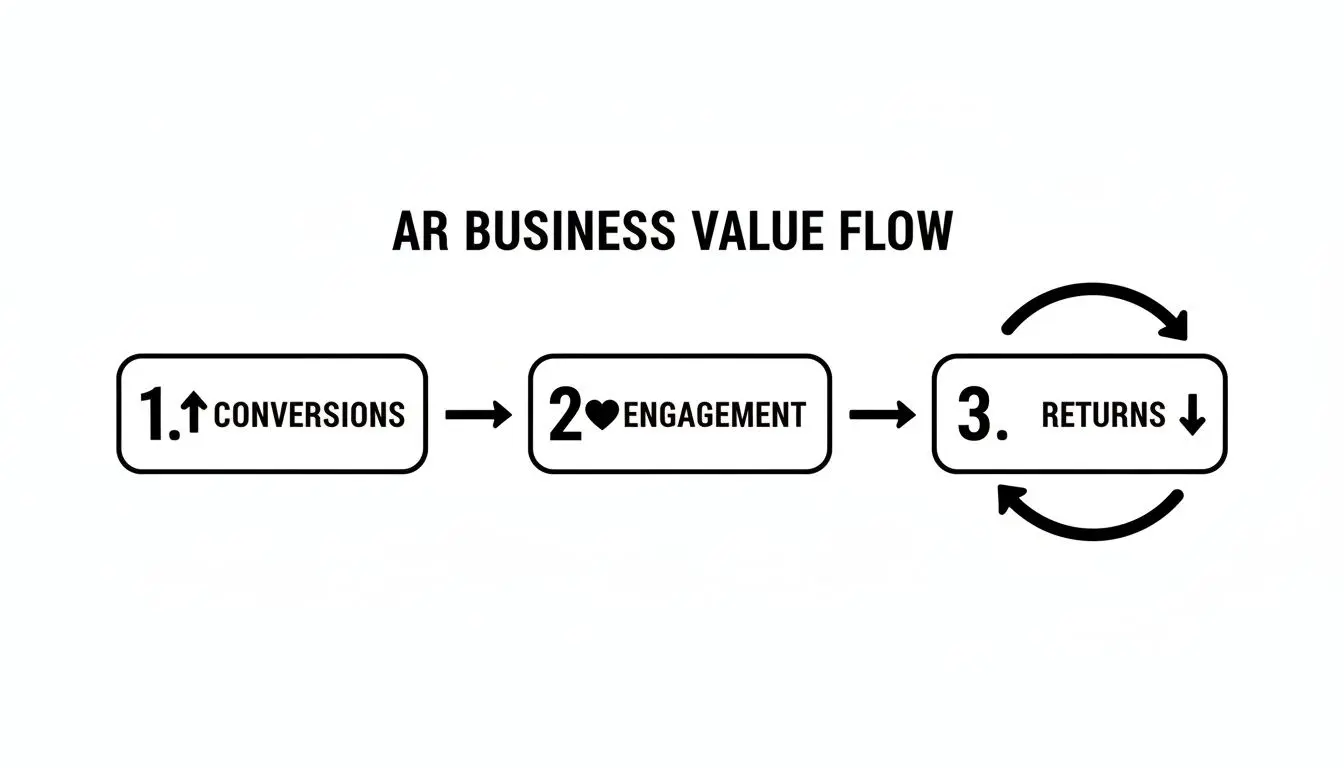
When you improve engagement with immersive visuals, you can significantly lift conversions while reducing the headache of costly returns. It’s a clear win-win.
Stage 3: Development In Unity Or Unreal
Now, the construction begins. Our development team takes the approved 3D assets and brings them into a powerful real-time game engine, usually Unity or Unreal Engine. This is where we build the logic, the user interface (UI), and all the interactive features of your experience. This stage involves everything from programming how a user can change a product’s colour to ensuring the AR tracking is stable and accurate. The UK’s immersive entertainment market, which generated USD 8,934.6 million in 2025 and is projected to hit USD 68,549.0 million by 2033, is built on the power of these engines. The market's explosive 29.9% CAGR is driven by applications like AR product try-ons, which have shown a 35% uplift in user engagement in UK marketing campaigns alone. You can read the full research on the growth of the UK's immersive entertainment market.
Stage 4: Rigorous Testing And Deployment
Before we hand over the keys, we conduct rigorous quality assurance (QA) testing. Our team tests the experience across a wide array of target devices, from the latest iPhones to older Android models, to catch bugs, fix performance issues, and guarantee a flawless user experience for everyone.
A buggy or slow AR experience can do more harm to your brand than having no AR at all. Meticulous testing is non-negotiable.
Once it passes our demanding QA process, we move to deployment. This could mean launching a WebAR experience via a simple QR code, submitting a native app to the Apple and Google Play stores, or integrating the AR feature directly into your existing e-commerce platform. Finally, we help you set up analytics to track key performance indicators. We measure user engagement, session length, and conversion events, giving you the hard data needed to prove ROI and refine your future AR strategy. You can find even more detail in our complete guide to AR development from concept to launch.
Real-World Examples of AR for Products in Action
It’s one thing to talk about the potential of AR, but seeing it solve real-world business problems is where things get exciting. The theory is great, but the proof is in the results. Let’s dive into a few stories from the trenches. These aren't just concepts; they are examples of how we've used creative AR to tackle specific challenges for our clients, turning abstract ideas into commercial wins. Each one started with a clear business problem and ended with a tangible, measurable outcome.
Case Study: Animated Machinery At Exhibitions
- •The Challenge: A B2B client manufacturing large-scale industrial machinery was getting lost in the noise of crowded trade shows. Their equipment was far too big and heavy to bring to the stand, and glossy brochures just weren't cutting it. They couldn't show the intricate, internal workings that made their products special.
- •Our Solution: We developed a marker-based AR experience that brought the machine to life right on the exhibition floor. Visitors simply aimed a tablet at a large floor graphic, and a full-scale, animated 3D model of the machinery appeared before them. They could walk around it, peer inside, and watch detailed cutaway animations demonstrating its unique processes.
- •The Result: The interactive AR demo became the star of their stand. We saw their average dwell time increase by over 300%. More importantly, the quality of leads shot up, as the sales team could have much deeper, more informed conversations. The buzz it created lasted long after the show ended. You can find out more about how we use AR for exhibitions to increase stand dwell time in our dedicated guide.
Case Study: The Branded Product Mobile Game
- •The Challenge: A popular snack brand was looking for a fresh way to connect with a younger, more tech-savvy audience. They knew traditional advertising wouldn't be enough and wanted an engaging digital experience that would keep people interacting with the brand long after the initial contact.
- •Our Solution: We built a fun and slightly addictive AR mobile game. The premise was simple: players had to explore their real-world environment to find and collect virtual versions of the brand’s snacks. We cleverly designed the game to integrate product recognition, encouraging social sharing and repeat plays.
- •The Result: The app was a huge hit, generating over 50,000 downloads in the first month alone and driving a massive spike in social media mentions. The game successfully turned passive consumers into active participants, building a much stronger and more personal connection with their target demographic.
Case Study: The Fashion Virtual Try-On
One of the most powerful and now widespread uses of AR for products is virtual try-on technology. It directly tackles one of the biggest hurdles in e-commerce: buyer uncertainty.
- •The Challenge: A high-end eyewear brand was struggling with high return rates from their online shop. Customers were understandably hesitant to spend a significant amount on frames they couldn't try on first. This hesitation led to lost sales and expensive reverse logistics.
- •Our Solution: We created a seamless WebAR feature that lived directly on their product pages, no app download required. Using their smartphone’s front-facing camera, shoppers could instantly see how any pair of glasses looked on them. The AR accurately tracked their facial movements, so they could turn their head and view the frames from different angles with incredible realism.
- •The Result: The impact was immediate and significant. Within three months of going live, the brand reported a 40% reduction in product returns and a 22% increase in online conversion rates. By removing that final barrier to purchase, we gave customers the confidence they needed to click "buy".
How To Choose Your AR Production Partner
Picking the right production partner for your augmented reality project is probably the single most important decision you'll make. It’s a choice that defines not just the quality of the final AR experience, but how smooth and predictable the entire journey is to get there. A great partner is a strategic guide, not just another supplier on the books. What you’re really looking for is a studio that brings more than just raw technical skill to the table. They need to have a deep, proven history of creative execution and a genuinely collaborative spirit. Look for a team that can walk you through a clear, transparent process from day one, so you know exactly what to expect.
Proven Track Record And Creative Heritage
Your first port of call should be the studio's history. An agency with a long-standing heritage in digital content, like our own studio history dating back to 2019, shows you they have stability and a consistent record of delivering top-tier work for major clients. This isn't just about being around for a long time; it's about the mountain of experience they've built up.
Choosing a partner with a rich background in 3D animation and storytelling ensures your AR product experience won't just be technically functional, it will be creatively compelling and beautiful.
A studio with a background in broadcast, for instance, instinctively understands the incredibly high bar for visual quality and performance. That’s a crucial mindset for creating AR that genuinely impresses customers and makes your brand look its best.
Deep Expertise In 3D And Technical Development
Augmented reality for products exists right at the crossroads of high-end 3D art and solid technical development. A partner that only excels in one of these areas is a big risk. You might get a team that’s strong on the creative side but weak on coding, and they’ll build beautiful models that completely fail to perform on a mobile phone. On the other hand, a technically sharp team without a strong 3D animation pipeline might deliver a functional app, but it could be visually dull and fail to capture anyone's imagination. The best partners, like us here at Studio Liddell, have deep, in-house expertise in both. This integrated skill set is what allows a studio to:
- •Create stunning, photorealistic 3D assets from scratch.
- •Optimise those assets so they perform flawlessly in real-time.
- •Develop the experience in powerful engines like Unity and Unreal Engine.
- •Scale projects from simple WebAR to complex, multi-feature apps.
A Collaborative And Scalable Partner
Finally, you need to get a feel for how the studio actually works. A truly collaborative process means you feel like part of the team, with regular check-ins and a clear view of progress at every single stage. The ability to scale is just as important. You might be starting small with a simple WebAR viewer for one product, but your ambitions will likely grow. Your chosen partner should be able to grow right alongside you. They need to be just as comfortable handling a quick-turnaround marketing campaign as they are building a full-blown immersive application that becomes a core part of your business strategy. Making the right choice means investing in a partnership that will elevate your brand and deliver real, measurable results. Your product deserves to be seen in the best possible light. Ready to see how your products could look in AR? Brief us on your product and let our experts show you what's possible.
Your Top Questions About AR For Products, Answered
Jumping into a new technology like augmented reality always brings up a few practical questions. It's a new world for many businesses, so we've put together some straight answers to the most common things we get asked. This should help you figure out your next steps with confidence.
How Much Does An Augmented Reality Product Experience Cost?
The honest answer? It really depends. The cost of an AR experience can vary quite a bit based on what you want to achieve. For a simple WebAR viewer for one product that's already well-optimised, you could be looking at a starting price in the low thousands of pounds. This is a great entry point, perfect for a specific marketing campaign or a single product launch. If you're thinking bigger, like a completely custom-built app with complex animations, tons of user interactions, and a whole catalogue of products, the budget can range from £20,000 to over £100,000. The final price tag really comes down to the quality of the 3D assets, how many features you need, and whether you opt for WebAR or a native app. The best first move is always to jump on a quick scoping call so we can give you a proper estimate based on your goals.
Do My Customers Need A Special App To Use Our AR?
Not necessarily, and that’s fantastic news for getting people to actually use it. With modern WebAR technology, your customers can launch an AR experience right from the web browser on their phone. All they have to do is click a link or scan a QR code, no app store, no downloads, no waiting.
WebAR is brilliant for e-commerce and marketing campaigns where you need instant engagement. On the other hand, a native app needs a download, but it unlocks more power and advanced features. It’s the better choice if you're aiming to build a long-term brand ecosystem with loyal users.
Ultimately, deciding between WebAR and a native app comes down to your strategy and the kind of experience you want to create for your customers.
What 3D Files Do We Need To Get Started?
To get the ball rolling, you’ll need optimised 3D models of your products. The good news is that you might already have what you need without even realising it. If your design or manufacturing process uses CAD files, our team can often convert and get them ready for real-time performance in AR. Don't have any existing 3D files? That’s no problem at all. Our artists are experts at creating photorealistic and efficient 'low-poly' 3D models from scratch. All we need are some good product photos or even a physical sample to work from. The goal is always the same: create assets that look absolutely stunning but run smoothly on the widest range of phones and devices possible.
Ready to bring your products to life with AR? Studio Liddell has been a trusted creative partner since 2019, turning ambitious ideas into reality. Brief us on your product