Augmented Reality for Ecommerce: The Ultimate Guide to Boosting Sales and Slashing Returns
Augmented reality for ecommerce isn't just a futuristic gimmick; it's a powerful tool that lets your customers place a realistic 3D model of your product directly into their own space using just their phone. Think of it as a digital bridge connecting your online store to a customer's living room, giving them a genuine chance to _try before they buy_. This simple yet transformative idea tackles one of the biggest hurdles in online shopping: the inability to see how an item _truly_ looks and fits in a personal environment.
Bridging the Gap Between Your Store and Their Space

Let's be honest, online shopping has always involved a degree of guesswork. Will that armchair you’ve been eyeing up completely dominate your study? Is that shade of lipstick _actually_ going to complement your skin tone? These uncertainties lead to hesitation, abandoned carts, and the expensive hassle of returns. Augmented reality (AR) for ecommerce steps in to eliminate that doubt. Instead of just browsing static photos or a slick video, AR invites customers into an interactive experience. Using their phone's camera, they can place a true-to-scale 3D model of your product right onto their floor. It's more than a fun feature; it's a practical tool that empowers decision-making. A passive browsing session is instantly transformed into an active, hands-on evaluation.
How Does AR Work in an Ecommerce Context?
At its core, AR technology leverages a device’s camera and sensors to understand the physical environment. It then overlays computer-generated imagery onto that real-world view. For a retail application, the process typically breaks down like this:
- •Spatial Recognition: The technology scans the room, identifying surfaces like a floor or tabletop to determine where a digital object can be placed.
- •3D Product Visualisation: A detailed and accurately scaled 3D model of your product is loaded and rendered in real-time.
- •User Interaction: The customer can then move the virtual product, rotate it, and sometimes even change its colour or fabric, just as if it were physically present.
This ability to contextualise products is what makes AR so powerful. A customer isn't just seeing a sofa; they're seeing _the_ sofa, in _their_ home, next to _their_ coffee table. This deep level of personalisation creates an immediate connection and a much stronger sense of purchase confidence.
By allowing customers to visualise products in their own environment, AR effectively minimises the "imagination gap" that plagues online retail, leading to more informed and satisfying purchases.
Brands are rapidly moving beyond flat, 2D images, creating shopping journeys that are far more dynamic and immersive. To dive deeper into the core concepts driving this shift, explore our comprehensive guide to augmented reality experiences. This technology isn't just about showing products; it’s about letting customers truly experience them in a personal, tangible way before they ever click "add to cart."
Why AR Integration is a Game-Changer for Your Business
Moving beyond the novelty factor, integrating augmented reality into your ecommerce platform delivers serious strategic advantages that directly impact your bottom line. This isn't about adding a flashy feature; it's about fundamentally solving some of the biggest pain points in online retail. The goal is to convert hesitant browsers into confident buyers and build a loyal customer base. At its core, the primary benefit of AR is its incredible ability to erase customer uncertainty. When someone can physically see how a product will look in their space, the decision to buy ceases to feel like a gamble. It becomes a confident choice. This newfound certainty is a direct line to higher conversion rates because they're no longer just _hoping_ an item will fit or match their decor, they _know_ it will. This proactive method of reassuring customers creates a positive ripple effect. You're not just selling a product anymore; you're selling the confidence that comes with making the right decision. In a crowded market, that's a powerful differentiator.
Slashing Return Rates with Accurate Previews
Ask any ecommerce manager about their biggest operational drains, and returns will be high on the list. The cost, the logistics, it's a nightmare. A high return rate is often a clear signal of a disconnect between what customers _expect_ and what actually arrives. AR tackles this problem head-on by setting crystal-clear expectations from the outset. Imagine a home decor brand dealing with constant returns because a shade of blue cushion looks different in person. By adding an AR viewer, they let customers place that cushion on their own sofa, under their own living room lighting. This simple act of contextualisation can slash return rates.
For instance, a furniture retailer could see returns drop by as much as a third after launching an AR feature. By empowering customers to verify size, scale, and style in their home, you virtually eliminate the primary reasons for returns: “it didn’t fit” or “it didn’t look right.”
This reduction has an immediate financial benefit. You save money on reverse logistics, restocking, and handling potentially damaged goods. Plus, it results in a much happier customer, because nobody enjoys the hassle of sending something back.
Driving Deeper Customer Engagement and Loyalty
AR transforms the passive act of scrolling through product photos into an active, engaging, and even fun experience. Customers spend more time on your product pages, interacting with 3D models and exploring different colours or styles. This increased "dwell time" is a strong indicator of purchase intent and provides more opportunities to build a genuine brand connection. This interactive element makes shopping feel less like a chore and more like a process of discovery. Brands offering these helpful, immersive tools are perceived as more customer-focused and innovative, which enhances brand perception and encourages repeat business. It's also worth understanding the bigger picture; considering AI's impact on ecommerce helps put into context how AR fits into the broader evolution of retail technology.
Boosting Conversions with Tangible Data
The numbers don't lie. Brands that have embraced AR often see a significant jump in gross transaction volume, effectively turning curious onlookers into paying customers through this deeper level of engagement. With the number of UK online shoppers projected to swell to 62.1 million by 2025, adopting AR isn't just a smart move, it's aligning your business with where consumer behaviour is heading. This AR boom in the UK presents a huge opportunity for ecommerce brands to cut down on returns and seriously spike their conversion rates. Ultimately, augmented reality for ecommerce is a strategic investment that delivers a measurable return. By boosting conversion rates, slashing returns, and fostering deeper engagement, AR proves it's an essential tool for any business serious about thriving online.
How Top Brands Are Using AR in Online Retail
Theory is one thing, but seeing augmented reality for ecommerce in action is what truly demonstrates its power. The world's leading brands aren't just experimenting with AR; they're integrating it directly into the customer journey to solve real-world problems and achieve tangible results. Their strategies provide a clear blueprint for how you can make this technology work for your own business. The most successful AR integrations fall into a few key categories, each tackling a specific challenge customers face when shopping online. Whether it's trying on glasses without leaving home or ensuring a new sofa fits perfectly, these tools are closing the gap between browsing and buying with confidence. Let's break down the most impactful use cases.
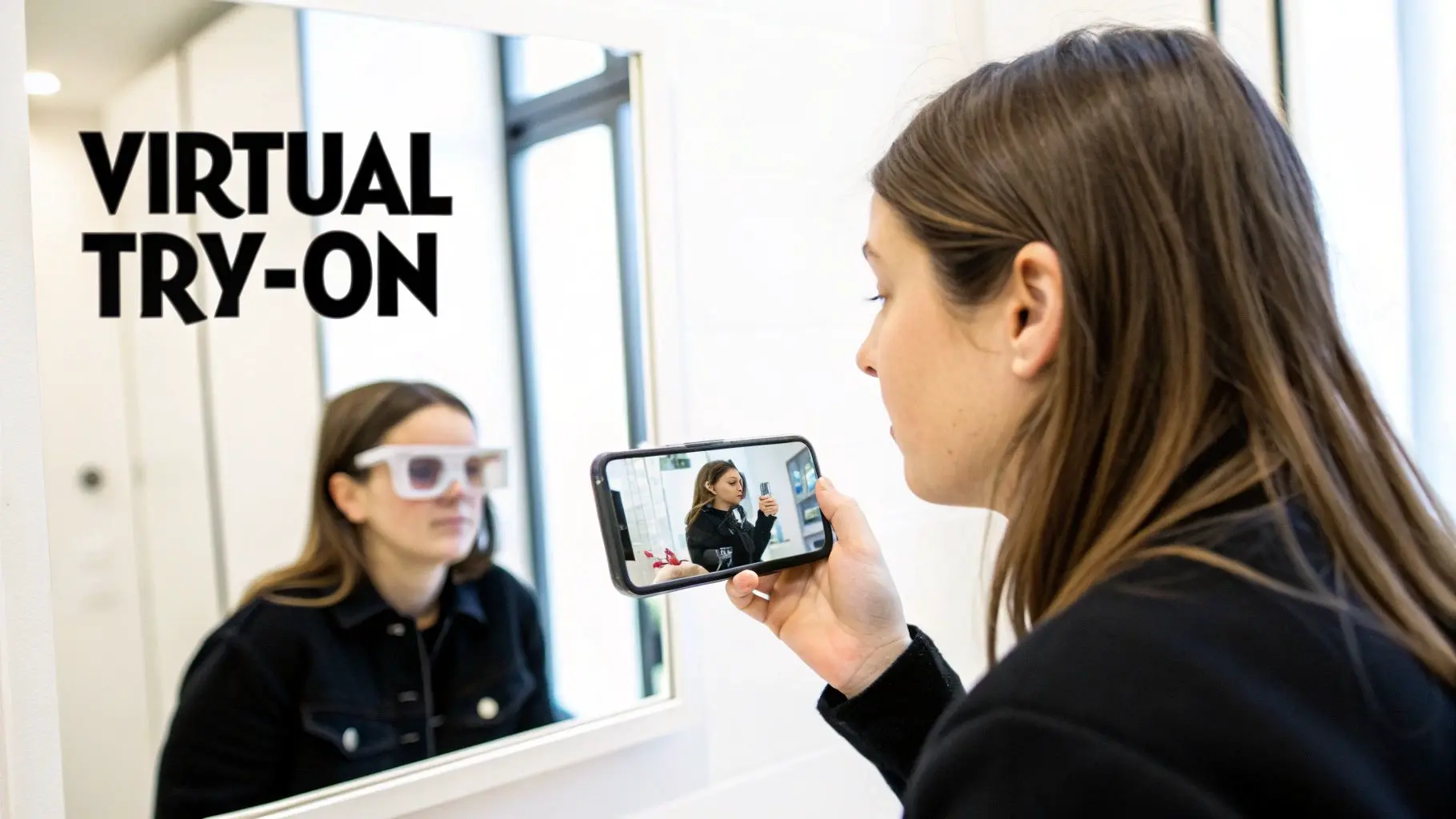
Virtual Try-On for Fashion and Beauty
Easily one of the most personal and effective uses of AR, the virtual try-on lets customers see how products like makeup, glasses, jewellery, or even clothing will look on them in real-time, all through their device's camera. Cosmetics giant Sephora was a pioneer with its "Virtual Artist" feature, allowing shoppers to instantly test thousands of lipstick shades or eyeshadow palettes, completely sidestepping the friction and hygiene issues of in-store testers. The result is a playful, personalised experience that encourages experimentation and leads to more confident purchases. The demand for this technology is particularly high in the UK. Recent research shows that UK luxury fashion shoppers are very keen on augmented reality in ecommerce, with a massive 72% expecting to use it more frequently in the next few years. A major driver is the appeal of 'home try-on' features, which 67% of shoppers see as a significant benefit. To dive deeper, you can discover more about the latest AR shopping statistics and see how they're shaping the future of fashion.
View in My Space for Furniture and Home Decor
Perhaps the most practical application of augmented reality for ecommerce is the "View in My Space" feature, famously used by brands like IKEA. This tool directly solves the age-old problem of buying large items online: will it actually fit and look good in my home? Using their smartphone, a customer can place a true-to-scale 3D model of a sofa, table, or lamp directly in their living room. They can walk around it, check its dimensions, and see how the colour complements their existing decor.
This simple act of visualisation almost completely removes the guesswork and buyer's remorse that often comes with big-ticket purchases. It also has a massive impact on reducing return rates, which is a huge operational cost for furniture retailers.
This functionality builds incredible trust and offers a level of utility that static photos and videos simply cannot match. It helps turn a high-stakes purchase into a well-informed, confident decision.
Interactive Product Visualisation and Manuals
For products with complex features or tricky assembly, AR can become a brilliant interactive manual. Instead of deciphering a confusing paper diagram, customers can use AR to see an animated, step-by-step overlay of the entire assembly process. Mercedes-Benz, for instance, uses AR to help customers understand the intricate features inside their vehicles. By simply pointing their phone at the dashboard, drivers can get interactive pop-ups explaining what different buttons and functions do. This approach enhances the post-purchase experience, turning a potential moment of frustration into one of discovery and positive brand engagement. The table below breaks down how these popular AR applications fit into different retail sectors and what they help businesses achieve.
Comparing AR Applications Across Ecommerce Sectors
| AR Application | Primary Use Case | Best Suited For | Main Business Impact |
|---|---|---|---|
| Virtual Try-On | Seeing how a product looks on the user in real-time. | Fashion, Cosmetics, Accessories | Increases conversion, reduces returns, boosts engagement. |
| View in My Space | Visualising a product in the user's physical environment. | Furniture, Home Decor, Appliances | Slashes return rates, builds purchase confidence, shortens sales cycle. |
| Interactive Manuals | Providing animated, contextual assembly or usage guides. | Electronics, Automotive, Complex Machinery | Improves customer satisfaction, reduces support calls, adds value. |
As these examples show, AR is far more than a gimmick. When applied thoughtfully, it becomes an essential tool that solves genuine customer problems, builds lasting brand loyalty, and directly contributes to a healthier bottom line.
Choosing the Right AR Technology for Your Brand
So, you’re ready to bring AR into your ecommerce strategy. Great decision. The next crucial question is: which technology is the right fit? This choice is a critical fork in the road, influencing everything from your budget and timeline to the ultimate customer experience. Broadly speaking, you have two main paths in augmented reality for ecommerce: a dedicated, downloadable app or the increasingly popular WebAR, which works directly from a phone's web browser. Think of a native app like a high-performance sports car, it's incredibly powerful, finely tuned, and packed with premium features for a high-octane experience. WebAR, on the other hand, is like a reliable family car. It’s accessible to everyone, incredibly easy to use (no download required), and gets you where you need to go with minimum fuss. Neither is inherently "better." The best choice depends on your goals and your audience.
App-Based AR: The Premium Experience
App-based AR requires customers to download your application from the App Store or Google Play. While this is an extra step, it unlocks a level of performance and functionality that browser-based AR can't quite match yet. The biggest advantage of native apps is raw power. Because the app communicates directly with the device’s hardware, it can handle more demanding tasks, think complex 3D models with ultra-realistic textures, slick animations, and rock-solid tracking. This translates into a smoother, more stable, and visually stunning user experience. Key advantages include:
- •Higher Fidelity: Apps support incredibly detailed models and sophisticated lighting, making your products look almost indistinguishable from the real thing.
- •Advanced Features: You can build a complete brand ecosystem within an app, integrating push notifications, customer accounts, and offline functionality.
- •Greater Stability: Native apps tend to offer more dependable performance and tracking across a wider range of devices.
The obvious challenge is the "download barrier." Convincing a customer to commit precious phone space to another app is difficult, which may limit your reach to your most loyal brand fans. If you're exploring this route, our guide to AR mobile app development is a great place to start.
WebAR: Maximum Reach with Minimum Friction
WebAR completely sidesteps the download issue. Users can launch the experience instantly by clicking a link or scanning a QR code. There’s no app, no waiting, no friction. This makes it immediately accessible to anyone with a modern smartphone. This instant access is WebAR's superpower. It’s the perfect tool for large-scale marketing campaigns, quick product visualisations, and getting your AR in front of the largest possible audience. A customer can go from seeing an ad on social media to viewing your sofa in their living room in just seconds.
WebAR trades a little raw power for maximum reach and convenience. It's the go-to option for brands that want to eliminate barriers to entry and make their AR experience as shareable as a link.
While the technology is advancing at a blistering pace, WebAR can still face browser limitations, meaning highly complex 3D models might need some optimisation. However, for the vast majority of ecommerce applications, the quality is more than sufficient to deliver a brilliant and effective experience.
The Powerhouse Engines: Unity and Unreal
Whether you choose an app or WebAR, the experience itself needs to be built with a powerful engine. This is where industry-leading platforms like Unity and Unreal Engine come in. These are the same real-time engines used to create blockbuster video games and Hollywood-level special effects. Here at Studio Liddell, we live and breathe these engines. Our deep expertise in both Unity and Unreal allows us to craft visually breathtaking and perfectly functional AR worlds. We can push the limits to create everything from photorealistic product models to complex, interactive configurators. By leveraging our production knowledge, you get an AR experience that doesn't just work, it captivates, drives serious engagement, and delivers measurable results for your business.
Your Step-by-Step AR Implementation Roadmap
Bringing an augmented reality for ecommerce project from concept to a live feature isn't a single magical leap; it's a structured, disciplined process. A step-by-step production plan is what separates a gimmick from a game-changing tool. By breaking the journey into clear phases, you ensure every detail is handled correctly, resulting in a feature that is genuinely valuable for your customers. A successful AR feature is built on a solid strategic foundation. Before any code is written, you must be crystal clear on your objectives. Are you aiming to slash returns for a specific product category, like furniture? Or do you want to boost engagement across your entire catalogue? Defining these goals at the outset clarifies the project's scope and provides a clear target for the team. This is also where you map out the user experience (UX). How will customers discover and launch the AR feature? What actions can they take once the 3D model appears in their room? An intuitive design is non-negotiable; if the tool is clunky or confusing, users will abandon it within seconds.
Building Your Digital Assets
The heart of any AR experience is the library of 3D models of your products. This isn't just a technical step, it's an art form. Each model must be a photorealistic, true-to-scale digital twin of the physical item. High-quality textures, accurate colours, and precise dimensions are essential for building trust and creating a believable experience. The challenge lies in balancing stunning visuals with performance. A beautiful but overly complex model with a large file size will take forever to load on a mobile connection, leading to user frustration. This is where optimisation is critical. The trick is to cleverly reduce the model's complexity (or polygon count) without any noticeable drop in visual quality. A typical asset creation workflow looks like this:
- •3D Scanning or Modelling: We either scan products using specialised hardware for maximum accuracy or have our 3D artists meticulously model them from scratch using photos and product specifications.
- •Texturing and Lighting: Our artists then apply realistic surface materials and textures, ensuring the model reacts to the light in the user's environment just like the real item would.
- •Optimisation and Conversion: Finally, the model is optimised for real-time performance and converted into the correct file format, such as USDZ for Apple devices and GLB for Android.
Integration and Launch
With your 3D assets ready, the next step is integrating them into your chosen platform, whether a native app or a WebAR solution. This involves connecting the AR function to your product pages, ensuring the correct 3D model loads instantly when a customer taps the "View in your space" button. For a deeper dive into the technical side, you can explore our guide to augmented reality code to see what's happening behind the scenes. This flowchart illustrates the two main deployment paths for AR, both leading to the same ultimate goal: a confident purchase.
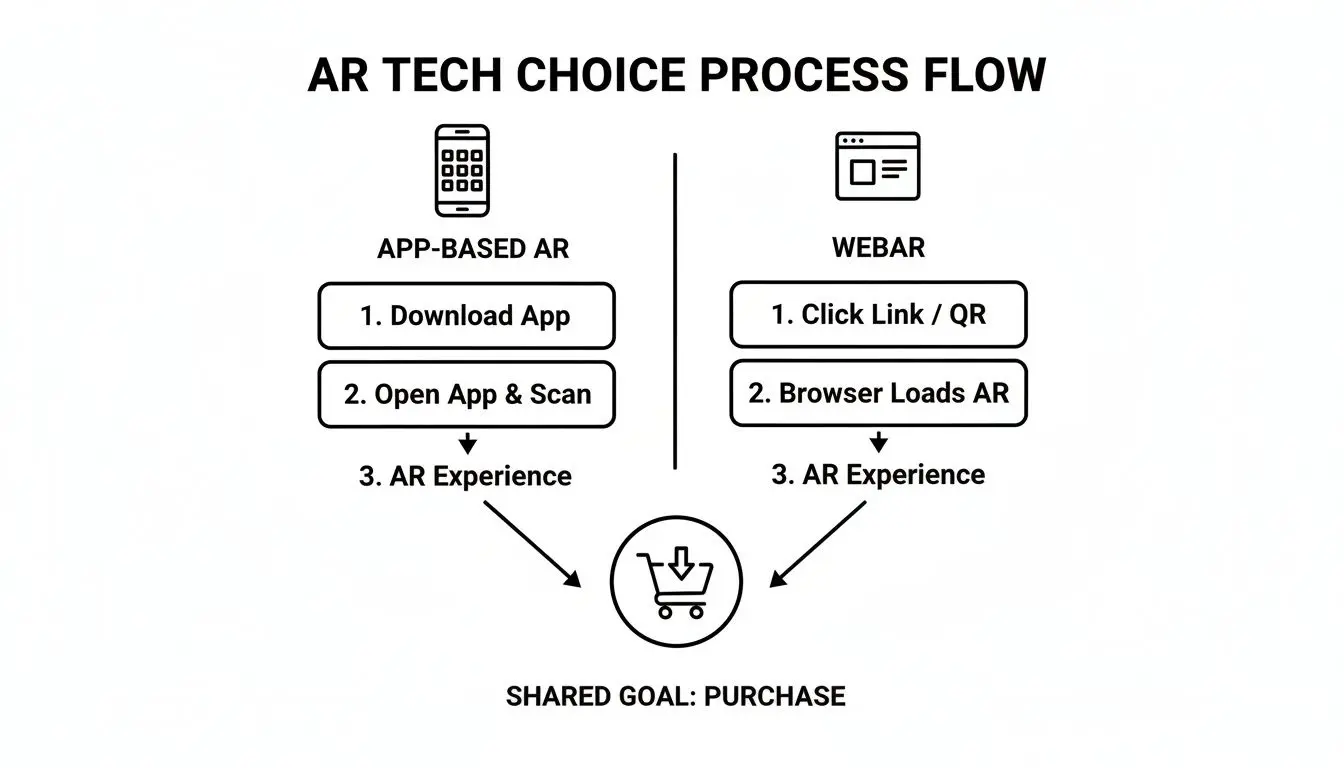
As the chart shows, while the delivery method may differ, the end game is a seamless path to purchase. The final steps before launch involve rigorous testing across a wide range of devices to eliminate bugs and ensure a consistently brilliant experience for every user. But the journey doesn't end at launch; we continuously monitor analytics to gather insights, allowing us to refine and improve the feature over time.
How to Measure AR Success and Prove ROI
You've launched your augmented reality feature. The technology is exciting, but it’s only as good as the results it delivers. To justify the investment, you need to move beyond anecdotal feedback and focus on the numbers that truly matter. Proving the value of augmented reality for ecommerce requires a clear framework for tracking performance. It starts with robust analytics that show not just _if_ people are using your AR tool, but _how_ they're using it. This data is the foundation for demonstrating that AR is a serious business driver, not just a flashy gimmick.
Key Performance Indicators for AR
To build a rock-solid business case, you must focus on metrics that link AR usage directly to sales and customer satisfaction. These KPIs are the heart of your ROI analysis, painting a clear picture of the tangible benefits for stakeholders. Here are the essential metrics to monitor:
- •Conversion Rate Lift: This is the most crucial metric. Compare the conversion rate of shoppers who engage with the AR feature against those who don’t. A significant lift is the clearest signal that AR is providing the confidence needed to click "buy".
- •Reduction in Product Returns: Track the return rates for products viewed in AR versus those that were not. If the AR group returns fewer items, you have proof that the technology sets accurate expectations and reduces costly reverse logistics.
- •AR Engagement Rate: What percentage of visitors on a product page actually launch the AR experience? This indicates how well you’re promoting the feature and how appealing it is to your customers.
- •Dwell Time: Measure how much longer users stay on product pages when interacting with AR. Increased time on page is a classic sign of high purchase intent.
Translating Metrics into a Compelling ROI Story
Gathering data is just the first step; the magic is in how you present it. The goal is to show a clear financial return. For example, you can calculate the exact monetary value of reduced returns or quantify the additional revenue generated by the conversion rate lift. The impact is already being felt across UK ecommerce. Augmented reality is giving the sector a major boost by eliminating buyer hesitation. A massive 67% of luxury shoppers have praised 'home try-on' features for giving them the same confidence as being in a physical store. Looking at broader statistics, the story gets even better. Conversion rates can leap by an incredible 90% for users who interact with AR, and 71% of consumers say they'd shop more often if a site offered it. As you build your own ROI case, these industry benchmarks provide powerful context for your results. You can explore more UK ecommerce insights to get the bigger picture. By focusing on these hard numbers, you can confidently prove that your AR implementation isn't just another expense, it's a profitable investment that is actively driving business growth.
Frequently Asked Questions About AR for Ecommerce
Diving into the world of augmented reality for ecommerce naturally brings up many questions. From budgets and timelines to figuring out where to even start, getting clear, straightforward answers is key to moving forward with confidence. Here, we tackle the most common queries we hear from businesses, offering practical advice to help you make informed decisions.
How Much Does an AR Ecommerce Project Cost?
This is always the first question, and the honest answer is: it depends. The final cost hinges on several factors, such as the complexity of your products, the number of 3D models required, and whether you choose a WebAR solution or a dedicated native app. A simple project with a handful of optimised 3D models for a WebAR viewer could start in the low thousands. Conversely, a large-scale project for a brand with hundreds of products, requiring a custom-built native app with advanced features, will represent a much larger investment.
The biggest cost driver is typically the creation of the 3D asset library. High-quality, photorealistic models are the foundation of an amazing AR experience, and producing them at scale requires specialist skills and time.
How Long Does Development Take?
Like the cost, the timeline is directly tied to the project's size and complexity. A simple WebAR implementation, particularly if you already have 3D models, can be surprisingly fast, often a matter of weeks from start to finish. This makes it a fantastic option for a pilot project or a focused marketing campaign. In contrast, building a full-fledged native AR application is a more involved journey. Factoring in strategy, design, development, rigorous testing, and app store approval, a typical timeline might range from three to six months. For highly complex solutions, it could be longer.
Do I Need 3D Models for All My Products?
Absolutely not. In fact, it's smarter to start small and be selective. The best approach is to focus on the products that will benefit most from an AR visualisation. Consider starting with:
- •Your Best-Sellers: Maximise your return on investment by enabling AR for your most popular items.
- •High-Consideration Products: Help customers feel more confident about big-ticket items like furniture or complex electronics.
- •Products with High Return Rates: Tackle the "it wasn't right" problem by letting customers check for fit and style in their own homes.
You can always expand your 3D library over time. Starting with a curated collection allows you to test the waters, gather valuable data, and prove the ROI before committing to digitising your entire catalogue. At Studio Liddell, our job is to demystify the production process. We provide clear roadmaps and transparent pricing to bring your AR vision to life. Book a production scoping call to discuss your project with our expert team.