Apps Development Business in the UK: A Practical Guide
A publisher has a familiar character and an audience that already knows it. A museum wants visitors to explore an exhibition through their phones. A training team needs people to practise a procedure, not just watch a presentation. In each case, someone asks the same first question: should this become an app, and what would it take to make it useful? The answer depends on more than the screen or device. The team needs to decide who the experience is for, what the app should help them do, how it will connect to existing systems, and who will maintain it after launch. For interactive projects, there may be further choices around animation, game mechanics, or virtual and augmented reality. An apps development business can help turn those questions into a workable product, from discovery and design through engineering and support. The right partner might be a software specialist, a freelance developer, or a creative production studio. The important thing is matching the supplier's capabilities and commercial model to the actual job.
When a Brand Realises It Needs an App
The idea usually starts outside a software team. A children's publisher sees an opportunity to extend a television property into a mobile game. A museum wants a visitor companion that adds context to physical displays. A learning lead wants staff to practise a difficult scenario in an interactive simulation. A marketing agency is planning a campaign and needs a useful companion experience, not another page that disappears when the campaign ends. Each project has a different audience and purpose, but the first meeting tends to surface similar questions. What will users do in the app that they can't already do on a website? Does the experience need to work offline or on a specific device? Is the priority audience engagement, learning, service delivery, or a commercial product? Who owns the content and technology, and who will handle updates? Those questions matter because “build an app” isn't a complete brief. A museum companion may need accessible text, audio and reliable performance across visitors' devices. A game based on a known character needs consistent art direction and suitable age controls. A training simulation may require scenario design and a way to assess user decisions, not just attractive visuals.
Practical rule: Start with the user's task and the reason an app is the right format. Don't begin with a list of features.
A studio should help you test the premise before committing to a build. That means clarifying the audience, defining a first release that can be delivered and maintained, and identifying any technical or creative dependencies early. The aim isn't to shrink an ambitious idea arbitrarily. It's to make sure the first version proves something important, rather than spending the budget on features that don't serve the experience.
What an Apps Development Business Actually Does
An apps development business plans, designs, builds and supports software applications for mobile devices, the web, or interactive platforms. Its work can include product strategy, user research, interface design, engineering, testing, deployment and ongoing maintenance. The exact mix depends on the supplier and the project. The label alone won't tell you what a company can deliver. A software house often focuses on custom software, integrations and enterprise systems. A digital agency may concentrate on marketing, websites and branded campaigns. A full-service production studio may combine app development with animation, games or XR, which is useful when the product's value depends on interactive storytelling or rich media as well as code.
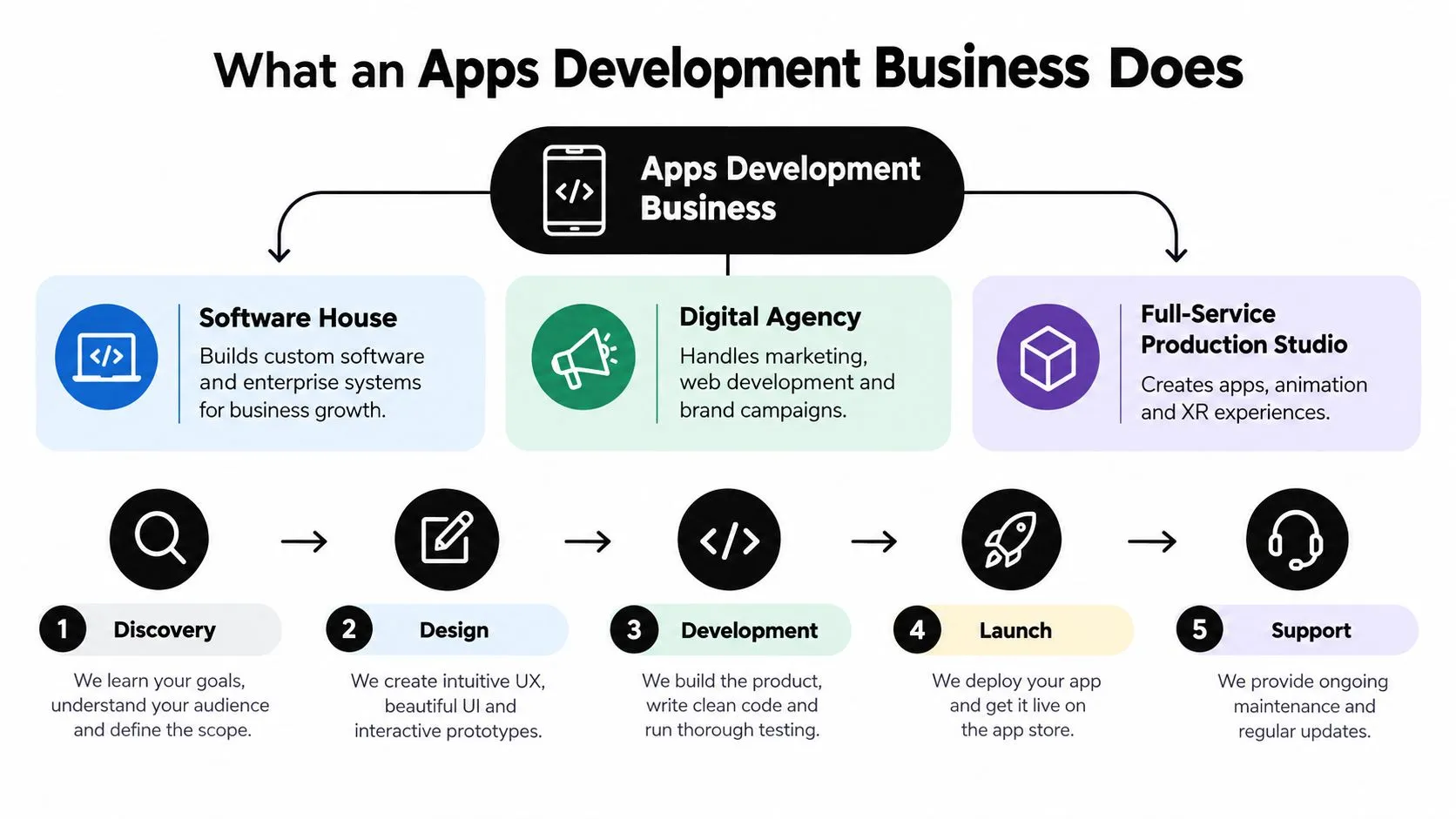
From discovery to support
A typical project moves through connected stages:
- •Discovery: Agree the users, problem, requirements, risks and scope.
- •Design: Shape the user experience and interface, then test ideas through prototypes.
- •Development: Build the app and its integrations, with testing throughout rather than only at the end.
- •Launch: Prepare releases, deployment and any required store submissions.
- •Support: Fix issues, update dependencies and adapt the product as needs change.
Discovery is where a vague ambition becomes a set of decisions the team can estimate and deliver. For a useful overview of how product work develops from early thinking into execution, SigOS shares product intelligence insights on development. The commercial arrangement also shapes the project. In a product model, the studio creates and owns a product that it may sell to multiple customers. In client-owned service work, the client commissions a solution and the contract sets out intellectual-property rights. Custom commissioned work is often built for a specific organisation or audience, with ownership and licensing terms agreed before production begins. Don't assume that paying for development automatically answers who owns code, content, assets or reusable tools. Get the rights and handover terms in writing.
How Big the UK Apps Development Market Really Is
The UK has a substantial base of app-development businesses, but it isn't dominated by a handful of giant suppliers. A UK Government survey estimated approximately 13,340 app developers nationwide, with around 9,340 allocated to computer programming activities and approximately 4,000 to IT consultancy. The same analysis compares those estimates with the wider business counts in each category, indicating that app development is spread through the broader software and digital-services economy rather than confined to a narrow specialist niche. See the UK app developer survey and market guide for further context and the government's technical report for the survey methodology and classification analysis. The business mix has practical consequences for buyers. In the survey, 70% of developers were microbusinesses with fewer than 10 employees, while 27% were small businesses with 10 to 49 employees. Medium-sized and large firms accounted for only 3% and 1%, respectively. Those proportions point to a market where small, specialist teams are common, alongside larger contractors with broader delivery capacity. A small studio may offer direct access to senior practitioners, while a larger supplier may be better equipped for complex procurement or sustained parallel work. Neither size guarantees fit. Demand spans several kinds of work. The survey found that 38% of developers created apps for IT and communications, 26% for arts, entertainment and recreation, and 22% for administration and support services. That spread helps explain why capabilities vary: one supplier may focus on business systems, while another has experience with audience-facing or creative products. Industry analysis estimated the UK app-development sector at approximately £32.3 billion in 2026, following a compound annual growth rate of 10.9% from 2021 to 2026. It also estimated 15,282 businesses in the sector in 2026. These are estimates, not a guarantee of demand for any individual product. The market-size definition covers revenue from app-development activities, not the value of purchases made through apps. The same analysis cites Ofcom data showing smartphone ownership rose from 17% in 2008 to 88% in 2023, a shift that helped make apps part of everyday services and entertainment. The UK app-development industry outlook provides further detail on those market estimates.
Service Models You Can Hire
The supplier model affects who makes decisions, where specialist knowledge sits and what happens after launch. Before comparing proposals, decide whether you need a defined project delivered for you, a team to work alongside your staff, or a product capability your organisation will own and operate.
| Model | Typical team size | Cost band | Best fit |
|---|---|---|---|
| Full-service agency | Multi-disciplinary team | Mid to high | A coordinated brief spanning strategy, design, development and launch |
| Specialist product studio | Small to medium specialist team | Mid to high | A focused product that needs experienced design and engineering |
| Freelance developer or small team | Individual or compact team | Low to mid | A tightly scoped build with clear requirements and internal product ownership |
| In-house build | Internal team | Ongoing salary and operating costs | Long-term development where the organisation needs continuous control and capability |
A full-service agency can coordinate disciplines under one contract, which simplifies production but may mean you are paying for broader overhead or services you do not need. Ask who will do the work, not just who presented the pitch. A specialist product studio is often a strong match for a new app with uncertainty around user needs, interaction or technical approach. You get concentrated product expertise, but you'll still need to agree how knowledge and source materials transfer to your team. A freelancer or small team can be cost-effective for a clear, contained build. The trade-off is resilience. If the project needs research, interface design, backend engineering, testing and support, a single person may not cover each discipline to the same depth. With an in-house team, you retain day-to-day control and build internal knowledge. That can suit a product that will evolve continuously, but it requires leadership, recruitment and enough ongoing work to keep the team effective. Don't choose in-house merely to avoid agency fees if the capability and workload aren't there.
Engagement and Pricing Models That Actually Work
Choose a commercial structure that reflects how much of the work is understood. A short, well-defined project can suit fixed scope. An experimental product often needs room to learn and change. Ongoing support calls for a different arrangement again.

Match the contract to the uncertainty
- •Fixed scope: The supplier prices agreed deliverables, assumptions and acceptance criteria. You get more budget predictability, but changes outside the agreement need a change request and can affect cost or timing. It works best when discovery has resolved the important unknowns.
- •Time and materials: You pay for the work done, usually against agreed roles and rates. This gives the team flexibility to respond to testing and new information, but you need active prioritisation and regular budget reviews.
- •Retainer: You reserve a defined amount of capacity for ongoing development or support. This suits products that need regular attention, but agree how work is prioritised and whether unused capacity carries over.
There isn't one reliable UK rate card for every senior engineer, designer or producer. Rates vary by experience, location, specialism and whether you're engaging an individual or a studio, so treat unsupported headline figures with caution. Ask for role-based estimates, day rates where relevant, assumptions, and a forecast tied to specific deliverables. A useful comparison point for how app pricing is framed in another market is this guide to app build pricing in New Zealand. For UK-specific scoping questions, see Studio Liddell's app development cost and pricing guide. “A simple app” often turns out to include accounts, content management, analytics, accessibility, integrations, security, testing and post-launch support. Ask what's excluded as carefully as what's included. A credible estimate should distinguish what the team knows, what it assumes and what discovery still needs to confirm.
Technical Capabilities a Modern App Studio Should Cover
A mobile app isn't only a choice between iOS and Android. The right architecture depends on the audience, the experience and the work the product must do behind the screen.
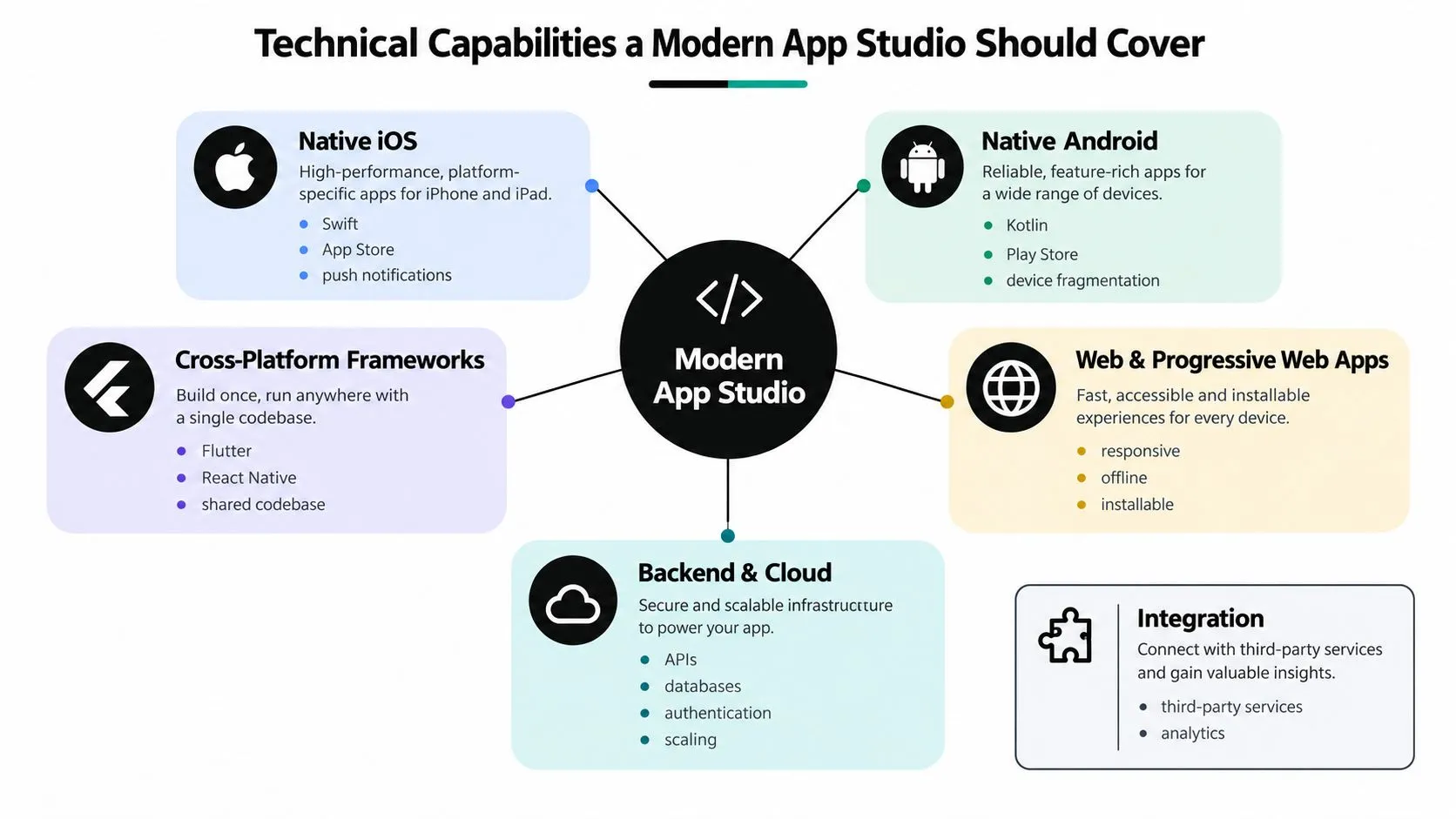
Choose platforms around use, not habit
Native iOS and Android development can make sense when the product needs platform-specific behaviour, close integration with device features or careful control over performance. A cross-platform framework such as Flutter or React Native can share parts of the codebase across platforms, which may simplify delivery and maintenance. That trade-off depends on the app's requirements and the team's ability to work with the chosen framework. A web app or progressive web app may be more appropriate when users need broad access without installing from an app store, or when the core experience is content-led. The backend matters just as much. Apps that handle accounts, saved progress or live information may need APIs, databases, authentication and a plan for data protection. Third-party integrations can add value, but each one brings a dependency to document, test and maintain. The most useful capability depends on the brief:
- •A learning app may need accessible interaction, progress tracking and reliable behaviour when connectivity is poor.
- •A location-based VR experience needs a real-time engine such as Unity or Unreal, along with practical testing in the venue where it will run.
- •An explainer app may need animation and motion graphics designed as part of the interface, not attached as an afterthought.
AI-assisted features need a clear reason to exist. UK adoption among businesses with 10 or more employees rose from around 12% in late 2023 to around 35% in 2026, while the average adopting business used about 1.6 AI technologies, according to the government's AI adoption plan for digital and technologies. Those figures describe business adoption, not the expected value of adding AI to a particular app. Decide what user problem justifies it, what data it needs, where human review belongs and how you'll judge its performance. For fixed rules or high-stakes decisions, deterministic software may be safer and easier to explain.
Why Studios That Combine Apps With Animation and XR Stand Out
A multi-discipline team can make a meaningful difference when an app's appeal depends on more than utility. Consider a children's brand extending its characters into a mobile companion experience. The team needs to protect the visual identity, make interactions suitable for the audience and build a product that feels responsive. If animation and software are commissioned separately, someone must still join up the asset pipeline, interface behaviour and technical delivery. A mixed-reality event game has a different set of constraints. Designers and artists shape the play experience, engineers build for the selected devices, and producers plan how the experience will be operated in a live setting. A training simulation needs its own blend: subject-matter experts shape the scenarios, designers make instructions understandable, and developers build interactions and assessment into the experience.
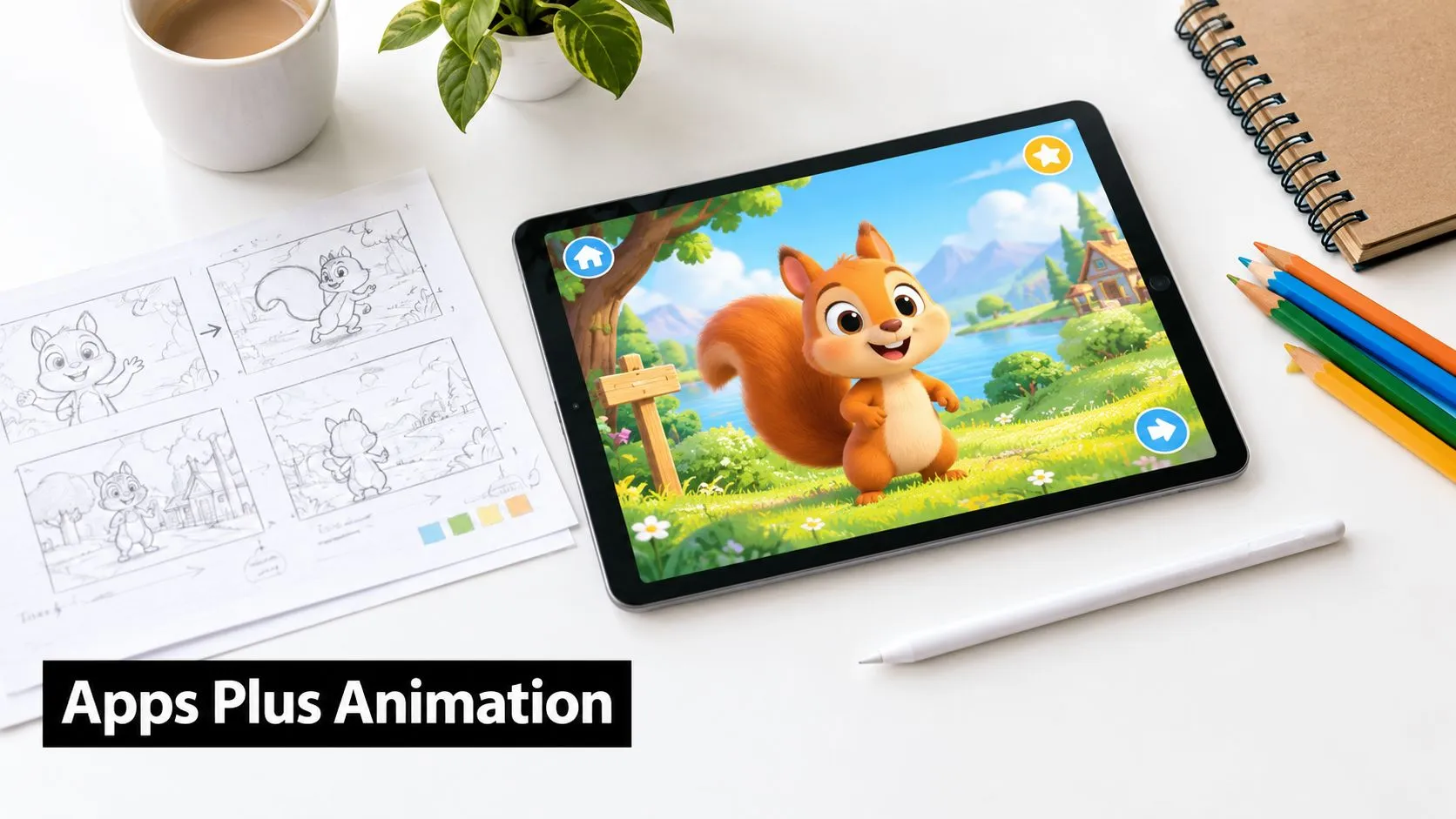
One roadmap, connected disciplines
The production advantage is coordination, not a promise that a combined studio will always cost less. A joined-up team can plan assets and engineering against one roadmap, reducing the risk of discovering late that the intended animation format is too heavy for the target device or that the interaction design conflicts with the story. But an integrated team may have a higher initial scope than a developer-only build because the brief includes creative production and specialist testing. Studio Liddell works across apps, games, animation and XR, including mobile development for iOS and Android. Its XR development guide outlines considerations for immersive projects. When comparing studios, ask how their creative and engineering teams hand work between disciplines, what assets they'll deliver, and who owns the integration decisions.
Choosing the Right Studio Without Getting Burned
A strong proposal should help you make decisions, not bury them in confident language. Ask prospective studios who will lead discovery, how they test prototypes with users, what intellectual property you'll own, and how they handle quality assurance. Request relevant examples and speak to references where possible. Find out what happens after launch, including support arrangements, documentation and access to source materials. Watch for red flags: a fixed quote that arrives before anyone understands the requirements, a portfolio that shows attractive screens but not working products, unclear ownership terms, or no defined handover. A supplier that can explain its assumptions and exclusions is more useful than one that promises everything without discussing risk. Accessibility belongs in acceptance criteria from the start. UK government monitoring identified 29,787 accessibility issues across public-sector websites and mobile apps. Organisations fixed 55.3% of recorded issues, and 68% had either fixed issues or established short-term plans after reports. The government's accessibility monitoring report shows why teams need a process for identifying and tracking defects. For an app, ask how the team checks screen-reader semantics, keyboard or switch navigation where relevant, colour contrast, text scaling, captions and touch targets, and whether manual testing complements automated checks. Procurement and internal delivery also depend on clear coordination. If you're comparing tools for organising project work, UI Lib's agency software roundup can help you think through the operational side. Before signing, confirm the project owner, approval process, release responsibilities and support route. Then commission discovery with specific outputs, so the build estimate follows an agreed understanding of the product rather than a guess. --- Studio Liddell brings app development together with animation, games and XR production, from early scoping and UX through build, launch and support. If your product needs interactive media as well as software engineering, visit Studio Liddell to discuss the audience, platform choices and a practical first scope.