Animation vs Animator: Key Differences
You need an animated piece. The launch date is fixed, stakeholders are already asking for drafts, and the internal brief still says “find an animator”. That wording sounds minor, but it changes the purchase. Are you hiring one specialist to do a defined part of the work, or are you buying a finished production with planning, approvals, delivery formats, and responsibility attached? In practice, that's what animation vs animator really means. A lot of teams blur the two. Marketing wants a product video. HR wants onboarding content. A brand team wants title cards, social cut-downs, and a polished master file. Then procurement compares a freelance day rate with a studio proposal as if they're interchangeable. They usually aren't. One is like hiring a skilled chef. The other is booking the whole catered event. Both can produce excellent work. The wrong choice usually fails not because of talent, but because the production model didn't match the job.
The Core Question Are You Buying a Skill or an Outcome
If your brief is tight, your assets already exist, and one person can realistically carry the work, hiring an animator can be the smart move. You get direct communication, craft focus, and fewer layers between idea and execution. If your project needs scripting, design development, storyboards, asset creation, animation, sound, revisions, multiple outputs, and delivery management, you're no longer buying a single skill. You're buying an outcome. That distinction matters because budgets rarely break on animation alone. They break on coordination. Missed approvals. Unclear ownership. Extra deliverables added late. A timeline that assumed one pass and turned into five.
Practical rule: If success depends on several disciplines working in sequence, treat it as production, not just staffing.
In commercial work, a finished animation is a business asset. It may need to sell a product, explain a service, support a funding pitch, reassure parents, train staff, or hold up across paid media, web, events, and social. That means someone has to manage more than movement on screen. Here's the simplest way to frame it:
| What you need | You are likely buying | Typical fit |
|---|---|---|
| A defined animation task inside an existing pipeline | A skill | Freelance animator |
| A finished piece with managed delivery | An outcome | Animation studio |
| Specialist support for a larger in-house team | A skill | Freelance specialist or contractor |
| Multi-format content with approvals and technical delivery | An outcome | Studio or managed production partner |
The mistake clients make is buying a skill while expecting an outcome. That's when the freelancer gets asked to become producer, strategist, editor, sound lead, and account manager. It's also when a studio can look expensive on paper but cheaper in reality, because it reduces risk that would otherwise sit with your team.
Understanding the Deliverable 'Animation'
An animation isn't just moving graphics. In a business context, it's a packaged deliverable with a clear purpose, production process, review cycle, and handover standard. That matters because clients often ask for “a 60-second animation” as if duration defines the job. It doesn't. The core job is the chain of decisions behind that minute of screen time.
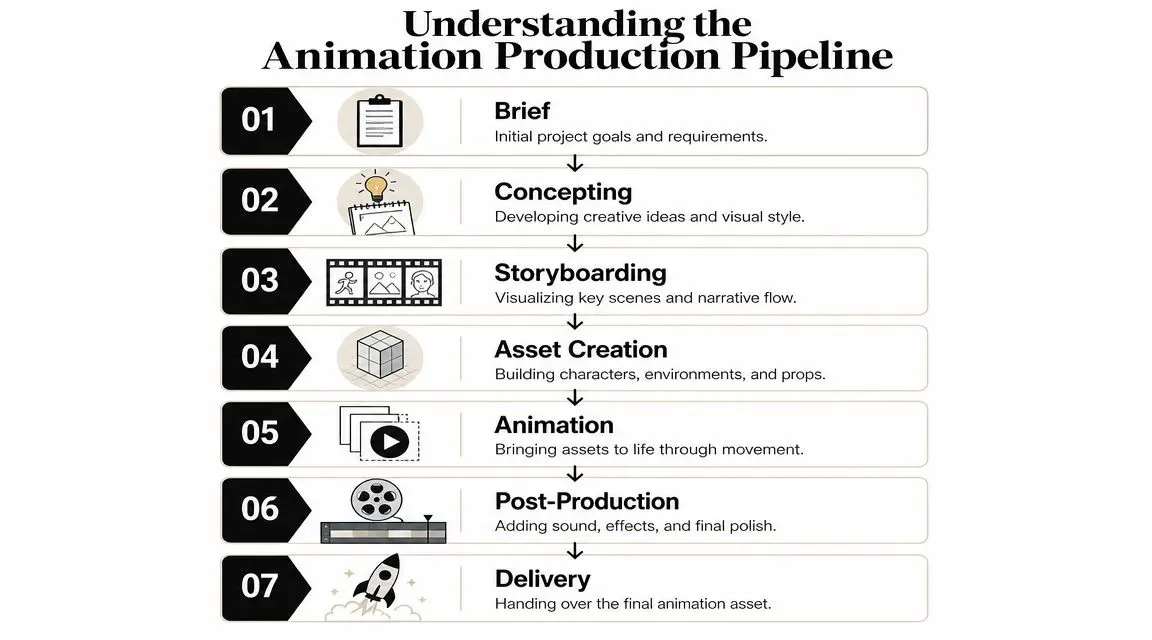
The seven stages clients should expect
Most professional projects move through a version of this pipeline:
- Brief
You define the objective, audience, message, platforms, brand constraints, and success criteria. If this stage is weak, every later stage becomes slower and more expensive.
- Concepting
The team tests visual directions, narrative approaches, and tone. Here, “playful”, “premium”, or “technical but approachable” gets translated into something visible.
- Storyboarding
The project becomes sequential. You can now judge pacing, clarity, structure, and whether the script works on screen.
- Asset creation
Characters, environments, product models, icons, rigs, textures, and graphic elements are built. In 3D work, this can include modelling, surfacing, lighting plans, and scene setup. In 2D, it often means illustration systems and motion-ready artwork.
- Animation
Performance, timing, transitions, camera moves, and motion behaviour are produced. This is the stage people usually imagine first, but it relies on all the decisions before it.
- Post-production
Editing, compositing, colour work, sound design, music, voice sync, and final polish happen here. A strong post pass often makes the difference between “it moves” and “it feels finished”.
- Delivery
The final package is exported to agreed specs. That might mean a master file, cut-downs, captions, social ratios, transparent versions, or clean and texted variants.
What the client is really commissioning
When buyers say they need animation, they usually mean one of a few deliverable types:
- •2D explainers for products, services, education, and internal comms
- •3D product visualisation for launches, demos, and technical storytelling
- •Motion graphics for branding, title sequences, events, and digital campaigns
- •Character-led shorts for children's content, digital series, and platform-native storytelling
- •Looping social assets for paid media, websites, and always-on brand content
Each one has a different production load. A slick logo sting might need strong design and precise timing. A technical 3D explainer needs script discipline, modelling, animation, rendering, and often stakeholder review from people who care about accuracy as much as aesthetics.
Clients shouldn't ask only “how long is the animation?” They should ask “what has to be designed, built, approved, and delivered for this to work?”
For teams publishing online, the final use case also matters. A homepage hero loop isn't built the same way as a trade show film or a social-first cut-down set. If your web team is reviewing implementation options, this overview of top animation plugins for WordPress is useful context because it shows how motion assets behave in real publishing environments, not just in the edit suite. A managed animation service wraps all of that into one accountable process. That's the key difference from hiring one animator alone.
Understanding the Professional 'Animator'
An animator is a person, not a full pipeline. That sounds obvious, but buyers miss it all the time. A talented animator may be brilliant at character performance, motion graphics, creature work, previz, or CG polish. That doesn't mean they also storyboard, write scripts, cast voiceovers, handle sound design, and run approvals. Sometimes they do some of those things. Usually, they shouldn't be expected to do all of them.
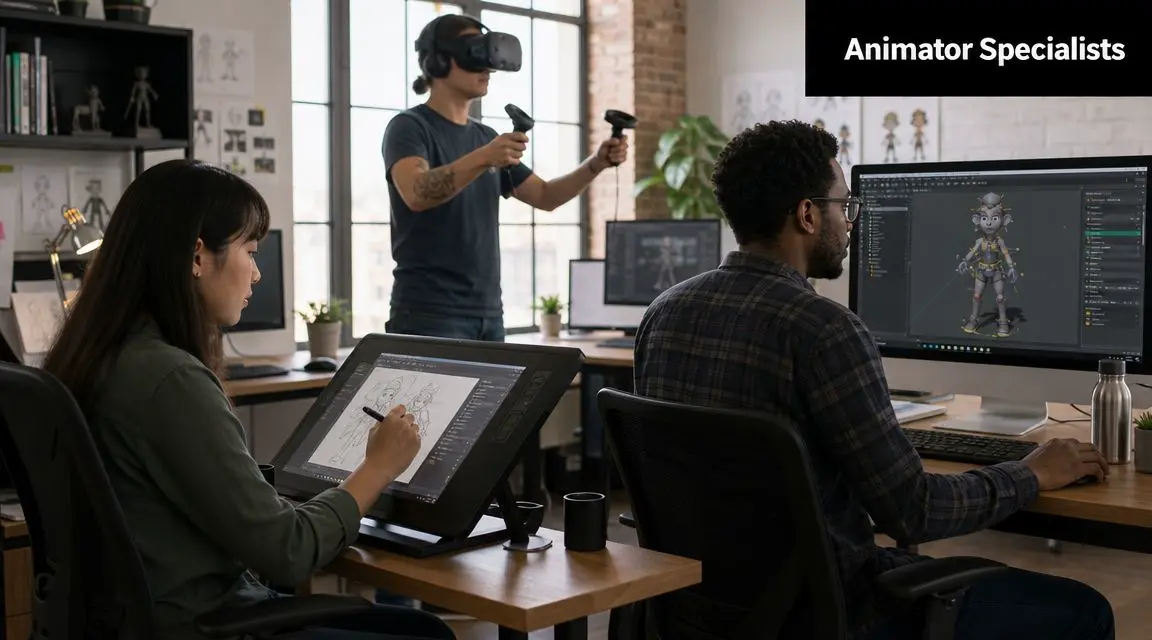
Animator is a category, not a single job
When a client says “we need an animator”, they could mean very different roles:
- •Character animator for acting, body mechanics, and facial performance
- •Motion graphics artist for typography, brand motion, title cards, and explainers
- •Rigger for building controls that let characters or products move correctly
- •3D generalist for a mix of modelling, lighting, animation, rendering, and compositing
- •Layout or previz artist for camera planning and scene blocking
- •Compositor for final image assembly, effects, and finishing
If you hire the wrong profile, the project won't fail because they lack talent. It will fail because the brief asked for a different discipline.
Seniority changes more than polish
A junior animator can execute well-scoped tasks inside a supervised pipeline. A mid-level animator usually brings stronger problem-solving and more consistency. A senior or lead often does two extra things that clients underestimate. They protect time, and they spot risk early. That's why seniority affects more than visual quality. It changes revision efficiency, communication quality, and how much handholding the project needs from your side. For businesses building internal understanding of roles and tools, this roundup of animation software for beginners is a practical starting point because it shows how different software choices often map to different kinds of animation work.
Why creator-led work became so visible
The independent creator model matters here because it changed how buyers think about animation. Alan Becker's Animator vs. Animation first premiered on 3 June 2006 and is widely described as a dialogue-light web animation centred on a stick figure trying to escape the animation program that created it, as outlined on the Animator vs. Animation reference page. In the UK, that arrived during a major shift in online viewing conditions. Ofcom reports that UK household internet access was 86% in 2006 and reached 97% by 2024, creating the environment in which creator-led, platform-native animation could move from niche viewing to mainstream online consumption. That change matters for commissioners. It normalised the idea that one creator could build audience attention without the old broadcast gatekeepers. It also made the animator more culturally visible as an author, not just a technician.
A freelance animator can absolutely be the right commercial choice. Just don't mistake authorship for full-service production capacity.
If you're mentoring younger talent or building family-friendly learning resources, Kubrio's complete guide for young animators is a useful example of how the craft is introduced early, long before specialisation becomes obvious to buyers.
Freelancer vs Studio A Strategic Decision Framework
The cleanest way to assess animation vs animator is to stop treating it as a creative preference and treat it as an operating model decision. A freelancer gives you focused capability. A studio gives you coordinated capability. Which one fits depends on how much complexity, risk, and change the project can absorb.
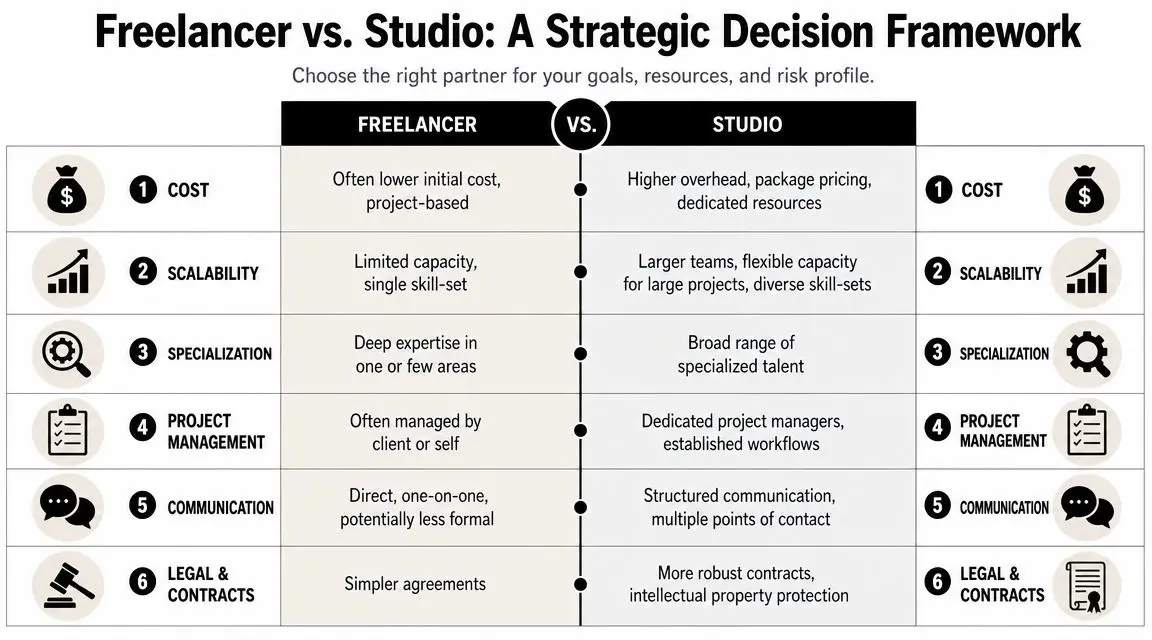
Decision matrix
| Factor | Best for Hiring a Freelance Animator | Best for Commissioning a Studio |
|---|---|---|
| Scope | One defined task or a narrow production slice | Multi-stage production with several deliverables |
| Complexity | Low to moderate, with limited dependencies | Moderate to high, with several specialist inputs |
| Budget structure | Tight upfront spend, simpler purchasing | Broader budget with management, production, and finishing included |
| Timeline | Flexible timeline with fewer approval layers | Fixed deadlines, overlapping workstreams, parallel production |
| Management overhead | Client can manage reviews, files, and feedback directly | Client needs a managed process and clear accountability |
| Creative development | Style is already clear | Concept, visual development, and production planning still need shaping |
| Risk | Lower if the brief is stable and contained | Lower if the brief may evolve or involve multiple stakeholders |
| Reuse and versioning | Limited output set | Campaign systems, localisation, cut-downs, and cross-platform packs |
Scope and complexity
A freelancer suits work with a tight perimeter. Think logo stings, short social loops, a character pass on an existing rig, or motion graphics added to an already edited film. A studio fits projects where dependencies stack up. Script changes affect boards. Boards affect asset creation. Asset changes affect animation and comp. Once several moving parts depend on each other, someone needs to orchestrate the sequence. Often, buyers under-scope. They start with “a short animation” and discover they also need product modelling, a voiceover script, subtitles, event-screen versions, and stakeholder review across marketing, legal, and sales.
Budget and cost structure
Freelancers often look cheaper because the line item is narrower. Sometimes that's correct. Sometimes the hidden cost lands on your team. If your producer, marketer, or founder has to manage references, script changes, file routing, music licensing questions, and final exports, the business is still paying. It's just paying in internal time rather than supplier fees. A studio proposal usually prices more of the production reality up front. That can feel heavier, but it may be more accurate if the project needs multiple disciplines. You're not only paying for labour. You're paying for the joins between labour.
Cheap production is often expensive management in disguise.
Timeline and capacity
A single animator can move very quickly on a clean brief. That's one of the biggest advantages of freelance talent. Fewer handoffs means less drag. But one person still has one bandwidth ceiling. Illness, conflicting bookings, render issues, and revision spikes all hit the same point of failure. A studio can usually spread work across design, animation, comp, edit, and production roles, which is why the model tends to cope better with hard deadlines and multi-format output. UK production realities make this practical rather than theoretical. In the current market, commissioning pressure and cross-platform content needs have become standard. BFI research highlights that UK animation studios work in hybrid pipelines across film, TV, games, and ads, and that model is often more resilient for iterative multi-platform delivery under tight deadlines, as noted in this UK animation sector discussion.
Risk and management overhead
When you hire a freelancer, you manage more directly. That can be a benefit. Feedback loops are short. Decisions are immediate. There's less process theatre. It becomes a problem when the client doesn't have the time or production discipline to manage the work. Then the project starts drifting. Versions become confusing. Approvals get delayed. Scope expands through emails instead of a controlled process. Studios reduce that operational load by formalising it. Briefing documents, review rounds, milestone sign-off, file standards, and delivery specs aren't glamorous, but they protect schedule and quality. If you're weighing supplier options more broadly, this buyer's guide to choosing an animation studio is useful because it frames due diligence in procurement terms, not only creative terms.
Creative strategy and ownership
Freelancers are often strongest when the vision is already set. You know the style. The message is approved. The assets exist. You need execution. Studios are often stronger when the brief is still forming. They can challenge weak messaging, identify missing deliverables, and shape a production plan that protects the idea from collapsing under revisions. For example, Studio Liddell operates as a full-service production company across animation and immersive work. In a buying context, that matters not as a badge line but because a managed supplier can combine concepting, production, and delivery when the project includes more than pure animation labour.
A fast way to choose
Use a freelancer when most of these are true:
- •The brief is fixed and unlikely to change.
- •You need one core skill rather than a full team.
- •Internal stakeholders are limited and approvals are simple.
- •Your team can manage production without it becoming a burden.
Use a studio when most of these are true:
- •The project has several stages with dependencies between them.
- •You need multiple outputs for web, social, events, or campaign reuse.
- •Deadlines are hard and slippage has business consequences.
- •More than one department will review and change requests are likely.
The right choice isn't ideological. It's operational.
Your Pre-Production Checklist Scoping for Success
Before you compare quotes, define the job properly. Most animation procurement problems begin before any supplier is contacted. A vague brief forces everyone to guess. Freelancers pad for uncertainty or underquote and struggle later. Studios build in contingency that may look excessive until the project starts changing shape. Clear scoping protects both sides.
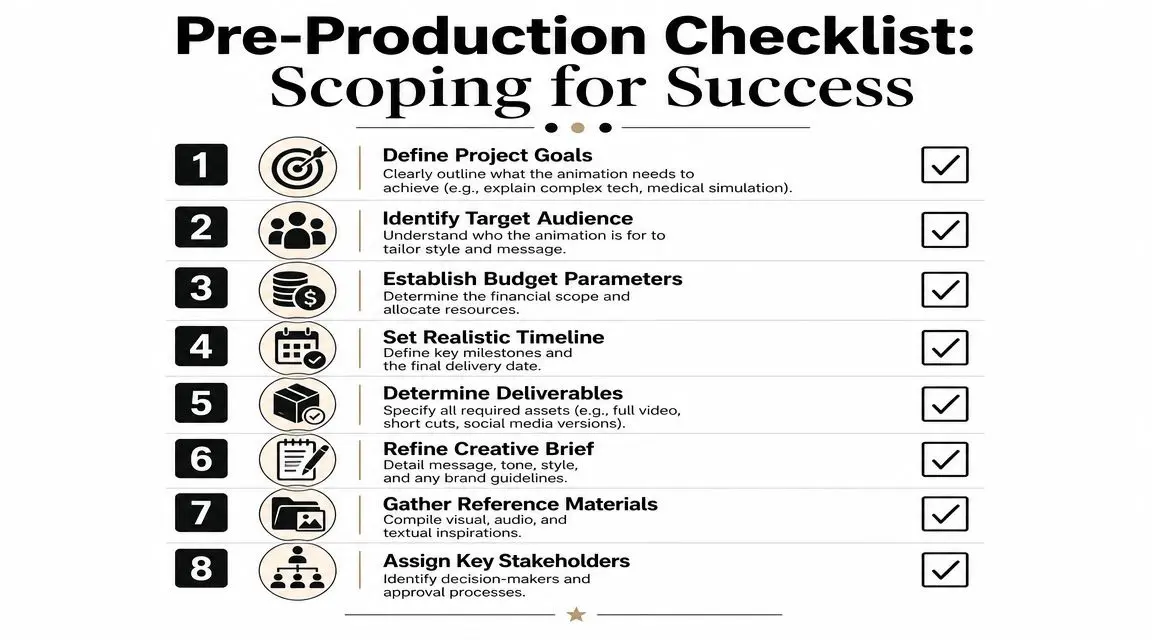
The questions that save time later
Work through these before you brief anyone:
- •What is the job of the animation
Is it selling, explaining, training, pitching, launching, or retaining attention on a landing page? “Raise awareness” is too vague to guide production.
- •Who is it for
A parent, buyer, investor, teacher, engineer, or internal team member will each need different pacing, language, and visual treatment.
- •What has to be delivered
One master video, social cut-downs, square and vertical versions, captioned exports, stills, editable project files, or clean versions for localisation all change the scope.
- •What assets already exist
Brand guidelines, scripts, product CAD, logos, voiceover talent, character designs, or previous campaigns can shorten production. If nothing exists, that needs pricing in.
The commercial questions buyers often avoid
These are less glamorous, but they decide whether the project runs smoothly:
- Who approves each stage
One approver is fast. A committee is slower. Name the decision-maker early.
- What is the actual deadline
The public launch date isn't the production deadline. You need time for platform checks, sign-off, and upload.
- What level of revision is realistic
Endless polish requests usually mean the brief was unresolved at the start.
- What rights and future use matter
If you may need future edits, multilingual versions, or reuse across campaigns, raise that before production starts.
A good brief doesn't restrict creativity. It removes avoidable confusion.
If you need a practical reference for commissioning discussions in a UK context, this guide to commissioning animation work in London is a useful checklist companion because it reflects the commercial questions clients usually face once real suppliers are involved.
Seeing the Difference Real-World Project Examples
The decision becomes easier when you look at project shape instead of job titles.
Example one when a freelancer is the right fit
A consumer brand needs a short animated logo sting and a set of looping social icons for an upcoming campaign. The brand pack already exists. The visual style is approved. There's no script, no voiceover, no character design, and no need for multiple approval stages. This is good freelance territory. The business needs precise motion, good taste, and clean exports. One motion graphics specialist can usually handle the work efficiently because the creative unknowns are limited. The client can review directly, request timing tweaks, and sign off without a heavy production structure. What works here is focus. What doesn't work is overbuilding the process.
Example two when a studio is the safer choice
A B2B company needs a technical explainer for a new product. The audience includes buyers and non-technical stakeholders. The team wants a polished master film, shorter edits for sales outreach, event-screen versions, and on-brand stills pulled from the animation. Now the work expands quickly. The script has to simplify complex information without becoming vague. Storyboards need to align with product accuracy. 3D assets may need to be built or adapted. Voiceover, music, sound, edits, captions, and versioning all need coordination. This is studio work because the risk sits between disciplines, not inside one discipline. If the product team rewrites a key section late, production has to absorb that change without the whole schedule collapsing.The more your project looks like a chain of approvals and dependencies, the less sensible it is to treat it as a one-person purchase.
The pattern behind both examples
Neither route is better in all cases. The match matters. A freelancer wins when the brief is clean and the production burden is light. A studio wins when complexity, change, and delivery obligations are part of the job. That's the practical answer to animation vs animator. Don't buy based on labels. Buy based on failure points.
Frequently Asked Questions for Hiring Animation
How does AI affect the animator versus studio decision
AI changes where labour sits. It doesn't remove the need for judgement. In UK creative industries, the more useful view is that AI is likely to commoditise routine tasks while increasing the value of creative direction, pipeline integration, and IP control, as discussed in this UK creative workflow analysis. For buyers, that means AI may help with speed in some parts of production, but it doesn't solve authorship, approvals, brand safety, or delivery management.
What should I look for in a freelance contract versus a studio statement of work
With a freelancer, check scope boundaries, revision limits, delivery formats, timeline assumptions, payment terms, and IP transfer. Keep it simple, but specific. With a studio, expect more structure. The document should define milestones, review rounds, responsibilities, exclusions, final deliverables, and who owns what at handover. More paperwork isn't bad. It usually means less ambiguity later.
How much should I care about software choices
Care about software only when it affects compatibility, handover, or pipeline risk. If your team needs editable After Effects files, that matters. If your product pipeline depends on 3D interchange, that matters too. But buyers often over-focus on whether someone uses Blender, Maya, Cinema 4D, or After Effects. What matters more is whether the supplier can deliver the result, versioning, and file package you need.
Is it ever sensible to start with a freelancer and move to a studio later
Yes, if the early task is exploratory. Styleframes, test loops, or concept animation can be a good freelance assignment. It becomes inefficient when you expect that early freelance work to scale directly into a larger campaign without rebuilding process, files, or rights arrangements. Prototype thinking is fine. Accidental pipeline design usually isn't.
If you're deciding between hiring a freelance specialist and commissioning a managed production, Studio Liddell is one option to consider for projects that need end-to-end animation, multi-platform delivery, or a broader production pipeline around the final asset.