A Guide to Commissioning Animation Work in London
When you're on the hunt for world-class animation, all roads eventually lead to London. For years, global brands and sharp creative agencies have known that the city is more than just a location; it's a creative powerhouse, packing a unique punch of artistry, technical skill, and commercial know-how that gives any project an undeniable edge.
Why London Is a Global Animation Powerhouse
You can think of London as the 'Silicon Valley' of animation. It’s the place where groundbreaking studios, the best artistic talent, and serious business opportunities all come together. This has created a thriving ecosystem that constantly redefines what's possible in digital content, whether it's for a blockbuster film or a complex immersive experience. For businesses looking to commission animation work in London, this means you get access to a level of quality and innovation that’s tough to match anywhere else. And this isn't just a hunch; the numbers back it up. London is Europe’s undisputed leader in animation and VFX, with a workforce of 10,564 professionals as of early 2025. That's more than double the talent pool of Paris and puts the city third in the world, right behind Mumbai and Los Angeles. This magnetic pull is fuelled by world-class studios and being right on the doorstep of major broadcasters like the BBC and Sky.
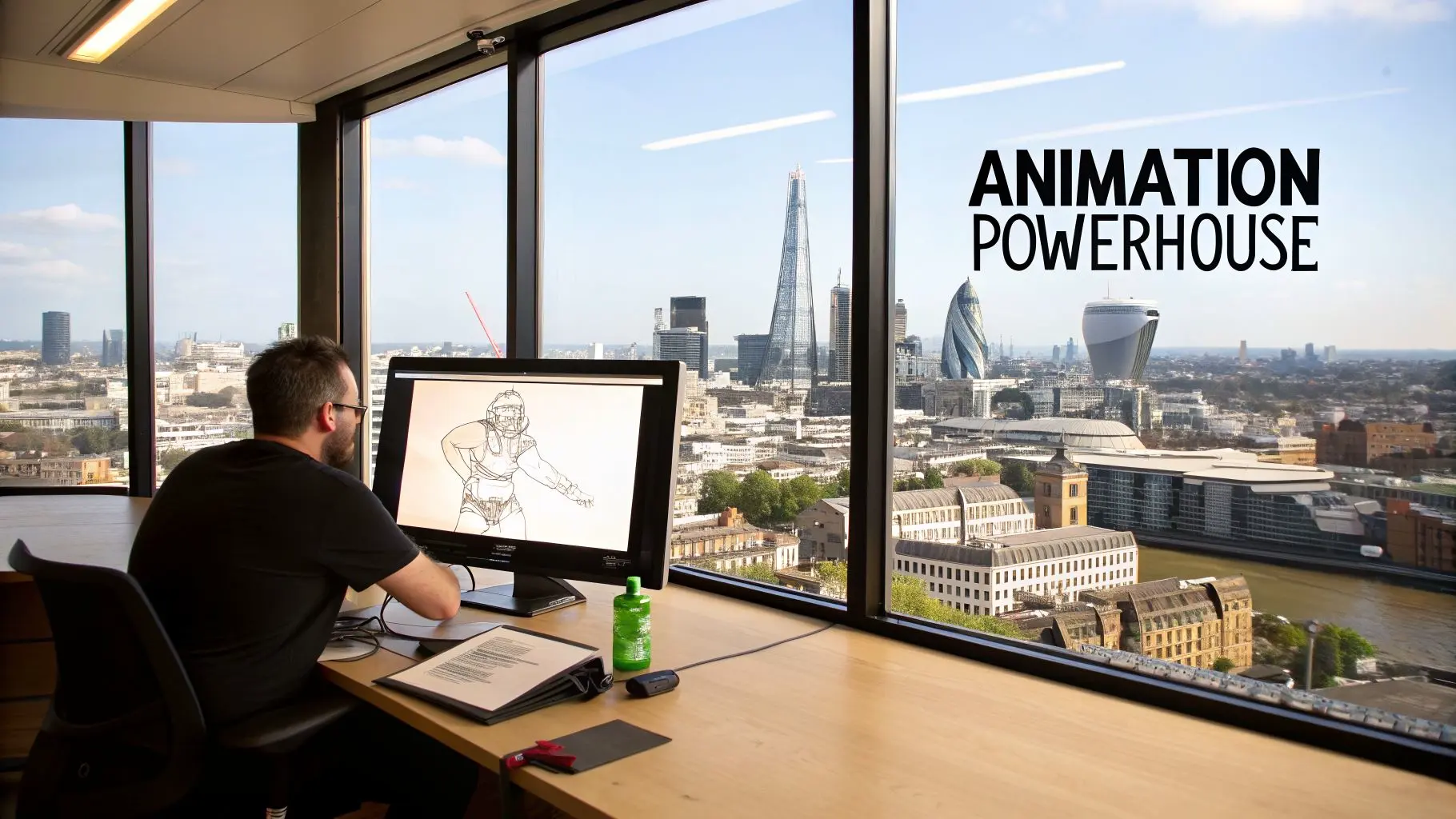
To put it simply, choosing London gives your project a serious head start. Here’s a quick look at why.
Why Commission Your Animation Project in London
| Advantage | Impact for Your Project |
|---|---|
| Elite Talent Pool | Access to a deep bench of specialised artists, directors, and technicians for any project scope. |
| Creative Innovation | An environment of healthy competition and collaboration that pushes creative boundaries. |
| Strategic Proximity | Closer partnerships with major broadcasters, ad agencies, and media headquarters. |
| Proven Track Record | Years of industry leadership and a reputation for delivering reliable, world-class results. |
Ultimately, commissioning your work here plugs you directly into an ecosystem built for excellence.
A Hub of Creative and Commercial Excellence
So, what makes London's animation scene so strong? It's the sheer density of talent. The city isn't just home to animators; it has a complete network of specialists, from directors and riggers to concept artists and XR developers. This incredible depth means studios can build custom-fit teams for absolutely any project, whether it's a charming children's series or a hyper-realistic virtual reality simulation for technical training. This concentration of expertise creates an environment where everyone is constantly learning and pushing each other, which lifts the quality of work for everyone involved.
The meeting point of creative talent, top-tier technology, and commercial drive in London gives studios a unique advantage. It lets them deliver globally recognised quality while staying nimble and tuned in to what clients really need.
Strategic Location and Industry Clout
You can't overstate London's importance as a global media capital. The headquarters of major broadcasters and advertising agencies are often just a short trip from the city's top animation studios. This closeness makes collaboration smoother, communication clearer, and leads to a much deeper understanding of the commercial goals that drive ambitious projects. On top of that, studios that have been around for years are the bedrock of this ecosystem. They've not only produced iconic work but have also trained generations of talent, cementing the city's reputation for reliability and excellence. As you weigh your options, you might find our guide on the top 7 VFX companies in London to watch useful for spotting the key players shaping the industry today.
Decoding the Different Types of Animation Services
When you decide to commission animation work in London, you’re unlocking a massive chest of creative tools. But before you can jump in, it’s worth getting to grips with the different types of animation and what each style is really good for. Matching the right service to your business goal is the first step. It's what makes sure your message hits home, whether you're explaining a tricky product or building a whole new world. Think of all the animation services available as a creative toolkit. Some tools are perfect for quick, sharp communication. Others are built for crafting deep, emotional connections. The real skill is knowing which one to pick for the job you have in mind.
2D and Motion Graphics for Clear Communication
At its heart, 2D animation is all about bringing flat images to life. This is the classic style we all know, from hand-drawn characters to slick vector graphics, and it's incredibly versatile. It’s a brilliant choice for explainer videos, where the main goal is to simplify a complex service or process. The clean, friendly nature of 2D helps people absorb information quickly without getting lost in pointless detail. Motion graphics is a specific type of 2D animation that focuses on giving life to text, logos, and other graphic elements. You see this style everywhere in corporate videos, social media content, and brand messaging.
- •Logo Stings: A short, dynamic animation of your company logo.
- •Explainer Videos: Breaking down complicated ideas into visuals that are easy to get.
- •Social Media Cut-downs: Creating snappy, eye-catching clips made for platforms like Instagram and LinkedIn.
Because it's so direct, motion graphics is one of the most powerful ways to get your brand identity and core messages across in a sharp, modern fashion.
3D CGI for Depth and Realism
When your project needs a serious dose of realism, depth, and a 'wow' factor, 3D Computer-Generated Imagery (CGI) is what you’re looking for. This is the same technology that powers blockbuster visual effects and high-end TV adverts. By creating models and environments in a three-dimensional digital space, animators can hit a level of detail and immersion that 2D just can't touch. 3D animation is the perfect fit for:
- •Product Visualisations: Showing off a product from every conceivable angle, even before a physical prototype exists.
- •Architectural Fly-throughs: Bringing proposed buildings and spaces to life for investors and stakeholders.
- •High-End Commercials: Creating visually stunning ads that stop people from scrolling.
- •Character Animation: Developing believable, lifelike characters for a series, film, or game.
The process is definitely more complex, calling for specialist skills in modelling, texturing, rigging, and lighting. But the payoff is a premium, cinematic quality that can really elevate your brand.
Animation allows metaphor itself to become visible because of the higher suspension of audience disbelief inherent to the medium. This makes it a powerful tool for showing a character's inner state or simplifying a complex idea without lengthy explanation.
Immersive Experiences with AR and VR
Looking beyond the traditional screen, Augmented Reality (AR) and Virtual Reality (VR) are pushing the very limits of animation work. These immersive technologies literally place your audience inside the experience, opening up incredible opportunities for engagement, training, and marketing.
- •VR Training Simulations: You can safely train employees on complex or even hazardous tasks in a controlled virtual environment.
- •AR for Exhibitions: Increase the time visitors spend at your stand by overlaying digital information onto physical products.
- •Immersive Storytelling: Craft unforgettable narratives where the user is actually part of the story, not just a passive observer.
Developing for XR (that's the umbrella term for AR and VR) requires a deep understanding of game engines like Unity and Unreal. It also demands a user-first design approach to make sure the experience is both powerful and easy to use. For businesses that really want to stand out, investing in AR or VR can create a brand interaction that people will be talking about for a long time. As you think about what’s right for you, our full guide to animation services for modern businesses is a great next step. And while we’ve covered the core human-led services, the world of animation is always growing, with new tools like an AI Short Video Generator emerging to help create content quickly for different platforms.
Navigating the Animation Production Pipeline
Kicking off an animation project might seem like a huge undertaking, but the production process is actually a very logical, step-by-step journey. Think of commissioning animation work in London as being like ordering a bespoke car. You begin with a detailed blueprint and end up with a polished vehicle, ready to drive. Every stage serves a clear purpose and, crucially, gives you a chance to give feedback, making sure the final product is exactly what you had in mind. It’s this methodical workflow that allows London’s top studios to handle everything from a quick social media video to a full-blown TV series. The UK’s animation workforce is bigger than ever, with over 12,000 individuals employed in the sector in 2022. This impressive talent pool, where the median salary is around £40,000, provides the specialised skills needed for every single step of production.
Stage 1: Brief and Storyboard
The whole process starts with the creative brief , this is your project’s blueprint. This document spells out your goals, who you’re talking to, the core message, and the style you're going for. It is the single most important piece of the puzzle, as it informs every decision that comes next. Once the brief is nailed down, we get to work on storyboarding. This is where our artists create a sequence of drawings that visually map out the entire animation, scene by scene. It sets the pacing, camera angles, and the overall story before any real animation work starts. Your input here is absolutely essential to make sure the narrative is hitting all the right beats.
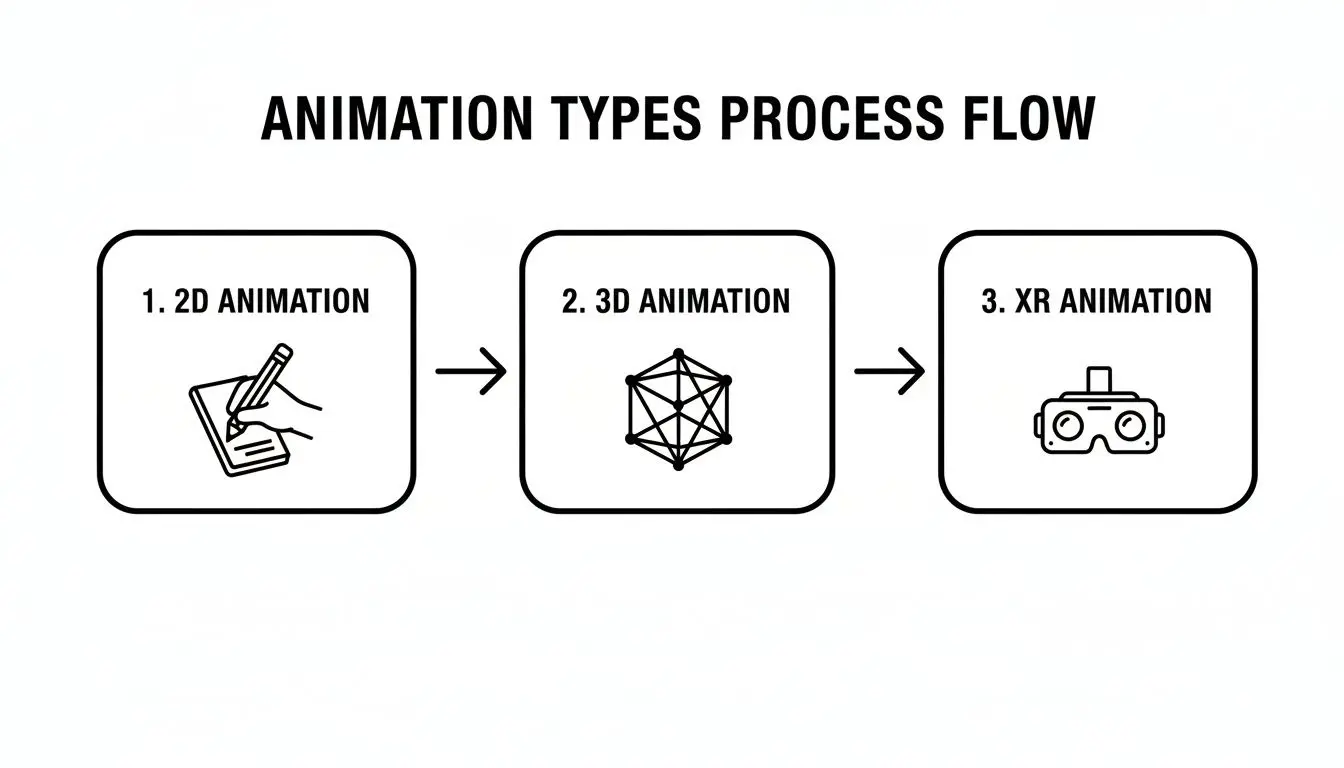
This diagram shows how different animation types have their own unique production paths. Whether you need the hand-drawn feel of 2D, the detailed models of 3D, or the interactive world of XR, each pipeline is custom-built for a specific creative vision.
Stage 2: Asset Creation and Animation
With the storyboard signed off, production moves on to building the core components. For 2D work, this means creating the character designs and backgrounds. In 3D, it’s a more technical process of asset creation (modelling characters and environments) and rigging, which is where we build a digital skeleton so the models can move. Then comes the animation itself. Following the storyboard, animators take the rigged assets and bring them to life, frame by frame. This stage demands a massive amount of skill and artistry, whether that’s creating smooth motion in 2D or crafting subtle performances in 3D. Knowing the different roles involved, like that of a highly skilled senior gameplay animator, helps you appreciate the depth of the entire production pipeline.
"A well-managed pipeline is the backbone of any successful animation project. It turns creative chaos into a predictable, collaborative process where client feedback at key milestones prevents costly revisions and ensures the vision remains on track from start to finish."
This structured approach is what makes it possible for studios to deliver complex projects on time and on budget, turning your initial concept into a living, breathing reality.
Stage 3: Lighting, Compositing, and Sound
The last stage is all about the finishing touches. Once the animation is locked, our artists add lighting and texturing to give the scenes depth, mood, and a sense of realism. This is the moment a 3D world starts to feel tangible and a 2D scene gets its unique atmosphere. This is followed by rendering, which is a computer-heavy process where the final images for each frame are exported. The very last step is compositing and sound design. Here, all the visual elements are layered together, effects are added, and the soundtrack, voice-overs, and sound effects are perfectly synced to the picture. This is where your animation truly becomes a complete, immersive experience, ready for the world to see.
How to Choose the Right London Animation Studio
Picking the right partner for your animation project goes way beyond finding a studio with a slick showreel. It's a strategic move that will directly shape your budget, timeline, and the quality of the final piece. To find the best fit for your animation work in London, you need to dig deeper than a quick Google search and do some proper homework. You're looking for a team that doesn't just get your creative vision but also has the technical chops and project management style to actually deliver it. Think of it like hiring a key business partner. You need to feel confident in their skills, have a crystal-clear understanding of how they work, and trust that they can take your project from a simple idea to a polished final product. The right studio acts as a guardian of your vision, navigating all the technical bits and pieces of production along the way.
Evaluate the Portfolio for Style and Substance
The portfolio is always your first stop, but you need to look at it with a discerning eye. Don’t just get dazzled by the flashy visuals; think about how their work connects to what _you_ need to achieve. A studio that’s a master of gritty, realistic 3D might not be the right choice for a cheerful 2D explainer video. As you look through their past projects, ask yourself these crucial questions:
- •Stylistic Fit: Does their work have a look and feel that clicks with your brand’s personality? Check for a consistent level of quality, even if they work in different styles.
- •Technical Skill: Do they show real expertise in the type of animation you need? If your project involves tricky character animation or an immersive VR world, look for specific examples that prove they can handle it.
- •Storytelling Power: Forget the visuals for a second. Can they tell a good story? A great animation needs to get its message across clearly and emotionally, keeping the viewer hooked from beginning to end.
A solid portfolio will show versatility, but it will also have a clear "sweet spot." Your job is to find the studio whose core strengths are a perfect match for your project's needs.
Assess Their Technical Pipeline and Project Management
Modern animation is built on a backbone of sophisticated technology and well-oiled workflows. How well a studio manages its technical pipeline is a huge clue to how efficient and capable they are. Today, that includes knowing their way around real-time engines like Unreal Engine and other advanced tools. Look for a studio that’s open and honest about its process. They should be able to walk you through their production stages, from the initial brief to final delivery, and tell you exactly where your feedback will be needed. This kind of structured approach is absolutely vital for keeping a project on schedule and on budget.
A studio’s project management style is just as important as its creative talent. Clear communication, regular updates, and a straightforward feedback process are the signs of a professional team that respects your time and investment.
This organised way of working is what prevents misunderstandings and expensive last-minute changes. A great partner will feel like an extension of your own team, proactively managing the project and keeping you in the loop at every important milestone.
Red Flags to Watch For
Knowing what to look for is only half the battle; you also need to know what to avoid. As you search for the right partner for your animation work in London, keep an eye out for these red flags that could signal problems down the road.
- •Mismatched Expertise: Be careful with studios that say they can do it all but only have a portfolio showing one type of work. A jack-of-all-trades can often be a master of none.
- •Poor Communication: If they take forever to reply to your first email or give you vague, unhelpful answers, that’s a pretty strong indicator of how they’ll communicate once they have your money.
- •Pushback on a Detailed Brief: A professional studio will be glad to get a detailed brief. If a potential partner seems keen to just start working without fully getting what you want, they're far more likely to miss the mark.
- •Unrealistic Promises: If a studio promises you a complex 3D animation on a tiny budget and an impossible deadline, be suspicious. Quality animation takes time, skill, and resources.
By carefully checking a studio's portfolio, technical skills, and communication style, while also watching for these red flags, you can confidently pick a partner who has the proven ability to deliver fantastic creative work and a smooth, professional production experience.
Understanding Animation Budgets and Timelines
So, let's talk about the big two: how much is this going to cost, and when will it be ready? When you're looking at commissioning animation work in London, the answer to both questions really comes down to a blend of creativity, complexity, and clear communication. A project's budget and timeline aren't just numbers plucked from thin air; they're a direct reflection of the skill and resources needed to bring your idea to life. Think of it like buying a house. Asking for the price of an animation is a bit like asking for the price of a house. A cosy one-bedroom flat carries a very different price tag and build time than a sprawling ten-bedroom mansion. Both are homes, but the scale, materials, and labour involved are worlds apart. It’s the same with animation. A quick 2D motion graphics piece for social media is a completely different beast to a 30-second, photorealistic 3D ad for a prime-time TV slot.
Key Factors That Influence Cost and Time
The main things that drive any animation budget are the style, the complexity, and the length. A 2D animation, which usually works with vector graphics and movement on a flat plane, is generally quicker and less intensive than full-on 3D CGI. Three-dimensional work just has more steps, like digital modelling, texturing, rigging (which is building a character’s digital skeleton), lighting, and then the complex rendering process. A few core elements will always shape your quote:
- •Style and Complexity: Are we talking simple 2D vectors or photorealistic 3D product shots? Does it need custom character designs with life-like performances, or is it more about slick motion graphics?
- •Duration: The runtime directly affects the workload. A 15-second social clip is a world away from a 3-minute explainer video or an entire interactive VR experience.
- •Number of Assets: How many unique characters, environments, and props need to be built from scratch? Every new asset adds to the production schedule.
- •Post-Production Needs: Things like visual effects (VFX), detailed sound design, and hiring professional voice-over artists all add to the final budget.
Indicative Budget Ranges for Common Projects
To give you a better sense of what to expect, it helps to look at some typical project scopes. Of course, every project is different, and a solid brief is the only way to get a firm quote. But these ranges are a realistic place to start your planning. For a deeper dive, check out our complete buyer's guide to choosing an animation studio.
| Project Type | Indicative Budget Range (GBP) | Indicative Timeline |
|---|---|---|
| Social Media Clip (15-30s) | £3,000 , £8,000 | 2 , 4 Weeks |
| 2D Explainer Video (60-90s) | £8,000 , £20,000+ | 6 , 10 Weeks |
| 3D Broadcast Commercial (30s) | £25,000 , £100,000+ | 12 , 20+ Weeks |
| Interactive VR/AR Experience | £30,000 , £150,000+ | 16 , 24+ Weeks |
These numbers really highlight why a detailed brief is so important. The clearer you are about your goals, audience, and creative ideas, the more accurately a studio can scope the project. That’s the best way to avoid scope creep and unexpected delays down the line.
The Value of UK Animation Tax Relief
When you're looking at costs, it’s also worth understanding the financial incentives that make London such a competitive hub for animation. The UK’s creative industry tax reliefs are a massive deal, allowing studios here to deliver world-class work at an incredible value. This government support is what keeps our creative ecosystem thriving.
To qualify for UK Animation Tax Relief, a project needs to be intended for broadcast, pass a cultural test, and have at least 10% of its core spending happen right here in the UK. This incentive makes a huge difference, keeping high-end UK production competitive on a global stage.
This financial framework is a cornerstone of the industry's strength, powering what has grown into a £1.7 billion sector in the UK. According to 2023 ONS figures, motion picture post-production alone involved 3,412 enterprises generating a turnover of £1.572 billion. That’s a powerful testament to the economic engine that studios in London and across the country represent. You can find out more about this global growth and its impact. By partnering with a UK-based studio, you’re not just buying a service; you’re plugging into a world-leading creative economy.
Your Checklist for Starting an Animation Project
Ready to bring your idea to life with animation? Before you dive in and commission animation work in London, a little preparation goes a long way. This checklist is your launchpad, designed to help you gather everything a studio needs before the first conversation even happens. A clear, well-thought-out brief is the single most valuable asset you can bring to the table. It helps studios provide an accurate quote and shows you're a serious partner who understands what it takes to create something great. A strong start like this paves the way for a smooth, creative, and successful collaboration from day one.
Step 1: Define Your Core Message and Goals
Before a single frame is drawn, you need to know exactly what you want to say and achieve. This is the strategic foundation of your project. Without this clarity, even the most beautiful animation will miss the mark. A focused message is the project’s compass, guiding every creative decision. Get specific by asking these questions:
- •Core Message: What is the one single idea you want your audience to remember after watching?
- •Target Audience: Who are you really trying to reach? Go beyond demographics and think about their needs, wants, and what genuinely grabs their attention.
- •Primary Goal: What specific action should they take? Is it to buy a product, sign up for a newsletter, or simply grasp a complex idea?
Step 2: Gather Your Brand Assets and References
Your animation needs to look and feel like it belongs to your brand. To make that happen, the studio needs all your key brand identity materials right from the start. Providing these upfront ensures consistency and helps the creative team align their designs with your established look. Start pulling together a folder that includes:
- •Brand Guidelines: Your official document covering logos, colour palettes, typography, and tone of voice.
- •Logo Files: Always provide high-resolution vector versions of your logo (like .AI, .EPS, or .SVG files).
- •Visual References: Collect examples of animation, design, or even photography that capture the style and mood you're aiming for.
"A great brief doesn't just tell us what to do; it shows us what you love. Visual references are our window into your creative vision and are just as important as the written goals."
Step 3: Set Clear Success Metrics
How will you know if your animation actually worked? Setting clear Key Performance Indicators (KPIs) from the outset turns a creative project into a measurable business tool. This helps you judge the return on your investment and gives the studio a clear target to aim for during the creative process. Think about what a win looks like for you. It could be increased website engagement, higher conversion rates on a landing page, or a specific number of views and shares on social media. With this checklist complete, you have the raw materials for a powerful creative brief. Use it to start a conversation with a prospective studio and turn your knowledge into tangible progress.
Your Animation Questions, Answered
Stepping into the world of animation for the first time can feel a little daunting. There are always practical questions about how it all works. To give you a clearer picture and help you plan your next project, we've put together some straightforward answers to the questions we hear most often about commissioning animation work in London.
How Much Does Animation Work in London Typically Cost?
This is the big question, and the honest answer is: it varies. The cost really hinges on the style, length, and how complex the visuals are. For something like a simple 2D motion graphics video for your social channels, you might be looking at a starting point in the £3,000, £5,000 range. On the other end of the spectrum, a high-end 3D animated commercial for a TV broadcast could easily run from £20,000 to well over £100,000. What drives these costs? It boils down to a few key things:
- •The sheer amount of an animator's time needed.
- •The technical heavy lifting, like creating character rigs or complex visual effects.
- •The computing power required for rendering the final, polished visuals.
The only way to get a firm number is to talk it through. A detailed creative brief is the best starting point for a precise quote.
How Long Does a Typical Animation Project Take?
Just like cost, the timeline is tied directly to the project's ambition. A short and sharp 2D explainer video can often be turned around in about 4, 8 weeks. However, if you're commissioning a more intricate 3D animation for an ad campaign or even a short film, you should plan for a longer runway. These projects can take anywhere from 3 to 6 months, and sometimes even longer for truly ambitious concepts. Every project follows a structured production pipeline, moving from script and storyboards to design, animation, and final post-production touches. Crucially, we build in dedicated moments for your feedback at every key stage, making sure the final piece is exactly what you envisioned.
A strong, detailed brief is the absolute foundation of a successful animation project. Think of it as the roadmap that keeps everyone, client and studio, aligned on the destination from day one.
What Information Should I Include in My Animation Brief?
Your brief is the single most important document you'll create for the project. At its heart, it needs to outline what you want to achieve. Is it to explain a complex service? Drive sign-ups? Announce a new product? Make sure to clearly define your target audience, the core message you need to land, and the overall tone and style you're going for. Sending over visual examples of what you like (and what you don't!) is massively helpful here. Finally, include the practical details: the final length, where it will be shown (e.g., social media, website, broadcast), your deadline, and a rough budget range. The more detail you can provide, the more accurately a studio can shape its proposal to fit your needs perfectly.
Ready to turn your vision into a stunning visual reality? The team at Studio Liddell has been delivering world-class animation and immersive experiences since 2019. Book a production scoping call