Animation for Marketing: A Practical Guide
You've got a brief open on one screen, three studio quotes on another, and none of them use the same language for format, scope or delivery. One quote is for “animation”, another is for “content production”, and the third appears cheaper until you notice it excludes the storyboard, sound mix, cut-downs and editable files. That confusion is normal, but it's expensive. Animation for marketing is a format decision before it's an aesthetic decision. Choose the wrong format and the budget expands during production, then the finished asset struggles to travel across the channels that were meant to make it pay back. The useful question isn't “Would animation look good?” It's “What must this asset make the audience understand or do, and where will that happen?” This guide gives you a practical model for answering that question, with UK production costs, lead times, pipeline decisions, measurement and studio-vetting advice for buyers who have to defend a spend next week.
The Marketing Brief Meets an Animation Studio
A marketing lead rarely starts with a blank creative canvas. More often, the campaign has a launch date, a budget that's already being challenged, several stakeholders and a product that's difficult to explain in one sentence. The creative team wants something distinctive. Sales wants something usable. Procurement wants a comparable quote. The audience wants you to get to the point. Animation can solve the communication problem, but only when the production choice follows the commercial job. A short motion graphic may be right for stopping a paid-social scroll. It may be completely wrong for a technical buyer who needs to understand a process before requesting a demonstration. A polished 3D film can make a product desirable, but it won't automatically create a conversion path.
Producer's rule: Decide where the asset sits in the funnel before you decide how it should look.
The UK has a long tradition of using animation to sell. The first animated UK television advertisement aired in 1955 for Remington Razor, and the British Film Institute records how commercial television pushed animated advertising from longer cinema-style pieces towards shorter broadcast formats designed for limited attention spans. Earlier cinema advertisements had already used comic set pieces that ended with a pack shot, showing that visual storytelling and product persuasion have worked together in British advertising for decades. The British Film Institute's animation advertising archive provides useful historical context. Today, the production ecosystem is broad enough to support television commercials, branded explainers, social cut-downs, CGI product films and immersive work. BFI-compiled analysis recorded £97.1 million spent on UK-qualifying animation programmes in 2016, including domestic production and inward investment, with direct employment and wider spillover effects making animation a substantial creative industry rather than a niche visual style. The BFI and Nordicity sector analysis sets out that economic picture. The rest of your decision should follow three tests: funnel stage, distribution requirement and production constraint. A good studio won't just show you a reel. It'll explain why the chosen format can survive the schedule, the budget and the media plan.
The Four Formats Buyers Actually Choose Between
Most marketing buyers are choosing between four working formats. They overlap, and a strong campaign often combines them, but each has a different reason to exist.
2D animation
Use 2D animation when the work depends on character, illustration, visual metaphor or a recognisable brand world. It's a strong fit for mascots, brand storytelling, editorial explainers and social cut-downs because the visual language can be stylised without pretending to be physically real. 2D also makes localisation and versioning practical. A studio can often adapt backgrounds, labels, characters or end cards without rebuilding a physical shoot. The format earns its place when personality and clarity matter more than photoreal surface detail.
3D animation
Choose 3D animation for products, environments and hero films where volume, materials, lighting or camera movement carry the message. It's particularly useful when the product doesn't yet exist physically, when a camera needs to travel inside a mechanism, or when the brand wants a premium visual treatment. 3D isn't automatically better. It introduces modelling, rigging, lighting, rendering and more demanding asset management. You're paying for control over the object and the world around it, so use it when that control changes the audience's understanding or desire.
Motion graphics
Motion graphics is the practical choice for data-heavy explainers, SaaS interface flythroughs, internal communications and campaigns built around typography, diagrams or brand systems. It's usually faster to produce than character-led animation because the creative system can rely on graphic shapes, UI screens and editorial pacing. That makes it useful at the awareness and consideration stages, especially when a product needs a clean explanation rather than a fictional narrative. It can also act as the connective tissue between a brand film, a sales deck and a set of paid-social edits.
XR and interactive 3D
XR covers AR, VR and interactive 3D experiences. Use it when the audience needs to explore, configure, practise or participate rather than just watch. Exhibition product demonstrations, retail configurators, training simulations and event activations can justify the additional design and technical work because interaction is part of the proposition. Before commissioning XR, decide where the experience will run, who will operate it, what hardware is available and how success will be measured. A beautiful prototype that can't be deployed reliably is not a marketing asset.
| Format | Best for | Typical length | Production complexity |
|---|---|---|---|
| 2D animation | Brand stories, characters, explainers and social edits | Short to medium | Moderate |
| 3D animation | Product visualisation, hero films and photoreal scenes | Short to medium | High |
| Motion graphics | Data, SaaS interfaces, presentations and internal comms | Short | Low to moderate |
| XR and interactive 3D | Activations, configurators, training and experiential campaigns | Session-based | High |
If you're exploring AI-assisted advertorial work alongside conventional animation, Landra's guide to building an AI advertorial is a useful resource for separating concept development from production delivery. The same discipline applies here: define the job first, then select the toolset.
Why Animation Earns Its Place in the Marketing Mix
Animation earns budget when it removes a communication barrier that live action or static design handles poorly. It can reveal an internal mechanism without cutting open a product, make an abstract service tangible without staging an artificial scene, and create one consistent visual world across markets without repeatedly booking locations or actors. Use it for abstract concepts, complex product demonstrations and messages that need localisation. A finance product can turn an unfamiliar process into clear visual steps. A healthcare brand can explain a pathway without relying on a patient scenario. A technology company can show system architecture through movement, hierarchy and controlled emphasis. The format should serve the funnel. At awareness, short animation can make an unfamiliar idea recognisable and hold attention in crowded feeds. At consideration, it can explain how a product works, clarify differences and answer objections without forcing a presenter to carry every detail. At conversion, interactive elements can guide a viewer towards a configured product, completed form or other defined action. UK video-marketing reporting places videos under one minute at around 50% engagement, while videos shorter than 30 seconds are reported to achieve 200% higher completion rates than longer formats. The same source reports 5.60% engagement by impressions for LinkedIn video among UK B2B audiences. Educational Voice's UK video marketing statistics provides those figures and related format guidance.
Interactive video adds value at the consideration and conversion stages. UK reporting indicates that 62% of UK consumers engage with interactive videos, with average viewing time reported at 4 minutes 30 seconds and campaign conversion reported at 28%. Clickable hotspots and quizzes can encourage deeper engagement, but treat these figures as directional. Set the conversion event first, then test performance against your own audience and channel. Founder stories, authentic user-generated content and earned-media moments benefit from real people, real environments and the credibility of an unscripted response. Animation is the better choice when controlled visual explanation creates more value than physical realism. The brief should make that decision explicit before production begins.
UK Costs and Lead Times by Format
A range is only useful if you understand what sits inside it. UK production pricing changes with design complexity, duration, voiceover, sound design, stock licences, language versions, source files, delivery formats and the number of structured revision rounds. Published UK guides place 2D vector and character animation at £3,000 to £8,000 per minute, with standard lead times of 4 to 6 weeks. They place 3D animation from £8,000 per minute, with complex product visualisations exceeding £20,000 per minute, and typical lead times of 8 to 16 weeks. This UK animation production guide gives those ranges. Other UK pricing guidance puts motion graphics at roughly 3 to 4 weeks, compared with 4 to 6 weeks for 2D and 6 to 10 or more weeks for 3D. Media Village's UK animation pricing guide explains how modelling, lighting and rendering extend 3D schedules.
| Format | Typical UK price band | Lead time | Best for | Main cost drivers |
|---|---|---|---|---|
| Motion graphics | Lower than character or 3D work, quoted by scope | Around 3 to 4 weeks for straightforward work | Social, data, UI and internal comms | Design system, copy, versions and audio |
| 2D animation | £3,000 to £8,000 per minute in published guidance | Around 4 to 6 weeks | Explainers, characters and brand stories | Illustration, rigging, animation and revisions |
| 3D animation | £5,000 to £20,000 or more per minute in published guidance | Around 6 to 12 weeks in explainer guidance, longer for complex work | Product visualisation and hero films | Modelling, materials, lighting, rendering and simulation |
| XR | Scope-led rather than minute-led | Depends on experience and deployment | Activations, training and configurators | Interaction design, software, hardware and optimisation |
A separate UK breakdown gives £2,000 to £7,500 per minute for 2D and £5,000 to £15,000 per minute for 3D, with 6 to 8 weeks common for a full project from scriptwriting through audio. Educational Voice's animation cost breakdown shows why quotes vary between studios. For a buyer, the hidden costs matter more than the headline rate. Storyboards, multi-platform re-edits, editable project files, additional voice versions and late stakeholder changes can alter the final invoice. This UK 2D versus 3D buyer's guide is useful when you need to compare scope rather than compare a single per-minute figure. Rushing production is the most expensive thing a marketing lead can do. It compresses approvals, encourages shortcuts in design and leaves no room to solve technical problems before launch.
How a Production Pipeline Actually Runs
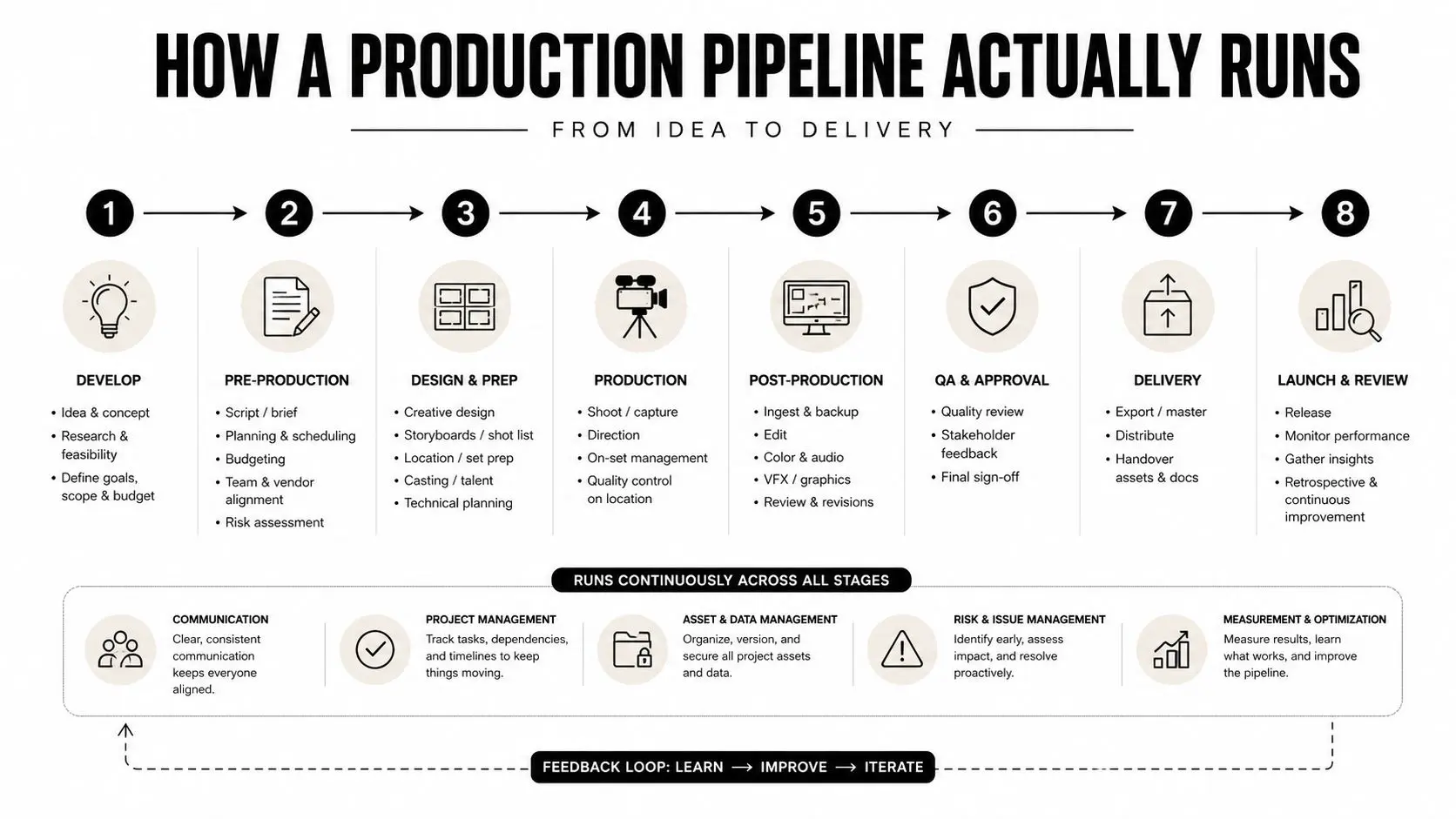
The visible work is the animation. The schedule is usually won or lost before anyone animates the first frame.
Discovery and brief alignment
The studio needs the audience, business objective, KPI, distribution channels, must-show messages, brand assets, references, delivery dates and approval structure. “Make it engaging” isn't a brief. “Explain the onboarding process to operations directors and drive demonstration requests from the landing page” gives the creative team something to solve. Choose one person who can consolidate stakeholder feedback. Five people sending separate notes will create contradictions, not better animation.
Concept and script
The concept establishes the central idea, tone and visual route. The script controls duration, narration and message hierarchy. If the voiceover is too long, the problem should be fixed here, not after animation has already been built.
Storyboard and styleframes
The storyboard maps the sequence. Styleframes show what the finished world might look like. Approving both before full production protects the budget because changes to a static frame cost less than changes to completed shots. You can find a fuller breakdown of the stages in Studio Liddell's animation production pipeline guide. Use it to prepare internal stakeholders for the approval points rather than treating review as one final event.
Animation, audio and delivery
Once the boards and style are approved, the team creates assets, animates scenes, records voiceover, adds music and sound design, then prepares the masters and cut-downs. Review should happen at agreed gates, with revisions grouped by round and prioritised against the brief. Late feedback usually comes from unclear objectives, missing brand material or an approval process nobody documented. The cheapest way to make animation faster isn't to add a bigger team. It's to write a better brief and make decisions on time.
Distribution Channels and KPIs That Prove the Work
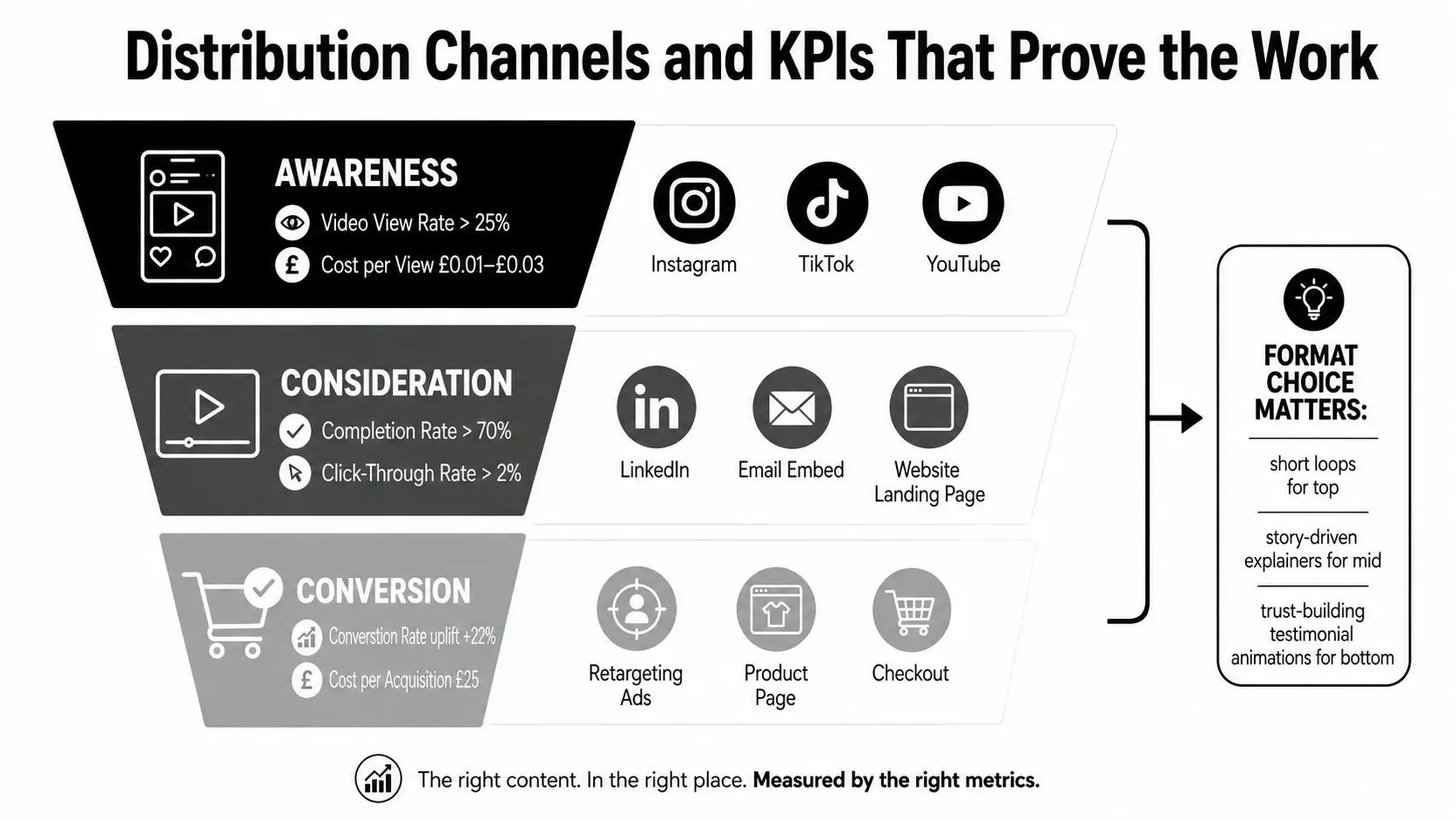
A finished film earns its place only when the format, channel and measurement plan support the same funnel stage. Decide distribution before production, then scope the edits, aspect ratios and tracking requirements into the brief. At awareness, short motion graphics and 3D social cuts suit paid social, TikTok, YouTube pre-roll and other placements where the opening seconds carry the message. Track thumb-stop rate, view-through rate, cost per view and the point where viewers leave. Put the first proposition on screen early. If the media plan needs vertical, square and horizontal versions, price them before production starts. For consideration, place a 2D or 3D brand film on a landing page, in a sales deck or inside an email nurture sequence. Explainers suit onboarding and technical education because they guide viewers through a controlled sequence instead of forcing them to decode dense copy. Measure completion, dwell time, scroll depth, click-through and the quality of sales conversations that follow.
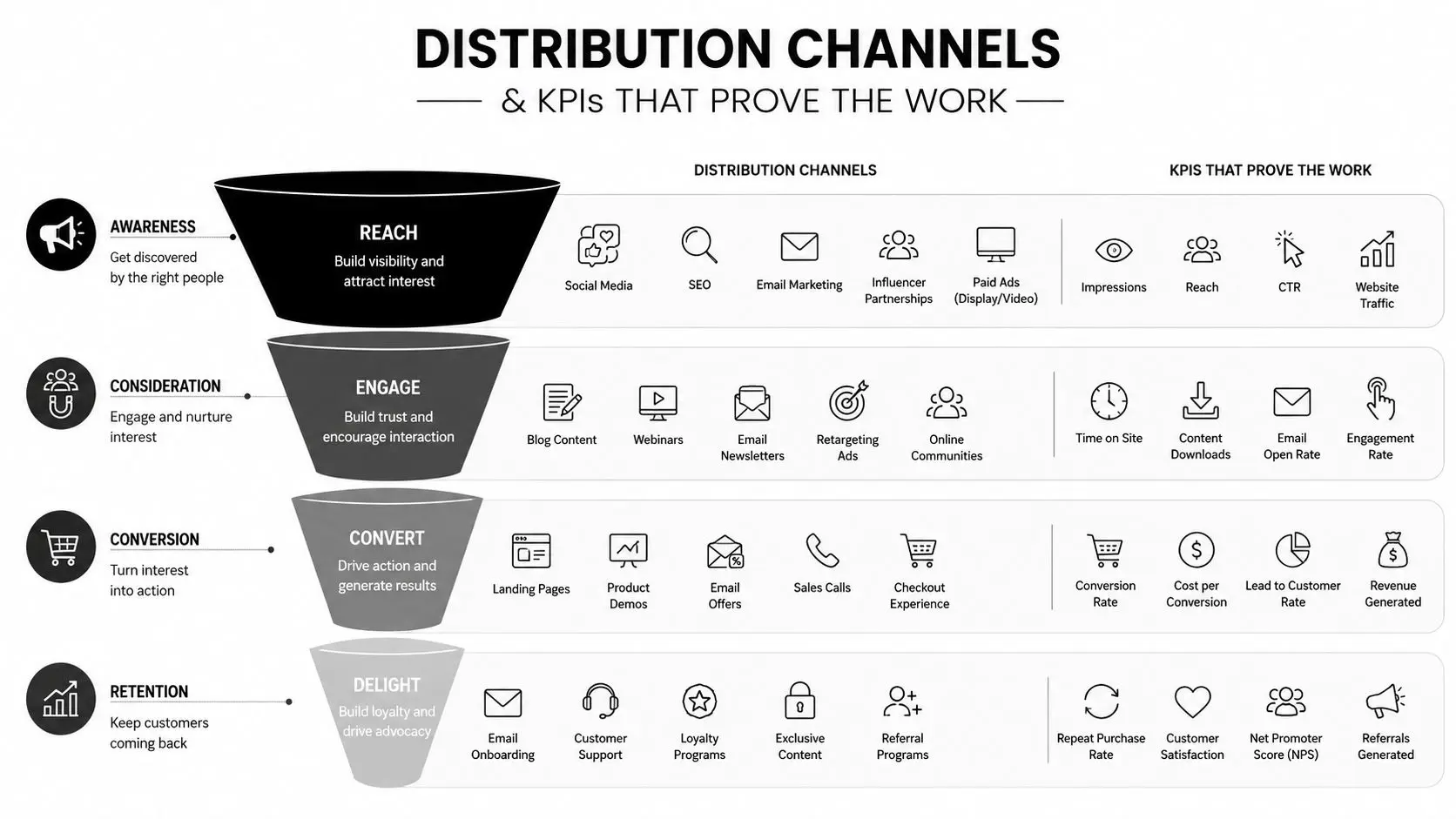
Conversion needs more than attention. Product-interaction 3D, configurators and XR can give a buyer the confidence to act when the product is difficult to understand from static content. Track conversion rate, assisted pipeline, qualified enquiries and completed actions inside the experience. Use the reported 28% conversion from interactive campaigns as a planning reference, not a forecast. Your audience, offer and conversion event must produce the evidence. For a practical overview of owned, earned and paid content distribution channels explained, align the media plan with the measurement setup. Add UTM tagging, define the conversion event and schedule reviews at 30, 60 and 90 days. First-week views can mislead, particularly when animation supports a longer sales cycle. A strong awareness result is not a conversion result, so judge each asset against the job it was commissioned to do.
Choosing a Studio Without Getting Burned
A marketing lead can lose budget before production starts by accepting a low quote that excludes revisions, format conversions and approval delays. The studio may appear affordable, yet the final cost rises as each missing item becomes a change request. Paid creative development should be your first filter. Ask studios to explain their proposed route, but commission a treatment or storyboard as a defined concept stage. Free speculative work rewards recycled ideas and tells you little about the team that will produce the finished animation. Check the delivery team behind the reel. Confirm who will direct, animate, produce and manage technical delivery. A polished sizzle reel proves presentation skill, not that the named team can solve your brief within its budget and schedule.
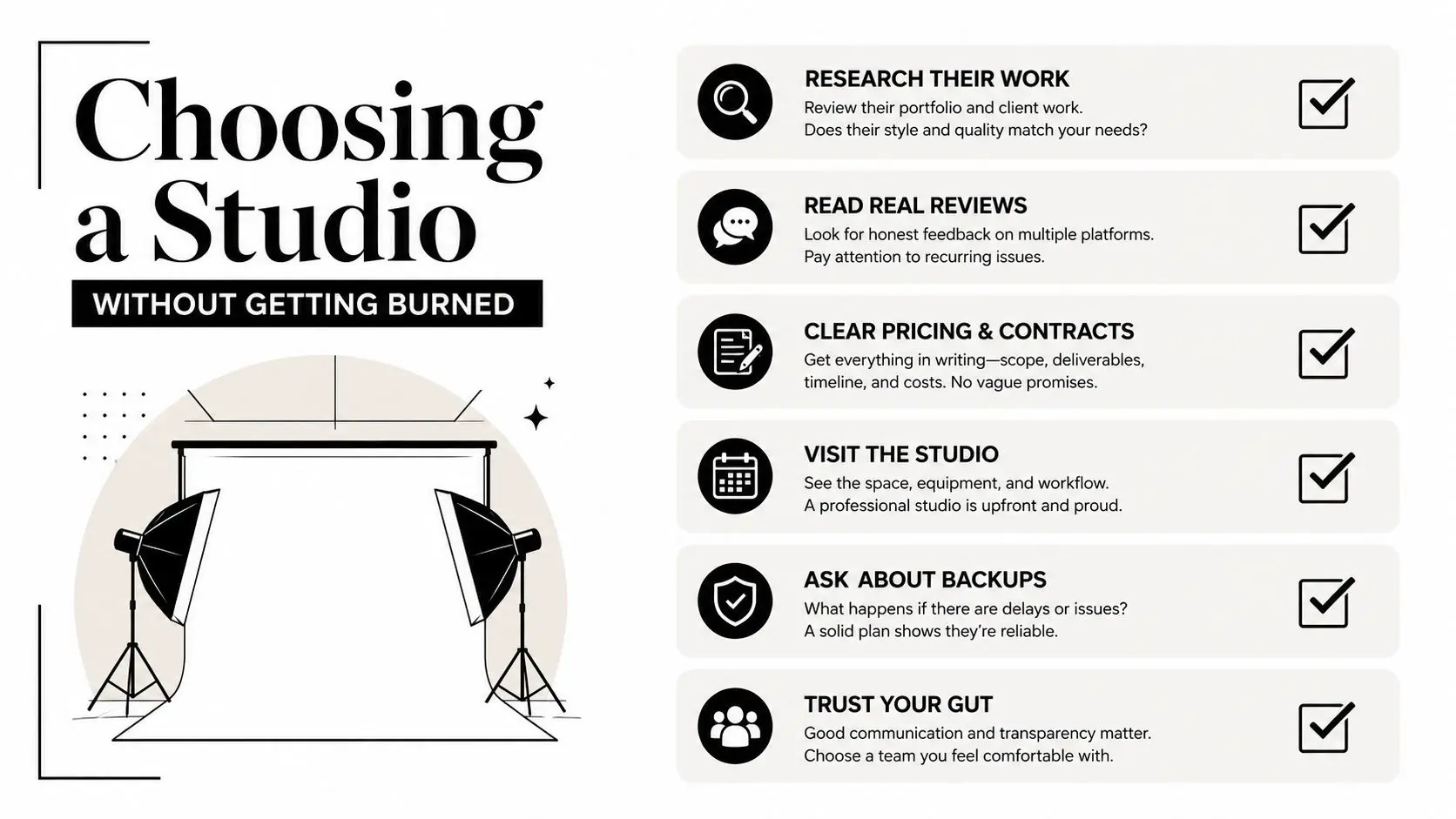
Before appointing a studio, require:
- •Paid concept stage: Commission a treatment or storyboard route instead of requesting free speculative work.
- •Fixed-fee scope: List inclusions, exclusions and the written rate for approved changes.
- •Named team: Confirm the people assigned to the project, not only those in the pitch.
- •Capped revisions: Define each review round and appoint one person to consolidate feedback.
- •Usable delivery: Specify broadcast-safe masters, platform versions and editable project files where required.
- •Verifiable proof: Request named-client case studies, completion certificates and credible awards, including recognition from bodies such as EVCOM or UK Screen Alliance.
Protect confidential information with an NDA that also defines ownership and usage rights. Ask for the director's reel, relevant examples and a schedule showing approval gates. Check that the proposed process supports the funnel job, whether the animation is intended to build awareness, explain the offer or support conversion. Studio Liddell's buyer's guide to choosing an animation studio sets out the questions buyers should settle before appointing a production partner. Use it to test the quote, team structure and production terms before signing.
A Short Decision Framework for Your Next Campaign
Start with the action, not the aesthetic.
- Name the funnel job. Awareness usually calls for short motion graphics or 3D social cuts. Consideration often needs a 2D or motion-graphics explainer with enough time to make the product understandable. Conversion may justify interactive 3D or XR when exploration affects the purchase decision.
- Set the constraints. Confirm the budget, launch date, channels, number of edits, localisation requirements and whether the studio must supply editable files.
- Choose the format. Select the simplest format that can deliver the message. Complexity should earn its place by improving understanding, desire or action.
- Test the production route. Ask for a treatment, schedule, revision structure and delivery specification before approving the full build.
- •SaaS launch: A consideration-led product story with UI screens and a complex workflow suits motion graphics or restrained 2D. Published UK motion-graphics schedules can be around 3 to 4 weeks, while a 2D explainer is commonly priced at £3,000 to £8,000 per minute in UK guidance. Media Village's pricing guide and Mooviemakers' explainer pricing guide provide the relevant ranges.
- •FMCG social burst: Choose short 2D character animation or modular motion graphics if the campaign needs multiple cut-downs and a strong visual hook. Keep the master flexible so the opening, product moment and end card can be re-edited for each channel.
- •B2B trade-show reel: Use 3D product visualisation when the product's construction or mechanism needs to be seen. Published UK guidance places complex 3D work at 8 to 16 weeks, so approve the route before the exhibition deadline becomes immovable. The UK animation production guide supports that planning range.
Book a paid 30-minute concept call with one shortlisted studio before writing a long brief. Animation rewards clarity at the start far more than volume in the document. --- Studio Liddell works across 2D and 3D animation, motion graphics, TV advertising, branded content and Unity or Unreal-based XR experiences. Visit Studio Liddell with your objective, launch date and distribution plan, and ask for a production scoping conversation that matches the format to the funnel job.