Android Popular Game Secrets
Most discussions about an android popular game start in the wrong place. They start with visibility, not demand. In the UK, that misses a commercially important segment. UK-specific data shows 68% of Android gamers prefer offline titles, linked to average monthly data usage of 12GB per user, and offline games rose 22% in UK downloads in early 2026, even while top charts are still crowded with online-first titles, according to Ofcom’s UK market data. For producers, that changes the brief. The question isn’t limited to “what’s charting?” It’s “what kind of game demand is being poorly served by the chart itself?” That distinction matters because popularity on Android isn’t a single phenomenon. Some games dominate install velocity through ad spend, network effects, or algorithmic featuring. Others build durable value because they fit the realities of how people use their phones: on trains, in classrooms, in waiting rooms, or anywhere a data connection is unreliable, expensive, or both. In the UK market, those realities are becoming a strategic filter, not a footnote. Studios that treat popularity as pure mass-market mimicry often enter the most saturated part of the market. Studios that read popularity as a signal of unmet behaviour can find room to compete.
Beyond the Top Charts What Defines a Popular Game
The UK Android market is misread when popularity is treated as a chart position. For studios, the better question is whether player demand can be served profitably with the team, budget, and operating model you have. The common shorthand for an android popular game still centres on top-grossing habits: heavy live ops, constant events, and persistent connectivity. That view captures one part of the market, but it misses a commercially attractive segment in the UK. High-quality offline games meet real usage constraints, reduce operating overhead, and fit a consumer base that is more sensitive to data costs than global chart narratives suggest.

Popularity is three different business signals
Studios make better portfolio decisions when they separate visibility from product-market fit.
- •Chart popularity reflects discoverability. It usually comes from featuring, paid acquisition efficiency, recognisable IP, or broad early install appeal.
- •Behavioural popularity reflects repeated use in ordinary conditions, including short sessions, weak connections, and limited data budgets.
- •Commercial popularity reflects whether retention, monetisation, support costs, and content demands produce durable margin.
These are related, but they do not move in lockstep. A game can rank highly while remaining structurally expensive to run if it depends on server uptime, frequent content drops, and aggressive user acquisition. A different title may never dominate category charts yet still outperform on return because it is cheaper to maintain, easier to port across devices, and more dependable for players who want entertainment without a constant connection. That distinction changes greenlight logic.
The offline gap is a production opportunity
As noted earlier, UK market evidence points to stronger demand for offline Android play than the top charts imply. This is important because market intelligence should reflect local usage habits, not just the games that can afford to stay visible. For UK studios, that opens a lane where craft can beat scale. Offline-first or offline-capable design lowers technical complexity, reduces live-service burden, and broadens addressable play contexts. Commuter sessions, school breaks, travel, and low-signal environments all favour games that start fast and keep working. The strategic implication is easy to miss. An underserved category does not need to be niche if the friction is practical rather than creative. Players are not rejecting quality. They are often rejecting battery drain, data use, forced logins, and session interruption.
What a strong target looks like
A strategically attractive Android title in this market usually combines product discipline with cost discipline:
- •Immediate session readability so the core loop makes sense in seconds
- •Offline reliability as a design standard, not a backup mode
- •Performance across mid-range devices to widen reach without inflating support risk
- •Art direction with a clear identity so the game competes on memorability rather than media spend
- •Retention systems that respect player attention, including Android push notification strategy for re-engagement when online prompts are appropriate
- •Manageable content demands so the game does not require live-service staffing to stay viable
Often, many teams misprice opportunity. They assume lower chart visibility means lower market value. In practice, the better business can sit below the loudest rankings if it serves a recurring need with a leaner operating model. A popular Android game, then, is not merely one that attracts installs. It is one that fits how people play, can be sustained without excessive infrastructure, and turns demand into margin. In the UK, that often points away from the noisiest online categories and toward polished offline experiences that the market still does not supply well enough.
The Core Pillars of Engagement and Retention
Retention doesn’t come from one trick. It comes from several systems supporting each other without creating friction. The strongest Android titles usually combine six elements well: clear gameplay, meaningful progression, social connection where appropriate, strong performance, a reason to return, and monetisation that doesn’t damage trust. Teams often over-focus on one of these and underinvest in the others. That’s usually where promising prototypes stall.
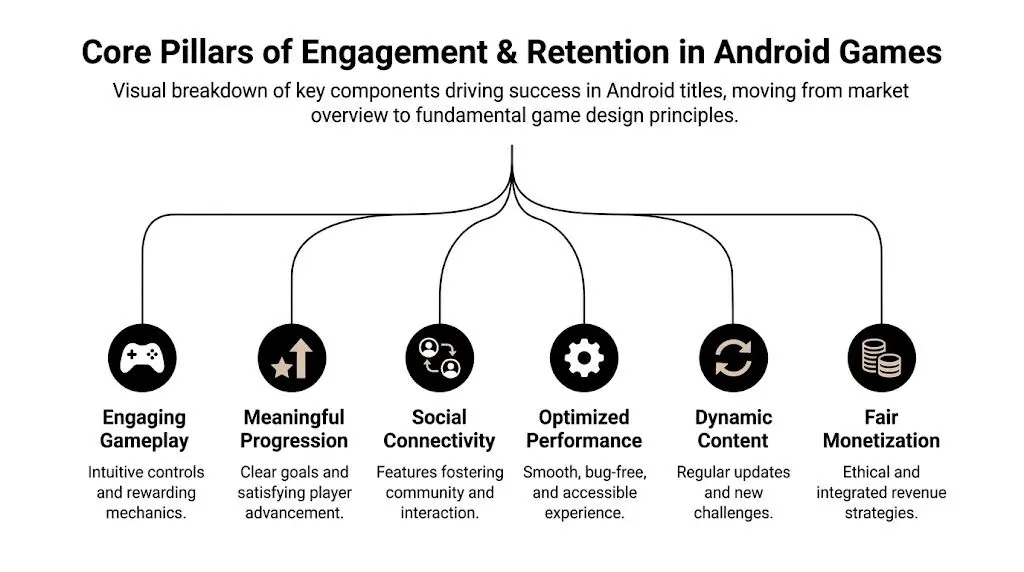
The loop has to feel good before anything else
If the first minute isn’t legible, no progression system will save the game. On Android, touch interaction has to communicate instantly. Players should know what action matters, what feedback confirms success, and what the next decision is. Puzzle games do this well when a single swipe, tap, or drag produces immediate consequence. Action games do it when movement, camera, and attack timing feel readable on glass, not just on a controller. Strategy games do it when information density is disciplined rather than clever for its own sake. A practical test helps here:
- •First action should feel safe to attempt.
- •First reward should arrive quickly.
- •First failure should teach, not punish.
- •First objective should be memorable.
Progression needs shape, not just accumulation
Many teams mistake progression for content volume. Players don’t stay because numbers rise. They stay because advancement has meaning. That meaning can come from new content access, mastery, collection, narrative reveal, or expanded tactical choice. The key is that progression changes how the game feels, not only what the UI displays. If every upgrade is incremental and invisible, the system reads as admin. Some of the best mobile designs alternate short-term and long-term rewards. A single run gives a clear payoff. A week of play changes your strategic options. That rhythm matters more than raw feature count.
A healthy progression system answers three questions at all times: what did I earn, why does it matter, and what should I chase next?
Social features should support the loop, not distort it
Not every Android game needs guilds, chat, or synchronous competition. Some do better with asynchronous comparison, co-operative goals, or lightweight sharing. Social design works when it deepens motivation that already exists. In this context, push strategy becomes important. Teams that want to bring players back without damaging goodwill need to think carefully about timing, relevance, and permission. Studio leaders evaluating retention design may find this guide to Android push notification strategy useful because it focuses on how messaging supports habit rather than becoming background spam. A few principles are durable:
- •Use social proof carefully because pressure can drive churn as easily as return visits.
- •Make co-operation optional if offline or solo sessions are part of the product promise.
- •Reward shared play with utility rather than vanity alone.
Performance is part of game design
Players rarely separate UX, frame stability, load times, and readability into different buckets. They experience all of it as “this game feels polished” or “this game feels annoying”. That means optimisation decisions are not late-stage technical chores. They affect market reach, review sentiment, and retention. A clean UI, reliable save behaviour, sensible battery use, and stable touch response all influence whether players keep the app installed.
Content cadence and fairness complete the system
Live content doesn’t have to mean endless production strain. It can mean rotating challenges, curated events, new objectives, or smart reuse of existing systems. The job is to create fresh context for the same strong loop. Monetisation also sits inside retention, not outside it. If players feel manipulated, even a highly engaging loop weakens. Fairness isn’t moral decoration. It protects lifetime value by preserving trust.
Choosing Your Monetisation Strategy in 2026
The wrong monetisation model can break a good game faster than a weak art style or a missed feature. That’s because revenue design changes player behaviour. It changes pacing, session length, economy balance, and what kind of audience you attract. Studios should choose monetisation after identifying the core fantasy and usage context. A commuter puzzle game, a competitive battler, and a narrative offline premium title shouldn’t be pushed into the same revenue logic because one model dominates the charts.
Android Game Monetisation Model Comparison
| Model | Best For Genres | Pros | Cons |
|---|---|---|---|
| Free-to-play with in-app purchases | Strategy, RPG, collection games, competitive live service | Broad reach, flexible spend depth, supports long-term economies | High balance risk, heavy content pressure, can erode trust if progression feels pay-gated |
| Battle pass or subscription-style layer | Season-based action, shooters, collection games with recurring goals | Predictable return cycles, strong habit reinforcement, good fit for live ops | Needs ongoing content planning, weakens if the core loop doesn’t support regular return |
| Ad-supported | Hyper-casual, simple puzzles, broad-reach utility play | Low spending barrier, works for large top-of-funnel audiences, simple to test early | Easily damages UX, weak fit for premium-feeling products, revenue depends on careful placement |
| Premium paid app | Narrative games, ports, polished offline experiences, niche genre titles | Clear value exchange, protects immersion, aligns well with offline proposition | Higher install friction, harder store conversion, less forgiving if branding is weak |
Free-to-play suits depth, but demands discipline
F2P remains powerful when the game naturally supports collection, optimisation, scarcity, and repeated return. It works best when spending accelerates preference rather than removes pain the designer created. If players sense the economy is withholding enjoyment, sentiment turns quickly. This model also commits the studio to ongoing operational competence. Economy tuning, event planning, segmentation, and support are not optional extras. They become part of the product.
Ads can work, but only if the game earns the interruption
Many teams treat ads as default monetisation for mobile. That’s lazy thinking. Ad-supported design only works when session structure accommodates breaks without undermining satisfaction. For teams weighing placements, reward structures, and pacing, this overview of in-app advertisement and monetization strategies is a useful reference because it frames ads as a design choice, not just a revenue plug-in. A few practical distinctions matter:
- •Rewarded ads can feel additive when the exchange is clear.
- •Interstitials need careful timing or they break flow.
- •Banner-heavy experiences often weaken perceived quality.
Premium is strategically stronger than many studios assume
For offline-first games, premium pricing can be the cleanest expression of the product’s value. It tells the player what they’re buying and removes the need to distort pacing around monetisation beats. That can be a real advantage for narrative, puzzle, tactics, and console-style ports. The challenge is discoverability. Premium titles need sharper positioning, stronger store assets, and a more confident creative identity. They can’t rely on “free” to reduce hesitation.
Producer's check: If your team wants premium presentation but your business model depends on constant interruption, one of those decisions is wrong.
Hybrid approaches need a clear logic
A hybrid model can work. The danger is stacking monetisation layers without a player-facing rationale. A premium game with ads feels incoherent. A free game with purchases, passes, ads, and gated convenience often feels hostile. Studios should document one sentence before implementation: “Players will accept this model because…” If the team can’t finish that sentence clearly, the monetisation plan probably needs rework. Teams that want a broader view of model selection can also compare options through this rundown of mobile app monetization models, especially when the product sits between game and app-like utility.
Key Android Gaming Trends for UK Studios
The most important Android trend for UK studios isn’t a flashy mechanic. It’s a shift in what practical value looks like on mobile. For years, many teams read market momentum as a race towards more live connectivity, more constant events, and more services wrapped around the game. That logic still fits some categories. It doesn’t fit every commercial opportunity now.

The offline renaissance is a production opportunity
Offline demand changes design priorities in useful ways. It pushes teams to focus on core loop quality, save integrity, local performance, efficient content packaging, and onboarding clarity. Those are healthy constraints. It also creates room for genres that charts often under-serve. Tactics, management, story-rich puzzle games, and stylised action can all benefit. These games don’t need to mimic service-heavy leaders. They need to be dependable, elegant, and complete enough that players trust them on everyday journeys. For UK-facing teams, this matters because market intelligence should reflect local usage habits, not only global leaderboard theatre. The broader app and platform context in this guide to the UK apps market is useful for framing how regional conditions affect product decisions.
AI belongs in the pipeline before it belongs in the pitch
Studios are right to explore AI-assisted production, but the strongest use cases are still operational. Teams can use AI-supported workflows for concept iteration, asset organisation, pre-production exploration, documentation, and testing assistance. That can remove waste without changing the player promise. The weaker use case is treating AI itself as the marketable hook when the underlying game loop is ordinary. Players don’t retain because a feature sounds futuristic. They retain because the product feels coherent and useful.
Cross-platform IP extension is becoming a safer bet
Mobile games attached to existing IP still rise and fall on execution, but the strategic logic is getting stronger. A children’s property, sports brand, or educational universe can use Android as the most accessible touchpoint in a broader ecosystem that includes streaming, social video, and immersive experiences. That doesn’t mean every IP should become a mobile game. It means producers should think in systems. If a world already has characters, recognisable interactions, and repeatable audience habits, Android can become the daily-use layer of the brand.
Hybrid-casual has replaced one-note hyper-casual thinking
Pure hyper-casual logic often creates a disposable relationship with the product. That can still work for testing concepts or ad-driven scale, but many studios now need stronger retention and a clearer brand footprint. Hybrid-casual design addresses that by layering progression, collection, or light meta systems onto simple loops. This trend matters because it narrows the old gap between “easy to start” and “worth keeping”. Players don’t want friction. They also don’t want emptiness.
Teams that win on Android usually make one hard choice early. They decide whether they’re building a disposable click toy or a product players will choose to keep.
Lessons from Standout Android Titles
The strongest Android hits do not win by copying the top charts. They win by making a sharp product choice, then aligning design, monetisation, and technical scope around it. For UK studios, that matters because the largest opportunity may not sit in crowded online categories at all. It may sit in polished offline games that respect battery life, storage limits, and rising mobile data costs. Three recent standouts show what that alignment looks like in practice.
Pokémon TCG Pocket and the economics of ritual
Google Play named Pokémon TCG Pocket its Best Game of 2025 in Google Play’s Best of 2025 roundup. The award matters less than the product logic behind it. The game turns a familiar collector behaviour into a daily mobile habit. That distinction is commercially important. Many studios study collectible games and conclude that IP did the heavy lifting. The more useful conclusion is narrower. The title gives players a compact sequence they already understand: acquire, reveal, evaluate, compare, and chase the next small improvement. Those actions fit fragmented phone sessions, and each one carries enough emotional weight to justify returning. For production teams, the lesson is clear. Retention often improves when the core loop feels like a ritual rather than a task list.
- •Ritual creates revisit triggers because players know exactly what satisfying action they are coming back for.
- •Collection systems work best when items carry identity, status, or aesthetic appeal, not just numerical strength.
- •Sensory polish supports monetisation because animation, timing, and sound increase the perceived value of each reward moment.
This is also why free-to-play performs best in categories with built-in anticipation. The spending prompt sits on top of an existing desire cycle. It does not have to manufacture one.
DREDGE and the case for offline premium depth
Another winner from the 2025 awards, DREDGE, points to a different commercial path. On Android, it proves there is still room for a paid or subscription-supported game built around atmosphere, pacing, and authored tension rather than constant live-service pressure. That matters more in the UK than many mobile teams admit. A player commuting on patchy coverage, conserving data, or avoiding always-online friction has a different value equation from a player chasing competitive progression. Offline support is not a minor feature in that context. It is part of the product promise. DREDGE works because every system reinforces the same fantasy. Movement, risk, visual tone, and narrative unease all support one emotional outcome. Studios often underestimate how rare that cohesion is on Android, where many products combine premium art direction with retention mechanics that interrupt the mood. A high-quality offline game can therefore compete from a position of difference, not from budget parity with large live-service operators.
Premium mobile games perform better when the studio protects immersion from business-model interference.
The production implication is practical. Teams can invest in controls, save stability, loading performance, and content density instead of planning an endless release calendar. That changes the operating model, the staffing plan, and the marketing message. It also changes user acquisition. A title with a strong authored identity often depends less on broad performance marketing and more on clear community positioning, creator coverage, and disciplined social media growth strategies that communicate mood and distinctiveness.
Disney Speedstorm and the value of transferable technology
In the same announcement, Google Play recognised Disney Speedstorm as Best Multi-device Game of 2025. The strategic lesson is not just wider platform reach. It is that technical architecture can expand or limit a game’s commercial options long before launch. A racing game has little tolerance for input lag, cluttered UI, or inconsistent frame pacing. If a team solves those constraints across devices, it gains more than portability. It gains flexibility in distribution, merchandising, audience segmentation, and future platform partnerships. In many Android projects, long-term value is lost. They treat mobile as a one-off build instead of a core product node. A stronger approach sets up input abstraction, adaptable interface layouts, account systems, and performance budgets early enough that the title can extend to tablet, PC, or other screens without expensive rework. For studios with limited capital, that discipline matters. It can reduce future porting cost and increase the number of viable commercial outcomes.
What these examples share
These games target different audiences and business models, but they follow the same operating principle.
| Title | Core lesson | Commercial implication |
|---|---|---|
| Pokémon TCG Pocket | Build around repeatable ritual | Predictable return behaviour supports F2P spending and long-term habit formation |
| DREDGE | Protect immersion and offline usability | Premium craft can stand out in an underserved segment, especially for UK players managing data use |
| Disney Speedstorm | Build technology that travels | Early technical discipline expands future platform and distribution options |
The common thread is alignment. Successful Android titles choose one clear source of value, then support it consistently. Problems start when a game promises offline convenience but requires constant sync, sells premium immersion but interrupts it with aggressive ads, or aims for live-service depth without the team size to sustain it. Studios that understand this usually make better greenlight decisions. They do not ask only which games are popular. They ask why those games earned the right to be kept on a player’s phone.
Your Strategic Blueprint for the Android Market
Before greenlighting any Android title, a studio lead should pressure-test the concept against a small set of commercial questions.
Questions worth asking before production starts
- •What kind of popularity are we targeting? Chart visibility, dependable retention, or a durable niche can each support a business. They don’t require the same product.
- •Does the game fit real phone behaviour? If sessions are fragmented, the loop must survive interruption without losing clarity.
- •Is offline support central or cosmetic? If the product promise leans on convenience and accessibility, offline play has to be built into design, not patched in late.
- •Will our monetisation strengthen or weaken the fantasy? Revenue logic should support how the game feels, not interrupt it arbitrarily.
- •Can our team sustain the operating model? A live-service design commits the studio to content, balancing, and support. A premium model commits it to stronger up-front craft and sharper positioning.
- •Are we building for one device context or many? UI, input, and save architecture should reflect that answer early.
The strongest projects usually have one clear conviction
The best Android concepts are easy to describe in one sentence. Not because they’re simple, but because their strategic logic is coherent. “A premium offline tactics game for commuters” is clearer than “a mass-market strategy game with social features, optional ads, and live events”. The second idea may sound bigger. It’s often just blurrier. Marketing also needs to match that clarity. Teams planning launch support should think beyond paid acquisition and study how creators package repeatable hooks, visual snippets, and audience-specific messaging. This overview of social media growth strategies is useful in that context because it focuses on how content compounds when the message is already sharp.
If a producer can’t explain who the game is for, where it fits into daily life, and why its business model belongs there, the project isn’t ready.
An android popular game in 2026 won't be defined only by store rank. For UK studios, the more valuable question is whether the game matches local player behaviour, device realities, and a business model the team can sustain. That's where the better opportunities are.
If you're shaping an Android, XR, or cross-platform interactive product and want a production partner with strengths in animation, games, and immersive development, Studio Liddell is worth speaking to. You can explore their work and book a conversation to scope a project that fits both the audience and the production realities.