Android App Development Company UK
You're probably in one of two situations. Either you need an Android app because a real business process has outgrown spreadsheets, email chains, and patched-together web tools. Or you already have an app concept, and now you need to choose a UK partner without wasting budget on a team that can make screens but can't ship a dependable product. That's where most buyers get stuck. Search results for android app development company uk are crowded with directories, rankings, and agency pages that all say roughly the same thing. Everyone claims strong delivery, clean design, agile methods, and “end-to-end” service. Very few explain what actually drives project success once contracts are signed. The hard part isn't finding a company that can code. The hard part is choosing a partner that understands product scope, technical risk, security exposure, maintenance load, and how Android fits your wider digital strategy. If you're leading the budget, that's the decision that matters. I've seen the strongest app projects start with brutal clarity on three things: what the app must do for the business, what can break during delivery, and what must still be true a year after launch. If you need a useful primer on managing software engineering risks, that's a sensible companion read before you start vendor conversations.
Introduction Navigating Your Android App Project
Hiring an Android development partner in the UK looks simple until procurement starts. Then important questions appear. Do you need native Android, or will cross-platform do the job? Is the agency showing you polished portfolio work that hides weak architecture underneath? Are you buying a build, or are you buying a team that can own release management, QA, analytics, security, and post-launch change? Those questions matter because mobile projects fail in ordinary ways. The brief is vague. Features are approved before technical dependencies are understood. Design gets signed off without considering Android device variance. The launch budget is approved, but the maintenance budget isn't. Six months later, the app works, but the business still doesn't. A good Android partner helps prevent that drift. They push on scope, define trade-offs early, and explain technical choices in business terms. If they can't do that in sales, they won't do it once the statement of work is signed.
Practical rule: If an agency talks more about screens than workflows, or more about features than operating risk, keep looking.
The UK Android Development Landscape in 2026
The UK gives buyers a broad and credible supplier market, but it's not a uniform one. You're not choosing from a neat stack of like-for-like firms. You're choosing from a crowded mix of boutique studios, regional specialists, mobile agencies, product consultancies, and larger software houses. IBISWorld reports that the UK App Development industry reached 15,282 businesses in 2026, after growing at a CAGR of 5.5% between 2021 and 2026. The same market view places the broader industry at £28.3 billion and notes 73,470 employees across 14,527 businesses in 2024 to 2025, which points to a sizeable labour pool for app delivery in the UK (IBISWorld UK app development industry data). That matters for Android buying decisions because scale changes your options. In a shallow market, you often settle for a generalist. In the UK, you can usually find firms that align to a sector, stack, or delivery model.
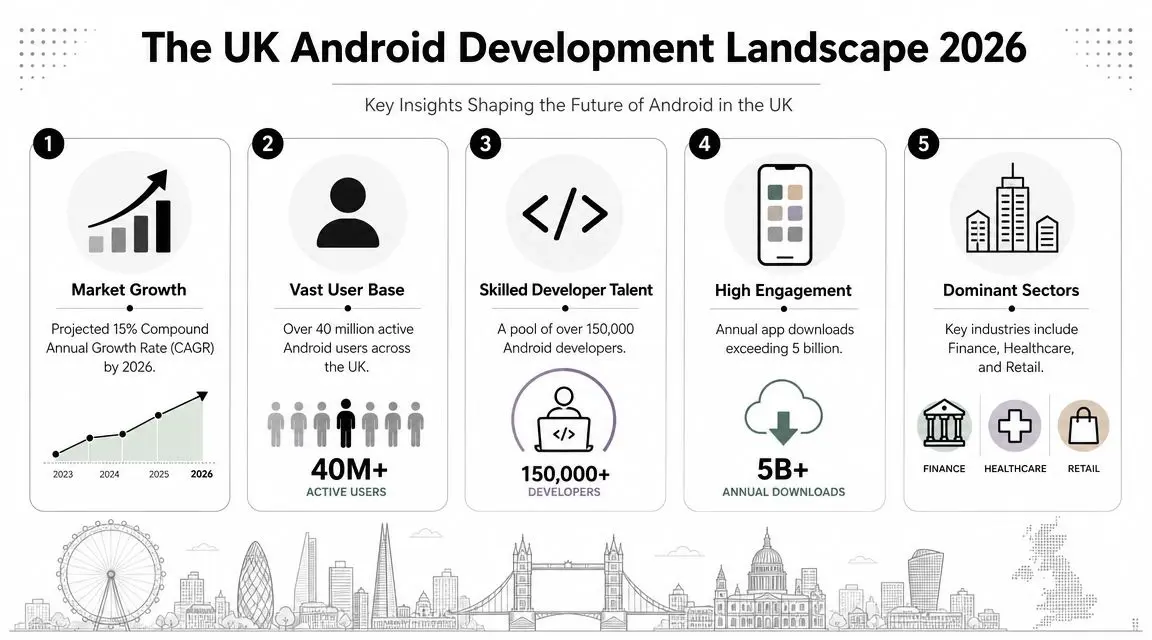
What the supplier base really looks like
The market is large, but it's also fragmented. The UK government's app developer survey found that 70% of surveyed app developers were micro businesses, and the most common business size was two directly employed staff (UK government app developer survey). That changes how you should read proposals. A micro-studio may give you direct access to senior talent, quick decisions, and lean communication. It may also struggle with parallel workstreams, structured QA, security review, or sustained support after launch. A larger team can offer better resilience and clearer role separation, but you may get layers of account management between you and the people making technical decisions. Here's the practical reading of the market:
| Agency shape | Usually works well for | Watch for |
|---|---|---|
| Micro studio | MVPs, focused Android builds, design-led work | Key-person dependency, limited QA capacity |
| Mid-sized specialist | Product builds with ongoing roadmap needs | Process quality varies more than websites suggest |
| Larger consultancy | Enterprise integration, governance-heavy work | Slower decisions, higher overhead, diluted ownership |
Regional depth matters more than rankings
London is still the obvious buying centre, but it isn't the only one that matters. Android development activity is concentrated in hubs such as London, Manchester, Leeds, Birmingham, and Edinburgh, and those regional ecosystems often shape delivery style as much as technical quality. Manchester and Leeds firms often work comfortably with growth-stage businesses that need a product team rather than a polished procurement deck. London agencies may be stronger when the project needs enterprise stakeholder handling, multi-vendor coordination, or investor-facing product presentation. That regional spread is useful if you want in-person workshops without limiting yourself to one expensive market. It also makes it easier to find agencies that understand sector-specific needs, especially in education, healthcare, fintech, and retail. For a producer-led view of how mobile work fits into wider digital planning, this UK mobile app producer's guide is worth reviewing alongside agency proposals.
Pricing exists in bands, not a single market rate
Public directories don't give a perfect pricing picture, but they do show a broad range. UK listings commonly show hourly rates around $25 to $49 or $100 to $149 per hour, with project minimums from $10,000 to $50,000+ in reviewed company profiles, as summarised in the verified market notes above. Don't treat those numbers as a quoting tool. Treat them as a warning that “UK Android development” covers very different operating models. A low rate might reflect offshore-heavy delivery, junior-heavy teams, or narrow scope assumptions. A high rate might reflect stronger architecture, QA, compliance, and product input. Sometimes it just reflects expensive overhead. The point isn't to chase the middle. The point is to understand what the rate is buying.
Decoding Services and Modern Technology Stacks
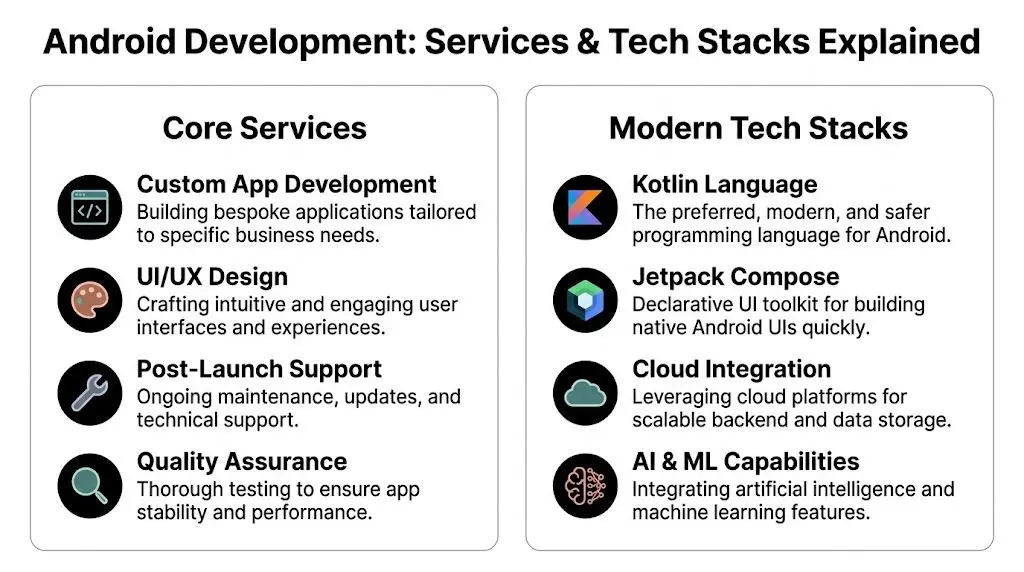
When buyers say they need an Android app development company, they often mean one of several very different jobs. That's where confusion starts. Some projects need a native Android product built with Kotlin and the Android toolchain. Others need a cross-platform app because the business can't justify separate Android and iOS teams. Others still need something closer to an interactive product, where Unity or Unreal is part of the answer because the app connects to gaming, XR, simulation, or spatial content. If the agency can't explain these differences clearly, they're not advising you. They're selling whatever they already prefer.
Native Android when quality and control matter most
For Android-first products, native still makes sense more often than some agencies admit. The reason isn't ideology. It's control. A native stack usually means Kotlin, Android Studio, the Android SDK, and increasingly Android Jetpack libraries. The benefit is practical. You get closer alignment with platform behaviour, stronger handling of device-specific patterns, and fewer compromises around performance, lifecycle management, and background work. The verified market guidance is blunt on this point. Top UK Android firms commonly build with native stacks like Kotlin and Android Jetpack, which improve code safety and reduce maintenance costs. Buyers should demand an explicit architecture plan such as MVVM (UK mobile stack guidance). That architecture request is not technical theatre. It tells you whether the team can think beyond the first release. A good agency should be able to answer:
- •How will state be managed? You're listening for a coherent app structure, not hand-waving.
- •Where are the module boundaries? If every feature touches everything else, change will get expensive fast.
- •What sits in CI/CD? Manual release rituals usually signal weak engineering discipline.
- •How are testing responsibilities split? Unit, integration, device, and UAT all need an owner.
Cross-platform when speed and reach outweigh platform depth
Cross-platform can be the right commercial decision. It often is when your product logic is shared across platforms and the user experience doesn't depend heavily on Android-specific behaviour. The problem is that some agencies position cross-platform as the default because it's easier to sell a single codebase than to discuss trade-offs in full. That's where buyers get trapped. They hear “faster” and “more efficient”, but not “limited access to native behaviours”, “higher complexity in edge cases”, or “future rewrites if the product becomes more ambitious”. Cross-platform tends to work best when:
| Good fit | Poor fit |
|---|---|
| Form-heavy business apps | Apps that need deep device integration |
| Early MVPs with uncertain roadmap | Performance-sensitive consumer apps |
| Internal tools and service workflows | Products with complex offline or background behaviour |
If your roadmap includes richer Android-specific features later, ask how the team avoids painting you into a corner now.
Unity and Unreal are not just for games
Many Android buying guides fall short. They treat app development as a mobile-only discipline, when many businesses now need a connected experience stack. If your app includes immersive training, animated learning content, product visualisation, branded interactions, or AR-led engagement, then Unity or Unreal may belong in the conversation from day one. Not because they're fashionable, but because they solve a different class of problem. The UK market is moving in that direction. The verified industry view notes that businesses increasingly want apps connected with Unity or Unreal for XR, gamified learning, and AI-assisted content pipelines, rather than isolated mobile products. That changes what “Android app development company uk” should mean in practice.
What a modern service package should include
A capable agency shouldn't just sell build hours. It should define a delivery system. Look for a service scope that covers:
- •Product discovery with feature prioritisation and technical scoping.
- •UI and UX design that respects Android patterns instead of porting iPhone assumptions across.
- •Engineering with explicit stack and architecture choices.
- •QA that includes real device testing, not just emulator confidence.
- •Release support for store submission, telemetry, crash monitoring, and update planning.
- •Post-launch support that treats the app as a living product.
The better agencies explain where they stop as clearly as where they help. That clarity saves money.
Mapping Your Project Timelines and Budget
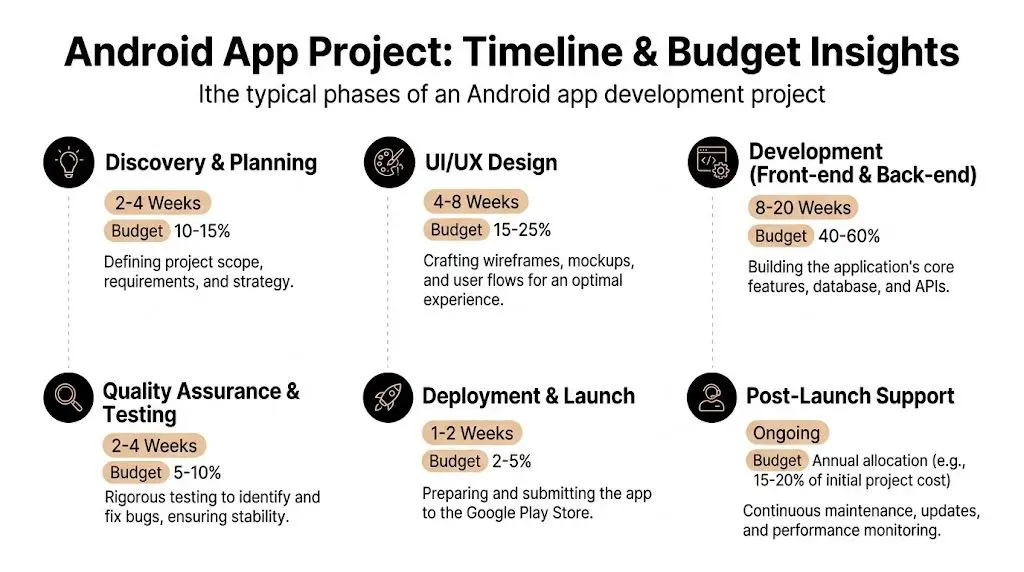
Most Android budgets go wrong before development starts. The issue usually isn't that the agency lied. It's that the client bought a feature list without understanding the delivery phases behind it. Apps aren't one purchase. They're a sequence of decisions. Discovery shapes scope. Design exposes workflow gaps. Development reveals integration friction. QA surfaces assumptions nobody wrote down. Launch creates operational work that many teams forget to fund. That's why I prefer phased budgeting over “how much for an app?” conversations.
Treat discovery as a cost control tool
The cheapest way to save app budget is to spend properly on discovery. That phase defines the user journeys, business rules, technical constraints, integrations, release assumptions, and what's in version one. When clients skip it, they don't save money. They move expensive decisions into development, where every change costs more and delays compound. A healthy discovery phase should produce:
- •A prioritised scope, not a brainstorm list.
- •A technical approach, including whether native Android is justified.
- •A risk register, especially around APIs, data, compliance, and content workflows.
- •A release plan, even if it's provisional.
For a useful reference on sequencing those stages, this app development timeline guide aligns well with how experienced teams structure delivery.
Budget bands should follow complexity, not agency branding
You'll see public UK pricing ranges, but those only tell part of the story. The actual cost driver is complexity. A simple content or utility app sits in a different category from a role-based operational platform. A business app that connects to existing systems is different again. Add media workflows, gamification, or XR-linked interactions, and the delivery model changes because the asset pipeline changes too. Here's a practical way to think about budget pressure:
| Project type | Main cost drivers |
|---|---|
| Simple app | Core screens, account flow, light backend work |
| Operational business app | Roles, permissions, APIs, data handling, testing |
| Consumer product app | Polish, device variance, analytics, retention features |
| Interactive or XR-linked app | Asset production, real-time content, specialist tooling |
The budget conversation should always include maintenance. If the agency only prices the build and leaves support vague, assume the total cost of ownership is still unknown.
Timelines fail when scope and approval routes are fuzzy
A project can move quickly with the right structure. It can also crawl if decisions sit in stakeholder limbo. The agencies that hit dates usually do a few things consistently:
- Freeze the release scope early. They allow backlog movement, but not constant reshaping of the current sprint plan.
- Separate design approval from feature approval. These are not the same discussion.
- Define client responsibilities. Content, legal review, API access, test feedback, and sign-off all need owners.
- Plan UAT properly. User acceptance testing often gets squeezed, then everybody acts surprised when late issues appear.
Budget for the app you can govern, not the app you can imagine.A practical timeline is one that includes time for decisions, not just coding.
A Practical Framework for Evaluating UK Agencies
Most agency shortlists are built backwards. Buyers start with appearance. They look at websites, logos, awards, and polished case studies. Then they try to infer delivery quality from presentation. That's risky. Good marketing doesn't prove weak execution, but it doesn't prove strong execution either. You need a scorecard that tests how the agency thinks, how it works, and how it handles risk once the project becomes messy.Four things that matter more than a glossy portfolio
Use these four lenses when comparing agencies. #### Technical judgement You're not just checking whether the team knows Kotlin or Android Studio. You're checking whether they choose tools for the right reasons. Ask how they decide between native and cross-platform. Ask how they structure app architecture. Ask what they automate in testing and releases. Strong teams give specific, bounded answers. Weak teams retreat into generic confidence. #### Process maturity A mature process doesn't mean bureaucratic process. It means repeatable delivery with visible controls. Look for sprint rituals, issue tracking discipline, acceptance criteria, QA ownership, release procedures, and change control. If they can't explain how work moves from requirement to release, they probably improvise more than they admit. #### Strategic thinking A useful partner challenges the brief when needed. They don't say yes to every request just to win the contract. If your stated feature set creates UX friction, technical debt, or support risk, the agency should say so. You want constructive pushback, not obedience. The best firms help refine the product you should build, not just the product you first described. #### Security and compliance discipline This is the area most buyers underweight until it becomes expensive. The UK Cyber Security Breaches Survey 2025 found that 43% of businesses reported a cyber breach or attack in the last 12 months, which is why app security belongs in vendor evaluation, not as an afterthought in delivery (UK security context for app buyers). That affects Android procurement directly. You need to know how the agency handles secure coding, authentication, permissions, data minimisation, telemetry, dependency management, and GDPR-aware decisions around personal data.A simple evaluation table
| Evaluation area | Strong sign | Weak sign |
|---|---|---|
| Technical planning | Shows architecture, tooling, and release logic | Talks only about features and screens |
| Delivery process | Clear ceremonies, QA flow, and reporting | “We're agile” with no detail |
| Product thinking | Challenges assumptions and narrows scope | Accepts every request without question |
| Security posture | Can explain data handling and secure practices | Treats security as a post-launch add-on |
Borrow selection discipline from other specialist hires
This isn't unique to software. The same pattern shows up when businesses choose agencies in adjacent fields. A useful example is this guide to selecting a UK PR partner, which frames selection around fit, process, and outcomes rather than branding. The principle carries across neatly. Capability matters, but operating style matters just as much.A weak agency proposal often looks comprehensive because it includes everything. A strong one usually looks sharper because it excludes what doesn't belong in phase one.
Essential Interview Questions and Critical Red Flags
Once you've narrowed the list, the interview is where good agencies separate themselves from good sales teams. Don't ask broad questions like “How do you work?” You'll get rehearsed answers. Ask questions that force specifics.Questions that expose how they really deliver
Ask them to describe a project that went wrong. You want to hear what changed, how they diagnosed the issue, what they did with stakeholders, and what they learned. Good teams can discuss failure without becoming defensive. Weak teams either blame the client or claim everything always went smoothly. Ask how they handle technical debt. A mature answer includes trade-offs. Sometimes they defer it. Sometimes they fix it immediately. What matters is whether they track it deliberately and explain when debt becomes a delivery risk. Ask who writes acceptance criteria. If nobody owns acceptance criteria, disputes appear late. Strong teams define what “done” means before development starts. Ask how they run UAT. You're looking for structure. Who prepares scenarios? Who triages issues? What gets fixed before release, and what moves to backlog? Ask what happens after launch. If the answer is vague, support is probably vague too. Good agencies can describe monitoring, bug response, update cadence, and change request handling.What strong, average, and weak answers sound like
| Question | Strong answer | Average answer | Weak answer |
|---|---|---|---|
| What happens when scope changes? | Explains change control and impact on time or budget | Says they'll “be flexible” | Says “no problem” without discussing consequences |
| How do you test? | Describes layered QA and ownership | Mentions testing in general terms | Relies on developers checking their own work |
| How do you manage releases? | Has release checklist and rollback thinking | Can submit builds but lacks depth | Treats launch as a one-off handoff |
| How do you communicate risk? | Uses regular reporting and escalation paths | Mentions meetings but little structure | Avoids risk talk during sales |
Red flags that should end the conversation
Some warning signs don't need further interpretation.- •They won't show working process artefacts. If they can't share sample sprint boards, test plans, or requirement formats in anonymised form, their process may be thinner than advertised.
- •They focus on visual polish over business logic. Nice UI matters. It isn't enough.
- •They avoid naming senior delivery people. You need to know who will run the work.
- •They promise certainty too early. Serious teams don't fully estimate unclear projects without caveats.
- •They minimise maintenance. Android products need updates, issue handling, and periodic review.
- •They treat security as optional. That's a procurement mistake waiting to happen.
Ask every finalist what they need from you to make the project succeed. The honest answer tells you a lot about how they work with clients.
The best interviews feel slightly uncomfortable in a good way. Both sides are testing whether the partnership can survive pressure, ambiguity, and changing priorities.
Beyond the App Store Connecting Android with XR and Animation
The most important shift in this market isn't just technical. It's strategic. A lot of Android work is still commissioned as if the app is the final product. For many businesses, it isn't. The app is the access point. It's the delivery layer that connects users to content, training, storytelling, services, or interactive experiences that live beyond a standard mobile interface. That changes who you should hire.

The app as part of a wider experience stack
The UK market is moving towards integrated products, not isolated apps. The verified industry view is clear that businesses increasingly want partners who can connect Android apps with Unity or Unreal for XR, gamified learning, and AI-assisted content pipelines, creating a broader digital ecosystem rather than a standalone mobile build (UK view on integrated app experiences). That's a big deal for buyers because it changes brief writing. If you're in education, your Android app may need to provide access to animated learning modules, AR overlays, or progression systems. If you're in training, the mobile app may handle identity, scheduling, reporting, and assessment while the core learning interaction happens in VR. If you're in entertainment or children's content, the app may function as a companion product to animated IP rather than a conventional utility app. In each case, a pure-play mobile agency can build the shell and still miss the commercial opportunity.
Where connected delivery creates more value
Consider a few common scenarios:
- •Training and simulation
The Android app manages enrolment, user progress, and reporting. Unity powers the simulation environment. The value comes from joining the systems, not treating them as separate procurements.
- •Education and gamified learning
The app handles accounts, lesson flow, and parent or teacher access. Animated sequences, interactive scenes, or AR moments deliver the engagement layer.
- •Branded content ecosystems
The mobile product becomes one touchpoint in a larger IP strategy that includes shorts, character assets, games, or immersive experiences.
Why this changes vendor selection
If your roadmap touches interactive media, an Android partner should understand more than mobile release workflows. They should understand asset pipelines, performance constraints with media-rich content, real-time engine dependencies, and how UX shifts when users move between phone, tablet, headset, and large-format display. That doesn't mean every client needs one full-service studio. Sometimes a specialist Android team plus a separate XR or animation partner is the right setup. But if the product spans those areas from the start, a joined-up partner model usually reduces handoff friction. One option in the UK market is Studio Liddell's guide to Unity development for XR and animation, which reflects the kind of cross-disciplinary planning buyers should expect when app work intersects with immersive content, animation, or interactive production. The better question in 2026 isn't “Who can build our app?” It's “Who can help us design the role this app plays in the full experience?”
If you're weighing an Android build against a wider interactive roadmap, Studio Liddell is one of the UK options that works across apps, animation, games, and XR. That's useful when your mobile product isn't a standalone deliverable but part of a broader digital experience that has to stay coherent from concept through launch.