Alphablocks Series 7 the Complete Guide
If you're a parent, you may be checking whether a new batch of Alphablocks is on the way or just another rumour circulating in fan spaces. If you're a teacher, you're probably asking a different question: will the next series give you something you can use in class, or is it merely more familiar branding wrapped around old phonics beats? That's why Alphablocks Series 7 matters. It isn't just another preschool renewal. It looks like a significant release in UK children's educational media, with implications for literacy teaching, platform strategy, and the long-term future of one of the country's most recognisable learning brands. For families, the headline is simple. A trusted reading programme is returning. For educators and production professionals, the story is more interesting. This new series arrives at a point when broadcasters, creators, and education partners all need preschool content to do more than entertain. It has to teach clearly, travel well across platforms, and still feel fresh enough to hold a young audience's attention.
The Next Chapter in Learning to Read
For many families, Alphablocks sits in that small category of children's television that parents actively welcome. It helps with sounds, blending, and early word recognition, but it does so through characters and stories children remember after the screen is off. That reputation didn't appear overnight. Alphablocks first debuted on 25 January 2010 and has since become a trusted preschool phonics programme with a global audience, according to Blue Zoo's announcement on the future of the Blocks Universe. In classroom terms, that longevity matters. Teachers know the brand. Parents recognise the format. Children often arrive with some prior familiarity, which lowers the barrier to learning.
Why this return feels bigger than a routine recommission
A new preschool series only becomes important when it solves a real problem for the next wave of learners. Reading readiness hasn't changed as a priority. What has changed is how children encounter educational content. They now move between broadcast, streaming, clips, games, and toys without noticing the platform shift. That's one reason educational animation remains so effective when it's made well. A good phonics series repeats key patterns, visualises abstract sound rules, and uses character performance to keep repetition from feeling like drill. That broader production context is worth understanding in this UK guide to animation for education and engaging learners.
Practical rule: The best early years media doesn't replace adult teaching. It gives adults a shared language they can reuse at home or in class.
What parents and teachers should watch for
When a long-running literacy show comes back, three questions matter straight away:
- •What stage is it aimed at. Children who already know basic sounds need something different from absolute beginners.
- •How much new material is there. More episodes can mean more room for revision, progression, and confidence-building.
- •Has the teaching model evolved. A returning series should build on what worked without freezing the format in time.
Those questions become especially relevant with Series 7, because this release appears designed as more than a simple continuation. It has the feel of a major next step for the franchise.
Alphablocks Series 7 Release Date and Availability
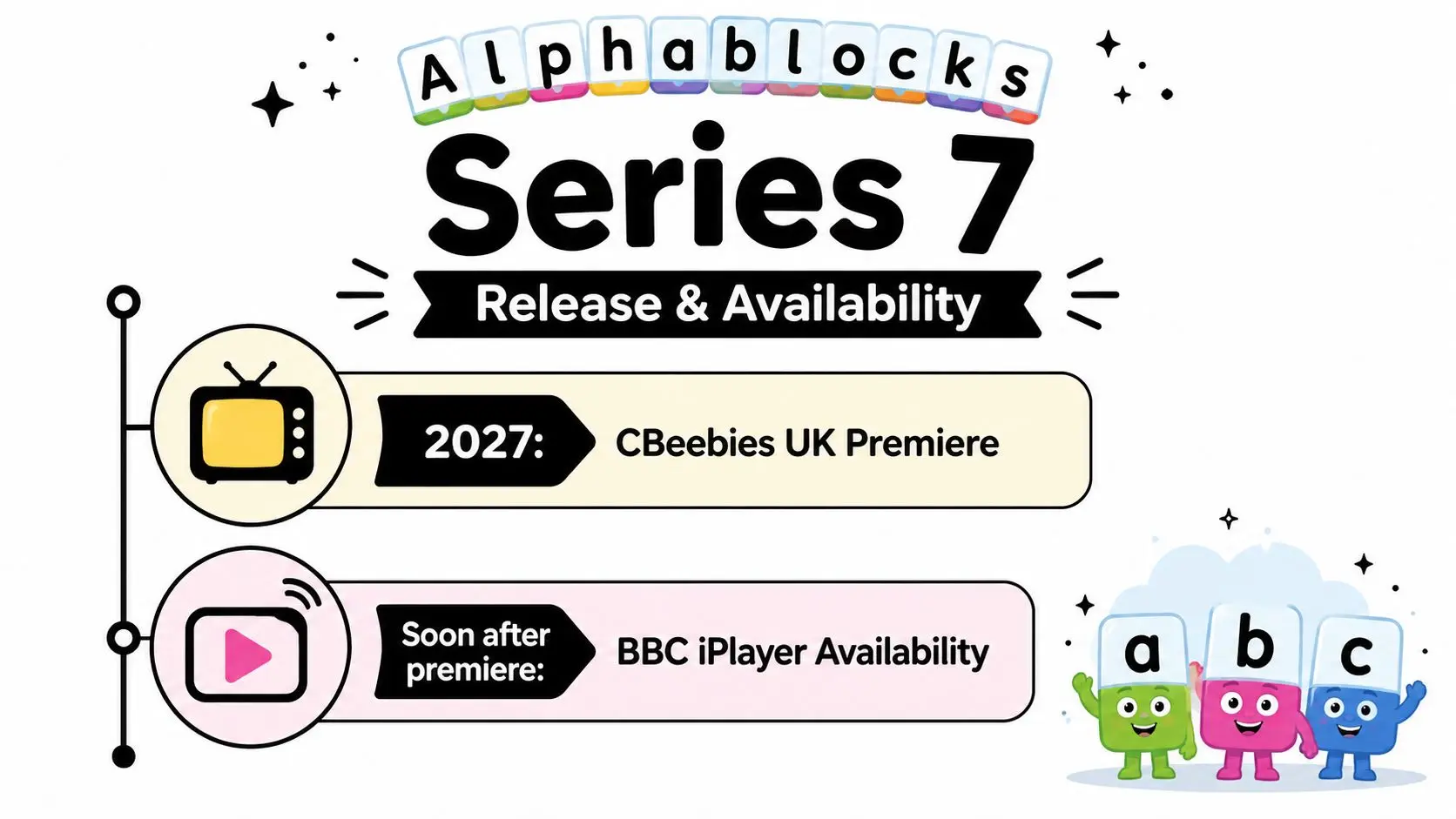
A parent in the UK is likely to meet Series 7 in a familiar way. Breakfast television is on, CBeebies is part of the routine, and then the same episode is replayed later on iPlayer because one viewing rarely settles a new sound pattern. For a phonics series, that release pattern is part of the teaching model, not just a distribution choice. The clearest scheduling point so far is that Alphablocks Series 7 is set for 2027. As noted earlier, it also sits within a much larger rollout across the wider Blocks Universe, which matters for anyone tracking how successful preschool brands are now managed. Educational commissioners are no longer backing single shows in isolation. They are backing families of formats that can hold attention across broadcast, streaming, publishing, apps, and licensing.
Where UK audiences are likely to find it
For UK viewers, the natural home is still CBeebies, with BBC iPlayer expected to support catch-up and repeat viewing around the broadcast window. That pairing works especially well for early literacy. Broadcast creates habit. On-demand viewing supports repetition. Repetition is how phonics sticks. A child often needs to hear a sound, see it modelled in a word, and meet it again in a calmer moment before it becomes usable knowledge.
| Platform | Likely role |
|---|---|
| CBeebies | UK television premiere in 2027 |
| BBC iPlayer | On-demand access for replay and catch-up |
For parents, that means convenience. For teachers, it means episodes are easier to reuse in short bursts. For production teams, it shows that public service distribution still has real value in preschool. Reach matters, but so does trusted context. A phonics brand shown inside the CBeebies environment benefits from years of audience confidence.
Why availability matters beyond convenience
Release timing shapes how a series is used. A cinema film asks for one concentrated sitting. A preschool phonics series works more like a set of stackable lesson prompts. Families dip in and repeat. Teachers borrow a segment, then echo the language in class. That is one reason BBC platforms remain such a strong fit for educational IP aimed at reception and Key Stage 1 readiness. The production continuity matters too. Alphablocks Ltd. and Blue Zoo Productions remain the key partnership behind the property, which usually signals consistency in tone, pedagogy, and visual execution. In children's media, that kind of continuity protects trust. Parents want the show to feel familiar. Educators want the learning method to stay clear. Broadcasters want a proven team that can deliver a recognisable brand without flattening its creative spark. Seen from an industry angle, Series 7 looks less like a routine recommission and more like a carefully placed release within a mature transmedia strategy. The date matters. The platforms matter more. Together, they show how a literacy brand stays current by meeting children where they already are, while still serving the curriculum logic adults expect.
Episode Guide and New Learning Themes
The standout structural change is the episode count. Alphablocks Series 7 will be the first series in the show's history to consist of exactly 30 episodes, with the expanded format designed to support an advanced phonics curriculum covering more complex words and sentences for young UK learners, as described on the Series 7 fanon overview). That single production decision tells us a lot. More episodes don't just mean more screen time. They create room for better pacing. In phonics television, pacing is curriculum design.
What 30 episodes changes in practice
A shorter run often forces educational shows into a narrow loop. Introduce a sound. Demonstrate it quickly. Resolve the story. Move on. That can work for foundational material, but it leaves less room for children who need repetition or for concepts that sit beyond first-step decoding. With 30 episodes, the writing team can do more of the following:
- •Revisit concepts from different angles so one episode introduces a pattern and another applies it in a fresh story context.
- •Move from single-word work into sentence-level understanding, which is where many children begin to need more support.
- •Balance confidence and stretch by mixing consolidation with new learning rather than pushing forward too fast.
Why “advanced” doesn't mean inaccessible
Parents sometimes hear “advanced phonics curriculum” and assume the series may become too difficult. That isn't usually how strong preschool design works. Good early years progression doesn't jump suddenly. It layers. A child might first notice a sound in isolation, then hear it in a word, then spot it in a short phrase, then meet it again in a sentence. The educational value sits in that gradual build. A 30-episode run gives the producers far more room to construct that ladder carefully.
Likely themes without overpromising specifics
Public information points to more complex words, more complex sentences, and new letter sounds. That suggests a broader language focus than a simple alphabet recap. Here's the practical interpretation for different readers:
- •Parents can expect a series that may support children who are moving beyond very early sound recognition.
- •Teachers can look for material that might sit closer to classroom progression rather than pure introductory reinforcement.
- •Content professionals can read the season order as evidence that the educational brief has expanded, not just the episode roster.
A longer series gives preschool writers one luxury they rarely get: enough screen time to teach a concept, test it in story form, and then reinforce it before attention drifts.
A Deeper Dive into the Phonics Curriculum
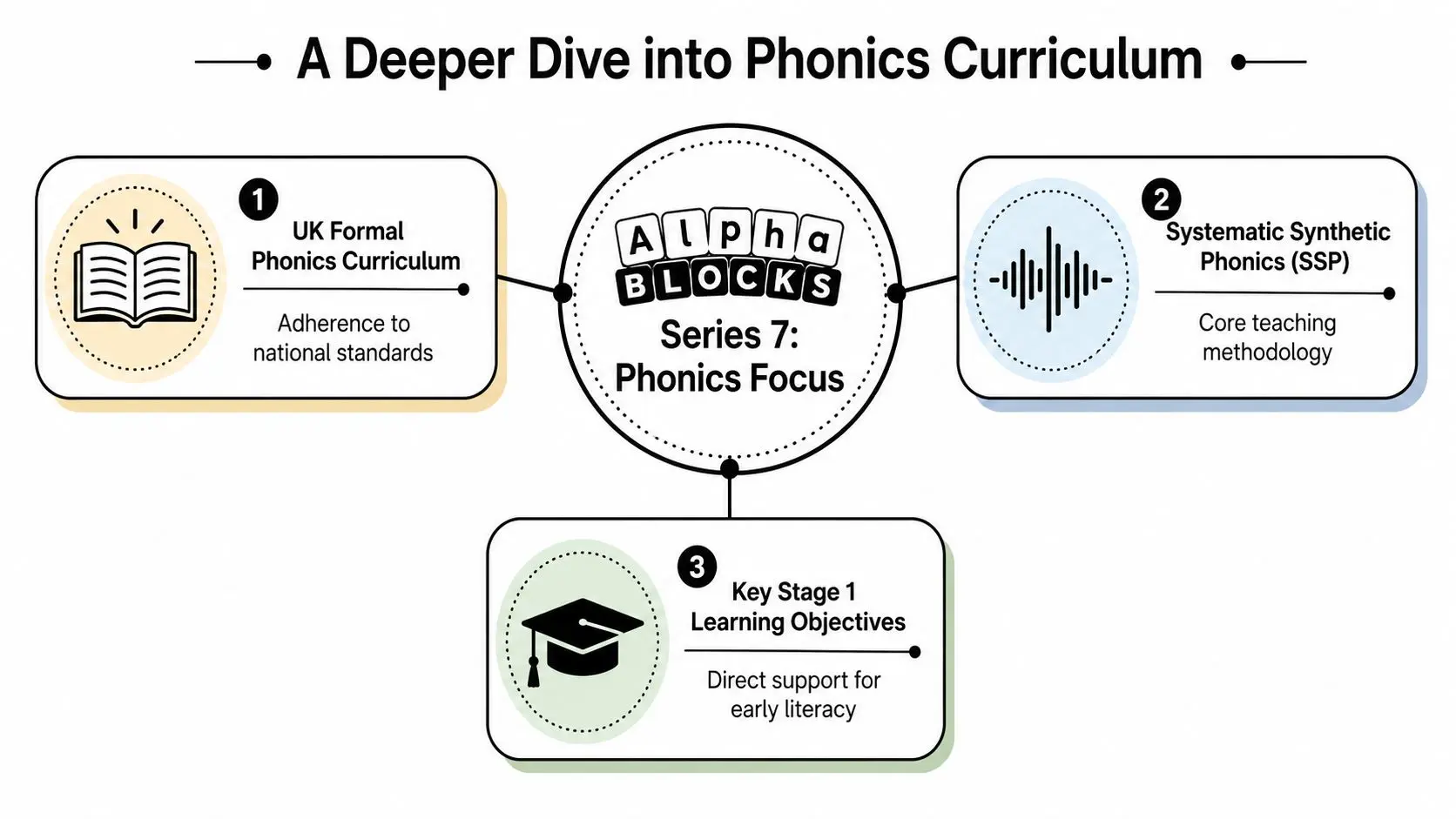
At the centre of Alphablocks is a simple promise: reading instruction made visible. Letters become characters. Sounds become actions. Blending becomes something children can watch, not just hear explained. That's why the curriculum side matters more than any release announcement. One important public claim already shapes the discussion. Alphablocks is credited with helping “a million children learn to read”, but a key unanswered question for Series 7 is which specific new phonics concepts it will introduce, and no public source currently maps the new curriculum against the UK National Curriculum for English, as noted in this YouTube discussion of the Series 7 curriculum gap.
What educators can say now
There's enough information to say that Series 7 is being positioned as a stronger curriculum-facing instalment. There isn't enough public detail yet to map episode-by-episode teaching outcomes with confidence. That distinction matters. In schools, a show becomes more useful when staff can answer practical questions such as:
- •Does this episode reinforce a sound pattern we're teaching this week
- •Does it support blending, segmenting, spelling, or sentence reading
- •Is it revision, extension, or a fresh concept
Without that mapping, teachers will need to preview episodes before plugging them into lessons.
What parents can usefully look for at home
Parents don't need a formal curriculum grid to get value from the series. They do need a way to notice what their child is practising. If a child starts spotting sound patterns in books, experimenting with spelling, or recognising familiar chunks inside longer words, that's useful evidence the programme is doing more than entertaining. For families building a wider early literacy routine, resources on understanding alphabet learning toys can help explain how physical play and screen-based phonics support each other when adults keep the focus on sound, recognition, and repetition.
The missing curriculum map doesn't reduce the show's potential value. It simply means educators should treat early episodes as material to assess, not assumptions to slot straight into planning.
Production and Animation Style Upgrades
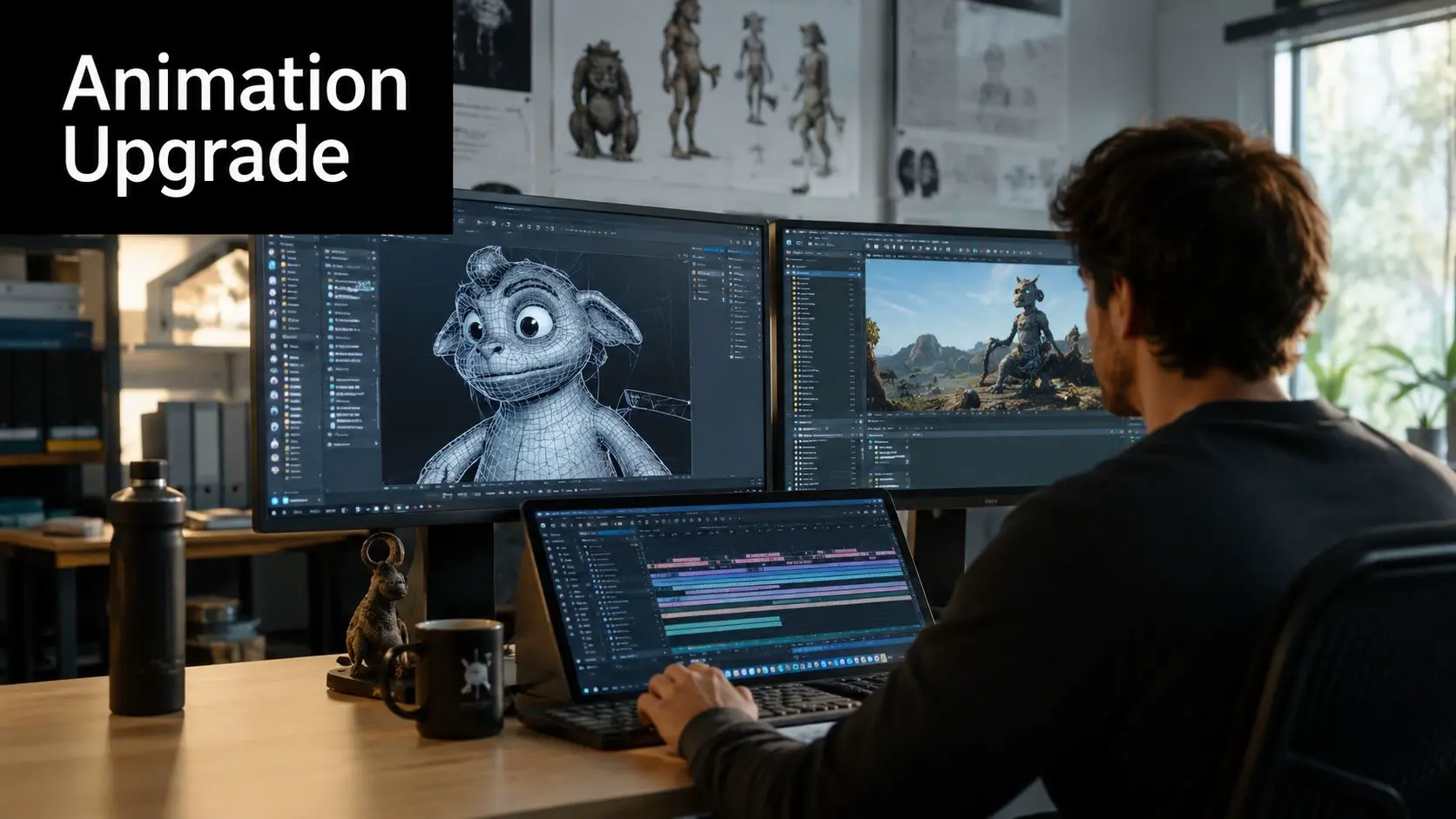
The phrase attached to Series 7 is telling. The new series promises a “fresh visual upgrade” alongside an “advanced phonics curriculum”, and it is expected to follow the digital distribution model used by sibling shows across CBeebies, BBC iPlayer, and YouTube, with related series generating over 81 million views in Q4 2024 alone, according to UK Screen Alliance coverage of the new series. That pairing matters. Educational content works best when pedagogy and production evolve together. A prettier show isn't automatically a better teaching tool. A clearer one can be.
What a visual upgrade usually means in preschool animation
From a studio perspective, “visual upgrade” can cover several kinds of improvement:
| Area | Why it matters educationally |
|---|---|
| Character clarity | Children need to recognise letter shapes and expressions instantly |
| Lighting and colour control | Better contrast can make visual information easier to read |
| Word Magic staging | Effects need to feel exciting without obscuring the learning point |
| Compositing polish | Cleaner final images reduce distraction and improve focus |
This isn't abstract pipeline talk. In phonics television, readability is part of teaching. If a child can't quickly parse what's happening on screen, the educational mechanic weakens.
The likely pipeline thinking behind it
A standard UK 3D animation service pipeline includes rigging, lighting, and rendering, as explained in One Bright Dot's overview of what a 3D animation studio does. Those production stages are exactly where a show like Alphablocks can sharpen clarity and consistency. For readers who want the broader studio workflow behind that kind of polish, this complete guide to the animation production pipeline is a useful technical companion.
Why platform strategy shapes the art direction
A preschool show now has to read well in several environments. It must work on a living-room television, on demand through iPlayer, and in short-form digital exposure where a child may meet the brand through clips before full episodes. That puts pressure on design choices. Character silhouettes need to remain readable. Letter transformations need to land quickly. Background detail has to support, not compete with, the lesson. The best educational animation teams know that every aesthetic decision is also a teaching decision.
Opportunities for Licensing and Collaboration
When a preschool series returns with renewed attention, the screen product is only one part of the story. The other part is the commercial ecosystem around it. For a property like Alphablocks, new episodes can reactivate interest in publishing, learning products, classroom outreach, and digital extensions. That doesn't mean every educational brand should chase every category. It means trusted IP creates options. Alphablocks already holds a specific place in family life and school-adjacent learning. That makes it unusually well suited to partnerships where education and play overlap.
Where the strongest opportunities sit
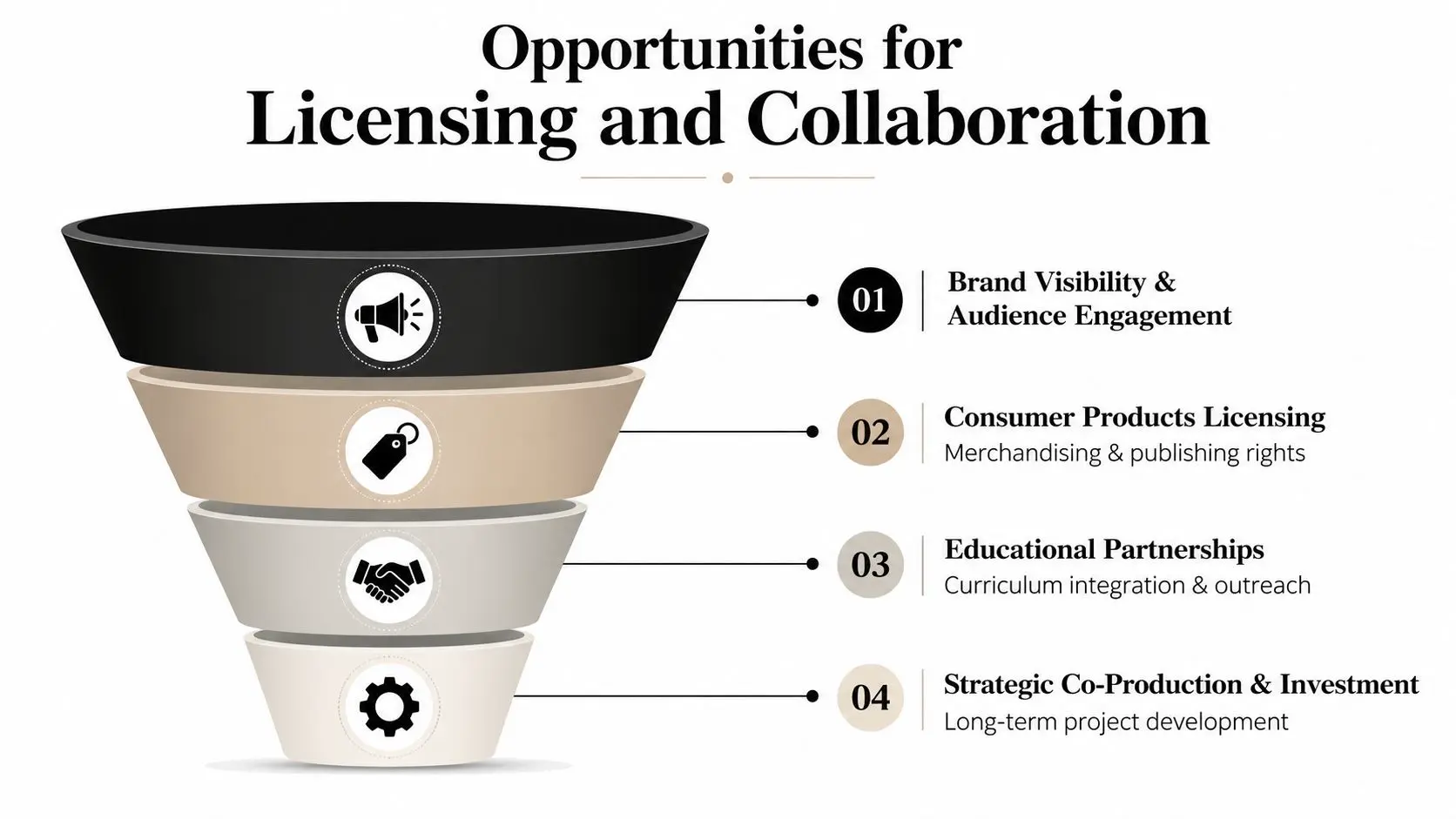
Rather than treating licensing as just merchandise, it's more useful to divide the opportunities by purpose.
- •Consumer products work when they carry the show's learning logic into books, toys, and activity formats.
- •Educational partnerships make sense when schools, libraries, or literacy organisations can use familiar characters to increase engagement.
- •Digital spin-offs become stronger when they extend the phonics mechanic rather than merely re-skinning generic games.
- •Co-production and format partnerships matter if the wider Blocks Universe continues to expand across adjacent subjects and platforms.
Why transmedia planning matters here
Children don't experience IP in neat silos. They move from episode to app to book to toy naturally. The strongest preschool brands plan for that from the start. They ask whether each extension reinforces the core educational promise or dilutes it. That's the difference between brand sprawl and coherent transmedia development. Anyone looking at the strategic side of children's IP can see why IP development planning has become central to long-term franchise value.
A literacy brand becomes more durable when every extension answers the same question: does this help a child practise the skill that made the show trusted in the first place?
What Series 7 Means for the Blocks Universe
The bigger significance of Alphablocks Series 7 isn't only that it's returning. It's that the series appears to carry a sense of closure. Alphablocks Series 7 is confirmed to be the nineteenth series within the entire Blocks Universe and is scheduled for 2027. It is also widely implied to be the final instalment, positioning it as a legacy capstone for an educational IP that has served UK preschoolers via CBeebies for over 15 years, according to the Blocks Universe Series 7 overview. If that implication holds, then Series 7 has two jobs. It must still work as a practical learning tool for new children. It also has to function as a culminating statement about what Alphablocks has been.
Why a capstone can be powerful
A final main-series instalment can sharpen creative choices. Teams often become more deliberate when they know a release may define the long-term memory of the brand. That can lead to clearer educational design, stronger visual craft, and a more intentional relationship to the wider franchise. For parents, that may mean a polished final run. For industry observers, it suggests something more strategic. Core broadcast series can close while the IP itself stays active through clips, library viewing, publishing, licensing, and sibling properties inside the same universe.
The likely future beyond the main series
I don't think this looks like an ending in the blunt sense. It looks more like a handover point. The Blocks Universe has already shown that educational brands can expand by subject area and platform while retaining a shared identity. That opens several plausible paths:
- •Alphablocks remains a library staple used repeatedly by new generations of early readers.
- •The universe grows sideways through related properties and complementary learning themes.
- •The IP lives on through transmedia formats that support literacy without requiring an endless traditional series model.
That's why Alphablocks Series 7 feels unusually important. It isn't just one more season. It may be the release that defines how a successful UK educational property moves from long-running show to long-lasting franchise. --- If you're developing children's content, educational media, or cross-platform IP, Studio Liddell is worth a look. Their work spans animation, TV series production, games, and immersive experiences, which makes them a strong partner for teams thinking beyond a single format and toward a durable learning brand.