A Guide to Animation Services for Modern Businesses
Animation services are so much more than just cartoons. Think of them as a powerful toolkit for solving tricky business problems, from explaining a complex product to creating an unforgettable brand story. At its core, animation is about bringing static ideas to life, using everything from charming hand-drawn 2D sketches to breathtaking 3D computer-generated imagery (CGI), to make a real impact.
What Exactly Are Animation Services Today?
When you hear the word "animation," your mind might jump straight to Saturday morning cartoons. But in the business world, modern animation services are a whole different beast. This isn't just about entertainment; it's about crafting a specific message for a specific audience to get a tangible result, whether that's boosting sales, making employee training stick, or getting crucial buy-in from stakeholders. Think of different animation styles as different languages. A crisp, clean 2D explainer video is perfect for a friendly, conversational message, like walking new users through a software feature. On the other hand, a cinematic 3D product showcase makes a huge, emotional statement, perfect for a major launch where you need to wow your audience. It all comes down to what you need to achieve. For a deeper dive into the different styles, our guide explains CGI and animation for modern brands.
A Spectrum of Strategic Solutions
Today’s animation is less about one specific technique and more about a whole collection of tools we can tailor to your exact needs. The service you end up needing might involve:
- •Storytelling: Weaving a narrative that connects with your audience on a human, emotional level.
- •Visualisation: Making the invisible, visible. Think about showing how a medical device works inside the body or the intricate process inside a jet engine.
- •Simulation: Creating safe, repeatable virtual environments for training people on complex machinery or testing a product before it’s even built.
- •Branding: Bringing a company’s logo and visual identity to life through dynamic motion graphics.
This incredible versatility is animation's greatest strength. It can simplify what's complex, visualise what's abstract, and pull in an audience in a way that static text and images just can't. If you're curious about the fundamental skills that make all this possible, there's a complete guide to learning animation that offers fantastic insights into the craft.
A project's success is defined by how well the chosen animation style serves the core business goal. The most impressive visuals are ineffective if they don't communicate the intended message clearly and persuasively.
Ultimately, understanding animation services means seeing them not as just a creative product, but as a strategic partnership. A studio's real job is to translate your business goals into a visual language that truly speaks to your audience. The end result shouldn't just be beautiful, it has to be effective.
Exploring the Core Types of Animation Production
Think of animation as a toolbox. Knowing which tool to grab is the first step to getting the job done right. Each style has its own unique strengths, production workflow, and ideal use case. Choosing the right one is about more than just aesthetics; it’s about making sure your content achieves its specific goal. Whether you're trying to simplify a complex idea or build an entire world from scratch, the animation style sets the foundation for success. Let's break down the main categories you'll encounter and explore what makes each one tick.
The Clarity of 2D Animation
When you need to deliver a message with absolute clarity and charm, 2D animation is your go-to. This style creates characters and scenes in a two-dimensional space, relying on strong design and movement to tell a story. In many ways, it's the digital evolution of classic hand-drawn cartoons. This approach is brilliant at breaking down complicated information into visuals that are easy to digest. It’s no surprise that 2D is the engine behind so many successful explainer videos, social media ads, and educational modules. Its streamlined nature keeps the narrative direct and focused, without the distraction of photorealistic detail. Key applications for 2D animation include:
- •Explainer Videos: Guiding customers through a new piece of software or service.
- •Social Media Content: Creating eye-catching, shareable clips perfect for platforms like Instagram and TikTok.
- •E-Learning Modules: Visualising concepts in a way that helps people learn and remember.
The Depth of 3D and CGI Animation
For projects that demand realism, depth, and a true sense of scale, 3D and CGI (Computer-Generated Imagery) is the industry powerhouse. The process involves building digital models of characters, objects, and environments and then animating them within a three-dimensional virtual space. The end result is content with a tangible, cinematic quality. Imagine you need to show off a new piece of engineering. With 3D animation, you can spin it around, look inside it, and see every moving part in action, things that are simply impossible with a live-action shoot. This makes it invaluable for product visualisations, architectural fly-throughs, and creating visual spectacles that really capture an audience's imagination.
The real strength of 3D isn't just making things look real; it's the complete control it gives you over light, shadow, texture, and perspective. You're not just capturing a world, you're building it from the ground up.
This is the level of detail that allows brands to create hyper-realistic product demos and production companies to bring entire fantasy worlds to life.
The Dynamism of Motion Graphics
While 2D and 3D animation often focus on characters and narrative, motion graphics is all about bringing graphic design to life. This discipline takes static elements, logos, text, data charts, and animates them to create dynamic, engaging visual content. It's the secret sauce behind slick brand videos and compelling data storytelling. If you’ve ever watched a logo sting at the end of a commercial or seen statistics presented in a dynamic, easy-to-understand way, you've seen motion graphics at work. Its main job is to communicate information quickly and with style. Common uses for motion graphics are:
- •Brand Identity: Animating logos and creating title sequences for corporate videos.
- •Data Visualisation: Turning complex spreadsheets and reports into clear, impactful animated infographics.
- •User Interface (UI) Animation: Showing how a user interacts with an app or website.
The Magic of Visual Effects (VFX)
Finally, Visual Effects (VFX) is the art of seamlessly blending computer-generated imagery with live-action footage. This process lets filmmakers and advertisers create scenes that would be impossible, dangerous, or just too expensive to capture in-camera. From adding digital characters to a real-world city street to removing unwanted elements from a shot, VFX is a critical part of modern filmmaking and high-end advertising. It works best when the audience doesn’t even realise it's there, creating a believable reality that serves the story. This fusion of real and digital is what pushes the boundaries of what can be shown on screen, making truly breathtaking visual storytelling possible.
Stepping into Immersive XR, AR and VR Production
Beyond the familiar flat screen, there's a whole new frontier for grabbing your audience's attention. This is the world of immersive experiences, brought to life by technologies like Extended Reality (XR), Augmented Reality (AR), and Virtual Reality (VR). These aren't just trendy buzzwords; they represent a massive shift in how you can connect with customers, train your teams, and tell unforgettable stories. These powerful forms of animation services are typically built on real-time game engines like Unity and Unreal. They go way beyond just passive viewing, inviting your audience to actually step inside a digital world and interact with it. The result is a level of engagement and memory retention that traditional media simply can't touch.
Understanding the Immersive Spectrum
While they often get lumped together, AR, VR, and XR all do different things, and each offers a unique way to connect with people. Getting your head around the differences is the first step to picking the right tool for the job.
- •Augmented Reality (AR): This is all about overlaying digital information, like animations, 3D models, or text, onto the real world, usually through a smartphone or tablet. Think of a customer using their phone to see exactly how a new sofa would look in their living room before they click 'buy'. That's AR working its magic.
- •Virtual Reality (VR): VR is a total immersion. It swaps the user's real-world surroundings for a completely computer-generated environment, experienced through a headset. It’s perfect for highly detailed training simulations, virtual property tours, or any story where you need someone's complete, undivided attention.
- •Extended Reality (XR): This is simply the umbrella term that covers AR, VR, and everything in between. It’s the whole spectrum of technologies that merge the real and virtual worlds, opening up brand-new ways for us to interact with computers.
If you're exploring what's possible with advanced immersive tech, checking out options for Virtual Reality (VR) experiences can show you how it’s being used to create a real buzz at events and in marketing.
From Concept to Immersive Reality
Creating these experiences is a special kind of craft, blending the artistry of animation with some pretty complex software development. The process is a real partnership, turning a business goal into a tangible, interactive world. It’s an act of translation, taking a flat storyboard idea and building it into a dimensional space that people can actually explore. The production pipeline for an immersive project is very different from traditional animation. It kicks off with some serious concepting and user experience (UX) design, where we map out exactly how a user will move, look, and interact within the digital space. This stage is absolutely critical for making sure the final product feels natural and easy to use.
The real magic of an immersive experience is when the technology just disappears. A successful project makes the user feel completely present in the digital world, whether they're learning a new skill or exploring a brand story.
This deep focus on user interaction is what really sets XR production apart. You can find out more about how we tackle these unique challenges in our overview of virtual and augmented reality services.
Practical Applications That Drive Real Results
The true power of immersive technology is unlocked when you apply it to solve real-world business problems. XR-based animation services aren't just about creating a novelty; they're about delivering measurable results and giving you a genuine competitive edge. Just look at some of these powerful use cases:
- •Retail and E-commerce: AR apps that let customers "try before they buy", from placing virtual furniture to trying on digital accessories, have been shown to seriously boost conversion rates.
- •Training and Education: VR simulations give employees a place to practise complex or dangerous tasks, like operating heavy machinery or performing a medical procedure, in a totally safe and repeatable virtual environment.
- •Marketing and Events: Brands can create unforgettable event activations with location-based VR games or AR-powered scavenger hunts that drive foot traffic and get people talking on social media.
- •Property and Architecture: Immersive virtual tours allow potential buyers to walk through a property before a single brick has been laid, helping to speed up off-plan sales and secure investment.
By moving animation off the screen and into the user's own space, XR offers a much deeper, more memorable way to communicate, educate, and persuade.
How a Project Moves From Brief to Final Render
Ever wondered what happens between signing on the dotted line and seeing the final, polished animation? The journey from a simple creative brief to a final render isn’t magic; it’s a highly structured process designed to keep everything on track, on budget, and perfectly aligned with your vision. This production pipeline isn’t just a list of tasks. It's a collaborative framework with crucial feedback loops built in, so there are no nasty surprises waiting for you at the end. Think of it like building a house. You wouldn’t start laying bricks without a detailed blueprint. In animation, that blueprint is meticulously crafted during the pre-production phase. This is where a seasoned studio really proves its worth, translating your business goals into a concrete visual plan.
Phase 1: Pre-production and Concept Development
This is the foundation. It's all about planning, mapping things out, and getting everyone on the same page. Honestly, this is the most critical part of the entire process, because the decisions made here will steer every single step that follows. A rock-solid pre-production phase prevents costly changes down the line and makes sure we're all aiming for the same creative target. We start by taking a deep dive into your project brief, getting to grips with your objectives, your audience, and the key messages you need to land. From there, the creative work begins to take shape through a series of key deliverables.
- •Scriptwriting: A powerful script is the backbone of any good story. This is where we nail down the narrative, the tone of voice, and the overall pacing.
- •Storyboarding: This is the first time you’ll actually “see” your project. A storyboard is basically a comic book version of your animation, a sequence of drawings that maps out each scene and brings the script to life visually.
- •Animatic: We then take those storyboard frames, edit them together, and time them out with a rough voiceover or some temporary music. This basic video gives you a surprisingly clear feel for the project's flow and timing before we commit to any proper animation.
Phase 2: Production and Asset Creation
Once the blueprint from pre-production gets the green light, the production phase kicks into high gear. This is where the world we've planned starts getting built, piece by piece. Our artists, modellers, and animators get to work creating all the visual components needed for the final product. The exact process here depends entirely on the project's style, whether it's 2D, 3D, or an immersive XR experience. For a 3D project, this means modelling characters and environments, texturing them to add colour and detail, and rigging them with a digital skeleton so they can actually move. For 2D, it’s all about creating the character artwork and background illustrations.
When the goal is scaling beloved IP across platforms, every asset must be built with future uses in mind. A character rig designed for a TV series might need adapting for a real-time game, requiring a pipeline that’s both robust and flexible.
This quote gets right to the heart of the production process: faithfully translating an idea from one medium to another while planning for its future life. Every single asset is created with the final vision from the storyboard front and centre, ensuring everything looks and feels cohesive. This diagram shows how the path diverges when we're creating different types of immersive experiences.
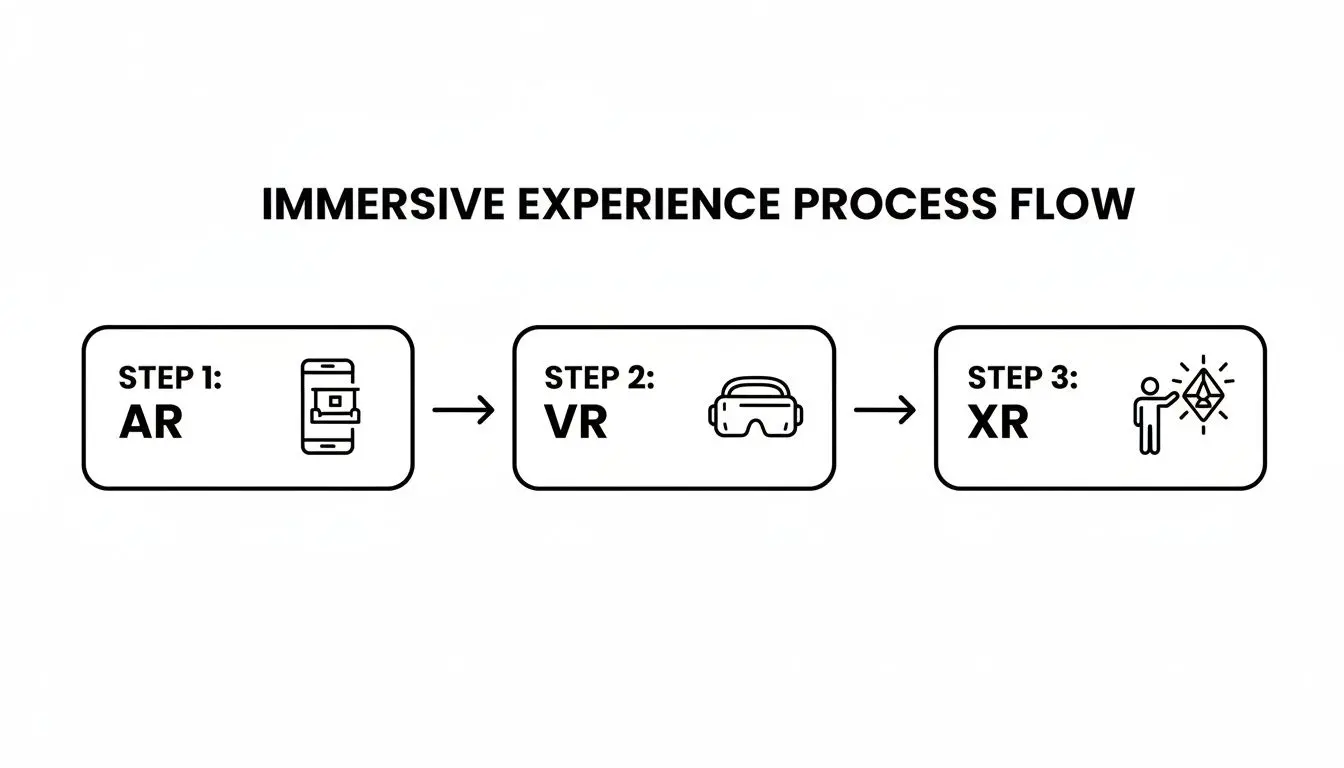
You can see how the production focus shifts, from overlaying digital content for AR to building entire self-contained worlds for VR and XR.
Phase 3: Post-production and Final Delivery
With all the scenes animated and the assets in place, the project enters its final stage: post-production. This is where we assemble all the individual elements and apply that final layer of polish that brings everything together. It's the last bit of magic. The key steps in this stage include:
- Compositing and VFX: Animated elements are layered together with backgrounds and any visual effects. This is also where we do the colour grading, making sure the final look is vibrant and consistent from start to finish.
- Sound Design and Mixing: We add and mix professional voiceovers, sound effects, and a custom musical score to create an audio experience that pulls the viewer in.
- Rendering: This is the heavy lifting, computationally speaking. It's the technical process where the computer takes all the data from our 3D scenes and exports it as the final video frames.
- Final Delivery: The finished animation is exported in all the required formats and specifications, ready for broadcast, your website, or your social media channels.
So, How Much Will It Cost and When Will It Be Ready?
These are the two questions at the top of every client’s list, and rightly so. Getting a handle on what drives animation budgets and timelines is the first step towards a great partnership. It helps demystify the investment needed to create something truly special. Let's be upfront: there’s no simple price list for creative work. The cost and schedule for any project are tied directly to its ambition. A clean, snappy 60-second 2D explainer video is a completely different beast from a hyper-realistic 3D product demo packed with complex visual effects.What Shapes the Budget and Timeline?
Think of your animation project as a recipe. The ingredients you choose and the complexity of the dish will determine the cooking time and the final bill. Here are the main drivers we’ll need to talk about:- •Style and Technique: A 2D motion graphics piece is generally quicker and more cost-effective to produce than a full 3D character animation. The latter involves a much more intensive process of modelling, rigging, texturing, and rendering.
- •Complexity and Detail: How much is going on in the frame? A single character against a simple background is far less involved than a bustling city scene with crowds, traffic, and detailed environments. More detail means more artist hours.
- •Project Length: While a longer video will naturally cost more, it’s not always a straight line. The initial setup, creating assets, designing characters, building worlds, takes up a big chunk of the work. Because of this, adding an extra 30 seconds to a two-minute video can be much more economical than creating a whole new 30-second spot from scratch.
- •Production Speed: Need it in a hurry? An accelerated timeline often means bringing more artists onto the project or scheduling overtime, which will bump up the budget.
Understanding these variables helps us have a much more productive conversation. It’s all about aligning your creative vision with the practical realities of time and money.
The UK Animation Tax Relief: Your Secret Weapon
For anyone commissioning work in the UK, there’s a game-changing financial incentive that makes world-class animation more accessible than ever. The UK's Animation Tax Relief (ATR) is a generous government scheme designed to champion our industry, allowing qualifying projects to claim a cash rebate of up to 25% of their production costs. This isn’t just for big-budget feature films. The relief applies to broadcast series, web content, and even high-end commercial projects, as long as they meet certain cultural and spending criteria. This tax break makes the UK an incredibly competitive place for animation production, essentially stretching your budget further without a single compromise on quality.
Schemes like the ATR are why the UK is a global hub for animation. It empowers studios like ours to invest in top-tier talent and technology, delivering premium results while offering a real financial advantage to our clients.
The impact is huge. According to the latest UK government stats for 2023-2024, there were 120 claims for Animation Tax Relief, supporting 145 projects and paying out a massive £33 million. A significant 33% of these claims were for over £250,000, accounting for 80% of the total relief, which shows just how much the scheme drives major investment. You can explore more about these creative industry statistics and see the full breakdown for yourself. This incentive gives both international and domestic companies a powerful reason to partner with UK studios. It completely reframes the budget conversation, making ambitious, high-calibre animation a much more attainable and strategically sound investment.
How to Choose the Right Animation Studio
Picking a creative partner is one of the biggest calls you’ll make for your project. The right animation studio isn’t just a supplier; they become an extension of your team, a group of specialists whose job is to turn your vision into a compelling visual story. But with so many flashy demo reels out there, how do you find a studio that truly gets it? You need a partner with the technical chops, the project management skills, and the collaborative spirit to see your project through from start to finish. This is about finding a team you can trust to not only create something beautiful but to deliver on your core business goals.
Look Beyond the Showreel
A studio's portfolio is their highlight reel, polished to perfection. While it’s a great starting point, you’ve got to dig a bit deeper to find the right fit. Look for consistency across different styles and projects, but more importantly, hunt for case studies that resonate with your industry or your specific challenge. An award-winning animated short is one thing, but if you need a technical explainer for a complex medical device, you’ll want proof they’ve successfully handled that kind of material before. Their ability to make intricate subjects clear and engaging is far more valuable than general creative flair alone.
A studio’s real value isn’t just in _what_ they create, but in _how_ they create it. A transparent, collaborative production process is often the single biggest indicator of a project's future success.
It's also worth thinking about the talent you're tapping into. The UK animation scene is a creative powerhouse, employing thousands of highly skilled professionals and supporting up to 15,390 jobs across the wider industry. When you work with a UK-based studio, you’re plugging directly into that world-class expertise. You can get a better sense of this from research on the UK’s animation workforce.
Key Questions to Ask Potential Studios
When that first discovery call comes around, being armed with the right questions can tell you everything you need to know. This isn't just about grilling them; it’s about starting a conversation to see if you click. For a complete rundown of what to ask, have a look at our 2025 buyer's guide to choosing an animation studio. To get you started, here’s a practical checklist to guide those initial chats and help you vet potential partners with confidence.
Animation Studio Vetting Checklist
Use this simple checklist to guide your conversations with potential studios. It’s designed to help you look past the portfolio and understand how they actually work, ensuring you find a partner who is a true fit for your project's needs.
| Evaluation Area | Key Questions to Ask | What to Look For |
|---|---|---|
| Technical Pipeline | Can you walk me through your production workflow, from brief to delivery? What software and tools do you primarily use? | A clear, structured process with defined stages for client feedback. Experience with industry-standard software like Maya, Unreal Engine, or Cinema 4D. |
| Project Management | Who would be my main point of contact? How often can I expect updates, and how do you handle feedback and revisions? | A dedicated project manager or producer. A commitment to regular, scheduled communication and a clear, fair process for revisions. |
| Industry Experience | Can you share examples of projects you've completed in our sector (e.g., tech, healthcare, entertainment)? | Specific case studies that demonstrate an understanding of your industry’s language, audience, and unique communication challenges. |
| Team & Culture | Who would be working on our project? What is your studio's approach to creative collaboration? | A clear idea of the core team's expertise. An open, collaborative attitude that shows they value your input as a key stakeholder. |
By taking a structured approach like this, you can move beyond a simple gut feeling. You'll be able to make a strategic choice and find a studio with the proven ability to bring your vision to life, on time and on budget.
Got Questions About Animation? We've Got Answers
Stepping into the world of animation for the first time can feel a bit like learning a new language. There are lots of moving parts, and it’s natural to have questions about how it all comes together. To clear things up, here are some straightforward answers to the queries we hear most often.
How Long Does It Take to Make a One-Minute Video?
This is probably the most common question we get, and the honest answer is: it depends! For a typical one-minute 2D explainer video, you should budget for around 4 to 8 weeks. That timeline gives us enough breathing room to cover everything properly, from hashing out the initial idea and script, through to storyboarding, animating, and adding the final sound design. If you’re thinking about something in 3D, the timeline naturally gets a bit longer. Building everything in three dimensions, the modelling, texturing, lighting, and rendering, is a much more intensive process. For a one-minute 3D animation, you're usually looking at 12 weeks or more.
What Do I Need to Give You to Get Started?
The best starting point is always a clear, simple brief. Don't worry, it doesn't need to be a novel. Just a document that lays out what you want to achieve, who you’re talking to, and the main messages you need to get across. This brief becomes our roadmap for the entire project. Beyond that, your brand guidelines are a massive help. Things like your logo files, specific brand colours (hex codes are perfect!), and any official fonts help us keep everything looking consistent and professional. If you've already got a rough script, a PowerPoint presentation, or even just a few bullet points scribbled down, share those too, it gives our creative team a fantastic launchpad.
Can I Make Changes Along the Way?
Of course! We wouldn't have it any other way. Collaboration is at the heart of what we do, and your feedback is what makes a good animation great. A professional production process is built around key review stages, so you'll have plenty of chances to share your thoughts. We'll typically check in with you for approval after the script is finalised, once the storyboard is ready, and again after we've created a rough animation test (we call this an 'animatic'). This step-by-step approach means there are no big surprises at the end, and it guarantees the final piece is exactly what you had in mind.
At Studio Liddell, we bring broadcast pedigree and technical innovation to every project, offering end-to-end production from initial pitch to final delivery. Feel ready to chat about your own project? Book a production scoping call with our team and let's get the conversation started.