A Guide to a R Codes: Brand Engagement
You're probably looking at a familiar mix of channels right now. Print still matters. Social still matters. Packaging, point-of-sale, event graphics, direct mail, outdoor, all still matter. But the weak point is obvious. Most of those touchpoints still hand people off to flat content, a landing page, a video, a PDF, or a standard QR journey that gets the job done without creating much memory. That's where AR codes start to earn their place. Used well, they turn a passive surface into an interactive one. A poster can launch a product demo. Packaging can open a 3D explainer. An exhibition graphic can become a guided object reveal. For a marketing director, that's the shift worth paying attention to. You're not just adding novelty. You're creating a clearer bridge from physical attention to digital action. The commercial logic is straightforward. People already scan. They already browse on mobile. They already buy online. The question isn't whether audiences understand the behaviour. The question is whether your experience gives them something better than a generic destination page.
From Static Ads to Interactive Experiences
The problem with most brand touchpoints isn't reach. It's flatness. A printed ad can still look sharp. A shelf-talker can still stop someone. Event signage can still attract a crowd. But when the interaction ends at “scan for more information”, the experience often collapses into a routine mobile moment that feels no different from any other link. That's where AR codes become useful. They add a layer of interaction at the moment of intent, not later in the funnel.
Why passive media now feels incomplete
A normal QR code is functional. It gets a user from one place to another. An AR code does more. It can place animation, product visualisation, guided information, or character-led storytelling directly into the user's view of the physical world. That changes the role of the physical asset. It stops being only a signpost and starts acting as the launch point for an experience. For retail and commerce teams exploring broader augmented reality solutions for retail, this matters because the strongest AR work doesn't sit in isolation. It connects packaging, point-of-sale, product education, and decision support in one journey.
AR works best when it removes uncertainty, not when it adds spectacle for its own sake.
Where AR codes fit in a real marketing mix
The practical value of AR codes is that they sit comfortably inside channels brands already buy and produce:
- •Print campaigns: Posters, leaflets, inserts, and direct mail can trigger a 3D object, film trailer extension, or guided brand story.
- •Retail environments: Shelf-edge graphics and packaging can launch product information in a more spatial, memorable format.
- •Events and exhibitions: Stand graphics can move visitors from glance to participation without needing staff to explain the interaction first.
- •Education and public information: A worksheet, wall graphic, or display panel can reveal layered content without forcing users into a separate app journey.
That's why AR codes aren't a futuristic side project anymore. They're a practical response to an old problem. Physical media gets attention, but often struggles to deepen engagement. AR closes that gap.
What Exactly Are AR Codes and Their Types
The simplest way to explain AR codes is this. A QR code is usually a shortcut to content. An AR code is a shortcut to content that appears in context. That distinction matters. One sends you somewhere else. The other can place digital material into the user's real-world view, which makes the interaction feel immediate rather than redirected.
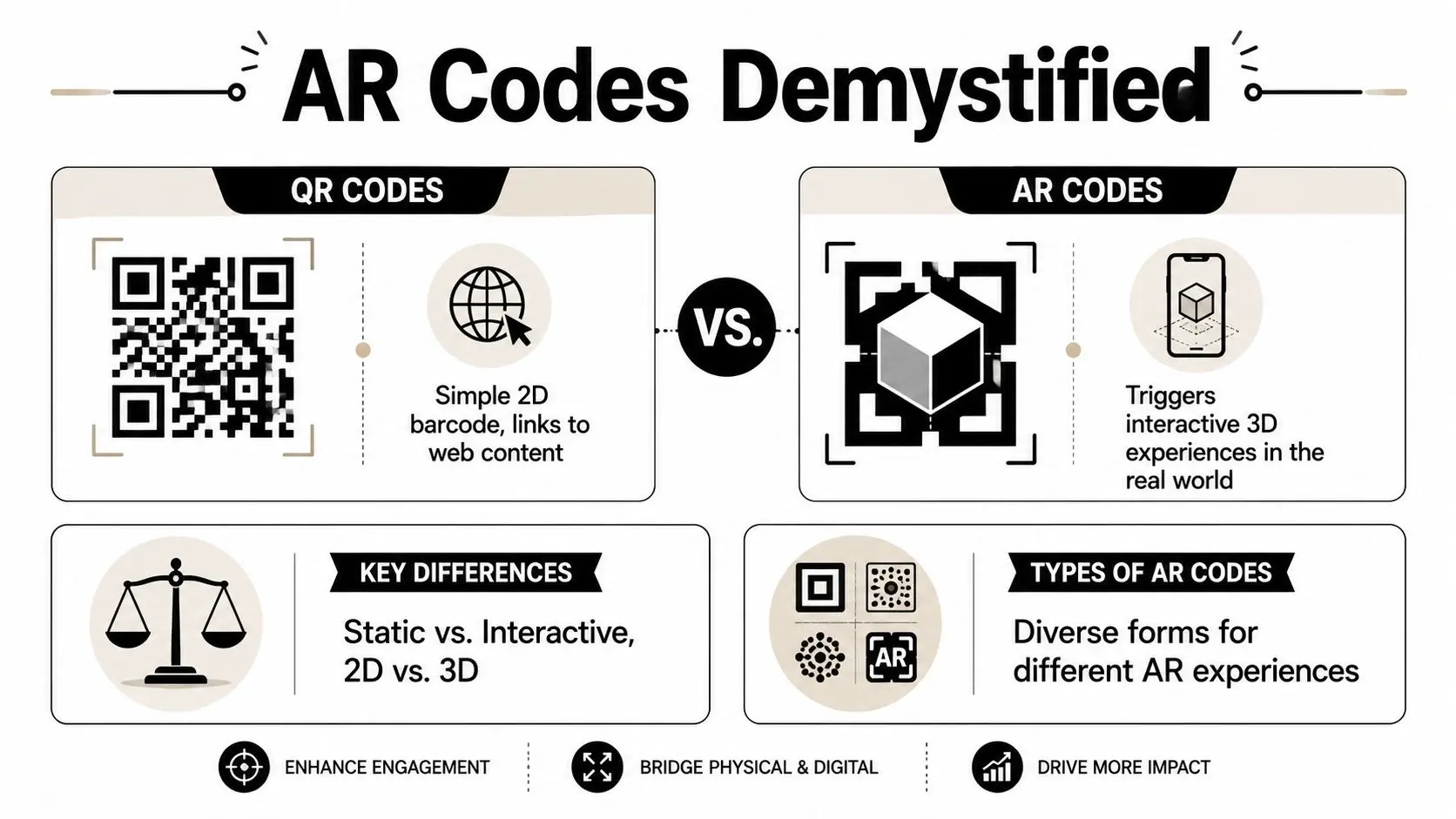
If you want a more detailed companion read on implementation choices, Studio Liddell's guide to augmented reality cards explained is a useful reference point.
The core idea
Think of standard QR as a link. Think of AR code as a trigger plus an anchor. Sometimes the “code” is visually obvious and scannable. Sometimes it's a marker designed for tracking. Sometimes the system blends QR-style access with image-based or environment-based AR. In all cases, the job is the same. Get the user into an interactive scene with as little friction as possible.
The main types you'll encounter
| Type | What it relies on | Best fit | Main trade-off |
|---|---|---|---|
| Marker-based AR | A specific visual marker or code | Packaging, education cards, museum labels, controlled print | Stronger dependence on print quality, contrast, and visibility |
| Markerless AR | Surface detection and environment mapping | Product placement, room-scale visualisation, open-floor demos | More variable performance in mixed real-world settings |
| QR-AR hybrid | A QR-style entry point plus browser-based AR experience | Campaigns that need simple public access | Easier launch, but content still needs careful optimisation |
When to use marker-based AR
Marker-based experiences are the most production-friendly when you need control. If the user scans packaging, a card, a poster, or a printed display, a marker gives the system a clear visual reference. That usually makes alignment easier to manage, especially when you want a character, product model, or animated layer to appear in a specific place relative to the print item itself. This is often the right choice for brand activations, learning materials, and promotional collectibles because you control the trigger surface.
When markerless AR is the better option
Markerless AR suits experiences where the object should live in the space rather than on a printed item. Furniture visualisation is the obvious example, but the same logic applies to exhibitions, educational walkthroughs, and room-based training interactions. The upside is flexibility. The downside is consistency. Real rooms are messy. Lighting varies. Surfaces vary. Camera distance varies. That affects stability.
Practical rule: Use marker-based AR when placement needs to be precise. Use markerless AR when spatial freedom matters more than exact alignment to print.
Why QR-AR hybrids are commercially attractive
For many campaigns, QR-AR hybrids are the sweet spot. They use behaviour audiences already know. Scan the code, open the browser, launch the experience. That makes them much easier to deploy across public-facing campaigns than workflows that depend on users installing an app first. In practice, that's why most marketing-led AR code projects start here.
How AR Codes Work The Technology Explained
The technology sounds more exotic than it is. In production terms, AR codes depend on a chain of simple things going right in sequence. The camera has to recognise what it's looking at. The device has to work out where that thing sits in space. Then the browser or app has to render digital content in the right place, at the right scale, without obvious lag.
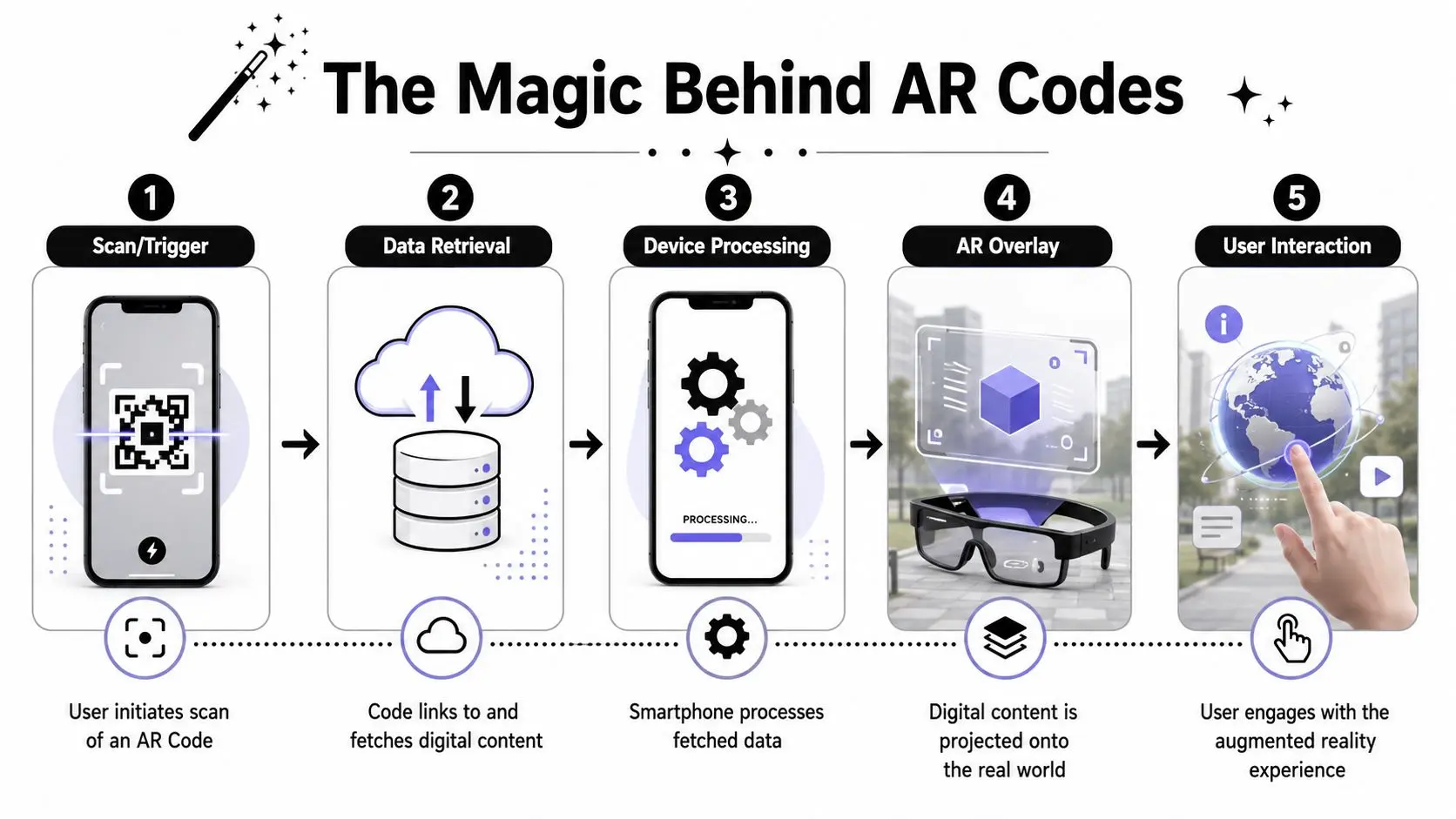
For a broader production view of platforms and build paths, this overview of augmented reality application development covers the main technical choices.
Recognition and tracking
In UK-facing WebAR deployments, an AR code should be treated as a computer-vision anchor. The marker must remain visually detectable long enough for the device to estimate pose, its 3D position and orientation, and that stability is what keeps the overlay from drifting or detaching from the target, as explained in this overview of AR code marker behaviour. That has direct production implications. Low-contrast artwork, glossy reflections, tiny print sizes, and busy backgrounds all make recognition harder. So do partial folds, curved packaging, and poor venue lighting.
Pose estimation and why it matters
Once the device detects the marker or environment, it estimates pose. That's the technical step that decides whether the digital layer feels properly attached to the world or obviously fake. Marketing teams often focus on the 3D asset first. In practice, tracking quality usually matters more. A beautiful model with unstable pose feels broken. A simpler model with solid tracking feels convincing. That's why testing with the actual printed substrate, likely viewing distance, and common handset mix matters more than a polished desktop demo.
If the marker can't hold tracking in normal use, the creative doesn't matter. Users will read it as failure, not ambition.
Rendering and delivery choices
There are two common routes here. WebAR is usually the right commercial choice for public campaigns because it opens in the browser and reduces friction. It's easier to distribute through posters, packaging, inserts, and event graphics. The compromise is technical restraint. Assets need to be lighter, cleaner, and optimised for mobile delivery. Unity or Unreal become more relevant when the experience is deeper, more bespoke, or tied to a dedicated app, exhibition build, headset deployment, or a broader real-time content pipeline. They give teams more room for interaction design and visual control, but they add complexity to deployment and usually raise the bar on production planning.
The geospatial layer
Some AR experiences also need location logic. Not all a r codes do, but if the interaction changes by venue, site, or place, geospatial thinking becomes part of the brief. This plain-language explainer on geospatial data is useful if your campaign starts moving into location-aware territory.
What works and what usually fails
- •Works well: high-contrast markers, generous quiet zones, clean browser launch, compressed textures, and concise scene design.
- •Common failure point: treating print design and AR tracking as separate jobs.
- •Also fails: loading a heavy scene over mobile data and expecting the user to wait.
- •Often overlooked: testing in the actual environment, not just in the studio.
Practical Use Cases and Tangible ROI
The most useful question isn't “Can AR do this?” It's “What business job is this interaction doing?” When AR codes work, they reduce hesitation, improve comprehension, or create a stronger reason to act. The technology matters, but the return usually comes from one of those three outcomes.

The audience conditions in Britain are already favourable. In 2024, 88% of adults in Great Britain were recent internet users, 89% of those recent users accessed the internet via a mobile phone, and 69% bought goods or services online, which is why code-based interactions can scale in public-facing campaigns without asking people to change behaviour first, according to these UK digital adoption figures.
Retail and packaging
A shopper stands in front of a product with limited shelf space and limited patience. Static packaging has to fight hard to explain value. An AR code can launch assembly guidance, ingredient provenance, feature breakdowns, or a product visualisation that places the item in use. The ROI logic is practical:
- •Purchase confidence: clearer understanding before checkout
- •Reduced service burden: fewer basic questions pushed to staff or support teams
- •Richer product storytelling: more depth without overcrowding the pack
- •Better behavioural insight: teams can compare scans, launches, and completions rather than guessing what customers explored
Education and training
AR codes are strong when the subject is spatial, layered, or difficult to visualise in 2D. That makes them useful for classrooms, museums, healthcare learning, public information, and staff training. A worksheet can reveal a 3D object. A display panel can show process animation. A training card can launch a guided sequence on a phone rather than relying on a printed diagram alone. This article on augmented reality ROI and engagement is useful if you're framing these outcomes internally and need a clearer business case.
Exhibitions and live environments
Events are where AR codes often move from “interesting” to “commercially obvious”. Printed graphics already exist. Footfall already exists. The challenge is converting attention into a memorable interaction without forcing queue-heavy hardware or staffed explanation. A browser-based AR launch can give visitors a quick hands-on product reveal, a character interaction, or a guided story beat that deepens stand dwell time and makes post-event follow-up more meaningful.
The strongest AR activation is usually the one that respects the pace of the environment. Fast launch. Clear payoff. No tutorial needed.
Entertainment and brand worlds
In entertainment, AR codes are less about utility and more about emotional stickiness. A film poster can reveal a creature. A toy pack can animate a character. A promo insert can open a collectible scene that feels shareable and branded without becoming a full app product. That kind of work tends to perform best when it extends an existing story world rather than trying to invent one at the scan point.
Your Roadmap to a Successful AR Implementation
An AR code campaign usually succeeds or fails long before launch day. The deciding factors are basic production choices. Is the marker readable on the final print stock? Does the experience load fast enough on a mid-range phone on mobile data? Are you measuring the action that matters after the scan?
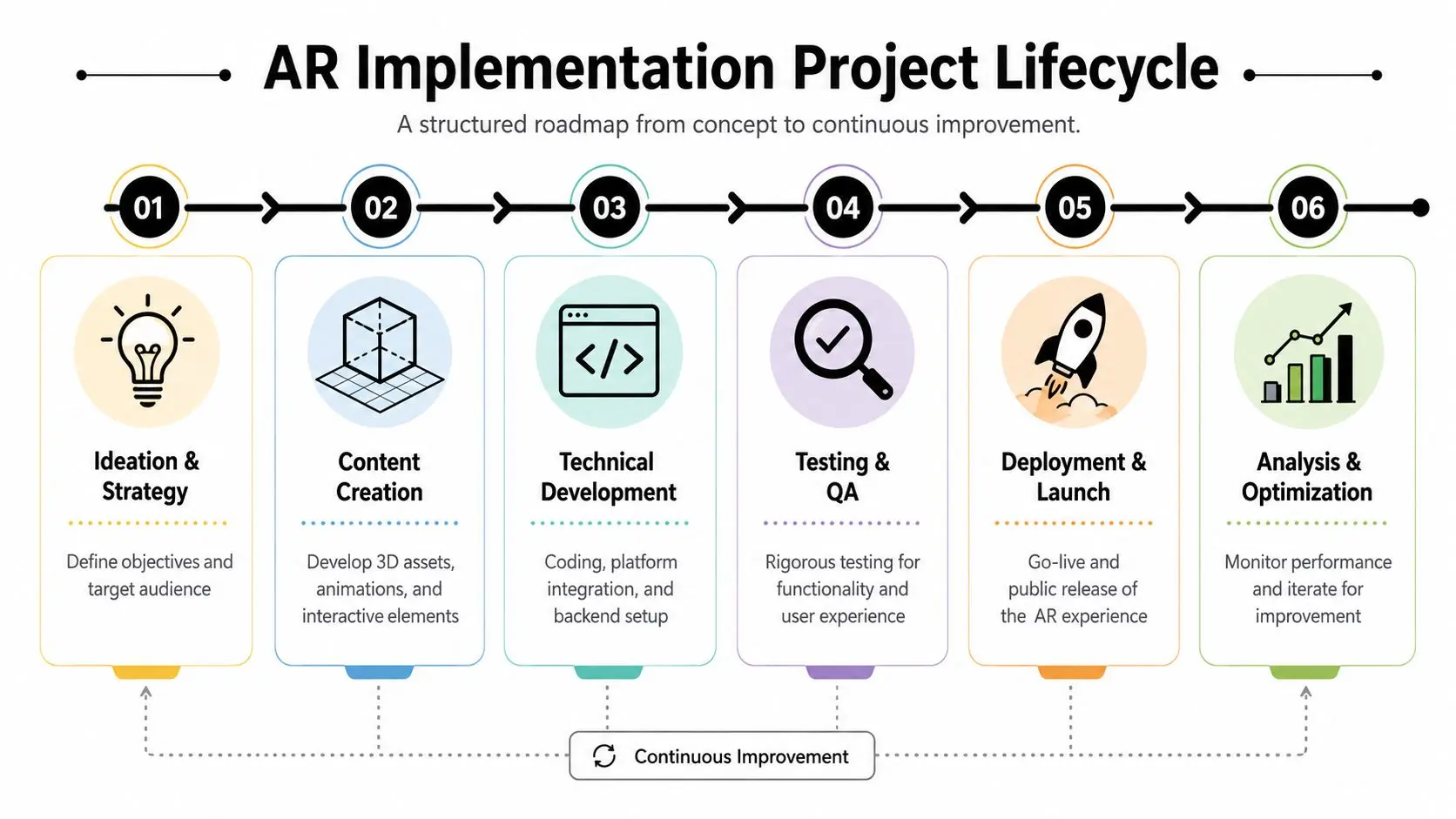
Start with one clear business objective
Set the commercial goal first, then shape the experience around it. If the brief says “do something immersive,” the result is usually a novelty layer with no clear job to do. A stronger brief defines the business problem in plain terms. Reduce hesitation at shelf. Increase dwell time at a stand. Improve comprehension in training. Support a sales conversation with a product demo that fits in a browser. A useful brief should pin down four things:
- •User moment: where and why the person encounters the code
- •Desired action: what they should do after scanning
- •Core value: what the AR layer adds that static media cannot show clearly
- •Success metric: what counts as a worthwhile completion
That last point matters. If success is measured only by scan volume, teams end up optimising for curiosity instead of business value.
Design the trigger and the experience together
The printed trigger and the AR scene are one system. Treating them as separate workstreams creates avoidable problems late in production. Marker size, contrast, placement, finish, and surrounding layout affect detection. So do viewing angle, camera framing, and the first visual moment in the scene. A beautifully built experience can still underperform if the code sits on reflective varnish, appears too small on pack, or gets buried in cluttered artwork. This is usually where practical trade-offs show up. A larger code may interrupt the packaging design. A cleaner placement may improve scan rate enough to justify that compromise. Good teams make that call early, not at artwork sign-off.
Build for web reality, not studio perfection
Public-facing AR codes usually work best when they open in the browser. That reduces launch friction, but it also sets hard limits on asset weight, animation length, and interaction complexity, as outlined by AR Code's WebAR workflow. The creative should be built differently for web delivery. Heavy geometry, oversized textures, and long intro sequences often survive internal reviews and fail in real use. People scan in imperfect conditions, with mixed connectivity, on phones your team did not test in the studio. A good rule is simple. Show value fast. If the first meaningful visual takes too long to appear, a large share of users will leave before the experience earns their attention.
Test in the environments that matter
Lab testing is not enough. A peer-reviewed study on marker-less tracking found that accuracy drops as the subject moves farther from the camera, which is exactly the kind of limitation that affects schools, clinics, public venues, and other spaces where distance and room layout vary, as shown in this study on real-world tracking limits. A serious QA plan should cover:
- Device spread: newer and older phones, different browsers, different camera quality
- Lighting variance: daylight, low indoor light, exhibition lighting
- Distance checks: close scan, natural holding position, and wider viewing range
- Print checks: final stock, final size, and final finish, not just on-screen artwork
Measure what happens after the scan
Scans show interest. They do not show effectiveness. The more useful questions are whether the experience loaded, whether the user reached the key moment, how long they stayed, and whether they took the intended next step. That might be a product view, a content completion, a lead action, or a sales handoff. Those are the metrics that help a marketing team decide whether AR deserves a larger role in the channel mix. Partner choice matters here too. The essential requirement is not just creative capability. It is the ability to handle concept, optimisation, deployment, QA, and measurement as one delivery process.Real World Success Stories with AR Codes
The best way to assess AR codes is to strip away the hype and look at use in context. The pattern is usually consistent. There's a communication problem, a physical touchpoint, and a user who needs a stronger reason to engage.Retail product confidence
A homewares brand has strong in-store presentation but a weak explanation layer. The product is well designed, yet customers hesitate because material finish, scale, and setup aren't easy to grasp from packaging alone. The solution is an AR code on pack and shelf display that launches a lightweight product visualisation and a short guided feature reveal in-browser. The user doesn't have to install anything. They scan, place, inspect, and move on. The result isn't magic. It's better decision support. Customers understand the product more quickly, sales staff spend less time on basic explanation, and the brand gets a clearer picture of which products attract deeper interaction.Education and complex subjects
A school, museum, or learning publisher often faces the same issue. Flat diagrams can explain sequence, but not always structure. That's especially true when the subject involves anatomy, engineering, archaeology, or layered scientific systems. The solution is a printed learning asset that triggers a spatial model, a labelled animation, or an explainer sequence tied directly to the physical page. The code becomes the bridge between curriculum material and richer visual understanding. The result is usually stronger engagement and fewer moments where learners stall because the diagram alone isn't enough. In education, that matters more than novelty. If the AR layer clarifies the concept, it earns its keep.Entertainment and promotional campaigns
An entertainment campaign has a different brief. The audience doesn't need instruction. They need a reason to care. A poster, trading card, ticket insert, or toy pack can launch a character moment, a world-building scene, or an interactive teaser. The point isn't to replicate a game. It's to extend the campaign beyond the printed object and give fans something worth revisiting or sharing.The strongest campaign-led AR doesn't try to do too much. It delivers one memorable interaction that feels native to the IP.The result is a promotional asset with more staying power. The printed piece no longer ends at the visual design. It becomes a repeatable trigger for story, anticipation, and brand memory.
Best Practices and Partnering for Success
A good AR code project is usually disciplined rather than flashy. Keep the marker or trigger highly legible. Design for real lighting, not just ideal lighting. Optimise 3D assets for mobile web delivery. Make the first interaction obvious without needing instructions. Treat analytics as part of the brief, not an afterthought. And test on the devices people use, in the spaces where they'll use them. The launch path matters just as much as the creative. Browser-based WebAR is often the right call for campaigns, education, retail, and public engagement because it removes the app-install barrier. That doesn't make production easier. It makes optimisation more important. A good partner should be able to say no to ideas that look impressive in pitch decks but won't survive in the field. That includes markers with poor contrast, scenes that are too heavy, and interactions that ask too much from a cold audience on mobile. The practical win is simple. Less friction, stronger clarity, better completion. If you're evaluating a r codes seriously, judge them on business usefulness. Do they help someone understand, decide, remember, or act more effectively than a static touchpoint would? If the answer is yes, the format is doing its job.If you're weighing where AR fits in your campaign, product, exhibition, or learning brief, Studio Liddell is one route to scope the work properly. A useful first step is a discovery conversation that defines the user moment, the launch method, the asset requirements, and the success metric before production starts.