3D Animation Techniques: A Practitioner's Guide
A producer has a script, a locked delivery date and a character that needs to feel alive. The obvious question is often, “Which software should we use?” On a real UK production, that's usually the wrong starting point. The useful question is whether the chosen technique can survive revisions, broadcast checks, staffing gaps, render constraints and the performance demands of the brief. 3D animation techniques aren't interchangeable shortcuts. Keyframing gives an animator precise control over acting. Motion capture can solve grounded movement efficiently, but it brings cleanup and retargeting work. Procedural systems handle repetition and scale, while simulations add believable secondary motion at the cost of caching and integration. Shading and lighting then determine whether the work is suited to offline broadcast, a stylised series or a real-time experience. UK production adds another layer. Animation Tax Relief has helped create a sector in which auditable UK spend, skilled labour and predictable delivery matter commercially. HMRC reported that companies had claimed for 570 programmes, with £166 million paid out by August 2024 since the relief began in 2013. In the 2022 to 2023 financial year, 95 claims were made and £26 million was paid out, according to the UK creative industries statistics commentary. The technique that looks most impressive in a demo isn't automatically the technique that belongs in your schedule. This guide treats each approach as a production decision, with attention to control, labour, revision cost and delivery.
Choosing the Right 3D Animation Technique on a Real Project
A Cardiff studio has won a 12-episode children's broadcast slot with an 18-week schedule. Its mascot walks, talks and appears in nearly every episode. The team could hand-key the performance with spline curves, retarget motion capture to a stylised rig, or use procedural rules for background crowds. The right choice depends on what must hold up through revisions, staffing changes and delivery checks. Classify the brief into hero performance, repeatable movement and environmental activity. Eye-lines, pauses and comic timing need animator control. A captured walk can supply useful lower-body mechanics, provided the team has time for cleanup and retargeting. Rule-driven crowds can fill a background without an animator creating every action by hand.
Three pressures shape the decision
Delivery cadence sets the first constraint. A broadcast schedule has little room for a technique that produces attractive tests but unreliable revisions. UK occupational standards describe blocking with stepped or spline techniques, followed by curve adjustment, added keys and motion-capture cleanup where capture is used. The UK occupational standard for creating 3D animation also calls for analysis of the brief, visual references and technical parameters before animation begins. Eligible UK labour affects the production plan and the tax position. The team needs records showing who performed each task, particularly where Animation Tax Relief depends on qualifying activity and cultural requirements. An automated setup has limited value if no available artist can maintain it, revise it or explain how its labour contribution fits the claim. Freelance capacity can settle the decision. UK animation relies heavily on freelance workers, alongside a smaller pool of directly employed specialists. The figures are documented in the government creative industries statistics. A technique that depends on a rare specialist can become a recruitment problem halfway through production, especially when a broadcast delivery date cannot move.
Practical rule: Give the director control where the audience is looking, and automation where repetition is consuming the schedule.
Before animating, classify each shot as a performance, mechanics, repeatable systems or effects shot. That map usually indicates where keyframes, capture, procedural animation and simulation should work together.
Keyframing and the Craft of Blocking and Polishing
Keyframing is still the highest-control technique for character acting. Think of a key as a metronome mark in a bar. The curve between keys is the phrase the performer plays, and the animator decides whether that phrase is sharp, soft, delayed or deliberately uneven. A strong workflow starts with blocking. Set the essential poses, camera composition and timing before chasing fluid movement. In a stepped pass, the software holds each pose until the next key, making the choices easy to read. That's useful for snappy silhouettes, graphic acting and work that deliberately echoes stop-motion timing.
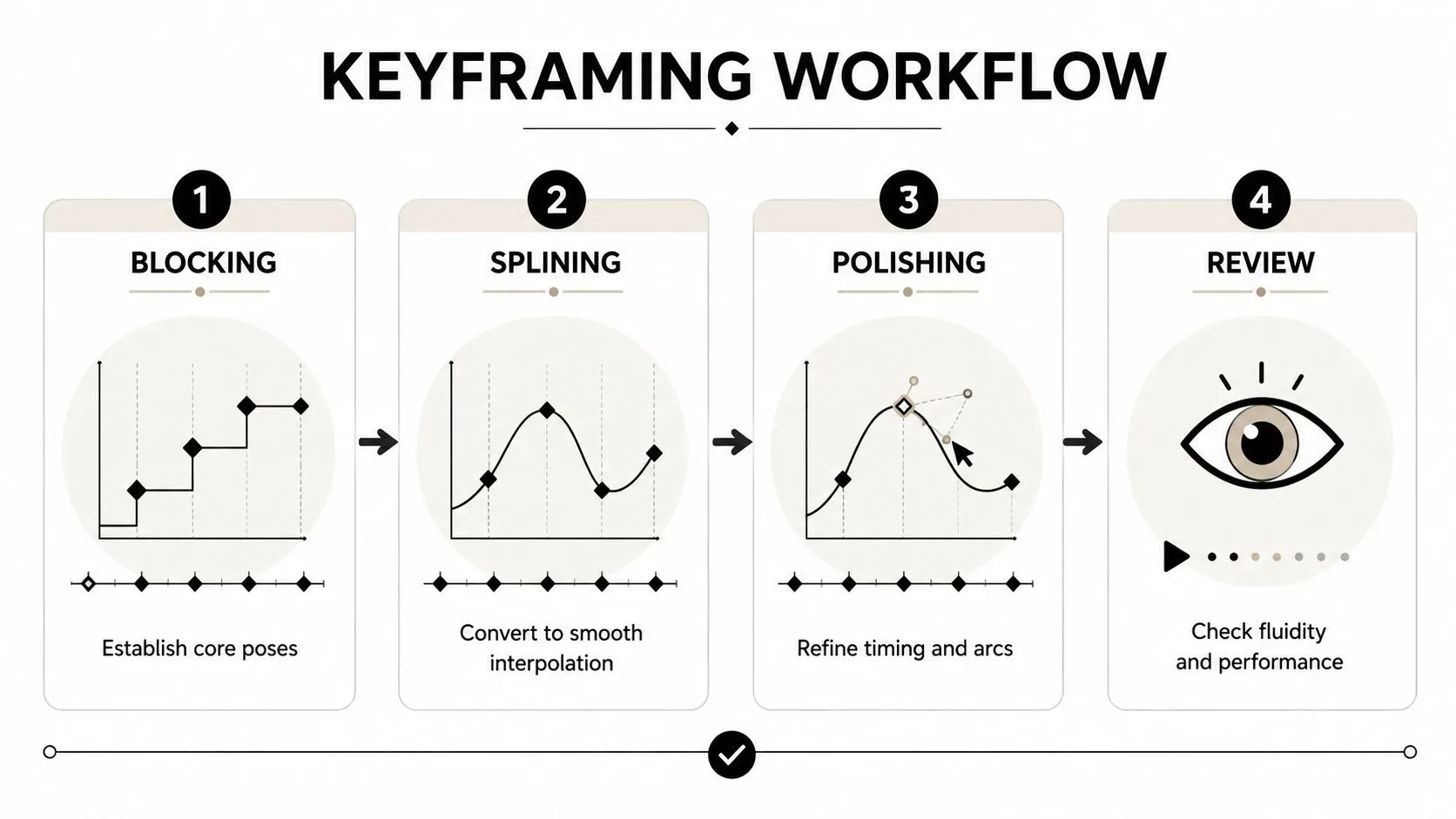
Three types of keys earn different jobs
Stepped keys establish intent. They let a lead animator and director judge whether a pose communicates before interpolation hides weak choices. Spline keys create continuous movement. They're the daily working mode for character acting, but they can also create the familiar CG float when every tangent is smoothed into the same predictable arc. Breakdown keys explain how a character travels between two important poses. A breakdown might show the line of action, the direction of a hand, the twist in a torso or the point where weight transfers. Without those decisions, a body often follows a mathematically tidy path that doesn't feel physically motivated. The polish pass adjusts curves, adds extra keys and refines arcs. Overshoot gives a head or hand momentum. A settle shows where the body absorbs that momentum. Small offsets between hips, chest, head and hands create hierarchy in the movement.
Graph-editor test: If every control reaches its destination at the same moment, look for a reason. Real performances usually contain offsets, holds and recoveries.
Over-smoothed tangents produce float. Under-edited curves leave distracting pops and force the team to spend polish days fixing timing that should have been solved in blocking. On a fixed broadcast deadline, the solution isn't to add keys everywhere. It's to protect the major poses, then edit only the curves that affect weight, eye-line, silhouette and story.
Motion Capture, Keyframe, and Hybrid Performance Workflows
Motion capture is valuable when the production needs repeatable physical behaviour across many shots. Keyframing remains stronger for stylised acting, facial nuance and deliberate timing. Hybrid work usually gives a broadcast team the most practical balance, especially when a character has realistic weight but an intentionally designed face and gesture language.
| Workflow | Data Source | Cleanup Cost | Best Fit |
|---|---|---|---|
| Keyframe | Animator-created poses and curves | High creative labour, controlled revisions | Hero acting, stylised characters and creatures |
| Optical capture | Marker-stage performance | Retargeting and curve cleanup | Grounded biped locomotion across many shots |
| Inertial capture | Suit-based performance | Drift correction, contact and prop cleanup | Location or stage-limited reference |
| Markerless retargeting | Video reference processed into motion | Rough reference still needs hand-keyed refinement | Early exploration and blocking |
| Hybrid | Capture combined with hand animation | Focused cleanup on face, hands and style | Stylised broadcast heroes |
Optical stages, including facilities in London and around Pinewood, can produce comparatively clean movement data for locomotion. Inertial suits are more flexible when a production can't use a marker stage, but they need attention around drift, contact and prop interaction. Markerless AI retargeting can give a team useful reference quickly, yet it shouldn't be mistaken for finished performance. It often supplies a starting point rather than a final acting pass.
What the animator still has to solve
Capture records what happened in front of the sensors. It doesn't automatically understand the character's design, camera framing or story intention. A performer may walk naturally while missing the required eye-line. A hand may pass through a prop. A stylised creature may need a different centre of gravity from the human performer who supplied the data. Full mocap earns its keep when many shots require grounded bipedal movement and the team can support retargeting and cleanup. For a stylised hero, the dependable choice is often captured lower-body motion, hand-keyed hands and face, then a deliberate pass for eye direction, weight and comic timing. The motion-capture guide for clients is useful when deciding what capture should solve before a shoot is booked. A mocap cleanup specialist and a character animator aren't interchangeable hires. Treating them as the same role usually hides the true schedule.
Procedural Animation and Simulations at Production Scale
Procedural animation earns its place when repetition makes hand-keying uneconomical. A wind-driven flag rig can populate a crowd of 300 background characters, a cloth solver can add secondary motion to a keyed walk, and a particle system can replace weeks of manually placed environmental effects. The rule is simple, build the system only when the repeated work justifies the setup.
Match the solver to the problem
Particle systems handle snow, dust, rain, sparks and other high-volume elements. Rigid-body dynamics suit objects that collide without meaningful deformation, while soft-body systems handle flexible forms that squash, stretch or bend. Cloth and hair solvers sit on top of an approved character animation, and crowd agents use rules for navigation, spacing and variation. A 22-minute preschool episode might need a snowstorm across 40 shots. Manual snow animation would create inconsistent timing and consume labour that could be spent on performance. A Houdini-driven particle simulation can be cached, reused and adjusted through controlled parameters, giving the team a repeatable starting point for each shot.
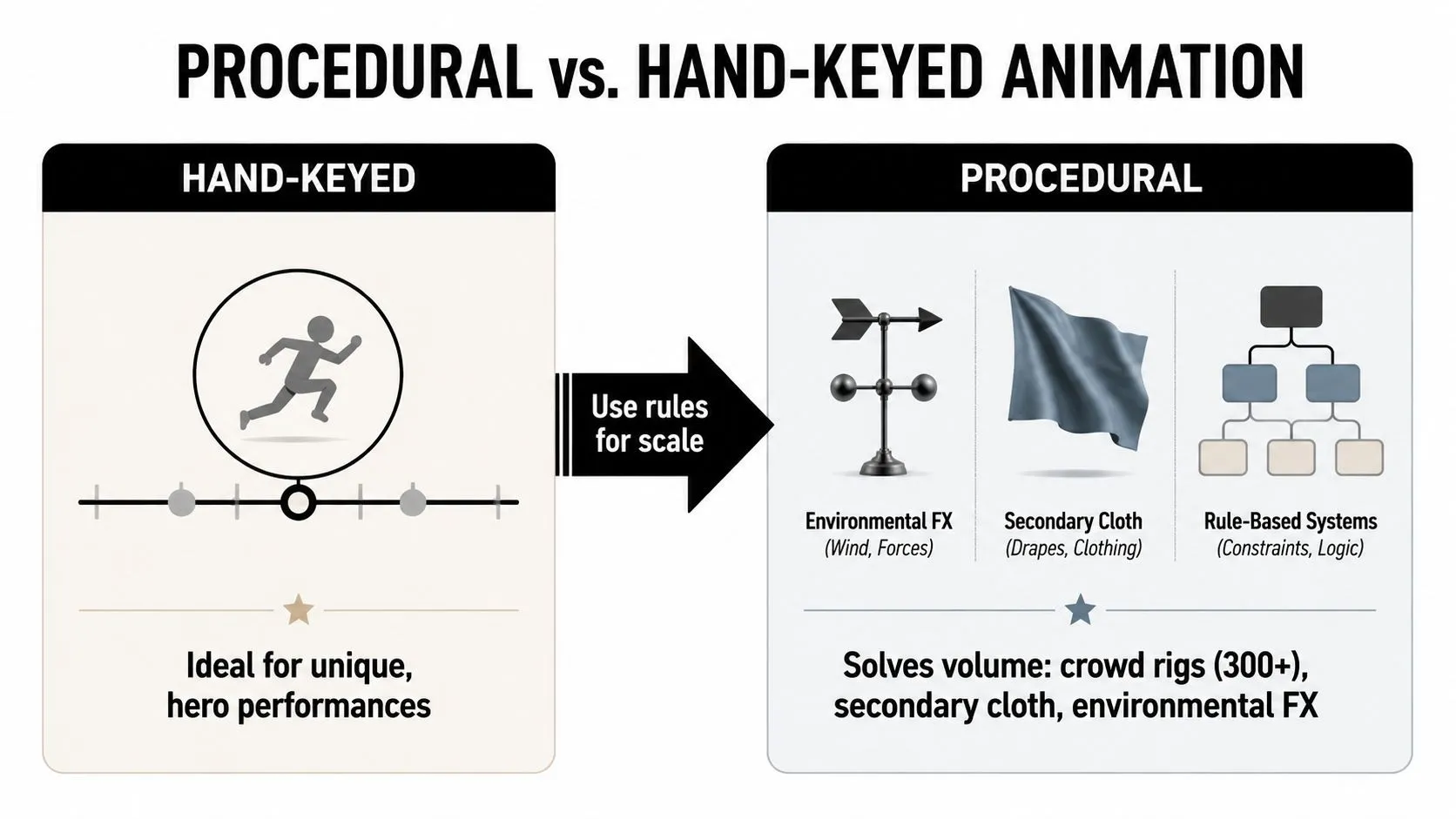
Automation still needs supervision
Procedural work isn't free. Artists have to design the rules, test edge cases, wait for solver runs, cache results, adjust the look and integrate the output into individual shots. A crowd that works in a wide shot may intersect a foreground prop when the camera changes. Cloth can solve correctly but distract from the face. A particle field can obscure a story beat. The UK animation sector's economics make this distinction important. Animation Tax Relief claims and qualifying labour depend on auditable production activity, not on the claim that a tool made the work automatic. Use procedural systems to multiply an artist's decisions, then keep an artist responsible for the shot.
Production check: Ask how many assets, shots or episodes will reuse the system. If the answer is “one hero moment”, hand-keying may be faster and easier to revise.
Shading and Lighting Approaches for Different End Uses
Shading and lighting should follow the delivery format, not the artist's preferred render engine. Physically based rendering, or PBR, is a strong default for photographic materials, believable light response and film-style compositing. Non-photorealistic rendering, or NPR, is often more useful when the design depends on stable colour blocks, controlled outlines or a deliberately illustrative surface. A 4K HDR film deliverable needs offline rendering, careful exposure decisions and disciplined colour management. The team has more freedom to spend time on complex light transport because the audience isn't interacting with the scene. A real-time XR installation has the opposite constraint. It needs consistent frame delivery while the viewer moves through the experience, so shader graphs, baked lighting and asset budgets become central design tools.
| Approach | Best End Use | Render Cost Driver | Typical UK Team Size |
|---|---|---|---|
| Offline PBR | Film, premium broadcast and photoreal CGI | Samples, light bounces, textures and render-farm time | Lighting, look development, rendering and compositing specialists |
| NPR | Stylised series, explainers and game-adjacent work | Look consistency, outlines and controlled material response | Smaller look-development and lighting team |
| Real-time rasterised | XR, previs, games and interactive installations | Draw calls, shader complexity, texture memory and optimisation | Technical artist, real-time artist, designer and developer |
| Real-time path traced | High-quality previs and controlled interactive scenes | Hardware capability, ray tracing and scene complexity | Real-time lighting and technical art specialists |
Protect the look before production locks
NPR isn't just “cheaper PBR”. It shifts effort into design rules, material consistency and camera-aware decisions. That can protect a preschool series from repeated per-frame rescue in compositing, particularly when colour reviews are frequent. Real-time rendering can accelerate iteration, but it introduces skills that traditional offline teams may not have. UK policy work identifies specialised technical roles, including virtual production, as an emerging concern, while digital and data skills remain difficult to source. The Skills England sector assessment for creative industries also points to stronger alignment between games, VFX, animation and emerging technology than between those areas and post-production. Switching engines late can invalidate materials, lighting setups, render tests and artist assumptions. Choose the end-use path during look development, not after the first final-quality shots.
Matching Technique to Brief, Budget, and Team
A producer needs a defensible starting point, not a list of fashionable techniques. The matrix below maps common UK project types to a dominant approach, the supporting disciplines that make it work and the staffing profile most likely to deliver it without avoidable rework.
| Project Type | Primary Technique | Supporting Techniques | Staffing Reality |
|---|---|---|---|
| 30-second broadcast ident | Keyframe-led performance and graphic timing | Rigging, controlled NPR or PBR shading, compositing | A compact team needs a lead animator who can make fast creative decisions |
| Episodic children's TV series | Keyframe for heroes, procedural systems for repeatable backgrounds | Mocap reference, cloth, hair, reusable rigs and broadcast QC | A stable animation and rigging team matters more than a complex one-off setup |
| 60-second pre-rendered cinematic | Keyframe or mocap-led performance, depending on realism | PBR look development, simulation, offline lighting and comp | Specialist animation, FX, lighting and compositing roles need clear handoffs |
| Mobile game trailer | Keyframe for designed beats, real-time previews for iteration | Optimised rigs, baked animation, procedural environmental motion | Artists must understand both cinematic staging and engine constraints |
| Live XR activation | Real-time engine workflow | Shader graphs, baked lighting, tracking, performance profiling | Technical artists and developers need to work alongside animation and design |
Animation Tax Relief has helped embed animation within a broader UK screen-production economy. Parliamentary evidence recorded £254.6 million in GVA in 2019 for parts of the sector supported by Animation Tax Relief, following £261.0 million in 2018 and £258.1 million in 2017. The same answer recorded £1.68 billion in GVA for UK VFX in 2019, supporting 27,430 jobs, as shown in the UK Parliament evidence on animation and VFX. The cultural test also creates a practical production requirement. Keep skilled work, approvals and technical decisions documented so the production can evidence its UK contribution. That record helps the producer understand whether a procedural setup is reducing labour or moving it into a specialist department. For software selection, avoid treating the application as the pipeline. Rig compatibility, version control, asset exchange and the team's existing knowledge will usually matter more than a feature comparison. A useful reference is this review of 3D animation software, but the final choice should follow the project matrix, not replace it.
Why the Best Technique Is the One You Can Staff
A production can have an impressive rig, a fast renderer and a technically elegant solver, then lose time because the assigned animator cannot use them confidently. A rig becomes a production asset only when its animator understands the controls, deformation behaviour and failure modes. If a freelancer spends the opening part of a contract learning an unfamiliar setup, the schedule absorbs that onboarding before the first performance reaches approval. A Houdini effect may look efficient in a test, yet create delivery risk if nobody on the crew can debug the network or integrate its cache. UK evidence describes the staffing pressure directly. 78% of creative-industry employers reported shortages in the top three occupational groups, while nearly 60,000 creative workers weren't fully proficient in 2022, an increase of 15,000 since 2017, according to the Creative PEC analysis of skills mismatches. Higher-skilled roles and mid-level recruitment remain pressure points across animation, VFX and post-production.
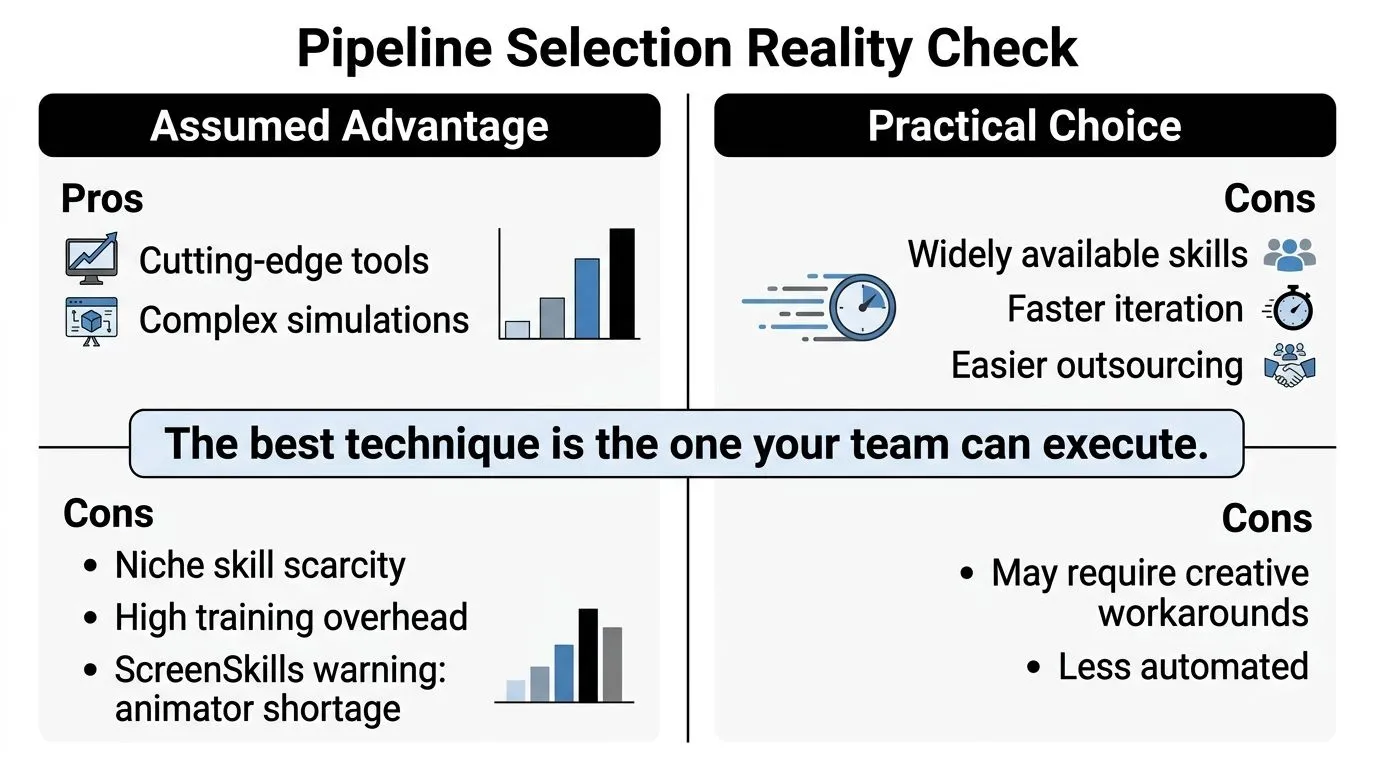
Match the method to the people
A mocap cleanup artist solves different problems from a keyframe character animator. A Houdini FX specialist cannot replace a Maya generalist, and a technical artist who profiles an Unreal scene may not be the right person to polish facial acting. Run the staffing test before approving the technique:
- •Name the owner: Assign one person to the rig, solver, shader system or engine integration.
- •Test a representative shot: Use the hardest ordinary shot, not a flattering demo.
- •Record the handoff: Define what arrives from capture, layout or simulation and what the animator must repair.
- •Plan the replacement: Identify who can take over if a freelancer becomes unavailable.
- •Protect the review path: Ensure the director can request changes without rebuilding the system.
Predictable delivery also supports the economics of a qualifying UK production. Government statistics report £2.4 billion in creative industries tax relief paid across 2023 to 2024, showing the scale of the ecosystem in which animation operates. As noted earlier, tax relief planning makes staffing, documentation and delivery control part of the production decision, not a separate finance exercise. The senior choice is often less glamorous. It may be the rig the available team already knows, the renderer the farm supports, or the workflow a replacement freelancer can learn without destabilising delivery.
Stacking Techniques Across a Live Production Pipeline
A preschool series demonstrates how several techniques can coexist without competing for the same job. Storyboarding and the animatic establish the edit, camera and performance intent. Layout then places the approved characters and environments in 3D, while keyframed blocking builds the acting and lip-sync against that timing. A presenter reference or motion-capture session can inform creature movement, particularly for weight and rhythm. The animator still reshapes the performance for the character. Background crowd layout and environmental motion can then use procedural rules, leaving hand-keying for the shots where the audience reads a face or gesture.
The handoff sequence matters
The production should approve each layer before the next department spends heavily on it:
- Brief and animatic: Lock story intention, camera timing and delivery requirements.
- Rig scope: Test deformation, facial controls, hands, props and export behaviour.
- Performance source: Decide whether each shot begins with keyframes, mocap, reference or a hybrid.
- Animation approval: Review blocking first, then spline and polish passes.
- Simulation budget: Run cloth, hair or particles only after the underlying animation is approved.
- Look development and lighting: Confirm materials, colour response and lighting direction before final shots.
- Compositing and QC: Combine passes, check continuity and verify the delivery specification.
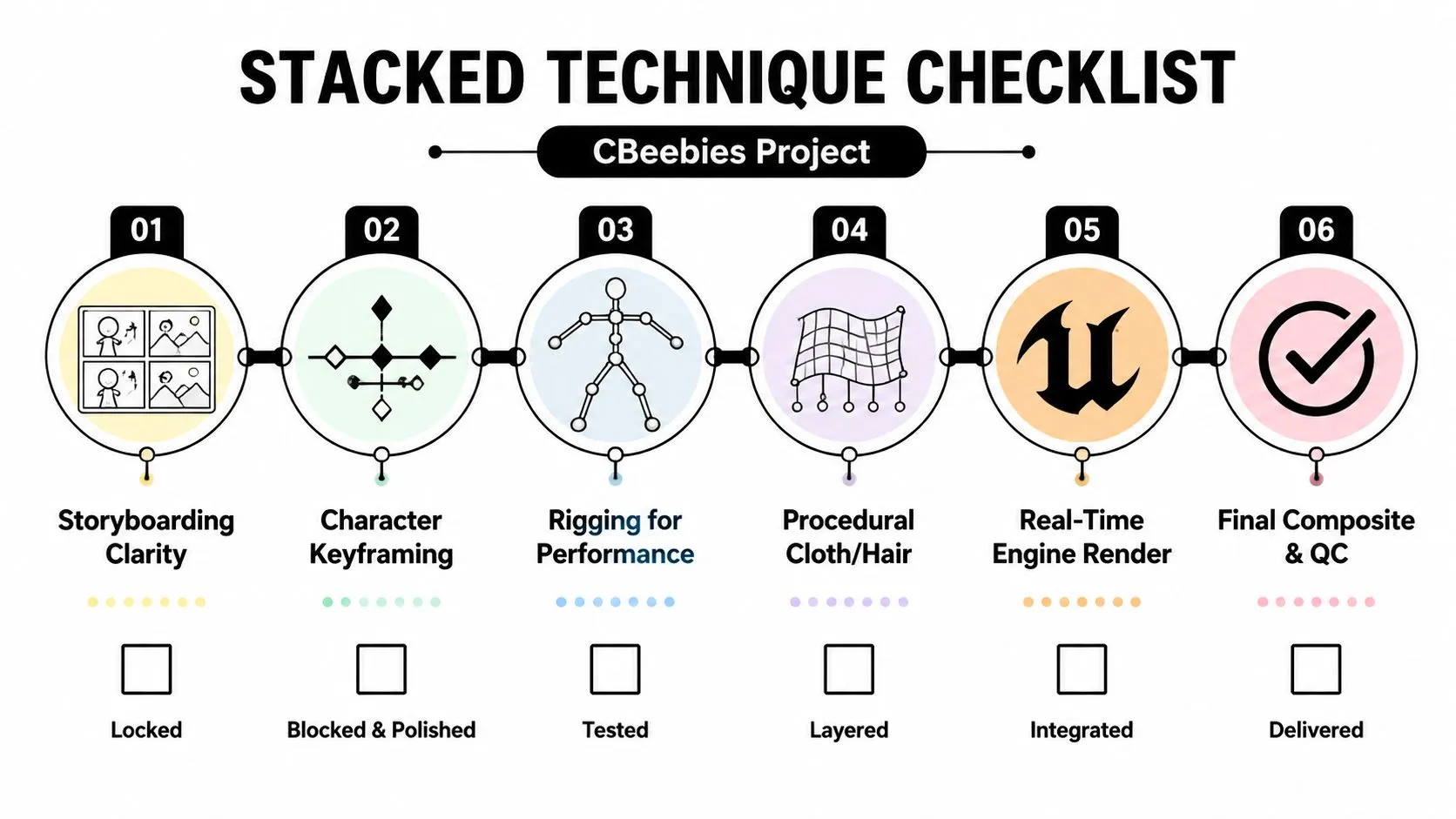
Kick-off checklist: brief, rig scope, performance source, simulation budget, look-development owner and the one item that absolutely can't slip.A clear pipeline prevents a late cloth solve from exposing an unapproved pose, or a lighting change from revealing that the material setup can't meet delivery. The animation production pipeline guide offers a useful reference for organising those handoffs across departments. --- Studio Liddell combines 3D animation, character performance, real-time workflows and final compositing for broadcast, film, games and XR projects. If you need to choose between keyframe, mocap, procedural or hybrid techniques, visit Studio Liddell to discuss the brief, staffing reality and delivery path before production begins.