Your Guide to Modern Digital Product Development
What exactly is digital product development? At its core, it's the entire journey of taking an idea for a software-based solution, whether that's an animated series, an enterprise VR simulation, or a mobile game, and turning it into a real, market-ready product. This isn't just about code; it's a strategic process that weaves together market research, creative direction, technical execution, and a smart launch strategy to solve a specific problem for your audience.
From TV IP to Immersive Experiences: Extending Brands Across Platforms
Think of digital product development as a framework for building valuable assets. You start with a concept (like a beloved children's TV character), then move to a production pipeline where designers, animators, and developers bring it to life, and finally, you launch it to a global audience. This structured approach transforms a creative spark into a tangible, commercially successful IP that can live across multiple platforms. This process is the engine powering a huge slice of the UK's creative and tech economy. The software development industry is a cornerstone of the nation's digital strength. As of 2025, there are 715,000 businesses in this sector across the UK, reflecting a compound annual growth rate of 8.3% since 2020. This incredible expansion shows the high demand for expertly crafted digital solutions. You can explore more on the UK's software development market growth and its projected £490.0 billion market size.
More Than Just Code
When we discuss digital product development, we're referring to a comprehensive discipline that covers a massive spectrum of creations, from hit animated series to sophisticated VR training simulations for medical professionals. No matter the final form, every product follows a similar, well-trodden path from concept to reality. The key ingredients are always in the mix:
- •Defining the Problem: It all starts with pinpointing a clear challenge or need that the product will solve for a specific audience.
- •Strategic Planning: This is where we map everything out, the product’s goals, who it's for, and what makes it special in a crowded market.
- •Creative and Technical Execution: Here, the magic happens. We blend design (UI/UX), animation, or immersive world-building with solid, robust engineering and coding.
- •Launch and Iteration: The product is released into the wild, and we use real-world feedback to guide future updates and improvements. This is a cycle, not a one-off event.
A truly successful digital product is one that flawlessly merges what users need with what the business wants to achieve. The development process is the bridge that connects that brilliant idea to a commercially viable and genuinely useful solution, ensuring every single feature serves a purpose.
Ultimately, this methodical journey ensures the final output isn't just functional. It's engaging, intuitive, and perfectly aligned with its intended goals. It’s about building solutions that solve real-world problems, and solve them well.
Navigating the Core Stages of the Development Lifecycle
Every successful digital product, whether it’s a slick mobile app or an immersive VR simulation, follows a structured path from idea to reality. This journey, the digital product development lifecycle, isn’t a rigid set of rules but more like a strategic roadmap. It brings order to the creative chaos, ensuring every decision and line of code purposefully builds towards the final goal. To make sense of it all, we can break this journey down into a few distinct, interconnected stages. Each phase has its own clear objective, key activities, and specific deliverables that push the project forward, making sure nothing gets missed. The image below gives you a bird's-eye view of this process, from the initial blueprint right through to the final product hitting the showroom floor.
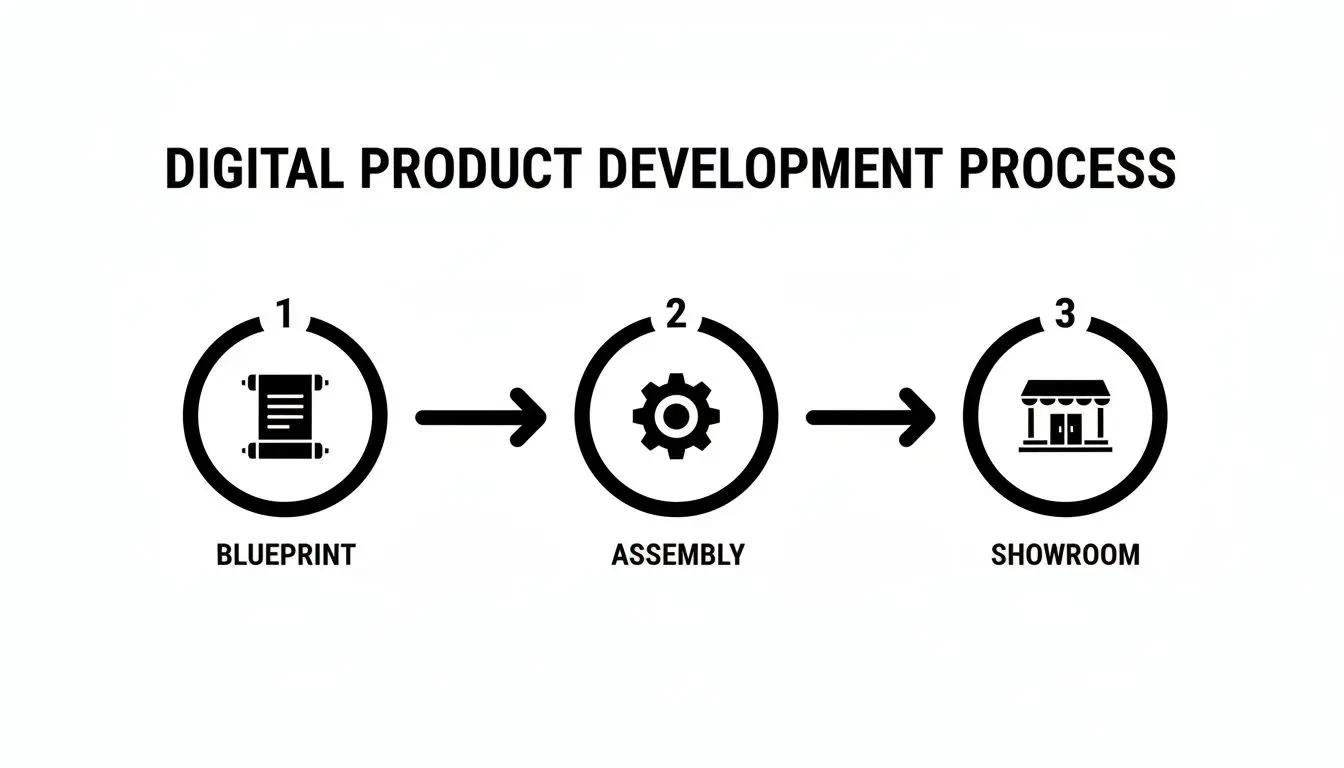
This visual really simplifies the journey, showing a clear progression from strategic planning to hands-on assembly and, finally, to launch and beyond. To give you a clearer picture of how these phases connect, here's a quick summary of the entire lifecycle.
Digital Product Development Lifecycle Stages
| Stage | Primary Objective | Key Deliverables |
|---|---|---|
| Concept & Strategy | To validate the idea and define a clear plan for success. | Project brief, market analysis, technical feasibility report, product roadmap. |
| Prototyping & Design | To translate the strategy into a tangible user experience. | Wireframes, interactive prototypes, UI/UX designs, user flow diagrams. |
| Production & Engineering | To build the fully functional product based on the approved designs. | Working software/application, clean code, integrated features, server-side logic. |
| QA & Launch | To ensure the product is bug-free, polished, and ready for the market. | Test plans, bug reports, performance metrics, a live and deployed product. |
Each stage builds on the last, creating a solid foundation for a product that not only works well but also meets real-world user needs and business goals.
Stage 1: Concept and Strategy
This is where it all begins. A spark of an idea is pressure-tested and hammered into a viable plan. It's all about asking the tough questions right at the start to set the project up for success. Before a single pixel is designed or a line of code is written, you have to nail down the "why" behind the product. Key moves in this phase include:
- •Market Research: Figuring out who the target audience is, understanding their frustrations, and seeing what competitors are already doing.
- •Goal Definition: Setting clear, measurable business objectives and Key Performance Indicators (KPIs) that will tell you what success looks like.
- •Technical Feasibility: Sizing up the technical needs and potential roadblocks to make sure the idea is actually buildable within realistic limits.
- •Roadmapping: Sketching out a high-level plan that outlines the product's features, what's most important, and a rough timeline.
The main takeaway from this stage is a detailed project brief and a strategic roadmap, the essential blueprint for everything that follows.
Stage 2: Prototyping and Design
With a solid strategy locked in, the focus shifts to bringing the vision to life, both visually and functionally. This is a hugely collaborative phase where ideas become tangible through user experience (UX) and user interface (UI) design. It’s about much more than making things look pretty; it's about crafting an intuitive and engaging journey for the user. This stage involves creating wireframes to map out the structure, then moving on to interactive prototypes that let you click through and simulate the user flow. For an app, this could be a clickable mock-up. For a VR experience, it might be a simple "greybox" environment to test scale and interaction before any detailed artwork is created. The goal is to test, refine, and get stakeholder buy-in on the design _before_ committing to the heavy lifting of production.
This iterative design process is absolutely crucial. It allows for quick feedback and tweaks, which can save thousands of pounds and weeks of work by catching design flaws early on, long before they become expensive engineering headaches.
Stage 3: Production and Engineering
This is the main construction phase. Here, the validated designs and prototypes are turned into a fully functional product. Developers write the code, artists create the assets, and all the individual pieces are assembled into a cohesive whole. This is typically the longest and most resource-heavy part of the entire lifecycle. For a complex project, it helps to know what to expect; you can get a better sense by understanding the app development timeline in our detailed guide. As you move through these stages, different methodologies can come into play. To get a better feel for one popular approach, this Guide to the Agile Product Development Process offers some great insights into iterative workflows.
Stage 4: Quality Assurance and Launch
Before your product gets anywhere near an audience, it has to go through some serious testing. The Quality Assurance (QA) team meticulously hunts for bugs, performance issues, and usability problems across different devices and platforms. This stage is non-negotiable; it ensures the final product is stable, polished, and delivers a brilliant user experience. Once QA gives the green light, it’s time to launch. This might mean deploying an app to the stores, pushing a website live, or installing an experience on-site. But the work doesn't stop there. The lifecycle simply enters a new phase of monitoring performance, gathering user feedback, and planning for the next round of improvements and updates.
Unlocking Creative Potential with Modern Production Capabilities
Great digital product development is a balancing act. It needs that perfect mix of creative vision and serious technical muscle. The final product is only ever as strong as the tools and talent used to create it, which is why today’s most captivating experiences come from teams with a deep, specialised production toolkit. It’s about more than just writing code. It's about building worlds, telling stories, and crafting user journeys that grab attention and offer something genuinely useful. At the heart of it all are a few key production pillars that form the bedrock of any standout digital product.
The Power of Animation in Digital Storytelling
Animation, whether 2D or 3D, is an incredibly powerful way to connect and engage. From broadcast TV series to viral social shorts, it's a vital tool for explaining tricky concepts, forging memorable brand identities, and sparking a real emotional connection with your audience.
- •3D Animation: This is where we create lifelike characters, incredibly detailed environments, and cinematic visual effects. It’s the magic behind high-end product visualisations, epic game trailers, and immersive training simulations where realism is non-negotiable.
- •2D Animation: With its huge stylistic flexibility, 2D is perfect for crisp explainer videos, slick user interfaces in apps, and branded motion graphics that pop. It delivers information with personality and clarity.
Being fluent in both means a development partner can pick the perfect visual language for the job, making sure the style always serves the message.
Building Immersive Worlds with XR
Extended Reality (XR) is the catch-all term for Virtual Reality (VR) and Augmented Reality (AR), and it’s completely changing the game for user interaction. These technologies have moved far beyond the realm of niche hobbies and are now practical tools solving real business problems. VR can drop a user into a completely digital world, making it the perfect solution for hands-on training where real-world practice is too dangerous or costly. AR, on the other hand, layers digital information over our own world, opening up amazing possibilities for things like retail product configurators, interactive museum exhibits, or on-the-spot industrial maintenance guides.
Developing for XR demands a unique blend of skills. It’s one part game engine mastery, one part spatial design intuition, and a whole lot of focus on user comfort. The aim is always to create experiences that are not just impressive to look at, but are intuitive and genuinely helpful.
Interactive Apps and Games as Core Products
For many digital strategies, interactive apps and games are where everything comes together. This is the point where all the creative and technical threads are woven into one seamless user experience. The rules of engagement are the same whether it's a mobile game, an educational app, or a corporate training tool. Truly effective app and game development boils down to three things:
- Solid Engineering: Building on a stable, scalable foundation using powerful engines like Unity or Unreal Engine.
- Engaging Mechanics: Designing core interactions that are fun, rewarding, and make people want to come back for more.
- Polished Art and Audio: Pulling it all together with high-quality visuals and sound to create a complete, immersive package.
How AI Is Supercharging Creative Production Pipelines
Let’s be honest, Artificial Intelligence isn't some far-off concept anymore. It's a real, practical toolkit that's already changing the game in digital product development. The real magic of AI isn't about replacing talented people; it’s about giving them an intelligent co-pilot. It’s here to automate the grind and free up creative and technical teams to do what they do best. And this shift is happening fast. Across the UK, businesses are weaving AI into their operations at an incredible rate. As of late September 2025, 23% of UK businesses said they were using AI in some form. That’s a massive leap from just 9% back in September 2023, showing just how essential it's become to stay competitive. For a creative studio, this means giving our artists and developers tools that chew through the grunt work. The result? They can pour all their energy into the human stuff: compelling stories, groundbreaking design, and genuine innovation.Streamlining Animation and XR Workflows
In the world of animation, AI is a massive help for tasks that used to take forever. Take character rigging, the painstaking process of building a digital skeleton so a 3D model can move. AI can now automate huge chunks of this foundational work, handing animators a solid starting point in a matter of hours, not days. It’s making a similar impact elsewhere, too:- •Motion Capture Cleanup: AI algorithms can sift through raw motion capture data, automatically smoothing out jitter and fixing errors far quicker than a human ever could.
- •Automated In-betweening: For 2D animation, AI can generate all the intermediate frames between key poses, delivering fluid, natural motion with a fraction of the manual effort.
- •XR Environment Optimisation: When building for VR and AR, performance is everything. AI helps automatically optimise 3D models and textures, making sure experiences run smoothly on hardware like the Meta Quest without killing the visual quality.
AI acts as a force multiplier for creative teams. It handles the laborious, repetitive tasks, which not only accelerates production timelines but also lowers the barrier to entry for more ambitious and visually complex projects.
Faster Iterations and Greater Creative Freedom
One of the biggest wins from an AI-boosted pipeline is the sheer speed of iteration. When you remove technical roadblocks, your creative team has the freedom to experiment. They can play with different lighting setups, tweak character performances, or redesign entire levels and see the outcome almost immediately. This kind of rapid feedback loop is priceless. It gives directors and artists the confidence to make bolder creative choices, pushing the quality of the final product to new heights. Of course, bringing AI into your pipeline means you need to be smart about the potential pitfalls, which is where something like an AI Risk Checklist tool can be a huge help. At the end of the day, these efficiencies have a direct impact on the bottom line. Faster creative cycles lead to lower costs and a quicker route to market. For any business investing in digital product development, that means a much better return on investment and the ability to bring bigger, better, and more ambitious experiences to life, knowing the production pipeline can handle the vision.
Seeing Digital Products in Action Across Industries
The real magic of digital product development isn't found in the lines of code or the tech specs. It's in seeing how these tools solve real-world problems for businesses just like yours. Across every industry, from healthcare to entertainment, companies are using this blend of creativity and technical skill to get better results, hook their audiences, and see genuine growth. It’s all about turning pixels on a screen into practical solutions with a clear return on investment. These aren't just pie-in-the-sky ideas; they are actively changing how entire sectors operate. Let's look at a few concrete examples to see how a smart investment in a digital product can deliver serious commercial value.
Enhancing Safety and Skills with XR Simulations
In high-stakes fields like medicine and heavy industry, proper training is non-negotiable. The problem is, real-world practice can be dangerous, incredibly expensive, or just plain impractical. This is where XR (that's VR and AR) training simulations are making a massive difference. A surgeon, for instance, can run through a complex procedure in a totally risk-free virtual world, honing their muscle memory and decision-making skills over and over before they even think about stepping into an operating theatre. In the same way, an engineer can get to grips with maintaining complex machinery inside a virtual plant, spotting potential hazards without any physical risk whatsoever. These simulations deliver a solid ROI in several ways:
- •Reduced Training Costs: They cut down the need for pricey physical equipment and one-on-one instructor time.
- •Improved Safety Outcomes: The risk of accidents plummets when people can learn the ropes in a safe, controlled space.
- •Increased Knowledge Retention: Studies have shown that learning by _doing_ in a VR environment leads to far higher retention rates than just reading a manual or watching a video.
By building photorealistic, interactive scenarios, VR training simulation UK providers give professionals a space to build critical skills and confidence. This direct, hands-on experience translates into better job performance and fewer mistakes, making for a very compelling business case.
Boosting Engagement and Sales at Exhibitions
Trade shows are a battleground for attention. It’s a loud, crowded, and competitive environment where grabbing a visitor's eye, and keeping it, is a huge challenge. Let's be honest, the standard pop-up banners and glossy brochures just don't cut through the noise anymore. Augmented Reality offers a brilliant way to turn a simple exhibition stand into an interactive experience people will actually remember. Imagine a visitor pointing their phone at a physical product model on your stand. Instantly, a full-scale, animated version appears right there in the room with them. They could walk around it, explore its features, switch out colours, and even see how it works from the inside out. This kind of AR for exhibitions doesn't just get you noticed; it pulls people in and speeds up the sales conversation. The ROI is obvious: people spend more time at your stand, you get more qualified leads, and you have an incredible tool for showing off complex products in a way that’s simple and genuinely exciting.
Simplifying Complexity with Technical Animation
Trying to explain complex engineering, scientific, or financial concepts to people who aren't experts can feel like hitting a brick wall. A dense PowerPoint packed with jargon or a thick technical manual is more likely to make eyes glaze over than win over a board of directors or potential investors. This is where technical animation comes into its own. By transforming intricate processes into clear, compelling 3D visuals, you can communicate your value proposition with absolute clarity. A renewable energy company can show exactly how its new turbine technology captures wind power, or a fintech firm can visualise a complex financial product in a way that anyone can understand. The benefits are immediate:
- •Increased Stakeholder Buy-in: It makes it much easier for decision-makers to grasp the value and potential of your idea.
- •Faster Approval Cycles: When everyone is on the same page, misunderstandings are reduced and projects get the green light quicker.
- •Enhanced Marketing Impact: You're left with powerful visual assets that can be used in presentations, on your website, and in marketing campaigns to explain what makes your product special.
Each of these examples shows that digital product development is so much more than a technical task. It’s a strategic business tool that, when applied with a bit of insight, creates engaging experiences, solves critical challenges, and delivers a powerful return on investment.
How to Choose the Right Development Partner
Picking the right creative and technical partner is probably the single biggest decision you'll make when developing a new digital product. This choice isn't just about comparing quotes; it’s about finding a team that genuinely becomes an extension of your own, one that truly gets your vision and has the technical chops to bring it to life without a hitch. The best partners are focused on delivering real value, not just coming in with the lowest price. You should be looking for a proven track record, a portfolio packed with work relevant to your project, and a deeply collaborative process. A great partner will challenge your ideas (in a good way), offer creative solutions you hadn't thought of, and steer you through the complexities of production with a clear, confident hand.
Evaluating Technical and Creative Expertise
Let's be clear: your partner's technical skill is non-negotiable. They need deep, proven expertise in the core tech your project relies on, whether that’s building breathtaking worlds in Unity and Unreal Engine or crafting slick, reliable mobile apps. This goes beyond just owning the right software; it's about understanding the fine art of optimisation, performance, and the unique quirks of each platform. Don't be shy about digging deep when you're vetting potential studios. Ask them about their project management style, how they handle quality assurance, and what kind of support they offer after the product goes live. A confident, seasoned team will welcome these questions and give you straight, detailed answers.
A partner’s portfolio is their CV. Look for solid proof that they have successfully delivered projects of a similar scale and complexity to yours. It’s the clearest sign of their ability to handle your vision and navigate the challenges that will inevitably pop up.
Key Questions for Your Shortlist
As you start to narrow down the field, having a solid list of questions ready will help you make a properly informed decision. A structured approach means you won't miss any crucial details before you commit to a contract. Here are a few essential questions to get you started:
- •Process and Communication: How do you keep clients in the loop and handle feedback during the project? What does your review and approval process look like for each stage?
- •Team and Experience: Who are the key people who will be working on my project, and what’s their direct experience with this kind of work?
- •Post-Launch Support: What kind of support and maintenance do you offer once the product is out in the wild? How do you manage updates and fix bugs?
Choosing the right partner is all about doing your homework. For a more detailed look, our guide on choosing the right mobile app development agency offers a great framework that works just as well for other digital products. Ultimately, you're looking for a team that not only has the right skills but also shares your passion for quality. The UK's creative digital scene is buzzing, with 8,509 agencies operating in 2024 and pulling in £20.4 billion in revenue. In such a busy market, finding a partner with a proven pedigree and a collaborative spirit is what will turn your idea into a genuine success. You can read more about digital agency growth in the UK to get a better feel for the landscape.
Your Digital Product Development Questions Answered
Starting a digital product development project is a big step, and it's only natural to have questions. It’s a serious investment, so getting clear on the practical side of things is vital before you jump in. We've pulled together some of the most common questions we get from clients to give you some straightforward answers.
How Long Does the Development Process Take?
This is usually the first question on everyone's mind, and the honest answer is: it really depends on the complexity of your project. There's no one-size-fits-all timeline. For instance, a fairly straightforward 2D animated explainer video might only take 4-6 weeks from start to finish. On the other end of the spectrum, a complex VR training simulation packed with multiple interactive scenarios and highly detailed environments could easily take 6-12 months or even longer. That's why a detailed scoping phase right at the start is so important, it lets us map out a realistic timeline with clear milestones built around your specific goals.
What Is the Difference Between Unity and Unreal Engine?
Both Unity and Unreal Engine are incredible, powerful real-time 3D engines, but they excel in different areas. You could think of them as two different high-performance cars, each built for a different kind of race.
- •Unity: is known for its amazing flexibility and fantastic support for mobile and XR platforms. It's often the first choice for projects where running smoothly across different devices is the top priority.
- •Unreal Engine: is celebrated for its breathtaking graphical power and photorealistic rendering. When you need jaw-dropping cinematic visuals and truly stunning experiences, Unreal is the way to go.
There's no single "best" choice; the right engine is always dictated by the project's unique creative vision and technical needs.
Choosing the right engine isn't just a technical detail, it's a strategic decision that shapes everything from visual polish to performance and development timelines. A good partner will help you select the technology that best serves your product's long-term vision.
How Much Does Digital Product Development Cost?
Just like the timeline, the cost is tied directly to the project's scope, the size of the team needed, and how long it will take. Budgets can range from a few thousand pounds for a short animation to well into six figures for a huge interactive game or an enterprise-level simulation. We're big believers in total transparency. Our pricing is always based on a detailed brief and a full breakdown of the work required. The best way to get a solid number is to talk through your concept with our production team. That allows us to give you a detailed cost breakdown with no surprises later on.
What Does Your Client Collaboration Process Look Like?
We treat every project like a genuine partnership. Our entire process is built on open communication, meaning you're kept in the loop and involved at every crucial stage. It all kicks off with a deep-dive discovery workshop where we get to grips with your vision. After that, we settle into a rhythm of regular calls, scheduled reviews at key milestones, and consistent progress updates. This back-and-forth approach ensures the final product is exactly what you envisioned, making us feel like an extension of your own team.
Ready to bring your idea to life as a market-leading digital product? The team at Studio Liddell has the creative flair and technical muscle to guide you from the first spark of an idea to a successful launch. Book a production scoping call today and let's build something incredible together.