Your Guide to an Environmental Artist Job
Ever wondered who builds the breathtaking worlds you explore in video games, films, or VR? That’s the work of an environmental artist, the architect of digital universes. They craft everything you see that isn’t a character, blending artistic vision with serious technical skill to make virtual worlds feel truly alive. This comprehensive guide for 2026 will walk you through what it takes to land a top-tier environmental artist job, covering the essential skills, portfolio requirements, and career path you can expect.
What Does an Environmental Artist Actually Do?
Think of an environmental artist as a digital set designer, a landscape architect, and a storyteller all rolled into one. Their job isn't just about making a scene look pretty; it's about telling a story, setting a mood, and even guiding the player without them realising it. They are the ones who transform concept art and design documents into fully-realised, interactive 3D spaces. From the grand, sweeping vistas of an open-world game to the claustrophobic corridors of a sci-fi horror, every element is a deliberate choice. An artist decides where to place a crumbling wall to hint at a past conflict, how to use god-rays filtering through a forest canopy to draw a player forward, or why a room should feel stark and sterile versus cluttered and lived-in.
Blending Art and Technology
This role is a unique fusion of pure artistic talent and deep technical know-how. On any given day, an environmental artist might find themselves:
- •Modelling 3D assets like ancient ruins, futuristic buildings, and dense foliage.
- •Texturing surfaces to create believable materials, from worn leather to gleaming chrome.
- •Composing entire scenes to create visually striking and navigable layouts.
- •Lighting environments to evoke a specific mood, whether it's the cheerful glow of a fantasy village or the ominous gloom of a haunted mansion.
They are masters of illusion, using clever techniques to build vast, complex worlds that still run smoothly on a games console or in a VR headset. This demands a solid understanding of game engines like Unreal Engine and Unity, the very platforms where these digital worlds are assembled and brought to life. Many of the core principles they rely on are covered in our guide on the fundamentals of 3D computer graphics.
Core Responsibilities of an Environmental Artist
| Task Area | Description | Key Objective |
|---|---|---|
| Asset Creation | Building individual 3D models (props, structures, foliage) from scratch using software like Maya or Blender. | To populate the world with high-quality, optimised objects that fit the established art style. |
| Texturing & Materials | Creating and applying textures to give surfaces a realistic or stylised appearance, using tools like Substance Painter. | To make the world feel tangible and believable, conveying information like age, wear, and material type. |
| World Building | Assembling all assets within the game engine to compose cohesive and interesting scenes and levels. | To build a navigable, visually appealing, and immersive space that supports gameplay and narrative. |
| Lighting & Atmospherics | Setting up lighting, fog, and post-processing effects to establish mood and guide the player's eye. | To create atmosphere, enhance visual storytelling, and ensure the scene is both beautiful and readable. |
| Optimisation | Ensuring the environment runs efficiently on the target hardware without sacrificing visual quality. | To guarantee a smooth and stable player experience by managing performance budgets. |
These tasks all work together, turning an empty digital space into a world that feels rich with history and purpose.
More Than Just Scenery
Ultimately, the work of an environmental artist is fundamental to a player’s emotional connection with a game or experience. A well-crafted environment doesn't just act as a backdrop; it becomes a character in its own right. It sets the rules of the world, creates believable context, and makes the entire experience far more memorable. This is a critical role in a thriving creative sector. In the UK, the creative industries contributed a staggering £117 billion to the economy in 2022. This sector now employs over 2.3 million people, with a 15% surge in demand for environment art roles driven by the growth of games and immersive tech. With the UK games industry alone valued at £7.3 billion, the need for skilled artists who can build compelling virtual worlds has never been greater. It's a challenging but incredibly rewarding field for anyone with a passion for creating worlds.
The Essential Skills for an Environmental Artist Job
Becoming a successful environmental artist is all about walking a tightrope. You're part artist, part technician. Getting hired isn't just about knowing the software; it's about proving you have a dual skill set to build worlds that are both beautiful and functional. Studios need people who are masters of both the creative fundamentals and the nitty-gritty production techniques. The biggest pitfall for aspiring artists? Excelling in one of these areas while letting the other slide. You have to nail both.
The Artistic Foundation
Before you even think about opening a 3D program, your artistic instincts must be sharp. It's this artistic eye that separates a bland, technically correct model from a truly immersive and believable world. It’s the ‘why’ behind every single creative choice you make. These are the core artistic skills that matter:
- •Composition and Storytelling: You need to know how to arrange elements in a scene to guide the player's eye, create visual interest, and tell a story without a single word of dialogue. This means mastering principles like the rule of thirds, using leading lines, and establishing clear focal points.
- •Colour Theory: Your ability to build and use colour palettes is fundamental for setting the mood. Whether you're building a vibrant, alien world or a grimy, post-apocalyptic city, your colour choices are what trigger an emotional response.
- •Lighting: You could argue that lighting is the most powerful tool in your entire arsenal. A real mastery of light lets you inject drama, highlight key areas, and make a static scene feel utterly dynamic and alive.
- •Architectural and Natural Principles: Having a basic grasp of architectural forms, how buildings are actually constructed, and how nature weathers a surface adds a crucial layer of authenticity. This knowledge helps you create environments that feel grounded and real.
The Technical Necessities
While your artistic talent provides the vision, your technical skills are what turn that vision into a reality. In any production pipeline, your ability to create clean, optimised, and bug-free assets is completely non-negotiable. Studios need artists who can build worlds that not only look fantastic but also run smoothly on whatever platform they're designed for. These technical skills are the backbone of your day-to-day work:
- •3D Modelling: You must be skilled in creating both hard-surface models (think architecture, vehicles, and props) and organic models (like rocks, trees, and terrain).
- •UV Mapping and Texturing: This is the craft of 'unwrapping' a 3D model so you can apply a 2D texture to it. Efficient UV mapping is critical for creating detailed, high-quality surfaces without eating up precious memory.
- •PBR Workflow: Physically Based Rendering, or PBR, is the undisputed industry standard for creating realistic materials. You'll need a deep understanding of how to create textures for materials like metal, wood, and stone so they react to light just as they would in the real world.
A classic rookie mistake is spending ages modelling a perfectly clean, simple object and then just slapping a generic texture on it. If you really want to show off your texturing skills, pick references with interesting material variation, wear, and history. A weathered, complex surface shows what you can do far better than a pristine one.
The Essential Soft Skills
In a collaborative studio environment, how you work with other people is every bit as important as your raw talent. Deadlines are always tight and projects are incredibly complex, so you need a team of specialists all pulling in the same direction.
- •Communication: You have to be able to clearly explain your ideas, walk others through your process, and understand both technical and artistic feedback from your leads and directors.
- •Problem-Solving: You will hit creative and technical roadblocks. All the time. A great environmental artist is a resourceful problem-solver who can figure out efficient solutions without needing constant hand-holding.
- •Accepting Feedback: Art might be subjective, but game development is a team sport. Being able to take constructive criticism gracefully and implement changes is absolutely essential for your own growth and for the good of the project.
Mastering the Environmental Artist's Toolkit in 2026
So, what does an environment artist actually do all day? You'll find them in a digital workshop, following a well-trodden production path that takes a world from a basic concept to a fully interactive scene. Getting your head around this workflow is the first step to understanding the real technical skills behind the job. It all starts with the blockout. Using 3D software like Maya or Blender, the artist builds a rough version of the environment with simple shapes, think cubes, spheres, and cylinders. This stage is like an architect's first sketch; it's all about nailing the scale, layout, and feel of a space before diving into the details. Our own guide to the best 3D animation software covers many of the tools used here. With the blockout signed off, it's time to create the detailed assets. This is where high-poly sculpting programs like ZBrush shine, letting artists carve in all the tiny, intricate details, the grain in a wooden plank, the cracks in a stone wall, or the folds in a piece of fabric.
From Model to Material
Once the models are built, the focus shifts to texturing. Tools like Adobe Substance Painter are the industry go-to for giving surfaces a realistic look and feel. Artists literally paint materials onto their 3D models, layering on the dirt, wear, and tear that tells the story of a place and makes it feel lived-in. A massive part of this process is modular asset creation. Instead of building an entire world from unique, one-off pieces, artists create a library of reusable parts. Think wall sections, floor tiles, and window frames that can be snapped together in different combinations. It's a clever way for a small team to build huge, complex worlds without starting from scratch every time. This diagram shows how an environment artist needs a solid mix of artistic talent, technical know-how, and teamwork to succeed.
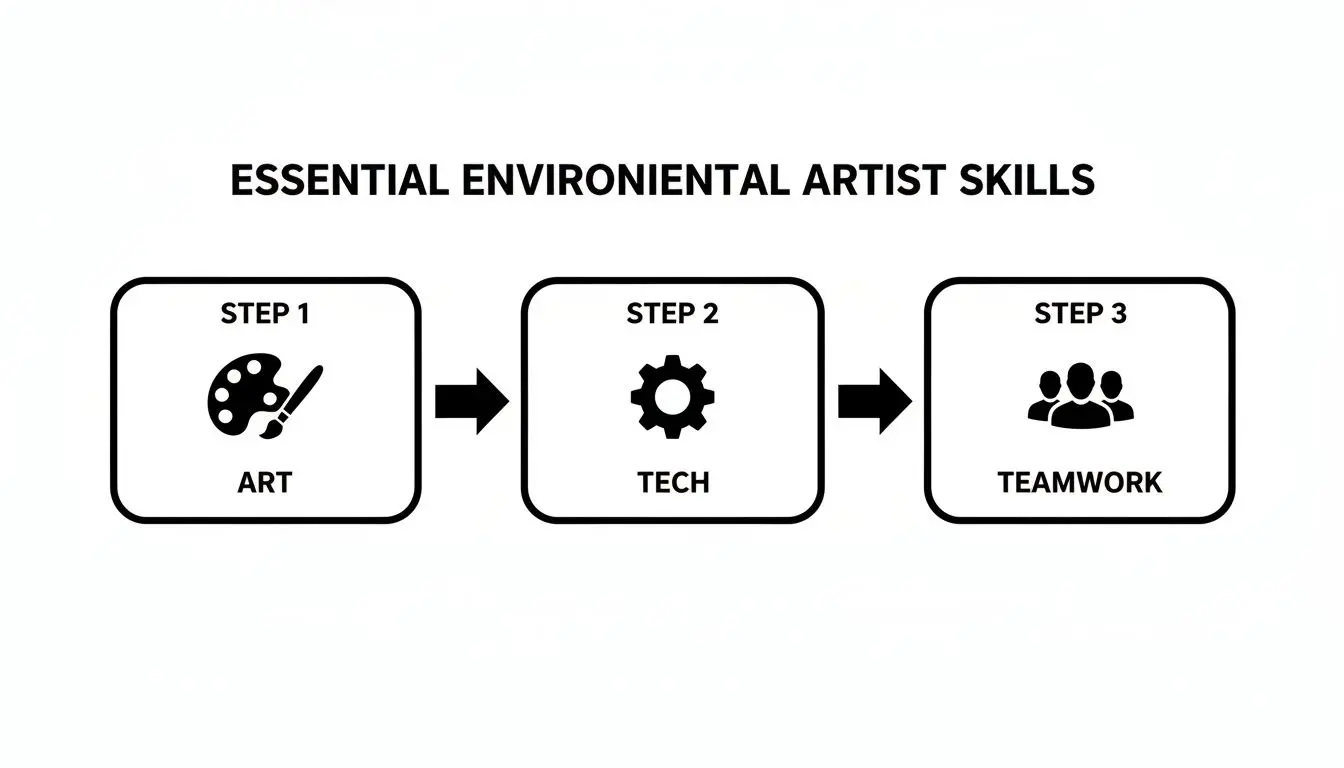
It’s a constant balancing act between creative vision and technical execution, all while working closely with the rest of the team.
Assembly in the Game Engine
The final stop is the game engine. This is where all the individual models, textures, and props are brought together and arranged to build the finished scene. The two big players here are Unreal Engine and Unity. This is where the artist becomes more like a set designer, focusing on composition, lighting, and post-processing. They'll add atmospheric effects like fog, rain, and dust motes to really dial in the mood. Adding dynamic elements can make a scene feel truly alive; for instance, knowing how to create custom particle effects in Unity for sparks, magic, or smoke is an incredibly valuable skill.
The most powerful tool for an artist is not the software, but the ability to think critically about the 'why'. Why does this place feel ancient? Why is this area lit so brightly? Every tool is just a means to answer these storytelling questions.
We’re also seeing a huge rise in AI-assisted tools that help artists generate texture variations or foliage. This frees them up to focus on the bigger creative picture. This efficiency is having a real impact on the freelance market, too. Self-employment for UK environment artists shot up, making up 42% of the creative workforce in 2023. Top-tier freelancers can pull in over £60,000, with 28% reporting higher income after using AI tools that boosted their production speed by 25%. It just goes to show that staying on top of the latest tech isn't just a creative boost, it's a financial one.
Building a Portfolio That Gets You Hired in 2026

In the creative world, your portfolio does all the talking. It’s your CV, your first impression, and your proof of skill, all rolled into one. For an environmental artist job, a killer portfolio is the single most important tool you have for catching a recruiter’s or art director’s eye. The biggest mistake I see aspiring artists make is throwing everything they’ve ever created into their portfolio. Studios don't have time to wade through dozens of half-finished sketches or so-so pieces. They want to see polished, professional work that proves you can deliver. The secret? Quality over quantity. Forget showing everything. Instead, focus on creating three or four outstanding ‘hero’ pieces. These should be complete, fully realised environments that show off your range and skill. A strong portfolio proves you can handle different challenges and art styles.
Curating Your Hero Pieces
To really show your versatility, aim for variety in these core projects. A well-rounded portfolio that ticks all the boxes might include:
- •An Organic Landscape: This is your chance to show you can create natural worlds, think terrain, foliage, rocks, and water. It demonstrates your grasp of composition and your ability to build believable, atmospheric exterior scenes.
- •An Architectural Scene: A piece centred on buildings or interiors proves you can handle hard-surface modelling, create modular assets, and build clean, precise structures. It shows you understand form and construction.
- •A Detailed Prop Breakdown: This involves taking a single, complex asset from one of your scenes and giving it a dedicated spotlight. It’s a fantastic way to show off your top-tier modelling and texturing skills up close.
By including these different types of projects, you’re immediately telling a studio that you're a flexible and capable artist who can take on a wide array of tasks.
Showcasing Your Technical Process
A beautiful final render is great, but recruiters need to see how you got there. They need to know you have the technical chops to work inside a professional production pipeline. Showing your process is non-negotiable. For each hero piece, you have to include breakdowns that pull back the curtain on the technical work. This shows you aren't just making pretty pictures, but are building optimised, game-ready assets.
Your portfolio should answer the silent questions every recruiter has: "Is your topology clean? Are your UVs efficient? Do you understand the PBR workflow?" Showing your wireframes and texture maps provides the definitive 'yes'.
Make sure you include the following for each project:
- High-Resolution Renders: Showcase your finished scene from several compelling angles. Pay close attention to your lighting and composition, make it sing.
- Wireframe Shots: Display the underlying geometry of your models. A clean, organised wireframe is the mark of a disciplined and professional artist.
- Texture Maps: Include shots of your base colour, normal, roughness, and metallic maps. This proves you understand the PBR texturing workflow and can create materials that react realistically to light.
Presenting Your Work Professionally
Once you have your hero pieces and their breakdowns ready, you need a professional platform to show them off. ArtStation is the industry standard for game and film artists, and having a polished profile there is absolutely essential. When you upload a project, don't just dump the images. Use the description to tell a story. Briefly explain the project's goals, the software you used, and any specific challenges you overcame. This adds valuable context and shows you think critically about your work. Your portfolio is your first and most important conversation with a potential employer. By focusing on quality, demonstrating your full range of skills, and showing your technical process, you make it easy for a studio to see your value and say ‘yes’. A strong portfolio is what turns an application into an interview for a top environmental artist job.Your Career Path and Salary Expectations in 2026
Stepping into a job as an environmental artist is the start of a seriously rewarding career. But it helps to know what the journey looks like, especially when it comes to your salary and responsibilities. You’ll see a huge shift as you grow. You'll start by executing specific tasks, but over time, you’ll be the one shaping the artistic vision for entire projects. The UK's creative sector has a well-trodden path for this, and understanding it will help you navigate your career from your first day as a junior to a senior leadership role.The Standard Career Trajectory
Most artists climb a pretty clear ladder. Each rung brings more responsibility, greater creative freedom, and, of course, a bigger paycheque. It's a path built on constant learning and proving you can deliver incredible work on a production schedule.- •Junior Environmental Artist: This is where it all begins. As a junior, you’ll focus on creating individual assets, props, textures, and small set pieces. You’ll be working under a senior or lead artist, learning the studio pipeline and proving you can create clean, optimised assets.
- •Mid-Level Environmental Artist: After a few years, you'll start tackling more complex work. This might mean owning entire sections of an environment, working with more independence, and even starting to mentor the new juniors on the team. You've mastered the technical side and are now honing your unique artistic eye.
- •Senior Environmental Artist: A senior artist is the team's trusted expert. You'll get the biggest artistic and technical challenges, taking ownership of massive, critical areas of a project. Seniors are the go-to problem-solvers who set the quality bar for everyone else.
Once you hit the senior level, your path can branch out. You might aim to become a Lead Environmental Artist, managing the environment team and working with the art director to define the project's look. Or, you could specialise in a niche like lighting, procedural content generation, or shader art, becoming the resident genius in that field. Our guide on finding animation jobs in London offers more tips on building a career in the UK's biggest creative hubs.
UK Salary Benchmarks for 2026
Before we get into the numbers, it's worth noting that salaries can vary quite a bit. Your location plays a big part, hubs like London, Manchester, and Edinburgh often pay more to reflect the higher cost of living. The games industry is a huge employer of environmental artists, with tons of opportunities to find well-paid gaming jobs. The demand for talented artists is high. In 2026 alone, we've seen over 1,200 environmental artist roles advertised across UK job sites. So, what can you expect to earn? Here's a look at the typical progression.
UK Environmental Artist Salary and Career Path (2026)
| Career Level | Average Annual Salary (UK) | Key Responsibilities & Focus |
|---|---|---|
| Junior Artist | £28,000 - £35,000 | Creating individual assets, learning the pipeline, taking direction from seniors. |
| Mid-Level Artist | £35,000 - £48,000 | Building larger scene components, working more autonomously, mentoring juniors. |
| Senior Artist | £48,000 - £65,000 | Owning major environments, solving complex technical/artistic problems, quality control. |
| Lead Artist | £65,000 - £80,000+ | Managing the environment team, setting visual direction, collaborating with directors. |
These figures are a great starting point, but they aren't set in stone. Your skills, portfolio, and the specific studio you work for will all influence your final salary.
A killer portfolio can completely change the game. We've seen juniors with outstanding portfolios command higher starting salaries and get promoted much faster than their peers. Your work is your most powerful negotiating tool, make it count.
Answering Your Questions on Becoming an Environment Artist
Thinking about a career in environment art? It's a fantastic path, but it's natural to have a lot of questions before you dive in. We get asked these all the time, so let's clear up a few of the big ones.
Do I Really Need a University Degree to Get Hired?
Honestly? Not always. While a degree in game art or animation can give you a great foundation and some good contacts, it's not the magic wand for getting a job. In this industry, one thing matters above all else: your portfolio is what truly gets you hired. An incredible portfolio that shows off your artistic eye and technical skill will always beat a degree certificate on its own. Plenty of amazing artists are self-taught or have built their expertise through specialist online courses. At the end of the day, what you can do is what gets you through the door.
What’s the Difference Between a Prop Artist and an Environment Artist?
It's a great question, and the roles can sometimes overlap. Think of the environment artist as the set designer and cinematographer of a digital world. They're in charge of the big picture , the layout of the scene, the lighting, the overall mood, and making sure everything feels like a believable, cohesive place. The prop artist is the master craftsperson who builds the specific items that fill that world. They focus on creating top-quality individual assets like furniture, weapons, vehicles, or streetlights. While the prop artist perfects the individual pieces, the environment artist’s job is to bring them all together into an immersive world. In smaller studios, you'll often find one artist wearing both hats.
A good way to think about it is like making a film. The environment artist is the production designer and director of photography, creating the overall look and feel of the set. The prop artist is in the workshop, building the hero sword or the futuristic chair that the actors interact with. Both are crucial to building a believable world.
Should I Learn Both Unreal Engine and Unity?
Mastering one engine is a must. Knowing your way around both is a huge plus for your career. The good news is that the core skills, modelling, texturing, composition, are the same no matter which engine you use. It's the workflows and specific tools that differ. Start by going deep on one engine. Really master it. A good way to choose is to look at the job descriptions for studios you'd love to work for. Are they making high-fidelity AAA games? Prioritise Unreal Engine. Are they focused on mobile, XR, or stylised projects? Unity might be your best bet. Once you're truly confident in one, start tinkering with the other. Having that flexibility on your CV makes you a much more appealing candidate to a wider range of studios.
At Studio Liddell, our team uses a range of industry-leading tools to bring ambitious creative visions to life. If you have an idea for an animation or immersive experience, book a production scoping call with our experts to see how we can help.