What Are Serious Games? Uses, Examples and Limits
A serious game is a game whose primary purpose is education, training, healthcare, public awareness or professional simulation rather than entertainment. But if someone enjoys playing it, does that make it less serious? Not at all. The useful question isn't whether the player had fun, but what they can do differently afterwards. That distinction helps answer “what are serious games?” without confusing a learning tool with entertainment that happens to teach something.
What Serious Games Are and Why They Exist
A serious game is designed for a purpose beyond entertainment. Think of a flight simulator: a trainee can experiment, make mistakes and try again, but the point is what they can carry into the cockpit. A nursing scenario trainer follows the same principle, giving a learner opportunities to recognise a problem and choose an appropriate response. Say a trainee nurse enters a digital ward. A patient's condition changes, and the trainee must decide what to check, which action to take and when to seek help. The experience becomes useful when those decisions relate to a defined clinical skill, not when the trainee finishes the level.
The parts you can check
Look for these features when deciding whether an experience counts:
- •Game elements: Players encounter challenges, rules, feedback and progression. They do something that affects what happens next.
- •An intended purpose: The designer identifies the educational, training or public-interest goal before choosing the mechanics.
- •A measurable outcome: Someone can assess the intended change, such as a better decision, more accurate procedure or safer habit.
A game doesn't have to achieve its intended outcome to belong to the category. An ineffective serious game is still a serious game, just as an ineffective lesson is still a lesson. Classification describes its purpose; evaluation establishes its value. That distinction matters across schools, hospitals, employers and public agencies. A colourful puzzle can serve a demanding learning objective, while a sombre, realistic environment can offer little useful practice. Serious describes purpose, not tone. Humour, imaginative characters and playful challenges are compatible with careful teaching.
A game is serious when its purpose is decided before its fun.
How Serious Games Differ from Entertainment Games
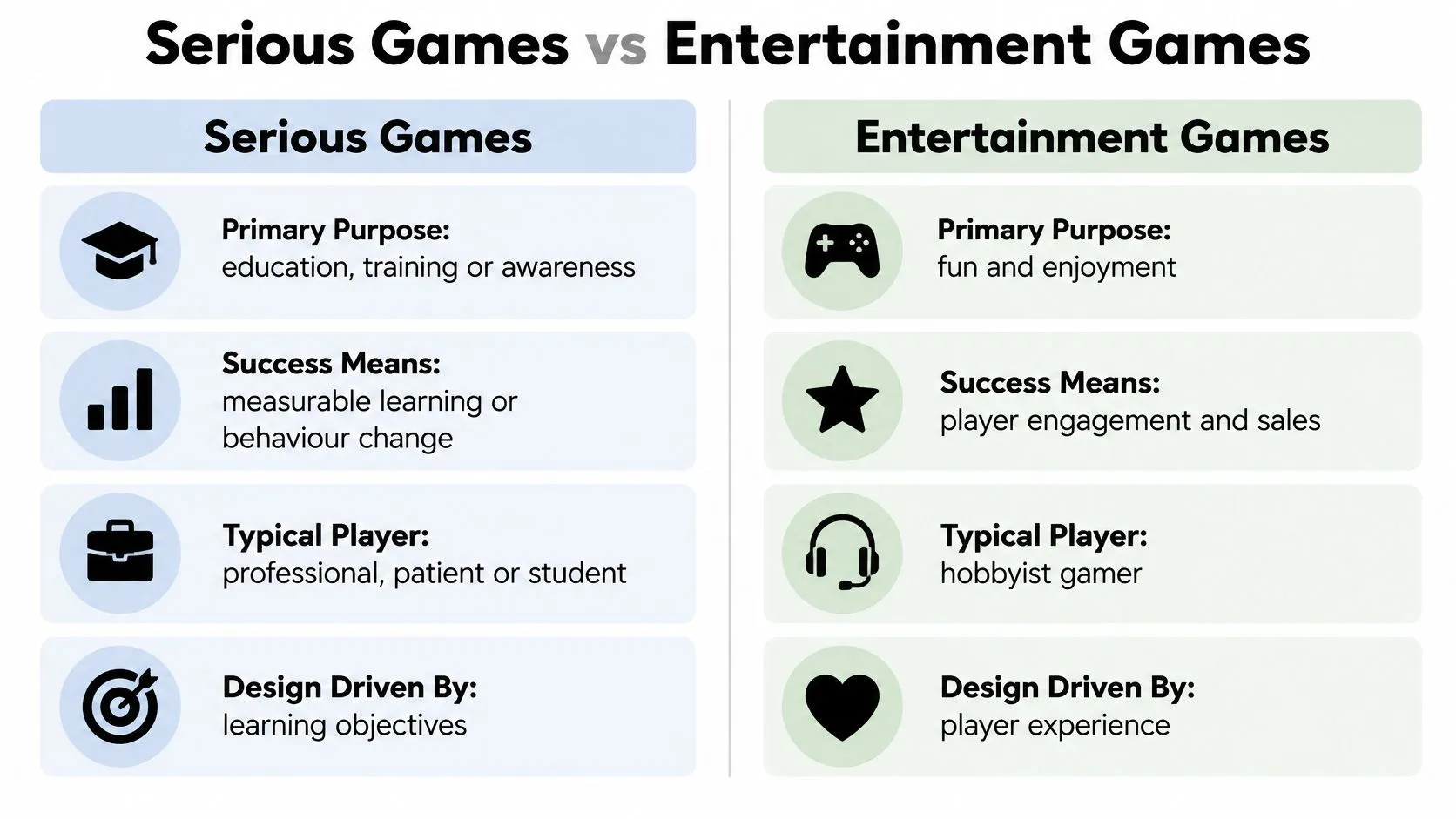
Serious games compared with entertainment games
| Criterion | Serious game | Entertainment game |
|---|---|---|
| Primary purpose | Learning, training, behaviour change or professional simulation | Enjoyment, challenge and leisure |
| Success measure | Knowledge, skill, decision quality or changed behaviour | Engagement, reviews, playtime and sales |
| Typical player | Learner, employee, patient or citizen | Player seeking leisure |
| Design driver | The learning objective defines the mechanics | Fun and challenge define the mechanics |
| Evaluation | Pre and post testing, telemetry linked to outcomes | Player feedback, retention and revenue |
The simplest test is to ask what the design is judged on. An entertainment game can succeed because players love its world, recommend it or keep returning. A training game needs an additional justification: learners should acquire or demonstrate something relevant beyond playing. Suppose both games involve navigating a spaceship. In the entertainment title, managing an engine failure might create tension and excitement. In a technical training game, the same scene might require players to diagnose a fault using a specified procedure. The graphics, setting and controls could look similar. The difference lies in why the designer included the task and what the evaluator measures.
Learning by accident isn't the same as learning by design
Entertainment games can teach vocabulary, planning or teamwork. That incidental benefit doesn't automatically make them serious games. Equally, a serious game can borrow suspense, storytelling and competition without becoming primarily entertainment. Ask what players should leave with. If the answer is enjoyment or excitement, the purpose is entertainment. If it's a specified, assessable change, the experience has a serious-game purpose, although its effectiveness still needs testing. Gamification is a related but distinct approach. It adds elements such as points, badges or leaderboards to an existing activity, rather than necessarily creating a complete game. For example, awarding badges for finishing workplace lessons gamifies the course. Building a decision-based workplace scenario with rules and consequences creates a game-based experience. Gamification sits alongside serious games on the spectrum of game-informed learning, and it deserves the same scrutiny of its intended outcome. Neither a leaderboard nor a realistic environment proves educational value. The boundary concerns intent and evidence, not graphics or genre.
Where Serious Games Are Used Today
Main sectors for serious games and their purposes
| Sector | Main purpose | Typical example |
|---|---|---|
| Healthcare training | Procedural and clinical decision skills | Purpose-built or adapted games for medical-procedure practice |
| Corporate training | Compliance, decision-making and conversation skills | Scenario-based simulations for staff |
| Public awareness | Changing risky behaviour | A game that trains adults to detect romance fraud |
| Education | Curriculum knowledge and practice | Classroom games for maths or history concepts |
| Technical simulation | Practising procedures without real risk | Operator rehearsal of costly or dangerous tasks |
Healthcare provides a substantial body of evidence to examine. A University of Manchester systematic review assessed 17 randomised controlled trials involving 2,978 participants and distinguished purpose-built learning games, game-design elements added to learning activities, and commercial games adapted for medical-procedure training. Those categories describe different production choices. A bespoke nursing game can focus tightly on clinical decisions; an adapted commercial game might support a narrower component of procedural practice. Neither should be treated as a substitute for supervised competence assessment. Healthcare applications also extend beyond professional education. Re-Mission, developed by HopeLab, helps young people with cancer learn to manage their treatment. Foldit asks players to fold protein structures, connecting puzzle play with research contributions.
Matching the experience to the setting
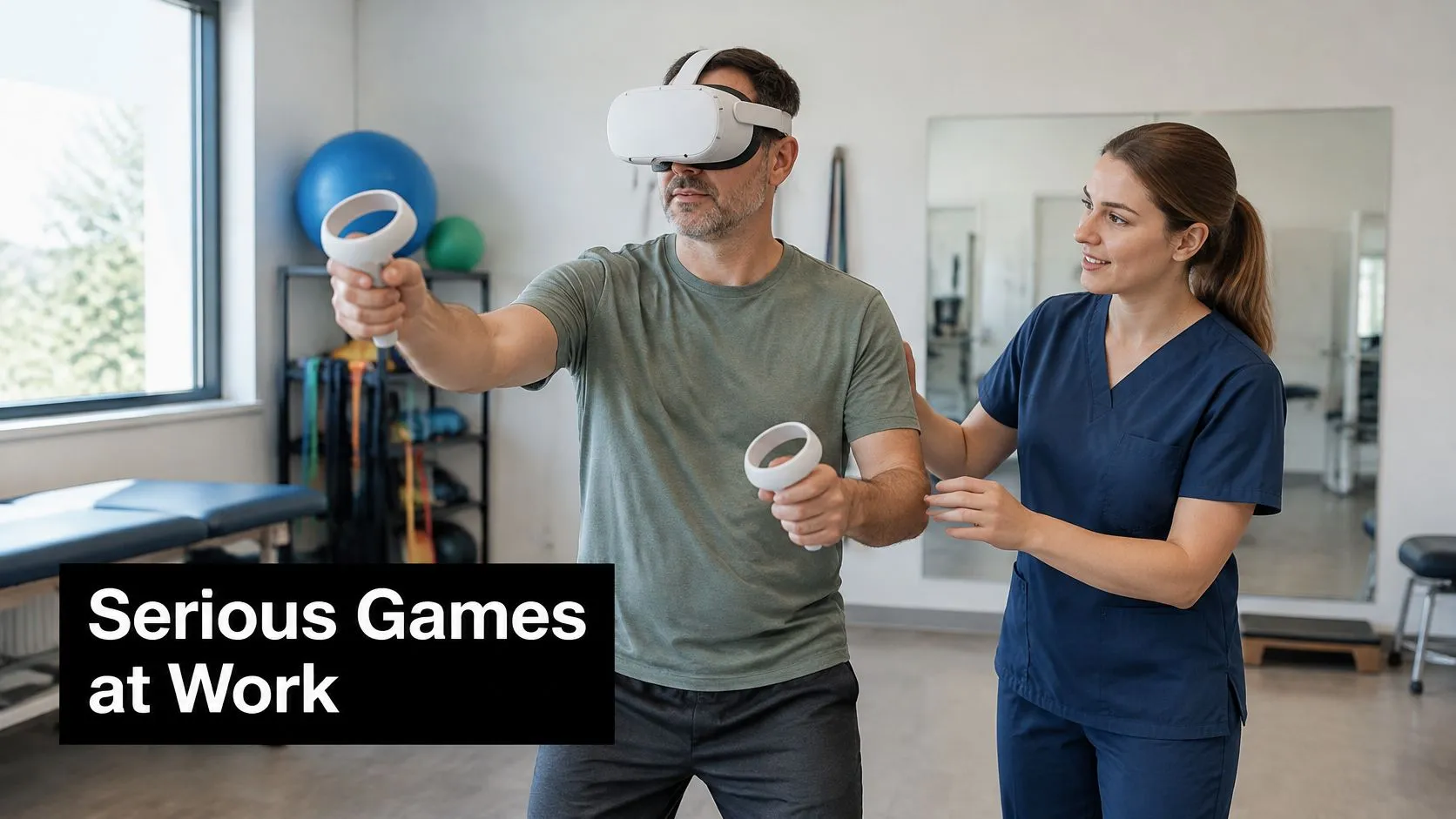
Physical activities need separate consideration from knowledge-based games. For readers exploring movement-based experiences with older adults, Orange Neurosciences' guide to selecting safe VR exercise for seniors is a useful companion when considering suitability and supervision. An engaging activity isn't automatically appropriate for every participant. In corporate training, a manager might rehearse a difficult conversation with a virtual colleague. Branching responses let the learner explore consequences without exposing an actual employee to a poorly handled discussion. Compliance scenarios can similarly ask staff to apply a rule rather than merely recognise its wording. Public-awareness games can make manipulation something people practise identifying. Classroom games can provide opportunities to apply maths or history concepts, while technical simulations let operators rehearse shutdowns, inspections or fault diagnosis. For educators considering lighter-touch classroom approaches, our guide to gamification in education explores how game elements can support learning activities.
Practical rule: The stronger the need to rehearse a risky, expensive or hard-to-repeat situation, the stronger the case for considering a serious game.
The best application isn't necessarily the most immersive. It's the one that gives learners useful practice they couldn't readily obtain another way.
How a Serious Game Teaches Through Play
A serious game needs a connection between what players do and what they're supposed to learn. A useful design approach is a learning loop: demonstrate, practise, explain and test again.
- Model the task. Show what competent performance looks like, whether that means following a procedure or spotting a warning sign in a message. Modelling reduces guessing about what the learner is being asked to achieve.
- Require action. Ask the player to choose, decide or perform rather than watch. Acting requires the learner to retrieve and apply knowledge.
- Give immediate, explanatory feedback. Explain why a choice worked or failed while the decision is still fresh. A score alone tells players how they performed, not how to improve.
- Reassess against a baseline. Test the skill again in an unfamiliar scenario, including after a delay where appropriate. Reassessment helps distinguish transferable learning from memorising the game's answers.
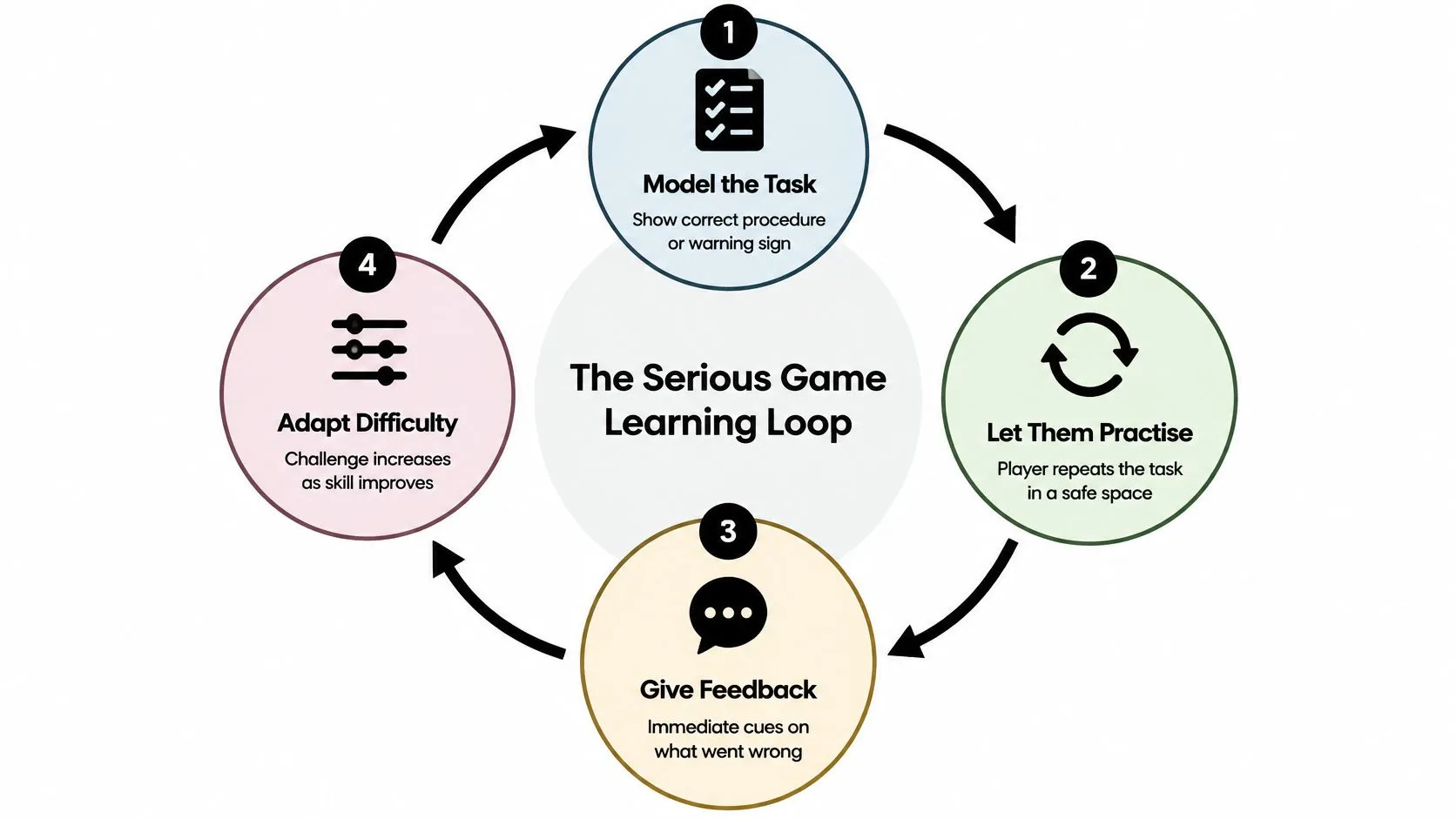 Difficulty can increase as learners improve, but harder levels don't replace assessment. A player might become faster at operating the interface without becoming better at the underlying task. A systematic review hosted by the UK Health Security Agency found moderate-to-large knowledge effects in five studies of individually delivered interventions and small-to-large skills effects in 10 studies, while rating the overall evidence low or very low quality. Those findings support testing a learning design, not assuming that any interactive format will work.
Check what each interaction teaches
A common design failure is to reward activity unrelated to the target skill. If learners earn points by clicking quickly through safety instructions, the designer may be rewarding speed rather than careful judgement. Check that the experience includes:- •A defined target skill: Describe the action learners should perform outside the game.
- •Meaningful repetition: Change the circumstances so players practise applying a principle.
- •Accessible feedback: Make explanations understandable without relying solely on colour, sound or fast reactions.
- •A measure of change: Record performance relevant to the objective, not just completion.
For a language-learning perspective, Gaeilgeoir AI on gamified learning offers a useful companion to thinking about practice and progression. Our guide to crafting engaging interactive learning experiences also considers how to connect interaction with educational purpose. Think of a driving instructor: they explain a manoeuvre, let you attempt it, correct a missed mirror check and assess you on another road. Play is the method; the learning loop is what makes it teach.
What the Evidence Shows and Where It Falls Short
A University of East Anglia evidence review examined 30 studies involving 3,634 participants, including 27 randomised controlled trials and three cluster-randomised trials, and found serious gaming and gamification at least as effective as comparison methods and often more effective for knowledge, practical skills and learner satisfaction. That's a credible foundation for considering game-based learning. It isn't a guarantee that a particular game will outperform a particular course, instructor or practical exercise. The distinction matters because satisfaction, learning and performance are different outcomes. A learner can enjoy a session without retaining its content. They can remember a rule without applying it correctly under pressure.
What a positive result actually tells you
Suppose a game's players achieve better knowledge-test scores than learners using a workbook. That result supports a claim about the tested knowledge, population and comparison. It doesn't automatically establish that players will make fewer workplace errors. A careful evaluation separates several questions:
- •Knowledge acquisition: Can learners explain or recognise the relevant information?
- •Practical competence: Can they perform the task accurately?
- •Retention: Can they still demonstrate the skill after time has passed?
- •Transfer: Can they use it outside the scenarios they practised?
Confidence can also be worth measuring, but it shouldn't replace competence. A confident learner who misses a critical safety step still needs further instruction.
Give the limitations equal weight
The review's authors reported low-quality evidence across much of the literature and called for more rigorous, theory-driven evaluation. Imprecision, inconsistent findings and limitations in study design reduce how confidently organisations can apply the results. Different outcome measures create another problem. A knowledge quiz, a simulated procedure and a satisfaction questionnaire don't establish the same thing. Grouping them under a broad claim that games work hides the decisions a commissioner needs to make. There's also insufficient evidence to declare a universally superior format. Choosing virtual reality, a mobile game or a desktop simulation should follow the task, audience and delivery conditions, rather than a belief that newer technology necessarily teaches better.
A well-designed evaluation tests the promised change, not just whether participants liked the experience.
For clinical projects, our guide to medical training simulations in XR considers accuracy, assessment and compliance together. Subject-matter review and clear assessment criteria belong in production planning, not as additions after the visuals are finished. The fair verdict is that serious games are a credible teaching method when their design and evaluation are sound. Treating them as attractive digital content removes the very discipline that makes an educational claim defensible. Ask these questions of any claimed result:
- •What was measured? Identify the actual skill or outcome.
- •Against what baseline? Establish what the game was compared with.
- •For how long? Distinguish immediate improvement from retained capability.
Deciding Whether a Serious Game Fits Your Goal
A serious game doesn't work because it's interactive. Before commissioning one, establish whether making decisions inside a game is a useful way to practise the task. Use this checklist before choosing an engine, visual style or headset:
- Name the change. Replace a broad aim such as better awareness with an observable skill or behaviour.
- Choose the measure first. Decide what evidence would demonstrate improvement before production begins.
- Check persistence. Plan assessment after play, not only on the completion screen.
- Match mechanics to purpose. Make the player's repeated actions relevant to the intended capability.
- Consider a simpler format. A short video, guided exercise or clear reference sheet may achieve the goal without game development.