The Ultimate Guide to Creating Immersive 4D Rides
So, what exactly is a 4D ride? At its core, it's an immersive attraction that takes a 3D film and layers it with synchronised physical effects right there in the theatre. It's a world away from your standard cinema trip. Instead of just watching the action, you feel like you're right in the middle of it, thanks to a full-sensory assault of motion, scents, and atmospheric effects.
What Makes a 4D Ride Truly Immersive
Think of a traditional film as a storyteller. It tells you a great story, but you're always an observer. A 4D ride tears down that wall and pulls you _into_ the story, turning you from a passive viewer into an active participant. This leap from observation to experience is the secret sauce. It’s the difference between watching a rollercoaster on screen and feeling that gut-wrenching drop in your seat as the wind whips past your face. The experience feels real because it engages more than just your eyes and ears.
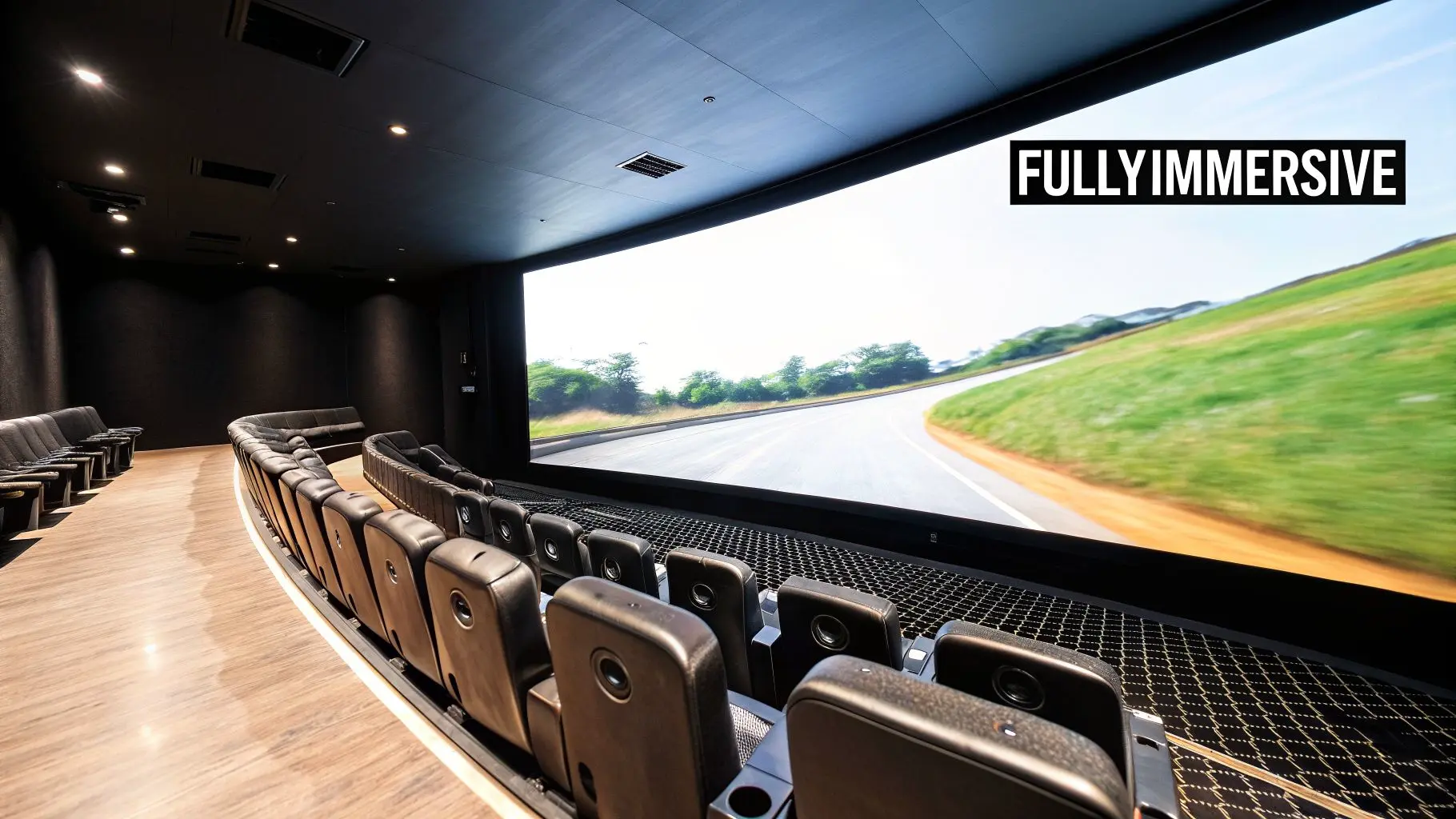
This multi-sensory approach is meticulously engineered to convince your brain. By perfectly timing visual, auditory, and physical sensations, a 4D ride creates a powerful illusion of reality. When your eyes see rain on the screen and, at that exact moment, you feel a light mist on your skin, your brain buys into the experience. This builds a much stronger, more memorable emotional connection to what's happening.
The Core Components of Immersion
This immersive quality is no accident. It’s the result of several key components working together in perfect harmony, each playing a critical role in building a believable world for the audience. Let's break down the essential building blocks that combine to create a compelling 4D ride. Each element is crucial for crafting an experience that feels less like watching a film and more like living inside one.
The Core Components of a 4D Ride Experience
| Component | Description | Impact on Audience |
|---|---|---|
| High-Fidelity 3D Visuals | The visual backbone of the ride, using crystal-clear stereoscopic imagery to create a sense of depth and place the guest inside the environment. | Creates the "world" of the ride, making on-screen environments feel tangible and real. |
| Synchronised Motion Base | The seats are dynamic platforms, programmed to heave, pitch, roll, and vibrate in perfect sync with the on-screen action. | Simulates movement, from a gentle flight to a high-speed chase, creating a powerful physical connection to the narrative. |
| In-Theatre Physical Effects | This is the "4D" magic. Wind, water sprays, smoke, fog, and even custom scents are deployed at precise moments. | Engages senses beyond sight and sound, dramatically heightening realism and surprise. |
| Spatial Audio Design | A sophisticated sound system that makes audio cues feel like they are moving around the theatre, matching the on-screen action. | Reinforces the sense of space and directionality, making the audience feel completely enveloped by the soundscape. |
These components are the toolkit for creating what we in the industry call 'presence'.
The goal of a 4D ride is not just to entertain but to create a 'presence illusion', a psychological state where the guest's mind accepts the virtual environment as real. This is what generates powerful, lasting memories.
Ultimately, the magic is in the seamless integration. When a dragon swoops past on screen and you feel a gust of warm wind while catching the faint smell of smoke, the boundary between the screen and your seat completely dissolves. That’s what elevates an attraction from a simple movie to an unforgettable adventure.
The Tech Making Sensory Immersion a Reality
The magic of a 4D ride isn't down to one single gadget. It’s a carefully choreographed symphony of hardware and software working in perfect harmony. Each piece has a specific role, and it's their flawless synchronisation that turns a passive viewing into a genuinely physical experience. At the core of it all is the technology that translates what's happening on screen into real, tangible sensations. Getting this right demands a deep understanding of both creative storytelling and complex engineering. The system has to react in milliseconds, matching a visual cue with a physical jolt, a blast of wind, or a sudden drop in temperature. It's this razor-sharp precision that sells the illusion and makes the experience stick with you.
The Foundation: Motion and Haptics
The most obvious piece of kit in any 4D attraction is the motion base , the dynamic seating platform that acts as the main physical connection between the audience and the story. These aren't just vibrating chairs; they're sophisticated robotic systems. Modern motion bases usually operate on three to six degrees of freedom (DOF), which allows for an incredible range of movement:
- •Heave: Moving straight up and down.
- •Sway: Shifting from side to side.
- •Surge: Lurching forwards and backwards.
- •Pitch: Tilting forwards and backwards.
- •Roll: Tilting from one side to the other.
- •Yaw: Turning left and right.
A 6-DOF system can flawlessly mimic everything from the subtle drift of a spaceship to the violent shudder of an explosion. This kind of tech is a huge driver of the market's growth. For instance, the UK's 4D cinema market, valued at USD 80.34 million, is expected to hit USD 185.58 million by 2033. Motion seats are the biggest and most critical part of that expansion.
Beyond Movement: Atmospheric and Special Effects
While the motion base handles the big, gut-wrenching movements, an array of other effects adds layers of fine detail and realism. A massive part of what makes a 4D ride truly immersive comes from expertly integrated spectacular special effects for events, pushing the sensory input far beyond just sight and sound. These systems are installed throughout the theatre and often built right into the seats, delivering highly targeted sensations to each guest. Common In-Theatre Effects Include:
- •Wind and Air Blasts: From a gentle breeze to a sudden gale, synchronised fans create a powerful feeling of speed and environmental interaction. Small, targeted air jets , often called neck and leg ticklers , can simulate anything from crawling insects to brushing past jungle foliage.
- •Water and Mist Effects: A fine mist can instantly replicate fog or light rain, while sharper sprays feel just like the splash from an ocean wave or a monster's roar. This kind of tactile feedback is incredibly effective at grounding the guest in the moment.
- •Scent Delivery Systems: This is perhaps the most potent tool for tapping into memory and emotion. Scent technology releases specific aromas timed perfectly to on-screen events. The smell of pine in a forest, gunpowder during a battle, or salt in the sea air adds a powerful, subconscious layer of believability.
- •Lighting and Strobes: Flashes of lightning, fiery explosions, or magical spells are brought into the physical space with high-speed strobe lights and targeted LED systems. This extends the on-screen visuals right into the audience's peripheral vision.
The key isn't just _having_ these effects, but choreographing them. The timing, intensity, and combination of effects have to be programmed with the precision of a musical score. The goal is to support the story, never to distract from it.
The Brain: The Show Control System
Orchestrating this complex array of hardware is the show control system. Think of it as the central nervous system of the entire attraction. It's a sophisticated piece of software that ensures every single effect, from a tiny seat vibration to a huge puff of smoke, is triggered at the exact right frame of the film. This system reads a master timeline of the media and sends out commands to the motion bases, scent machines, fans, and water jets. Without this flawless synchronisation, the whole illusion shatters. The ride becomes a chaotic mess of disconnected sensations rather than a cohesive, believable world. This integration is where a skilled production partner's expertise becomes absolutely essential, bridging the gap between a creative vision and the technical execution needed to bring it to life.
The Production Pipeline for 4D Ride Content
Creating a 4D ride is a fascinating blend of blockbuster filmmaking and precision engineering. It’s a journey that takes a spark of an idea and transforms it into a technically perfect, multi-sensory experience. This whole process needs a special kind of team, one that lives and breathes storytelling but also understands the nuts and bolts of hardware integration. The golden rule for the entire production is this: the visuals must dictate every single physical sensation. Unlike a standard film, every camera swoop, every explosion, and every drop of rain is designed from the ground up with the motion base and theatre effects in mind. This isn't something you tack on at the end; it's the very foundation of the project.
From Concept to Pre-visualisation
Every unforgettable 4D attraction starts with a killer story. This is the creative crucible where the narrative is born, key moments are mapped out, and the overall vision takes shape. We're asking the big questions here: What journey are we taking the audience on? What do we want them to feel when they leave their seats? With a solid concept in place, the idea moves through a few critical stages:
- •Storyboarding: The whole ride is drawn out, shot by shot. This is the first point where we start thinking about timing, earmarking the big moments for motion cues and physical effects.
- •Animatics: We take those static storyboards and turn them into a rough, timed animation. This 2D animatic acts as the essential blueprint for the 3D production, helping nail the pacing before we dive into expensive CGI.
- •Technical Pre-visualisation (Techviz): This is where it gets really interesting. We build a simple, blocky 3D version of the ride. It’s a crucial step that lets us test motion programming and effect choreography in a virtual space, making sure our creative ambition is actually possible, and feels right, before committing serious resources.
This visualisation shows how we layer the core sensory elements during production, starting with the motion base, adding special effects, and finally syncing the audio.
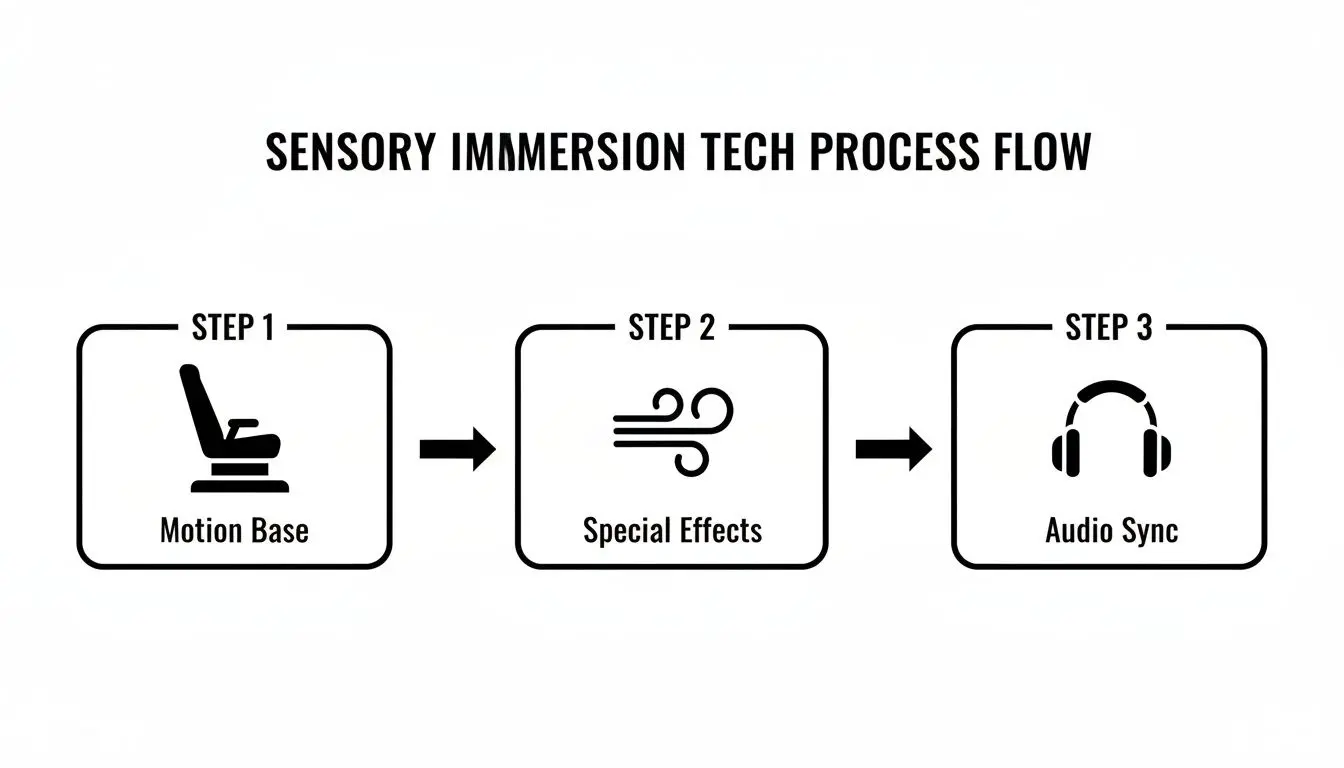
This methodical approach ensures each layer builds on a solid foundation, saving a lot of headaches and costly changes down the line.
Full-Scale CGI Production and Animation
Once the blueprint is locked in, the full-scale production kicks off. This is the most intense part of the process, bringing in a big team of artists and technicians to build the world our audience will fly through. They create everything from characters and environments to props, and then bring it all to life with animation. The real magic for 4D rides happens in the constant back-and-forth between the animators and the ride programmers. As an animator crafts a high-speed chase sequence, the motion team is right there with them, choreographing the exact seat movements to match. It’s a deeply collaborative dance that ensures the physical feeling perfectly mirrors the on-screen action, frame by frame.
The Rise of Real-Time Engines
For years, 4D content was "baked" into a final video file, like a movie. But powerful real-time game engines like Unity and Unreal Engine are completely changing how we do things. These platforms open the door to dynamic, interactive experiences that can react to the audience or be updated with new content far more easily.
Real-time engines give us incredible flexibility. We can tweak the intensity of motion, adjust the timing of an effect, or even build branching story paths right there in the engine. This rapid, hands-on process leads to a much more refined and powerful final ride.
This move towards real-time rendering is a massive leap forward. It’s what’s enabling attractions to become more complex, personalised, and replayable than ever before. To get a sense of how all these pieces come together, have a look at the creative and technical process behind our Washington 4D Ride case study.
Hardware Integration and On-Site Programming
The last and most critical piece of the puzzle is bringing the finished content and the physical ride hardware together in the actual venue. This is where the virtual world smashes into the real one. Creatives and technicians work side-by-side on-site, riding the attraction over and over again to fine-tune every last detail. It's a meticulous process of calibrating the motion base, getting the intensity of the wind and water sprays just right, and ensuring the spatial audio is perfectly mixed for the room. This is what it takes to make sure the final experience is not just thrilling, but also safe, dependable, and ready to blow minds on opening day.
Planning for Success: Safety, Throughput, and ROI
A jaw-dropping 4D attraction is more than just incredible visuals and spot-on effects; it's a complex operational machine. For venue operators and investors, the real measure of success comes down to commercial viability. A stunning experience is only half the story if it isn't also safe, efficient, and profitable. So, let's shift gears from the creative side to the practical realities of running the business. This is where we balance the magic of the guest experience with the nuts and bolts of operating a high-traffic attraction. Things like guest throughput, safety protocols, and staffing aren't just details to figure out later, they need to be baked into the ride’s design from day one.
Designing for High Guest Throughput
For any attraction, the single most critical operational metric is throughput. This is the number of guests you can get through the ride every hour. High throughput is the key to maximising revenue and, just as importantly, preventing the kind of long, frustrating queues that can spoil an otherwise great day out. Getting this right means planning every little detail, from the physical layout of the theatre right down to the runtime of the film itself.
- •Optimised Entry and Exit: People need to flow in and out of the attraction smoothly. Think wide, clear pathways, smart queueing systems, and a simple, quick process for getting guests seated and secured.
- •Ride Cycle Time: The total cycle time covers loading, the ride experience, and unloading. Here, every second counts. A shorter, high-impact film, say 5-7 minutes, will always deliver higher throughput than a 15-minute epic, letting you serve far more guests throughout the day.
- •Staffing Efficiency: Your team needs to be a well-oiled machine when it comes to managing guest flow. Well-practised procedures for greeting, seating, and checking restraints can shave precious moments off each cycle, which really adds up to boost hourly capacity.
Upholding Robust Safety Standards
Safety is, of course, completely non-negotiable. 4D rides are designed to feel thrilling, even a little unpredictable, but behind the curtain is a highly controlled and regulated environment. Keeping guests safe involves a layered approach that covers everything from the hardware to your operational playbook and how you communicate with visitors.
A successful attraction delivers _perceived_ risk while operating in a state of _absolute_ safety. This builds guest trust and ensures long-term operational integrity, protecting both visitors and your investment.
The pillars of safety include rigorous daily maintenance checks on all motion bases and effects systems, clear and visible safety briefings for guests, and rock-solid emergency procedures. Every single element, from height restrictions to the intensity of the motion, is carefully calibrated to deliver a thrilling yet completely secure experience. For a deeper look into these operational must-haves, check out our producer's guide to location-based VR throughput, safety, and ROI, which shares many of the same core principles as 4D attractions.
Measuring Your Return on Investment
At the end of the day, a 4D ride is an investment, and it needs to deliver a return. The most direct path to profitability is through premium ticket pricing, a strategy that the cinema industry has used to great effect. Premium formats like 4DX are changing the financial game for exhibitors, allowing them to price tickets 40%-60% higher than a standard 2D screening. This is a massive advantage in a competitive market. To get the full picture on this trend, you can discover more insights about the movie theatre market from Mordor Intelligence. But the ROI of a 4D ride goes well beyond just ticket sales. You can measure its impact through several other key performance indicators (KPIs):
- •Increased Dwell Time: A standout attraction gives people a reason to stay at your venue longer. That extra time often translates into higher secondary spending on food, drinks, and merchandise.
- •Enhanced Visitor Satisfaction: A memorable, high-quality ride generates glowing reviews and powerful word-of-mouth marketing. This boosts your brand's reputation and helps attract new visitors.
- •Ancillary Revenue Streams: The ride itself can become a new revenue channel. Think sponsorships, private event bookings, and even exclusive merchandise lines tied to the experience.
By carefully planning for these operational and commercial realities from the outset, you can turn a brilliant creative concept into a profitable and sustainable centrepiece for your venue.
Real-World Examples of Impactful 4D Rides
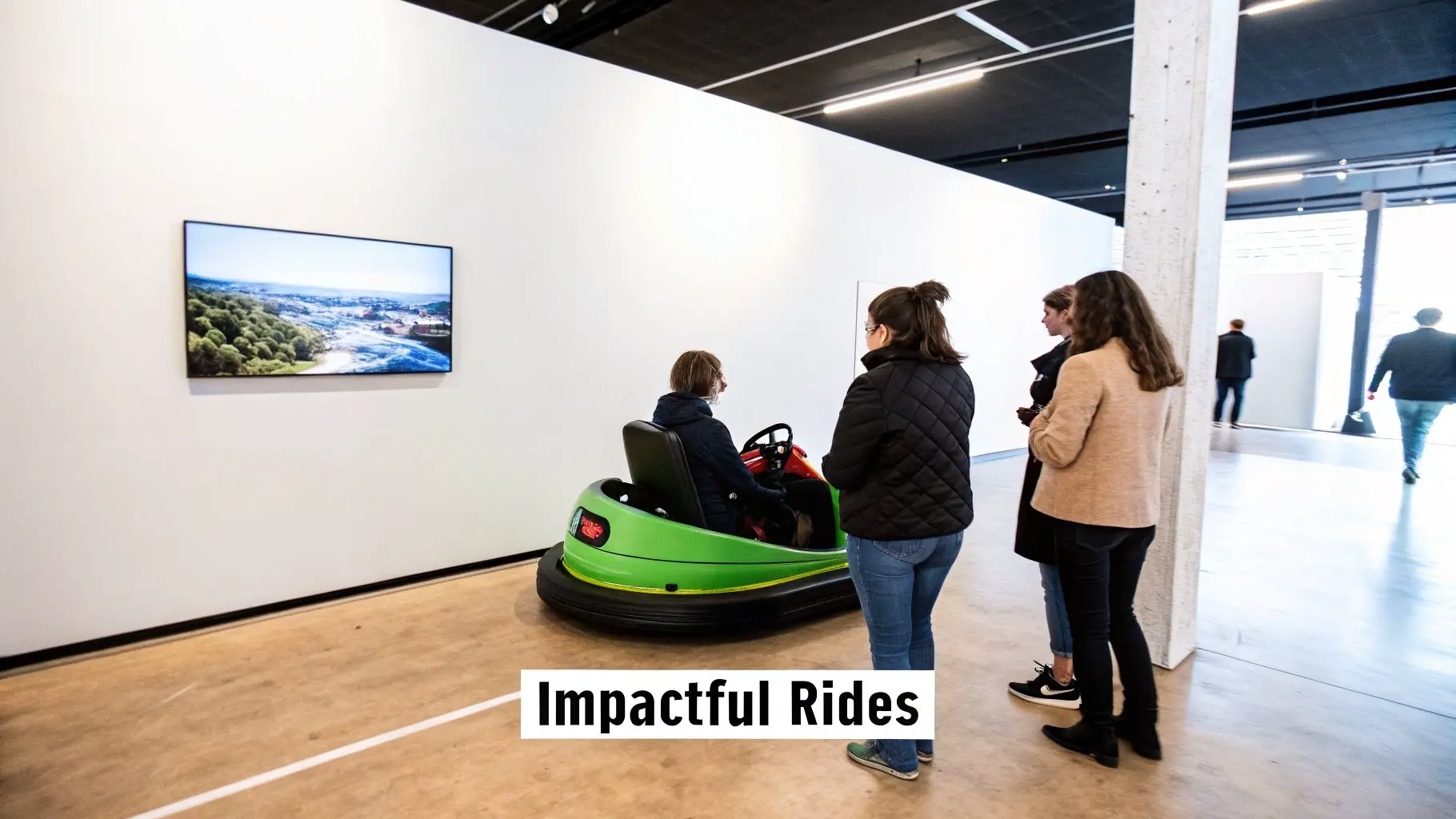
The best way to grasp the power of a 4D ride is to look at the results they deliver in the real world. You can see their value everywhere, from becoming the headline attraction at a theme park to turning a museum visit into a genuine adventure. Looking at how they're actually used shows us how sharp storytelling and technical wizardry come together to hit specific business goals. These attractions are much more than just thrill machines. They're strategic investments built to pull in visitors, get people talking, and create memories that stick. A successful ride always has a clear line connecting its creative concept to its intended impact.
Theme Parks and Entertainment Venues
In the fiercely competitive theme park world, 4D rides are absolute crowd-pullers. Take an experience like _Mickey's PhilharMagic_, a staple at Disney parks worldwide. It blends beloved characters and classic music with 3D visuals, scents, and water effects, creating a gentle but deeply immersive show that’s perfect for the whole family. Its success lies in being a high-capacity, repeatable attraction that keeps guests happily entertained. The short runtime means it can handle huge crowds, while the sensory touches make it a memorable highlight that deepens that all-important emotional connection to the Disney brand. Another winning formula is building a 4D ride around a huge film franchise. These attractions tap into a ready-made audience, using motion and atmospheric effects to drop fans right into their favourite scenes. It’s a proven model for creating a "must-see" experience that can justify higher ticket prices and become the star of a park's marketing push.
Museums and Educational Institutions
Beyond the theme park gates, 4D rides have found a powerful calling in education. Museums are increasingly using this technology to bring history and science to life in a way that a static display behind glass simply can't. Imagine a natural history museum that doesn't just show you dinosaurs but sends you back to their world. You get scientifically accurate CGI, a motion base that mimics the thud of a T-Rex's footstep, and even the smell of a prehistoric forest. It creates a gut-level, educational moment that really sticks, especially with younger visitors. Our work on the award-winning Emmen Zoo 4D ride is a perfect example of how this tech can forge a journey that's as informative as it is thrilling.
In these settings, the aim is "edu-tainment", making learning feel like an active, exciting discovery. When you engage more of the senses, you don't just entertain; you help people remember what they've learned and spark a real curiosity that stays with them.
Brand Activations and Cinema Experiences
The principles behind 4D are also making waves far beyond traditional attractions. For cinemas, 4D is a secret weapon in the fight against a comfy sofa and a streaming subscription. The UK cinema market is showing strong signs of recovery, with revenues projected to hit £1.3 billion and admissions climbing by 62.7% in 2022. 4D is a key part of this, offering a premium experience you just can't get at home. Brands are catching on, too, using pop-up 4D experiences at trade shows and product launches to make a massive splash. Picture a car company letting you "feel" the G-force and tight handling of its new sports car in a quick, intense 4D ride. It’s a brilliant way to create a positive, physical memory of the brand that cuts right through the noise of a busy event. It proves just how versatile these attractions can be for any organisation wanting to leave a lasting impression.
How to Choose the Right 4D Production Partner
Let’s be direct: investing in a 4D ride is a massive commitment. The single most important decision you'll make in this entire process is picking the right creative and technical partner to build it with. Think of the ideal studio as a rare hybrid, part cinematic storyteller, part expert engineer. You need a team that can deliver a heart-pounding experience that is also a rock-solid, operationally sound attraction. Your success hinges on finding someone who can navigate the entire journey, from that first creative spark to the final on-site calibration. Choosing a partner without the right kind of experience is a huge risk. A studio that’s brilliant at traditional animation might know nothing about the very specific demands of motion programming or hardware integration. This mismatch often leads to a disjointed final product where the chair’s movement and the wind effects feel completely disconnected from the action on screen, shattering the very immersion you’re trying to create.
Key Evaluation Criteria
When you start talking to potential partners, you need to vet their capabilities across both the creative and the technical. Ask direct questions, and don't be shy about requesting concrete proof to back up their claims. A genuinely experienced studio will welcome this level of scrutiny, they’ll be eager to show you what they can do. Here’s a checklist of what to dig into:
- •A Relevant Portfolio: Don’t just look for pretty CGI. Look for a track record that specifically includes immersive, location-based experiences. Have they actually delivered projects for theme parks, museums, or brand centres before?
- •Deep Technical Expertise: A top-tier studio needs to be fluent in both traditional pre-rendered CGI pipelines and real-time engines like Unity or Unreal Engine. This dual expertise is non-negotiable for modern 4D rides, as it offers far greater flexibility and opens the door to interactivity.
- •End-to-End Project Management: Ask to see their production process. A reliable partner will have a clearly documented pipeline that covers every single stage, from storyboarding and pre-visualisation right through to on-site hardware integration and programming.
- •A Hardware-Agnostic Approach: The studio should have experience working with a wide range of motion base manufacturers and special effects suppliers. This is crucial because it ensures they can recommend and integrate the best hardware for your specific creative vision and budget, rather than just pushing a single system they're tied to.
The right production partner doesn’t just make a film for you; they become a strategic ally who gets the operational and commercial realities of your venue. They design experiences where safety, guest throughput, and long-term ROI are baked in from the very beginning.
By sticking to these criteria, you can sift through the options and find a partner who not only gets your creative vision but also has the proven technical chops to bring it to life without a hitch. This due diligence isn't just a box-ticking exercise; it's the foundation of a successful and profitable attraction.
Your 4D Ride Questions, Answered
Even with a solid plan, stepping into the world of 4D attractions is bound to bring up a few questions. It’s a big investment, after all. Here, we'll tackle some of the most common queries we get from venue operators, producers, and investors, giving you the straightforward answers you need to move forward.
What’s a Realistic Development Timeline?
For a custom 4D ride film, a realistic timeline from the first creative conversation to final on-site installation is typically somewhere between six to twelve months. What pushes a project to one end of that scale or the other? It really comes down to the complexity of the CGI, the total run-time, and how much interactivity you’re building in. A shorter piece using some existing creative assets will be on the quicker end. A flagship, world-class attraction built from the ground up, however, will naturally need that extra time to get every single detail just right.
How Much Does Content Production Cost?
There's no single price tag for 4D content, but the budget tends to fall into a few clear brackets. A simpler, shorter experience might start in the low six-figure range. On the other hand, a major headline attraction with bespoke, high-fidelity animation and a battery of effects can easily push into the high six figures and beyond. The big cost drivers are almost always:
- •Film Length: More minutes on screen means more animation, more rendering, and more programming time. It's a simple equation.
- •CGI Complexity: The level of detail in your characters, environments, and special effects is probably the single biggest factor. Photorealism costs more than stylised animation.
- •IP Licensing: Bringing a famous character or world into your attraction? You'll need to budget for the licensing fees that come with it.
It's vital to have a frank discussion about your creative ambitions early on, as they will have the biggest influence on the final investment.
Can We Just Convert an Existing 3D Movie?
Technically, you _can_ take a standard 3D film and add a motion and effects track after the fact. But honestly, the results are nearly always underwhelming. The most powerful 4D rides are the ones where the physical experience was baked into the creative DNA from day one.
When you just bolt 4D effects onto a finished film, it often feels gimmicky and disconnected. A truly immersive experience is choreographed, with camera moves and on-screen action designed from the outset to work in perfect harmony with the motion base and in-theatre effects.
What's the Real Difference Between 4D and VR?
While both 4D rides and virtual reality (VR) are chasing that feeling of immersion, they get there in completely different ways. A 4D ride is fundamentally a shared, social experience. You're in a physical theatre with a crowd, all reacting together as the story unfolds on screen and is enhanced by real-world hardware. VR, in contrast, is an intensely personal and isolating experience. You strap on a headset, and your immediate reality is completely replaced by a digital one. Think of it this way: 4D enhances the cinema experience you're in, while VR replaces it entirely.
Ready to explore what a 4D attraction could do for your venue? Studio Liddell has been crafting world-class immersive experiences since 2019. Book a production scoping call with our team to start the conversation.