Secure Top Animation Jobs UK
If you're searching for animation jobs uk, start with the uncomfortable truth. London is still Europe’s largest animation and VFX workforce hub, but its workforce fell by 5.1% in the first half of 2025, after the closures of The Mill, MPC and Jellyfish Pictures contributed to around 500 UK job losses, according to Animation UK’s report on the VFX and Animation World Atlas. That doesn’t mean the UK industry is broken. It means you need a better strategy than “make a reel and apply everywhere”. From a hiring perspective, most weak applications fail for predictable reasons. The work may be decent, but the candidate doesn’t show pipeline awareness, doesn’t target the right studios, or applies as if the whole market works like Soho. It doesn’t. Regional hubs matter. Real-time skills matter. Clear communication matters. Reliability matters more than applicants think. If you want a realistic starting point, this guide to UK 3D animation jobs is useful alongside the broader market view here. The point isn’t to chase one mythical “industry path”. The point is to understand how UK studios hire in practice, what they screen for, and where the opportunities sit when London isn’t the only plan.
The Reality of the UK Animation Job Market in 2026
The UK animation sector is still one of the most attractive creative industries in Europe. It has global studios, strong broadcast heritage, respected training routes, and a long track record of producing work across television, advertising, games, VFX and immersive media. But prestige doesn’t make the market easy. The current hiring climate rewards candidates who understand volatility as well as craft. A lot of applicants still act as if talent alone will carry them through. It won’t. Studios hire when projects land, when financing clears, when pipeline gaps appear, or when a team needs a very specific skill. That creates a stop-start market, especially at junior level.
What the headline numbers actually mean
London still carries enormous weight, and that matters if you're aiming for feature work, bigger VFX pipelines, or a broader spread of specialist roles. At the same time, the recent contraction showed how exposed the capital can be to large studio closures and consolidation.
Practical rule: Don’t read “largest hub” as “safest place to build a career”. Big hubs offer volume, but they also concentrate risk.
That’s why a smart job search in animation jobs uk needs two tracks running at once. One track is the obvious one: established hubs, known studios, visible roles. The second track is less glamorous but often more productive: regional studios, adjacent sectors, real-time production, branded content, educational content, and hybrid animation work that doesn’t always look like a classic film or TV vacancy.
What hiring managers are actually screening for
At review stage, studios usually aren’t asking one vague question. They’re asking several practical ones very quickly:
- •Can this person work inside a pipeline
- •Can they take notes without drama
- •Do they understand deadlines and delivery specs
- •Do they fit the kind of work we make
- •Are they applying to us, or to an imaginary version of us
A lot of candidates lose out because they answer only the artistic question. Employers are also hiring for production reality. If your reel is strong but your application feels generic, or your work suggests no awareness of collaborative workflows, you’ll often get passed over for someone slightly less flashy but easier to trust on a live job.
Understanding UK Animation Hubs and Career Paths
The UK industry isn’t one market. It’s several overlapping ones. If you treat all animation roles as interchangeable, you’ll aim too broadly and miss obvious fits. The strongest applications usually come from people who know both their specialism and their geography. They can say what they do, what pipeline they suit, and where those jobs are likely to exist.
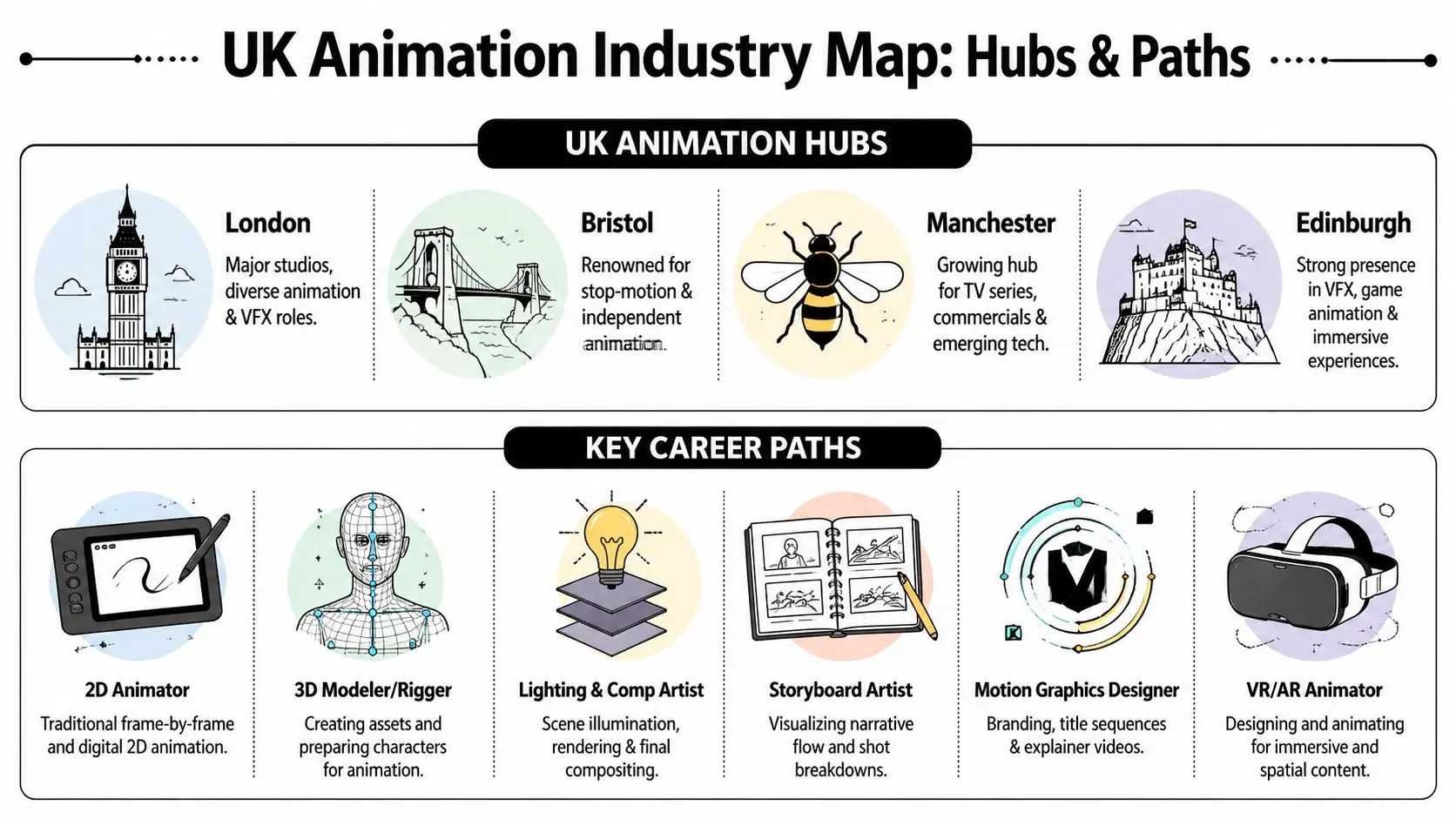
The main career paths worth targeting
“Animator” is too broad to be useful on its own. In practice, studios hire into narrower functions.
| Career path | What studios expect |
|---|---|
| 2D animation | Strong draftsmanship, timing, posing, cleanup discipline, scene continuity |
| 3D animation | Performance, body mechanics, camera awareness, polish, consistency across shots |
| Rigging and character setup | Clean deformation, controls that animators can actually use, troubleshooting mindset |
| Storyboarding | Shot logic, staging, visual storytelling, speed under changing briefs |
| Lighting and compositing | Taste, technical control, render awareness, consistency, delivery discipline |
| Motion graphics | Typography, design sense, brand interpretation, pace, edit awareness |
| Real-time and XR animation | Engine awareness, optimisation, interaction logic, Unity or Unreal fluency |
Some candidates make the mistake of branding themselves too narrowly too early. Others stay so broad that nobody knows where to place them. The better move is focused range. For example, “3D animator with strong creature work and working knowledge of Unreal” tells a studio far more than “multidisciplinary creative”.
London, the North West, and the jobs between them
London still matters for scale and concentration. If you want exposure to major VFX pipelines, larger commercial rosters, or a wider range of specialist departments, it remains a major destination. But candidates outside the capital shouldn’t assume the rest of the UK is peripheral. The North West animation sector’s combined company turnover rose from £50 million between 2017 and 2021 to £120.3 million between 2022 and 2024, supporting 1,665 jobs in 2025, according to SENAL News coverage of the region’s growth. That tells you something important. Regional growth is real, even if the local hiring picture is uneven. There is a trade-off, though. A growing region can still have a fragile freelance base and a market shaped by a small number of large employers or suppliers. So don’t romanticise “regional growth” either. It creates opportunity, but often with fewer visible entry points and less margin for vague applications.
Regional hubs often reward candidates who can do more than one useful thing. Not badly. Competently.
How to choose a path that matches the market
Ask yourself three blunt questions:
- What work do I want to make
- What software and pipeline does that work require
- Which UK locations or studios consistently produce that kind of work
Building a Showreel That Demonstrates Pipeline Readiness
A junior reel usually gets judged in under a minute. The question is simple. Can this person slot into production and deliver work that holds up under notes, deadlines, and technical constraints? That is the standard many applicants miss. They cut a reel to show taste, range, or personal style, then leave out the evidence that reduces hiring risk. For UK studios hiring outside the biggest London pipelines, that gap matters even more. Smaller teams in Bristol, Manchester, Dundee, Cardiff, Belfast, and Leeds often need juniors who can contribute across a real workflow, not just produce one polished shot in isolation. A good benchmark is the Skills England junior animator occupational standard. It spells out what junior animators are expected to handle: briefs, animatics, file management, feedback, and delivery requirements. Hiring teams may not quote the document in interviews, but they do screen for those behaviours.
 What hiring teams actually look for
A reel needs to answer practical questions fast. Can you animate with control? Can you make clear choices from a brief? Do you understand continuity, timing, screen direction, and shot purpose? Does your presentation suggest you will keep a scene organised and survive a notes round without drama? The work itself should show:- •Interpretation of a brief: The shot should have a clear objective. Random acting choices and decorative movement usually read as student work.
- •Timing and spacing: This still rejects more candidates than any software gap.
- •Readable performance: Action needs to land immediately, whether it is character acting, creature work, UI animation, or motion design.
- •Technical awareness: Frame rate, aspect ratio, export settings, naming, and version control are part of the job.
- •Response to feedback: Revised passes, cleaner second versions, or annotated development work help more than people think.
One strong shot with a clear brief behind it often does more for your chances than a long montage of half-resolved experiments.
Common reel problems that get people filtered out
Long logo cards waste time. Slow intros waste time. Music-led editing that hides the animation wastes time. Open with the best shot. Label your contribution clearly. If you only animated, say that. If you rigged, lit, comped, or edited as well, list it. If a recruiter has to guess what you owned, confidence drops fast. The other recurring problem is tool-led thinking. Maya, Blender, Toon Boom Harmony, After Effects, and Unreal all matter, but software alone does not make a reel employable. Judgment does. Studios hire people who can use tools properly inside a pipeline. If you need to fill a gap in your technical stack, this guide to the best 3D animation software of 2024 is a useful starting point.
Show how you work, not just what you finished
The reel is the hook. The supporting material often closes the gap between "interesting" and "interview." Use your portfolio site or PDF to show a small amount of production evidence:
| Include this | Why it helps |
|---|---|
| Shot breakdowns | Confirms what you actually did |
| Blocking or animatic stages | Shows decision-making and process |
| File naming or version examples | Signals basic production discipline |
| Brief summary | Proves the shot solved a specific problem |
| Notes and revision samples | Shows you can improve work under direction |
This matters a lot in regional studios and mixed-discipline teams. A candidate with solid animation, clean files, and a calm approach to notes is often easier to place than someone with flashes of brilliance and chaotic working habits. I have also seen candidates overlook the nature of hybrid and remote production. If you are applying beyond your immediate area, your reel and portfolio need to communicate clearly without you in the room to explain them. That is especially relevant if you are also tracking remote jobs in the UK, where async review and written feedback are common.
Match the reel to the studio's actual output
Studios rarely hire for your potential in the abstract. They hire for the work on the slate. If the studio produces preschool series, send material with appeal, clarity, consistency, and age-appropriate performance. If it works in branded content or explainers, show pacing, design control, and the ability to communicate a message. If the team handles XR, interactive work, or real-time production, include examples that show engine awareness, optimisation choices, or motion that supports user interaction. Non-traditional candidates can compete well. Someone coming from games modding, motion design, previz, teaching content, or freelance social animation can still look hireable if the reel is edited around production relevance rather than identity. The package has to tell the truth about what kind of problem you can solve.
A blunt test before you apply
Review the reel and ask:
- •Would the work still read with the sound off
- •Would a recruiter understand my role in under 30 seconds
- •Do the shots show a repeatable skill that belongs in production
- •Does the presentation suggest I can take direction and stay organised
If the answer is unclear, the reel needs another pass.
Your Multi-Channel Strategy for Finding Animation Jobs
Job seekers often search for animation jobs uk in the same tired way. They refresh a couple of job boards, apply to the obvious listings, then assume there’s nothing happening if they don’t see a role that matches exactly. That approach misses a lot of the market.

Listings are heavily concentrated in London, and graduate or entry-level roles outside the capital are much harder to spot on mainstream platforms, as noted in this review of UK animation job search patterns. That doesn’t mean regional work doesn’t exist. It means you often need to uncover it indirectly.
Use job boards, but don’t rely on them
Indeed, Glassdoor and LinkedIn still matter. They give you a quick read on active hiring language, common software requirements, and the kinds of credits studios expect. Use them as market signals, not as your whole strategy. Create a tracking sheet with target studios, role types, software requirements, and whether they advertise publicly or mostly recruit through direct approaches. If a studio rarely posts junior roles, that’s still useful information. It tells you to watch for freelance overflow, placements, production support openings, or speculative windows.
Direct outreach works better than people think
When regional roles are poorly advertised, direct contact becomes more important. Not spam. Targeted outreach. A useful direct application usually includes:
- •A specific message: Mention the studio’s actual output, not generic praise.
- •A relevant reel: Cut or reorder work to fit their pipeline.
- •A clear ask: Are you asking about junior roles, freelance overflow, work experience, or future openings?
- •A sensible follow-up: One follow-up is professional. Repeated chasing isn’t.
Hiring reality: A concise, well-aimed speculative email can outperform a lazy application to a public listing with hundreds of applicants.
Keep a shortlist of studios by category: TV animation, branded content, games trailers, XR, motion design, educational content. Smaller studios often need people who can bridge roles, and they may hire through networks before a role ever reaches a large board. If London is still part of your plan, these resources for animation jobs in London are worth using as one channel among several.
Build a search system, not a mood
Don’t job hunt reactively. Build a weekly rhythm.
| Channel | What it’s good for |
|---|---|
| Job boards | Active listings, skill keywords, recruiter visibility |
| Studio careers pages | Early notice, better targeting, fewer generic applicants |
| Hiring posts, producer visibility, network building | |
| Festivals and events | Informal access, portfolio reviews, referrals |
| Alumni and tutors | Warm introductions, honest feedback |
| Remote-first boards | Adjacent creative roles, hybrid opportunities |
If you’re open to flexible working patterns, browsing curated lists of remote jobs in the UK can also surface adjacent creative and production roles that help you stay employed while building an animation-focused portfolio. That’s especially useful when you’re between contracts or pivoting into the sector.
Networking without turning into a nuisance
Networking works best when it’s specific and low-pressure. Ask informed questions. Comment on released work. Share your own work only when it’s relevant. Producers and leads remember applicants who sound like colleagues, not cold marketers. The strongest candidates usually combine public listings, direct applications, relationships, and ongoing visibility. That mix creates momentum. One channel almost never does.
Nailing the Application, Interview, and Job Offer
By the time you reach interview stage, the work has already done part of the selling. What happens next usually comes down to fit, clarity and reliability. Before that, you need to decide what kind of role you’re pursuing. A lot of candidates drift between freelance and permanent applications without changing how they present themselves. That causes problems because studios assess those two routes differently.
Freelance vs permanent studio role comparison
| Factor | Freelance Animator | Permanent Studio Animator |
|---|---|---|
| Working pattern | Project-based, variable workload | More stable day-to-day structure |
| Income shape | Can rise and fall sharply between bookings | More predictable monthly income |
| Hiring focus | Immediate availability, specialist fit, self-management | Team fit, consistency, long-term contribution |
| Portfolio emphasis | Range, speed, adaptability, recent client-relevant work | Role fit, craft development, collaboration |
| Admin burden | Contracts, invoicing, scheduling, client communication | Lower personal admin, more internal process |
| Career development | Self-directed, network-driven | Often clearer mentoring and progression pathways |
| Best for | Experienced self-starters or specialists | Juniors and mid-level artists building depth |
What a strong permanent application does
A good cover letter isn’t a life story. It’s a relevance document. It should tell the studio why you fit their work, what you’ve done that relates to the role, and how your skills map to their pipeline. If writing concise application copy isn’t your strength, looking at a clean structure like this guide to an admin cover letter that gets you hired can help you tighten the basics even if the role isn’t administrative. The principle is the same. Clear, direct, role-specific writing wins. For studio interviews, expect questions around:
- •Pipeline familiarity
- •How you take feedback
- •How you organise your work
- •Why you want that studio specifically
- •What part of production suits you best
If there’s a test, follow the brief exactly. Many candidates fail not because the work is poor, but because they ignore instructions, rename files oddly, overcomplicate the task, or deliver late.
What a strong freelance application does
Freelancers need to reduce perceived risk quickly. Studios want to know you can drop into a pipeline, hit the brief, and communicate well without heavy management. That means your freelance pitch should make four things obvious:
- What you do best
- What software and workflow you use
- How quickly you can start
- How you prefer to work with clients or production teams
The offer stage is not the moment to become vague about money, start dates, or working arrangements. Clarity protects both sides.
Watch for red flags on both sides
Candidates should assess studios as well. Look carefully at whether the brief is coherent, whether the hiring contact can explain the role, whether the test is proportionate, and whether communication feels organised. If a process is chaotic before you start, it often stays chaotic after you start. Likewise, studios will watch for candidates who miss deadlines, dodge direct questions, or present themselves one way in email and another way in conversation. Consistency matters. So does being someone people can work with under pressure.Navigating Salaries, Visas, and Long-Term Career Growth
A lot of people ask about getting in. Fewer ask the harder question. What does a sustainable career look like once you’re through the door? That’s where salary expectations, immigration realities, and progression choices start to matter.
Salary expectations need context
There isn’t one clean salary ladder across the whole UK animation industry. Pay varies by location, sector, contract type, and whether the role sits in core animation, a related value-chain role, or a hybrid discipline such as real-time production. The verified workforce material available for the UK animation sector notes a median England salary of £50k, with £34k at the 10th percentile, in the context of animator job postings and workforce analysis in Animation UK’s animation workforce information. Use that carefully. It’s not a promise of what a junior will walk into. It’s a benchmark that helps frame the wider market. For practical purposes:- •Junior roles usually need realism. Focus on learning rate, mentoring, and credit quality alongside pay.
- •Mid-level roles should show clearer value. By this point, you should be able to point to repeatable production value.
- •Senior roles are less about software familiarity and more about ownership, problem-solving and team impact.
If you negotiate, tie your case to contribution. Mention pipeline skills, reliability, specialist tools, or relevant production experience. Don’t negotiate on enthusiasm alone.
Visas and work eligibility can shape hiring
Work eligibility matters more than many applicants want to admit. It affects hiring speed, risk, scheduling and legal process. Some studios can sponsor. Some can’t. Some will only do it for hard-to-fill specialist roles. The smartest move is to be transparent early. If you need sponsorship, say so professionally and without apology. If you already have the right to work in the UK, make that visible. Ambiguity can slow or end a hiring conversation even when the work is strong. In practical terms, candidates needing visa support should prepare:
- •Current work status
- •Location and relocation flexibility
- •Notice periods
- •Whether the role is specialised
- •How clearly their portfolio matches the vacancy
Studios hiring against deadlines often prefer certainty. Your task is to remove unknowns where you can.
Long-term growth often comes from adjacent skills
The old picture of career progression was fairly linear. Junior animator, animator, senior animator, lead, supervisor. That path still exists, but it’s no longer the only meaningful route. Many careers now branch into adjacent areas:
| Direction | What drives the move |
|---|---|
| Lead or supervision | Shot consistency, mentoring, note-giving, delivery ownership |
| Technical art or rigging | Strong systems thinking and problem-solving |
| Story or previs | Shot design, visual communication, editorial awareness |
| Motion design leadership | Brand thinking, client communication, fast turnaround control |
| Real-time and XR | Engine fluency, optimisation, interactivity, cross-discipline collaboration |
| Production or coordination | Organisation, scheduling, communication, pipeline oversight |
This is one reason hybrid skills matter. If you understand animation principles and can also work sensibly with Unity, Unreal, mocap cleanup, interactive logic or technical delivery, you’re often more resilient in a changing market than someone who only fits one narrow production model.
Career growth doesn’t only come from getting better at shots. It also comes from becoming easier to trust with harder problems.
Don’t confuse progression with prestige
Some artists should become leads. Some shouldn’t. Some are strongest as senior specialists. Others move into production, development, teaching, technical roles or immersive work and build excellent careers there. The best long-term decisions usually come from recognising how you work best. If you like mentoring and review, supervision may suit you. If you like systems and tools, technical routes may be stronger. If you like client-facing problem solving, motion or branded content can be a better fit than chasing feature credits for status alone.
Your Questions on UK Animation Careers Answered
A large share of people asking about animation jobs in the UK are not fresh graduates. They are career changers, parents returning to work, freelancers trying to get into studio production, or candidates based far outside London. Standard careers advice often misses them. That gap matters. Some entry routes still favour people with very limited paid experience, which can leave mid-career applicants in an awkward middle ground, as noted on the ScreenSkills Animation Trainee Finder page.
Can I move into animation if I don’t have an animation degree
Yes. The trade-off is simple. Qualifications carry less weight, so your portfolio has to carry more. The strongest career changers usually arrive with something useful already built in. Designers understand briefs and feedback. Editors understand timing. Games candidates often understand engines, optimisation and team workflows. Teachers can explain ideas clearly and handle structure. Those strengths count if the work shows a clear fit for the role. Keep the transition narrow at first. A candidate moving from graphic design into motion design should show typography, layout judgment and purposeful animation. A candidate moving from games into real-time animation should show engine-aware work, performance choices and clean technical handoff. Broad ambition is less convincing than specific evidence.
Are apprenticeships better than university
They suit different people and different stages. University gives time to experiment, collaborate and make mistakes before a client or producer is involved. Apprenticeships give earlier exposure to delivery standards, team habits and commercial constraints. Studios hire the result, not the route. Candidates coming out of university often need stronger production discipline. Candidates coming through apprenticeship routes sometimes need more range, taste and storytelling confidence. Either path can work well if you know what it does and does not give you.
What should I do if there are hardly any entry-level jobs near me
Treat job boards as partial, not complete. Outside London, a lot of work sits in smaller studios, agencies, educational media teams, games companies, children's content producers and immersive teams that hire irregularly or fill roles through referrals before they post anything publicly. Manchester, Bristol, Cardiff, Dundee, Belfast and Glasgow can offer better odds than many applicants expect, especially if you are open to motion, interactive, previs, kids' content or branded work rather than chasing one narrow version of studio animation. A practical approach works better than waiting.
- •Map the region properly: Include animation studios, design agencies, e-learning companies, games teams and production houses.
- •Send selective speculative applications: Short, relevant and targeted beats mass outreach.
- •Take adjacent paid work: Editing, motion design, social content and visualisation work can keep your skills current.
- •Stay visible online: Finished work, breakdowns and process clips help recruiters understand how you think.
- •Travel with intent: Festivals, expos and portfolio reviews can create contacts that local job markets do not.
Regional candidates often do better by building a base where they are, then stepping into stronger studio roles once they have credits, references and a clearer specialism.
How do I network if I hate networking
Treat it as familiarity and follow-through. You do not need to be loud or charming. You need to be recognisable for solid work, sensible communication and good judgement. A short message after a talk, a useful question, a polite update when you finish a new piece, or a well-timed reply to someone you met six months ago usually does more than forced small talk. Specificity helps. Comment on a shot, a process choice, a delivery challenge or a tool decision. Generic messages about passion rarely start good conversations.
You are trying to stay credible and memorable with the people who may hire, refer or recommend you.
Is AI going to remove junior animation roles
AI is already changing parts of production. That is real. It affects concept iteration, reference generation, some cleanup tasks and parts of high-volume content workflows. Junior roles will still exist, but the shape of them is shifting. Studios still need people who can take notes properly, make performance choices, work cleanly in shared files, hit deadlines and understand what a supervisor asked for. The candidates with the best odds are usually the ones who combine fundamentals with practical production sense.
| Focus area | Why it matters |
|---|---|
| Animation principles | Timing, spacing and performance still separate weak work from strong work |
| File and pipeline discipline | Teams need people who can work cleanly in shared environments |
| Taste and decision-making | Tools do not replace judgment |
| Real-time awareness | More productions now intersect with engine-based workflows |
| Communication | Notes, revisions and collaboration remain heavily human |
How can I tell if I’m ready to apply
You are ready when the work shows a repeatable skill that solves a studio need. Confidence is not the test. Clarity is. If the reel is focused, the portfolio is easy to read, and you can explain where you fit, start applying. Waiting until everything feels finished usually slows people down more than it helps. Applications are part of training. Rejection, silence and mixed feedback are normal in this market, especially in busier hubs where competition is high and hiring swings with project funding.
What usually gets someone hired over another candidate with similar skill
Usually, it is not one dramatic difference. It is a stack of small signals. A reel that matches the brief. A cleaner application. Better file naming. Faster test turnaround. Clearer note-taking. Better questions in interview. Stronger understanding of the studio's work and constraints. Hiring teams notice these details because they reduce risk. That matters even more outside the biggest hubs, where smaller teams often cannot afford a long settling-in period. A candidate who looks reliable, trainable and easy to slot into production can beat a slightly flashier candidate who looks harder to manage. If you want a practical benchmark, study the kind of work studios are shipping. Studio Liddell is one useful example. Reviewing active studio output in animation, interactive production and XR helps you judge where your skills fit, what hybrid strengths are valued, and how to target roles with more accuracy.