Your Guide to UK 3D Animation Jobs
Thinking about a career in 3D animation? You’ve picked a great time. The demand for skilled artists is higher than it’s ever been, with studios scrambling to find talent for everything from blockbuster films and binge-worthy TV shows to the next generation of games and immersive digital worlds. If you’re just starting out, getting a handle on the job market is your first big step. It’s about understanding where the opportunities are and what studios are genuinely looking for.
The Booming UK 3D Animation Job Market
The UK has really cemented its reputation as a world leader in digital content. This isn't just a fleeting trend; we're seeing sustained growth that's creating a serious need for 3D artists, especially in creative hubs like London, Manchester, and across Scotland. For anyone looking to break into the industry, the numbers speak for themselves. The UK's creative sectors are a massive part of the economy, and that growth translates directly into real jobs for artists like you.
A Sector on Fire
Let's be honest, the appetite for 3D content has absolutely exploded. It's the magic behind big-screen visual effects, the charm in our kids' favourite cartoons, and the backbone of the virtual and augmented reality worlds we're just beginning to explore. 3D animation is everywhere, and that has created a job market that’s not just healthy, it’s thriving. Don't just take my word for it; the data tells a powerful story. To put it all in perspective, here are the key figures showing just how strong the UK’s animation sector is right now.
UK 3D Animation Job Market at a Glance (2026)
| Metric | Statistic | Source Insight |
|---|---|---|
| Total Creative Industry Value | £117 billion GVA (2022) | DCMS figures show animation is a major contributor to a massive economic sector. |
| Animation & VFX Jobs | ~12,500 full-time roles | According to a 2023 ScreenSkills report, this is a solid, established workforce. |
| Share of 3D Roles | 45% of animation/VFX jobs | Nearly half the jobs in the field are specifically for 3D artists, showing high demand. |
| Projected Job Growth | 8% annually through 2030 | This growth is heavily driven by new frontiers like XR, signalling long-term career stability. |
These aren't just abstract numbers. They represent thousands of real opportunities for artists. The ScreenSkills report, in particular, is worth a look. It digs deep into the industry's skills needs and what's being done to train the next wave of talent. The big takeaway? The industry knows it needs more skilled people. Studios and training bodies are actively working to fill skills gaps, which is a fantastic sign for anyone looking to build a career here. It means the industry is invested in its future, and yours.
In a field that changes so fast, the one constant is the need for skilled, creative, and adaptable 3D artists. Animation isn't just for movies anymore. With the rise of streaming, interactive games, and business applications, it's become a fundamental language for how we communicate and build experiences.
What This All Means for Your Career
This incredible growth isn't just good news for the industry; it's a massive opportunity for you. Plain and simple, it means:
- •More Jobs Are Opening Up: Studios are hiring at all levels, from your first junior role to senior and lead positions.
- •You Can Specialise: The demand is huge across film, TV, advertising, games, and even technical visualisation for industries like architecture and medicine.
- •It’s a Stable Career Path: This isn't a flash in the pan. 3D animation is now a core part of our digital economy, offering real career longevity.
To make the most of this, you need to know where to look and what skills to build. If you're serious about making your mark, especially in a competitive hub, staying plugged into the industry's needs is key. To get started, you might find our practical advice on how to find animation London jobs and build your career useful. Think of it as the first step on your roadmap.
Core Roles in a 3D Animation Pipeline
The term “3D animator” gets thrown around a lot, but honestly, it’s a massive oversimplification. A modern studio isn’t just a room full of animators; it's a specialist pipeline, where every stage of a project is handled by an expert with a very specific skillset. Figuring out these distinct 3D animation jobs is your first step to finding exactly where you fit in the puzzle. Think of it like building a custom car. You wouldn't have one person smelt the steel, machine the engine, wire the electronics, and apply the final paint job. It's the same in 3D. You have specialists for the digital chassis, the engine of movement, the lighting, and the final polish. Each role is unique, but they all have to work in perfect sync. This chart breaks down where animation sits inside the UK's enormous creative economy.
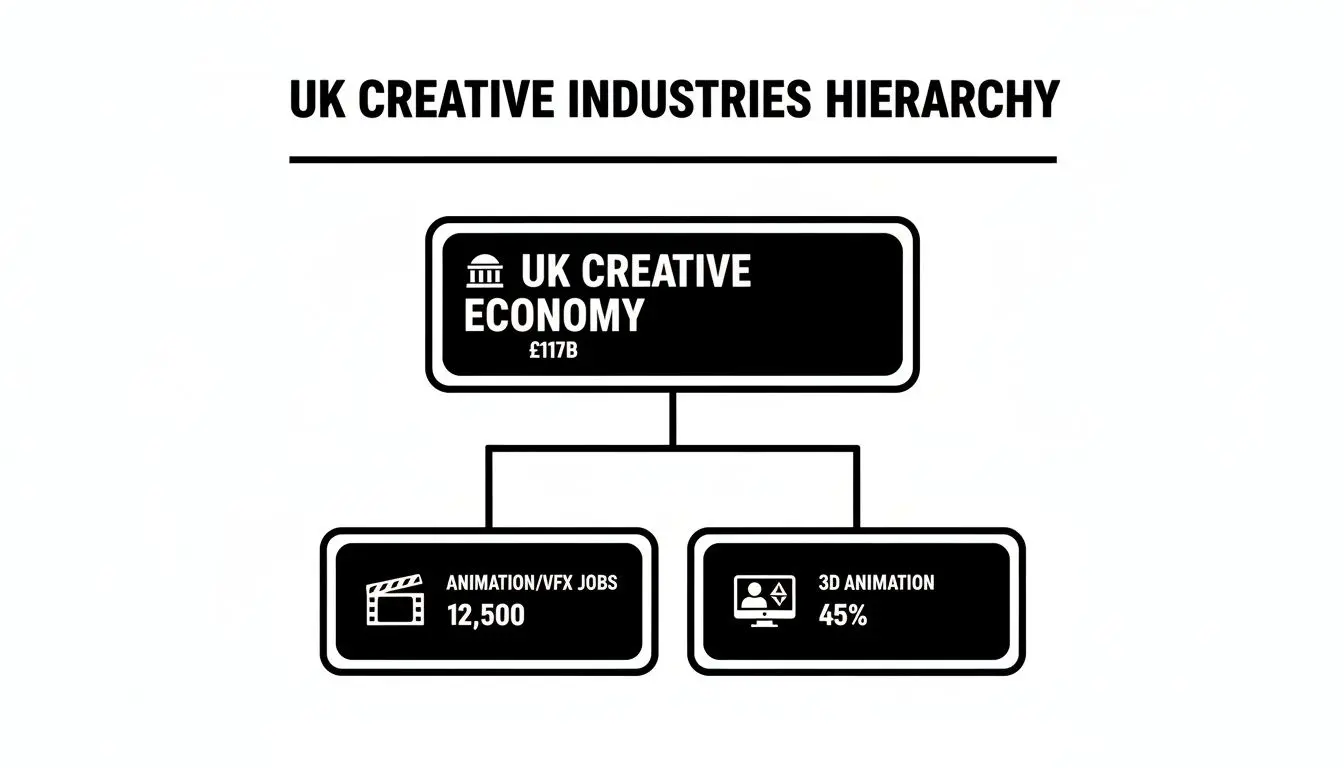
What's really telling is that 3D animation roles make up nearly half of the entire specialised animation and VFX workforce. The demand for these skills is undeniable.
The Architects and Sculptors
Every production kicks off by creating the assets, the characters, props, and worlds that will fill the screen. This is where the digital architects and sculptors get to work.
- •3D Modellers: These are the sculptors of the digital age. They take 2D concept art and build it into a three-dimensional form using software like Maya, Blender, or ZBrush. Their work is the literal foundation for everything else.
- •Texture Artists: Texture artists are the painters. They take the plain, grey models and breathe life into them with colour, materials, and surface detail. They’re the ones who make a dragon's scales look rough and ancient or a spaceship's hull appear scratched and battle-worn.
These roles are all about defining the static 'what' of a scene. Next, another group of specialists takes over to figure out the 'how', how it all moves.
The Puppeteers and Performers
Once an asset is built, it needs to be able to move. This is where the technical artists and performers come in, building the underlying systems that make believable motion and emotion possible.
A great rig is invisible. It’s a complex skeleton and muscle system that gives an animator the freedom to create a performance without fighting the technology. It’s the unsung hero of character animation.
Rigging Artists, sometimes called Technical Animators, are the puppet masters. They construct the digital skeleton, joints, and control system inside a 3D model. A solid rig is what lets an animator intuitively pose a character, from a simple head turn to a complex, emotional facial expression. From there, the 3D Animators step in. They are the actors who use that rig to create a performance. Whether they’re painstakingly setting keyframes or refining motion capture data, their job is to convey personality and story through movement alone.
The Cinematographers and Finishers
With the performance locked in, the final stage is all about making it look stunning and integrating it into the final shot. This is where the scene is lit and all the separate elements are brought together.
- •Lighting Artists: Think of them as the Directors of Photography. They place digital lights in a scene to establish mood, guide the viewer’s eye, and make sure everything feels like it belongs in the same world. They define the time of day, the atmosphere of a space, and the final visual tone.
- •Compositors: These artists are the final assemblers. They take all the different layers, the rendered animation, visual effects, background plates, and lighting passes, and merge them into one seamless, final image. It's a role that demands a sharp artistic eye and deep technical knowledge.
And watching over this whole intricate dance is the Technical Director (TD). TDs are the ultimate problem-solvers. They build and maintain the studio's pipeline, create custom tools for artists, and troubleshoot the gnarly technical issues that inevitably pop up. When a workflow breaks, the TD is the one who dives in to fix it and keep the whole production on track.
Essential Skills and Software for Modern Animators
Getting a top job in 3D animation comes down to a combination of raw artistic talent and serious technical know-how. It's not just about knowing your way around a program; it's about understanding which tool is right for the job and having the foundational art skills to make the technology really shine. Building out this toolkit is what makes you an essential part of any studio team.
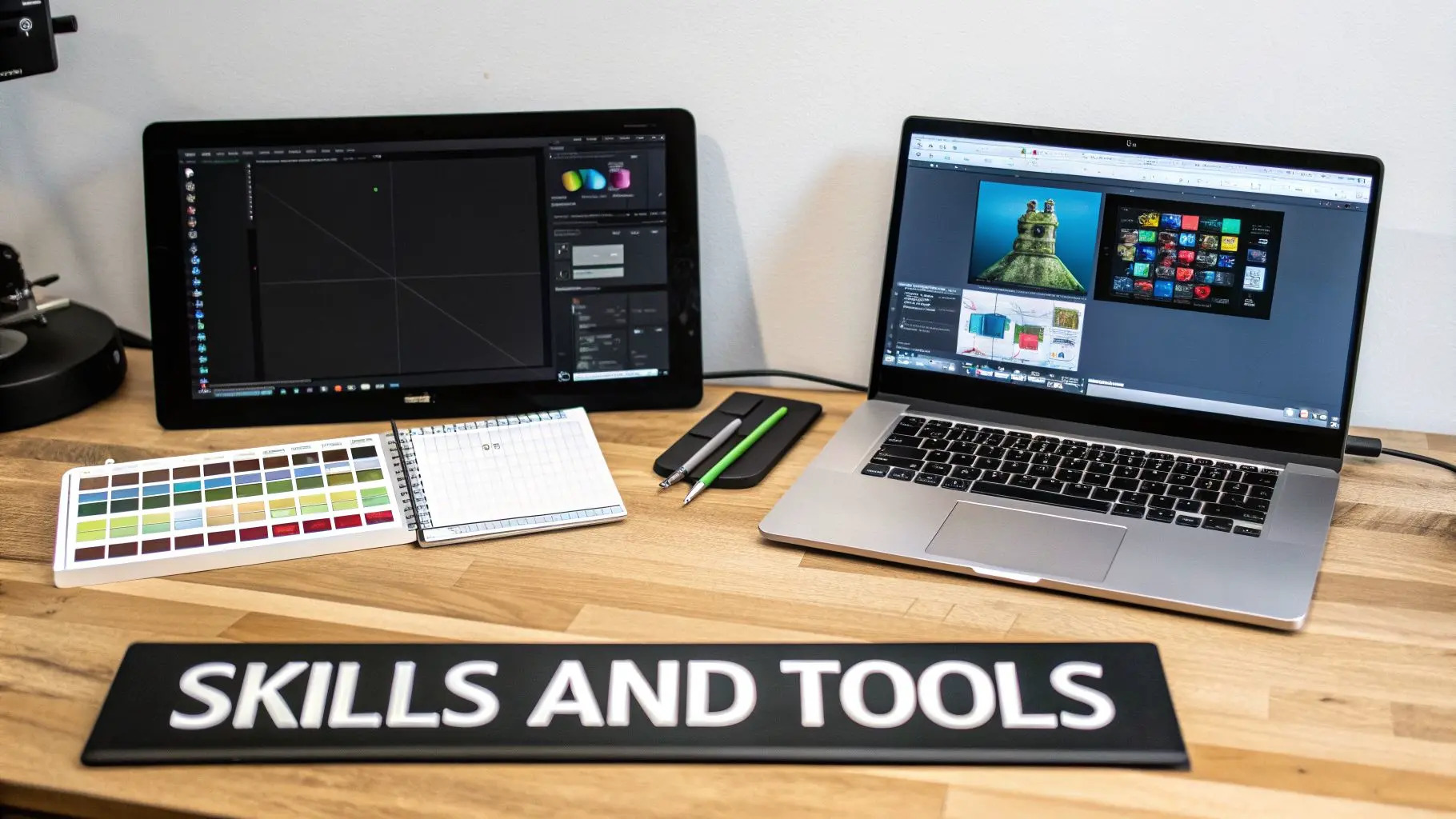
An animator's desk says it all. You'll often see multiple screens juggling 3D models, shot timelines, real-world reference footage, and colour palettes. This setup is a perfect reflection of the job itself, where you're constantly balancing technical inputs with creative choices to bring an idea to life.
The Bedrock Artistic Skills
Before you even think about software, there are timeless artistic principles that underpin all great animation. Technology will always change, but these skills are forever.
- •A Strong Sense of Timing and Spacing: This is the absolute soul of believable movement. It’s what gives a character personality, communicates their weight, and makes an action feel snappy or sluggish.
- •Understanding of Form and Weight: Great animators make you feel the physics. They intuitively know that a bowling ball and a beach ball move, bounce, and collide in completely different ways, giving their scenes a real sense of grounding.
- •Knowledge of Colour Theory and Composition: These skills are all about guiding the viewer's eye and setting the mood. Knowing how to compose a beautiful shot and use colour to evoke emotion is a game-changer, especially for lighters and compositors.
- •Keen Observation Skills: The best animators are students of the world around them. They watch how people walk, how animals express themselves, and how objects interact with their environment, then pour all those little details back into their work.
These are the fundamentals that separate a good animator from a great one. They are the artistic muscles you’ll need to train constantly, no matter what software you're using.
Industry-Standard Software You Need to Know
While artistry is king, technical skill is the key that unlocks the door. Studios have established pipelines built around specific software, and you simply have to be fluent in them to be considered for most 3D animation jobs. To get a broad look at what's out there, check out this list of the best tools for animators. To give you a clearer picture, here's a look at the core software used across different roles in a typical 3D pipeline. Getting comfortable with these will make you a far more appealing candidate.
Core Software by 3D Animation Specialisation
| Role/Specialisation | Primary Software | Key Use Case |
|---|---|---|
| 3D Modelling | Autodesk Maya, Blender, ZBrush | Building characters, props, and entire worlds. ZBrush is the king for hyper-detailed organic sculpting. |
| Rigging | Autodesk Maya | Creating the digital skeletons and control systems that animators use to bring characters to life. |
| Animation | Autodesk Maya, Blender | The actual process of keyframe animating characters and objects to craft a performance. |
| Lighting & Rendering | V-Ray, Arnold, Redshift, Unreal Engine | Setting up digital lights to craft the mood and atmosphere, then rendering out the final images. Unreal Engine is now a massive player for real-time work. |
| Compositing | Foundry Nuke, Adobe After Effects | Taking all the different rendered layers and effects and blending them together into the final, polished shot. |
The best approach is to go deep and truly master one or two of these programs while having a solid working knowledge of the others. For a more detailed breakdown, have a look at our guide on The Best 3D Animation Software of 2026.
The Next Wave of Skills
This industry never sits still. To stay relevant and future-proof your career, there are two areas that are becoming incredibly important for any modern animator.
I’ve been told two other times in my career that the computer was going to take my job away from me. In both cases (the development of CG animation, and the development of Motion capture technology) the computer didn’t erase my job, but it did change it, and I had to adapt. - Chad Stewart, Veteran Animator
Chad's experience gets to the heart of it: animators must be ready to adapt. The new frontiers right now are scripting and AI.
- •Scripting (Python): Even a little bit of Python knowledge gives you a huge leg up. It lets you automate tedious tasks, build custom tools for your team, and generally make the whole pipeline run smoother. This is especially true for technical roles like rigging and TD work.
- •AI-Assisted Workflows: AI isn't coming for your job; it's becoming an incredibly powerful assistant. Tools are already emerging that can help generate background crowds, clean up messy motion-capture data, or suggest texture variations. This frees up artists to spend less time on grunt work and more time on the creative decisions that really matter.
Building a Portfolio That Gets You Hired
Let's be blunt: in 3D animation, your portfolio isn't just part of your application. It is your application. It acts as your CV, your creative pitch, and your first-round interview all at once. Studios aren't just looking for someone who can create a polished final image. We want to see your thought process, your problem-solving skills, and how you'd fit into a professional pipeline. Your portfolio is the story of your artistic voice and technical readiness. It's what gets you through the door.

Quality Over Quantity, Always
One of the most common mistakes we see is a portfolio crammed with every project an artist has ever touched. You have to resist that urge. A tight, focused portfolio with three exceptional pieces will always beat one with ten mediocre ones. Hiring managers are incredibly busy. We want to see your absolute best, not your entire journey from day one. Every piece should be curated to showcase a skill relevant to the job you want. If you're a modeller, show us immaculate topology and stunning detail. If you're an animator, your reel should be full of character performances that ooze personality. Be ruthless.
Structure Your Showreel for Maximum Impact
Think of your showreel as the trailer for your career. You’ve got about 30 seconds to grab a recruiter’s attention, so don't bury the lead. Put your best work right at the start. A reel that gets our attention usually follows a structure like this:
- •The Hook (0-5 seconds): Your single most impressive shot. It needs to be visually stunning and immediately communicate what you do best.
- •The Core (5-30 seconds): A quick succession of your next best 3-5 shots. Keep them short, punchy, and varied enough to showcase your range.
- •The Breakdown (30-60 seconds): If you still have their attention, this is your chance to show off breakdowns or slightly longer clips. This is where you prove you understand the technical side of things.
- •The Closer: Finish strong with your second-best shot, followed by a clean, professional title card with your name and contact details.
This front-loaded approach respects a recruiter's limited time and guarantees your best work gets seen.
Show Your Process, Not Just the Polish
A gallery of finished renders is fine, but studios hire technical artists and problem-solvers. Including breakdowns of your work is a powerful way to demonstrate your expertise and how you think.
When I see a portfolio that only has final renders, I see someone who can make things look pretty. When I see wireframes, rig tests, or lighting passes, I see an artist who understands how to build something from scratch and can navigate the challenges of a real production.
Including these behind-the-scenes glimpses proves you’re not just an artist, but a technician who gets the pipeline. For character artists, demonstrating a solid understanding of anatomy is non-negotiable. It might be worth reviewing some of the 10 hidden secrets to bring your 3D characters to life to make your work truly stand out.
Tailor Your Portfolio to the Studio
A generic, one-size-fits-all portfolio is a missed opportunity. Before you hit 'apply', take the time to study the studio’s work. Look at their recent projects, their style, and their client base. If you’re applying to a studio famous for stylised children's animation, leading with your hyper-realistic creature design might not be the smartest move. Customise your portfolio and reel to highlight the work that best aligns with their creative output. It shows you’ve done your research and are genuinely interested in what they do. To make a real impact, it’s vital to understand how to build a strong career portfolio that speaks directly to the hiring manager. Competition is fierce. Research from ScreenSkills indicates that 62% of UK animation studios are planning to hire more 3D specialists. A targeted portfolio shows you’re not just looking for any job, you’re looking for a role specifically with them.
Navigating Salaries and Market Trends
Let's talk money and career longevity. Knowing what you can earn and where the industry is heading is just as important as mastering your craft. The world of 3D animation jobs is always on the move, and new tech is constantly creating fresh opportunities for artists who are ready to jump on them. We’ll break down what you can realistically expect your payslip to look like and cover the key trends you need to watch to keep your career thriving for years to come.
UK Salary Expectations Across Career Stages
Your salary as a 3D artist can swing quite a bit depending on your specialisation, how many years you've been in the game, and where you're based. As you'd probably guess, big city hubs like London and Manchester often pay more to offset the higher cost of living, but solid opportunities are popping up all over the UK. This screenshot from Prospects.ac.uk gives a pretty good ballpark for typical salary bands. You can see a clear path of progression here. A junior artist just starting out might land somewhere in the £20,000 to £25,000 range. With experience, senior animators can push past £50,000. Keep in mind, these are just general figures. A sought-after Technical Director or a real-time artist with killer Unreal Engine skills can earn significantly more.
Key Market Trends Shaping the Future
Right now, some powerful shifts are changing not just what we make, but how we make it. Getting ahead of these trends is the smartest move you can make for your long-term career security.
- •The Rise of Real-Time Production: Game engines like Unreal Engine and Unity aren't just for games anymore. They’re being adopted across film, TV, and advertising for real-time rendering and virtual production. Artists who know their way around these engines are in huge demand.
- •Explosive Growth in XR: The hunger for virtual and augmented reality content is carving out entirely new career paths. We're seeing more and more roles for XR developers, world builders, and real-time animators as companies pour money into immersive training, virtual events, and location-based entertainment.
- •Integration of AI Tools: Don't worry, AI isn't here to take your job; it’s becoming more like a powerful assistant. AI-driven workflows can handle the grind of repetitive tasks like rotoscoping or cleaning up mocap data. This frees you up to focus on the creative decisions that really matter.
The UK's 3D animation sector is proving incredibly robust. Back in 2023, the industry supported 15,200 jobs, with forecasts showing a steady 5% annual rise through 2030.
This growth is backed by strong salary figures. The average salary hit £48,200 in 2026, with XR specialists earning over £55,000. On top of that, nearly half of UK studios are now using generative AI, which is creating thousands of new, hybrid roles. If you want to dig deeper into the numbers, you can find more animation industry statistics at KasraDesign.com.
Freelance vs Permanent Studio Work
One of the biggest choices you'll face is whether to go for a permanent studio role or embrace the freedom of freelance life. There's no right or wrong answer, it really comes down to your personality, what you want from your career, and the kind of lifestyle you're after.
| Aspect | Freelance Career | Permanent Studio Role |
|---|---|---|
| Stability | Income can be unpredictable. You need to be constantly networking and hunting for the next gig. | You get a steady salary, paid time off, and a consistent flow of work. |
| Flexibility | You're the boss of your own schedule, location, and the projects you take on. | Work hours and location are usually fixed, and you have less say in project choice. |
| Variety | You get to work with lots of different studios, styles, and pipelines. | You get to deeply integrate with one team and can specialise within a specific pipeline. |
| Benefits | You're on your own for taxes, pension contributions, and sick pay. | Usually comes with benefits like health insurance, a pension scheme, and training opportunities. |
Your Questions About 3D Animation Careers Answered
Getting your foot in the door of the 3D animation industry can be tough. Here, we answer some of the most common questions aspiring artists ask when looking to launch their careers and land professional 3D animation jobs.
Is a University Degree Essential?
This is a question we hear all the time. While a degree in animation is a great way to get structured training and build a network, it’s not a requirement to get hired.
In a creative field like ours, your portfolio and showreel are everything. A reel that shows off incredible technical skill and a strong artistic eye will always beat a piece of paper.
Ultimately, studios hire for skill and vision. A self-taught artist with a brilliant portfolio showing a real grasp of modelling, rigging, or animation will often stand out more than a graduate with an average reel. The most important thing is to have undeniable proof of what you can do.
How Can I Network Without Feeling Awkward?
The secret to networking is to stop thinking about collecting contacts and start thinking about building genuine relationships. Begin by engaging with artists and studios you admire on sites like LinkedIn or ArtStation. Leave thoughtful comments on their work instead of just asking for a job. Industry events, both in-person and virtual, are another fantastic way to connect. Don't try to talk to everyone. Your goal should be to have a few good, memorable conversations. Ask people about their projects, what they're passionate about, and the challenges they face. Real curiosity is the best networking tool there is.
What's the Biggest Mistake in an Interview?
By far, the most common mistake is not being prepared. This isn't just about researching the studio, it's about being ready to talk about your own work in detail. You should be able to discuss every single project in your portfolio. Why did you make that specific creative choice? What was the biggest technical problem you solved? What would you do differently today? When you can answer these questions with confidence, it shows you're a thoughtful artist who understands the process. It proves you're ready to grow, learn, and become a valuable part of a professional team.
At Studio Liddell, we look for passionate, skilled artists who understand the entire creative process. If our approach resonates with you, explore our work and see the kind of groundbreaking projects our team brings to life. Visit our website to learn more about our studio and career opportunities