A Buyer's Guide to the Modern VR Headset for Business
When you hear "VR headset," it's easy to picture someone playing a video game. But in a business setting, these devices are less about play and more about powerful, practical problem-solving. A VR headset is a specialised tool that opens up immersive digital worlds for training, design collaboration, and engaging with clients in entirely new ways. It's an interface that takes enterprise applications off the flat screen and into a three-dimensional space, offering real solutions to tangible business challenges.
Unlocking New Realities for Business
Forget its consumer roots for a moment. In a commercial environment, a VR headset is a gateway to custom-built virtual worlds tailored to your industry. Instead of thinking of it as a console, picture it as a dynamic new medium for your software. Architects can stop viewing 3D models on a monitor and start walking through their buildings at full scale. Engineers can practise complex repairs on a virtual machine without touching the real thing, eliminating risk and downtime. This is exactly why we're seeing such huge investment and adoption. The UK virtual reality headset market is ballooning, growing from USD 369.3 million in 2023 to a projected USD 1,967.9 million by 2030. A big driver for this is the rise of standalone headsets that don't need to be tethered to a powerful PC, making them far easier for businesses to deploy at scale.
The Core Components of a VR Headset
To really grasp its business value, it helps to understand the tech that makes the magic happen. Three key pieces work together to create a believable and interactive virtual experience:
- •High-Resolution Displays: These are the tiny screens, one for each eye, that show you the digital world. The higher the resolution, the sharper and more detailed the image. This is crucial whether you're reading a virtual dashboard or inspecting the fine details on a product prototype.
- •Precision Lenses: Sitting between your eyes and the displays, these lenses focus and stretch the image to fill your field of view. They are what create that wide, immersive feeling without causing distortion or eye strain.
- •Advanced Sensors (Tracking): This is what translates your real-world movements into the virtual one. Internal sensors track every tilt and turn of your head, letting you look around just as you would in reality. This is known as "six degrees of freedom" (6DoF) tracking, and it's what lets you physically walk, duck, and interact within the virtual space.
By blending these elements, a modern VR headset effectively tricks your brain into believing you are somewhere else entirely. This feeling of "presence" is the secret sauce behind effective training simulations, unforgettable sales pitches, and truly insightful design reviews.
Once you see how these components come together to deliver immersive experiences, you can better appreciate the tangible value of virtual and augmented reality services. The technology stops being a novelty and becomes a strategic asset, ready to solve complex problems in manufacturing, healthcare, architecture, and beyond.
Choosing the Right VR Headset for Your Business
Picking the right hardware is the first, most crucial step in any virtual reality project. The market is awash with options, but for a business, this isn't about chasing the latest gaming specs. It's about finding the right tool for the job. Think of a VR headset as just that, a tool. The one you choose needs to perfectly match its strengths to the task at hand, whether that’s training your staff, showing off a new product, or poring over a complex 3D design. The whole decision boils down to understanding the main types of VR hardware and what they're built for. This isn't a one-size-fits-all situation. The perfect device for a high-traffic public event is worlds away from what's needed for a meticulous engineering review where every millimetre matters.
Standalone VR Headsets: The Scalable All-Rounders
Standalone headsets are the grab-and-go option. Devices like the popular Meta Quest series are completely self-contained, with no need for a powerful PC or external tracking sensors. This all-in-one nature is their biggest advantage in a business setting. For big training programmes or public-facing events, the benefits become really clear:
- •Easy to Deploy: No cables or complicated setup means you can get a large team up and running in minutes, or quickly set up several stations at a trade show.
- •Lower Total Cost: Because they don't need expensive PCs to run, building a fleet of standalone headsets is much friendlier on the budget.
- •Total User Freedom: Being untethered is a game-changer for interactive simulations where people need to walk, duck, and physically engage with their virtual world.
These devices are the real workhorses of enterprise VR, ideal for any situation where you need to scale up quickly and keep things simple.
PC-Tethered VR Headsets: The High-Fidelity Powerhouses
When you absolutely cannot compromise on graphics and performance, PC-tethered systems are the only way to go. Headsets like the Valve Index plug directly into a high-spec computer, using its beefy processor and graphics card to render unbelievably detailed and complex virtual worlds. This raw power makes them the go-to choice for very specific, demanding jobs. Imagine an architectural firm doing a design review where photorealistic lighting is critical to get a client's approval. Or an automotive designer who needs to see every single curve and reflection on a virtual car prototype with perfect clarity.
The trade-off for this visual brilliance is freedom and cost. Each headset needs its own powerful, and often pricey, PC, and the cable can restrict movement. This makes them much better for experiences where the user is mostly sitting or standing in one spot.
Enterprise-Grade VR Headsets: Precision for Mission-Critical Work
Finally, there’s a specialised category of enterprise-grade hardware built for the most demanding professional jobs imaginable. Brands like Varjo and certain VIVE Pro models are engineered for situations where pinpoint precision is non-negotiable. These headsets come packed with features you just don't find in consumer devices. We're talking "retinal resolution" displays that mimic the clarity of the human eye, advanced eye-tracking for detailed analytics, and deep integration with professional software. They’re built for high-stakes simulations in aviation, medical training, and industrial design, fields where a virtual mistake could have real-world consequences. Their price is significantly higher, but for jobs that demand absolute accuracy, the investment is easy to justify. To help you navigate these choices, here's a quick breakdown of how the different headset types stack up for business use.
A Commercial Comparison of VR Headset Types
This table gives a clear overview of the main categories, helping you match the technology to your specific commercial goals, from large-scale training to high-precision design.
| Headset Type | Key Strengths | Best For | Typical Budget |
|---|---|---|---|
| Standalone | All-in-one, wireless, easy to deploy, scalable. | Large-scale training, events, sales demos, onboarding. | £ (Low to Mid) |
| PC-Tethered | Highest graphical fidelity, superior performance. | Design reviews, complex data visualisation, high-end simulations. | ££ (Mid to High) |
| Enterprise-Grade | Ultra-high resolution, eye-tracking, professional software integration. | Medical training, flight simulation, industrial design, research. | £££ (Premium) |
Ultimately, choosing the right VR headset means taking a clear-eyed look at your project's goals, budget, and what you want to achieve. Each category offers a different path, and understanding which one is right for you is the key to unlocking what immersive technology can really do for your business.
Understanding The Specs That Actually Matter
Diving into the technical specifications for any piece of hardware can feel like you’re swimming in an alphabet soup of acronyms and numbers. When you're looking at a VR headset for your business, it’s all too easy to get bogged down in the details. The real trick is to connect that jargon to a tangible business impact, making sure the device you pick can actually deliver the experience you’ve envisioned. Let's cut through the noise and break down the core specs that directly shape the quality, comfort, and capability of your virtual reality application. Grasping these concepts will give you the confidence to have clear, informed conversations with developers and vendors. You'll be able to spell out exactly what you need, whether it's for a razor-sharp product showcase or a fully interactive training simulation.
Visual Fidelity: Resolution and Field of View
Resolution, measured in pixels per eye, is one of the most important factors for visual clarity. In a business context, higher resolution means text is crisp, tiny details on a 3D model are perfectly clear, and the whole experience feels polished and professional, not like a video game. Low resolution can cause a "screen door effect," where the gaps between pixels are visible, which instantly shatters the sense of immersion. Think of it as the difference between watching standard-definition TV versus brilliant 4K. For a virtual product demonstration, you need customers to see every texture and feature in pristine detail. A headset with a high resolution makes sure your product looks its absolute best. Field of View (FoV) is all about how much of the virtual world you can see at any one time, measured in degrees. A wider FoV is far more immersive because it fills your peripheral vision, making it feel less like you’re peering through a pair of binoculars. Most consumer headsets hover around a 110-degree FoV, while our natural human vision is closer to 200 degrees. A wider FoV simply makes you feel more present and naturally grounded in the environment.
User Comfort and Fluidity: Refresh Rate
The Refresh Rate, measured in Hertz (Hz), tells you how many times the display updates with a new image every second. A higher refresh rate means smoother, more fluid motion. While 72Hz is often the baseline for a decent experience, headsets offering 90Hz or even 120Hz deliver a noticeably more comfortable and natural-feeling experience. This isn’t just a nice-to-have; it's vital for user comfort. A low or choppy refresh rate can lead to motion sickness, especially during longer sessions. If you're planning an hour-long training module or an extended design review, a high refresh rate is non-negotiable. It keeps your users comfortable, focused, and engaged.
Choosing the right VR headset means prioritising specs that support your specific business case. For detailed visual analysis, focus on resolution. For long-duration training, prioritise a high refresh rate to guarantee user comfort and engagement.
Interactivity and Immersion: Degrees of Freedom
The level of interactivity in a VR experience comes down to its Degrees of Freedom (DoF). This term describes how a user can move around inside the virtual space. There are two main types you’ll come across:
- •3DoF (Three Degrees of Freedom): This allows for rotational tracking only. You can look up, down, and side-to-side, but you can’t physically move forward, backward, or crouch down in the virtual world. It’s a good fit for seated experiences like 360-degree video tours or simple observational training.
- •6DoF (Six Degrees of Freedom): This adds translational tracking to the mix. The system follows your body’s position in a physical space, allowing you to walk around, duck under, and step closer to virtual objects. 6DoF is absolutely essential for truly interactive simulations, like practising a complex repair or walking through an architectural model.
When picking a headset, don’t forget that its spatial audio capabilities are also critical for delivering a truly immersive experience. Sound that accurately comes from its source in 3D space is just as important as the visuals for creating a believable world. By focusing on these core specifications, you can make sure the hardware you choose is perfectly matched to your business goals.
How Businesses Are Using VR Technology Today
Beyond the specs and hardware choices, the real story is how VR headsets are creating tangible value across a huge range of industries. Businesses are finally moving past the novelty and discovering practical, high-impact applications that improve safety, make complex processes easier to manage, and create unforgettable customer experiences. This technology isn't some far-off concept anymore; it's a powerful tool being used right now to solve real-world commercial challenges. The applications are as diverse as the industries adopting them. From the factory floor to the hospital operating theatre, VR is providing a safe, controlled environment where people can truly learn by doing. This hands-on approach is proving far more effective than just reading a manual, especially for high-stakes or complex tasks.
Immersive Training and Safety Simulations
One of the most powerful uses for a VR headset is professional training and development. Immersive simulations let employees practise difficult or dangerous procedures in a completely risk-free virtual world. This is a complete game-changer for sectors where a mistake can have serious consequences.
- •Medical and Healthcare: Surgeons can rehearse complex operations, helping to reduce errors and improve patient outcomes. Paramedics can train for mass-casualty incidents, learning to make critical decisions under pressure without endangering a single real life.
- •Manufacturing and Engineering: Engineers can learn to maintain or repair heavy machinery in a virtual setting. This not only prevents costly damage to real equipment but also dramatically improves worker safety by building muscle memory for high-risk jobs.
Many modern businesses are exploring different training methods, and using VR technology for engaging training programs is a leading way to boost employee learning. By allowing for infinite repetition and immediate feedback, VR training drives much higher knowledge retention rates compared to passive learning from a textbook or video.
Architectural Visualisation and Construction
The architecture, engineering, and construction (AEC) industry has fully embraced VR to bridge the gap between a 2D blueprint and a finished building. A VR headset allows everyone involved, from clients to contractors, to walk through a digital twin of a building before a single brick is laid. This kind of immersive visualisation has profound benefits. It allows architects and clients to get a true sense of scale, flow, and lighting in a way that static renders never could. Spotting a design flaw in VR that would have been a costly change order during construction can save tens of thousands of pounds and prevent major project delays. It transforms the design review process from an abstract discussion into a shared, tangible experience.
VR enables a collaborative design process where stakeholders can literally stand inside their future space, making informed decisions that lead to better outcomes, fewer revisions, and greater client satisfaction.
Virtual Showrooms and Enhanced Sales Cycles
For sales and marketing teams, the VR headset offers a way to create powerful, emotionally resonant experiences that drive engagement and shorten the sales cycle. Brands are building virtual showrooms that allow customers to interact with products in ways that are simply impossible in a physical store or on a website. Imagine a car brand letting a potential buyer sit inside a virtual car, change the interior leather, and see how different paint colours look in various lighting conditions. This level of customisation and interaction creates a memorable experience that builds a strong connection to the product. It’s not just about showing an item; it’s about letting the customer experience it on their own terms, leading to higher engagement and more confident buying decisions. This shift towards software-driven experiences is fuelling massive growth. The UK's immersive virtual reality market generated USD 1,239.9 million in 2024 and is projected to hit USD 5,254.1 million by 2030, driven by the expanding use of VR headsets, services, and especially software.
Your Production Journey From Concept to Deployment
Turning a great idea into a fully-fledged VR application is a journey, not just a transaction. When you partner with a professional studio, you’re not just buying an app off the shelf; you’re starting a collaborative process to bring a specific vision to life. This journey is designed to methodically transform your initial concept into an immersive experience that delivers tangible business results, keeping everyone aligned from start to finish. The whole workflow is built on trust and clarity. We’ll move together from high-level strategy and big ideas right down to the nitty-gritty technical details. Think of it as a roadmap that keeps your project on time, on budget, and completely true to its original purpose.
The Discovery and Definition Phase
Everything kicks off with a deep dive into what you actually want to achieve. This initial discovery phase is easily the most important step. We move past the simple "we need a VR app" and dig into what success really looks like for you. It’s all about strategy, understanding your audience, defining your desired outcomes, and setting clear performance indicators. In this stage, we’ll map out the user journeys together. Who is going to be putting on the headset? What do you want them to think, feel, or be able to do after the experience? Nailing these things down upfront gives the entire project a rock-solid foundation and saves a lot of headaches and costly changes down the road.
Pre-production and Asset Creation
Once the strategy is locked in, we get into pre-production. This is where the creative vision starts to take shape. Storyboards are sketched out to visualise how a user will move through the experience, while concept art helps establish the overall look and feel of your new virtual world. This is also where we create the 3D assets that will populate your application, all the models, environments, and textures. It could be a hyper-realistic digital twin of a factory floor for training or a more stylised, imaginative environment for a brand showcase. Either way, these are the fundamental building blocks of your virtual world, and they’re crafted with meticulous care. This diagram shows how different types of VR applications, whether for training, design, or sales, all stem from a similar core development process.
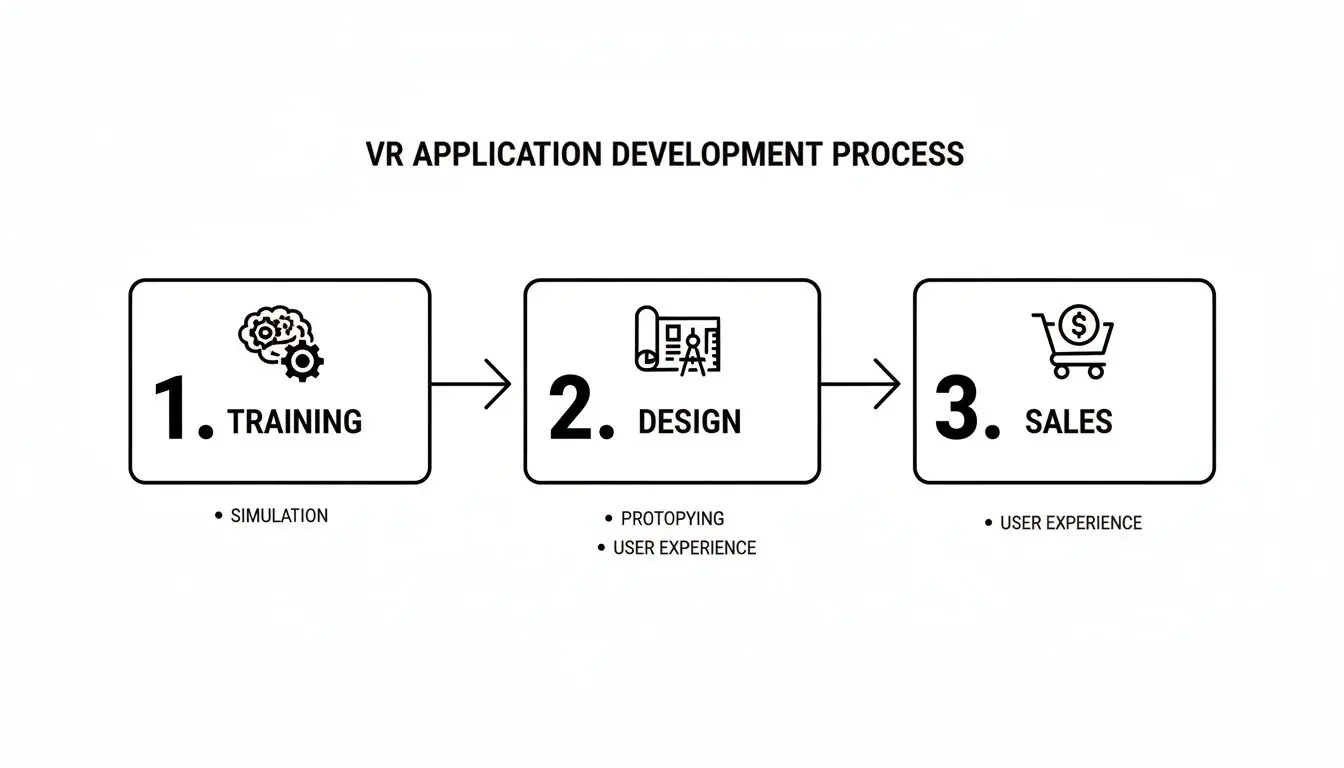
As you can see, even though the final goals are different, the main production pipeline shares the same essential stages of idea, creation, and deployment.
Development and Rigorous Testing
With the blueprint and assets in hand, the development phase begins. Our developers jump into powerful game engines like Unity or Unreal Engine to actually build the experience. They’ll integrate the 3D models, code all the interactive elements, and implement the logic that makes the virtual environment tick. After the initial build, the application goes through some serious testing. This is more than just squashing bugs. We run user acceptance testing (UAT) to make sure the experience feels intuitive, is comfortable to use, and actually hits the goals we set back in the discovery phase. Performance is also fine-tuned to ensure a smooth, consistent frame rate on the target VR headset, this is absolutely essential for preventing motion sickness and ensuring a good user experience. For a more detailed look at the whole process, check out our producer’s guide to virtual reality application development.
The final hurdle is deployment. This might mean installing the app on a whole fleet of VR headsets for an internal training programme, publishing it to a public app store like the Meta Quest Store, or setting it up for a big exhibition. A good studio partner will handle this entire process for you, making sure the launch is completely seamless.
This kind of structured journey is becoming standard as the industry matures. In fact, the United Kingdom's VR headset market is expected to grow at a compound annual growth rate of 18.7% between 2025 and 2035, largely driven by applications in education, virtual events, and immersive storytelling. This steady growth shows just how important a professional, structured production process has become.
How to Choose the Right VR Development Partner
The hardware is only one piece of the puzzle. At the end of the day, the success of your VR project hinges on the skill and vision of your development partner. Choosing the right studio isn't like picking a simple vendor; it's about finding a creative and technical ally who genuinely gets your business goals. This decision will define everything that follows. A great partner doesn't just take orders and build what you ask for. They get in the trenches with you, collaborating to turn your commercial objectives into an immersive experience that actually works. They bring strategic thinking to the table, helping you wrestle with the complexities of user experience design, interactive storytelling, and the technical nitty-gritty.
Key Criteria for Selecting a Studio
When you start evaluating potential partners, the first thing to look at is their track record. Their portfolio should do more than just dazzle you with creative flair; it needs to show deep technical muscle. Have they built projects in powerful game engines like Unity or Unreal Engine? That kind of expertise is non-negotiable for creating high-fidelity experiences that run like a dream on your chosen headset. Beyond their finished work, dig into their process. A transparent, structured workflow is the hallmark of a professional studio. They should be able to walk you through their approach to:
- •Discovery and Strategy: How do they define project goals and KPIs right from the start?
- •Creative Development: What's their process for storyboarding, asset creation, and interactive design?
- •Technical Execution: Can they prove their proficiency across different VR platforms?
- •Deployment and Support: How do they ensure a smooth launch and what kind of ongoing maintenance do they offer?
A strong partner acts as an extension of your team. They should be as invested in the project's success as you are, providing guidance and pushing the creative boundaries to achieve the best possible outcome.
Finding the right fit can feel like a huge task, but focusing on these core areas will help you zero in on the best teams. To give you a head start, we’ve put together a guide on some of the top virtual reality development companies in the UK, which is a solid starting point for your research. Ultimately, you’re looking for a partner with that perfect blend of artistic vision and engineering prowess to bring your immersive world to life.
Your Questions About Business VR, Answered
Stepping into the world of virtual reality can bring up a lot of practical questions for any business. From budgets to the nitty-gritty technical details, getting your head around the fundamentals is key before you make a confident investment. We've put together answers to the most common queries we hear from organisations just starting to explore what a VR headset and custom software can do for them. These are the clear, straightforward answers to help you navigate those first thoughts, cutting through the jargon and demystifying the process of bringing immersive tech into your operations.
How Much Will a Custom VR Experience Cost?
This is the big one, and the honest answer is: it varies wildly. The final figure really depends on the complexity, level of interaction, and visual polish you're after. A simple 360-degree video tour might start in the low thousands, whereas a sophisticated, interactive training simulation with custom-built assets in Unity or Unreal Engine can range from £25,000 to over £100,000. What drives the cost up? Things like the amount of 3D modelling needed, how complex the user interactions are, and the number of different platforms you need it to run on. The best way forward is always to start with a discovery workshop to map out exactly what you need and get a detailed, tailored quote.
What's the Difference Between VR, AR, and MR?
Think of it as a spectrum of immersion. Getting this distinction right is vital for picking the technology that actually matches your business goals.
- •Virtual Reality (VR) is total immersion. When you pop on a VR headset, your real-world view is completely replaced with a digital one. You are fully in a new virtual environment.
- •Augmented Reality (AR) adds a digital layer on top of your real world, usually through a phone or smart glasses. A great example is an app that lets you see how a new sofa would look in your living room.
- •Mixed Reality (MR) is the next step up from AR. Here, digital objects are aware of and can actually interact with your real-world environment. Imagine a virtual ball bouncing off your real-life meeting room table.
We help our clients choose the right technology based on what they're trying to achieve. The decision between VR, AR, or MR comes down to the story you want to tell and how you need your audience to interact with it.
How Do We Handle Hygiene for VR Headsets at Public Events?
Hygiene and safety are non-negotiable for any public VR setup. For hygiene, we always recommend using disposable sanitary face covers or VR-specific antimicrobial wipes between every single use. The headsets and controllers themselves should also get a thorough clean-down every day. On the safety front, you need a clearly marked physical space (a 'play area') for each user. This stops them from walking into walls or bumping into other people. Having trained staff on hand to help users get set up and guide them through the experience is absolutely essential for a safe and positive event.
Can We Integrate a VR Headset with Our Existing Software?
Yes, absolutely, and this is often where the real value lies. Many VR training applications are built with APIs that allow them to plug straight into existing Learning Management Systems (LMS). This means you can track user progress, assessment scores, and completion rates right inside the systems you already use. Pulling this off requires some collaboration between the VR studio and your own IT department to make sure data flows smoothly and securely. It’s crucial to discuss your existing systems right at the start, during the initial discovery phase, to ensure a successful integration. At Studio Liddell, we don't just build VR experiences; we partner with you to solve real business challenges. From the first spark of an idea to the final deployment, our team has the creative flair and technical know-how to bring your vision to life. Ready to explore how a VR headset could genuinely change things for your business? Book a production scoping call with our experts today.