A Producer's Guide to Game Augmented Reality Development
Imagine your living room floor cracking open to reveal a lava pit, or a mischievous dragon suddenly perched on your coffee table, all visible through your smartphone screen. That's the magic of game augmented reality. Unlike virtual reality, which completely shuts out the real world, AR creatively layers digital characters, puzzles, and battlefields right on top of your physical surroundings. It doesn't replace your world; it enhances it.
Why Augmented Reality Gaming Matters Now
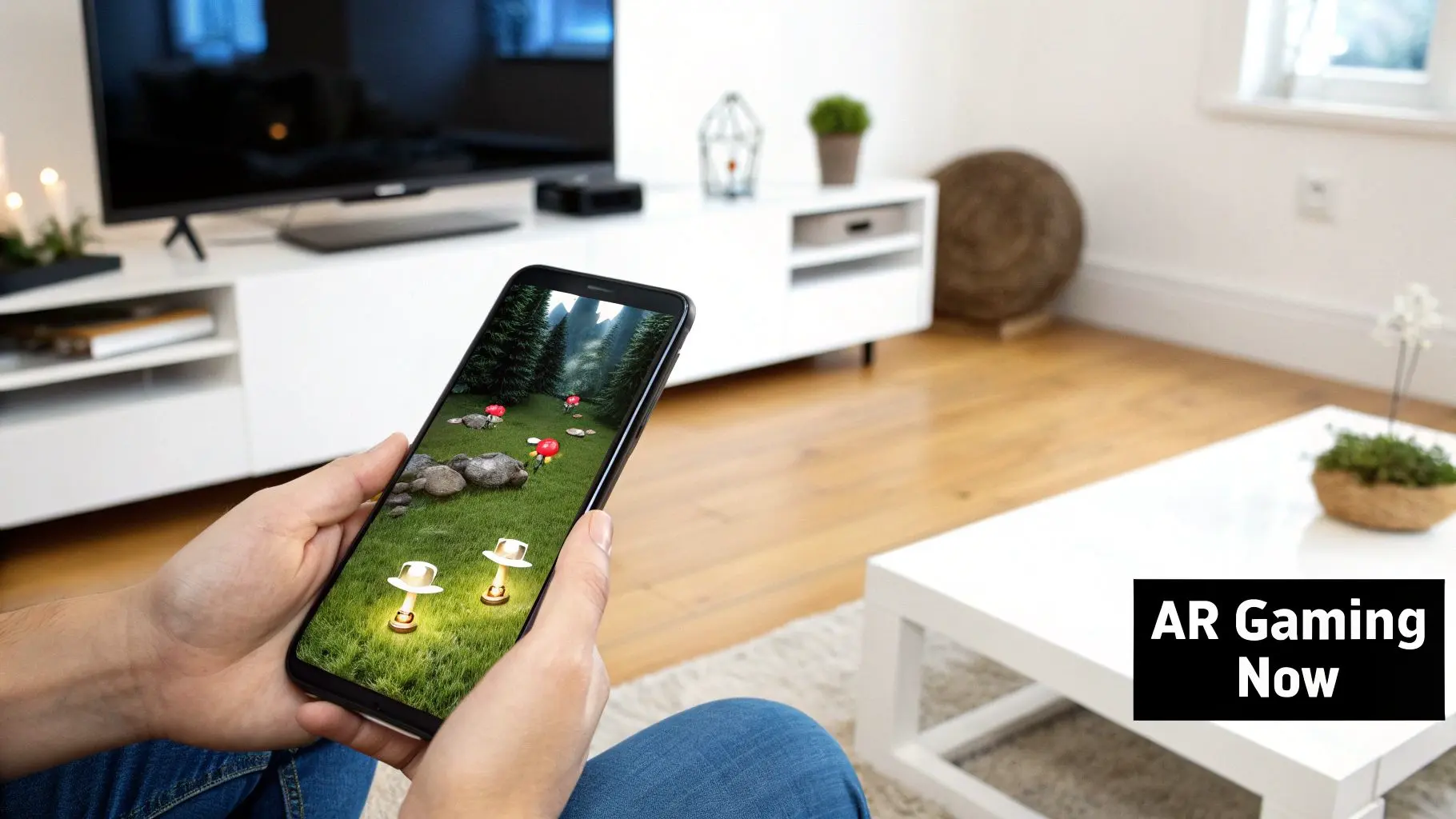
Augmented reality gaming isn't just another fad; it represents a fundamental shift in how we play. By moving the action off the screen and into our actual environment, AR creates experiences that feel incredibly personal and immediate. It works by using the cameras, sensors, and processors already built into our phones to seamlessly merge computer-generated worlds with a live view of reality. Its greatest strength is its accessibility. While virtual reality often demands expensive, isolating headsets, AR works with the one device millions of us already own and carry everywhere. This completely lowers the barrier to entry, making it possible for anyone to jump into a shared, fantastical experience at a moment's notice.
The Blurring Line Between Digital and Physical Play
The real charm of a well-crafted game augmented reality experience is how it makes the virtual feel tangible. A digital creature isn't just an image on your screen; it looks like it’s actually sitting on your kitchen counter. A puzzle’s clues aren’t just in the app; they’re scattered across your real-world floor, waiting to be discovered. This unique blend creates a powerful sense of presence that traditional screen-based games can only dream of. It also encourages a new kind of active play. You might have to physically walk around a digital statue to find a hidden symbol or duck behind your own sofa to dodge a virtual attack, creating a direct link between digital fun and real-world movement.
The Commercial Power of Immersive Experiences
Beyond just fun and games, the commercial power of AR is growing at an incredible pace. The UK augmented reality market recently generated a staggering USD 4,131.2 million in revenue, and it’s projected to explode to USD 25,763.2 million by 2030. That growth is fuelled by a compound annual growth rate (CAGR) of 34.7%, with hardware like smartphones and AR glasses leading the charge. This isn't just a trend; it's a massive opportunity for businesses. AR has moved from a futuristic gimmick to a genuinely powerful tool for:
- •Marketing and Branding: Crafting memorable, interactive campaigns that get people talking and sharing online.
- •Retail: Letting customers see how a new sofa would look in their living room or how a pair of trainers fits their style, all before buying.
- •Education and Training: Building hands-on learning modules that bring complex subjects, from human anatomy to engineering, to life.
By turning passive consumption into active participation, AR games and experiences open up an exciting new way for brands to connect with their audience, drive genuine engagement, and offer real value that was simply impossible before.
Understanding the Core Technology That Powers AR Games
For an AR game to feel believable, the technology behind it first needs to understand the world you're in. This isn't magic; it's a clever partnership between specialised software that senses your surroundings and powerful game engines that bring digital creations to life within that space. At the heart of it all are the software development kits, or SDKs. You can think of these as the "senses" of an AR app. The two big names here are Apple’s ARKit and Google’s ARCore, which give developers the essential tools for building AR experiences on iOS and Android devices. These SDKs do the heavy lifting. They're responsible for mapping the environment, figuring out where flat surfaces like tables and floors are, tracking how your phone is moving through space, and even estimating the real-world lighting so virtual objects don't look out of place.
The Powerhouse Game Engines: Unity and Unreal
Once the SDKs have gathered all that sensory data, developers need a place to actually build the game. That’s where game engines like Unity and Unreal Engine come in. These are the digital workshops where artists and programmers create, animate, and deploy the virtual characters and worlds that players will interact with.
- •Unity: A hugely popular choice for AR game development, known for its flexibility and fantastic support for mobile devices. Its massive asset store and active community help developers get projects up and running much faster.
- •Unreal Engine: If you want jaw-dropping visuals, Unreal Engine is the way to go. It's famous for its high-fidelity graphics and photorealistic rendering, making it perfect for AR experiences that really push the visual boundaries.
These engines take the information from ARKit or ARCore, like the exact position of your floor, and use it to place a digital character convincingly in your room. They make sure that when you move your phone, that character stays put, creating a powerful illusion that it's really there. For a deeper dive into how this all comes together, check out our complete guide to augmented reality application development.
How the Tech Stack Works Together
The relationship between SDKs and game engines is a true partnership. The SDK is the scout, constantly scanning and reporting on the environment. The game engine is the director, telling the virtual actors where to stand and how to react based on the scout’s intel. Here's a look at Unity's AR development interface, which shows how developers can visualise and build these interactive experiences. This interface gives creators precise control over how virtual objects are placed and manipulated within a simulated real-world space. It’s this tight integration that allows a digital monster to realistically hide behind your actual sofa or a virtual treasure chest to appear firmly planted on your rug. And as hardware evolves, devices like the Apple Vision Pro are pushing the boundaries of how these digital elements can merge with our physical world.
The real success of an AR game lies in this seamless partnership. When the technology works flawlessly, the player stops seeing the code and starts believing in the dragon on their lawn.
Ultimately, this combination of world-sensing SDKs and creative game engines provides the complete technical foundation needed to build truly compelling AR games. Without them working in perfect sync, the magic of blending virtual and real just wouldn't be possible.
The Production Blueprint for a Successful AR Game
Turning a brilliant idea into a polished game augmented reality experience isn't magic; it's a structured, multi-stage production pipeline. This journey is all about translating a creative vision into a technically sound and, most importantly, fun final product. Each phase builds on the last, taking you from abstract concepts to a tangible, interactive world layered onto your own. This whole process kicks off long before anyone writes a single line of code or models a 3D character. It starts with a solid plan.
Concept and Design: The Foundation
Every great project starts with a strong concept. In this initial phase, we nail down the core gameplay loop. What will players actually do, and what will make them want to keep doing it? The team gets to work storyboarding the user journey, mapping out every single interaction from the moment the game boots up to the final objective. This is where we have to answer the big questions:
- •Who are we building this for? A game for young kids needs completely different mechanics and interfaces than one for seasoned adult gamers.
- •What's the core mechanic? Is it about solving clever puzzles, collecting virtual items scattered around a real park, or engaging in tactical battles?
- •How does AR make it better? The game must use AR in a meaningful way, not just as a flashy gimmick. For instance, does the gameplay need players to physically walk around virtual objects to find clues?
The flowchart below shows how the key technologies come together to bring these concepts to life.
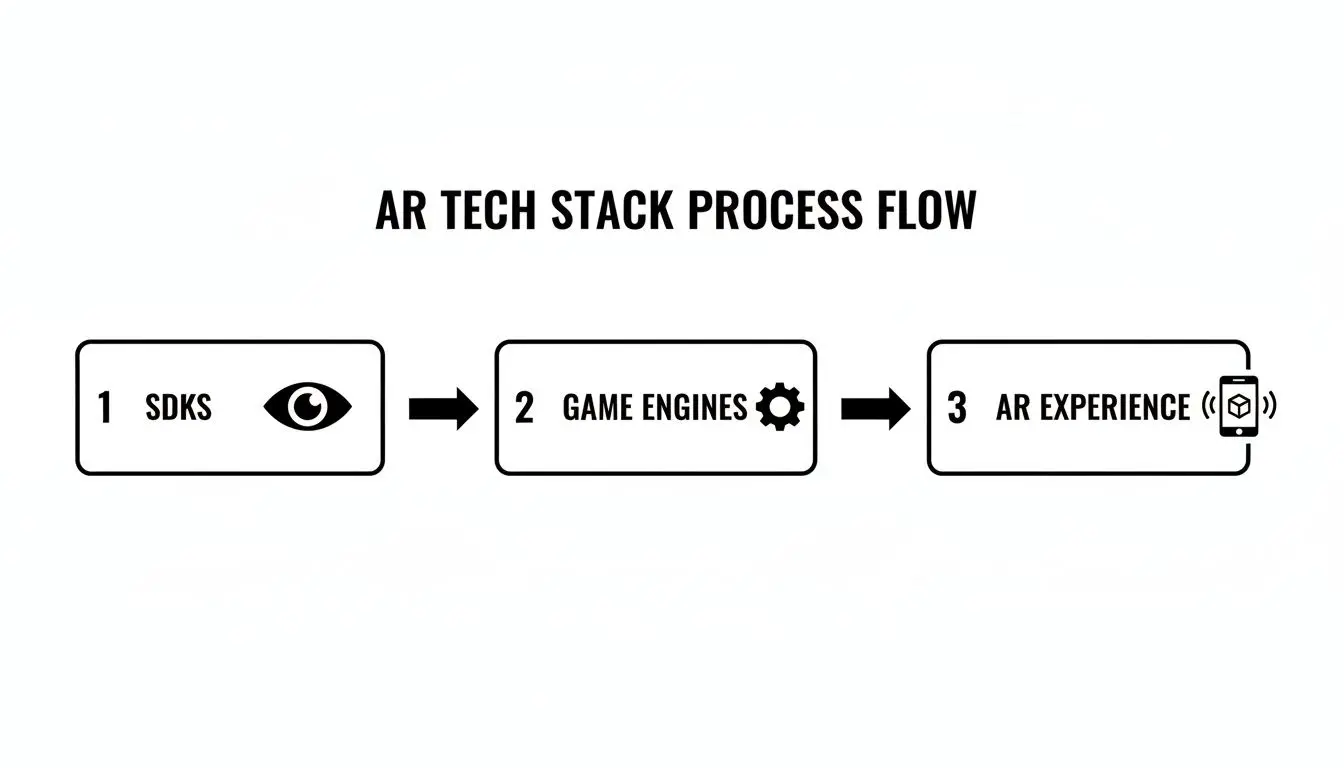
You can see how the foundational SDKs give the game engine its "senses," letting it understand the environment and turn a creative idea into something you can actually play.
Crafting Digital Worlds with 3D Asset Creation
With a rock-solid design in place, our artists start building the visual guts of the game. This means modelling, texturing, and animating every character, object, and environment that will pop up in the player's world. These assets have to be a perfect blend of beautiful aesthetics and lean, mean mobile performance. A single unoptimised 3D model can make a phone stutter, lag, or overheat, completely shattering the player's immersion. Our artists are masters at balancing visual detail with performance, creating assets that look incredible without demanding too much from the device.
Development: The Programming Phase
This is where developers breathe life into the game. Using powerful game engines like Unity or Unreal Engine, they write the code that governs every single interaction. They lay down the rules of the game and stitch the artists' assets into a cohesive, playable experience. Programmers link the game's logic to the AR SDKs (ARKit/ARCore), making sure virtual objects behave realistically in the real world. For a closer look at what this involves, our guide to game development using Unity offers a detailed walkthrough. Part of getting a project off the ground is often securing investment, and for that, you might find this founder's guide to creating pitch decks that close deals incredibly helpful.
The development phase is a deeply collaborative effort. Programmers, artists, and designers have to work in lockstep to ensure the technical execution perfectly captures the original creative spark.
It's a constant cycle of building, testing, and refining based on real-time feedback.
Testing and Optimisation: The Final Polish
The final stage is, without a doubt, the most crucial for a successful launch. Our quality assurance (QA) team gets to work, rigorously testing the game on a huge range of devices. They become expert bug hunters, sniffing out performance bottlenecks and giving honest feedback on the overall user experience. During this phase, we're laser-focused on a few key areas:
- Performance: Does the game run smoothly? How fast does it drain the battery? Does it turn the phone into a hand-warmer?
- Compatibility: Does the AR tracking work just as well on the latest flagship phone as it does on a three-year-old model?
- Usability: Is the game intuitive? Can a new player jump in and understand what to do without getting frustrated?
Designing Player Experiences That Feel Real
 A truly great game augmented reality experience just feels right. It’s intuitive and natural, never clumsy or confusing. That magic evaporates the second a player has to wrestle with awkward controls or feels unsafe moving around their living room. Because of this, success hangs entirely on thoughtful user experience (UX) that respects the player’s real, physical space. This isn't about designing for a predictable, flat screen. The player's environment could be a cluttered bedroom, a busy park, or a wide-open office. The game has to adapt gracefully to all of them, turning potential obstacles into part of the fun. This seamless blend of digital and physical is the heart of the AR game design challenge.
 Mastering Spatial Awareness and Player Safety
Unlike traditional games, AR gets players up and moving. This simple fact introduces a whole new layer of design responsibility, all centred on spatial awareness. The goal is to encourage movement that feels natural and safe, preventing players from bumping into the coffee table or wandering into the road. Smart design uses subtle cues to guide players without yanking them out of the experience. Placing a valuable virtual item just out of reach encourages a few steps forward. A gentle on-screen warning can alert a player if they’re moving too fast or about to leave the designated play area. Key considerations here include:- •Defining the Play Space: Does the game need a small, room-scale area or a massive outdoor park? These needs must be communicated clearly to the player right from the start.
- •Environmental Cues: The game should intelligently recognise real-world objects. A virtual character could leap onto a real sofa or duck behind a real table, making the whole world feel more alive and interactive.
- •Movement Guidance: Gentle visual hints, like glowing pathways or subtle arrows, can guide players toward objectives without shattering the immersion.
Creating Intuitive Onboarding and Interaction
Let’s be honest, AR mechanics are still new to most people. We all know how to tap, swipe, and pinch on a screen, but interacting with 3D objects floating in our physical space isn’t second nature. A crystal-clear onboarding process is absolutely essential to avoid frustration. Instead of hitting players with walls of tutorial text, the best AR games teach through doing. The first level might involve a simple task, like tapping on a virtual creature that appears on the floor. Just like that, the player learns the core interaction in a fun, rewarding way.
A successful onboarding process makes the player feel smart. It guides them to discover mechanics naturally, so the unique controls of AR feel like an extension of their own hands rather than a confusing new language they have to learn.
The aim is to build confidence quickly, ensuring the player knows exactly how to interact with the world before the challenges really begin.
Making Interactions Feel Tangible and Responsive
The final piece of the puzzle is making every interaction satisfying. When a player taps a virtual button, pets a digital creature, or throws a digital ball, the game has to respond with immediate, believable feedback. Without it, the whole illusion shatters. This feedback comes in a few different flavours:
- •Visual Cues: Think sparks, flashes, or little animations that confirm a successful touch.
- •Haptic Feedback: A subtle vibration in the phone when an interaction occurs, making it feel more physical.
- •Audio Effects: A satisfying "click," "pop," or character sound that matches the player's action perfectly.
When all these elements work in harmony, they create a sense of tangibility. The player isn’t just tapping on glass; they are truly affecting the virtual world layered over their own. It’s this responsiveness that transforms a clever tech demo into a genuinely immersive game augmented reality adventure.
Putting AR Games to Work Beyond Entertainment
The magic of game augmented reality isn't just about catching monsters in the park or fighting dragons in your back garden. The same ideas that make AR games so addictive, engagement, interaction, and real-world awareness, are now being picked up by businesses to solve practical challenges and create real value. It’s a smart move from pure fun to functional application. These gamified experiences use AR to flip passive observation into active participation. By layering interactive digital info onto a customer's or employee's view of the world, companies can break down complex ideas, make decisions simpler, and create training that actually sticks. This shift is totally changing how industries connect with people.
Revolutionising Retail and E-commerce
Retail is one of the places where game augmented reality is making a massive splash. Businesses are building AR product configurators that turn a customer's living room into a personal showroom. This tech closes that huge gap between browsing online and feeling confident enough to actually buy something. Think about redecorating. Instead of guessing if that new sofa will fit or match your curtains, an AR app lets you drop a true-to-scale 3D model right into your space. You can walk around it, change the colour, and see exactly how it looks from every angle. This "try before you buy" feature is proven to boost sales and, just as crucially, cut down on product returns, a major headache for online retailers. In fact, one report found that 40% of consumers would happily pay more for something if they could test it out in AR first.
Transforming Education and Corporate Training
The world of education is another area getting a serious upgrade from AR game mechanics. Interactive AR modules can bring subjects to life in a way textbooks just can’t compete with. A biology student could pull apart a detailed 3D model of a human heart, watching the valves open and close right there on their desk. This exact technology is also being rolled out for corporate and industrial training. Gamified AR simulations give employees a safe space to practise complicated or even dangerous jobs. Imagine:
- •An engineering trainee learns to assemble a complex engine by following holographic instructions layered over the real parts.
- •A new shop assistant practises stocking shelves or using the till in a virtual store that’s identical to their real workplace.
- •Medical students can run through simulated surgeries, building muscle memory and confidence without any risk to a patient.
These hands-on experiences help people learn faster and retain more, all while cutting down the risk of expensive mistakes in the real world. For a deeper dive, you can explore some of the top augmented reality examples that are changing industries and see how this tech is already being used today.
By turning learning into a hands-on, interactive game, businesses can significantly shorten the learning curve for new skills, making their workforce more adaptable and efficient.
This approach doesn't just make people more competent; it makes the whole training process more enjoyable. That leads to better engagement and, ultimately, better results all around. The power to see and interact with digital information in a physical context is proving to be an incredible tool for modern business. The applications for gamified AR are incredibly broad, touching nearly every sector. By reframing a business challenge as an interactive experience, companies can drive engagement and achieve their goals more effectively.
AR Game Applications Across Industries
| Industry | Application Example | Primary Benefit |
|---|---|---|
| Healthcare | Gamified surgical simulations for medical students to practise procedures. | Risk-free skill development and improved patient safety. |
| Manufacturing | Step-by-step AR assembly guides for complex machinery. | Reduced assembly errors and faster employee onboarding. |
| Real Estate | AR apps that let potential buyers furnish and tour empty properties. | Enhanced visualisation and stronger emotional connection. |
| Marketing | Interactive AR product demos launched from packaging or print ads. | Increased brand engagement and memorable customer experiences. |
From training the next generation of surgeons to helping someone choose the perfect armchair, the core principles of AR gaming are demonstrating their immense value far beyond the world of entertainment.
Frequently Asked Questions About AR Game Development
Diving into the world of augmented reality for the first time naturally brings up a few questions. Here are some straightforward answers to the queries we hear most often from partners and clients thinking about creating their first game augmented reality experience.
How Much Does an AR Game Cost?
This is always the big question, and the honest answer is: it completely depends on the complexity. You could get a simple AR game off the ground, perhaps with basic interactions and ready-made assets, starting in the low five figures. But if you’re dreaming bigger, think a highly polished title with custom-designed 3D models, slick animations, and really sophisticated gameplay, the budget can easily climb into the six-figure range. The main things that shape the final cost are:
- •Asset Quality: Are we creating bespoke 3D characters from the ground up, or can we work with existing assets?
- •Gameplay Complexity: A straightforward "tap to place an object" game is a world away from one with advanced physics, scoring, and player progression.
- •Platform Support: Building for both iOS and Android at the same time means more hours spent on testing and optimisation to get it just right on both.
What Is a Typical Development Timeline?
Just like the cost, the timeline really flexes with the scope of the project. A simple prototype or a proof-of-concept to test an idea could be in your hands within 4-6 weeks. For a more complete game with a polished user experience and multiple levels, you’re typically looking at a 3-6 month journey from the first chat to launch day. Of course, massive projects with tons of content and backend server support can stretch beyond that six-month mark.
Which Devices Do AR Games Work On?
The great news is that modern AR games are built to run on the smartphones and tablets people already have in their pockets. The two main playgrounds are:
While most recent phones are AR-ready, how well they perform can vary. A massive part of our process is putting the game through its paces on a whole spectrum of popular devices, not just the flashy new flagship models, to make sure it runs smoothly for everyone.
Do I Need an App to Launch an AR Experience?
Not necessarily! While a dedicated app gives you the most power and creative freedom, there's another great option. WebAR technology lets people jump into an AR experience right from their mobile browser, usually by just scanning a QR code or tapping a link. This is a fantastic choice for marketing campaigns or quick product showcases where you want as few barriers as possible for your audience. Deciding between a native app and WebAR really comes down to your project's goals for gameplay complexity versus user accessibility. Ready to see how a game augmented reality experience could get people talking about your brand? The team at Studio Liddell has been delivering world-class digital productions since 2019. Book a production scoping call