A Producer's Guide to Enhanced Reality Games
When you hear the term enhanced reality games, don't just think of a simple filter slapped over your phone's camera. This is something much deeper. We're talking about genuinely immersive experiences where digital elements don't just sit on top of your world; they actively react and interact with it. Imagine a game where the story unfolds based on your movements, using your own physical space as the stage. That’s the core idea of enhanced reality.
Blending Digital Worlds with Physical Reality
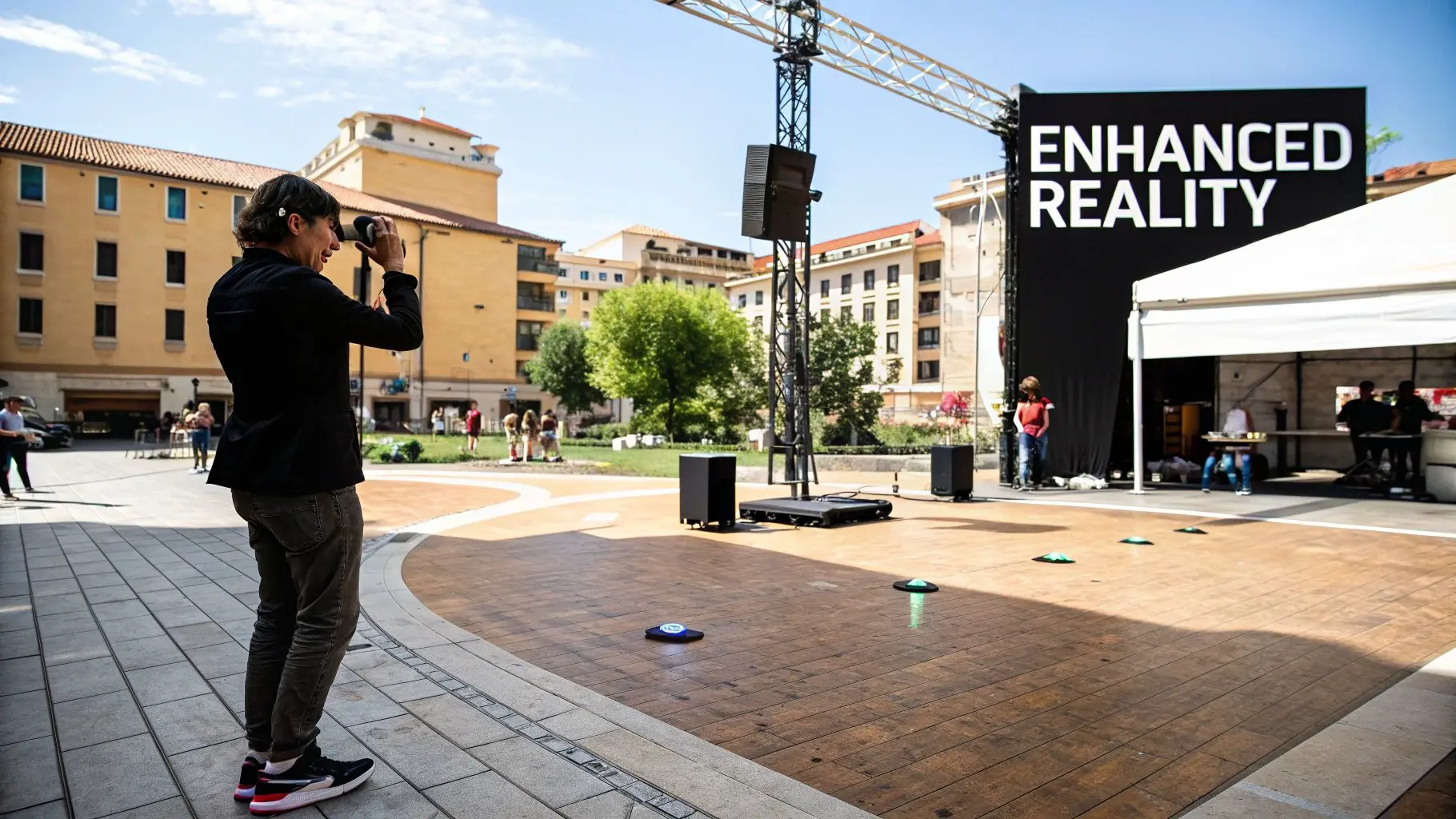
The phrase “enhanced reality” (ER) marks a real step up from what we typically call augmented reality (AR). While AR is great at overlaying digital information onto a live view, ER aims for a much more meaningful blend. It’s less of a one-way broadcast and more of a dynamic conversation between the digital and the physical. So, instead of just placing a 3D model on your coffee table, an ER game would have a virtual character that actually understands the layout of your room. It might cleverly navigate around your furniture, react when you open a real door, or even change its mood based on the time of day. This is where the "enhancement" really shines, the digital layer isn't just present, it's context-aware.
The Key Differences From AR and VR
Getting your head around where ER fits in can be tricky, as the lines between these technologies often blur. The main distinction comes down to how you, the user, interact with your environment. If you want to dive deeper into how these worlds are merging, our complete guide to mixed reality is a great place to start. Here's a quick way to break it down:
- •Virtual Reality (VR): This completely shuts out the real world. Once you put on a VR headset, you’re in a totally digital space, cut off from your physical surroundings.
- •Augmented Reality (AR): This adds a digital layer on top of your reality, usually through your phone. Think of those fun social media filters or apps that show you how a new sofa might look in your living room.
- •Enhanced Reality (ER): This is the next evolution. Digital objects don't just appear in your world; they interact with it. They understand the shape of your room and respond to real-world changes, creating a truly hybrid experience.
Why This Distinction Matters
This shift from simple augmentation to genuine enhancement is more than just a name change. It reflects a fundamental change in both design thinking and technical power. Enhanced reality games are built to feel so immersive that the digital elements feel like a natural, believable part of the physical world.
The ultimate goal of enhanced reality is to make digital interactions feel as intuitive and responsive as physical ones. It's about creating a persistent digital layer that adds genuine depth, context, and magic to our everyday environments.
This approach unlocks a whole new world of possibilities for gameplay, storytelling, and user engagement. It lets us build worlds that are uniquely tied to a player’s own space, making every experience feel personal and unforgettable. As the technology matures, this sophisticated blend of worlds is set to become the new standard for immersive entertainment.
The Technology Powering Immersive Worlds
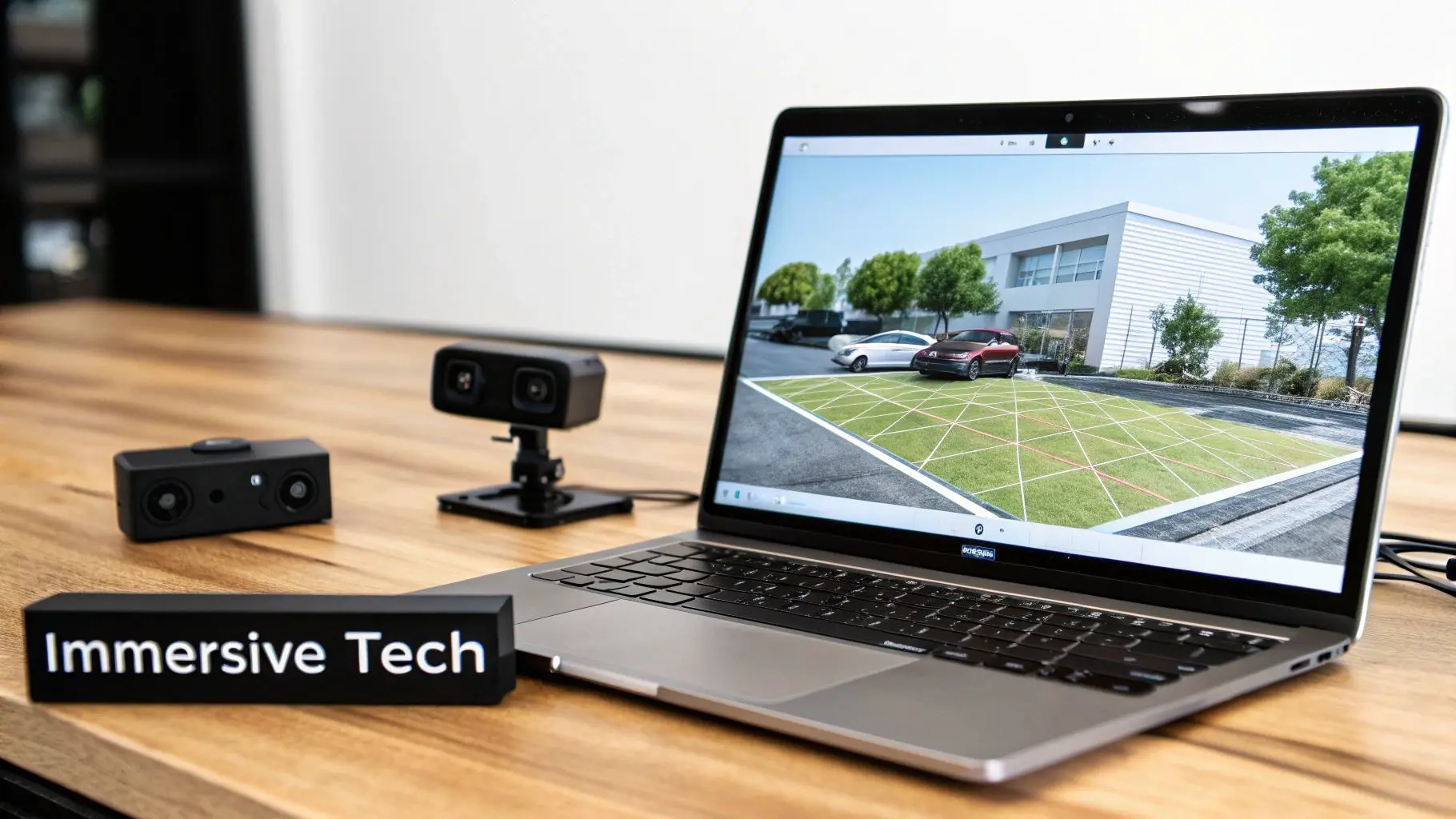
Creating a truly believable enhanced reality game isn't magic. It's more like a carefully conducted symphony, where powerful software and hardware work together in perfect harmony. At the centre of it all are the game engines, the digital canvases where these immersive worlds are born. Think of an engine as the foundational framework for building any interactive 3D content. It handles the heavy lifting, from physics and graphics to animation and sound, giving developers the essential toolkit they need to bring a creative vision to life.
The Core Game Engines
When it comes to building enhanced reality games, the industry really revolves around two powerhouse platforms. Each one offers a unique set of tools and advantages, and the right choice nearly always comes down to the specific needs of the project.
- •Unity: Known for its incredible flexibility and ability to run on almost anything, Unity is a hugely popular choice for mobile ER experiences. Its massive asset store and vibrant developer community make it a brilliant engine for creating and deploying games across a wide range of devices efficiently.
- •Unreal Engine: Famous for its jaw-dropping visual fidelity and photorealistic rendering, Unreal Engine is the undisputed king of high-end, graphically intense experiences. It's the engine you turn to when visual impact is absolutely paramount.
Getting to grips with the strengths of each platform is crucial for producers and technical buyers. Our guide to mastering Unity development for business and XR offers a deeper look into how these engines can be put to work effectively.
Advanced Sensors: The Eyes and Ears of ER
What truly separates enhanced reality from simpler AR is its ability to actually perceive and react to the physical world around it. This is all made possible by the array of sophisticated sensors packed into modern devices. These tiny components are the unsung heroes bridging the gap between the digital and the physical. They continuously feed the game engine real-world data, allowing digital elements to interact with your environment in an intelligent way.
This constant stream of environmental data is what makes an enhanced reality game feel so grounded and responsive. Without it, digital objects would be little more than floating stickers, completely unaware of the world they inhabit.
Key sensors include:
- •LiDAR (Light Detection and Ranging): This tech uses lasers to create a highly accurate 3D map of the environment, which allows for incredibly precise object placement and occlusion.
- •Accelerometers & Gyroscopes: These are what track your device's orientation and movement, translating your physical actions into in-game motion.
- •Cameras and Computer Vision: Sophisticated algorithms analyse the camera feed to recognise surfaces, objects, and even human gestures, enabling all sorts of dynamic interactions.
The Role of AI in Production
Developing these complex systems requires a slick and sophisticated production pipeline. Here at Studio Liddell, we integrate AI-enhanced workflows to speed up development and push the quality even higher. AI can automate repetitive tasks like asset optimisation and bug detection, which frees up our creative teams to focus on what really matters: crafting unforgettable gameplay experiences. This approach helps us manage the immense complexity involved in building persistent, context-aware worlds. After all, when you’re delving into the complex digital frameworks that underpin enhanced reality, a solid understanding of core coding and computer science principles is an essential foundation. By combining powerful game engines, precise sensor data, and intelligent production pipelines, we build enhanced reality games that aren't just technically impressive, but also deeply engaging and immersive.
Designing Gameplay for a Hybrid Reality
Great tech is only half the story. A truly unforgettable enhanced reality game lives and dies by its design. Crafting an experience that genuinely merges the physical and digital worlds is a unique challenge, but it’s also where the real magic happens. It forces a complete shift in thinking , you’re no longer designing for a screen, but for the space all around you. The real task is to make the interactions feel completely natural, as if they belong in the player's own environment. When digital effects react logically to physical objects and movements, the illusion of a blended reality becomes incredibly powerful and immersive. This isn't just about letting players move; it's about building game mechanics that demand and reward it.
Weaving Your Story into the Real World
Unlike traditional games where the world is built from scratch, enhanced reality uses the player's immediate surroundings as its stage. A great ER narrative has to be aware of this. A game could use the actual time of day, the local weather, or even nearby landmarks to kick off specific story moments or character interactions. Imagine a mystery game that needs you to physically walk to a local park to find a clue, a clue that only appears when you're standing right there. This simple act turns a passive player into an active participant, making the story feel urgent and personal. The world itself stops being just a backdrop and becomes a main character.
The best enhanced reality games make players feel like the hero of a story that’s happening right here, right now. The secret is making the digital world feel not just pasted on top of reality, but properly woven into it.
Keeping Players Safe and Getting Them Started Right
When your game encourages people to move through physical spaces, safety has to be your top priority. As designers, we have to carefully manage the player's attention to make sure they stay aware of their real-world surroundings. The last thing you want is someone walking into a lamppost or causing a scene in public. This is where a solid onboarding process comes in. A well-designed ER game will:
- •Clearly define the play area: It sets the boundaries right at the start, so players know exactly where the game is meant to happen.
- •Introduce mechanics one by one: It teaches players how to interact with the world in a safe, controlled way before letting them loose in more dynamic situations.
- •Use an intuitive UI: The interface should be minimal and out of the way, giving just enough information without pulling focus from the real world.
The jump from traditional AR to a true enhanced reality experience requires a fundamental change in design philosophy. This table breaks down the key differences in how we approach building these worlds.
Comparing Game Design Approaches AR vs ER
| Design Element | Traditional AR Approach | Enhanced Reality (ER) Approach |
|---|---|---|
| Player Interaction | Mostly screen-based taps and swipes; digital objects are passive overlays. | Encourages physical movement and environmental interaction; digital elements react to the real world. |
| Environment | The real world is just a simple backdrop for digital content. | The real world is an active and essential part of the game's mechanics and story. |
| Narrative Design | The story is linear and separate from the player's physical context. | The story is dynamic and context-aware, changing based on the player's location and actions. |
As you can see, ER design is far more integrated, treating the player's reality as a core component of the experience rather than just a canvas.
Building Engagement Through Physical Action
Location-based games like Pokémon Go proved there’s a massive appetite for gameplay that gets people exploring. Enhanced Reality takes that concept and pushes it further by creating much more meaningful interactions within those locations. The aim is to design mechanics that are not only fun but also feel deeply connected to the act of moving and exploring. For instance, a puzzle might need players to physically line up their device with a real-world building, or a combat mechanic could be directly tied to how fast they're walking. By making physical actions a core part of the game, we can create satisfying and memorable experiences that are simply impossible to get in a purely digital format. Ultimately, it’s these design principles that elevate enhanced reality from a cool tech demo into a genuinely new and exciting way to play.
Unlocking Business and Educational Value
While gaming often brings to mind entertainment for the masses, the real game-changing applications of enhanced reality are cropping up in business and education. These immersive experiences offer a powerful return on investment, completely flipping the script on how people engage with information, products, and new skills. It’s a move away from just passively looking at something, towards actively participating in it , and that’s where you get tangible results. This shift couldn't be more timely. The UK’s online gaming community, a perfect demographic for enhanced reality games, swelled to 10.84 million players in 2023 and is on track to hit 11.56 million by 2027. When you realise 80% of 16-24-year-olds play online, and even 48% of those over 65 are getting involved, you see the huge, cross-generational appetite for interactive digital experiences. It’s a trend that confirms ER has broad appeal, and you can explore more about the UK's thriving gaming scene and its demographic shifts.
Transforming Exhibitions and Retail Spaces
For any business on the floor of an exhibition or in a retail space, enhanced reality is a direct line to deeper customer engagement. Suddenly, a static product display becomes an interactive showcase, inviting people to get hands-on and explore features in a way they’ll actually remember. Picture a bustling trade show. Instead of a static machine, attendees can grab a tablet, see a complex piece of equipment in full 3D, and even operate its virtual controls to watch an animated breakdown of how it works. This isn't just a gimmick; it hits several key business goals:
- •Keeps people on your stand for longer. Interactive content gives visitors a real reason to stick around, opening the door for your sales team to strike up a meaningful conversation.
- •Makes complex products easy to understand. It cuts through the jargon and shows, rather than tells, making your product's value crystal clear.
- •Creates a brand experience people talk about. A slick ER game or demo generates buzz and makes you the brand everyone remembers long after the event is over.
At its core, the business value of enhanced reality is its power to turn passive window-shoppers into active participants. When a customer can virtually 'hold' and play with a product, their connection to it deepens, nudging them much further along the path to making a purchase.
A New Era for Training and Technical Communication
Beyond the sales floor, ER is proving to be a powerhouse for corporate training and technical education. Think of VR training simulations, a close cousin to ER, which can drop employees into realistic, high-stakes situations without any of the real-world risk. For industries like manufacturing, healthcare, and engineering where complex procedures are the norm, this is invaluable. For example, a technician could learn to assemble a new engine by following holographic guides projected directly onto the physical parts. This kind of hands-on, guided learning blows old-school manuals out of the water when it comes to knowledge retention. Our own work on projects like GeoEnergy NI shows just how effective immersive visuals can be at making highly technical information feel intuitive and engaging. Good ER training pays for itself by cutting down on mistakes, boosting safety, and getting new hires up to speed in record time.
Creating Educational Modules That Stick
In the world of academia, enhanced reality games are tearing down the classroom walls. They offer a brilliant way to bring abstract concepts to life, turning dry theory into something tangible and exciting. A history lesson is no longer just words on a page; it’s a virtual walk through an ancient city. A biology class can take a tour of the human circulatory system from the inside. This way of learning is incredibly effective because it fires up multiple senses and encourages genuine exploration. Students aren’t just memorising facts for an exam; they’re experiencing them. The result is dramatically higher knowledge retention and a real enthusiasm for the subject. It proves ER is more than just a flashy new toy, it's a fundamental shift in how we can share and absorb information.
The Production Pipeline from Concept to Reality
Taking an enhanced reality game from a bright idea to a polished, real-world experience is a carefully structured journey. For anyone looking to commission a project, understanding this process is key. It demystifies production and shows exactly how a simple concept evolves into an interactive reality, ensuring every stage is handled with precision. The whole thing begins not with code, but with conversation. The initial concept and design phase is arguably the most critical. This is where we pin down the core gameplay, figure out who we're talking to, and establish what success actually looks like. Through collaborative workshops and quick-fire prototyping, we map out the entire user journey to make sure the final product is intuitive, engaging, and perfectly aligned with your goals. This structured process, moving from engagement to education and finally to training, really visualises the core value that enhanced reality delivers.
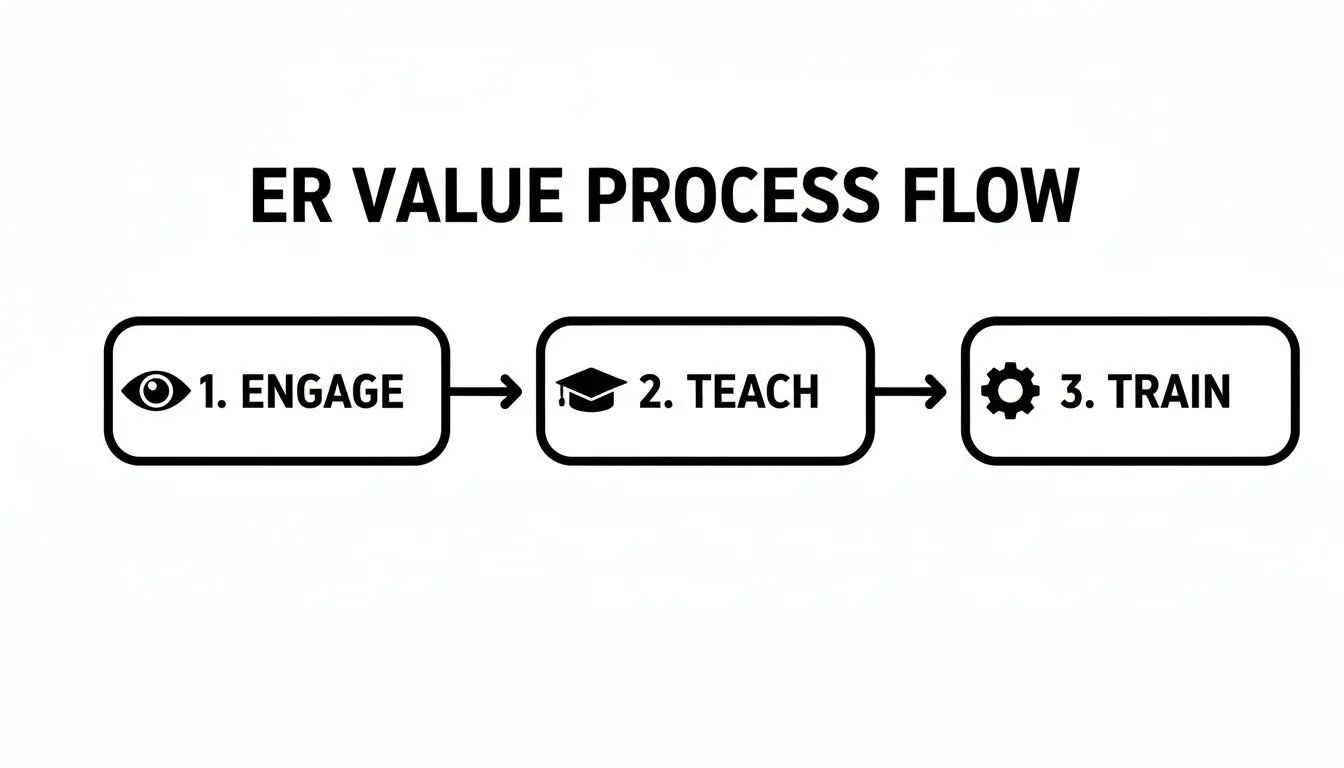
Each step naturally builds on the last, turning a passive audience into active, skilled participants.
Development in Unity or Unreal
Once the blueprint is locked in, our team gets to work in a powerful game engine like Unity or Unreal Engine. The choice here is strategic. Unity's incredible cross-platform flexibility makes it a fantastic choice for mobile ER apps, while Unreal's sheer graphical horsepower is second to none for creating jaw-droppingly realistic visuals. Our developers build the core mechanics, integrate the 3D assets, and write the clever code that makes the digital world respond intelligently to whatever the player is doing in the physical one. This phase is all about iteration. We build, we test, we learn, and we improve, making sure the technical performance and creative vision stay perfectly in sync.
Optimisation for Target Hardware
An enhanced reality game is only as good as the hardware it runs on. A massive part of the production pipeline is the painstaking work of optimising the experience for the target devices, whether that’s a huge range of modern smartphones or a specific headset like the Meta Quest. This means fine-tuning everything from the complexity of 3D models and texture sizes to how the game uses the processor and memory. The goal is simple: deliver a buttery-smooth experience with no frustrating lag or glitches. This technical discipline is what separates a professional, polished product from a clunky tech demo. The experience has to feel fluid and responsive to keep the user completely immersed.
The success of an ER game hinges on flawless performance. Every millisecond of delay or visual stutter breaks the illusion and reminds the player they are just looking at a screen. Optimisation isn't a final step; it's a constant focus from day one.
Case Study: Dance! Dance! Dance!
Our work on the mixed reality game Dance! Dance! Dance! is a great real-world example of this pipeline in action. The project was designed for busy, high-traffic events, so a huge production challenge was ensuring high throughput, basically, the ability for lots of people to play quickly and seamlessly without massive queues forming.
- •Concepting: We designed a fast-paced, intuitive game loop that new players could grasp in seconds.
- •Development: Using a robust engine, we built a system that could handle rapid resets and non-stop play.
- •Optimisation: We rigorously tested the game on the actual event hardware to guarantee stability and performance under pressure.
- •Deployment: The final deployment included on-site technical support to manage the experience and keep the energy high.
The success of Dance! Dance! Dance! really underscores how important it is to have a production pipeline that thinks about the real-world context, not just the game itself. This kind of forward-thinking is vital, especially as the market for these experiences continues to boom. In the UK, the augmented reality market, a cornerstone of enhanced reality games, generated an impressive USD 4,131.2 million in 2024. With projections showing a surge to USD 25,763.2 million by 2030, driven by a powerful growth rate of 34.7%, the commercial potential is undeniable. As around 95% of the UK's 68.3 million people are expected to own a smartphone by 2025, the audience is vast and ready. You can read the full UK augmented reality market analysis to understand the drivers behind this growth. From the first chat to the final launch, a structured and iterative pipeline is the secret to creating a successful ER game that captivates users and delivers genuine results.
How to Commission Your First ER Project
Dipping your toes into enhanced reality for the first time is a massive opportunity, but turning a brilliant idea into a successful, tangible project needs a solid game plan. Finding the right production studio to partner with is half the battle, and that process starts long before anyone writes a single line of code. It all begins with a clear, well-thought-out brief. Think of your project brief as the roadmap for the entire journey. It's your chance to lay out your vision, what you want to achieve, and any limitations you're working with. Getting this right ensures everyone, from your team to ours, is on the same page from the get-go. It doesn’t have to be a hyper-technical document, but it does need to paint a vivid picture of the enhanced reality games or experiences you’re imagining.
Crafting a Clear and Effective Brief
To make those initial chats with a production partner as productive as possible, your brief should nail down the answers to a few key questions. This clarity is what helps a studio like ours grasp your needs and come back with a realistic, effective plan. Your brief should include:
- •The Core Concept: What’s the big idea? In just a few sentences, describe the experience you want to create for your user.
- •Your Primary Goal: What’s the number one business objective? Are you looking to boost engagement at an event, get staff up to speed with new training, or drive more sales?
- •Target Audience: Who are you actually making this for? Defining this group shapes everything from the look and feel of the interface to how complex the interactions should be.
- •Key Performance Indicators (KPIs): How will you know if it’s worked? This could be anything from dwell time and user sign-ups to completion rates for a training module.
Timelines and Budget Considerations
Don't be shy about your expected timelines or budget range. Being upfront allows an experienced studio to work smartly within your constraints, suggesting the best approaches to deliver maximum impact for your investment. A typical ER project could take a few months for a straightforward mobile app, but a complex, multi-platform experience will naturally take longer. For a really detailed look at how a mobile project gets mapped out, our guide to AR mobile app development is a great resource for understanding the process.
Defining your success metrics upfront is non-negotiable. Knowing what you want to measure from the start ensures the entire production process is focused on delivering tangible, reportable results that align with your business goals.
Remember, this is a collaborative effort. Expect regular check-ins, prototype reviews, and plenty of opportunities to give feedback. This back-and-forth ensures the final product doesn't just meet the brief, but genuinely blows your expectations out of the water. With a solid plan and the right creative partner, commissioning your first enhanced reality project is a straightforward and hugely rewarding journey.
Got Questions? We've Got Answers
Still curious about enhanced reality games? We get it. Here are some of the most common questions we hear, with straightforward answers to help clear things up.
What’s the Real Difference Between AR and ER Games?
The simplest way to think about it is the level of interaction. Standard Augmented Reality (AR) tends to be a one-way street, laying a digital image over your real-world view, a bit like a fun social media filter. Enhanced Reality (ER), on the other hand, creates a proper two-way conversation. The game doesn’t just show you things; it actively uses your location and physical movements to change what happens next. The digital world feels like it truly knows where you are and what you’re doing, creating a much more convincing and immersive experience.
What Sort of Kit Do I Need for Enhanced Reality?
You probably already have it. A huge advantage of enhanced reality is its accessibility, with many games designed to run perfectly on the smartphone or tablet in your pocket. These devices are packed with the cameras and sensors needed to map out a space and track your position. For those looking to push the boundaries, more specialised gear like AR glasses or mixed reality headsets (think the Meta Quest 3) can unlock even more powerful experiences. The hardware really just depends on how ambitious the game's design is.
The beauty of ER is its scalability. An experience can be crafted for the phone in your pocket or a cutting-edge headset, making it adaptable for broad consumer audiences or specialised enterprise training.
How Can My Business Actually Measure the ROI of an ER Game?
Measuring the return on investment (ROI) is all about defining what success looks like for your business from day one. This isn't an afterthought for us; it’s a critical part of our initial planning. We work with you to set clear key performance indicators (KPIs) so the project is geared towards delivering tangible results. A few examples of how we track ROI:
- •For Marketing and Events: We'd look at things like user engagement time, how long people stick around your exhibition stand, social media shares the experience generates, and the number of qualified leads captured.
- •For Training Applications: The proof is in the data. Here, ROI is demonstrated by measuring faster skill acquisition, noticeable reductions in workplace errors, and quicker onboarding for new staff.
Ready to explore how an enhanced reality game could transform your brand engagement or training programme? The team at Studio Liddell can help you scope, design, and build an immersive experience that delivers real results. Book a production scoping call with our experts today.