A Practical Guide to VR Game Development in the UK
VR game development isn't just about making games; it's the art and science of building entirely new worlds. It combines creative design with highly specialised software engineering to create interactive, immersive experiences. Unlike traditional gaming on a flat screen, VR puts the player inside the digital world, which changes absolutely everything, from how a user interacts with a menu to how we manage performance.
The UK's VR Gaming Scene is Booming
Virtual reality has officially moved out of the hobbyist's garage and into the mainstream. It’s now a rapidly expanding entertainment sector with serious commercial muscle. For developers, IP holders, and businesses across the UK, this explosion in popularity is a golden opportunity to connect with audiences in a completely fresh way. The player base isn't just the early-adopter crowd anymore. We're talking about a massive, mainstream audience hungry for incredible content on established platforms like the Meta Quest and PlayStation VR2. This growing user base creates a solid foundation for ambitious VR game development, meaning the investment needed to create high-quality, immersive experiences now has a clear and growing path to profitability. The question is no longer if VR gaming will be a major market, but how you can strategically get involved.
Understanding the Scale of the Opportunity
A quick look at the numbers behind the UK’s VR scene tells a very exciting story. The market isn't just growing; it's accelerating at an incredible rate, pushed forward by better hardware and a real demand for top-tier software. This creates the perfect environment for innovation and investment. A few key signs of this growth include:
- •Strong Revenue Figures: The market has already hit major revenue milestones, proving that both consumers and businesses are spending.
- •Sustained Growth Projections: Industry forecasts are all pointing in one direction, up. They predict continued, aggressive expansion for years to come, signalling long-term stability.
- •Hardware Adoption: A huge chunk of the market's revenue comes from hardware sales, which tells us there's a growing army of headset owners ready for new games and experiences.
The UK's virtual reality in gaming market hit a revenue of USD 1,376.2 million in 2024, showing just how central VR development has become to the nation's gaming industry. Hardware from giants like Sony and Meta made up a massive 65.13% of this. Looking ahead, the market is projected to swell to USD 4,081.1 million by 2030, driven by a compound annual growth rate (CAGR) of 19.1% from 2025. You can dive deeper into these trends in the full report from Grand View Research.
Why This Growth Matters for Your Business
This isn't just about big numbers on a chart; it's about what they mean for your business strategy. The rapid expansion of the VR market is unlocking new ways to build brand loyalty, extend the life of your intellectual property, and create entirely new income streams. Whether you're a brand wanting to create an unforgettable marketing experience or an animation studio with a character people already love, VR gives you a powerful new stage to tell your stories. You can connect with your audience on a much deeper, more interactive level. The barrier to entry has never been lower, but the ceiling for creative and commercial success has never been higher.
Your VR Game Development Journey From Idea to Launch
Taking a brilliant idea and turning it into a polished, immersive VR experience isn't magic; it follows a well-trodden, structured path. The VR game development lifecycle is a journey through multiple stages, with each step building on the last to make sure the final product is fun, comfortable, and technically solid. Understanding this roadmap helps demystify the process, whether you're a brand manager, an IP holder, or just curious about how these worlds get built. This journey is more than just a creative exercise, it's a serious commercial opportunity, especially in a market with such explosive potential. The growth projected for the UK's VR gaming market, as you can see below, is pretty staggering.
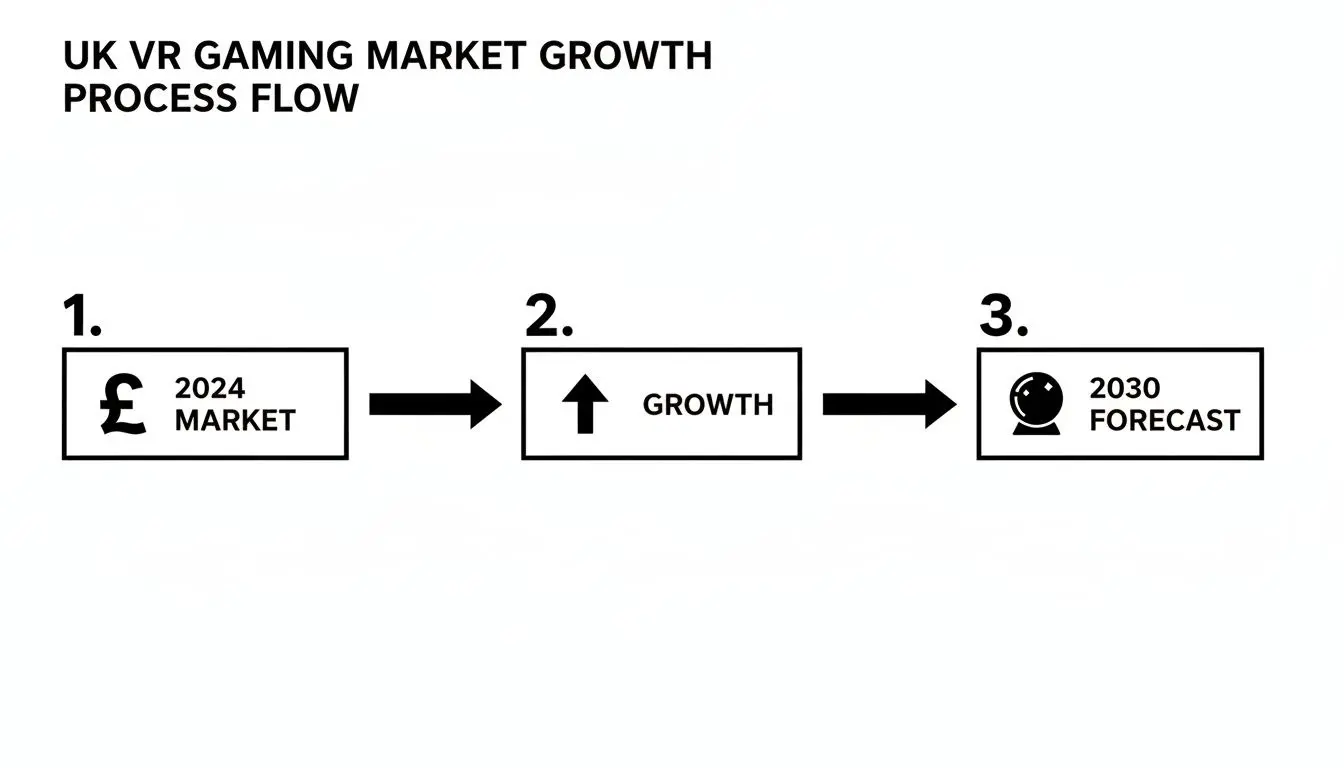
This kind of growth is exactly why a disciplined, proven development process is so vital. It’s the key to tapping into this ever-expanding audience of VR users.
Stage 1: Concept and Design
Every great VR project starts long before a single line of code is written. It begins with a solid idea and an even more solid plan. This is the foundation, where we pin down the absolute core of the experience. What’s the main thing players will do? Who are we building this for? And most importantly, why does this idea have to be in VR? This stage gives birth to the Game Design Document (GDD), which becomes the project's bible. It outlines everything from the game’s mechanics and story to the user interface and interaction models. For VR, this document gets extra specific about things like player comfort, movement systems (locomotion), and making sure interactions feel natural in a 3D space.
Stage 2: Prototyping
With a plan on paper, the next job is to see if it's actually any good in practice. Prototyping is all about building rough, playable versions of the key mechanics, often with nothing more than simple grey boxes and untextured shapes. The aim isn't to make it look pretty; it's to get answers to the big questions, fast.
- •Does the movement feel natural, or is it a one-way ticket to motion sickness?
- •Are the main interactions fun to do over and over again?
- •Does the sense of scale feel right?
This phase is all about quick-fire iteration. Failing fast here saves a huge amount of time and money down the line. It's where we find out what works in reality, not just in a document, ensuring the core experience is rock-solid before we commit to building the whole thing.
Stage 3: Asset Production
Once the prototype proves the concept has legs, it's time to start building the world. The asset production stage is where our artists create every single visual and audio element that brings the game to life. This is everything the player will see, hear, and touch. Key production tasks include:
- •3D Modelling: Building all the characters, environments, and props.
- •Texturing: Giving those models colour, detail, and surface properties.
- •Animation: Making characters and objects move believably.
- •Sound Design: Creating the immersive audio landscape, from background noise to the satisfying click of a button.
In VR, asset creation demands a specialist touch. Models have to be carefully optimised to keep performance high, and animations need to feel completely natural from a first-person view to keep the player fully immersed.
Stage 4: Engineering and Development
This is where it all comes together. The engineering phase is where our developers take all the concepts, designs, and art assets and weave them into a functional game with code. They build the underlying systems that make everything tick, from player controls and physics to enemy AI and core gameplay loops. Adhering to essential software engineering best practices is non-negotiable for a smooth project. Here, the GDD acts as the blueprint for the programming team. They implement the features defined during the design phase, connecting the 3D models and animations to interactive systems. It’s an iterative process, with the team creating regular builds of the game to test new features as they get added.
Stage 5: QA and Optimisation
The final hurdle is all about polish. Quality Assurance (QA) and optimisation are absolutely critical. QA testers play the game relentlessly, trying to break it in every way imaginable to find and report bugs, glitches, and design flaws. They check every mechanic and scenario to ensure the experience is stable and seamless. At the same time, the development team shifts its focus to optimisation. This is especially vital for VR, where maintaining a high, stable frame rate (usually 90 frames per second or higher) is the difference between an amazing experience and an uncomfortable one. This involves refining code, simplifying 3D models, and using clever rendering tricks to make sure the game runs like a dream on the target hardware, whether that's a Meta Quest headset or a powerful PC VR rig. After this final polish, the game is ready for the world.
Choosing Your Engine: Unreal vs Unity for VR
Picking a game engine is one of those foundational decisions that echoes through the entire production. Think of it like a sculptor choosing their material , are you working with marble or a more versatile clay? Both can create a masterpiece, but the tools, techniques, and final feel will be completely different. In the world of VR game development, the two undisputed heavyweights are Unreal Engine and Unity. This isn’t some abstract debate for the tech team. For producers and brand owners, this choice directly shapes budgets, timelines, the talent you need to hire, and the final polish of the experience. It's a strategic call that affects everything from day one of development to deployment on headsets like the Meta Quest.

Unreal Engine: The Visual Powerhouse
Developed by Epic Games, Unreal Engine has built a reputation for jaw-dropping visual fidelity right out of the box. If your project absolutely must have photorealism , we're talking high-end architectural walkthroughs, cinematic VR stories, or ultra-realistic training simulations , Unreal is usually the first port of call. Its rendering systems are built to push graphical limits. But that graphical muscle comes with a steeper learning curve. Unreal is primarily a C++ engine, which is a more complex language than Unity's C#. While its visual scripting system, Blueprints, is incredibly powerful, mastering it still requires a solid grasp of the engine's architecture. On a practical note, finding experienced Unreal developers here in the UK can be a little tougher and more expensive than finding talent for Unity.
Unity: The Versatile All-Rounder
Unity has been the engine of choice for a huge number of mobile and indie games for years. This legacy has made it a massively popular option for VR, especially for the standalone Meta Quest headsets. Its key strengths are flexibility, a vast ecosystem of ready-made assets, and a huge, helpful developer community. For most VR projects that aren't chasing absolute hyper-realism, Unity offers a quicker, more direct path to a finished product.
- •Wider Talent Pool: Because C# is so widely taught and Unity has been around for so long, it’s generally easier to staff up a project with experienced UK-based developers.
- •Asset Store: This marketplace is a genuine game-changer. It's packed with thousands of pre-built tools, 3D models, and systems that can shave weeks or even months off a development schedule.
- •Performance on Mobile: Unity is famously well-optimised for less powerful hardware. This is absolutely critical for getting a smooth, high-frame-rate experience on standalone headsets like the Quest. We've gone into more detail on this in our article on Unity VR development for high-performance experiences.
This all combines to make Unity a brilliant choice for stylised games, interactive apps, and any project that needs to be developed efficiently and rolled out across lots of different devices.
The choice isn't simply "graphics vs. flexibility". It's a strategic decision. Unreal often makes sense for projects where the visual spectacle is the main event. Unity shines where rapid development, broad platform support, and solid performance on constrained hardware are the top priorities.
Unreal Engine vs Unity: A Producer's View on VR Development
So, how do you actually make the call? Forget about which engine is technically "better." The only question that matters is which one is better for your project. Looking at the engines from a production standpoint, the key differences become much clearer. This table breaks down the decision-making process into the factors that typically matter most to producers, IP holders, and project managers.
| Factor | Unreal Engine | Unity |
|---|---|---|
| Visual Fidelity | Unmatched photorealism out of the box. The go-to for cinematic and simulation projects where visuals are paramount. | Capable of stunning, stylised looks. Can achieve realism, but it often requires more specialised work and optimisation. |
| Learning Curve | Steeper. The complexity of C++ and the editor itself can present a challenge for teams new to the engine. | More accessible. C# is a widely known language, and the massive community means help is never far away. |
| Talent Availability (UK) | The talent pool is more specialised and can often command higher rates due to lower supply. | A larger, more readily available pool of experienced developers makes staffing up projects easier and more predictable. |
| Asset Ecosystem | Its marketplace is solid and growing, but it’s smaller than Unity's, with fewer off-the-shelf solutions. | The Asset Store is a gigantic resource that can dramatically cut down development time and costs. |
| Target Platform | Excels on high-end PC VR. Getting it to run smoothly on mobile VR requires significant, expert optimisation. | Excellent performance on standalone headsets like the Meta Quest. It’s built with mobile hardware in mind. |
| Licensing Model | Royalty-based. You pay a percentage of your revenue after your project crosses a certain financial threshold. | Per-seat subscription model. Recent changes also introduce a runtime fee based on installs after certain thresholds are met. |
At the end of the day, the right engine is the one that best fits your creative vision, your team's skillset, your budget, and, crucially, your target platform. By weighing your project's core needs against these practical considerations, you can make an informed choice that puts you on the right path from the very start.
Assembling Your VR Development Dream Team
Behind every jaw-dropping VR experience, there’s a crack team of specialists. Building these immersive worlds is a true team sport, and successful VR game development hinges on getting the right people in the right roles. It’s less like a traditional software team and more like a film crew, where creative visionaries and technical wizards have to be perfectly in sync to bring a single idea to life. Understanding who does what is crucial, whether you’re looking to build your own team from scratch or partner with an established studio. A well-oiled team makes sure creative ambition doesn’t outpace technical reality, a balancing act that’s especially important in the UK, where the talent pool is deep but highly specialised.
The Core Roles in a VR Production
While every project is different, a professional VR production generally revolves around a few key roles. Each person is responsible for a critical piece of the development puzzle, from the first spark of an idea to the final layer of polish. Getting this mix right from day one is your first step towards a successful launch. These are the essential players:
- •The VR Producer: Think of them as the director and chief organiser. They’re in charge of managing timelines, budgets, and making sure everyone is talking to each other. They are the glue that holds the entire production together.
- •The Gameplay Designer: The architect of the experience itself. They figure out what players actually do, how they interact with the virtual world, and most importantly, what makes it all feel fun and intuitive in a 3D space.
- •The 3D and Technical Artists: These are your world-builders. 3D artists craft the characters, environments, and props you see. Technical artists then act as the bridge between art and code, making sure all those beautiful assets are optimised to run flawlessly.
- •The VR Developer: The engineer who writes the code that makes it all happen. They implement the game mechanics, build the interaction systems, and are absolutely obsessed with hitting that critical 90+ frames per second performance target.
- •The QA Tester: The ultimate quality gatekeeper. They put the experience through its paces, hunting for bugs, flagging comfort issues, and ensuring everything is stable and enjoyable before it ever reaches a user.
A great VR team is more than just the sum of its parts. It's a blend of creative storytellers who can think spatially and technical experts who understand the unique performance constraints of virtual reality. The magic happens when these disciplines work in lockstep.
What Makes Each Role Unique for VR
Working in VR asks for more than just standard game development chops. Every role needs a specialised mindset laser-focused on immersion, comfort, and performance. A VR Gameplay Designer, for instance, has to think far beyond a flat screen, designing interactions that feel completely natural when you’re performing them with your own hands. They’re in a constant battle with things like motion sickness, making user comfort an absolute top priority. Likewise, a VR Developer isn’t just a coder; they’re a performance engineer. They live and breathe the knowledge that a single dropped frame can shatter the illusion of presence. They become masters of optimisation, constantly finding clever workarounds to make complex scenes run smoothly on hardware like the Meta Quest. This unique blend of creative problem-solving and technical discipline is what separates a decent VR experience from an unforgettable one, and it’s a hallmark of the top VR development companies in the UK. If you're looking for a partner, it's vital to explore the top 7 virtual reality development companies in the UK to see this expertise in action. The UK's strength in this field is built on the legacy of its world-class game studios. Powerhouses like Rockstar North and Creative Assembly are pushing the boundaries of what's possible, but this high-end development comes at a cost, with major titles often costing over £50 million. This puts pressure on the smaller, independent studios that form the backbone of the industry, though growing partnerships with hardware giants like Meta and HTC are helping to lower the barriers to entry. You can learn more about the UK gaming market's dynamics and how these trends are shaping the future of development.
Designing for True Immersion and Flawless Performance
Building a virtual world is one thing; making it feel real is an entirely different challenge. In VR game development, true immersion isn't just a creative goal, it's a technical necessity. This is where art and engineering have to work in perfect harmony to convince the player’s brain that what they’re seeing is real. The key to that illusion? Flawless, consistent performance. Unlike traditional games, where a momentary dip in frame rate is just an annoyance, in VR, it can be a deal-breaker. Stuttering visuals or a lag between a player's head movement and what they see on screen can instantly shatter the sense of presence. Even worse, it can cause genuine discomfort or motion sickness. This makes performance the bedrock upon which all immersive design is built.
The Unbreakable Rule of 90+ FPS
The gold standard for a comfortable, high-quality VR experience is a rock-solid 90 frames per second (FPS) or higher. This isn't an arbitrary number. It’s the threshold where the virtual world updates fast enough to trick the human eye and brain into perceiving smooth, continuous motion, just like how we experience the real world. Maintaining this high frame rate is the primary technical hurdle, especially on standalone headsets like the Meta Quest, which run on mobile-grade processors. Every single element, from the 3D models to the lighting effects, has to be meticulously optimised. Key optimisation strategies include:
- •Managing Polygon Counts: Every object in your scene is built from polygons. Artists need to use these "polys" efficiently, creating visually appealing models without overloading the processor.
- •Reducing Draw Calls: Every time the processor has to draw a separate object on screen, it’s a "draw call." Cleverly batching objects together minimises these calls, freeing up crucial resources.
- •Using Foveated Rendering: This clever technique takes advantage of how human vision works. It renders the very centre of the player's gaze in high detail while lowering the quality in their peripheral vision, saving immense processing power without the user ever noticing.
Crafting User-Friendly Experiences in 3D Space
Beyond raw performance, immersion comes from intuitive design. How a player moves around and interacts with the world is fundamental to their comfort and enjoyment. Badly designed systems are not just frustrating; they can be physically disorienting. One of the biggest hurdles is locomotion, the method of movement. A first-person running mechanic that works perfectly on a flat screen can be intensely nauseating in VR. To solve this, developers have come up with several comfort-focused alternatives.
Teleportation is a common and effective solution. It allows players to point to a location and instantly appear there, eliminating the disorienting sensation of artificial movement. While it can break immersion for some, it’s a reliable way to ensure a comfortable experience for the widest possible audience.
Designing user interfaces (UIs) also requires a complete rethink. Menus can't just be flat panels floating in space; they need to feel like a tangible part of the world. Great VR UI design often involves diegetic interfaces, where menus and information are integrated directly into game objects, think a display on a character's wrist or a control panel on a dashboard. This keeps the player grounded in the virtual environment.
The Never-Ending Hunt for Performance Bottlenecks
Optimisation isn't a one-and-done task; it's a continuous process throughout development. Teams must constantly profile their game, hunting for anything that consumes too much memory or processing power. To achieve flawless performance and prevent frustrating slowdowns, understanding how to find a memory leak is critical. These subtle bugs can slowly eat away at resources, causing performance to degrade over time. Ultimately, designing for immersion means sweating the small stuff. It’s about ensuring every interaction feels natural, every movement is comfortable, and the frame rate never, ever falters. This relentless focus on performance and user-centric design is what separates a forgettable tech demo from a truly compelling virtual reality game.
Budgeting Your VR Project: Real Costs and Timelines
Two questions always come up right at the start of any project: "How much will it cost?" and "How long will it take?" When it comes to VR game development, the answers are a bit different because they’re tied directly to the unique challenges of building a truly immersive world. Getting a handle on these variables is the first step toward setting realistic expectations and creating a solid financial plan for your vision. The budget for a VR project isn’t one single figure; it’s a spectrum. The final cost is shaped most by the project's scope, its complexity, and the platform you're aiming for. A simple 360-degree video tour, for instance, is going to be far less expensive than a full-blown commercial game packed with complex mechanics and ultra-realistic art. Understanding these cost drivers is absolutely key for planning.
Key Factors That Drive VR Development Costs
A few core components will ultimately determine the budget and timeline for your VR project. Thinking through these upfront will help you and your studio partner scope everything out properly. Here's what really moves the needle:
- •Team Size and Composition: A small team building a simple proof-of-concept will naturally have a lower burn rate than a full crew of senior developers, artists, and designers needed for a AAA-quality title.
- •Asset Complexity: Are you picturing simple, stylised 3D models, or do you need photorealistic environments and incredibly detailed character animations? High-fidelity assets take more time from highly skilled artists.
- •Interaction and Gameplay Depth: A basic "look and click" experience is fairly straightforward to build. But a game with complex physics, AI-driven characters, and intricate gameplay systems? That requires a serious engineering effort.
- •Target Platform: Developing for a high-end PC VR headset gives you more graphical power to play with, but it might also demand more optimisation work than a title designed for a standalone headset like the Meta Quest.
Sample VR Project Budgets and Timelines
To give you a clearer picture, let’s break down some typical project scopes. These are just ballpark figures, every project has its own unique quirks, but they offer a useful starting point for any budget conversation.
| Project Type | Estimated Budget (UK) | Estimated Timeline | Description |
|---|---|---|---|
| Simple Interactive Demo | £20,000 - £50,000 | 2 - 4 Months | A proof-of-concept or a small-scale marketing experience with limited interactivity and simple assets. Ideal for testing a core idea. |
| Mid-Range VR Game / Training Sim | £50,000 - £150,000 | 4 - 9 Months | A more polished experience with several gameplay mechanics, custom assets, and a clear user journey. Common for enterprise training. |
| Complex Commercial VR Game | £150,000+ | 9+ Months | A feature-rich game intended for commercial release on platforms like the Meta Quest Store, involving extensive design, art, and QA. |
Ultimately, the smartest way to budget is to start by defining your Minimum Viable Product (MVP). What's the absolute core of the experience you want to create? Build that first. You can always add more bells and whistles later. This approach helps keep costs under control and gets your project out the door faster.
A Few Questions We Often Hear About VR Game Development
Stepping into the world of VR game development can feel a bit like putting on a headset for the first time , exciting, but with a lot of new things to figure out. For businesses looking to explore this space, questions are a natural part of the process. We've gathered some of the most common ones we hear from our clients and partners to give you a clearer picture. These aren't just technical answers; they’re insights from our years in the trenches, designed to give you a real, practical understanding of what it takes to start, what to budget for, and how to find the right people for your project.
What's the Real First Step in VR Game Development?
Before a single line of code is written or a 3D model is built, everything starts with the 'Concept and Design' phase. This is the absolute bedrock of your project. It’s where you have to pin down the core experience , what will people do? Who is this for? And crucially, what makes this idea something special that can only work in VR? This thinking solidifies into a Game Design Document (GDD), which is essentially the blueprint for the entire project. It lays out the mechanics, the story, and the user experience goals. Right after that, we jump into rapid prototyping. This is non-negotiable, as it’s the only way to prove the core concept is genuinely fun and, more importantly, comfortable for the player in a virtual space.
How Much Does It Cost to Develop a Simple VR Game in the UK?
This is the big question, and the honest answer is that costs can vary wildly depending on what you’re trying to build. But to give you a ballpark, a simple VR game or a basic interactive experience usually starts in the £20,000 - £50,000 range. That typically covers a small, focused team over a few months. If you’re thinking bigger, like a mid-tier game or a detailed training simulation, the budget will naturally climb, often landing between £50,000 and £200,000+. The main things that drive the cost are always the size of the team, how long the project runs, the complexity of the 3D art, and the overall level of polish and interactivity you're aiming for.
Which Engine Is Better for a Beginner in VR Development?
For anyone just dipping their toes into VR development, Unity is almost always our first recommendation. The programming language it uses, C#, is generally seen as more beginner-friendly than the C++ you'll find in Unreal Engine. Plus, Unity’s Asset Store is a massive advantage, offering a huge library of ready-made models and tools that can seriously speed things up.
It’s not just about the tech, though. The massive global community and extensive documentation behind Unity mean it’s far easier for a newcomer to find tutorials, guides, and answers when they inevitably get stuck on a problem.
How Do I Find a Reliable VR Development Studio?
Start by looking at a studio's portfolio. You need to see shipped VR titles that feel similar in ambition or style to what you want to create. It’s absolutely vital to check they have direct experience on your target platform, whether that’s the Meta Quest, PSVR2, or PC-based VR. Don't be shy about asking for client testimonials and really digging into their development process. A good partner will be completely transparent about how they work, especially when it comes to user comfort, performance optimisation, and quality assurance. A truly great studio won’t just build your idea; they’ll collaborate with you from day one to help refine your concept and make it even better. Ready to see what your VR project could become? The team at Studio Liddell has been bringing immersive worlds to life since 2019. Book a production scoping call with our experts to chat about your vision.