The Oculus VR Rift Development Kit: A Legacy That Built Modern VR
Long before consumer VR became a familiar concept, the scene was buzzing with something far more raw and exciting: the Oculus VR Rift Development Kit. These early headsets, affectionately known as DK1 and DK2, weren't the sleek, polished products we see today. They were foundational tools, put directly into the hands of creators and developers who would go on to map out the very future of immersive experiences.
The Spark of a New Reality
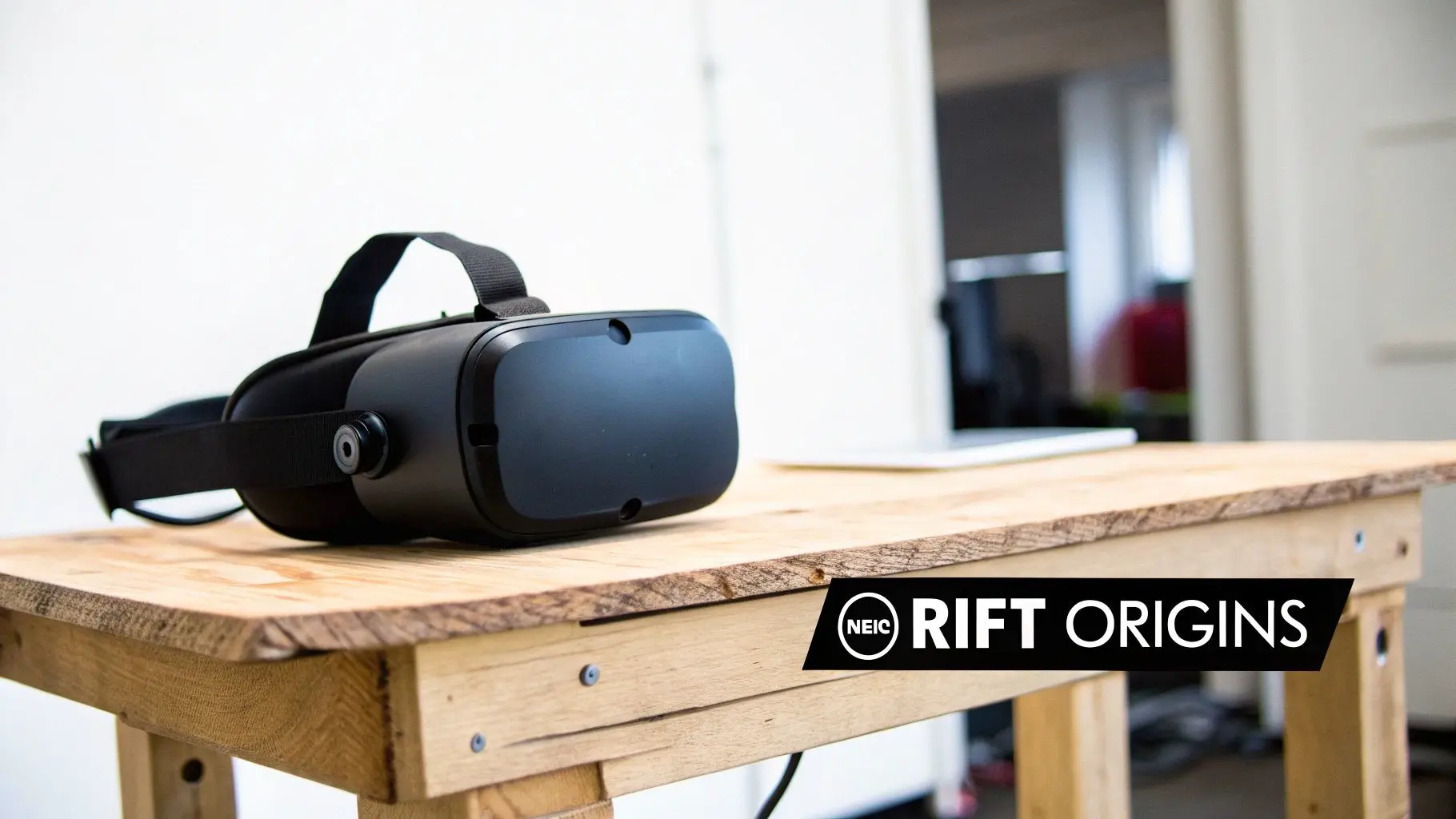
The story of modern VR didn't start in a sterile, high-tech corporate lab. It exploded into life thanks to a landmark Kickstarter campaign that completely captured the imagination of thousands. The Oculus Rift Development Kit 1 (DK1) was born from this crowdfunding frenzy, offering a genuine glimpse into a future previously confined to science fiction. Let’s be clear, these early kits were far from perfect. They were bulky, the screens were low-resolution, and they lacked the sophisticated tracking we now take for granted. But they absolutely nailed one critical thing: delivering a wide field of view that, for the first time in an accessible package, created a real sense of presence. That was the key that unlocked a global wave of experimentation.
An Early Hub of Innovation
The excitement was palpable everywhere, but the UK quickly cemented its reputation as a key early adopter of this new tech. This wasn't just casual interest; it was a serious commitment from the nation's sharpest development minds. In fact, the Oculus Rift Development Kit 1 (DK1) saw incredible uptake in the UK, placing it among the top countries by percentage of units sold worldwide. Of the 56,334 DK1 units that shipped globally after the Kickstarter, a significant number landed in Britain, positioning it as a leading hub for VR innovation right alongside the US. You can dig into the initial sales data of these pioneering VR kits to see the full picture. This screenshot shows the DK1 in its original, no-frills packaging, a perfect illustration of its developer-first design.
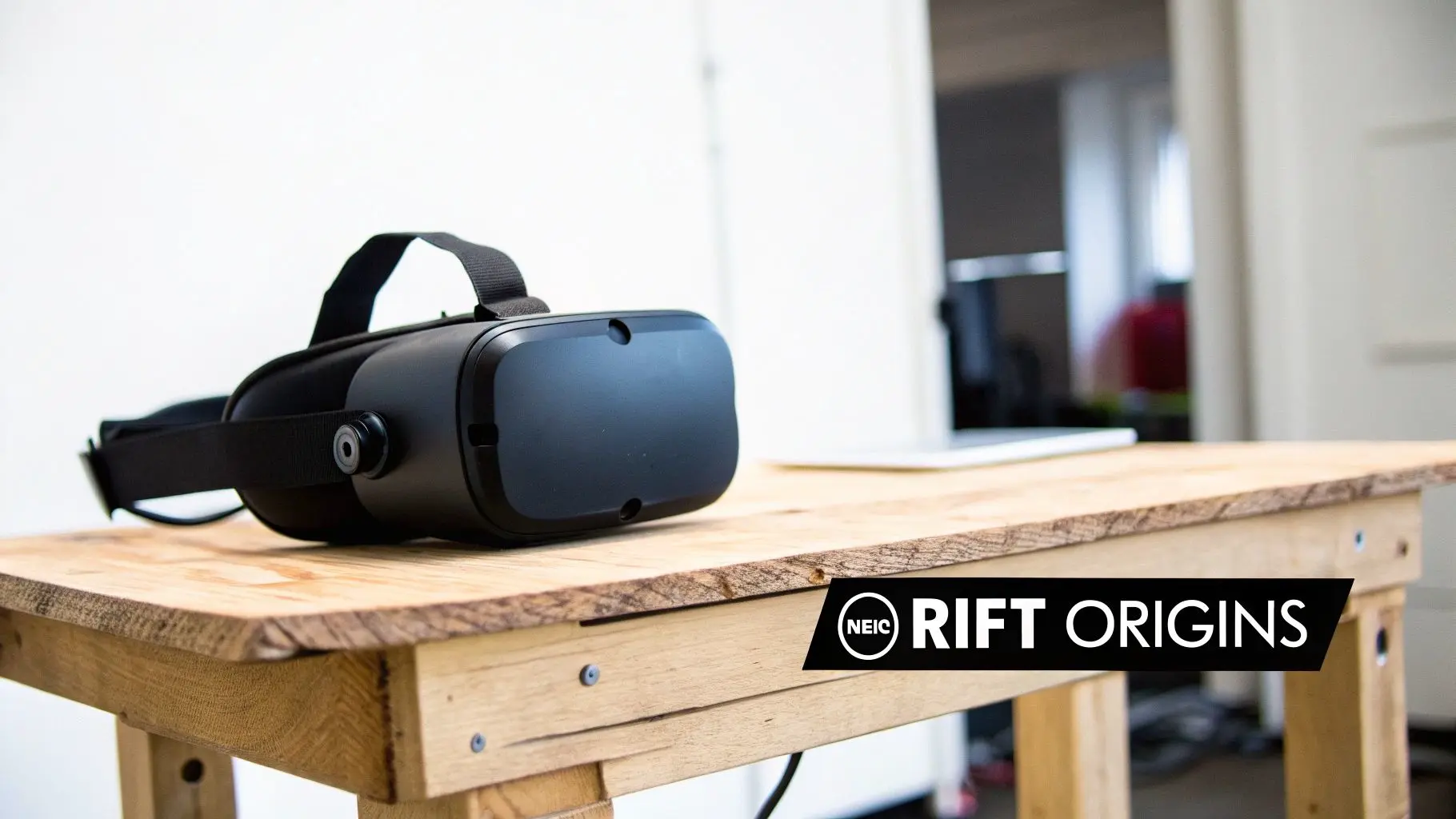
The image really brings home the functional nature of the kit. Complete with interchangeable lenses and basic accessories, it shouts that this was a tool for building, not just for playing.
It's impossible to overstate the legacy of these early dev kits. The challenges developers wrestled with and the clever solutions they engineered with this hardware forged the very best practices that are now standard across the entire XR industry.
The journey of the Oculus VR Rift development kit is more than a simple history lesson. It's a story about community, raw creativity, and the massive collaborative effort needed to build an entirely new medium from the ground up. The foundation laid by DK1 and its successor, DK2, directly shaped the design and capabilities of every VR headset that followed, setting the stage for the incredible immersive experiences we enjoy today.
A Technical Leap Forward: Comparing DK1 and DK2
Moving from the Oculus Rift Development Kit 1 (DK1) to its successor, the DK2, wasn't just a simple upgrade. It was a massive leap forward, born from a much deeper understanding of what it takes to create a genuinely immersive virtual reality experience. While the DK1 kicked the door open, the DK2 was all about refining the recipe, tackling the critical issues that stood in the way of true presence.
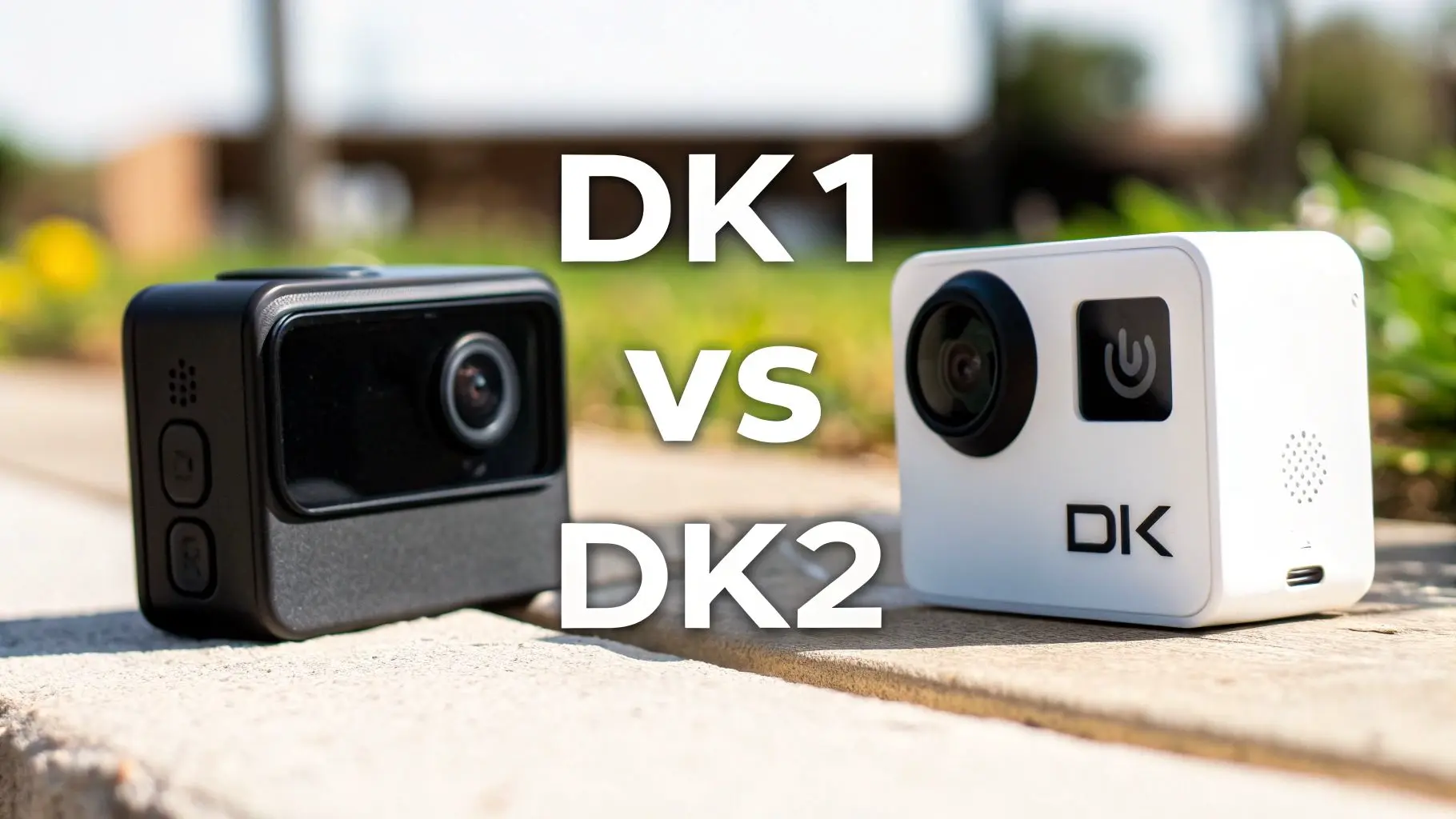
The DK1’s main achievement was its incredibly wide field of view, giving developers their first real taste of what presence felt like. But it had its problems. Its LCD screen was plagued with motion blur and a pronounced "screen-door effect," where you could literally see the gaps between the pixels. The DK2 went straight for the heart of these problems with one game-changing move: switching to an OLED panel.
The OLED Advantage
That jump to an OLED display was a masterstroke for a couple of key reasons. Firstly, OLED pixels can switch on and off much faster, which almost completely eliminated the nauseating motion blur of the DK1. Secondly, it unlocked a technique called low persistence, where the screen is only lit up for a tiny fraction of each frame. This meant that as you moved your head, the image flashed cleanly in front of your eyes instead of smearing across your vision. This single change made everything feel sharper, clearer, and, crucially, far more comfortable. It was a huge step in reducing motion sickness.
The True Game-Changer: Positional Tracking
But the single most important advancement in the DK2 was, without a doubt, the introduction of 6DoF (six degrees of freedom) positional tracking. The DK1 could only track the rotation of your head (3DoF), letting you look up, down, left, and right. It had no idea where you were in physical space. The DK2 changed everything. It added an external infrared camera that tracked a pattern of tiny LEDs hidden inside the headset's shell.
This wasn't just an upgrade; it was the birth of modern VR interaction. For the first time, developers could build worlds where you could physically lean in to get a closer look at something, duck behind a wall for cover, or peek over a virtual balcony.
This ability to map your real-world movements directly into the virtual space was a monumental leap for immersion. It made the virtual world feel solid, like a place you could actually inhabit rather than just watch. UK developers were particularly quick to embrace these new capabilities, cementing the nation's reputation as a VR pioneer. The demand was huge; out of 118,930 DK2 units shipped worldwide, a 110% increase over the DK1, the UK's share was remarkably high. You can learn more about the global sales data and developer adoption of the DK2.
Comparing the Key Specifications
Looking at the specs side-by-side, it's clear how the DK2 was a direct response to the lessons learned from the first wave of VR development. Every change was aimed squarely at boosting presence and stamping out discomfort. #### Oculus Rift Development Kit DK1 vs DK2 Technical Specifications The table below breaks down the major technical shifts between the two kits, highlighting not just what changed, but why it mattered so much for developers at the time.
| Feature | Oculus Rift DK1 | Oculus Rift DK2 | Impact on Development |
|---|---|---|---|
| Display Panel | 7" LCD | 5.7" OLED (from Samsung Note 3) | The OLED panel enabled low persistence, which dramatically cut motion blur and improved visual clarity. |
| Resolution | 1280×800 (640×800 per eye) | 1920×1080 (960×1080 per eye) | Higher resolution massively reduced the screen-door effect, making virtual worlds far more believable. |
| Refresh Rate | 60 Hz | 75 Hz | A higher refresh rate meant smoother visuals and was another key factor in reducing simulation sickness. |
| Tracking | 3DoF Rotational (Gyro, Accel) | 6DoF Positional & Rotational | Adding positional tracking was a revelation, finally allowing users to move naturally within a small space. |
| Onboard Processing | None | Onboard USB hub and control box | This streamlined cable management and took some of the processing load off the connected PC. |
Ultimately, the jump from DK1 to DK2 was about evolving from a fascinating proof-of-concept to a truly viable development platform. The DK2 gave creators the essential tools, low persistence, higher resolution, and positional tracking, they needed to build the first generation of genuinely compelling VR experiences. It set a brand-new baseline for what a VR headset had to be.
Building for the Rift: Early SDKs and Engine Workflows
Hardware is only half the story. The true potential of the Oculus Rift Development Kits was unlocked by its software. The early Oculus SDKs (Software Development Kits) were that crucial bridge, providing the essential code libraries developers needed to get a VR experience up and running on the headset's screens. Of course, most developers didn't work with the raw SDK alone. They flocked to powerful game engines like Unity and Unreal Engine, which quickly became the go-to platforms for VR creation. These engines offered a complete toolkit for building 3D worlds, handling physics, and managing assets. Oculus, in turn, supplied plugins that allowed these engines to talk directly with the DK1 and DK2. This combination of an engine and an SDK formed the basic workflow for that first wave of VR content. But getting everything to play nicely together was anything but simple.
Navigating the Wild West of Early VR Development
Developing for the first Oculus Rift dev kits felt like exploring a new frontier. There were no established best practices to follow. The community had to lean heavily on forums and shared knowledge just to overcome the technical hurdles that were a part of daily life. These early days gave us a glimpse into innovative user interface design, pushing developers to invent completely new ways for users to interact with digital worlds. But before they could innovate, they first had to get a stable build working at all. Common obstacles included:
- •Wrestling with Display Modes: Early on, you had to manually tell your PC if the Rift was an extended monitor or just cloning your main display. This often led to a frustrating cycle of resolution and orientation bugs before you could even test your experience.
- •Manual Camera Calibration: The DK2's positional tracking camera wasn't exactly plug-and-play. It demanded careful placement and manual calibration inside the Oculus configuration utility to ensure it could properly "see" the headset's tracking LEDs.
- •Performance Optimisation: The computers of the era were barely powerful enough to drive VR. Developers had to be absolutely ruthless with optimisation, constantly battling to keep a minimum of 75 frames per second on the DK2 to avoid causing motion sickness. This meant meticulously managing every polygon, texture, and lighting effect.
For many pioneers, the development process was a constant loop: code, compile, put on the headset, experience jarring judder, take the headset off, and dive back into the code to optimise some more. It was a demanding cycle, but it was the essential learning curve for the entire industry.
The Central Role of Unity and Unreal Engine
You really can't overstate the importance of game engines in this early ecosystem. They completely opened up VR development, allowing smaller teams and even individuals to start building immersive worlds without needing to create a rendering engine from scratch. Unity, in particular, gained massive traction thanks to its C# scripting language, a more user-friendly interface, and incredibly strong community support. It quickly became the engine of choice for a huge number of early VR demos and games. If you're curious about how things have evolved, exploring the fundamentals of Unity VR development for immersive, high-performance VR experiences shows a clear line from these early days to today's best practices. Unreal Engine also played a major part, especially for teams who were aiming for the highest possible visual fidelity. Its Blueprint visual scripting system was a game-changer, allowing creators to prototype complex interactions quickly without writing a single line of traditional code. Ultimately, the software workflows of the dev kit era were defined by experimentation and collaboration. The tools were often raw and unforgiving, but they empowered a generation of creators to write the first chapter of modern virtual reality. They were the ones who solved the fundamental problems and established the design principles that still guide development today.
Timeless Lessons from the Dev Kit Era
The challenges of the early Oculus Rift development kit era weren't setbacks; they were the very crucible where today's best practices were forged. The raw, often unforgiving nature of the hardware forced developers to solve fundamental problems through sheer ingenuity. These hard-won lessons are still profoundly relevant, forming the bedrock of modern, comfortable, and compelling VR design. In fact, many of today's standards were born from heated debates and relentless experimentation within that early developer community. The solutions they came up with weren't just clever workarounds; they were foundational insights into how we perceive and interact with virtual spaces.
The Great Locomotion Debate
One of the first, and biggest, hurdles was movement. How do you let a player explore a huge virtual world while they're standing in a small physical space, without making them sick? The community quickly split into two camps, sparking a debate that would define early VR game design.
- •Smooth Locomotion: This approach uses a controller's analogue stick to move you forward, just like in a traditional non-VR game. While it feels familiar to gamers, the visual motion clashes with what your inner ear is telling you (that you're standing still). For many, this sensory mismatch was a primary cause of simulation sickness.
- •Teleportation: To counter this, developers invented the "blink" or teleport mechanic. You simply aim at a spot and instantly appear there. This completely sidesteps the sensory conflict of smooth locomotion, proving to be a far more comfortable option for a much wider audience, even if some felt it was less immersive.
This debate was absolutely critical. It taught the industry that player comfort is non-negotiable and that offering a choice of movement options is almost always the best way forward. It's a direct legacy of these early experiments that most successful VR titles today let you pick between teleportation, smooth locomotion, and other hybrid methods.
Forging Intuitive User Interfaces
Another massive challenge was figuring out how to design user interfaces (UIs) that felt natural in a three-dimensional world. Just plastering a 2D menu in front of the user's view, locked to their face, was quickly found to be jarring and deeply uncomfortable. It shattered the sense of presence and could even cause eye strain.
Early developers learned that VR UIs work best when they are diegetic, in other words, when they exist as part of the game world itself. Think of a control panel on a virtual spaceship's dashboard or a menu projected onto your character's wrist-mounted device.
This principle of "world-space" UI is now a cornerstone of good VR design. It keeps the user grounded in the virtual environment and makes every interaction feel more tactile and intuitive. The awkward, screen-locked menus of the DK1 era gave way to the elegant, integrated systems that deepen immersion rather than destroy it.
The Unforgiving Tyranny of Frame Rate
Perhaps the most crucial lesson from the dev kit era was the absolute necessity of maintaining a high and stable frame rate. On a normal monitor, a dropped frame is a minor hiccup. In VR, it's a recipe for instant discomfort and nausea. When the frame rate dips below the headset's refresh rate (which was 75 Hz for the DK2), the world appears to stutter and lag behind your head movements. This lag creates a powerful sensory mismatch that your brain can interpret as a sign of poisoning, triggering motion sickness as a defence mechanism. Developers working with the Oculus VR Rift development kit had to become masters of performance optimisation. They learned to meticulously manage every single polygon, texture, and lighting effect to guarantee their experiences ran smoothly at all times. This relentless drive for performance established the "performance first" mantra that guides all professional VR development today, ensuring experiences are not just engaging but physically comfortable.
Connecting The Past To The Present: From DK2 To Meta Quest
The leap from a tethered 2014 Oculus Rift DK2 to a powerful, standalone Meta Quest headset is one of the most incredible technological sprints we've seen in recent memory. But how does a project first imagined for that early hardware even begin to make sense on a modern device? Bridging that gap means getting to grips with the monumental shifts in hardware, tracking, and the very way we interact with virtual worlds. The most obvious change is the jump from a tethered, PC-powered experience to a sleek, all-in-one headset running on a mobile chipset. Back in the day, developing for the Oculus VR Rift development kit was a constant battle for performance on desktop hardware. Now, developers have to be masters of optimisation for mobile processors, a completely different discipline that puts efficiency and thermal management front and centre.
The Leap From External Cameras To Inside-Out Tracking
A truly fundamental shift was in how headsets understand their position in space. The DK2 relied on a single, external infrared camera that you had to place just right to "see" the headset. This created a pretty limited, forward-facing tracking area. If you turned your back, you were lost. Modern headsets like the Meta Quest use what's called inside-out tracking. Multiple cameras are built directly into the headset itself, constantly scanning the room. They use clever computer vision algorithms to map the environment and pinpoint their own position within it. This untethered freedom is the single biggest factor that has propelled consumer VR into the mainstream. The timeline below touches on some of the core design lessons, like locomotion and framerate, that were learned the hard way in the dev kit era and have since been perfected for these modern inside-out systems.
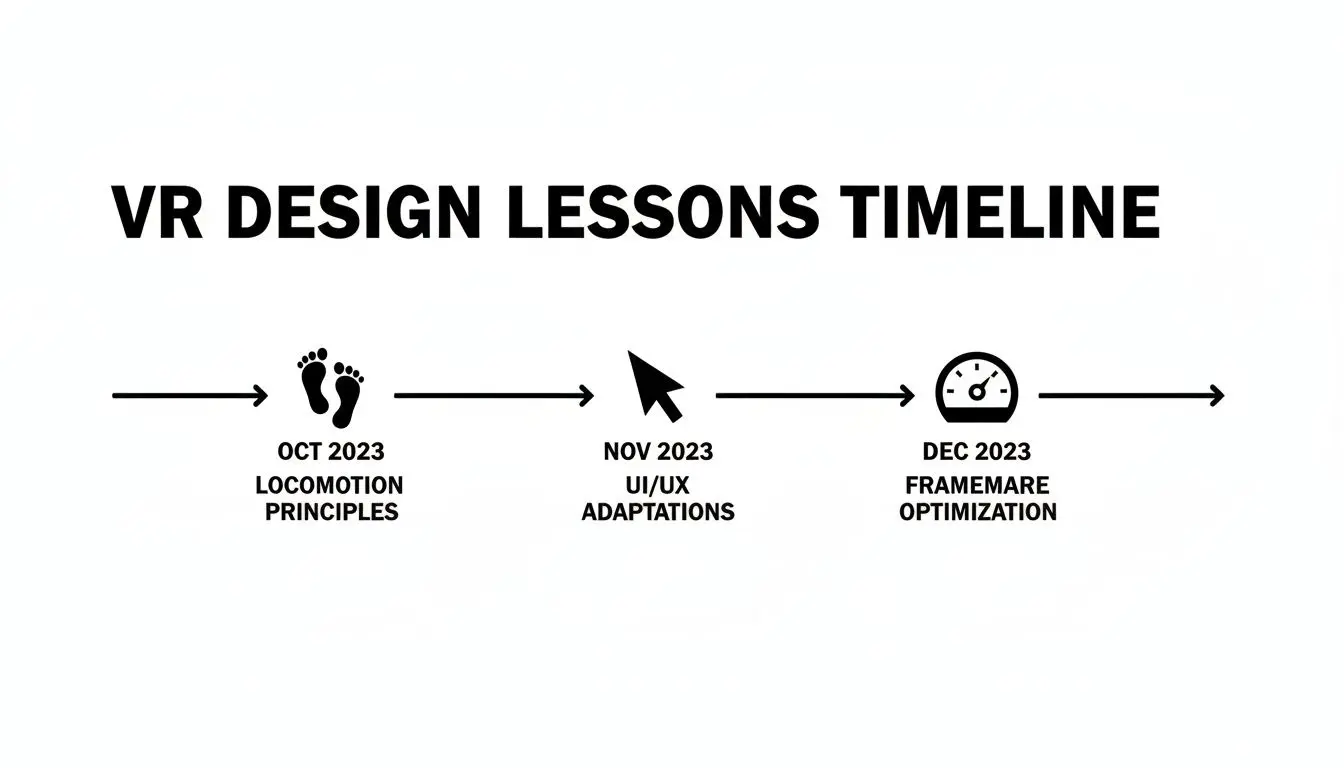
This just goes to show that the principles of user comfort hammered out during the DK days are still critical pillars of good VR development today.
From Gamepads To Full Hand Presence
Interaction has also been completely reimagined. The earliest DK2 experiences were mostly designed for traditional gamepads. The arrival of 6DoF (six degrees of freedom) motion controllers with the consumer Rift CV1 was a huge step up, but the Meta Quest platform has pushed this even further with incredibly sophisticated hand tracking. Now, developers can create experiences where your actual hands become the controllers. This demands a total rethink of user interfaces and interaction design, shifting away from button presses to natural, intuitive gestures. For any project looking to migrate from the DK era, this is often the biggest design hurdle. The core scene and assets might be reusable, but the entire interaction layer has to be rebuilt from the ground up for a modern audience. We put these modern principles into practice when building our high-energy VR game, Dance! Dance! Dance! for the Meta Quest, which is all about intuitive, controller-based movement.
The core logic of a VR scene, how objects are placed, how lighting works, the principles of scale and presence, remains surprisingly consistent. However, the way a user moves through and interacts with that scene has been completely transformed.
This whole journey from past to present shows just how far VR has come. To really appreciate its place in the bigger picture, it's worth exploring the complete landscape of Extended Reality (XR) technology. What started with clunky dev kits has blossomed into a rich and exciting ecosystem.
Partnering with an XR Studio to Build Your Vision
The leap from the early Oculus VR Rift development kit to today's Meta Quest platform shows just how much the world of VR development has matured. While the tools are more powerful and accessible than ever, creating a polished, professional, and genuinely memorable experience is a different challenge altogether. It now demands a much deeper level of expertise. This is where bringing a specialised XR production studio into the picture can make all the difference. An expert team knows how to navigate the tricky parts of the modern ecosystem, from optimising for different headsets to designing intuitive user interactions and building rock-solid location-based entertainment (LBE) experiences.
From an Idea to a Market-Ready Reality
A dedicated studio takes care of all the heavy technical lifting that can easily bog down a project. This frees you up to concentrate on your creative or strategic goals, knowing you have a team that understands the entire production pipeline, from start to finish. Working with a studio brings some key advantages:
- •Technical Problem-Solving: A good studio team will tackle the tough stuff, platform compliance, performance issues, and user comfort, to make sure the final product is smooth and professional.
- •Pipeline Efficiency: They come with established workflows for everything from asset creation and engine integration to quality assurance, which means your project gets delivered on time and to a high standard.
- •Future-Proofing Your Project: An expert partner is always looking ahead, keeping on top of hardware updates and software changes to ensure your application stays relevant and works properly as the technology moves forward.
At the end of the day, the goal is to turn a powerful idea into something real and ready for the market. A studio partnership provides the technical backbone and creative execution needed to build experiences that not only work perfectly but also leave a lasting impression on your audience.
For example, when we create experiences like our Aurora VR short film, we handle every single stage. That includes initial scriptwriting and performance capture all the way through to final optimisation and spatial sound design. Our full-service VR & AR production services are designed to take your vision and build it into something truly special.
Your Questions Answered
We get a lot of questions about the old Oculus Rift Development Kits. Here are some of the most common ones, with straightforward answers for anyone curious about these foundational pieces of VR history.
Can I Still Use an Oculus Rift Development Kit Today?
The short answer is: not for anything practical. While a dedicated tinkerer could probably get one running with old software and a lot of patience, it’s not a viable option for modern VR development or gaming. The original Oculus SDKs were retired long ago, and today’s platforms like SteamVR, along with engines such as Unreal Engine and Unity, have moved on. The hardware itself, the resolution, tracking, and lack of motion controllers, is so far behind current standards that it simply can't run modern content. Think of them now as fascinating collector's items, like a Model T Ford. They're incredible for understanding where we came from, but you wouldn't drive one to work.
What Was the Biggest Difference Between DK1 and DK2?
The leap from DK1 to DK2 was massive, but it really boiled down to one game-changing feature: positional tracking. The original DK1 only had rotational tracking, meaning it knew which way your head was tilted or turned. But with the DK2 and its external camera, the headset could track your physical position in 3D space. For the first time, you could lean in to get a closer look at something, peek around a corner, or dodge an incoming object. This was a monumental step for immersion and, crucially, for making VR comfortable by reducing motion sickness.
How Did the Rift Dev Kits Influence Modern VR Headsets?
Their influence is impossible to overstate. The dev kits essentially wrote the rulebook for consumer VR. They proved a passionate market existed, kickstarted a global community of developers, and gave us the hard data needed to figure out what makes a VR experience feel real.
Every major headset today, from the Quest 3 to the Valve Index, is built on the lessons learned from those early kits. The critical need for high frame rates, the magic of low-persistence displays to kill motion blur, and the non-negotiable requirement for positional tracking, all of that was figured out through the trial and error of the DK1 and DK2 era.
Ready to build on that legacy with the next generation of immersive experiences? Studio Liddell has the expertise to bring your vision to life on today's XR platforms. Let's start with a VR concept sprint and create something incredible together.