Visual FX Company: What It Is and How to Choose One
You've got a brief, a budget ceiling and a delivery date. The creative could be a polished advert, an animated explainer or an interactive experience, but you're unsure whether to hire an animator, a post-production house or a full visual FX company. Choose by looking beyond the showreel: the right supplier must fit the work, own a workable pipeline and explain how they'll protect your budget and deadline. A VFX contract is a production agreement, not just a promise to make impressive images. Before signing, get clear on what the studio will deliver, who controls the source files, where approvals happen and what happens when the brief changes.
What a Visual FX Company Actually Does
A visual FX company brings creative direction and technical production together to create, combine, and deliver visual content. Depending on the project, that can mean CGI, 2D or 3D animation, compositing, motion graphics, real-time 3D, or immersive work such as VR and AR. The useful distinction isn't the label on the studio's website. It's whether the team can take responsibility for the parts of production your project needs.
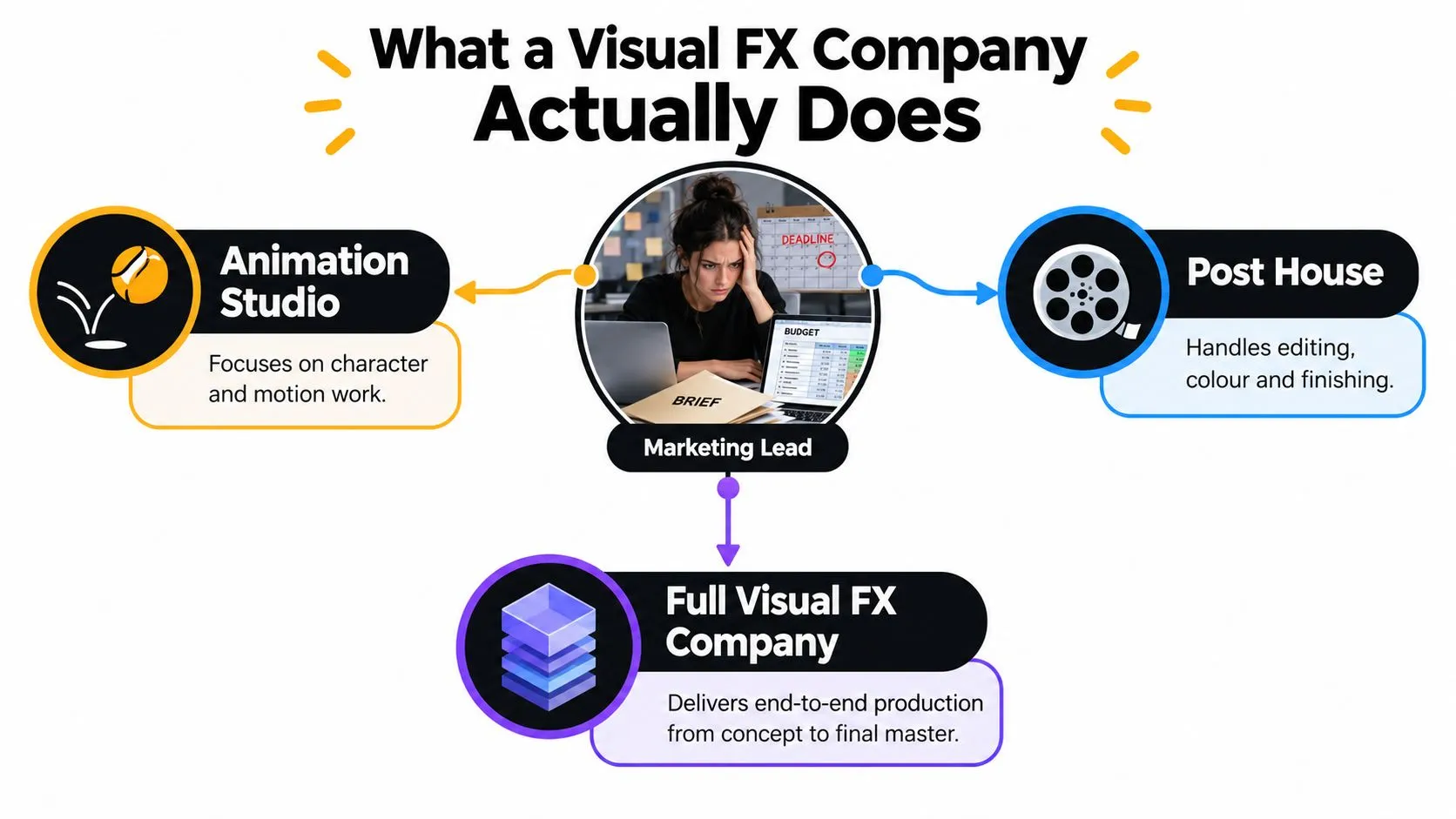
Match the supplier to the problem
An animation studio is often the right fit when the work centres on animated characters, performance, or stylised movement. A post house typically focuses on editing, colour and finishing, often working with footage that's already been shot. A full-service VFX company may cover a wider run of tasks, from developing the visual approach and building assets to compositing and preparing the final master. Those categories overlap. Some post houses animate; some animation studios composite; and some VFX companies work mainly in particular formats or industries. Ask who will lead your specific project and which stages the studio will handle directly. If it plans to bring in specialist partners, find out who manages those handovers and remains accountable for delivery. The term “VFX” also isn't limited to film and television. Brands, broadcasters, agencies, educators and independent producers may need an animated advert, a character-led series, a product visualisation or an interactive training experience. The core question is whether the supplier can connect the creative idea to the technical requirements of the platform it's meant for. If you're unsure whether your brief calls for practical effects, digital visual effects or a combination, this guide to SFX and VFX for producers can help clarify the distinction.
A simple decision test
Start with the outcome, not the software. If you need a single sequence colour-graded and finished, a post house may be sufficient. If you need original characters, designed environments, animation and a mastered film, look for a studio that can manage those connected disciplines. For a project that combines screen content with an interactive or immersive element, check that its team can support both the linear and real-time work. A capable supplier should explain what it will deliver, what you must provide and where your team needs to make decisions. If those responsibilities remain vague after the first conversation, don't treat the uncertainty as a minor detail. It's a sign the scope isn't ready for a contract.
The Production Pipeline From Brief to Final Master
A reliable VFX pipeline makes decisions visible before they become expensive. The work usually starts with the brief and creative direction, then moves through design, planning, asset creation, performance, image finishing and delivery. The exact path depends on the project, but the principle is consistent: agree on what you're making before asking the team to polish it.
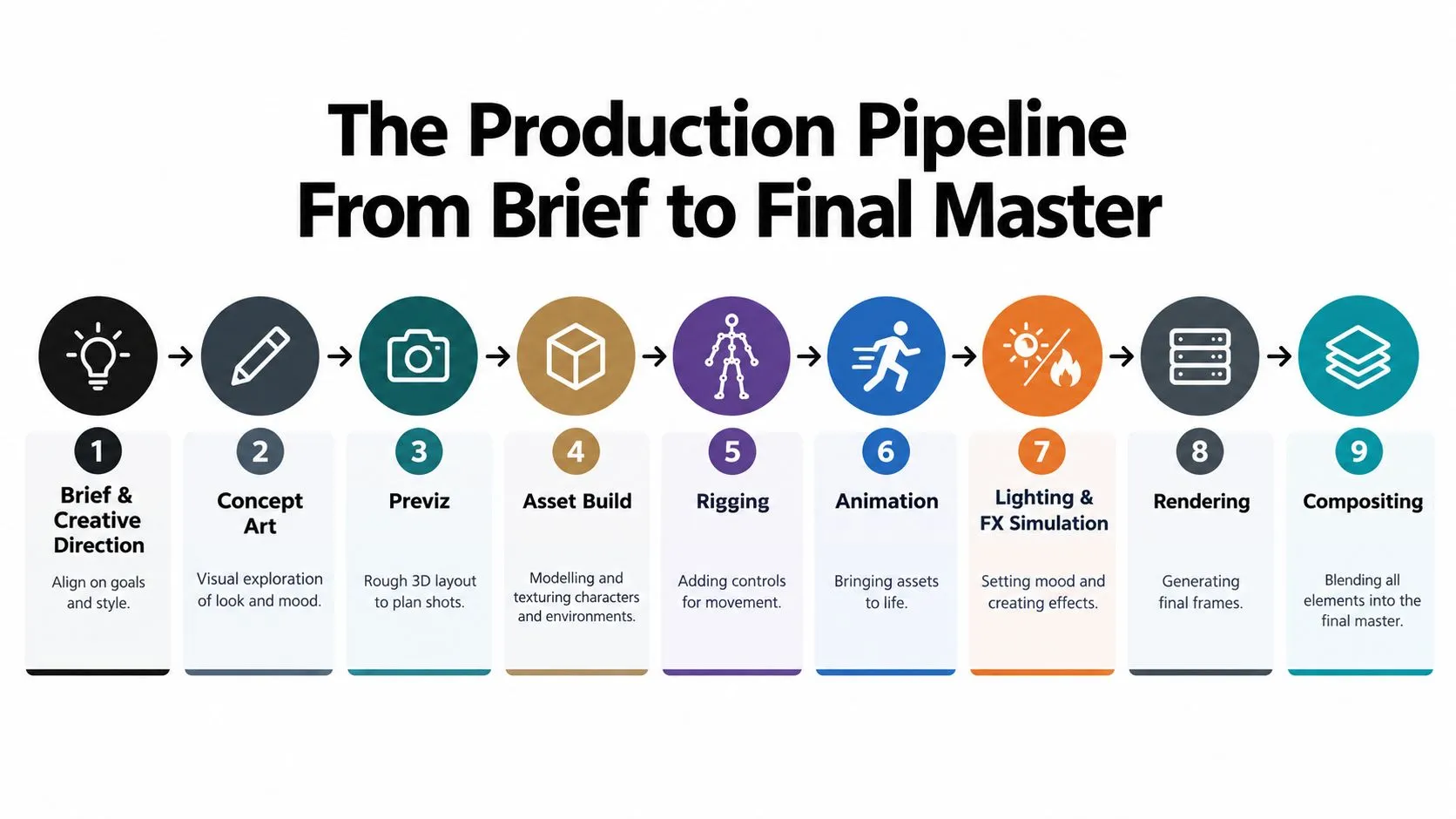
The stages where decisions cost less
The brief should define the audience, platform, creative objective, required deliverables and approval owners. Concept art establishes the look. Previsualisation, or previz, turns the idea into rough layouts or moving sequences so the client and production team can judge framing, timing and story before detailed assets are built. That early review matters. If the client waits until final lighting to decide that the character design or camera language doesn't fit the brand, the studio may need to revisit work across several departments. Approve the idea at the stage where it's still inexpensive to change. After previz, the studio may build and texture models, create rigs for movement, animate characters or objects, and develop lighting and effects. Rendering produces the image frames; compositing brings elements together and adjusts their relationships. Grade, sound and final mastering then prepare the work for its intended destination. Some jobs won't need every step, and a supplier should explain which stages are in scope rather than selling a generic pipeline.
Put approvals and delivery in the contract
Approvals need named decision-makers and clear review points. Ask what you'll see at each review, how feedback should be consolidated, and whether a sign-off closes that stage. Uncoordinated notes from several stakeholders can send production in conflicting directions. Late creative changes are normal; pretending they won't affect time or cost is not. Delivery is also production work. For BBC network television, programmes must be supplied as AS-11 DPP files, with editorial and technical checks completed before handover, as set out in the BBC's technical delivery requirements. For broadcast audio, the BBC specifies Linear PCM at 48 kHz and 16-bit or greater unless otherwise agreed, with RIFF/WAV identified as the required audio-file format in its audio technical specification.
Practical rule: Put delivery formats, testing responsibilities and sign-off conditions in the scope. “Final video” isn't a sufficient technical specification.
Offline rendering and real-time production also affect how teams review work. Offline rendering may suit detailed, carefully finished imagery, while real-time workflows can make interactive iteration more practical. Neither is automatically cheaper or better. The right choice depends on what the audience must see, how the content will be used and how quickly the creative team needs to review changes.
Real-Time Engines, AI, and XR in Modern Pipelines
A studio mentioning Unreal, Unity or AI hasn't yet shown that those tools belong in your production. Ask what problem the tool solves, what it replaces or enables, and how the team will confirm that it's working for your brief. Smaller organisations in particular can't afford to buy technology for its novelty.

Choose by production objective
Traditional CGI is a sensible choice when the deliverable is a finished film, advert or sequence that needs carefully controlled images. A real-time engine such as Unreal or Unity becomes more compelling when the work needs interactive content, live iteration or a shared pipeline for screen and immersive experiences. Real-time capability can also support previz and virtual production, but it brings its own technical requirements, including asset optimisation and reliable camera-to-engine coordination. AI-assisted workflows may help with specific tasks such as roto, early look development or generating asset variations. Treat those as proposals to test, not automatic savings. Confirm how the studio will handle source material, licensing, confidentiality, data protection and human review. Ask for a small, defined test before committing the whole project to a workflow you haven't used before. XR makes sense when viewers need to explore or interact rather than just watch. A VR training scenario, an AR product experience and a mixed-reality event game all have different needs. Discuss the intended hardware, user journey, deployment environment and support requirements before the supplier estimates production. For an accessible overview of where AI may fit into motion design, this guide to AI motion graphics and production workflows can help frame a practical conversation. Studio Liddell offers Unity and Unreal XR development and AI-enhanced production among its services, but those capabilities should be scoped to a particular production need, not added by default.
Buy a test before you buy a technology stack
Ask the studio to propose a limited pilot with a clear question: can this approach meet the visual target, run on the intended device or reduce a particular production risk? Agree what you'll review, who owns the resulting assets, and what evidence will justify moving into full production. If the pilot doesn't answer a decision you need to make, it's not a useful pilot. Real-time production can move parts of environment creation, lighting and compositing earlier in the process, but it also raises demands for camera tracking, colour management, wall calibration and asset optimisation. A producer's guide to real-time VFX can help you identify the technical questions to raise before you contract for that workflow.
Core Services a Full-Service Studio Covers
A full-service studio can package several disciplines under one production lead. That's useful when your brief crosses formats, but don't assume every project needs every service. Ask for the deliverables that solve your communication or entertainment problem, then check that the quote specifies what comes back and what your team must supply.
| Service | Typical Deliverables | Best Fit Brief |
|---|---|---|
| 2D and 3D animation | Series episodes, adverts, trailers, explainers | A story or product that needs designed motion |
| Motion graphics | Brand films, title sequences, animated graphics, social edits | A campaign that needs consistent visual identity |
| Character and creature animation | Modelled characters, rigs, performances, facial animation | A character-led story or branded IP |
| VR and AR production | Immersive experiences, interactive demonstrations, app content | A product, place or lesson that benefits from interaction |
| Location-based VR | Venue-ready experiences, operating and user materials | Events or attractions where visitors use a shared installation |
| XR training simulations | Scenarios, interactive learning content, assessment materials | Training that requires practice and feedback in a simulated setting |
Buy the output, not the category
A broadcaster commissioning a series may need character animation, episode masters and a repeatable production pipeline. A brand commissioning an advert may need motion design, a hero film and versions adapted for its planned placements. Those are different scopes, even when both suppliers describe their work as animation. For motion graphics, specify the aspect ratios and file types you need, who supplies the brand assets, whether editable project files are included, and how many cut-downs are in scope. If audio is part of delivery, call out its format separately. Don't assume a file prepared for social platforms will also meet a broadcaster's technical requirements. For XR, ask about the device, deployment setting and user experience. A headset-based training simulation has different operational needs from an AR experience used on a visitor's phone. If it'll run at an exhibition or venue, include the practical setup and support expectations in the conversation. The same discipline applies to character work. Ask whether the studio is creating a new character or adapting existing assets, and whether rigs and source files are part of the handover. A service label doesn't tell you how reusable the result will be. A well-defined deliverables list does.
Proof in Practice From Studio Liddell
A showreel can demonstrate taste and craft, but a project is more than its best shots. Look for evidence that a studio understands the practical job behind the visuals: reusing assets, supporting a live experience, carrying a story through an immersive format or making a technical subject clear to its audience.
Different briefs, different production questions
BooSnoo for Sky Kids is a useful reference for a client thinking about children's IP across formats. The commissioning question isn't whether a studio can animate a series. It's whether the characters and visual language can support related short-form content without losing their identity. That makes asset planning and consistency part of the creative discussion, not an administrative detail to leave until later. Dance! Dance! Dance! illustrates a different challenge: a mixed-reality game intended for events. A buyer should ask how the experience keeps moving, what staffing it needs and how the team will manage player flow. A visually polished experience can still disappoint if the interaction feels confusing or the venue can't run it smoothly. Aurora, a VR short, shifts attention to storytelling. Spatial work needs to be considered from the audience's position, not just framed like a conventional film. If performance capture or spatial sound is important to the concept, discuss how those choices shape production and what the finished experience requires to run well.
Match the example to your own risk
GeoEnergy NI offers a relevant comparison for organisations communicating complex technical subjects. The buyer's challenge is often not to display every detail, but to choose visuals that help stakeholders understand the system. Storyboarding gives the team a chance to test whether the explanation is clear before investing in detailed animation. These examples are useful because they represent different production pressures, not because one project proves that every brief should follow the same method. Review Studio Liddell's project portfolio with your own requirements in mind. Ask what parts of a relevant project were delivered, how the team dealt with the central constraint and whether the same approach would suit your audience and platform.
Questions to Ask Before You Commission a VFX Studio
A reel is evidence of visual quality, not evidence of reliable production. It won't tell you who owns the rigs, whether the team has room for your work or how the supplier will handle a late change. Compare studios on resilience and transparency as well as creative fit.
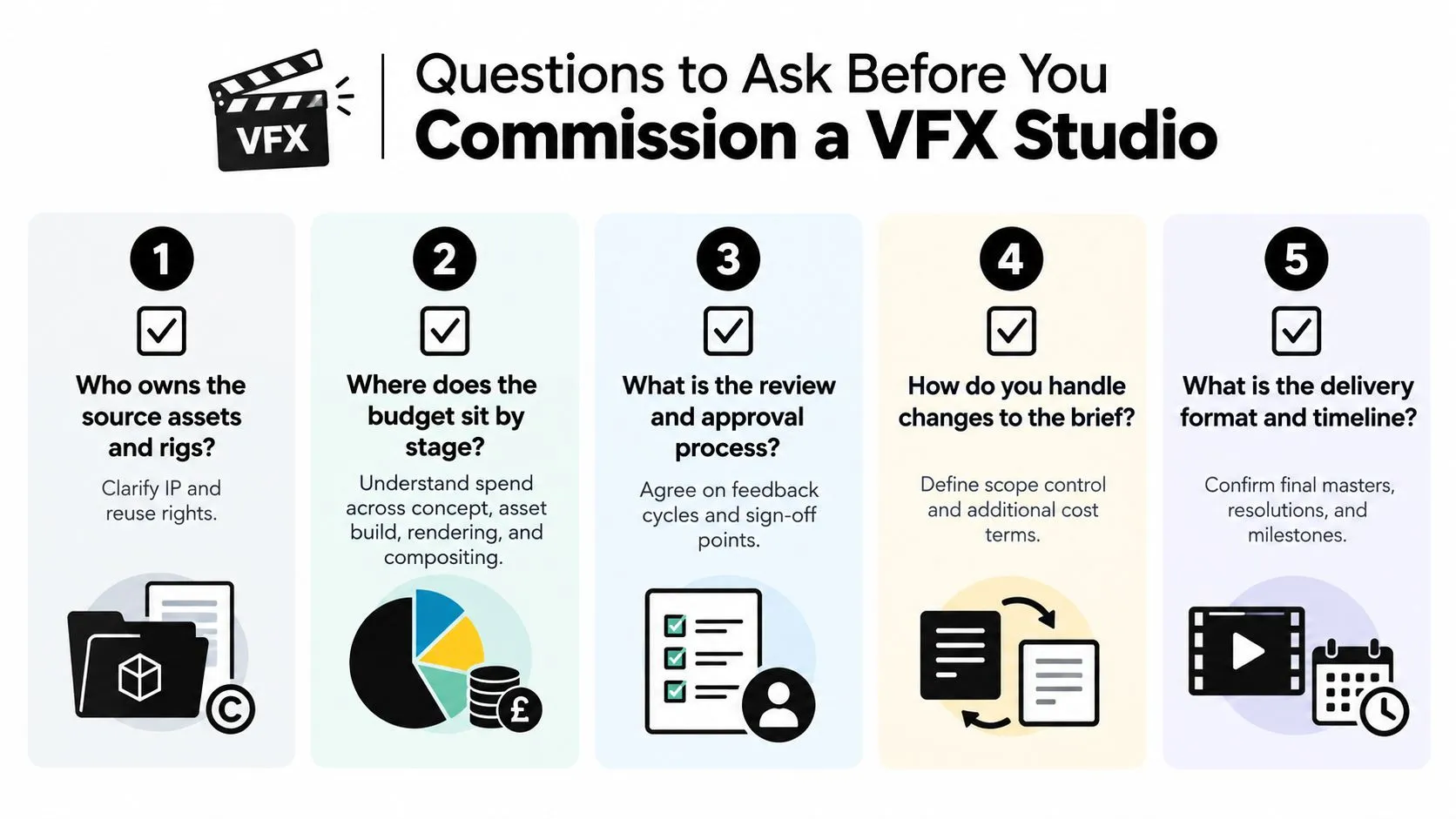
Ask these before you sign
- •Who owns the source assets and rigs? Confirm whether you'll receive models, project files and other reusable material, and whether the contract grants you the rights you need.
- •Where does the budget sit by stage? Request a breakdown that shows how the quote covers design, asset creation, animation, rendering, compositing and delivery where relevant.
- •How do reviews and approvals work? Agree who consolidates notes, when reviews happen and what counts as sign-off.
- •What happens when the brief changes? Ask how the studio will assess additional work and who must approve the cost and schedule impact.
- •How will you reserve capacity? Confirm who is assigned, when work is scheduled and how the studio will manage competing commitments.
- •Who is the technical lead? Get the name or role of the person accountable for pipeline decisions and delivery testing.
Capacity deserves a direct conversation. UK film and high-end television production spending reached £6.8 billion in 2025, and inward-investment productions accounted for £5.8 billion, or 85%, of total spending, according to official BFI statistics. Those figures describe the wider production environment, not the availability of a particular supplier. For your project, ask the studio to identify its actual capacity and explain how it'll protect your milestones.
Don't accept “we'll work it out in production” as a substitute for a change-control process.
Treat open-ended revision limits, unpaid speculative work with no agreed boundary and an inability to identify the technical lead as warning signs. A supplier should be able to discuss the risks plainly, including what it can't promise. If two quotes look different, compare the assumptions behind them before choosing the cheaper number.
Your Next Step and a Simple Scoping Plan
Before contacting a studio, prepare a one-page note with the project objective, audience, platform, deadline, budget range and visual references. Add what you already have, such as a script, brand pack, footage, character designs or technical documentation. Flag any fixed delivery requirements so the producer can identify constraints early. Use the first conversation to test fit, not to demand a complete pitch. A focused scoping call should help you understand whether the studio has the right disciplines, who would lead the work, how its pipeline fits the delivery and whether it has capacity for your schedule. It should also reveal what information is still missing before anyone can estimate the work responsibly.
Make the first conversation useful
Send the brief and references ahead of the call, then ask for a discussion of scope, milestones, approvals, asset ownership and delivery. If you're still choosing between formats, ask the producer to compare the production implications rather than recommend technology for its own sake. If the project includes uncertain technical elements, start with a bounded test and agree what decision that test will support. You don't need to have every creative answer before reaching out. You do need to be candid about budget limits, decision-makers and deadlines. That gives the studio a fair chance to propose an approach that can be delivered, and gives you a stronger basis for comparing suppliers. --- Studio Liddell works across animation, compositing, motion graphics, real-time production and XR, so you can scope connected visual work with a single production conversation. Bring your objective, delivery requirements and budget range, then visit Studio Liddell to start a scoping discussion.