SFX vs VFX: A Producer's Guide to Practical and Digital Effects
It’s a classic question in filmmaking, but the answer is surprisingly straightforward. The core difference between SFX and VFX boils down to one thing: timing. Special Effects (SFX) are created in-camera, right there on set during the shoot. Visual Effects (VFX), on the other hand, are added after the shoot, during post-production. Think of it this way: SFX is the magic happening right in front of the actors, while VFX is the magic woven into the footage on a computer later on.
Decoding SFX and VFX in Modern Production
Understanding this distinction is key to making smart production decisions. It’s not just about what looks cool on screen; it’s about the entire process behind it. One happens live, the other digitally. This single difference has a massive ripple effect on workflows, budgets, and the creative avenues you can explore.
What Are Special Effects (SFX)?
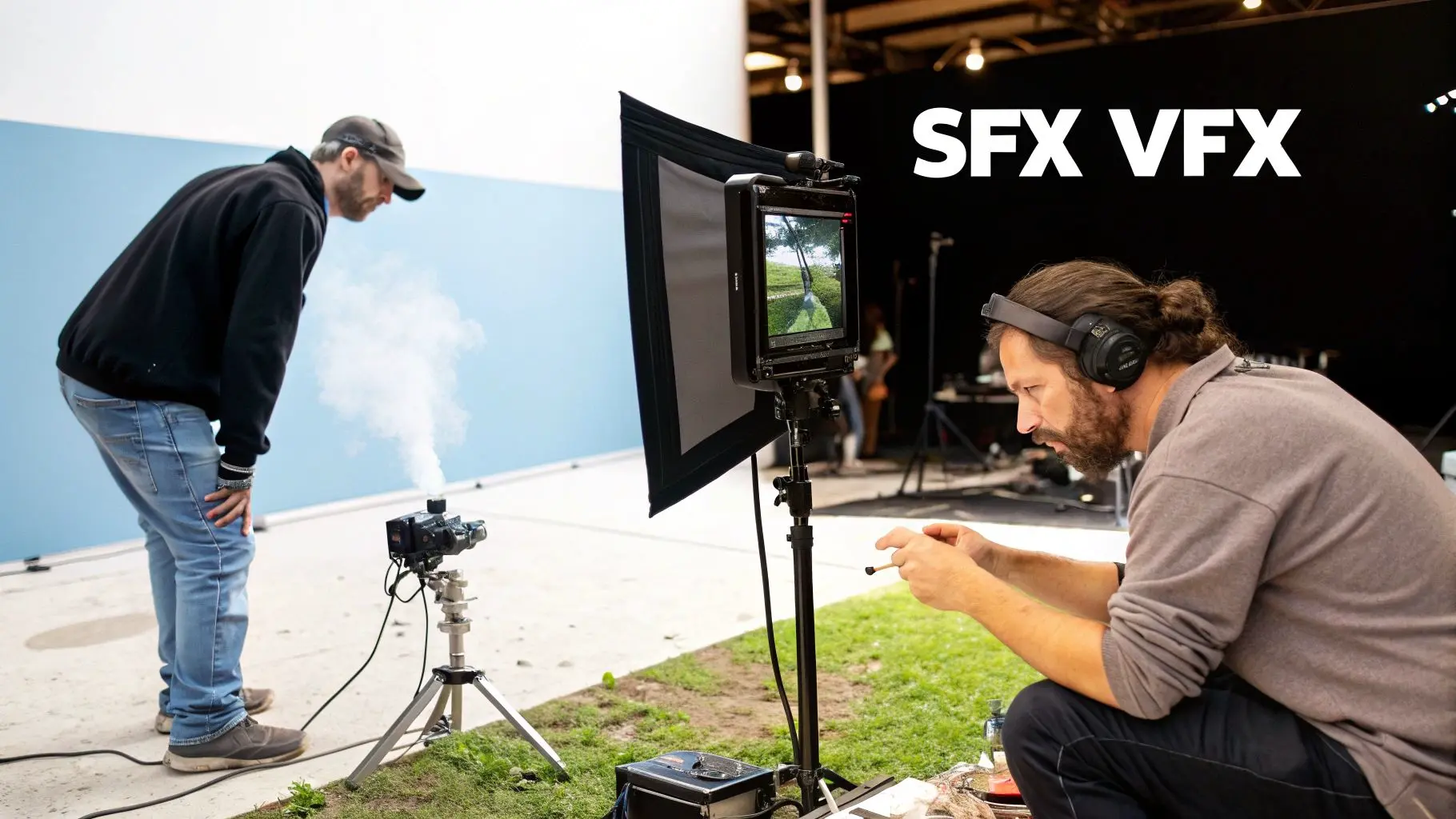
Special Effects, often called practical effects, are the tangible, physical illusions captured in real-time. They’re the mechanical gags and atmospheric tricks that happen on set, giving actors something real to see, touch, and react to. Common examples of SFX include:
- •Atmospherics: Using fog machines, rain towers, or giant fans to whip up convincing weather.
- •Pyrotechnics: Controlled and professionally supervised explosions, sparks, and fire.
- •Prosthetics and Animatronics: Elaborate makeup that transforms an actor, or a life-like robotic creature that moves and breathes on its own.
- •Miniatures: Incredibly detailed scale models used to stand in for massive buildings, vehicles, or landscapes.
The real power of SFX lies in its authenticity. A practical effect has a genuine physical presence that actors can interact with, which often draws out more visceral and believable performances.
What Are Visual Effects (VFX)?
Visual Effects are any images created or manipulated digitally after the cameras have stopped rolling. VFX artists work their magic in post-production, seamlessly blending digital creations with the live-action footage. Put simply, if it’s too dangerous, expensive, or downright impossible to build or perform on set, VFX steps in. VFX is a huge field that includes many techniques, most notably Computer-Generated Imagery (CGI). If you want to dive deeper into that specific discipline, check out our complete guide to CGI animation and digital creation. Some of the most common VFX techniques are:
- •Compositing: Melding separately filmed elements together, like dropping an actor shot against a green screen into a sprawling digital city.
- •Digital Environments: Creating entire worlds from scratch, alien planets, historical cities, or impossible landscapes.
- •Character Animation: Bringing imaginary creatures or digital stunt doubles to life.
- •Simulations: Generating photorealistic digital fire, water, smoke, or building collapses.
To make this even clearer, let's break down the key differences in a simple table.
SFX vs VFX At a Glance
The table below provides a quick side-by-side comparison of the core attributes that define Special Effects and Visual Effects.
| Attribute | SFX (Special Effects) | VFX (Visual Effects) |
|---|---|---|
| Creation Timing | During principal photography (on-set) | During post-production (on a computer) |
| Method | Practical, physical, mechanical | Digital, computer-generated |
| Workflow Stage | Pre-production and production | Post-production |
| Common Examples | Pyrotechnics, animatronics, weather | CGI, compositing, matte painting |
| Key Advantage | Tangible realism, actor interaction | Creative freedom, safety, scalability |
Ultimately, both SFX and VFX are powerful storytelling tools. Understanding when and how to use them, either separately or together, is what separates a good production from a great one.
Comparing Production Workflows and Timelines
Knowing the difference between SFX and VFX is one thing, but understanding how they shape a project's entire production pipeline is where the rubber really hits the road. The choice between practical and digital effects dictates everything, where you spend your money, when critical decisions get locked in, and how the schedule unfolds from day one. The workflows aren't just a little different; they are practically mirror images. An SFX pipeline is heavily front-loaded, with the most intense work happening before and during the shoot. A VFX pipeline, on the other hand, is back-loaded, pushing the most complex and time-consuming tasks into post-production.
The Front-Loaded World of SFX
For special effects, pre-production is king. This is where the meticulous planning, design, fabrication, and testing of every practical element happens. If an animatronic creature needs to interact with an actor or a miniature set has to be blown up, every single detail must be perfected before the cameras start rolling. A typical SFX workflow is a cascade of critical stages:
- •Concept & Design: Working hand-in-glove with the director to design the effect, followed by creating detailed blueprints and prototypes.
- •Fabrication & Engineering: This is the hands-on part, building the physical rigs, animatronics, prosthetics, or pyrotechnic devices. It demands workshops, specialised materials, and seriously skilled engineers.
- •Safety & Logistics: This involves rigorous safety planning and coordination with the on-set crew, especially for pyrotechnics or complex mechanical stunts. Rehearsals aren't just a good idea; they're essential.
- •On-Set Execution: The moment of truth. The SFX team executes the effect live during filming, often with only one chance to nail it.
This process forces major creative and technical decisions to be locked in early. Once an effect is captured on camera, it's pretty much final. There’s no “undo” button for a real explosion.
The Back-Loaded Pipeline of VFX
Visual effects might begin in pre-production with things like pre-visualisation (previz), but the real heavy lifting doesn't start until the shoot is over. The on-set VFX Supervisor plays a vital role, not in creating the effect, but in gathering all the data, camera info, lighting references, measurements, that the digital artists will need later on.
A key differentiator in the SFX vs VFX debate comes down to finality versus flexibility. SFX is about capturing a perfect, final moment in-camera. VFX offers an iterative process where elements can be refined, tweaked, or completely changed deep into post-production.
The VFX pipeline is a multi-layered marathon that can stretch for months after filming wraps:
- Matchmoving & Tracking: Artists analyse the live-action footage to replicate the camera's exact movement in a 3D space. This is crucial for making sure digital elements sit perfectly within the scene.
- Modelling & Texturing: This involves creating the 3D assets, be it a character, a vehicle, or an entire world, and applying detailed surface textures to make them look real.
- Animation & Simulation: Digital characters are brought to life through keyframe animation or motion capture. This stage also includes running complex simulations for things like fire, water, and destruction.
- Rendering: The computationally intensive process of turning all that 3D data into the final 2D images. This step can take days or even weeks on powerful render farms.
- Compositing: The final piece of the puzzle. Artists seamlessly integrate all the digital renders with the original live-action footage, adjusting colour, lighting, and focus to create a single, cohesive shot.
The Teams and Talent Behind the Magic
Behind every gut-wrenching explosion or photorealistic digital creature, there's a small army of highly specialised artists and technicians. The SFX vs VFX split runs right down to the talent on the ground; the skills needed to build a physical effect on set are worlds apart from those used to craft a digital one in a studio. Each discipline has its own unique structure, essential for bringing a director's vision to life. An SFX team is all about hands-on artistry and engineering. These are the people who get their hands dirty on set, building, rigging, and executing effects in real-time. Their work is a brilliant mix of creative craft and precision engineering, where safety and practicality are absolutely non-negotiable.The On-Set Artisans of SFX
The structure of a special effects crew is built around tangible creation and on-the-spot problem-solving. It’s a world of workshops, blueprints, and raw materials. Key roles you'll find in a typical SFX unit include:- •Special Effects Supervisor: This is the head of the department, responsible for planning, budgeting, and safely pulling off all the practical gags.
- •Mechanical Engineers & Technicians: The experts who design and build the complex rigs, animatronics, and mechanical props that move and interact right there on camera.
- •Pyrotechnicians: Licensed professionals who handle every controlled explosion, fire effect, and bullet hit, with an obsessive focus on safety protocols.
- •Prosthetic Makeup Artists: These are the artists who sculpt, mould, and apply lifelike prosthetics to transform actors, creating anything from subtle aging to monstrous creatures.
The core skill in SFX is ingenuity, the ability to solve physical problems with creative, mechanical solutions. It's about making the impossible happen right in front of the camera, a skill that demands a deep understanding of physics, materials, and safety.
The Digital Architects of VFX
By contrast, a modern VFX studio is a digital production powerhouse, organised into a pipeline of specialised departments. The work here is highly collaborative but often sequential, with shots moving from one group of artists to the next as each adds another layer of detail and polish. This structure is designed to manage immense complexity and allow for creative iteration throughout post-production. The United Kingdom, in particular, has become a global hub for this kind of digital artistry. The VFX industry is one of the fastest-growing parts of the UK's entire production sector. According to UK Screen Alliance data, the country directly employs around 10,680 professionals in VFX roles, supporting a wider ecosystem of over 27,430 jobs and contributing a massive £1.68 billion to the economy. A VFX studio's talent pool is vast and varied, including roles like:
- •VFX Supervisor: The creative and technical lead who oversees the entire process, from capturing data on-set to delivering the final shot.
- •Concept Artists & Modelers: They design the look of creatures, vehicles, and environments, then build them as 3D digital assets.
- •Animators: These artists bring digital characters and objects to life, focusing on performance and believable movement.
- •Compositors: The final assemblers who integrate all the digital elements with the live-action footage, ensuring everything matches perfectly in terms of colour, lighting, and focus.
- •Pipeline Technical Directors (TDs): The technical wizards who build the software tools and workflows that allow hundreds of artists to collaborate efficiently on a single project.
Choosing the right partner means knowing which of these specialised teams your project actually needs. For a deeper dive into making that call, our comprehensive buyer's guide on selecting an animation and visual effects studio offers some invaluable insights.
Analysing Budgets and Financial Impact
When it comes to SFX vs VFX, the way you spend your money is just as different as the techniques themselves. Budgeting for visual magic isn't a one-size-fits-all deal; where your cash goes depends entirely on whether you're building something on set or on a server. That choice sets the financial course for the entire project, from the first day of prep to the final delivery. Special Effects (SFX) costs are almost all front-loaded. Your budget gets hammered during pre-production and the shoot itself, covering tangible, physical expenses that need paying for right then and there. These costs are direct and often unforgiving, you don't get a second take with a custom-built rig designed to be blown up on camera. In contrast, Visual Effects (VFX) costs are back-loaded, spread out across the long post-production schedule. This side of the budget isn't about raw materials; it’s about paying for brainpower and computer power over time.
The Upfront Investment of SFX
Budgeting for SFX means planning for concrete, physical assets and the expert hands needed to build and manage them safely. The costs hit you immediately.
- •Materials and Fabrication: This covers everything from the timber and steel for a collapsing building to the silicone for creature prosthetics and the chemicals for a fireball.
- •Specialised Equipment Rental: Need a high-speed camera to capture that explosion just right? Or a complex wire rig to make an actor fly? Those are significant hire costs.
- •On-Set Crew and Safety: You’re paying for the time and expertise of engineers, pyrotechnicians, and safety coordinators on set. The insurance premiums for productions with hazardous SFX can also be a massive line item.
Think about a large-scale pyrotechnic event. It requires a huge upfront investment in materials, extensive testing, and a dedicated on-set safety team, with the entire cost hitting the books on a single day of filming.
The Long-Tail Cost of VFX
VFX budgeting is a completely different beast. It's all about allocating digital resources over weeks or even months. The main driver of cost here is time, specifically, the hours clocked by highly skilled artists.
- •Artist Hours: This is the biggest variable. The final cost is directly tied to the complexity of the shot and the number of artist hours needed for tracking, modelling, animation, and compositing.
- •Render Farm Usage: Turning complex 3D models into finished, photorealistic images takes a colossal amount of computational power. Render farms bill based on processing time, which can rocket upwards for intricate scenes and high-resolution outputs.
- •Software and Licensing: The professional VFX software suites and plugins from companies like Autodesk or Foundry come with hefty subscription or licensing fees that get baked into the studio’s overhead and project costs.
Creating a single, fully digital creature that interacts realistically with a live-action scene can chew through thousands of artist hours and demand extensive render time, spreading the cost across the entire post-production timeline.
The core financial trade-off is this: SFX demands a high, fixed, upfront investment for a tangible result you get on the day. VFX offers more creative wiggle room but comes with a variable, long-term cost driven by artist time and computing power in post.
UK Tax Credits and Market Growth
For anyone producing in the United Kingdom, financial planning gets a serious boost from government incentives. The UK’s generous tax relief schemes can give back up to 25.5% of qualifying production expenditure, making it a globally competitive hub for both practical and visual effects work. These incentives can completely change the financial viability of a project, encouraging producers to aim for higher-quality effects. This supportive environment is a key reason the sector is so healthy. The UK's VFX market hit a valuation of around USD 353.10 million in 2024 and is projected to nearly double to USD 688.78 million by 2033. You can dig into the drivers behind this incredible expansion in this detailed industry market analysis. This growth reflects the relentless demand for top-tier digital content, making a smart, detailed VFX budget analysis more critical than ever.
Strategic Use Cases: When to Choose SFX or VFX
Choosing between practical SFX and digital VFX isn't just a creative call, it's a strategic decision that ripples through your entire production, affecting everything from actor performances to the bottom line. Get it right, and the result is seamless. Get it wrong, and you risk a weightless effect, a flat performance, or a budget that spirals out of control. For any producer, understanding where each discipline shines is non-negotiable. It’s all about matching the right tool to the storytelling task, whether you're working on a feature film, a high-impact advert, or an immersive XR experience.
When Practical SFX Delivers Unbeatable Realism
Special effects are your best bet when you need something tangible and physically present on set. Their power lies in creating authentic interactions that both the camera and the actors can respond to in a completely natural way. You should lean on SFX when your main goal is:
- •Authentic Actor Interaction: If an actor needs to touch, react to, or be physically moved by something, SFX is almost always the superior choice. A performer reacting to a real, on-set animatronic or a blast of wind from a jet fan will give a far more visceral and believable performance than someone staring at a tennis ball on a green screen.
- •Intimate Character Transformation: For close-ups involving character changes, prosthetics and advanced makeup offer a level of detail that’s incredibly tough to replicate with CGI. Think subtle ageing effects, creature makeup, or realistic wounds, these tangible applications ground the character firmly in reality.
- •Capturing Unpredictable Physics: Some things are just too chaotic to fake perfectly. Water, fire, and explosions have a natural randomness that is immensely complex and expensive to simulate with VFX. A real pyrotechnic explosion will always have a unique, authentic energy that’s hard to beat.
The guiding principle for choosing SFX is groundedness. If the effect needs to have weight, occupy physical space, and directly influence the world of the scene, practical effects provide an unmatched level of authenticity.
Where Digital VFX Opens Creative Worlds
Visual effects step in when the laws of physics, safety concerns, or plain reality get in the way of your vision. VFX truly shines when it's tasked with creating the impossible, offering limitless creative freedom that practical effects simply can't match. Opt for VFX in situations that call for:
- •Impossible Scale and Scope: Need to level a city, assemble a fleet of a thousand spaceships, or build a fantasy kingdom from the ground up? VFX is the only way to go. It allows for vast, epic-scale environments and events that would be physically and financially impossible to construct for real.
- •Fantastical Creatures and Beings: When your story features a talking dragon, an alien species, or any creature that defies biology, VFX and CGI are essential. Digital creation gives you total control over the creature’s design, movement, and performance, bringing imaginary beings to life with photorealistic detail.
- •Safety and Controllability: Any effect that would put your cast or crew in real danger is a job for VFX. This includes large-scale destruction, complex aerial manoeuvres, or hazardous environmental effects. VFX provides a safe and highly controllable space to execute dangerous-looking sequences with pinpoint precision.
This flowchart helps to visualise how budget and complexity often steer the SFX vs. VFX decision.
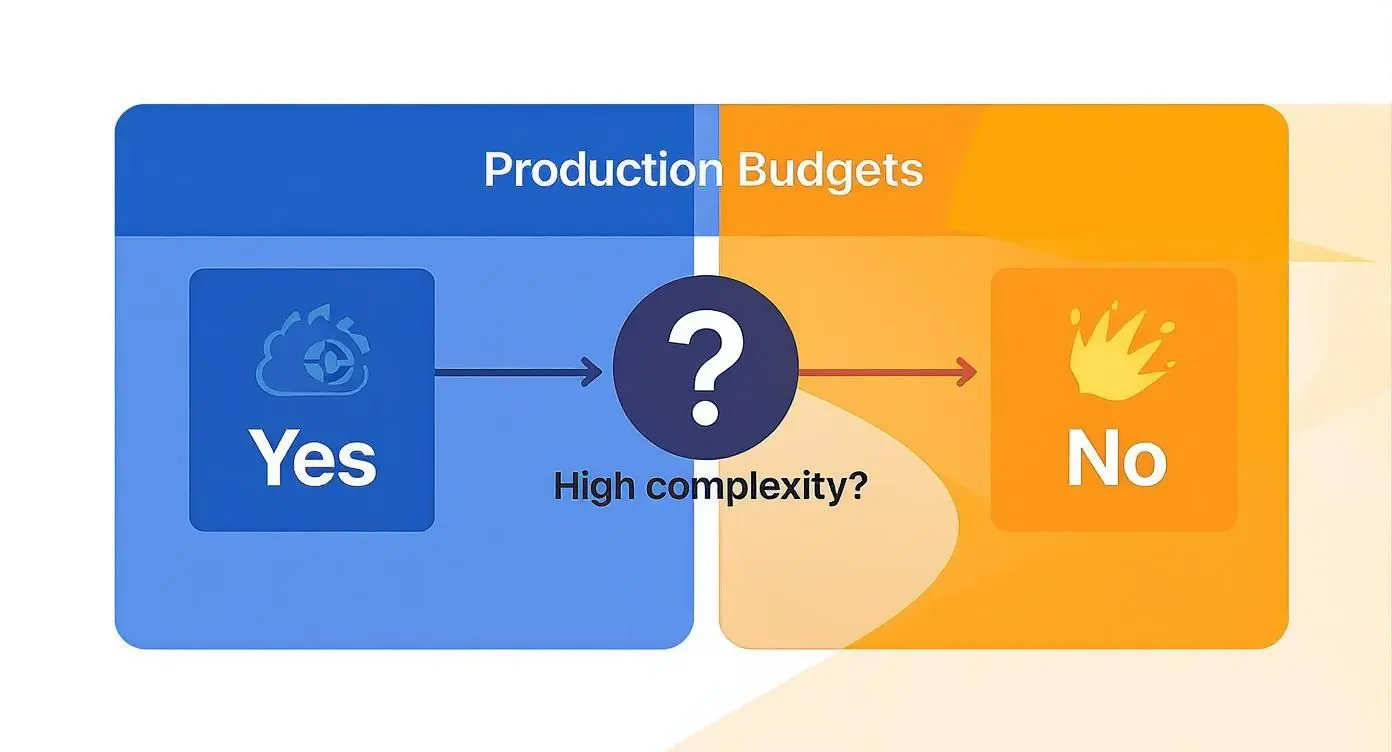
As you can see, as the complexity of an effect increases, the path often leads towards a digital solution. Simpler, high-impact moments, on the other hand, can often be managed more effectively with practical effects.
The Hybrid Approach: A Best-of-Both-Worlds Strategy
In truth, modern productions rarely stick to just one discipline. The smartest and most effective approach is usually a hybrid one, blending the strengths of SFX and VFX to create a powerful, seamless final image. This integrated method simply uses the best tool for each part of the shot.
- •Example 1: A Creature Interaction: You might use a practical animatronic creature head (SFX) for an actor's close-up interaction, capturing authentic reactions. For wide shots showing the full creature running, that practical element is then replaced or augmented by a full-body CGI version (VFX).
- •Example 2: A Controlled Explosion: A small, safe pyrotechnic charge (SFX) can be detonated on set to provide real light, smoke, and debris for the camera. In post-production, VFX artists can then build on this practical base, adding a larger digital fireball, shockwaves, and more flying debris to crank up the scale and danger.
By combining the tangible realism of SFX with the creative freedom of VFX, producers can achieve results that are more believable, dynamic, and cost-effective. The question is no longer "SFX or VFX?" but "how can SFX and VFX work together?"
The Future of Integrated Effects in Virtual Production
That hard line between SFX and VFX? It's dissolving, and fast. The reason is the rise of virtual production, a fundamental shift in how we create visual magic on screen. It’s no longer a debate about SFX vs VFX, but a conversation about how to blend them into one powerful, unified toolkit.
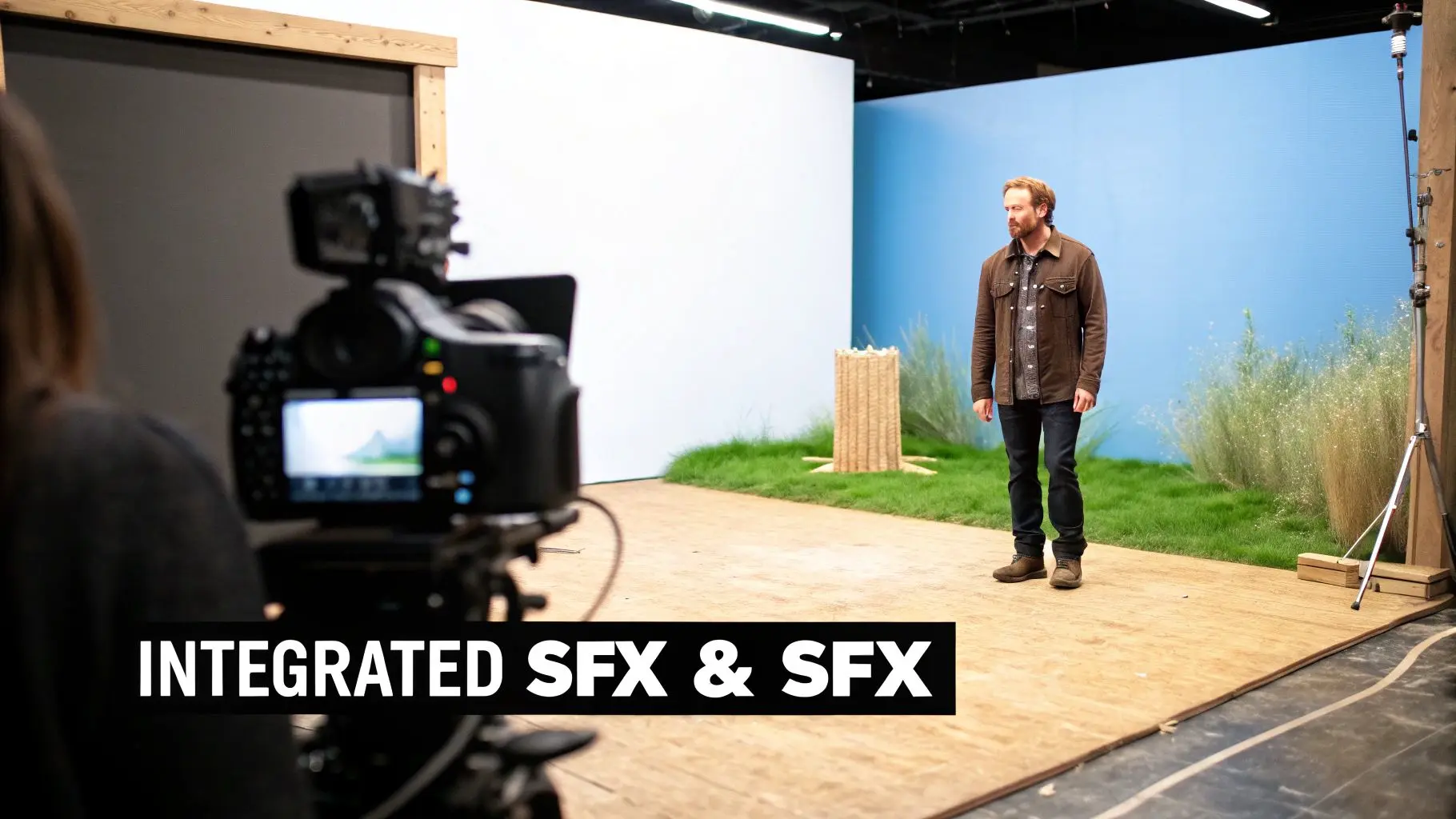
At the centre of this transformation are technologies like Unreal Engine powering massive LED volumes, often called The Volume or StageCraft. These incredible stages wrap a physical set in high-resolution LED screens, projecting photorealistic digital environments in real-time. Suddenly, filmmakers can merge the best of both worlds, right there in the camera.
Blurring the Lines with Real-Time Technology
Virtual production completely upends the traditional workflow. Instead of painstakingly adding a digital background in post-production months later, a complete VFX environment is rendered live on the LED walls during the shoot. A practical set piece (SFX) can sit right in front of a dynamic, interactive alien landscape (VFX), and the camera captures the final composite shot on the day. The benefits of this integration are huge:
- •Creative Control: Directors and cinematographers see a near-final shot as they film. This allows for immediate, on-the-fly adjustments to lighting, camera angles, and composition. No more guesswork.
- •Actor Performance: Performers are immersed in the digital world around them, reacting to it naturally. This leads to far more grounded performances compared to acting against an empty green screen.
- •Realistic Lighting: The LED walls actually emit light. This wraps the actors and the practical set in beautiful, dynamic lighting and reflections from the virtual environment, a holy grail that's notoriously difficult to fake convincingly in post-production.
This method collapses the traditional production pipeline. What was once a lengthy post-production compositing job is now a real-time, on-set activity. It effectively pulls a huge chunk of VFX work forward into the main production phase.
A New Production Paradigm
This integrated approach has profound implications for both timelines and budgets. While the initial setup for a virtual production stage is a significant investment, it can drastically cut down post-production costs and schedules. For producers, getting to grips with this new landscape is non-negotiable, and our producer's guide to real-time VFX offers a much deeper dive into managing these advanced pipelines. Looking ahead, the convergence of traditional effects with emerging tech like virtual production points towards a growing reliance on advanced digital content, often called synthetic media. The future isn't about choosing between practical and digital effects; it's about using both, simultaneously, to tell stories that are more ambitious and visually stunning than ever before.
Your Top SFX and VFX Questions, Answered
Even after you get the hang of what separates SFX from VFX, some very practical questions always pop up during the planning stages. Here are a few of the most common ones we hear from producers and creatives trying to figure out the best path for their project.
Can a Project Use Both SFX and VFX?
Not only can they, but they absolutely should. In fact, it’s the standard for almost any modern production. Combining practical SFX with digital VFX almost always creates the most convincing and visually exciting results. Imagine a battle scene. You might use a small, controlled pyrotechnic charge on set (that’s the SFX) to capture real light flashing across the actors' faces and to kick up actual debris. Later, in post-production, a VFX artist can layer in a much larger, more dramatic digital explosion for that blockbuster scale, all without risking anyone’s safety. It’s the perfect marriage: the tangible realism of SFX with the limitless creative freedom of VFX.
Which Is More Expensive: SFX or VFX?
This is the classic "how long is a piece of string?" question. There’s no easy answer because the cost is completely tied to the complexity and scale of what you’re trying to achieve. As a general rule, SFX costs hit you upfront. You’re paying for raw materials, workshop fabrication time, and the on-set crew to manage it all. It’s a big initial investment. VFX costs, on the other hand, are spread out over the long haul of post-production, driven by artist hours, software licences, and render farm time. A single, large-scale practical explosion might actually be cheaper than creating a fully digital creature that needs months of meticulous animation and compositing. But then again, building a gigantic, detailed miniature set (SFX) could easily cost far more than creating that same environment digitally (VFX).
Do SFX Artists Need Digital Skills These Days?
Yes, more and more. While the heart of SFX will always be hands-on craftsmanship, the lines are getting incredibly blurry. Modern SFX teams are now using 3D printing to quickly prototype props and prosthetics. Many of the animatronics you see on screen are controlled by complex software, needing technicians with serious digital know-how to operate them on set. This kind of digital literacy isn't just a bonus; it ensures that what they build on set will integrate smoothly with the VFX pipeline later on.
The modern effects artist, whether they're wrangling explosions on set or pixels on a screen, thrives with a cross-disciplinary skill set. Understanding both the physical and digital worlds leads to smarter, more seamless, and far more innovative results.
How Has Virtual Production Changed the SFX vs. VFX Relationship?
Virtual production hasn't just changed the relationship, it has completely merged them. By using massive LED walls to project real-time digital environments (VFX) behind physical set pieces and actors (SFX), filmmakers can capture what is essentially a final, composited shot right in the camera. This completely flips the old SFX vs VFX dynamic on its head. Instead of a linear, step-by-step process, it becomes a simultaneous, integrated workflow. Practical elements are lit perfectly by the digital backgrounds live on set, creating a totally cohesive image that tears down the old walls between production and post-production. At Studio Liddell, we have years of experience blending practical principles with digital artistry to achieve stunning results. Book a production scoping call