Motion Graphics 3D: A Guide To Modern Production Workflows
In simple terms, 3D motion graphics is about adding that all-important third dimension, depth, to animated design. This is what transforms a flat graphic into a living, breathing three-dimensional world. Suddenly, you can work with realistic lighting, authentic textures, and dynamic camera movements that pull the viewer right in. It’s the magic behind everything from high-end TV commercials to intricate product visualisations.
So, What Exactly Are 3D Motion Graphics?
Imagine 2D motion graphics as a very slick, digital puppet show on a flat stage. The characters and props can slide left, right, up, and down, but they're fundamentally paper-thin. There’s no real depth. Now, picture being able to step onto that stage, walk around the puppets, and see them from literally any angle. That's the leap to 3D motion graphics. Instead of just shuffling flat layers, our artists build and shape objects in a virtual 3D space, almost like digital sculptors. This shift opens up a whole universe of creative options that are simply out of reach in two dimensions.
The real power of 3D is its ability to create a sense of realism and substance. It lets us simulate how light bounces off different surfaces, from the gleam of polished chrome on a new car to the soft, ambient glow of a brand's logo. It makes the final image feel tangible and real.
This extra dimension isn't just a visual flourish. It's a seriously powerful communication tool, bringing a new level of impact and sophistication to how a story is told.
From Broadcast to Digital: A Legacy of Innovation
Studio Liddell was founded way back in 2019, and we’ve grown up right alongside the technology that drives 3D animation. We were there for the big shift from traditional broadcast to the multi-platform digital content we all consume today, mastering the tools and techniques that have come to define modern production. This deep-rooted experience means we know how to push creative boundaries while sticking to the rock-solid quality standards that world-class broadcasters and brands expect.
Why 3D Is a Strategic Asset for Brands
The uses for 3D motion graphics are massive and they’re growing all the time, making it a must-have for any modern business. Here are just a few ways it delivers real value:
- •Captivating Ads: We can create product visualisations that look and feel completely real, showing off features in ways that are often impossible with a live-action film crew.
- •Complex Explainers: Got a tricky technical or scientific concept? 3D animation can break it down into clear, engaging visuals that anyone can understand.
- •Immersive Experiences: 3D is the bedrock for creating assets for interactive Augmented Reality (AR) and Virtual Reality (VR) applications.
- •Episodic Content: It’s perfect for developing compelling characters and worlds for kids’ TV series and digital shorts, like the work we’ve done for platforms like Sky Kids.
The UK's animation and VFX market, which is home to 3D motion graphics, is on a massive growth trajectory. It's projected to jump from $3.94 billion in 2025 to a huge $9.36 billion by 2030. This boom is being driven by the insatiable demand for top-tier content from streaming platforms and global brands, a demand we've been meeting for years. Learn more about the UK's animation market growth.
The 3D Production Workflow: From Idea To Final Render
Creating compelling 3D motion graphics isn’t a single, monolithic task. It's a structured journey, much like building a house , you need a solid blueprint before you can even think about pouring the foundation. This disciplined process ensures the creative vision is perfectly translated into a polished final product, all while staying on time and on budget. The entire pipeline breaks down into five key stages, each one building on the last. It begins with pure, untethered creativity and then progressively layers on the technical execution until the final, gleaming render is delivered. This flow shows how the core elements of depth, story, and brand are the real guiding stars for the entire process.
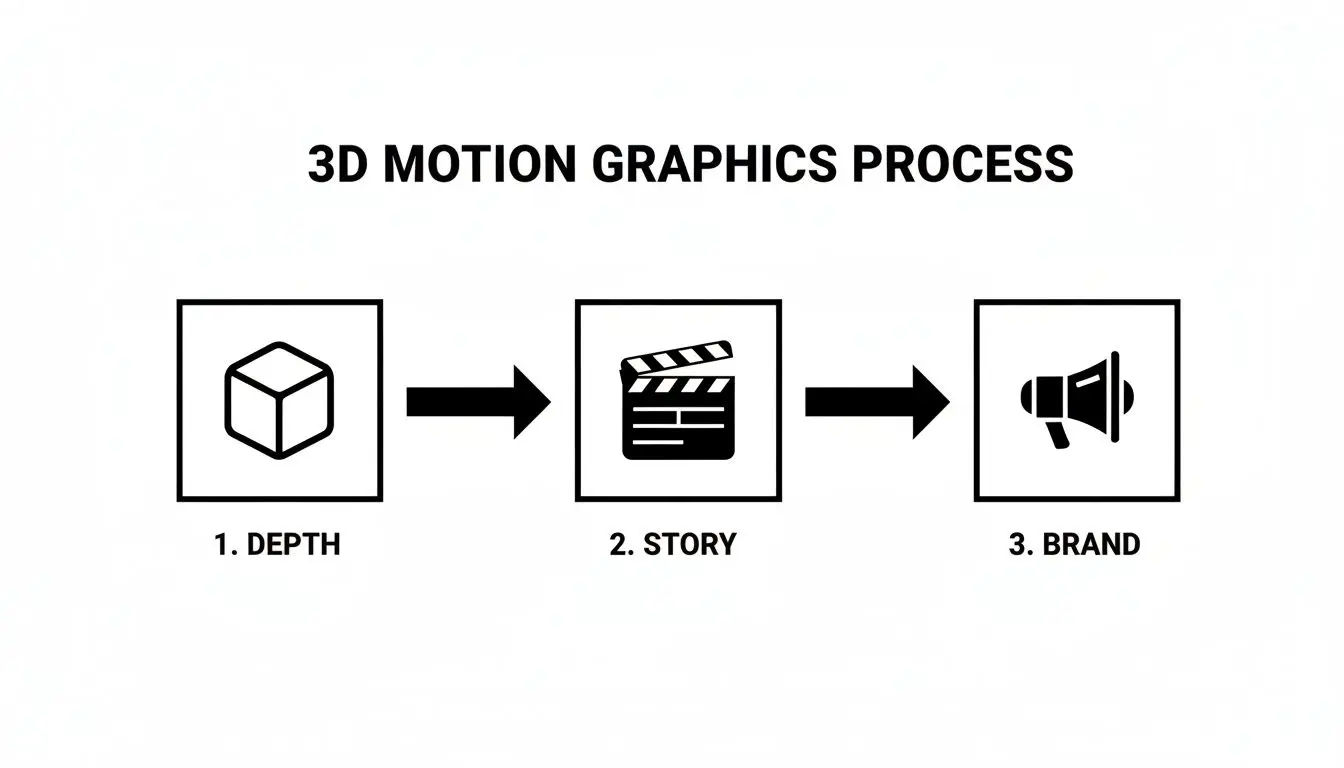
Successful 3D work isn't just about technical wizardry; it's fundamentally anchored in narrative and brand strategy. Let's walk through the end-to-end production workflow that brings a 3D motion graphics project to life. The following table summarises each of the five critical stages, from the initial spark of an idea to the final polished delivery.
The 5 Key Stages of 3D Motion Graphics Production
| Stage | Core Objective | Key Activities |
|---|---|---|
| 1. Concept & Storyboarding | Define the story and visual plan. | Brainstorming, scriptwriting, mood boarding, creating shot-by-shot storyboards and animatics. |
| 2. Modelling, Texturing & Rigging | Build the digital assets. | Creating 3D models, applying surface colours and materials (texturing), and building a digital skeleton for movement (rigging). |
| 3. Animation | Bring the assets to life. | Keyframe animation, motion capture, physics simulations, and character performance. |
| 4. Lighting & Rendering | Create the final look and atmosphere. | Placing virtual lights to create mood, setting up cameras, and computing the final images (rendering). |
| 5. Compositing & Post-Production | Polish and finalise the visuals. | Combining rendered layers, adding visual effects, colour grading, sound design, and final editing. |
Each stage is a crucial link in the chain, ensuring a smooth and predictable path from an initial brief to a stunning final piece of motion design.
Concept Development And Storyboarding
Every great 3D project starts with a simple idea. This first phase is all about collaboration, where we work with you to nail down the core message, the target audience, and the feeling you want to evoke. We ask the big questions: what’s the story here, and why should anyone care? Once that concept is solid, we translate it into a storyboard. Think of it as a comic book version of your animation, mapping out the action shot by shot. It locks in the visual narrative, camera angles, and pacing before any of the heavy-duty 3D work even begins. This blueprint is absolutely essential for getting everyone on the same page and avoiding costly changes down the line.
Modelling, Texturing And Rigging
With the storyboard signed off, our artists step into the digital realm. This is where the virtual world really starts to take shape.
- •Modelling: This is digital sculpting. Artists use specialist software to build the 3D models of every object, character, and environment that will appear in the animation. It’s like sculpting with clay, but using polygons and vertices instead.
- •Texturing: A 3D model is just a lifeless grey shape until it gets textured. Here, artists create and wrap 2D images, the textures, onto the models to give them colour, detail, and surface qualities. This is what makes a metal surface look shiny, a wooden floor look rustic, or a character’s skin look real.
- •Rigging: If an object needs to move, especially a character, it needs to be rigged. This involves building a digital "skeleton" of joints and controls inside the model. This rig is what allows our animators to manipulate the model, creating everything from a simple wave to a complex, emotional facial expression.
Animation
This is where the magic really happens. Animators take the rigged models and breathe life into them, meticulously crafting every single movement, frame by frame. It’s a highly skilled job that’s part technical expertise, part pure performance art. Whether it’s making a product elegantly assemble itself on screen or choreographing a character’s emotional journey, this stage is what turns the storyboard into living, breathing motion. It's a detailed and often time-consuming process that demands both artistic flair and incredible patience. During any intensive 3D production workflow, it's also critical to have robust processes for safeguarding media assets with Archiware P5 solutions.
Lighting And Rendering
Once the animation is locked, the scene is ready for its close-up. Lighting in 3D is just like lighting a real-world film set. Our artists place virtual lights to sculpt the scene, create a specific mood, direct the viewer’s eye, and make sure every element looks its absolute best. Next up is rendering. This is the heavyweight computational process where the computer takes everything, the models, textures, animation, and lighting, and calculates the final, pixel-perfect image for each frame. It’s an incredibly processor-intensive task that can take many hours, or even days, depending on how complex the scene is.
Rendering is the digital equivalent of developing film. It’s that final moment where all the separate components, the digital set, actors, and lights, are captured and transformed into the footage you can actually watch.
Compositing And Post-Production
The final stop is compositing, where all the separately rendered elements are brought together. This is where different layers of animation, visual effects (VFX), and any live-action footage are blended into one seamless, cohesive whole. Here, we apply colour grading to perfect the final look, add sound design and music to heighten the emotional impact, and apply any last bits of polish. This post-production step is what gives the animation its professional, cinematic quality, ensuring the final film is ready for broadcast, social media, or anywhere else it needs to shine.
The Tools and Tech Behind Modern 3D Graphics
The creative process for 3D motion graphics relies on a whole ecosystem of specialised software, with each tool playing its own crucial part. It helps to think of it like a digital workshop; you have different stations for sculpting, painting, assembly, and finally, filming. Getting a handle on this tech stack is the first step to talking confidently about what your project needs. At the heart of it all are the industry-standard applications that artists have trusted for years. These are the real workhorses for modelling, animating, and putting on the final polish.
A modern production pipeline blends traditional 3D software with real-time engines, creating a workflow that's both versatile and incredibly efficient.
The Traditional 3D Production Suite
For years, the backbone of 3D animation has been a combination of highly specialised programs. Each one is a master of a specific stage in the pipeline, and artists will often move assets between them to play to their unique strengths.
- •Autodesk Maya & Maxon Cinema 4D: These are the primary sandboxes where 3D assets are brought to life. Artists use them to model everything from complex characters to intricate products, rig them with digital skeletons for movement, and then meticulously animate them.
- •Adobe After Effects: While it’s a giant in the 2D motion graphics world, After Effects plays a vital role in 3D for compositing. This is the final assembly line where separately rendered 3D elements, visual effects, and other graphics are layered and blended together into one seamless, polished shot.
This traditional, layer-based workflow is incredibly precise and powerful. It’s how you get that cinematic quality you see in high-end adverts and broadcast shows. If you fancy a deeper look at these platforms, you can check out our guide on the best 3D animation software.
The Rise of Real-Time Engines
One of the biggest shifts in our industry has been the move towards real-time rendering engines, especially Unreal Engine and Unity. These were originally built for making interactive video games, but their ability to render complex 3D scenes in the blink of an eye has completely changed animation production. Instead of waiting hours, or even days, for a traditional render to finish, artists using these engines get instant visual feedback. This "what you see is what you get" approach makes for much faster creative decisions, lets you tweak lighting on the fly, and opens the door to entirely new forms of content.
Real-time engines have torn down the wall between creation and review. For producers and clients, this means seeing a near-final shot almost instantly. It makes for faster decisions and a much more collaborative, agile way of working.
This technology is what powers interactive AR/VR experiences, virtual production for film, and, increasingly, broadcast animation. The UK 3D Animation market is leaning heavily into this trend, which is part of a global sector expected to jump from $26.63 billion in 2025 to $44.44 billion by 2029. The sheer accessibility of tools like Unity and Unreal is a huge reason for this growth.
AI-Enabled Efficiencies
The latest addition to the toolkit is Artificial Intelligence. Modern software is now using AI to automate and speed up some of the most time-consuming tasks, which frees up artists to spend more time being creative. AI-powered features can now help with:
- •Masking and Rotoscoping: Automatically cutting out moving objects from their backgrounds.
- •Asset Generation: Quickly creating textures or concept art to get pre-production moving.
- •Motion Data Cleanup: Tidying up the raw data from motion capture sessions.
By mixing traditional craft, real-time power, and AI-driven smarts, a modern studio like Studio Liddell can deliver world-class 3D motion graphics faster and more collaboratively than ever before.
How 3D Motion Graphics Drive Business Results
Beyond the creative ‘wow’ factor, motion graphics 3D is a powerful engine for hitting real business goals. It’s not just about making things look good; it’s about creating visuals that persuade, educate, and ultimately, sell. By translating complex ideas or product features into compelling 3D worlds, businesses can connect with their audiences on a much deeper, more memorable level. This ability to build photorealistic environments and show products from impossible angles gives brands a serious competitive edge. It lets them demonstrate value in a way that static images or even live-action video just can't match, leading directly to measurable results like better engagement and higher sales.
High-Impact Advertising and Product Visualisation
One of the most obvious places you’ll see 3D motion graphics at work is in advertising. Imagine trying to film the intricate inner workings of a high-tech engine or show off a new property development before a single brick has been laid. Live-action has its limits, but 3D animation has none. We can take viewers on a journey inside a product, fly them through a virtual building, or make a brand logo come alive with cinematic flair. This kind of visual storytelling doesn't just grab attention, it builds desire and makes abstract benefits feel concrete.
Motion graphics 3D transforms a product from a static object into a dynamic experience. It’s the difference between showing someone a picture of a car and letting them see it navigating a stunning mountain road, its features highlighted in perfect detail.
This is exactly why the UK's 3D rendering services market, a core part of motion graphics, is on track to hit $6,998 million by 2025. Industries like real estate and construction are big drivers of this growth, using advanced visualisations for everything from virtual tours to securing stakeholder investment. You can discover more insights about the UK 3D rendering market.
Building Audiences with Episodic Content
For brands in the entertainment world, consistency and quality are everything. Creating engaging episodic content is a proven way to build a loyal, dedicated following. This is especially true in children's media, where captivating characters and imaginative worlds are the bedrock of success. Our work on productions for platforms like Sky Kids shows how a solid 3D pipeline can deliver broadcast-quality episodes efficiently and reliably. By developing beloved characters and rich environments, we help create intellectual property (IP) that keeps viewers coming back for more, building a valuable brand asset over time. This strategy isn't just for kids' TV, either. Brands can use episodic 3D content for all sorts of things:
- •Educational Series: Breaking down complex topics into bite-sized, visually engaging lessons.
- •Brand Storytelling: Creating a series of shorts that explore a brand's values, history, or mission.
- •Social Media Campaigns: Rolling out a sequence of animated clips that build anticipation and engagement.
Clarifying Complexity with Technical Explainers
Let's face it, some products or services are inherently difficult to explain. Whether it’s groundbreaking geothermal technology or a complex financial instrument, words and diagrams can only do so much. This is where technical animation shines. For our client GeoEnergy NI, we used clear and compelling motion graphics 3D to visualise a highly technical process. By turning abstract data and engineering schematics into an easy-to-follow visual narrative, we helped them communicate their project's value to key stakeholders with absolute clarity and impact. It’s a process that turns confusion into conviction. The real power of a well-crafted 3D explainer is its ability to simplify without dumbing down. It gets everyone, from expert engineers to potential investors, on the same page. You can learn more about our motion graphics services for brands and see how we tackle these challenges.
Immersive Training and XR Applications
The value of 3D assets doesn't stop at the screen. The very same models and environments built for a video can be repurposed for interactive Virtual and Augmented Reality (XR) applications, opening up entirely new avenues for training and customer engagement. In high-stakes industries like healthcare or aviation, VR simulations offer a safe, repeatable, and incredibly effective way to train staff on complex procedures. These immersive experiences, built from the ground up in 3D, allow for hands-on learning without any of the real-world risk. By linking technology to tangible results, we make a clear case for investing in professional 3D motion graphics.
Understanding Project Budgets And Timelines
Let's get straight to it. The two questions at the heart of every project conversation are always: “How much will it cost?” and “How long will it take?” When it comes to 3D motion graphics, there’s no simple price list. The final cost is tied directly to the time, talent, and technology needed to bring an idea to life. Think of it less like buying an off-the-shelf product and more like commissioning a bespoke piece of work. To demystify the budget, we first need to look at what drives the price up or down. At the end of the day, it almost always comes down to one thing: the amount of specialist time your project requires.
Key Factors Influencing Your Budget
A few core elements will shape the scope and cost of your 3D animation. Being really clear on these from the outset helps a studio give you an accurate quote and a realistic timeline.
- •Complexity and Detail: A simple, stylised animation with basic geometric shapes is far quicker (and cheaper) to produce than a photorealistic scene with custom characters, complex textures, and dynamic fluid simulations. The more intricate the models and effects, the more hours are needed. Simple as that.
- •Overall Duration: Now, a 30-second animation isn't always half the price of a 60-second one because of fixed setup costs. But the final length is still a major factor. More screen time means more modelling, animating, and rendering.
- •Level of Realism: Chasing photorealism is a huge undertaking. It requires an immense amount of attention to detail in texturing, lighting, and rendering. This is one of the most time-intensive aspects of 3D work and will have a significant impact on the budget.
Getting a handle on the financial side of a creative project is vital. It’s a similar logic to decoding the cost of software development, where a clear scope and shared understanding lead directly to predictable outcomes.
Think of it like commissioning a piece of furniture. A simple pine stool is straightforward. But a hand-carved oak armchair with custom upholstery involves more materials, higher-skilled craftsmanship, and significantly more time, and the price reflects that.
Illustrative Pricing And Timeline Bands
To give you a clearer picture, here are some typical project scopes and what you might expect in terms of cost and time. Remember, these are just guideposts; every project has its own unique requirements.
| Project Type | Illustrative Budget Band | Typical Timeline |
|---|---|---|
| Simple Logo Sting (5-10s) | £2,000 - £5,000 | 2-3 Weeks |
| Product Explainer (30-60s) | £7,000 - £15,000+ | 6-8 Weeks |
| Broadcast Ad (30s) | £20,000 - £50,000+ | 8-12+ Weeks |
The timeline directly reflects the production workflow we’ve talked about. For a typical 60-second explainer, you could see a breakdown like this: 1-2 weeks in concept and storyboarding, 3-4 weeks in modelling and animation, and another 2-3 weeks for rendering and post-production.
How You Can Help Manage Costs And Timelines
So, what’s the best way to keep a project on schedule and within budget? It all comes down to clear communication and collaboration. A well-written brief that nails down your goals, audience, and key messages is the best possible start you can give us. Just as important is providing timely and consolidated feedback during review stages. Delays in approvals or big, late-stage changes to the core concept can have a massive knock-on effect, pushing back deadlines and adding to the cost. A transparent and collaborative partnership is the secret to a smooth, successful production. For a complete overview, our buyer’s guide to choosing an animation studio offers much more detailed advice.
How to Choose the Right Animation Studio
Picking a creative partner is probably the biggest decision you'll make for your motion graphics 3D project. The right studio doesn't just follow instructions; they push your idea further, make the whole process feel effortless, and genuinely become part of your team. It's all about finding that perfect match. Start by really digging into their portfolio. Go beyond the flashy showreels and look for work that has the same feel and style you’re after for your brand. Have they worked in your world before, whether that’s broadcast ads, complex technical explainers, or playful kids' content? A great portfolio shows off creative flair, but it also proves they understand different business goals.
Do They Have the Technical Chops?
A gorgeous portfolio is one thing, but it needs to be backed up by serious technical skill. You need a studio that’s comfortable with the tools that drive today's most ambitious projects.
- •Core Software Skills: At a minimum, look for deep experience in industry-standard software like Cinema 4D, Maya, and After Effects. This is the bedrock of any professional 3D pipeline.
- •Real-Time Engine Know-How: Ask them about Unity and Unreal Engine. This is a huge tell. It shows they're equipped for interactive projects, VR/AR, or can offer a more flexible and collaborative production process.
- •A Proven Track Record: There’s no substitute for experience. A studio that’s been around for a while, like us, since 2019, has seen it all. They’ve navigated every production nightmare imaginable and have the finely-tuned processes to prove it.
Writing a Brief That Actually Works
Once you've got a shortlist, the next step is to give them a clear, solid creative brief. Think of this document as the North Star for your project; it gets everyone pointing in the same direction from day one. It doesn’t need to be a novel, but it does need to be specific.
Your brief is the blueprint for success. The more clarity you provide upfront, the smoother the production journey will be. It saves time, money, and makes sure the final animation hits the mark perfectly.
A great brief always covers these bases:
- Project Goals: What, exactly, do you need this animation to do? (e.g., boost sales by 15%, explain a new cloud service).
- Target Audience: Who are you talking to? Be specific.
- Core Message: If people only remember one thing, what should it be?
- Key Deliverables: What final files do you need? (e.g., a 60-second hero video for YouTube, a few 15-second cut-downs for socials).
Got Questions? We’ve Got Answers
Thinking about diving into 3D motion graphics? It’s a big step, and you’ve probably got a few questions floating around. Here are some of the most common ones we hear from businesses, with straightforward answers to help you get your bearings.What’s the Real Difference Between 2D and 3D for My Brand?
The simplest answer is depth. 2D motion graphics are flat, just like a classic cartoon. This makes them fantastic for clear, stylised explainers where the message needs to be front and centre. 3D, on the other hand, adds that third dimension. Suddenly, you have realistic objects, authentic lighting, shadows, and the freedom to move a virtual camera anywhere you want. For your brand, this translates into a more immersive, cinematic feel. It’s the perfect choice for high-end product showcases, architectural visualisations, or any project where you want to convey a sense of premium quality and realism. While 2D is often faster for simple ideas, 3D delivers an impact that's hard to beat.How Long Does a 60-Second 3D Motion Graphics Video _Actually_ Take?
This is the big one! A typical 60-second 3D video usually lands somewhere in the 6 to 12-week range, but honestly, "it depends" is the truest answer. The complexity of the project is the main driver. If we're working with simple models and straightforward camera movements, we'll be on the shorter end of that scale. But if your vision involves custom character design, intricate animations (known as 'rigging'), and photorealistic rendering, you’re looking at a longer timeline. The most time-consuming stages are almost always the initial modelling, the animation itself, and the final rendering. The best way to keep things moving? A clear brief and timely feedback.A clear, detailed brief is the single most effective tool for managing project timelines. The more information you can provide upfront about your goals, audience, and desired aesthetic, the more accurately a studio can plan and execute the work without costly delays or revisions.
Can I Reuse 3D Assets for VR or AR Projects Later On?
Absolutely, and you should! This is one of the biggest wins of investing in a modern 3D pipeline. The models, environments, and animations built for your video can be optimised and repurposed for interactive Virtual Reality (VR) or Augmented Reality (AR) experiences. Think about it: that beautifully detailed 3D product model from your new advert could be dropped into an AR app, letting customers place it in their own living room to see how it looks. This ‘create once, deploy anywhere’ approach, especially when working with a studio fluent in real-time engines like Unity and Unreal Engine, massively increases the return on your creative investment. You're not just getting a video; you're building a library of versatile digital assets for whatever comes next.Ready to bring your brand into the next dimension with stunning motion graphics 3D? The team at Studio Liddell has been delivering broadcast-quality animation since 2019 and is ready to be your strategic creative partner. Book a production scoping call to discuss your vision.