Influencer Marketing Services A UK Guide
The UK influencer market reached £1.825 billion in 2024, up from about £1.1 billion in 2023, a year-on-year rise of over 60% according to UK influencer marketing statistics from Socially Powerful. That kind of growth changes the conversation. Influencer marketing services are no longer a loose bundle of outreach and paid posts. They now sit much closer to media planning, creative production, brand governance, and performance measurement. That matters because many brands still buy influencer activity as if it's a simple endorsement deal. They focus on audience size, ask for a few deliverables, and hope the creator's personality does the rest. Sometimes that works. Often it produces content that feels disposable, under-tracked, and detached from the wider campaign. The more effective model treats creators as part of a production ecosystem. Strategy shapes the brief. Creative direction raises the quality bar. Paid media extends what performs. Analytics tie the work back to outcomes that matter. When that system is in place, influencer marketing services stop being a trend line and start acting like a mature commercial channel.
The Evolution of Influencer Marketing in the UK
Budgets changed first. Then expectations changed with them. In the UK, influencer marketing has moved from lightweight social activity into a channel that sits much closer to production, media, and brand systems. Earlier in this article, the market growth figures showed why. Once brands allocate real budget to creator work, they stop buying isolated posts and start asking whether the output can hold up across paid media, ecommerce, events, and broader campaign rollouts. That shift has changed what good service looks like. The job is no longer limited to finding a creator with the right audience and negotiating usage. Teams now need tighter briefing, clearer approvals, stronger compliance processes, and content planning that accounts for multiple formats from the start. A simple endorsement can still do a job. It just cannot carry the full weight of a premium campaign on its own.
From creator posts to creator productions
The biggest change I see is creative ambition. Brands want creator content that feels native to the platform without looking disposable. That creates a real trade-off. Raw content can feel more credible, but weak production often limits reuse, reduces paid performance, and makes premium brands look inconsistent. The stronger UK campaigns solve that tension through production design. They treat creators as on-camera talent, collaborators, or world-builders inside a larger creative system. That system might include scripting, motion design, product visualisation, set extensions, VFX clean-up, animation overlays, or XR elements that make a launch feel built for attention rather than dropped into a feed at the last minute. That matters most when the product needs explanation, demonstration, or a stronger visual universe. Beauty, tech, automotive, entertainment, luxury, and property campaigns often need more than a talking-head clip. They need content with structure, polish, and enough creative range to work across channels.
What mature influencer services now need to cover
As the channel has matured, agencies have had to widen their remit. Strong teams usually handle several functions at once:
- •Audience and creator strategy tied to business goals, not follower counts alone
- •Rights, approvals, and disclosure management built into the workflow
- •Creative direction and production planning before creators start filming
- •Asset versioning for organic social, paid social, retail, web, and events
- •Performance analysis linked to business outcomes, not vanity metrics
Video-heavy collaborations have made this even more obvious. Brands investing in longer-form storytelling, product education, or creator-led entertainment should study how platform demands differ. Influencer Marketing YouTube: 2026 Success Playbook is a useful example of how the production and planning standard rises when the format gives the audience more time.
Why this matters for premium brands
Low-effort influencer content often fails in the same predictable ways. The creator fit is fine, but the visual quality is off. The product story is unclear. There is no plan for cutdowns or paid usage. The assets cannot stretch beyond one post, so the brand pays for attention once and gets little long-tail value back. High-production creative changes that equation. Animation can clarify a technical feature in seconds. CGI can show product detail that live action cannot capture efficiently. XR can turn a creator collaboration into an experience with more press value, more audience interaction, and more reusable content. These are not decorative extras. In the right campaign, they improve understanding, memorability, and asset lifespan. Influencer marketing in the UK has grown up. The brands getting the best returns now treat creator partnerships as productions, not placements.
Defining Modern Influencer Marketing Services
A useful way to think about influencer marketing services is this. Hiring a creator isn't the same as buying a complete campaign, just as buying timber isn't the same as hiring a builder. The visible output is only one part of the job. The value sits in planning, filtering, shaping, and measuring the work around it. In practice, that matters because 63.8% of brands in the UK plan to partner with influencers in 2025, while live streaming accounts for 52.4% of content strategies, according to Aspire's 2025 influencer marketing guide. A busier market makes execution quality more important, not less.
The service stack behind a strong campaign
A full influencer marketing services offer usually includes several layers. #### Strategy and channel fit This is the part many buyers skip. Strategy decides the campaign's job before creator outreach begins. Is the brand trying to drive discovery, shift perception, generate demand, support social commerce, or create reusable media assets for a broader launch? That decision influences everything after it, including platform choice. If your team is developing a stronger video-led creator plan, Influencer Marketing YouTube: 2026 Success Playbook is a useful reference on how YouTube campaigns differ from shorter-form social placements. #### Discovery and vetting A serious service doesn't just present a list of popular names. It filters for relevance, audience quality, category fit, communication style, disclosure habits, and production reliability. In technical or specialist categories, it should also test whether the creator can explain the subject without flattening it into marketing clichés. #### Creative concepting This is the difference between a branded mention and a campaign. A good partner develops the concept architecture. That includes narrative angle, visual treatment, deliverable mix, creator role, brand guardrails, and how the campaign will adapt across platforms.
What agencies should actually manage
A modern service model should also cover the operational work that protects both quality and budget.
- •Briefing and negotiation
The agency translates marketing goals into creator-ready instructions, scopes deliverables, usage rights, revisions, timing, and approval stages.
- •Production oversight
This can range from light-touch supervision to full studio-level production with scripting, shoot support, motion design, VFX, sound, and post.
- •Paid amplification
The best-performing organic creator asset often deserves paid support. Services should account for whitelisting, creator licensing, and platform-ready variants.
- •Reporting and learning loops
A proper closeout doesn't just report what happened. It identifies what to repeat, what to cut, and which creators or formats should move into longer-term partnerships.
The service isn't the roster. It's the system that turns creator access into commercial output.
What a partial service often misses
Some providers only broker deals. That can work if your internal team already handles strategy, legal review, production, paid media, and analytics. Most brands don't have all of that lined up. Here's a quick way to distinguish the models:
| Service model | What you get | Common limitation |
|---|---|---|
| Brokerage only | Creator introductions and pricing | Little control over strategy or output quality |
| Campaign management | Outreach, coordination, approvals | Creative often stays at a basic level |
| Full-service influencer marketing services | Strategy, production, paid, analytics | Requires more due diligence up front |
The phrase "influencer marketing services" should mean managed capability, not just access to talent. If it doesn't include decision-making discipline, it isn't really a service. It's procurement.
Matching Campaign Types to Your Business Goals
Brands usually waste money on influencer marketing when they choose creators before they choose outcomes. Reach sounds attractive, but reach on its own doesn't tell you what the campaign is meant to do. The better approach is to match campaign type, creator tier, and production level to the job at hand.
When smaller creators outperform bigger names
For targeted campaigns, smaller creators often offer stronger signal. In the UK, nano-influencers deliver 2.8% average engagement rates on Instagram Reels, compared with 1.21% for mega-influencers, and they generate 22% higher earned impressions via shares than standard posts, according to eMarketer's influencer marketing report. That doesn't mean nano always wins. It means the choice should reflect the brief.
| Business goal | Best-fit creator profile | Why it tends to work |
|---|---|---|
| Mass awareness | Macro or mega creators | Broad reach, faster top-of-funnel visibility |
| Credibility in a niche | Nano or micro creators | Closer audience trust and category specificity |
| Product education | Specialist creators with strong on-camera explanation skills | Better at showing how something works |
| Community building | Repeat partnerships with smaller creators | Familiarity grows over time |
| Launch moments | Mixed roster | Large names create noise, smaller ones add depth |
Four common campaign models
Brand awareness Larger creators still have a place. If the objective is cultural visibility or launch momentum, broad reach can justify the spend. But awareness-only campaigns need stronger creative framing than they used to. A bland brand mention disappears quickly. Consideration and education This is the strongest use case for niche creators. Technical products, higher-ticket services, and categories with sceptical buyers usually benefit from someone who can explain, compare, or demonstrate with credibility. A disciplined content plan matters here. In this situation, a broader owned and earned system becomes useful, and a strategic content plan for modern user acquisition offers a sensible view of how content roles should connect rather than operate in isolation. Direct response and sales Affiliate links, promo mechanics, landing pages, and short-form product demos can all support conversion. But conversion campaigns break down quickly when the creator's alignment with the offer isn't sincere. Forced urgency and over-scripted talking points usually underperform because audiences can feel the disconnect. Community and retention Longer-term partnerships are often underrated. If the same creator appears in multiple phases of a campaign, the relationship starts to look more like brand familiarity and less like an ad insertion.
A creator who knows your product after six months will usually outperform a creator who learned the brief yesterday.
The trade-off most teams get wrong
Many marketers still overvalue clean follower-count optics. It's understandable. Big accounts look safer in a boardroom deck. But they can be a poor fit for campaigns that need trust, explanation, or audience action. What works is alignment between objective and creator role. What doesn't is paying for fame when the job requires persuasion.
Integrating High-Value Creative to Stand Out
A large share of influencer content looks interchangeable because it is interchangeable. Similar framing, similar pacing, similar edit language, similar platform trends. If a brand wants a creator partnership to hold attention longer than a scroll, the campaign often needs more than personality. It needs crafted creative. That doesn't mean every campaign requires a huge production. It means the creative idea should be strong enough to justify why this collaboration exists and why the audience should care.
Moving from endorsement to experience
For complex services such as XR development or CGI production, there isn't an established framework for tracking influencer-driven lead quality. But BCG's 2025 analysis of precision influencer marketing notes that compelling storytelling drives 86% of consumers to make at least one annual purchase inspired by influencers. The lesson isn't that every high-value service will convert like a consumer product. It's that storytelling quality still shapes action. For premium brands and technical categories, high-value creative helps in three ways:
- •It explains difficult ideas visually
Animation, compositing, and motion design can show systems, processes, or invisible product benefits more clearly than a talking head can.
- •It creates ownable campaign assets
Strong creator collaborations can produce footage and design elements that live on in paid media, landing pages, trade events, and sales decks.
- •It gives the creator a better role
Instead of reading a brief aloud, the creator participates in a format built around discovery, demonstration, or entertainment.
Formats that justify the investment
The smart question isn't "Should we add production?" It's "Which production layer will make this idea clearer, more memorable, or more reusable?" Here are formats that tend to create real separation. #### Animated overlays and explainers A creator can narrate a practical problem while animated overlays visualise the invisible part. This works well for software, health, engineering, fintech, and anything else that struggles in live-action-only formats. #### CGI product reveals Useful when the physical product isn't available, isn't visually dramatic enough on its own, or needs to be shown in impossible camera moves and exploded views. CGI also helps brands maintain visual consistency across markets and cutdowns. #### AR and spatial activations Influencer campaigns become more participatory when the audience can interact with a filter, lens, or simple spatial experience. In these cases, the creator isn't just promoting content. They're introducing an experience and modelling how to use it. A broader approach to this kind of work sits well within digital content creation services for engaging audiences, especially when a campaign needs assets that can travel across social, paid, and experiential touchpoints.
What high-production creator work gets right
There are practical advantages beyond aesthetics.
| Standard sponsored post | Creative-led influencer production |
|---|---|
| Fast to make | Slower, but more durable |
| Limited reuse | Easier to repurpose across channels |
| Depends heavily on creator charisma | Supported by visual storytelling |
| Often campaign-specific | Can become a long-lived brand asset |
High-production creator campaigns work best when the creator remains recognisably themselves. The added craft should sharpen the message, not suffocate it.
The main trade-offs
This approach isn't automatically better. It comes with more approvals, tighter timelines, and a greater need for pre-production. Brands also need a partner that understands both creator workflows and professional production pipelines. Many don't. What usually fails is bolting expensive visuals onto a weak idea. If the narrative is thin, better rendering won't save it. What works is a collaboration where the creative treatment solves a real communication problem. It helps a product land, makes a technical story easier to grasp, or gives the audience a reason to engage more meaningfully than they would with a standard paid mention. That's the core opportunity in influencer marketing services now. Not louder endorsements. Better experiences.
How to Select and Vet the Right Agency Partner
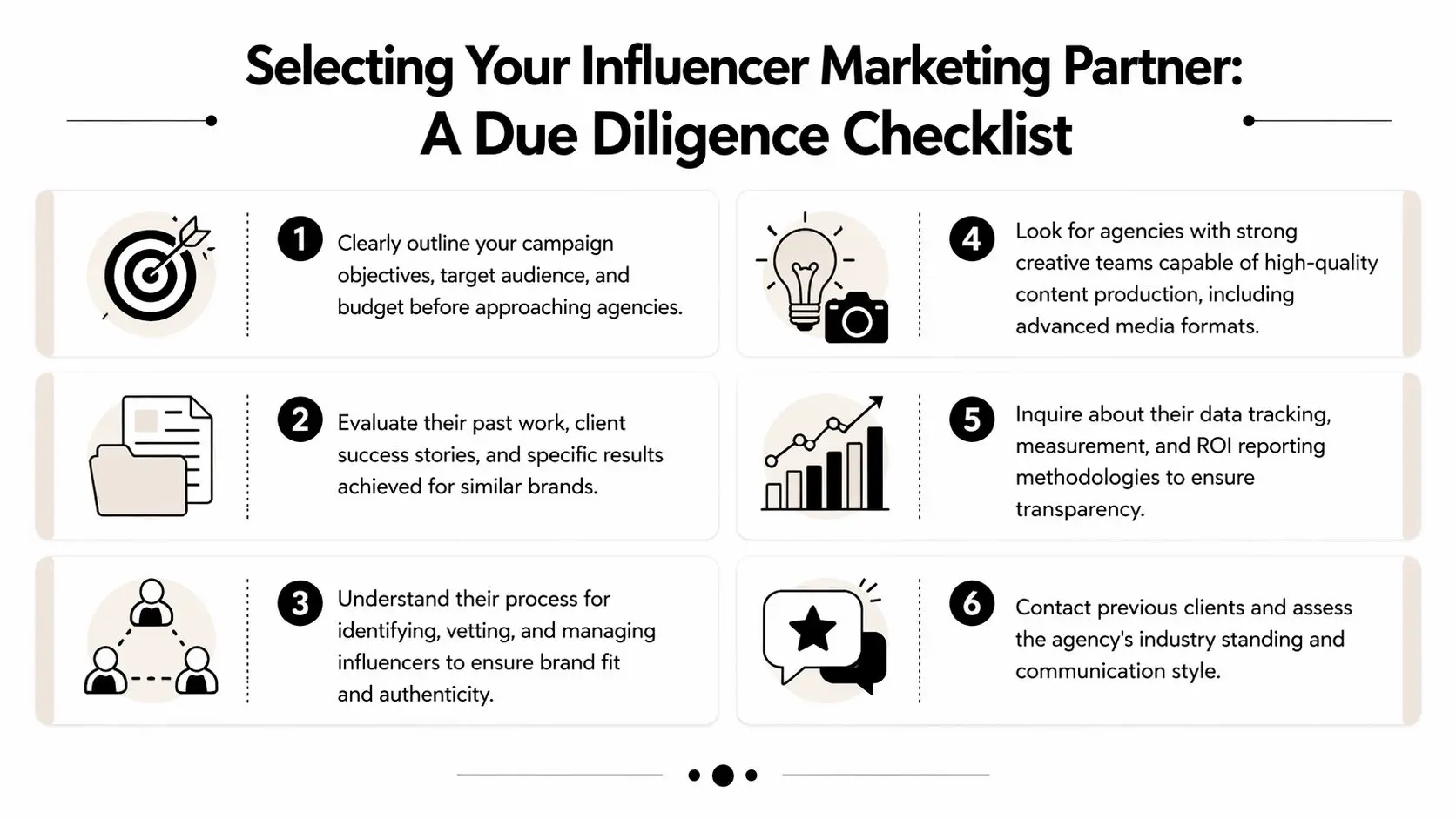
Choosing an agency for influencer marketing services isn't just about taste or chemistry. It's a due diligence exercise. The wrong partner can leave you with inflated creator fees, poor rights management, generic content, and reporting that never gets past engagement snapshots. The right partner should be able to think like a strategist, operate like a producer, and report like a performance marketer.
Start with the agency's actual operating model
Many firms describe themselves similarly, but they don't work the same way. Some mainly broker relationships. Some are strong at creator management but weak on production. Others excel at campaign craft but outsource too much of the delivery chain to control quality tightly. If you're comparing providers, it helps to review a broad market view of an Influencer Marketing Agency UK so you can see the range of positioning and service models before starting conversations.
Questions worth asking in a pitch
The most revealing questions are usually operational, not promotional.
- •How do you vet creators beyond audience size
Ask how they assess brand fit, disclosure discipline, reliability, and audience relevance.
- •Who leads creative development
If every idea depends on the creator improvising, the agency may be buying access rather than building campaigns.
- •What production capability sits in-house
This matters if the campaign needs motion graphics, CGI, AR assets, edit variants, or studio-grade post-production.
- •How do you handle approvals without killing the content
A good agency knows how to protect brand safety without stripping out the creator's native voice.
- •What happens when a creator misses deadline or quality mark
You want to hear a process, not optimism.
A practical shortlist framework
Use a scorecard, even if it's informal. It keeps the choice grounded when several agencies present well.
| Evaluation area | What good looks like | Warning sign |
|---|---|---|
| Strategy | Clear objective mapping and channel logic | Talks mostly about follower size |
| Creator vetting | Documented process and rationale | "We know a lot of people" |
| Creative | Strong concepts and production thinking | Generic content examples |
| Operations | Defined approvals, rights, and contingency plans | Vague delivery process |
| Measurement | Business-linked reporting approach | Reports centred only on vanity metrics |
Don't just ask for case studies. Ask how the agency made decisions inside the campaign. That's where competence shows up.
What brands often miss in specialist categories
If your campaign touches technical products, entertainment IP, immersive media, or premium brand worlds, creative capability becomes a selection criterion, not a nice extra. You need to know whether the agency can work with storyboards, previsualisation, motion workflows, and multi-format outputs, or whether it'll pass those jobs to unknown freelancers after winning the brief. That doesn't mean outsourced specialists are bad. It means the agency should be transparent about who does what, who owns quality control, and how timelines are protected.
The best partner usually isn't the loudest one
The strongest agencies often sound calmer in pitches because they know where creator campaigns fail. They talk about process, rights, edits, escalation paths, brand suitability, and content lifespan. That's a good sign. If an agency mainly sells excitement, ask more questions. If it sells a working system, you're closer to a reliable partner.
Understanding Pricing Models and Measuring True ROI
Most pricing conversations in influencer marketing are still too narrow. Teams ask what the creator costs, compare fee cards, and assume they've understood the investment. They haven't. The actual cost sits across creators, strategy, production, licensing, paid amplification, and reporting. The return side gets reduced too quickly as well. Many brands still treat engagement as the finish line when it's really just one signal.
Common pricing models and what they suit
Different structures fit different campaign goals.
Flat-fee creator deals These are common for awareness campaigns or one-off content packages. They're simple to scope, but the risk sits with the brand. If the content underperforms, the fee doesn't move.
Affiliate or commission-led structures Better suited to direct response campaigns where a creator can credibly drive measurable action. They reduce upfront risk but can attract opportunistic behaviour if the product and creator aren't a natural fit.
Hybrid models These blend fixed compensation with performance upside, content licensing, or paid media usage. In practice, they often work best because they recognise both the creator's production effort and the campaign's commercial ambition.
Why engagement isn't enough
In the UK, 68% of brands use engagement as their primary measurement, but the more advanced programmes use Marketing Mix Modelling to structure influencer data and connect activity to sales. In the same body of data, top UK campaigns report returns of up to £5.78 for every £1 spent, according to Sprout Social's influencer marketing statistics. That doesn't mean every campaign should promise that level of return. It means mature teams measure creator work inside a broader commercial model rather than as an isolated social metric.
What to measure instead
A practical ROI framework should vary by campaign type.
- •For awareness work
Look at content quality, message retention, brand search movement, earned reuse potential, and whether the campaign created assets worth extending in paid media.
- •For consideration campaigns
Track landing-page behaviour, enquiry quality, demo intent, newsletter sign-ups, sales-team feedback, and whether the creator improved comprehension of the offer.
- •For conversion campaigns
Use creator-specific links, promo codes, platform analytics, and post-purchase attribution where available.
- •For high-value B2B or specialist services
Focus on lead quality, meeting quality, stakeholder engagement, and progression through the pipeline. The sales cycle is usually longer, so instant-response thinking can distort decision-making. A creator-led video can also support platform monetisation and longer-tail audience growth when used well. If your team is building a video ecosystem around creators, unlocking advertising revenue on YouTube offers a useful adjacent perspective on how content value extends beyond the initial campaign moment.
A simple ROI lens for decision-makers
| Metric type | Useful for | Not enough on its own because |
|---|---|---|
| Likes and comments | Early content resonance | They don't prove business impact |
| Clicks and traffic | Measuring interest | Traffic quality can vary wildly |
| Leads or enquiries | Commercial intent | Quantity without quality misleads |
| Sales contribution | Clear financial readout | Can miss upper-funnel influence |
| Asset reuse value | High-production campaigns | Harder to capture in basic reports |
The finance conversation gets easier when influencer activity is framed as a mix of media, content production, and demand creation, not just social posting.
What works and what doesn't
What works is agreeing the measurement framework before contracting creators. That shapes links, landing pages, rights, and reporting infrastructure. What doesn't work is running the campaign first and trying to reverse-engineer ROI later. By then, the signal is messy, the content is gone from the feed cycle, and everyone argues about what "success" meant.
The Future is Collaborative and Creative
Influencer marketing services are heading in a clear direction. The channel is becoming more collaborative, more operationally disciplined, and more creatively ambitious. The brands that get real value won't be the ones chasing the biggest names by default. They'll be the ones building systems that connect creator fit, strong ideas, production quality, and business measurement. That's especially true in crowded categories. Generic creator posts are easy to buy and easy to ignore. Distinctive collaborations are harder to build, but they create a stronger memory structure and a better library of reusable assets. That's where animation, CGI, XR, and other premium production layers start to matter. Not as decoration, but as strategic tools. The next shift will probably tighten the connection between creator strategy and technology even further. AI is already influencing discovery, planning, workflow, and content development. Some brands are also exploring synthetic personalities and virtual talent. If you're assessing that space, this guide to creating an AI influencer is a useful starting point for understanding how the model works in practice. The important point is simpler than the tooling. Audiences still respond to relevance, clarity, and trust. Technology changes the execution options, but it doesn't replace judgement. The most effective influencer marketing services will keep balancing human credibility with more advanced creative delivery. Treat creators as collaborators. Treat content as an asset. Treat measurement as a design decision, not an afterthought. That's how the channel earns its place in a serious marketing mix.
If you're planning creator-led campaigns that need more than standard social output, Studio Liddell can help shape the production side. From animation and CGI to XR and immersive digital content, the team builds high-quality assets that give influencer collaborations a longer shelf life and a stronger strategic role.